Bohr Model Energy Levels Explained (Formula, Diagram & Examples) 2026
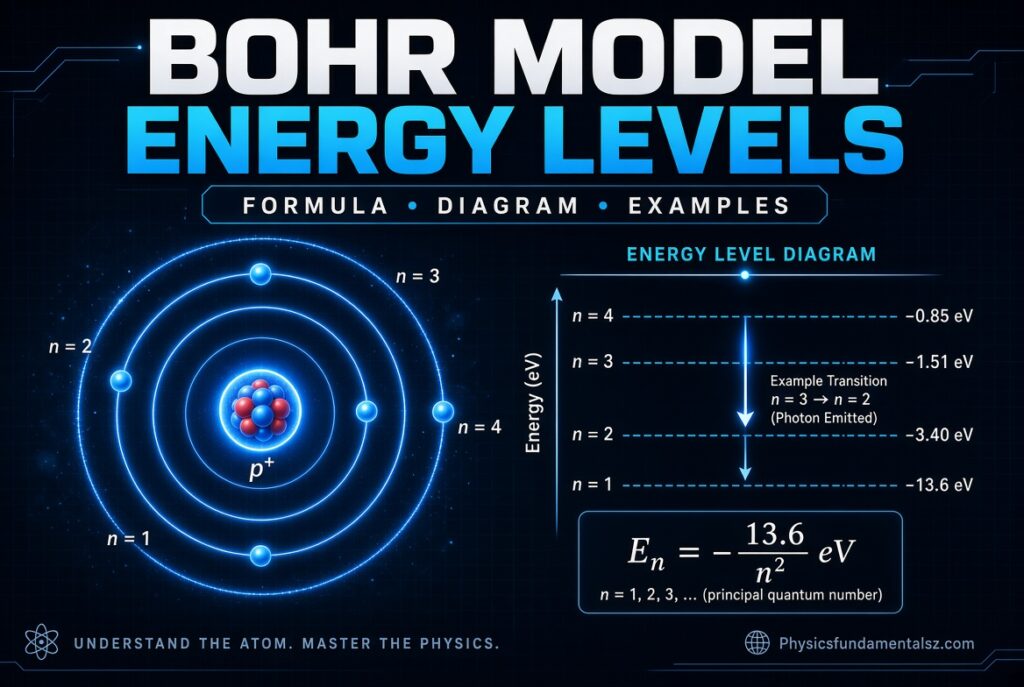
Bohr Model Energy Levels Explained describes how electrons in an atom occupy specific energy levels around the nucleus and how they move between these levels by absorbing or releasing energy.
Introduced by Niels Bohr, this atomic model explains the arrangement of electrons in fixed orbits and helps scientists understand the behavior of atoms, especially hydrogen.
Each energy level has a specific amount of energy, and electron transitions between levels produce electromagnetic radiation with particular wavelengths.
The Bohr model is widely used in chemistry and physics to explain atomic structure, energy changes, and the formation of atomic spectra.
Understanding these energy levels, formulas, diagrams, and examples provides a foundation for studying modern atomic theory and quantum mechanics.
Table of Contents
Bohr Model Energy Levels Explained
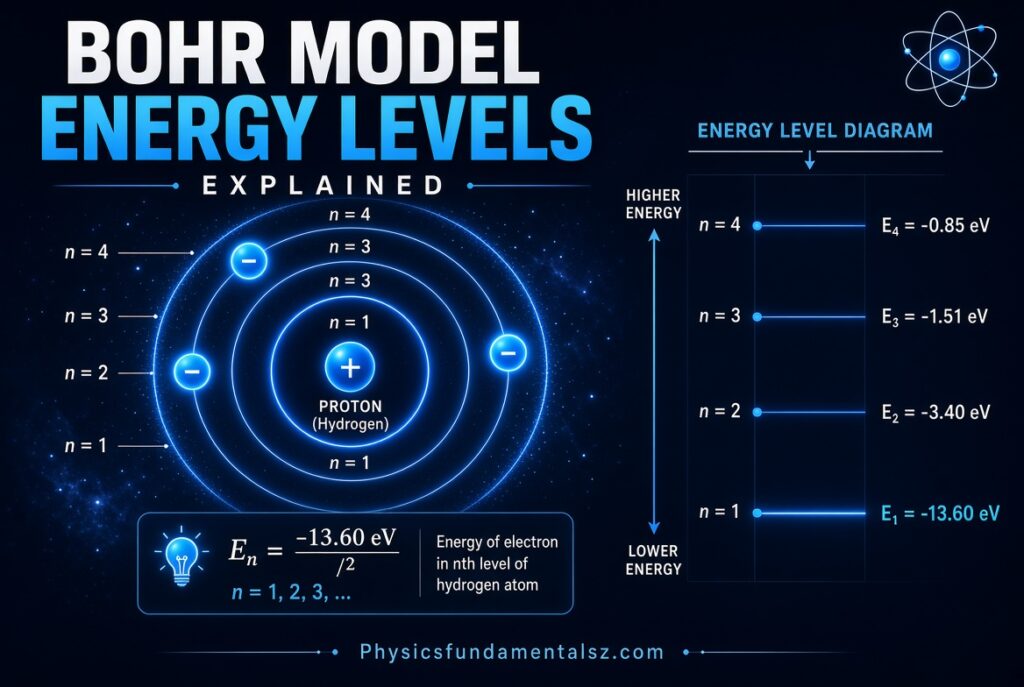
In the Bohr model, energy levels are fixed, quantized orbits an electron can occupy around the nucleus, numbered n = 1, 2, 3, and so on.
Each level has a specific energy given by En = −13.6/n² eV for hydrogen. Electrons absorb energy to jump up a level and release a photon when they fall back down.
What Is the Bohr Model?
The Bohr model is an early atomic model proposed by Niels Bohr in 1913. It describes electrons orbiting the nucleus in fixed, circular paths called energy levels or shells.
Bohr built this model to fix a major flaw in the Rutherford model, where orbiting electrons should have lost energy and spiraled into the nucleus.
He merged classical orbital mechanics with Max Planck’s idea of quantized energy, creating a model that finally matched hydrogen’s observed spectral lines.
Bohr’s Three Postulates
Bohr’s model rests on three core assumptions about how electrons behave inside an atom.
Postulate 1: The nucleus. Every atom has a small, positively charged nucleus at its center holding nearly all of the atom’s mass.
Postulate 2: Stationary orbits. Electrons move in fixed circular orbits called stationary states without radiating any energy, defying classical physics.
Postulate 3: Quantized transitions. Electrons absorb or emit energy only when jumping between these fixed orbits, and never in between.
Why Are Energy Levels Called Quantized?
Quantized means an electron can only exist at specific, allowed distances from the nucleus, never anywhere in between.
Think of it like a staircase instead of a ramp. An electron can stand on step 1 or step 2, but never hover between the steps.
Each step, or energy level, is labeled with a principal quantum number, n, where n = 1 is the lowest and closest to the nucleus.
The Bohr Model Energy Level Formula
The energy of an electron in any level n of a hydrogen atom is given by a simple formula.
Formula
En = −13.6 eV / n²
Here, En is the energy of level n, 13.6 eV is the ionization energy of hydrogen, and n is the principal quantum number (1, 2, 3…).
Why the Energy Is Negative
The negative sign shows the electron is bound to the nucleus by electrostatic attraction, not free.
As n increases, the energy becomes less negative, meaning the electron is less tightly held and easier to remove.
At n = infinity, the energy reaches zero, and the electron is completely free from the atom.
Worked Example: Calculating Energy Levels
Here’s what the first three energy levels of hydrogen actually look like using the formula above.
| Energy Level (n) | Calculation | Energy (eV) |
|---|---|---|
| n = 1 (ground state) | −13.6 / 1² | −13.6 eV |
| n = 2 | −13.6 / 2² | −3.4 eV |
| n = 3 | −13.6 / 3² | −1.51 eV |
| n = 4 | −13.6 / 4² | −0.85 eV |
Notice the gaps between levels shrink as n increases. This is why higher energy levels are packed closer together near the top of the diagram.
Ground State vs Excited State
An electron at its lowest possible energy level, n = 1, is in the ground state. This is the atom’s most stable configuration.
When the electron absorbs energy, it jumps to a higher level, like n = 2 or n = 3. This is called an excited state.
Excited states are unstable. The electron quickly falls back down, releasing the absorbed energy as a photon of light.
How Electron Transitions Work
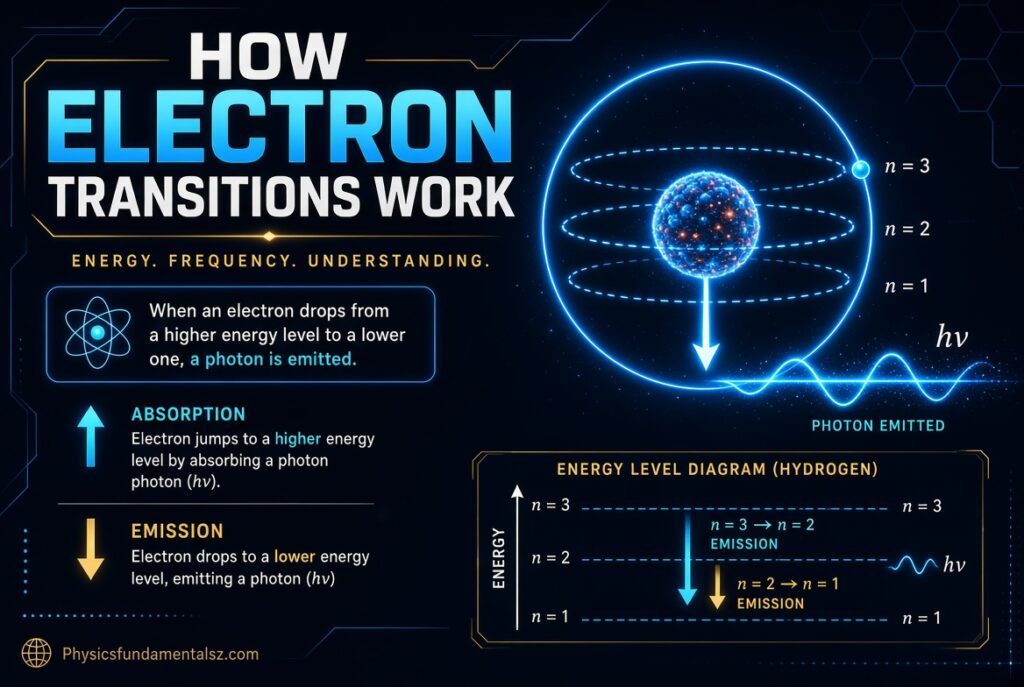
Electron transitions explain how atoms absorb and emit light, and they follow a strict energy rule.
Absorption
An electron absorbs a photon and jumps to a higher energy level only if the photon’s energy exactly matches the gap between two levels.
Emission
When the electron falls back to a lower level, it releases a photon with energy equal to the exact difference between the two levels.
The Transition Formula
ΔE = E(final) − E(initial) = hf
Here, h is Planck’s constant and f is the frequency of the emitted or absorbed photon.
Worked Example: A Real Transition
Suppose an electron falls from n = 3 to n = 2 in a hydrogen atom.
Using the formula, E3 = −1.51 eV and E2 = −3.4 eV. The energy released equals E3 − E2, which is 1.89 eV.
This 1.89 eV photon corresponds to a specific wavelength of visible light, which is exactly what shows up as a line in hydrogen’s emission spectrum.
How the Bohr Model Explains Atomic Spectra
Every element emits light at specific, fixed wavelengths when heated or electrified. This is called its emission spectrum.
Before Bohr, nobody could explain why these lines appeared at exact positions instead of a smooth, continuous rainbow.
Because energy levels are quantized, only certain transitions are possible, and each transition produces light of one precise wavelength.
This is why hydrogen always shows the same set of spectral lines, and it became the strongest early evidence supporting Bohr’s model.
The Balmer, Lyman, and Paschen Series
Hydrogen’s spectral lines are grouped into named series depending on which level the electron lands on.
| Series | Final Level (n) | Spectrum Region |
|---|---|---|
| Lyman series | n = 1 | Ultraviolet |
| Balmer series | n = 2 | Visible light |
| Paschen series | n = 3 | Infrared |
The Balmer series is the only one visible to the human eye, which is why it was discovered and documented first, decades before Bohr’s model existed.
How Many Electrons Fit in Each Energy Level?
Each energy level can only hold a maximum number of electrons, following the 2n² rule.
- Energy level 1 (n=1): holds up to 2 electrons
- Energy level 2 (n=2): holds up to 8 electrons
- Energy level 3 (n=3): holds up to 18 electrons
This rule explains why the periodic table is arranged in rows of specific lengths, and why some elements are far more chemically reactive than others.
Limitations of the Bohr Model
The Bohr model works extremely well for hydrogen but runs into serious problems elsewhere.
- It fails to accurately predict spectra for atoms with more than one electron.
- It cannot explain the fine structure seen in high-resolution spectral lines.
- It ignores electron-electron repulsion, which matters in multi-electron atoms.
- It treats electrons as particles in fixed orbits, ignoring their wave nature.
- It cannot account for the Zeeman effect in magnetic fields.
Bohr Model vs Quantum Mechanical Model
| Feature | Bohr Model | Quantum Mechanical Model |
|---|---|---|
| Electron path | Fixed circular orbit | Probability cloud (orbital) |
| Accuracy | Hydrogen only | All atoms |
| Basis | Classical + early quantum ideas | Full quantum mechanics |
| Electron position | Known precisely | Never known exactly |
| Complexity | Simple, visual | Mathematically complex |
The quantum mechanical model replaced fixed orbits with electron orbitals, regions of probability rather than exact paths.
Even so, the Bohr model remains the standard teaching tool because it makes quantized energy levels easy to visualize.
Real-World Applications of Bohr’s Energy Levels
The idea of quantized energy levels isn’t just theoretical. It shows up across modern technology.
- Neon signs and fluorescent lights: excited electrons emit specific colors of light as they drop energy levels.
- Lasers: rely on controlled electron transitions between precise energy levels to produce coherent light.
- Spectroscopy: scientists identify unknown elements in stars by reading their unique emission-line fingerprints.
- Fireworks: metal salts produce distinct colors because their electrons jump between characteristic energy levels.
Common Mistakes Students Make
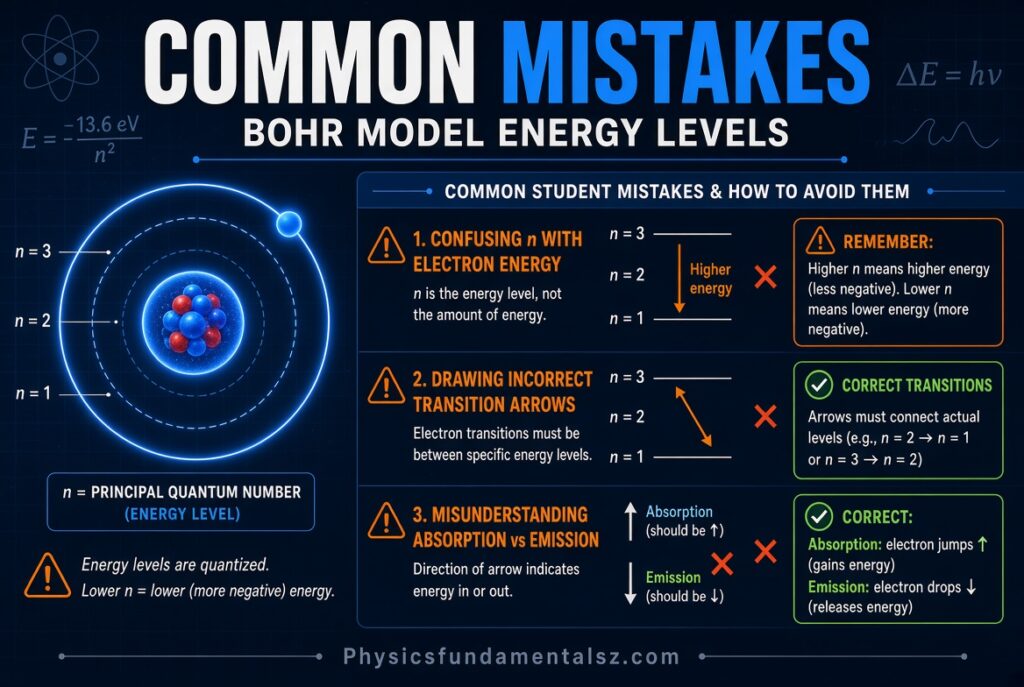
- Confusing energy level number (n) with the number of electrons in an atom.
- Forgetting the negative sign, which leads to wrong conclusions about binding energy.
- Assuming the Bohr model applies accurately to atoms other than hydrogen.
- Mixing up absorption and emission direction when solving transition problems.
Key Takeaways
- Bohr’s energy levels are fixed, quantized orbits labeled by the principal quantum number n.
- Energy is calculated using En = −13.6/n² eV for hydrogen.
- Electrons absorb energy moving up and emit photons moving down between levels.
- The model explains hydrogen’s line spectrum but fails for multi-electron atoms.
- The quantum mechanical model later replaced fixed orbits with probability-based orbitals.
Also Read:
- Physics Fundamentals: The Complete Guide to Core Concepts, Laws, and Equations
- Photoelectric Effect Equation Explained
- Mass Energy Equivalence Real Life Examples
- Entropy Explained for Beginners
- Constructive and Destructive Interference Examples
- Physics Calculators
Frequently Asked Questions (FAQs)
What are energy levels in the Bohr model?
Energy levels are fixed, quantized orbits around the nucleus where electrons can exist without losing energy.
Who created the Bohr model?
Niels Bohr, a Danish physicist, proposed the model in 1913 to explain hydrogen’s atomic structure and spectrum.
What is the formula for Bohr’s energy levels?
En = −13.6 eV / n², where n is the principal quantum number of the energy level.
Why is the energy of an electron negative?
The negative sign shows the electron is bound to the nucleus by attraction, not free to leave the atom.
What does the principal quantum number n represent?
It represents which energy level, or shell, an electron occupies, starting from n = 1 closest to the nucleus.
What is the ground state in the Bohr model?
The ground state is the lowest possible energy level an electron can occupy, usually n = 1.
What is an excited state?
An excited state occurs when an electron absorbs energy and jumps to a higher, less stable energy level.
How do electrons move between energy levels?
Electrons absorb energy to jump to higher levels and release energy as photons when falling to lower levels.
What happens when an electron falls to a lower energy level?
It emits a photon whose energy exactly equals the difference between the two energy levels.
Why does the Bohr model only work well for hydrogen?
Hydrogen has just one electron, so there’s no electron-electron repulsion to complicate the calculations.
What is the Balmer series?
It’s the set of hydrogen spectral lines produced when electrons fall to the n = 2 energy level, visible as colored light.
What is the Lyman series?
It’s the group of ultraviolet spectral lines produced when electrons fall to the n = 1 energy level.
How many electrons can each energy level hold?
Each level holds a maximum of 2n² electrons, so level 1 holds 2, level 2 holds 8, and level 3 holds 18.
What replaced the Bohr model?
The quantum mechanical model replaced it, describing electrons as probability clouds instead of fixed orbits.
Is the Bohr model still taught today?
Yes, because it’s a simple, visual way to introduce quantized energy levels before covering full quantum mechanics.
What is ionization energy in the Bohr model?
It’s the energy needed to remove an electron completely, moving it from its level to n = infinity, where energy equals zero.
Can the Bohr model explain the colors in fireworks or neon signs?
Yes, both rely on electrons dropping energy levels and emitting photons at specific, characteristic wavelengths.
What is the difference between absorption and emission?
Absorption is an electron gaining energy to move up a level; emission is releasing energy as it moves down.
Conclusion
The Bohr model energy levels explain, in a simple and visual way, why electrons sit at fixed distances from the nucleus instead of spiraling in freely.
The formula En = −13.6/n² eV lets you calculate any hydrogen energy level directly, and transitions between levels explain exactly why atoms emit specific colors of light.
While the model has real limits beyond hydrogen, it remains the clearest starting point for understanding quantized energy and atomic structure.