Half-Life Calculations: Formula & Worked Examples Explained
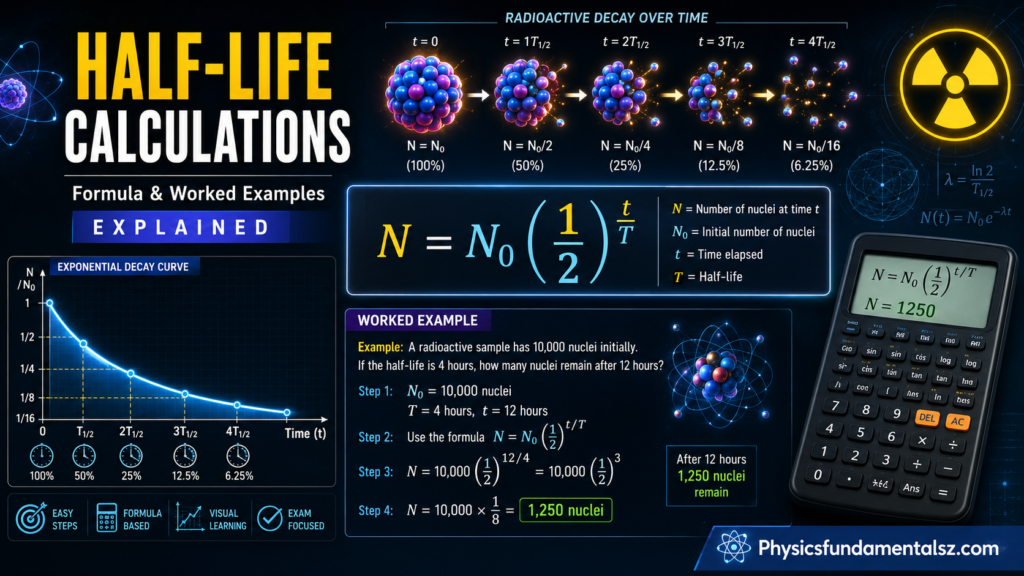
Half-life calculations tell you exactly how much of a substance remains after a set amount of time. You only need one formula and three known values to solve almost any problem.
Table of Contents
What Is Half-Life?
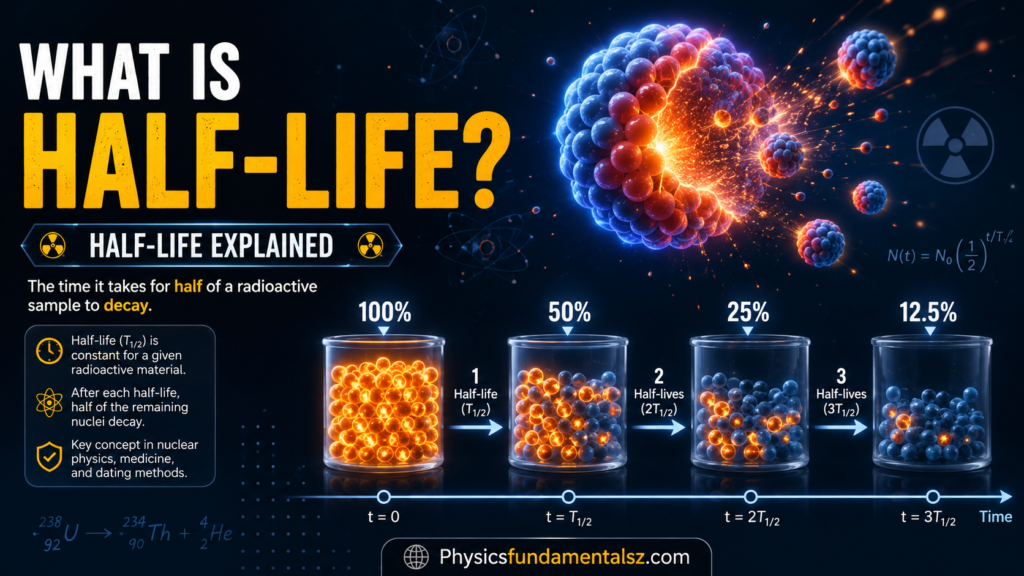
Half-life (t½) is the time it takes for half of a radioactive or decaying substance to disappear. It applies to atoms, drugs in the body, and any process that follows exponential decay.
The core formula is:
N(t) = N₀ × (1/2)^(t/t½)
Here, N₀ is the starting amount, N(t) is the amount left after time t, and t½ is the half-life.
The Half-Life Formula Explained
There are three common versions of the half-life formula. Each one is useful depending on what information you already have.
Version 1 — Using number of half-lives: N(t) = N₀ (1/2)ⁿ, where n = t / t½
Version 2 — Using the decay constant: N(t) = N₀ e^(−λt), where λ = ln(2) / t½
Version 3 — Solving for half-life itself: t½ = ln(2) / λ = 0.693 / λ
All three formulas describe the same exponential decay curve. Which one you use depends on whether you know the decay constant, the elapsed time, or the remaining quantity.
Key Terms You Need to Know
| Term | Symbol | Meaning |
|---|---|---|
| Half-life | t½ | Time for half the sample to decay |
| Decay constant | λ | Probability of decay per unit time |
| Mean lifetime | τ | Average time before decay (τ = 1/λ) |
| Initial quantity | N₀ | Amount present at t = 0 |
| Remaining quantity | N(t) | Amount left after time t |
| Number of half-lives | n | t divided by t½ |
These six variables cover almost every half-life problem you’ll encounter in chemistry, physics, or radiometric dating.
How to Calculate Half-Life: Step-by-Step
Follow these steps whenever you’re given a decay problem.
Step 1: Identify what you know. Write down N₀, N(t), t, or λ — whatever the problem gives you.
Step 2: Choose the right formula. If you have λ, use N(t) = N₀e^(−λt). If you only know the number of half-lives that passed, use N(t) = N₀(1/2)ⁿ.
Step 3: Solve for the unknown. Rearrange the formula algebraically, then plug in your numbers.
Step 4: Check your units. Time units for t and t½ must match — both in seconds, both in years, and so on.
Step 5: Sanity-check the answer. The remaining quantity should always be less than the starting quantity, and it should shrink faster early on.
Worked Example 1: Finding Remaining Quantity
A 100 g sample of a radioactive isotope has a half-life of 10 days. How much remains after 30 days?
Number of half-lives: n = 30 / 10 = 3
N(t) = 100 × (1/2)³ = 100 × 0.125 = 12.5 g
After three half-lives, only 12.5 grams of the original sample is left.
Worked Example 2: Finding the Half-Life Itself
A sample decays from 80 g to 10 g in 60 minutes. What is its half-life?
80 → 40 → 20 → 10 is three half-lives, so n = 3.
t½ = t / n = 60 / 3 = 20 minutes
The substance loses half its mass every 20 minutes.
Worked Example 3: Using the Decay Constant
Carbon-14 has a half-life of 5,730 years. Find its decay constant.
λ = ln(2) / t½ = 0.693 / 5,730 = 0.000121 per year
This decay constant is the number archaeologists actually plug into the exponential decay equation for carbon dating.
Worked Example 4: Radiocarbon Dating

A fossil contains 25% of the carbon-14 found in a living sample. How old is it?
25% = (1/2)ⁿ, so n = 2 (since 0.5² = 0.25)
Age = n × t½ = 2 × 5,730 = 11,460 years
This is exactly how scientists estimate the age of ancient organic material.
Common Half-Life Values Table
| Isotope | Half-Life | Common Use |
|---|---|---|
| Carbon-14 | 5,730 years | Archaeological dating |
| Uranium-238 | 4.5 billion years | Dating rocks and Earth’s age |
| Iodine-131 | 8 days | Thyroid cancer treatment |
| Cobalt-60 | 5.27 years | Radiotherapy, sterilization |
| Technetium-99m | 6 hours | Medical imaging |
| Radium-226 | 1,600 years | Historical cancer treatment |
| Potassium-40 | 1.25 billion years | Dating volcanic rock |
Medical isotopes tend to have short half-lives so they clear the body quickly, while dating isotopes have extremely long ones so they can measure geological time.
Half-Life vs Mean Lifetime vs Decay Constant
These three values describe the same decay process from different angles.
- Half-life (t½) — time for 50% of the sample to decay
- Mean lifetime (τ) — average time a single atom survives before decaying
- Decay constant (λ) — probability of decay per unit time
They’re all connected by: τ = t½ / ln(2) = 1/λ. Knowing one lets you calculate the other two instantly.
Real-World Applications of Half-Life Calculations
Half-life calculations aren’t just textbook exercises — they drive real decisions.
- Nuclear medicine — doctors time radioactive tracer doses using half-life
- Archaeology — carbon-14 dating estimates the age of artifacts
- Geology — uranium-lead dating estimates the age of rocks and minerals
- Pharmacology — drug half-life determines dosing schedules
- Nuclear power — reactor engineers track spent fuel decay for safe storage
- Environmental science — half-life predicts how long pollutants remain hazardous
Mistakes to Avoid When Calculating Half-Life
Small errors here lead to wildly wrong answers, so watch for these.
- Mixing time units (days vs. years) between t and t½
- Forgetting that n must be a whole or fractional number of half-lives, not raw time
- Using λ from a different isotope by mistake
- Rounding ln(2) too early instead of using 0.693 or more decimal places
- Confusing mean lifetime (τ) with half-life (t½) — they are not the same number
Half-Life Calculator: When to Use One
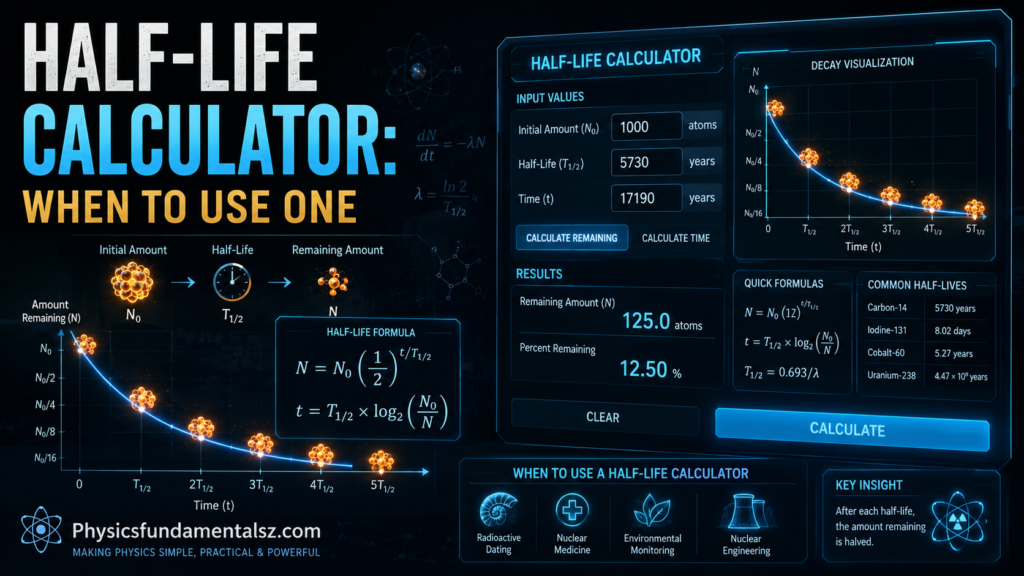
For quick answers, an online half-life calculator can solve for any one of N₀, N(t), t, or t½ once you enter the other three. This is useful for checking homework or handling non-round numbers that are tedious to compute by hand.
Understanding the formula first, though, means you’ll know if the calculator’s output actually makes sense.
Also Read:
- Nuclear Decay Equations: Alpha, Beta & Gamma Decay Explained
- Nuclear Fission and Fusion
- Quantum Numbers: n, l, m_l, m_s and Electron Configuration
- Special Relativity Explained
- The Photoelectric Effect
- The Heisenberg Uncertainty Principle
- Wave-Particle Duality
Frequently Asked Questions (FAQs)
What is the formula for half-life calculations?
The main formula is N(t) = N₀(1/2)^(t/t½), where N₀ is the starting amount and t½ is the half-life.
How do you calculate half-life from decay constant?
Use t½ = ln(2) / λ, which equals 0.693 divided by the decay constant.
What is the difference between half-life and decay constant?
Half-life is the time for half a sample to decay, while the decay constant is the probability of decay per unit time. They’re inversely related.
How many half-lives until a substance is essentially gone?
After about 7 half-lives, less than 1% of the original substance remains, which is considered negligible in most practical cases.
Can half-life change over time?
No. Half-life is constant for a given isotope regardless of the amount present or external conditions like temperature or pressure.
How is half-life used in carbon dating?
Scientists measure the remaining carbon-14 in a sample and compare it to the known half-life of 5,730 years to estimate age.
What is the half-life of Uranium-238?
Uranium-238 has a half-life of about 4.5 billion years, making it useful for dating extremely old rocks.
Is half-life the same as mean lifetime?
No. Mean lifetime (τ) is always longer than half-life, related by τ = t½ / ln(2).
How do you find the original amount if you know the half-life and current amount?
Rearrange the formula to N₀ = N(t) / (1/2)^(t/t½), solving backward from the remaining quantity.
What units should be used in half-life calculations?
Any consistent time unit works, as long as t and t½ use the same unit throughout the calculation.
Why do some isotopes have short half-lives and others long ones?
It depends on nuclear stability — less stable nuclei decay faster and have shorter half-lives.
How accurate is carbon dating using half-life?
Carbon dating is reliable up to roughly 50,000 years, after which too little carbon-14 remains to measure accurately.
What is a decay curve?
A decay curve is a graph showing how the quantity of a substance decreases exponentially over time.
How does half-life apply to medication dosing?
Doctors use a drug’s half-life to determine how often a dose should be taken to maintain effective levels in the body.
Can you calculate half-life without a calculator?
Yes, for simple whole-number half-lives you can repeatedly divide by 2, though a calculator helps with fractional half-lives.
Conclusion
Half-life calculations come down to one core formula and three connected variables: half-life, decay constant, and mean lifetime. Once you know any one of them, you can find the other two.
Practice with real numbers — carbon-14 dating, medical isotopes, or simple lab decay problems — until the steps feel automatic. That’s the fastest way to master half-life calculations for good.