Vectors and Scalars: Definitions, Examples & Vector Addition
Understanding vectors and scalars is one of the first major steps in learning physics. Every measurable quantity you will work with, from speed to force to temperature, falls into one of these two categories.
If you are new to physics, it also helps to first review the basics of physical quantities and units before diving into vectors and scalars, since this concept builds directly on that foundation.
Table of Contents
What Are Vectors and Scalars?
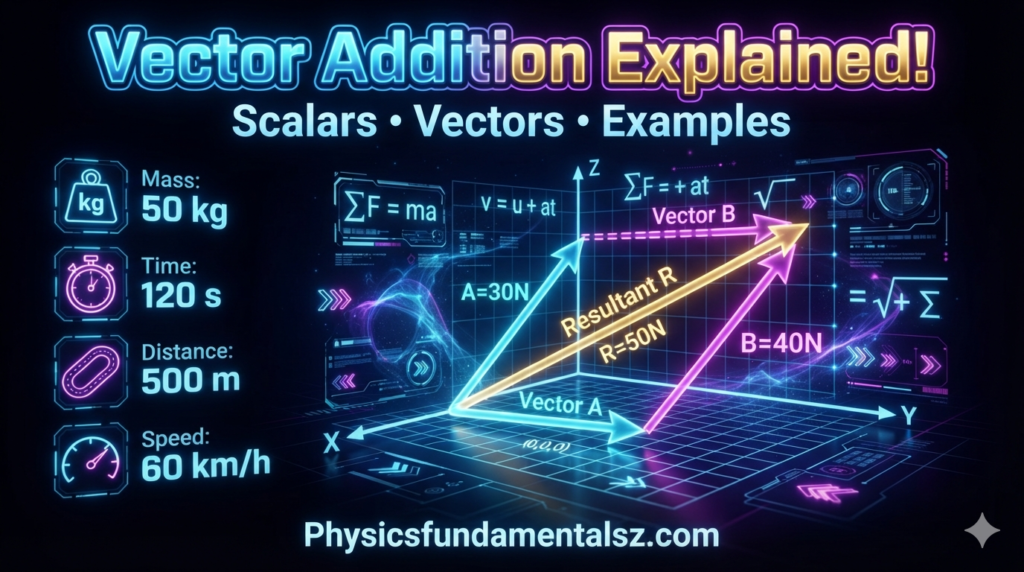
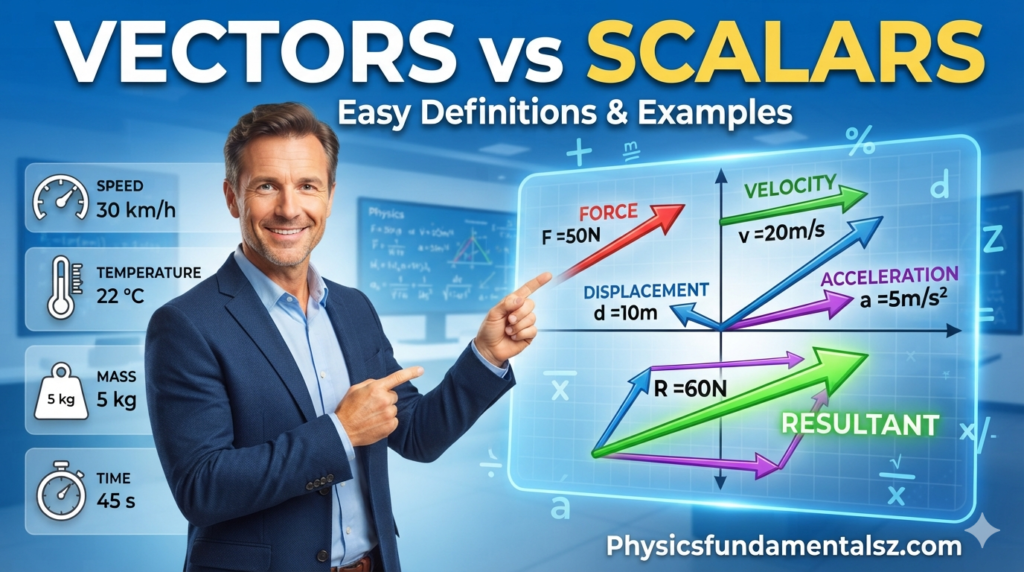
In physics and mathematics, vectors and scalars are the two broad categories used to classify physical quantities. The difference comes down to one thing: direction.
A scalar quantity has only a magnitude, meaning a size or amount. A vector quantity has both a magnitude and a direction. This single difference changes how each quantity is measured, added, subtracted, and applied in real world problems.
Knowing whether a quantity is a vector or a scalar is not just a definition to memorize. It determines how you solve almost every problem in mechanics, from calculating speed and velocity to working out the net force acting on an object.
What Is a Scalar Quantity?
A scalar quantity is a value that is completely described by a single number and a unit. There is no direction involved, only how much of something exists.
Examples of Scalar Quantities
Common examples of scalar quantities include:
- Distance
- Speed
- Time
- Mass
- Temperature
- Energy
- Volume
- Density
- Work
For example, saying the car traveled 60 kilometers or the room temperature is 25 degrees Celsius fully describes the quantity. No direction is needed or implied. This is what separates a scalar from a vector.
How to Add and Subtract Scalar Quantities
Scalars follow ordinary arithmetic rules. You simply add or subtract the numbers directly, the same way you would with everyday math.
3 kg + 5 kg = 8 kg
There is no need to account for direction, angle, or components when working with scalar addition or scalar subtraction. This is one of the easiest ways to identify a scalar quantity during a physics problem.
What Is a Vector Quantity?
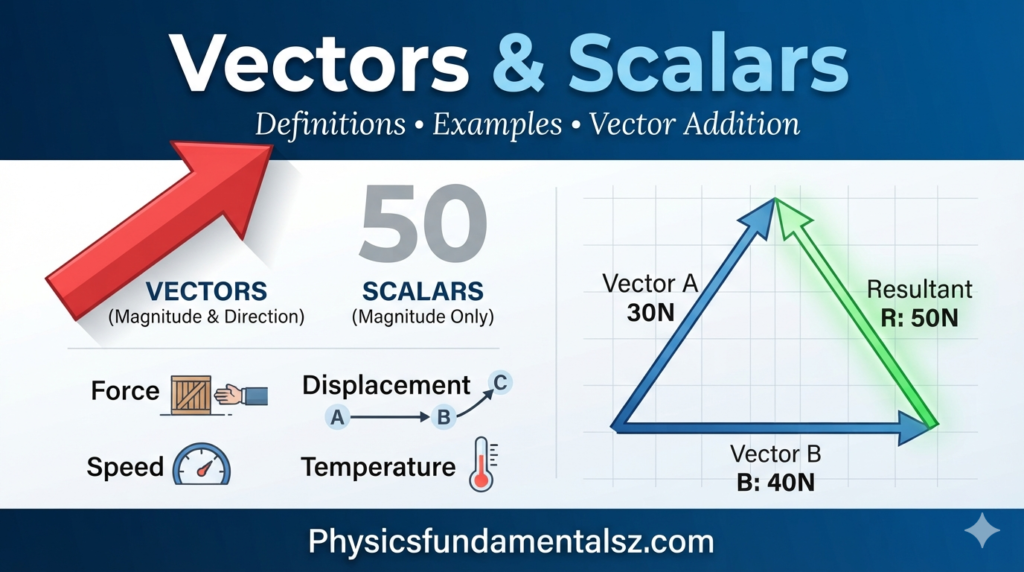
A vector quantity has both a magnitude and a direction. Without specifying direction, the description of a vector is incomplete.
Examples of Vector Quantities
Common examples of vector quantities include:
- Displacement
- Velocity
- Acceleration
- Force
- Momentum
- Weight
- Electric field
For example, saying the car traveled 60 km east is a vector quantity because it includes both the size, 60 km, and the direction, east. Compare that to distance, a scalar quantity, which only tells you 60 km with no direction attached. This distinction is explained in more depth in our guide to distance and displacement.
How Vectors Are Represented
Vectors are typically represented as arrows in diagrams, where the length of the arrow shows the magnitude and the direction the arrow points shows the direction of the vector.
In written notation, vectors are often shown in bold, such as F for force, or with an arrow symbol above the letter, such as v with an arrow above it for velocity. When only the size of the vector matters, the arrow is dropped and just the magnitude is used.
How to Add and Subtract Vector Quantities
Unlike scalars, vectors cannot simply be added using normal arithmetic because direction has to be taken into account. There are three common methods used for vector addition.
The triangle rule involves placing vectors head to tail and drawing the resultant vector from the starting point to the final point. The parallelogram method involves placing vectors tail to tail and completing a parallelogram shape to find the resultant. The component method involves breaking each vector into horizontal and vertical components, then adding the matching components separately before combining them again.
Vector subtraction works in a similar way, except you add the negative version of the vector being subtracted, which simply means reversing its direction before adding.
If you want a full breakdown of these methods with worked examples, see our detailed lesson on vector addition and subtraction.
Types of Vectors You Should Know
Beyond the basic definition, vectors are grouped into several types based on their properties. Knowing these types helps when solving more advanced problems involving vector addition, vector subtraction, and vector multiplication.
A unit vector is a vector with a magnitude of exactly one. It is used only to represent direction and has no meaningful size on its own. Unit vectors are often used as a base to build other vectors with specific magnitudes.
An equal vector is a vector that has the same magnitude and the same direction as another vector, even if the two vectors start at different points in space. As long as the size and direction match, the vectors are considered equal.
A negative vector, sometimes called an opposite vector, has the same magnitude as another vector but points in the exact opposite direction. Negative vectors are essential for performing vector subtraction correctly.
A null vector, also called a zero vector, has a magnitude of zero and no defined direction. A null vector usually appears as the result of adding a vector to its own negative vector, since the two cancel each other out completely.
A position vector describes the location of a point in space relative to a fixed origin. Position vectors are widely used in kinematics to describe how an object moves over time.
Understanding these vector types makes concepts like relative velocity and projectile motion far easier to follow, since many problems require you to combine several types of vectors at once.
Real World Applications of Vectors and Scalars
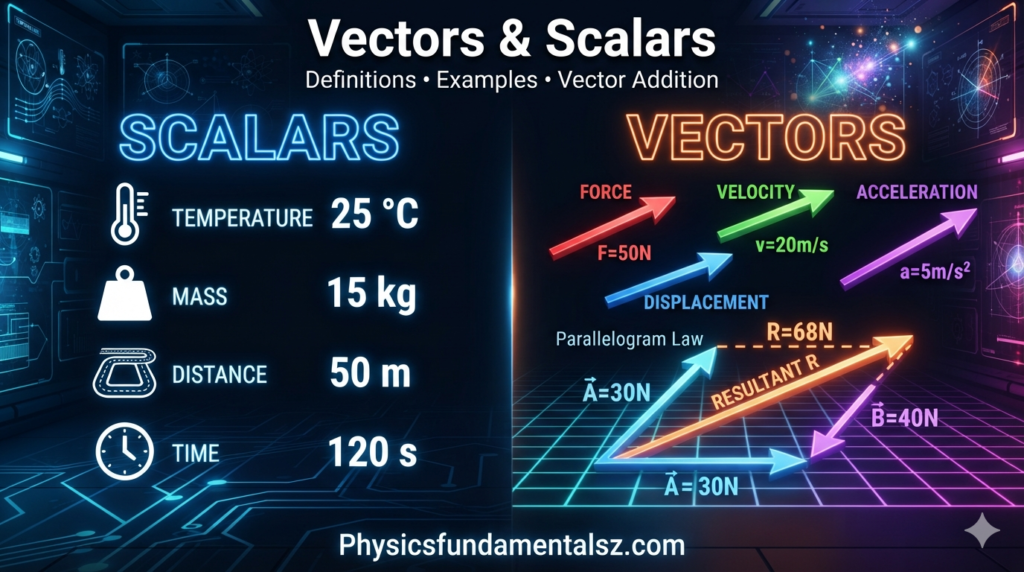
Vectors and scalars are not limited to textbook problems. They appear constantly in real world science, engineering, and even everyday activities.
In aviation and navigation, pilots must account for wind speed and wind direction, both vector quantities, in order to calculate the correct heading and ground speed of an aircraft. A small error in direction can lead to a significant deviation over a long flight.
In sports science, coaches and athletes analyze the velocity and acceleration of players and equipment, both vector quantities, to improve performance and reduce injury risk. Speed alone, a scalar quantity, does not tell the full story without knowing the direction of motion.
In construction and architecture, engineers calculate the forces acting on beams, columns, and foundations as vectors, since the direction of each force determines whether a structure can safely support its intended load.
In everyday life, something as simple as pushing a shopping cart involves vector quantities. The force you apply has both a magnitude, how hard you push, and a direction, which way the cart moves. If you push at an angle instead of straight ahead, only part of that force actually moves the cart forward.
Vector and Scalar Formulas You Should Know
Many core physics formulas depend entirely on whether the quantities involved are vectors or scalars.
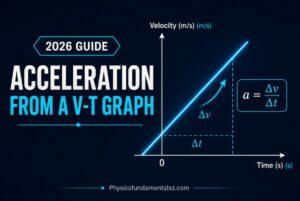
Speed, a scalar formula, is calculated as distance divided by time. Velocity, a vector formula, is calculated as displacement divided by time, and it always includes a direction. Acceleration is calculated as the change in velocity divided by time, and since velocity is a vector, acceleration is also a vector quantity.
Two additional operations are unique to vectors and do not apply to scalars at all: the dot product and the cross product.
The dot product, also called the scalar product, multiplies two vectors and produces a scalar result. It is used often in physics to calculate work done by a force. The cross product, also called the vector product, multiplies two vectors and produces a new vector that is perpendicular to both original vectors. It is commonly used in topics like torque and magnetic force.
For a closer look at how these operations are used in real physics problems, check out our page on work, energy, and power.
Key Differences Between Vectors and Scalars
The table below summarizes the main differences between vector and scalar quantities.
| Feature | Scalar Quantity | Vector Quantity |
|---|---|---|
| Direction | Not required | Required |
| Representation | Single number with a unit | Arrow showing magnitude and direction |
| Addition method | Simple arithmetic | Triangle rule, parallelogram method, or component method |
| Common examples | Mass, time, speed, energy, distance | Force, velocity, displacement, acceleration |
| Notation | Regular symbol such as m or t | Bold symbol or arrow symbol such as F or v with an arrow |
Common Vector and Scalar Pairs That Confuse Students

Some physical quantities sound almost identical but belong to completely different categories. These pairs are the most common source of confusion for students learning vectors and scalars for the first time.
Distance and displacement are a classic example. Distance is a scalar quantity representing the total path length traveled, while displacement is a vector quantity representing the straight line change in position along with its direction. You can walk a long distance around a park and still end up with almost zero displacement if you return to your starting point.
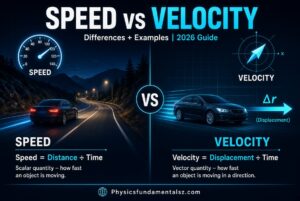
Speed and velocity follow the same pattern. Speed is a scalar quantity that only tells you how fast something is moving, while velocity is a vector quantity that tells you how fast something is moving and in what direction.
Mass and weight are often confused as well. Mass is a scalar quantity representing the amount of matter in an object, while weight is a vector quantity representing the force of gravity acting on that object, always directed toward the center of the Earth.
To strengthen this concept further, our article on motion in a straight line walks through several practice problems involving these exact comparisons.
Why Vectors and Scalars Matter in Physics
The distinction between vectors and scalars is not just a definition to memorize for a test. It directly affects how real world physics and engineering problems are solved.
In navigation and motion, calculating displacement and velocity requires vector math to properly account for changes in direction, not just changes in distance or speed.
In engineering and structural design, forces acting on a bridge, building, or machine must be treated as vectors, since the direction of each force determines whether a structure remains stable or fails under load.
In general physics problem solving, one of the most common mistakes students make is treating a vector quantity as though it were scalar, or the other way around, which leads to incorrect answers even when the numbers themselves are correct.
Understanding this distinction early makes later topics much easier to grasp, including Newton’s laws of motion and projectile motion, both of which depend heavily on correctly identifying vector quantities.
Also Read:
Work-Energy Theorem: Complete Guide with Formula, Derivation, and Examples
Physics Fundamentals: The Complete Guide to Core Concepts, Laws, and Equations
Speed of Light: The Ultimate Guide to c, the Cosmic Speed Limit
v=fλ: The Universal Wave Equation (Wave Speed Formula)
Circular Motion and Centripetal Force
Frequently Asked Questions (FAQs)
What is the main difference between a vector and a scalar?
A scalar has only magnitude, while a vector has both magnitude and direction.
Is temperature a vector or a scalar?
Temperature is a scalar quantity because it only has a magnitude and no direction.
Is force a vector or a scalar?
Force is a vector quantity because it has both a magnitude and a specific direction in which it acts.
Can a vector have a negative value?
Yes, a negative vector simply points in the opposite direction of the original vector, with the same magnitude.
What is a unit vector?
A unit vector is a vector with a magnitude of exactly one, used only to indicate direction rather than size.
Why is displacement a vector and distance a scalar?
Displacement includes the direction from the starting point to the ending point, while distance only measures the total length traveled, without any direction.
Quick Recap: Vectors and Scalars
Scalars have magnitude only, including quantities like mass, time, speed, energy, and distance. Vectors have magnitude and direction, including quantities like force, velocity, displacement, and acceleration.
Scalars are added using normal arithmetic, while vectors require direction aware methods such as the triangle rule, parallelogram method, or component method.
Confusing vector and scalar quantities is one of the most common early mistakes in physics, so it always helps to check whether direction matters before doing any calculation.
Once this distinction becomes clear, more advanced concepts such as momentum, projectile motion, and circular motion become much easier to understand, since nearly every formula in mechanics depends on correctly identifying which quantities are vectors and which are scalars. For a deeper dive into how these ideas connect, continue with our full guide on kinematics and equations of motion.