What Is Centripetal Force? Definition, Formula, and Real-World Examples

Introduction
When a car rounds a bend, a satellite circles Earth, or a child spins on a playground roundabout, something invisible is at work keeping the motion curved instead of straight. That something is centripetal force — the net force that pulls an object toward the center of its circular path. Without it, every turning object would simply fly off in a straight line, exactly as Newton’s first law predicts.
In this guide, you will learn the precise definition of centripetal force, derive its formula step by step, see how it differs from the often-confused centrifugal force, and work through real examples from everyday driving to planetary orbits. By the end, you will be able to solve standard centripetal force problems and explain why this force is not a new kind of force at all, but a role that familiar forces like friction, tension, gravity, and the normal force can play.
Quick answer: Centripetal force is the net force acting toward the center of a circular path that keeps an object moving in a circle. Its magnitude is F = mv²/r, where m is mass, v is speed, and r is the radius of the circle. It is always directed perpendicular to the object’s velocity.
What Is Centripetal Force? The Definition
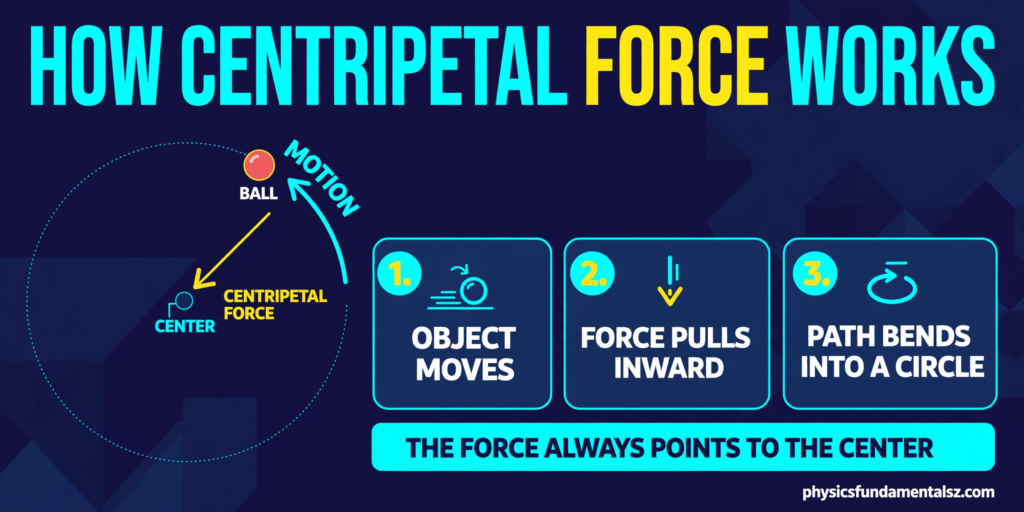
Centripetal force is any net force that causes an object to follow a curved or circular path. The word “centripetal” comes from the Latin centrum (center) and petere (to seek) — literally, “center-seeking.” The force always points toward the center of the circle, and it is always perpendicular to the object’s instantaneous velocity.
This perpendicular direction is the key to the whole idea. A force parallel to velocity changes an object’s speed. A force perpendicular to velocity changes only its direction. Centripetal force does the second job: it continuously bends the velocity vector toward the center without changing the object’s speed (in uniform circular motion).
Centripetal Force Is a Role, Not a New Force
One of the most common misconceptions in physics is treating centripetal force as if it were a separate, fifth fundamental force alongside gravity, friction, tension, and the normal force. It is not. “Centripetal” describes what a force does, not what a force is.
In different situations, different familiar forces supply the centripetal force:
- A car turning on a flat road: static friction between the tires and the road points toward the center of the turn.
- A ball on a string swung in a circle: tension in the string pulls the ball toward your hand.
- The Moon orbiting Earth: gravity pulls the Moon toward Earth’s center.
- A roller coaster looping the loop: a combination of gravity and the normal force from the track keeps the cars on their circular path.
- An electron orbiting in a magnetic field: the magnetic force bends its path into a circle.
Whenever you solve a centripetal force problem, your first job is always the same: identify which real force (or combination of forces) is pointing toward the center. That force, or the sum of its center-pointing components, is the centripetal force.
Centripetal Acceleration: Why Direction Change Needs a Force
Newton’s first law says an object in motion stays in motion in a straight line unless a net force acts on it. An object moving in a circle is constantly changing direction, so even if its speed is perfectly constant, its velocity is changing — and a changing velocity means acceleration.
This acceleration is called centripetal acceleration, and it also points toward the center of the circle. Its magnitude is:
a = v² / r
where v is the object’s speed and r is the radius of the circular path.
Notice what the formula tells us. Centripetal acceleration grows with the square of the speed: double the speed and the acceleration quadruples. And it shrinks as the radius grows: a wide, gentle turn needs far less acceleration than a tight turn at the same speed. This is exactly why highway curves are banked and wide, while a sharp corner at speed feels so violent.
Applying Newton’s second law (F = ma) to this acceleration gives the centripetal force formula:
F = m × v² / r
The Centripetal Force Formula, Step by Step
The Formula
F_c = mv² / r
- F_c = centripetal force, in newtons (N)
- m = mass of the object, in kilograms (kg)
- v = speed of the object, in meters per second (m/s)
- r = radius of the circular path, in meters (m)
Alternative Forms
Because circular motion is often described with angular quantities, two other forms are useful:
- F_c = mω²r, where ω (omega) is the angular velocity in radians per second. This form is handy when you know how fast something spins rather than its linear speed.
- F_c = 4π²mr / T², where T is the period — the time for one complete revolution. This form is ideal for orbits and rotating machinery, where the period is easy to measure.
All three forms are equivalent. Since v = ωr and ω = 2π/T, substituting one into another converts between them.
Worked Example 1: A Car on a Roundabout
A 1,200 kg car travels around a roundabout of radius 25 m at a steady speed of 10 m/s. What centripetal force keeps it on its path?
Using F = mv²/r:
F = (1,200 × 10²) / 25 = (1,200 × 100) / 25 = 120,000 / 25 = 4,800 N
So friction between the tires and the road must supply 4,800 N toward the center of the roundabout. If the road is wet and the tires cannot supply that much friction, the car slides outward — not because a force pushes it out, but because the inward force is no longer enough to bend its path.
Worked Example 2: A Ball on a String
A 0.5 kg ball is swung in a horizontal circle of radius 0.8 m at 3 m/s. What tension must the string provide?
F = (0.5 × 3²) / 0.8 = (0.5 × 9) / 0.8 = 4.5 / 0.8 = 5.625 N
The string’s tension of about 5.6 N is the centripetal force here. Swing the ball faster or shorten the string, and the tension rises sharply — which is why strings snap when swung too fast.
Worked Example 3: The Moon’s Orbit (Order of Magnitude)
The Moon orbits Earth at roughly 1,000 m/s at a distance of about 3.84 × 10⁸ m, with a mass of about 7.35 × 10²² kg. The required centripetal force is:
F = (7.35 × 10²² × 1,000²) / (3.84 × 10⁸) ≈ 1.9 × 10²⁰ N
That enormous number is supplied entirely by Earth’s gravity — a beautiful confirmation that the same force that drops an apple also holds the Moon in its orbit.
Centripetal vs Centrifugal Force: Clearing Up the Confusion
No discussion of centripetal force is complete without its famous counterpart, centrifugal force. Students mix them up constantly, so let us settle it.
Centripetal Force
- Real force (or net component of real forces).
- Points toward the center of the circle.
- Exists in all frames of reference.
- Example: friction pulling a turning car toward the center of the bend.
Centrifugal Force
- A fictitious (pseudo) force — it appears only in a rotating, non-inertial frame of reference.
- Points away from the center of the circle.
- It is the sensation you feel when your body, obeying Newton’s first law, tries to continue in a straight line while the car turns beneath you. Your body presses against the door, and it feels as if something pushed you outward. In reality, the door is pushing you inward — that inward push is the centripetal force.
From the roadside (an inertial frame), there is no outward force at all. The car turns because friction pulls it inward; your body continues straight until the seat belt or door supplies the inward force that makes you turn with the car.
| Feature | Centripetal Force | Centrifugal Force |
|---|---|---|
| Direction | Toward the center | Away from the center |
| Real or fictitious? | Real | Fictitious (frame-dependent) |
| Present in inertial frames? | Yes | No |
| What causes it | Friction, tension, gravity, normal force, etc. | Inertia, as felt in a rotating frame |
| Example | Gravity holding the Moon in orbit | The “push” you feel on a roundabout |
For a deeper look at the forces involved in turning motion, see our guide to what torque is in physics, which explains how forces cause rotation.
Uniform vs Non-Uniform Circular Motion
Uniform Circular Motion
In uniform circular motion, the speed is constant and only the direction changes. The net force is purely centripetal: it points exactly toward the center and is perpendicular to the velocity at every instant. Satellites in stable orbits and a record player spinning at constant speed are good examples.
Non-Uniform Circular Motion
In non-uniform circular motion, the speed changes as well as the direction. The net force then has two components:
- A centripetal (radial) component that changes direction: F_r = mv²/r.
- A tangential component that changes speed: F_t = ma_t, where a_t is the tangential acceleration.
A car speeding up while rounding a bend, or a roller coaster accelerating through a loop, experiences both. The total force is the vector sum of the two components.
Real-World Examples of Centripetal Force
1. Vehicles Turning on Roads
When a car turns, static friction between the tires and the road provides the centripetal force. This is why icy roads are dangerous: ice reduces the maximum static friction, so the maximum safe turning speed drops. Road designers bank curves — tilting the road surface so that part of the normal force also points toward the center — to let vehicles corner faster without relying on friction alone.
2. Satellites and Planetary Orbits
A satellite in a circular orbit is in a continuous state of free fall toward Earth, but its forward speed is so great that it keeps missing the ground. Gravity supplies exactly the centripetal force needed. The same principle holds for planets around the Sun and moons around planets. This connection between circular motion and gravity is explored further in our article on Newton’s law of universal gravitation.
3. Amusement Park Rides
On a loop-the-loop roller coaster, the track’s normal force and gravity together supply the centripetal force. At the top of the loop, both gravity and the normal force point downward toward the center, so the ride must be fast enough that their sum still provides mv²/r — otherwise the cars would lose contact with the track. Centrifuges in theme parks and astronaut training use the same physics at much higher speeds.
4. Washing Machines and Centrifuges
A washing machine’s spin cycle is a centrifuge in disguise. The drum’s wall supplies the centripetal force that keeps clothes moving in a circle, while water, which is not held back in the same way, escapes through the holes. Laboratory centrifuges separate blood components and DNA the same way, spinning samples so fast that denser material moves outward.
5. Sports
A hammer thrower spins to build up speed, then releases the hammer, which flies off tangentially — in a straight line along its instantaneous velocity at release. A cyclist leaning into a turn is letting the ground’s reaction force supply the needed centripetal force. Even a figure skater’s spin relies on the same principles, with angular momentum conservation shaping how the spin speeds up as the arms pull in.
6. Everyday Objects
A stone tied to a string, water in a bucket swung overhead, clothes in a dryer, and a merry-go-round all involve centripetal force. The bucket example is a classroom favorite: at the top of the swing, the water stays in because its inertia would carry it along a straight-line tangent, while the bucket forces it into a circular path.
The Maximum Speed on a Flat Curve
One of the most practical centripetal force calculations is the fastest speed a vehicle can take a flat, unbanked turn. On a flat road, the only center-pointing force is static friction, with a maximum value of μ_s × N = μ_s × mg (where μ_s is the coefficient of static friction and N is the normal force, equal to mg on flat ground).
Setting friction equal to the required centripetal force:
μ_s × mg = mv² / r
The mass cancels, giving:
v_max = √(μ_s × g × r)
This result is striking: the maximum safe speed does not depend on the vehicle’s mass. A heavy truck and a light car with the same tires on the same road can take the same bend at the same speed. It depends only on the road surface (μ_s) and the radius of the turn (r). For more on how mass relates to the forces involved, see our guide to the difference between mass and weight in physics.
Banked Curves: How Roads Help You Turn
On a banked curve, the road is tilted at an angle θ so that the normal force has a horizontal component pointing toward the center of the turn. For a frictionless banked road, the ideal speed — the speed at which no friction is needed at all — is:
v = √(g × r × tan θ)
At this speed, the horizontal component of the normal force supplies exactly the required centripetal force. Go slower, and the car tends to slide down the bank; go faster, and it tends to slide up, with friction stepping in to make up the difference in both cases. Race tracks and high-speed rail lines use banking precisely for this reason.
Centripetal Force in Engineering and Spaceflight

Engineers use centripetal force calculations everywhere rotating parts are involved. A centrifuge for training astronauts spins a gondola at the end of a long arm; the required centripetal acceleration can reach several times Earth’s gravity, simulating the loads of launch and re-entry. The designers must size the arm, bearings, and restraints for the full centripetal force at maximum speed, with a safety margin, because the force grows with the square of the speed and a small overspeed becomes a large overload.
Flywheels store energy in rotation, and their rims experience enormous centripetal forces. The faster a flywheel spins, the more energy it stores — but the rim material must withstand the centripetal stress trying to tear it apart. This trade-off limits flywheel design and explains why high-performance flywheels use strong composite materials rather than plain steel.
In spaceflight, centripetal force and gravity are two sides of the same coin. A spacecraft in low Earth orbit travels at roughly 7.8 km/s; at that speed, the centripetal force required to bend its path into a circle around Earth exactly equals Earth’s gravitational pull at that altitude. Go slower, and gravity wins: the orbit decays. Go faster, and the orbit becomes elliptical, or the spacecraft escapes altogether. Mission planners use this balance to choose orbital altitudes and transfer trajectories, and the same mathematics governs the orbits of GPS satellites, weather satellites, and the International Space Station. NASA’s educational material on orbits explains this free-fall picture clearly, and it is worth reading alongside any textbook treatment.
Particle accelerators are another striking application. In a synchrotron, powerful magnets supply the centripetal force that bends beams of charged particles into circular paths at nearly the speed of light. Because the particles are relativistic, the calculations need Einstein’s relativity rather than the simple mv²/r form, but the underlying idea is identical: a perpendicular force bends the path into a circle without changing the speed.
Even on a smaller scale, the humble centrifuge in a doctor’s office or a dairy plant is applied centripetal force. Spinning a sample forces denser components outward relative to the rotating frame, separating cream from milk or plasma from blood cells. The separation works because the centripetal force required for circular motion is proportional to mass, so denser material experiences a stronger outward tendency in the rotating frame.
Common Mistakes to Avoid
Mistake 1: Adding Centripetal Force as an Extra Force
When drawing a free-body diagram, never add a separate “centripetal force” arrow alongside gravity, friction, and tension. First draw all real forces, then identify which of them (or which components) point toward the center. Their sum is the centripetal force. Adding it again double-counts.
Mistake 2: Thinking Centripetal Force Pushes Objects Outward
The outward feeling in a turning car is inertia, not a real outward force. In an inertial frame, nothing pushes the turning object outward. If the centripetal force vanishes — the string breaks, the tires lose grip — the object does not fly radially outward. It flies off tangentially, in a straight line along its velocity at that moment.
Mistake 3: Using the Wrong Radius
The radius in F = mv²/r is the radius of the circular path, not the length of the string or the size of the object. For a conical pendulum, for example, the radius is the horizontal radius of the circle the bob traces, not the string length. Drawing the geometry carefully before plugging in numbers prevents this error.
Mistake 4: Confusing Speed and Velocity
In uniform circular motion, speed is constant but velocity is not, because velocity includes direction. Any argument that “nothing changes, so no force is needed” fails for this reason. Changing direction alone is a genuine acceleration that demands a genuine net force.
Mistake 5: Forgetting That Centripetal Force Does No Work
Because centripetal force is always perpendicular to the displacement, it does no work on the object (work = force × displacement × cos θ, and cos 90° = 0). That is why a satellite’s speed stays constant in a circular orbit: the force changes its direction forever without adding or removing energy.
How Centripetal Force Connects to Other Physics Topics
Centripetal force sits at a crossroads of mechanics. It uses Newton’s laws directly, it explains orbits together with gravitation, and it leads naturally into rotational dynamics. Understanding it deeply helps with:
- Newton’s third law: the object pulls back on whatever supplies the centripetal force — the Moon pulls on Earth just as Earth pulls on the Moon, and the tires pull outward on the road as the road pulls the car inward. See our explanation of Newton’s third law of motion.
- Momentum and energy: circular motion conserves angular momentum when no torque acts, and centripetal force never changes kinetic energy. Our guide to what momentum is in physics covers the momentum side.
- Kinetic energy: since speed is unchanged in uniform circular motion, kinetic energy stays constant even while velocity changes direction. See what kinetic energy is.
- Speed, velocity, and acceleration: the distinction between speed and velocity is the whole reason centripetal acceleration exists. Our article on the difference between speed and velocity covers it in detail, and the difference between velocity and acceleration completes the picture.
Practice Problems
Problem 1
A 900 kg car rounds a bend of radius 40 m at 15 m/s. Calculate the centripetal force.
Solution: F = mv²/r = (900 × 225) / 40 = 202,500 / 40 = 5,062.5 N. Friction must supply about 5,063 N toward the center.
Problem 2
A 2 kg mass moves in a circle of radius 1.5 m with a period of 2 s. Find the centripetal force.
Solution: Use F = 4π²mr / T² = (4 × π² × 2 × 1.5) / 4 = (4 × 9.87 × 3) / 4 ≈ 29.6 N.
Problem 3
What is the centripetal acceleration of a child on a merry-go-round of radius 3 m, moving at 2 m/s?
Solution: a = v²/r = 4 / 3 ≈ 1.33 m/s² toward the center.
Problem 4
A satellite orbits at a radius of 7.0 × 10⁶ m from Earth’s center with a period of about 5,900 s. Estimate its centripetal acceleration.
Solution: a = 4π²r / T² = (4 × 9.87 × 7.0 × 10⁶) / (5,900²) ≈ 276 × 10⁶ / 34.8 × 10⁶ ≈ 7.9 m/s². Close to the familiar 9.8 m/s² at Earth’s surface, reduced by altitude — as expected, since gravity supplies this acceleration.
Key Takeaways
- Centripetal force is the net force toward the center of a circular path; it changes direction, not speed.
- Its magnitude is F = mv²/r, equivalently mω²r or 4π²mr/T².
- It is a role played by real forces — friction, tension, gravity, normal force — not a separate force.
- Centrifugal force is fictitious, appearing only in rotating frames.
- When the centripetal force disappears, the object flies off tangentially, not radially outward.
- Maximum speed on a flat curve depends only on friction and radius, not on mass: v_max = √(μ_s g r).
Conclusion
Centripetal force is one of those ideas that looks simple on the surface — a single formula, a single direction — but quietly explains an enormous range of phenomena, from a car on a roundabout to the Moon in its orbit. The two insights that matter most are that the force always points toward the center, and that it is never a new kind of force: it is simply the name we give to whatever real force is doing the job of bending a path into a circle. Hold onto those two ideas, draw your free-body diagrams carefully, and centripetal force problems become some of the most reliable marks in physics.
If you found this guide useful, explore the rest of our mechanics coverage, including inertia, potential energy, and density.
Frequently Asked Questions
What is centripetal force in simple words?
Centripetal force is the inward pull that keeps an object moving in a circle instead of flying off in a straight line. It always points toward the center of the circle.
What is the formula for centripetal force?
The formula is F = mv²/r, where m is mass, v is speed, and r is the radius of the circular path. Equivalent forms are F = mω²r and F = 4π²mr/T².
What is an example of centripetal force in daily life?
A car turning a corner is the most familiar example: friction between the tires and the road pulls the car toward the center of the turn. Other examples include a satellite orbiting Earth and clothes spinning in a washing machine.
Is centripetal force a real force?
Yes. Centripetal force is the net effect of real forces such as friction, tension, gravity, or the normal force. What is not real is centrifugal force, which is a fictitious effect felt only in rotating frames.
What is the difference between centripetal and centrifugal force?
Centripetal force points toward the center and is real; centrifugal force appears to point away from the center but is only an apparent effect of inertia in a rotating frame of reference.
What happens if centripetal force is removed?
The object stops curving and moves off in a straight line tangent to the circle at the point where the force vanished. It does not fly outward along a radius.
What provides centripetal force for the Moon?
Earth’s gravity. The gravitational pull supplies exactly the centripetal force the Moon needs to stay in orbit, which is why the Moon is effectively in continuous free fall around Earth.
Does centripetal force change speed?
In uniform circular motion, no. Because the force is perpendicular to velocity, it changes only direction. In non-uniform circular motion, a separate tangential force component changes the speed.
Does centripetal force do work?
No. Work requires a force component along the direction of motion, and centripetal force is always perpendicular to motion, so it does zero work and does not change kinetic energy.
What is centripetal acceleration?
Centripetal acceleration is the acceleration toward the center of a circular path, with magnitude a = v²/r. It exists whenever an object changes direction, even at constant speed.
Why do roads bank their curves?
Banking tilts the road so that part of the normal force points toward the center of the turn, supplying some or all of the needed centripetal force and reducing reliance on tire friction.
What is the unit of centripetal force?
The newton (N), like all forces. It can also be expressed as kg·m/s².
Is centripetal force always toward the center?
Yes, by definition. Any net force component that points toward the center of the path is centripetal; components in other directions serve other purposes, such as changing speed.
Can gravity be a centripetal force?
Yes. Gravity is the centripetal force for satellites, planets, and moons in orbit. It is also part of the centripetal force for a roller coaster at the top of a loop.
How does radius affect centripetal force?
For a fixed mass and speed, centripetal force is inversely proportional to radius: halving the radius doubles the required force. Tight turns demand much larger forces than wide ones.
How does speed affect centripetal force?
Centripetal force grows with the square of speed. Doubling the speed quadruples the force, which is why cornering too fast is so dangerous.
What is the difference between centripetal force and tension?
Tension is a real force transmitted through a rope or string. When a ball is swung on a string, tension happens to be the force supplying the centripetal requirement — tension is the cause, centripetal is the role.
Why do you feel pushed outward on a roundabout?
Your body tends to continue in a straight line due to inertia while the car turns. The car door or seat belt pushes you inward (centripetal force), and your brain interprets the pressure as an outward push.
What is uniform circular motion?
Uniform circular motion is motion around a circle at constant speed. The acceleration is purely centripetal, directed toward the center, with magnitude v²/r.
What is the centripetal force on a satellite?
It is the gravitational force between Earth and the satellite, equal to GMm/r², which must equal mv²/r for a stable circular orbit. This equality lets us calculate orbital speeds.
References and Further Reading
- Khan Academy, “Centripetal force and acceleration” — khanacademy.org/science/physics/centripetal-force-and-gravitation
- HyperPhysics, Georgia State University, “Centripetal Force” — hyperphysics.phy-astr.gsu.edu/hbase/cf.html
- NASA, “Orbits and Kepler’s Laws” — science.nasa.gov
- Encyclopaedia Britannica, “Centripetal force” — britannica.com/science/centripetal-force
- University of Colorado PhET, “Circular motion simulations” — phet.colorado.edu