What Is Inertia in Physics?
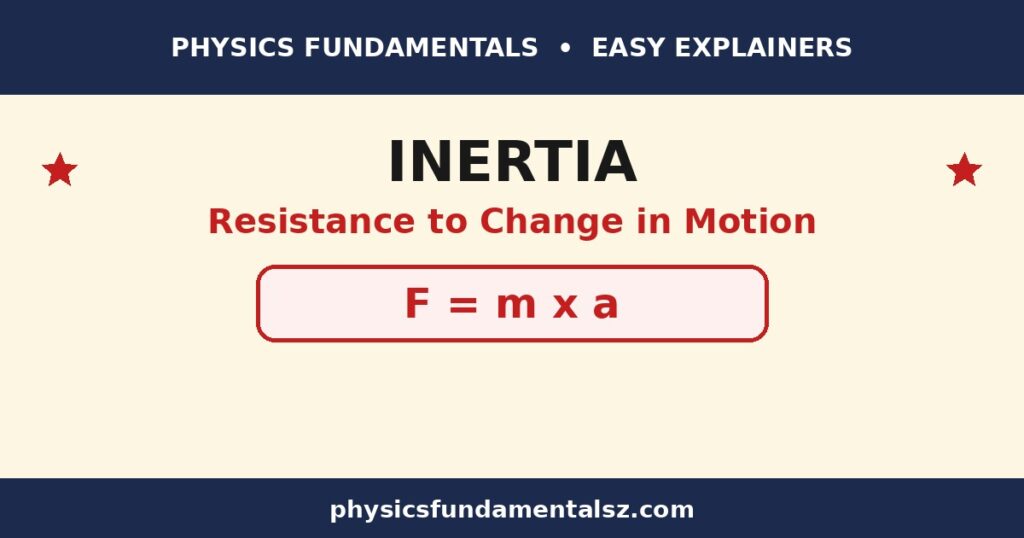
Quick answer: Inertia is the natural tendency of an object to resist changes in its state of motion. An object at rest stays at rest, and an object in motion keeps moving at the same speed in the same direction, unless a net external force acts on it. The greater the mass, the greater the inertia.
Inertia is one of the most familiar ideas in physics, even for people who have never studied it. You feel it when a bus brakes suddenly and your body lurches forward. You feel it when a car accelerates and you are pressed back into your seat. You see it when a tablecloth is pulled from under dishes that stay in place.
Yet inertia is also one of the most misunderstood ideas in physics. Many students think inertia is a force. It is not. Others think it only applies to objects at rest. It does not. Inertia applies to moving objects just as strongly, and understanding that fact is the key to Newton’s first law.
This guide explains inertia from first principles. You will learn its definition, its link to mass, its three types, and its rotational form. You will see real-life examples, worked problems, and the exam mistakes that catch students out most often.
The Definition of Inertia
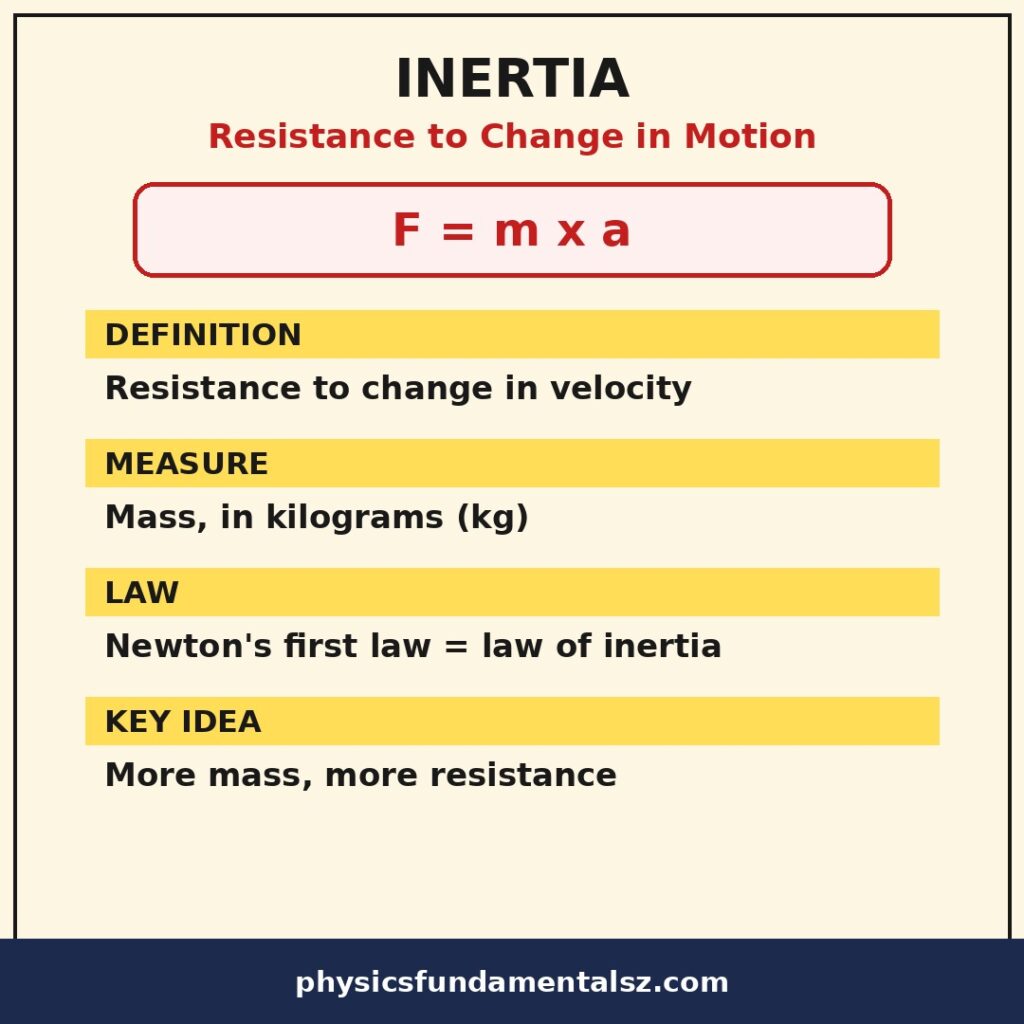
Inertia is the property of matter that resists any change in velocity. Velocity includes both speed and direction. A change in either one counts as a change in motion, and inertia resists it.
An object with no net force acting on it does not speed up, slow down, or change direction. It keeps its velocity exactly as it is. That includes a velocity of zero. Rest is simply motion with zero velocity, and inertia defends rest just as it defends motion.
Inertia is not a force, and it has no unit of its own. It is a property, like colour or density. We measure how much inertia an object has by its mass. More mass means more resistance to changes in motion. A fully loaded truck has far more inertia than a bicycle, which is why it takes far longer to stop or to turn.
The word inertia comes from the Latin word for inactivity or laziness. That origin is misleading in a useful way. Inertia is not laziness in the human sense. It is a neutral resistance to change, in both directions. It resists starting, and it resists stopping, with equal stubbornness.
Newton’s First Law: The Law of Inertia
Newton’s first law of motion is often called the law of inertia. It states that an object remains at rest or in uniform motion in a straight line unless acted upon by a net external force. Uniform motion means constant speed in a constant direction.
This law sounds simple, but it overturned centuries of thinking. Before Newton and Galileo, many people believed that a moving object needed a constant push to keep moving. Everyday experience seemed to support that view, because sliding objects always slow down and stop. Khan Academy’s physics course retells the Galileo inclined-plane reasoning that first challenged the older view.
Friction explains the everyday observation. A sliding book stops because friction applies a force against its motion. Remove friction, and the book would keep sliding. In deep space, far from friction and gravity, a spacecraft coasts at constant velocity with its engines off. Its inertia carries it onward.
Newton’s first law defines what happens when the net force is zero. The net force is the vector sum of all forces acting on the object. When forces balance, acceleration is zero, and velocity stays constant. Britannica’s entry on inertia states the same law and its history, and the OpenStax University Physics textbook develops it with worked examples. Our guide to Newton’s laws of motion explains all three laws together, and our guide to net force shows how balanced and unbalanced forces work.
A helpful way to remember the law is to think of velocity as the default. Forces change velocity. Without a net force, nothing changes. Inertia is the reason the default holds.
Mass and Inertia: The Direct Relationship
Mass is the measure of inertia. This is one of the most important sentences in mechanics. If you know an object’s mass, you know how strongly it resists changes in motion.
Doubling the mass doubles the inertia. A 2 kg block resists acceleration twice as strongly as a 1 kg block. The same force produces half the acceleration. This is exactly what Newton’s second law, F = ma, describes. For a given force, acceleration falls as mass rises.
Weight is different from mass, even though the two are linked. Weight is the force of gravity on an object, and it changes with location. Mass does not change with location. An astronaut’s mass is the same on the Moon as on Earth, and so is her inertia. Her weight is much smaller on the Moon, but she is just as hard to push around. See our comparison of mass and weight for the full distinction.
Inertial mass is the mass that appears in F = ma. It is the property measured by how an object responds to a force. Everyday weighing scales measure gravitational mass, which behaves the same way in practice. The distinction matters in advanced physics, but for school and college mechanics, mass is the measure of inertia.
A practical consequence follows. Heavy objects need larger forces to start, stop, or turn. Seatbelts, airbags, and crumple zones all exist because human bodies have inertia. Safety engineering is largely the business of managing inertia gently rather than suddenly.
The Three Types of Inertia
Physics textbooks often divide inertia into three types. The division is a teaching aid, not three different physical properties. All three are the same tendency, seen in different situations.
Inertia of Rest
Inertia of rest is the tendency of an object at rest to stay at rest. A book on a table stays put until a force moves it. A parked car stays parked until a force accelerates it. Dust falls off a carpet when the carpet is suddenly jerked, because the dust tends to stay where it was.
The tablecloth trick is the classic demonstration. A cloth is pulled sharply from under dishes. The dishes tend to remain at rest, so they stay in place while the cloth slides out. The pull must be fast and smooth. A slow pull drags the dishes along, because friction has time to act as a force.
Inertia of Motion
Inertia of motion is the tendency of a moving object to keep moving at the same velocity. A passenger lurches forward when a bus brakes, because her body tends to keep moving forward. A ball thrown in deep space would keep moving forever, because no force acts to stop it.
Athletes use inertia of motion constantly. A long jumper runs fast and then leaps, carrying forward motion into the jump. A hammer thrower spins and releases, letting the hammer’s inertia carry it through the air. In each case, the body or object keeps the motion it already had.
Inertia of Direction
Inertia of direction is the tendency of a moving object to keep moving in the same direction. A car turning a corner presses its passengers toward the outside of the turn. The passengers tend to continue in a straight line, while the car turns beneath them. A stone tied to a string flies off in a straight line when the string is cut, tangent to its circular path.
This type explains why sharp turns at speed feel violent. Changing direction is a change in velocity, even if speed stays constant. Inertia resists that change. A centripetal force must act to bend the path into a curve. Without it, motion continues straight.
| Type of inertia | Object’s tendency | Everyday example |
|---|---|---|
| Inertia of rest | Stay at rest | Dishes stay put when a tablecloth is pulled away |
| Inertia of motion | Keep moving at the same speed | Passengers lurch forward when a bus brakes |
| Inertia of direction | Keep moving in the same direction | Passengers lean outward when a car turns sharply |
All three types follow from the same law. The table simply organises the examples. In an exam, name the type that fits the situation, then explain it with Newton’s first law.
Rotational Inertia and Moment of Inertia
Linear inertia resists changes in straight-line motion. Rotational inertia resists changes in rotational motion. A spinning object tends to keep spinning. A still object tends to stay still, even when a twisting force is applied.
The measure of rotational inertia is the moment of inertia, symbol I. It depends on two things: the mass of the object, and how that mass is spread out from the axis of rotation. Mass far from the axis is harder to spin than mass close to the axis.
A figure skater shows this beautifully. With arms stretched wide, her moment of inertia is large, and she spins slowly. When she pulls her arms in, her moment of inertia falls, and her spin speeds up. No extra push is needed. The change follows from the conservation of angular momentum, which our guide to angular momentum explains in full.
A flywheel works on the same principle. Its heavy rim places mass far from the axle, giving a large moment of inertia. Once spinning, it resists changes in speed. Engines use flywheels to smooth out jerky power delivery. The flywheel’s inertia keeps the rotation steady between power pulses.
For a point mass, the moment of inertia is I = mr², where m is mass and r is the distance from the axis. For extended objects, different shapes have different formulas. A solid disc, a hoop, and a rod each distribute mass differently, so each has its own formula. HyperPhysics lists the standard moment-of-inertia formulas for common shapes. The key idea stays the same: more mass, or mass further out, means more rotational inertia.
Rotational inertia also explains why long tools work well. A long wrench gives a large turning effect for a modest force, and a tightrope walker’s long pole gives a large moment of inertia that resists tipping. In both cases, distance from the axis is doing the work.
Inertia in Everyday Life
Inertia shows up in dozens of small daily moments. Shaking a ketchup bottle uses inertia: the bottle stops, but the ketchup keeps moving downward. Tapping a book to straighten its pages uses inertia: the pages stop, but the book’s cover keeps moving until it meets them.
When you jump from a moving bus, your feet stop but your body keeps moving forward. That is why jumping from a moving vehicle is dangerous. Your feet meet the ground and friction stops them, while your body’s inertia carries you onward. The same effect throws a rider over the handlebars when a bicycle stops suddenly.
Seatbelts are inertia management devices. In a crash, the car stops quickly, but the occupants tend to keep moving at the car’s former speed. A seatbelt applies a gentler stopping force over a longer time, bringing the body to rest without a violent impact. Airbags spread the stopping force further. Both exist because inertia cannot be switched off.
Falling objects also show inertia in a subtle way. A coin dropped from a moving train falls straight down relative to the train, landing at the drop point on the floor. Relative to the ground, it follows a curved path, because its forward inertia carries it along while gravity pulls it down. Both descriptions are correct. They simply use different reference frames.
Even household cleaning uses inertia. Beating a rug sends the rug backward while dust tends to stay in place, then falls. Shaking a tree drops fruit because the branches stop but the fruit keeps moving. The principle is always the same: one part stops, the other keeps going.
Inertia, Momentum, and Friction: Clearing Up Confusion
Inertia and momentum are related but different. Inertia is a property of an object, measured by mass. Momentum is a quantity of motion, equal to mass times velocity. An object at rest has inertia but zero momentum. A moving object has both.
Momentum changes when a force acts over time. Inertia never changes for a given object, because mass stays constant. Think of inertia as the resistance, and momentum as the amount of motion being resisted. Our guide to momentum and impulse explains momentum in depth.
Friction is a force, not a property. It acts against relative motion between surfaces. Friction is often the force that overcomes inertia in everyday life. It stops sliding books and rolling balls. Without friction, inertia would keep them moving far longer than we expect.
Students sometimes say “inertia pulled me forward” in a braking car. Strictly, no force pulled them forward. Their inertia kept them moving while the car slowed around them. In the car’s frame of reference, it feels like a forward push. In the ground’s frame, nothing pushed them at all. This difference between frames is one of the deeper ideas in mechanics.
Another confusion is the idea of a “force of inertia”. There is no such force in Newtonian mechanics. Inertia describes what happens when forces are absent or balanced. When a real force acts, use Newton’s second law. Do not invent an extra force to explain why motion continues.
Worked Problems: Using Inertia and Newton’s Laws
Inertia itself rarely needs a calculation. Problems usually ask what happens when forces act, using F = ma. The inertia idea tells you the direction of the reasoning: without a net force, velocity stays constant.
Problem 1: Pushing Two Blocks
A 5 kg block and a 20 kg block rest on a smooth floor. The same horizontal force of 40 N is applied to each in turn. Find each acceleration, and explain the result with inertia.
For the 5 kg block: a = F ÷ m = 40 ÷ 5 = 8 m/s². For the 20 kg block: a = 40 ÷ 20 = 2 m/s². The heavier block has four times the mass and four times the inertia. The same force therefore gives one quarter of the acceleration. This is inertia made numerical.
Problem 2: The Braking Passenger
A bus travels at 12 m/s and brakes to rest in 3 seconds. A passenger’s body tends to keep moving at 12 m/s. Explain, with Newton’s first law, why a seatbelt helps.
While the bus decelerates, no forward force acts on the passenger except through the seat and belt. Her inertia keeps her moving forward at nearly 12 m/s. The seatbelt applies a backward force over the full 3 seconds, slowing her with the bus. Without the belt, she would meet the seat in front or the windscreen, which would stop her suddenly and violently.
Problem 3: The Spinning Skater
A skater spins with arms outstretched at 1.5 revolutions per second. She pulls her arms in, halving her moment of inertia. What happens to her spin rate, and why?
Her angular momentum stays nearly constant, because no significant external torque acts. Angular momentum is moment of inertia times angular velocity. Halving the moment of inertia doubles the angular velocity. Her spin rate rises to about 3 revolutions per second. Rotational inertia, like linear inertia, resists change, and redistributing mass changes how fast the spin must be.
Problem 4: Inertia in Space
A spacecraft drifts through deep space at 8,000 m/s with its engines off. No significant forces act on it. How far will it travel in one hour, and what will its speed be at the end of the hour?
With no net force, velocity stays constant at 8,000 m/s. In one hour, 3,600 seconds, it travels 8,000 × 3,600 = 28,800,000 m, or 28,800 km. Its speed at the end of the hour is still 8,000 m/s. Inertia keeps it moving without any fuel. Spacecraft use this fact for coasting phases between burns.
Inertia and Safety Engineering
Vehicle safety is applied inertia physics. Crumple zones lengthen the time over which a car stops in a crash. A longer stopping time means a smaller average force on the occupants, because impulse equals change in momentum. The occupants’ inertia is managed, not fought head-on.
Headrests prevent whiplash, another inertia effect. In a rear-end collision, the car lurches forward, but the occupant’s head tends to stay behind. The headrest catches the head and accelerates it with the body. Without it, the neck bends sharply backward.
Cargo restraint follows the same logic. A heavy load in a truck has large inertia. In a sudden stop, it keeps moving forward with great momentum. Straps, barriers, and load positioning exist to stop cargo before it reaches the cab. Drivers who ignore load restraint are ignoring inertia.
Helmets and padding spread stopping forces over a larger area and a longer time. They do not reduce the wearer’s inertia. They reduce the peak force that inertia produces when motion changes suddenly. The physics is identical from bicycles to construction sites.
A Short History: From Aristotle to Galileo to Newton
Aristotle taught that rest was the natural state of objects, and that motion needed a constant cause. This view matched everyday experience in a world full of friction. It held for nearly two thousand years.
Galileo challenged it with thought experiments and inclined-plane studies. He argued that a ball rolling on a perfectly smooth surface would keep rolling forever. Friction, not the absence of a push, was what stopped real balls. This insight was the seed of the inertia concept.
Newton formalised the idea as his first law in 1687. He placed it first because it defines the baseline: motion without net force. His second law then describes motion with net force, and his third law describes force pairs. The three laws together form classical mechanics.
Einstein later extended the story. In relativity, inertia and energy are deeply connected, and mass itself resists acceleration in ways that depend on speed. At everyday speeds, Newton’s picture is accurate and complete. The history matters because it shows that inertia was not obvious. It took careful thought to see past friction’s disguise.
Inertia in Different Reference Frames
Inertia behaves most simply in inertial frames: frames that move at constant velocity. On the ground, or in a steadily cruising train, Newton’s first law holds directly. A coin dropped in a cruising train falls straight down, just as on the ground.
In an accelerating frame, such as a braking bus, objects appear to accelerate without a visible force. Passengers feel thrown forward, though no forward force acts on them. Physicists explain this with a fictitious force in the accelerating frame. The effect is real to the passenger, but it is not a new physical force.
This distinction matters for careful reasoning. When analysing motion, choose an inertial frame where possible. The ground is close enough for most school problems. Then apply Newton’s laws directly, and inertia will behave as described throughout this guide.
Inertia and Centre of Mass
An object’s centre of mass is the point where its mass can be considered concentrated for translational motion. Inertia resists changes in the motion of that point. A force applied through the centre of mass causes pure translation. A force applied off-centre causes rotation as well.
Balancing acts depend on the centre of mass. A tightrope walker lowers her centre of mass and uses a long pole to increase rotational inertia. Both tricks make tipping harder. Our guide to the centre of mass explains the idea with worked examples.
Toppling also involves inertia. A tall, narrow object tips easily because a small tilt moves its centre of mass beyond its base. A low, wide object resists tipping. Furniture design, vehicle stability, and sports stances all use this principle, often without naming it.
Common Mistakes to Avoid
The biggest mistake is calling inertia a force. Inertia is a property, not a force. Forces are pushes and pulls with a source, such as gravity, friction, or a hand. Inertia has no source and no direction of its own. It describes resistance to change, not a push.
A second mistake is thinking inertia applies only to rest. Inertia of motion is equally important. A moving object keeps moving. Students who forget this half of the law struggle with braking, collisions, and spaceflight questions.
A third mistake is confusing mass and weight. Mass measures inertia and stays constant. Weight is a gravitational force and changes with location. On the Moon, your weight falls, but your inertia does not. Pushing a heavy rock on the Moon is still hard, even though lifting it is easier.
A fourth mistake is saying that a force is needed to keep an object moving. In the absence of friction, no force is needed. Friction is the hidden force in most everyday examples. When a question says “smooth surface” or “frictionless”, it is telling you to ignore that hidden force.
A fifth mistake is forgetting that changing direction is a change in motion. An object moving in a circle at constant speed is accelerating, because its velocity direction changes. Inertia resists that change, which is why a centripetal force is needed. Speed alone does not tell the whole story.
Expert Tips for Exams
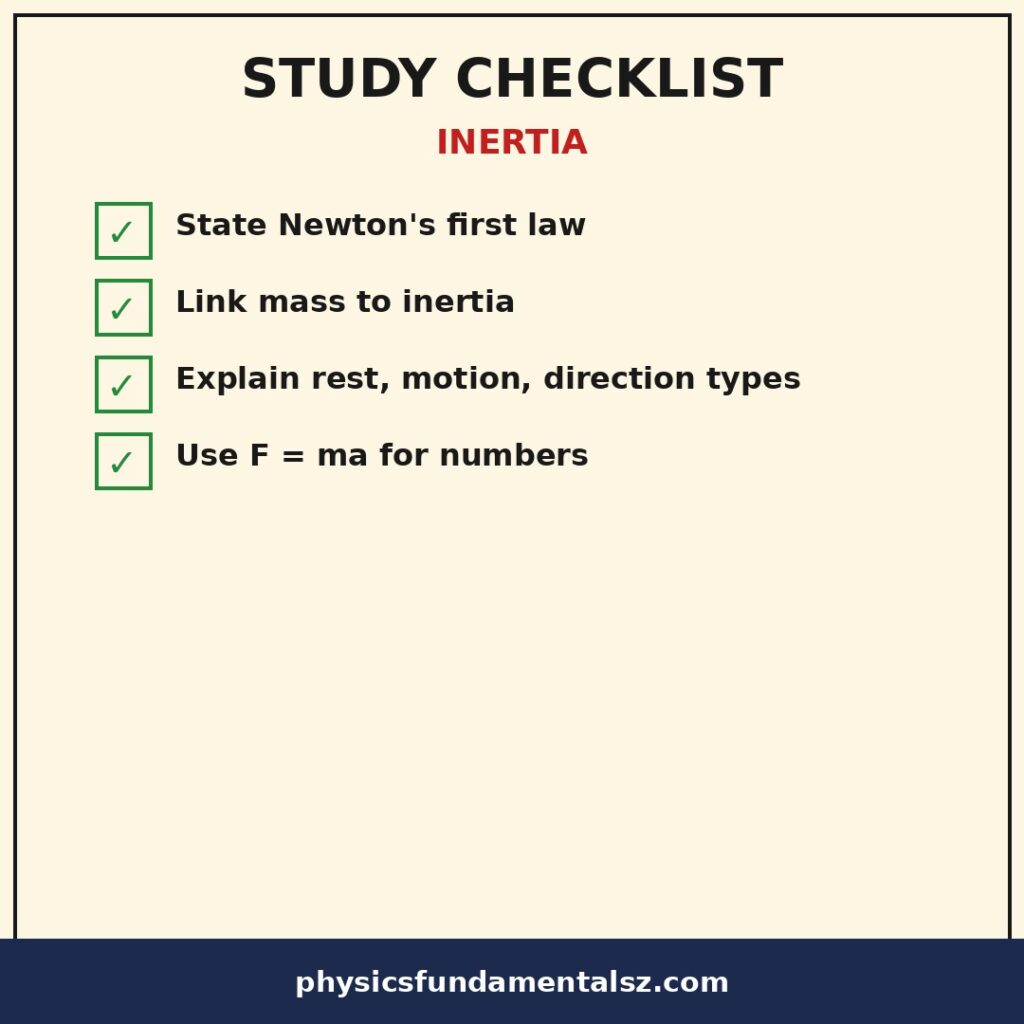
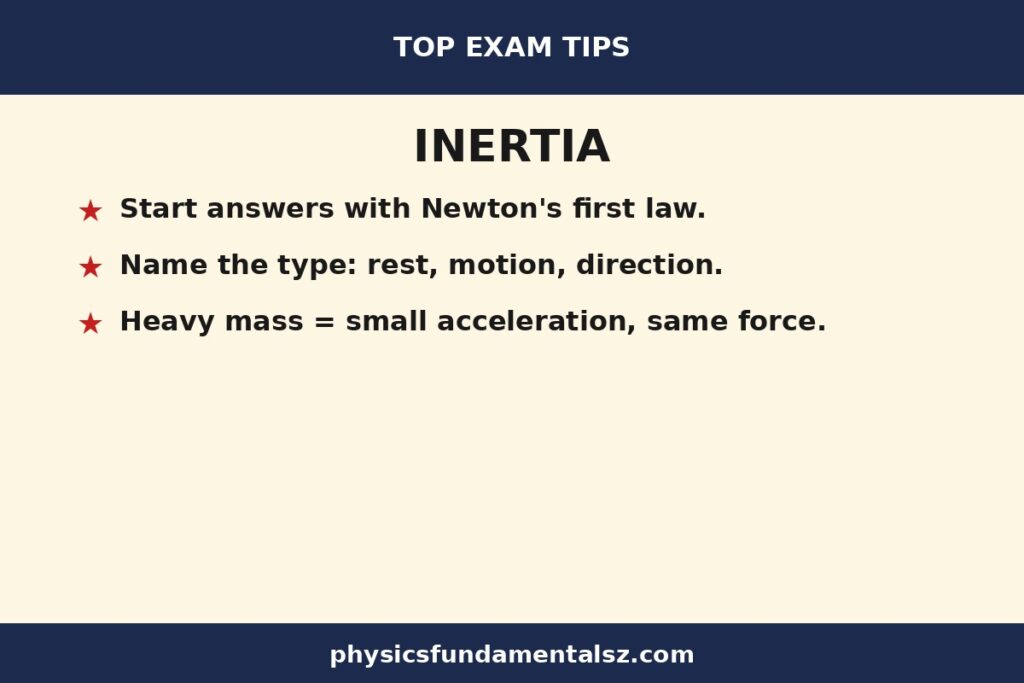
Always start inertia answers with Newton’s first law, stated in your own words. Examiners reward answers that connect the example to the law. “The body tends to keep its velocity because no net force acts” is a strong opening sentence for most inertia questions.
Name the type of inertia when the question invites it. Inertia of rest, inertia of motion, and inertia of direction are useful labels. Follow the label with the explanation. A label alone, without reasoning, earns little credit.
Draw free-body diagrams for force questions. Show each force with an arrow, and mark balanced forces clearly. When forces balance, state that acceleration is zero and velocity stays constant. Our guide to Newton’s second law shows how to move from diagrams to calculations.
Use F = ma whenever numbers are given. Inertia questions with numbers are usually second-law questions in disguise. Find the mass, find the force, and calculate the acceleration. Check that heavier masses give smaller accelerations for the same force. The Physics Classroom Newton’s laws tutorials give further worked problems in the same style.
Practise explaining everyday examples in two sentences. Sentence one: what happens. Sentence two: why inertia explains it. This habit turns vague intuition into exam-ready answers. It also reveals gaps in understanding quickly.
Frequently Asked Questions
What is inertia in simple words?
Inertia is an object’s resistance to changes in its motion. Things at rest tend to stay at rest. Things in motion tend to keep moving at the same speed in the same direction. A net force is needed to change either state.
Is inertia a force?
No. Inertia is a property of matter, not a force. Forces are pushes or pulls from an agent, such as gravity or friction. Inertia explains what happens when the net force is zero. It never pushes or pulls anything itself.
What is the law of inertia?
The law of inertia is Newton’s first law of motion. It states that an object stays at rest or in uniform straight-line motion unless a net external force acts on it. Uniform motion means constant speed and constant direction.
Does mass affect inertia?
Yes. Mass is the measure of inertia. Greater mass means greater inertia and greater resistance to changes in motion. Doubling the mass doubles the force needed for the same acceleration.
What are the three types of inertia?
The three types are inertia of rest, inertia of motion, and inertia of direction. Rest inertia keeps still objects still. Motion inertia keeps moving objects moving. Direction inertia keeps moving objects heading the same way. All three are the same property in different situations.
What is inertia of rest with an example?
Inertia of rest is the tendency of a still object to remain still. Dust falls from a carpet when the carpet is jerked suddenly, because the dust tends to stay in place. A book stays on a table until a force moves it.
What is inertia of motion with an example?
Inertia of motion is the tendency of a moving object to keep moving. Passengers lurch forward when a bus brakes suddenly, because their bodies keep moving at the bus’s former speed. A hockey puck slides on ice with little slowing when friction is small.
What is rotational inertia?
Rotational inertia is resistance to changes in spinning motion. It is measured by the moment of inertia, which depends on mass and how far mass sits from the rotation axis. Mass further from the axis gives greater rotational inertia.
Does inertia depend on speed?
No. Inertia depends on mass, not on speed. A parked truck and a moving truck have the same inertia, because they have the same mass. The moving truck has momentum, which does depend on speed, but its inertia is unchanged.
Does inertia exist in space?
Yes. Inertia works everywhere, including in deep space. A spacecraft with engines off keeps moving at constant velocity, because no net force acts on it. Friction and air resistance are absent, so inertia is easier to observe in space than on Earth.
Why do we wear seatbelts, in terms of inertia?
In a crash, the car stops suddenly, but occupants tend to keep moving at the car’s former speed. Seatbelts apply a stopping force over a longer time, bringing occupants to rest with the car. This reduces the peak force on the body.
What is the difference between inertia and momentum?
Inertia is a property measured by mass. Momentum is mass times velocity, a quantity of motion. An object at rest has inertia but no momentum. Inertia stays constant for an object, while momentum changes when forces act.
Can inertia be zero?
No, for any object with mass. Every massive object resists changes in motion to some degree. Only a hypothetical massless object would have no inertia. All real objects, from dust grains to planets, have inertia.
What is the SI unit of inertia?
Inertia has no unit of its own, because it is a property rather than a measured quantity. Mass, which measures inertia, is measured in kilograms (kg). Moment of inertia, for rotation, is measured in kg·m².
Who discovered inertia?
Galileo first described the idea clearly, arguing that motion would continue without friction. Newton formalised it as his first law of motion in 1687. The concept overturned the older Aristotelian view that motion needed a constant cause.
Why does a tablecloth trick work?
The cloth is pulled away quickly, and the dishes tend to remain at rest due to inertia. Friction between cloth and dishes acts only briefly, so it cannot move the dishes much. A slow pull gives friction time to drag the dishes along.
Does inertia apply to liquids and gases?
Yes. Fluids have mass, so they have inertia. Water sloshes forward in a braking car because it tends to keep moving. Air in a moving vehicle behaves the same way. Engineers account for fluid inertia in tanks, pipes, and aircraft fuel systems.
How is inertia used in engineering?
Engineers use inertia in flywheels, gyroscopes, and vibration dampers. Flywheels store rotational energy and smooth engine output. Gyroscopes use rotational inertia to hold direction in navigation systems. Safety engineers manage inertia with crumple zones and restraints.
Conclusion
Inertia is the tendency of matter to keep its state of motion. Rest stays rest. Motion stays motion. Direction stays direction. Only a net external force changes any of them.
Mass measures inertia. More mass means more resistance to starting, stopping, and turning. The three types of inertia, rest, motion, and direction, are one property seen from three angles. Rotational inertia extends the same idea to spinning objects.
Inertia explains seatbelts, tablecloth tricks, figure-skater spins, and spacecraft coasting. It also explains why heavy objects are hard to move and why changing direction needs a force. Keep Newton’s first law at the front of your mind, and inertia stops being mysterious.
For your next step, read our guides to Newton’s laws of motion and mass and weight. Then look for inertia in your next bus ride or car journey. Physics is easiest to remember when you have felt it yourself.