What Is a Magnetic Field in Physics? Definition, Field Lines, Formulas and Uses

Quick answer: A magnetic field is a region of space around a magnet, a moving electric charge, or a current-carrying wire, where a magnetic force can act on another magnet or moving charge. It is a vector field, which means it has both strength and direction at every point. Its strength is measured in tesla (T). Field lines map the field: they leave the north pole, enter the south pole outside a magnet, never cross, and crowd together where the field is strongest.
A compass needle points north because Earth itself is a giant magnet. A fridge magnet sticks because its field pulls on iron. An electric motor spins because a current in a magnetic field feels a force. One invisible field explains all three, and it explains far more besides.
Magnetic fields are easy to draw and hard to see. Iron filings sprinkled near a bar magnet form curved patterns that reveal the field’s shape. Those patterns are not decoration. They show direction, strength, and structure, and they predict how the magnet will push or pull anything placed in the field.
This guide explains the magnetic field from first principles. You will learn the definition, field lines, units, sources, the force on charges and wires, Earth’s field, electromagnets, induction, and the applications that run the modern world, from motors and generators to MRI scanners and maglev trains.
What Is a Magnetic Field? A Definition That Works
A magnetic field is a vector field that describes the magnetic influence in a region. At each point, the field has a magnitude, telling how strong the influence is, and a direction, telling which way a north pole would be pushed, or which way a compass needle would point.
The field is produced by magnetic materials, by electric currents, and by changing electric fields. It exerts a force on other magnets and on moving electric charges. A stationary electric charge feels no magnetic force, however strong the field. Motion, or a magnetic moment, is required. That condition separates magnetic forces from electric forces, which act on stationary charges too.
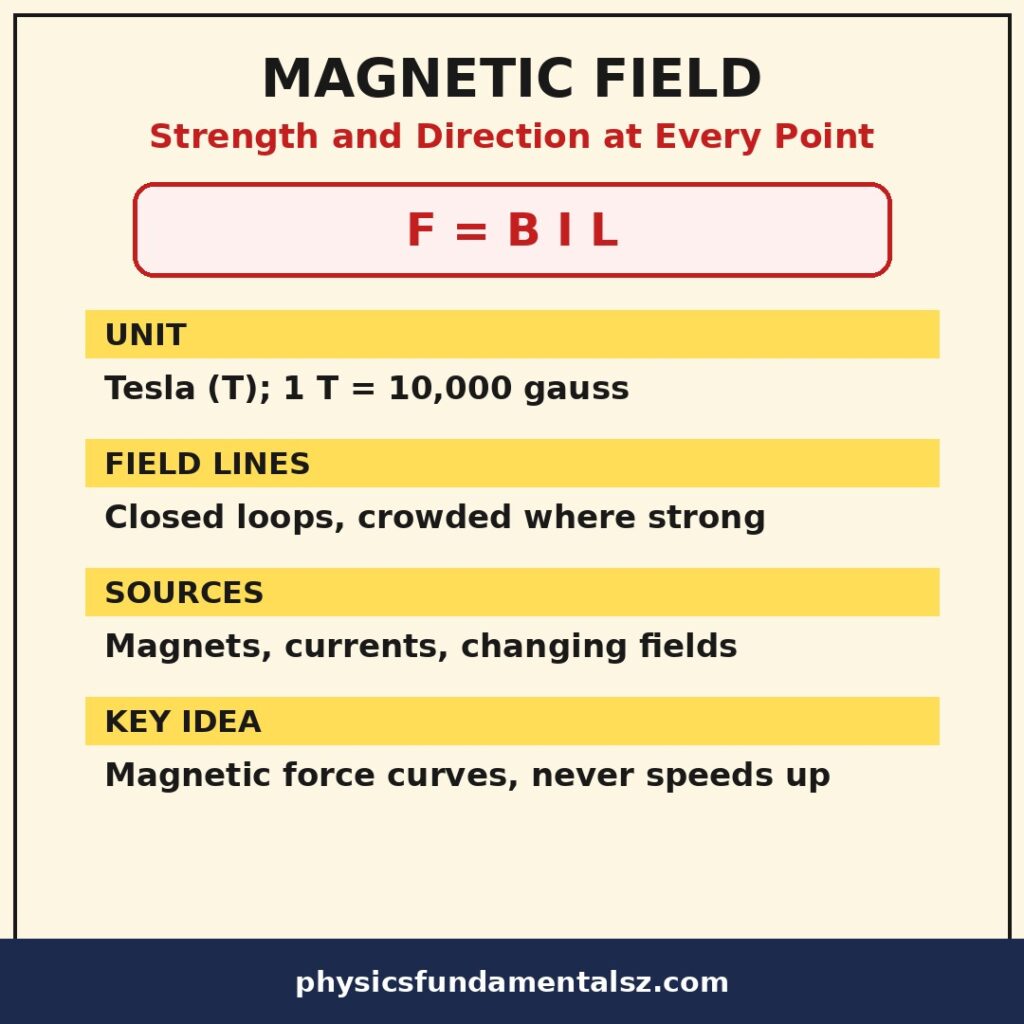
Physicists denote magnetic field strength, more precisely magnetic flux density, by the symbol B. Its SI unit is the tesla, named after Nikola Tesla. One tesla is a strong field: a typical fridge magnet is a few millitesla at its surface, Earth’s field is tens of microtesla, and an MRI scanner uses 1.5 T or 3 T. The older unit, the gauss (G), is still common in some contexts: 1 T = 10,000 G.
A field is not a substance that flows from a magnet. It is a description of how space around the magnet has been changed, so that a test object placed there feels a force. Remove the test object, and the field remains. Turn off the current in an electromagnet, and the field disappears. The field belongs to the source, and the force belongs to the interaction.
OpenStax University Physics covers magnetic fields, forces, and sources in its magnetism chapters. Khan Academy’s physics course introduces magnetic force on moving charges with worked examples. HyperPhysics shows field-line diagrams for bar magnets, wires, and coils that match the drawings used in this guide.
Magnetic Field Lines: How to Read the Map
Field lines are a visual tool, not physical threads. They show the field’s direction and relative strength. A compass needle placed at a point lines up tangent to the field line through that point, with its north end pointing along the line’s direction.
The rules for field lines are strict, and examiners test them directly. Outside a bar magnet, lines leave the north pole and enter the south pole. Inside the magnet, they run from south to north, completing closed loops. Lines never start or end in empty space, and they never cross each other, because the field can have only one direction at each point.
Line spacing shows strength. Lines close together mean a strong field. Lines far apart mean a weak field. Near the poles of a bar magnet, lines crowd together, and the field is strongest there. Far from the magnet, lines spread out, and the field weakens rapidly with distance. A uniform field, such as the field between the flat poles of a large magnet, is drawn with equally spaced parallel lines.
Iron filings reveal the pattern because each filing becomes a tiny magnet and lines up along the field. The filings do not create the pattern. They display a field that was already there. The same method works for a wire, a coil, and Earth itself, with different patterns for each source.
| Field-line feature | What it means |
|---|---|
| Direction of a line | Direction a compass north pole points at that point |
| Lines leaving north, entering south (outside) | Poles of a bar magnet |
| Lines never crossing | Field has one direction at each point |
| Close spacing | Strong field |
| Wide spacing | Weak field |
| Parallel, equal spacing | Uniform field |
Poles, Attraction, and Repulsion
Every magnet has two poles, north and south. Unlike poles attract. Like poles repel. Break a bar magnet in half, and each half gains its own north and south pole. No one has isolated a single magnetic pole, or magnetic monopole, in a confirmed experiment. Cutting a magnet smaller only makes smaller magnets, each with both poles.
The labels north and south come from Earth. The pole of a freely suspended magnet that points towards Earth’s geographic north is called its north-seeking pole, shortened to north pole. Earth’s magnetic field behaves as if a bar magnet inside Earth had its south pole near geographic north, which is why a compass north pole is attracted towards it. The naming is a convention with a twist, and it confuses learners until the convention is stated plainly.
Attraction is strongest for ferromagnetic materials: iron, nickel, cobalt, and some alloys. A magnet attracts an unmagnetised iron nail by inducing a temporary pole in the nail, opposite to the magnet’s nearest pole. The nail then sticks, and while stuck it can attract a second nail. Remove the magnet, and most of the induced magnetism in soft iron fades. Steel keeps more of it, which is why steel makes better permanent magnets than soft iron.
Sources of Magnetic Fields
Three sources produce magnetic fields: permanent magnets, electric currents, and changing electric fields. The first two cover almost every school and engineering case. The third completes the theory and leads to electromagnetic waves.
Permanent magnets owe their field to the alignment of atomic magnetic moments. In iron, each atom acts like a tiny magnet. In an unmagnetised piece, the atomic moments point in random directions, grouped in small regions called domains, and the fields cancel. Magnetising aligns the domains, so their fields add. Heat and hard knocks can randomise the domains again, weakening the magnet.
Electric currents produce fields because moving charge is the fundamental source of magnetism. Every current-carrying wire is surrounded by a magnetic field. The field’s direction follows the right-hand rule, explained below. The field is the reason motors, electromagnets, and transformers work. It also means that any circuit, however carefully built, has a magnetic field around its wires.
Changing electric fields also produce magnetic fields, as described by Maxwell’s equations. A charging capacitor, where no charge crosses the gap, still has a magnetic field around it, produced by the changing field between the plates. That idea, combined with the reverse effect, changing magnetic fields producing electric fields, gives electromagnetic waves. Our guide to electromagnetic waves explains how the two fields sustain each other as they travel through space.
The Magnetic Field Around a Straight Wire
A long straight wire carrying current produces circular field lines centred on the wire. The field circles the wire in planes at right angles to it. The direction is given by the right-hand grip rule: point the right thumb along the current, and the curled fingers show the field direction around the wire.
The field strength falls with distance from the wire. Close to the wire, the field is strong. Twice as far away, it is half as strong. The formula is B = μ₀I / (2πr), where I is the current, r is the distance from the wire, and μ₀ is the permeability of free space, 4π × 10⁻⁷ T·m/A. The formula applies to a long straight wire in free space, and it gives the order of magnitude in real circuits too.
Our guide to the magnetic field of a current-carrying wire works through this geometry with diagrams. Two parallel wires attract or repel depending on whether their currents flow the same way or opposite ways, because each wire sits in the other’s field and feels a force. That interaction defines the ampere in terms of force between wires in the older SI definition, and it remains a vivid demonstration of current producing a field that produces a force.
Worked Example 1: Field Around a Wire
A long straight wire carries a current of 10 A. What is the magnetic field strength at a distance of 5.0 cm from the wire?
Use B = μ₀I / (2πr). Convert distance: 5.0 cm = 0.050 m. Substitute: B = (4π × 10⁻⁷ × 10) / (2π × 0.050). Simplify: the π cancels, giving (4 × 10⁻⁷ × 10) / (2 × 0.050) = 4.0 × 10⁻⁶ / 0.10 = 4.0 × 10⁻⁵ T. The field is 40 μT, comparable to Earth’s field. A compass near a power cable can be deflected by a current of this size, which is why compasses and power lines are kept apart in sensitive measurements.
Coils, Solenoids, and Electromagnets
Bend a wire into a loop, and the field inside the loop adds up from all parts of the wire. Wind many loops into a coil, or solenoid, and the field inside becomes strong and nearly uniform, while the field outside is weak and spread out. The pattern resembles a bar magnet, with a north pole at one end and a south pole at the other.
The field inside a long solenoid is B = μ₀nI, where n is the number of turns per unit length and I is the current. More turns, or more current, means a stronger field. Put an iron core inside, and the field becomes much stronger, because the core’s domains align and add their own field. That combination, coil plus core, is an electromagnet.
Electromagnets can be switched on and off, and their strength can be varied by changing the current. Cranes lift scrap iron with electromagnets and drop it by switching off. Relays use a small current in an electromagnet to close a switch for a larger current. Loudspeakers, doorbells, and MRI scanners all use controlled electromagnets. A permanent magnet cannot be switched off, which is its strength in some uses and its weakness in others.
| Source | Field pattern | Strength control |
|---|---|---|
| Bar magnet | Loops from north to south outside | Fixed by material and size |
| Straight wire | Circles around the wire | Current and distance |
| Single loop | Stronger inside the loop | Current and loop radius |
| Solenoid | Uniform inside, bar-magnet-like outside | Current, turns per length, core |
| Electromagnet | Like a solenoid, amplified by core | Current, turns, core material |
The Right-Hand Rule: Finding Field and Force Directions
Direction questions dominate magnetic field exams. Three right-hand rules cover most cases, and they must not be mixed up. Learn each rule’s hand shape and what each finger means before you use it.
For a straight wire, use the grip rule. Right thumb along the current. Curled fingers show the field direction. Reverse the current, and the field circles reverse. This rule gives field direction, not force direction.
For a moving charge or a current in a field, use the flat-hand rule, sometimes called Fleming’s left-hand rule for motors. Point the fingers of the left hand along the field, from north to south. Point the thumb along the current, or along the velocity of a positive charge. The palm, at right angles to both, points in the direction of the force. For a negative charge, such as an electron, reverse the force direction, or use the right hand instead.
Our guide to the right-hand rule for magnetic fields explains the wire version with diagrams and practice cases. Practise the rules with a real hand and a real magnet, not only on paper. The geometry is three-dimensional, and a physical gesture fixes it in memory far better than a flat diagram.
Magnetic Force on a Moving Charge
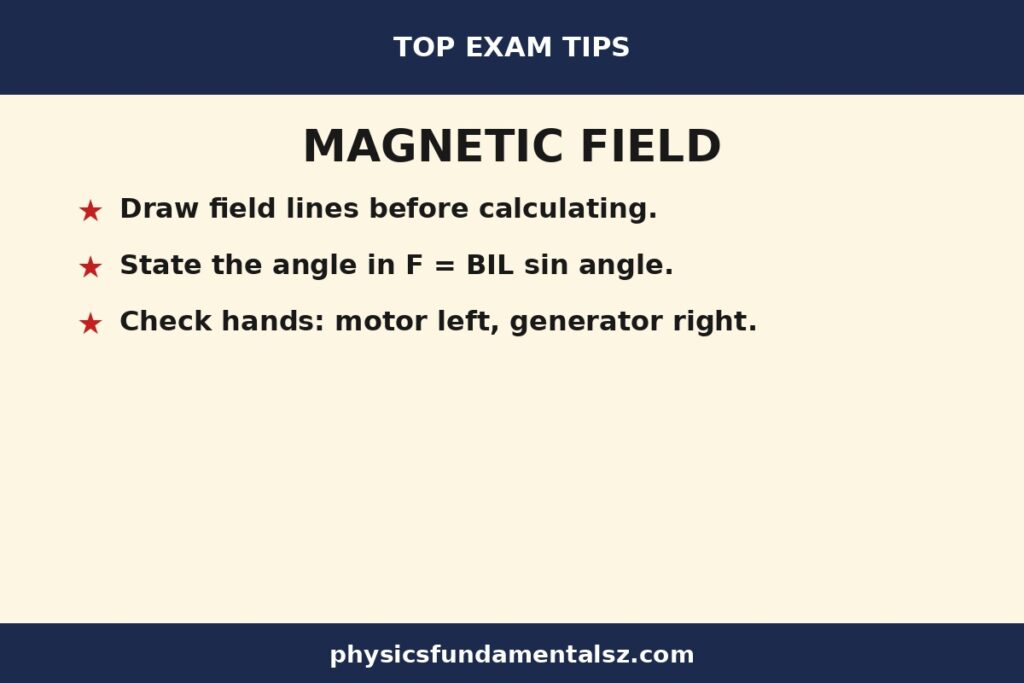
A charge q moving with velocity v at an angle θ to a magnetic field B feels a force F = qvB sin θ. The force is largest when motion is at right angles to the field, sin 90° = 1. It is zero when motion is parallel to the field, sin 0° = 0, because the charge then slides along the field lines without cutting them.
The force is always at right angles to both the velocity and the field. It therefore does no work on the charge and never changes its speed, only its direction. A charged particle in a uniform field moves in a circle or a helix, curving under a constant-magnitude force that always points towards the centre of the circle. Particle accelerators, mass spectrometers, and the aurora all use this curving motion.
The sign of the charge matters. A positive charge curves one way, a negative charge curves the opposite way, under the same field and velocity. That difference lets a mass spectrometer separate ions by charge and mass, and lets physicists identify particle charges in bubble-chamber photographs. Direction, as always in magnetism, carries as much information as size.
Worked Example 2: Force on an Electron Beam
An electron has charge 1.60 × 10⁻¹⁹ C and moves at 1.0 × 10⁶ m/s at right angles to a magnetic field of 0.10 T. What is the magnitude of the magnetic force on it?
Use F = qvB sin θ, with θ = 90° so sin θ = 1. Substitute: F = (1.60 × 10⁻¹⁹) × (1.0 × 10⁶) × 0.10 = 1.60 × 10⁻¹⁴ N. The force is tiny in everyday terms, but it acts on a particle of tiny mass, so the acceleration is enormous and the beam curves sharply. Television tubes and electron microscopes once relied on exactly this deflection, and particle detectors still do.
Magnetic Force on a Current-Carrying Wire
A wire in a magnetic field feels a force because its moving electrons feel forces that add up along the wire. For a straight wire of length L carrying current I at angle θ to a field B, the force is F = BIL sin θ. It is largest at right angles and zero when the wire lies along the field.
This force is the working principle of the electric motor. A coil in a field feels forces on opposite sides in opposite directions, producing a turning effect, or torque. A commutator reverses the current every half-turn, so the torque keeps turning the coil the same way. Without the commutator, the coil would rock back and forth and stop.
Our guide to the difference between AC and DC current explains the current types that drive motors, and the electric current guide covers the charge flow behind them. The motor converts electrical energy into mechanical energy. The generator does the reverse, using motion in a field to induce a current, as Faraday’s law describes.
Worked Example 3: Force on a Wire
A straight wire of length 0.30 m carries a current of 2.0 A at right angles to a uniform magnetic field of 0.50 T. What force acts on the wire?
Use F = BIL sin θ, with sin 90° = 1. Substitute: F = 0.50 × 2.0 × 0.30 = 0.30 N. The force is 0.30 newtons, about the weight of a small apple, acting at right angles to both wire and field. Double the current, and the force doubles. Halve the length in the field, and the force halves. The formula is linear in every factor, which makes scaling questions straightforward.
Worked Example 4: Field Inside a Solenoid
A solenoid has 500 turns per metre and carries a current of 2.0 A. What is the magnetic field strength inside it, away from the ends?
Use B = μ₀nI. Substitute: B = (4π × 10⁻⁷) × 500 × 2.0 = 4π × 10⁻⁷ × 1,000 = 1.26 × 10⁻³ T, about 1.3 mT. That is roughly 25 times Earth’s field. Add an iron core, and the field could rise by hundreds of times, because the core magnetises and adds its own field. The air-core value is the baseline from which the core multiplies.
State the assumption in solenoid answers: the formula holds well inside a long solenoid, away from the ends. Near the ends, the field weakens and spreads out. A short, fat coil needs a correction, and examiners usually specify “long solenoid” when they expect the simple formula.
Earth’s Magnetic Field
Earth’s magnetic field is generated in its liquid iron outer core, where moving conducting fluid acts as a dynamo. The field extends far into space, forming the magnetosphere, a protective bubble that deflects charged particles from the Sun. Without it, the solar wind would strip the atmosphere more rapidly and surface radiation would be higher.
At Earth’s surface, the field strength is roughly 25 μT near the equator and 65 μT near the poles. Its direction is not horizontal everywhere. Near the equator, field lines run nearly parallel to the surface. Near the poles, they dive steeply into the ground. A compass needle, free to tilt, dips by an angle called inclination, which grows towards the poles.
Earth’s magnetic poles wander. The magnetic north pole, where field lines point vertically downwards, moves measurably each year, and the field has reversed polarity many times in geological history, as recorded in magnetised rocks. A reversal does not happen overnight. It unfolds over thousands of years, during which the field weakens and becomes complex. Navigation systems use current models of the field, updated regularly, rather than assuming a fixed pole position.
Animals use Earth’s field for navigation. Migratory birds, sea turtles, and some fish sense the field’s direction and inclination, and use it as a compass and a map. The biological sensor is still debated, with evidence for both magnetite particles and light-sensitive chemical reactions in the eye. Either way, a field of tens of microtesla, far too weak to feel by hand, guides journeys of thousands of kilometres.
The aurora is Earth’s field made visible. Charged particles from the Sun spiral along field lines towards the poles, collide with air molecules high in the atmosphere, and make them glow. Green, red, and purple curtains of light mark the field lines in the sky. The same particles, trapped in radiation belts around Earth, are a hazard for satellites and astronauts, and space weather forecasts track them for that reason.
Magnetic Field vs Electric Field
Electric and magnetic fields are related, but they are not the same, and confusing them loses marks. The table below sets out the distinctions that matter most in school and college physics.
| Feature | Electric field (E) | Magnetic field (B) |
|---|---|---|
| Source | Electric charges | Moving charges, currents, magnets |
| Acts on | Any charge, moving or still | Moving charges, currents, magnets |
| Force direction | Along the field (for positive charge) | At right angles to field and velocity |
| Field lines | Start on positive, end on negative charge | Closed loops, no start or end |
| Unit | Volts per metre (V/m) or N/C | Tesla (T) |
| Does work? | Yes, can change speed and energy | No, changes direction only |
| Shielding | Blocked by conductors | Hard to shield; needs special alloys |
Our guide to Coulomb’s law covers the electric force between stationary charges, and the electric field and electric potential guide compares field and potential. The electric field of a charge and the magnetic field of a current are two faces of one electromagnetic field, a unity that becomes clear in relativity, where motion changes how the field appears. For most problems, keep the two columns separate and use the right formula for each.
Magnetic Flux, Faraday’s Law, and Lenz’s Law
Magnetic flux is a measure of how much magnetic field passes through an area. It is defined as Φ = BA cos θ, where A is the area and θ is the angle between the field and the normal to the area. Its unit is the weber (Wb). Flux is largest when the field is perpendicular to the area, and zero when the field lies in the plane of the area.
Faraday’s law says that a changing magnetic flux induces an electromotive force (EMF) in a circuit. The induced EMF equals the rate of change of flux, with a minus sign for direction: EMF = −N ΔΦ/Δt for a coil of N turns. Move a magnet towards a coil, and current flows. Move it away, and current flows the other way. Hold it still, and nothing happens, however strong the field. Change is the trigger, not strength alone.
Lenz’s law gives the direction: the induced current opposes the change that produced it. A magnet approaching a coil induces a current whose field repels the magnet. A magnet leaving induces a current whose field attracts it. Energy is conserved, because the opposition means work must be done to move the magnet, and that work becomes electrical energy in the circuit.
Our guides to magnetic flux and Faraday’s law and to Lenz’s law treat induction with diagrams and numbers. Generators, transformers, and induction hobs all use Faraday’s law. A generator rotates a coil in a field, changing flux continuously. A transformer changes flux in one coil to induce voltage in another, with no moving parts except the changing field itself.
Real-World Uses of Magnetic Fields
Magnetic fields run motors, store data, image the body, and guide navigation. The uses below show the same field ideas at very different scales, from a compass needle to a hospital scanner.
Motors, Generators, and Transformers
An electric motor turns electrical energy into motion using the force on a current in a field. A generator turns motion into electrical energy using induction. The two machines are mirror images, built from the same parts: coils, magnets, cores, and a rotating shaft. Power stations use generators driven by turbines. Vehicles, fans, and factory machines use motors driven by supplies.
A transformer changes AC voltage using induction between two coils on a shared core. It cannot work with steady DC, because induction needs changing flux. That limitation is one reason power grids use AC: transformers step voltage up for efficient transmission and down for safe use, with almost no moving parts and high efficiency. The AC and DC guide explains the current types behind this system.
Medicine: MRI Scanners
Magnetic resonance imaging uses a strong, uniform magnetic field, typically 1.5 T or 3 T, to align hydrogen nuclei in the body. Radio pulses disturb the alignment, and the nuclei emit signals as they return to it. Computers turn those signals into detailed images of soft tissue, brain, joints, and organs, without ionising radiation.
The field must be extremely uniform, or the images distort. Smaller gradient fields, switched rapidly, encode position, so each signal can be assigned to a place in the body. The scanner’s loud knocking is the gradient coils vibrating under magnetic forces. Patients with metal implants need checks before scanning, because the strong field can move or heat metal, and it can disturb implanted electronic devices.
Common Mistakes to Avoid
Mistake 1: Saying magnetic field lines start and end. They do not. They form closed loops. Lines leave the north pole outside the magnet and re-enter the south pole, then continue inside the magnet back to the north pole. A drawing that shows lines ending in space is wrong.
Mistake 2: Saying a magnetic field does work on a charge. It does not. The force is always perpendicular to velocity, so it curves the path without changing speed or kinetic energy. If a question asks for the work done by a magnetic field on a moving charge, the answer is zero.
Mistake 3: Applying magnetic force to a stationary charge. A stationary charge feels no magnetic force, however strong the field. It feels an electric force if an electric field is present. Check motion first, before applying any magnetic formula.
Mistake 4: Mixing up the hand rules. The grip rule gives field direction around a wire. Fleming’s left-hand rule gives motor force. Fleming’s right-hand rule gives generator current. Using the wrong hand or the wrong rule reverses the answer. Name the device and the wanted quantity before choosing a hand.
Mistake 5: Confusing field strength with flux. Field strength B is measured in tesla. Flux Φ = BA cos θ is measured in weber, and depends on area and angle as well as field. Faraday’s law uses rate of change of flux, not field strength alone. A strong field through a tiny area may carry less flux than a weak field through a large area.
Mistake 6: Thinking Earth’s magnetic north pole is a north pole. It is a magnetic south pole by the field-line convention, because compass north poles point towards it. The geographic name and the magnetic name describe different things. State which you mean in answers about compasses and Earth.
Expert Tips for Exams
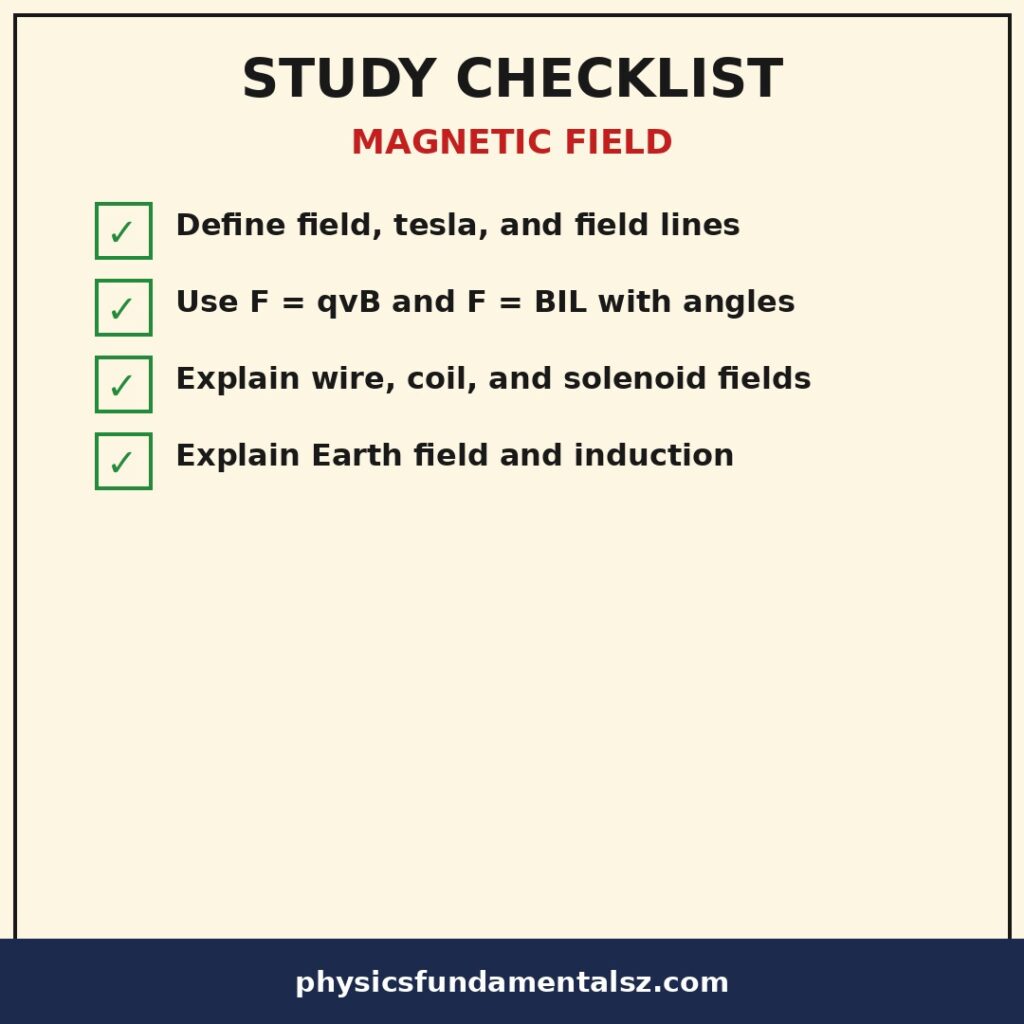
Draw field lines before calculating anything in a direction question. The drawing fixes north and south, shows where lines crowd, and prevents sign errors. A labelled sketch with a compass needle at the point of interest answers many questions on its own, before any formula is used.
Write the angle in every force calculation. F = qvB sin θ and F = BIL sin θ both contain sin θ, and θ is the angle between the field and the motion or current. At 90°, sin θ = 1. At 0°, sin θ = 0. Stating θ explicitly shows the examiner you have read the geometry, and it catches the common error of assuming every case is at right angles.
Keep units straight: tesla for B, weber for flux, ampere for current, metre for length. Convert centimetres to metres and microtesla to tesla before substituting. A field given as 40 μT is 40 × 10⁻⁶ T, not 40 T. Unit errors of a million are common and entirely avoidable.
For induction questions, ask two questions in order: is the flux changing, and which way does the induced effect oppose the change? The first decides whether anything happens. The second, Lenz’s law, decides direction. Answering in that order prevents the error of predicting a current from a strong but steady field.
Learn the three source patterns by heart: circles around a wire, loops through a bar magnet, uniform field inside a solenoid. Most direction and comparison questions reduce to one of those three patterns, or to a combination of them. If you can draw all three from memory, you can answer most field questions without a textbook.
Practice Problems With Answers
Problem 1. A wire carries 5.0 A at a distance of 0.10 m from a point. Find the magnetic field at that point.
B = μ₀I / (2πr) = (4π × 10⁻⁷ × 5.0) / (2π × 0.10) = 1.0 × 10⁻⁵ T, or 10 μT. The field is weaker than Earth’s field at the surface in many places, so a compass would barely notice it.
Problem 2. A proton, charge 1.60 × 10⁻¹⁹ C, moves at 2.0 × 10⁵ m/s at right angles to a 0.20 T field. Find the magnetic force.
F = qvB = (1.60 × 10⁻¹⁹) × (2.0 × 10⁵) × 0.20 = 6.4 × 10⁻¹⁵ N. The force curves the proton’s path into a circle, without changing its speed.
Problem 3. A 0.40 m wire carrying 3.0 A lies at 30° to a 0.80 T field. Find the force on the wire.
F = BIL sin θ = 0.80 × 3.0 × 0.40 × sin 30° = 0.80 × 3.0 × 0.40 × 0.50 = 0.48 N. The angle halves the force compared with the right-angle case.
Frequently Asked Questions
What is a magnetic field in simple terms?
A magnetic field is the region around a magnet or current where magnetic forces act. It has strength and direction at every point. Compasses, iron filings, and field-line diagrams show its shape.
What is the unit of magnetic field strength?
The SI unit is the tesla (T). One tesla is a strong field. Earth’s field is measured in microtesla, fridge magnets in millitesla, and MRI scanners in tesla. The older gauss unit equals 1/10,000 of a tesla.
Do magnetic field lines ever cross?
No. Field lines never cross, because the field has only one direction at each point. If two lines crossed, a compass at the crossing would need to point two ways at once, which is impossible.
Where is a bar magnet’s field strongest?
The field is strongest near the poles, where field lines crowd together. It is weakest far from the magnet and near the middle of the long sides, where lines spread out. Iron filings show this pattern clearly.
Can a magnetic field affect a stationary charge?
No. A stationary charge feels no magnetic force. Magnetic force needs motion: a moving charge, a current, or a magnetic moment. A stationary charge feels an electric force if an electric field is present.
What creates a magnetic field?
Magnets, moving charges, and electric currents create magnetic fields. Changing electric fields also create them. In a permanent magnet, aligned atomic moments are the source. In a wire, the moving electrons are the source.
What is the difference between a permanent magnet and an electromagnet?
A permanent magnet keeps its field without a power supply. An electromagnet produces a field only while current flows, and its strength can be changed by changing the current. Electromagnets can be switched off, permanent magnets cannot.
Why does a compass point north?
A compass needle is a small magnet. Earth’s magnetic field turns it so its north pole points towards Earth’s magnetic south pole, near geographic north. The needle aligns with the local field direction, which is roughly north-south over most of Earth.
What is magnetic flux?
Magnetic flux measures how much magnetic field passes through an area. It equals BA cos θ, in weber. Flux, and its rate of change, decide induction. A field alone, without a defined area and angle, does not define a flux.
How does a motor use a magnetic field?
A motor passes current through a coil in a magnetic field. The field exerts forces on opposite sides of the coil in opposite directions, creating torque that turns the coil. A commutator reverses the current each half-turn to keep the torque turning the same way.
How does a generator use a magnetic field?
A generator rotates a coil in a magnetic field, changing the flux through the coil. Faraday’s law induces a voltage, and current flows in an external circuit. Mechanical energy from the rotation becomes electrical energy in the circuit.
Why is Earth’s magnetic field important?
Earth’s field forms the magnetosphere, which deflects charged particles from the Sun and protects the atmosphere. It also provides a global compass for navigation by humans and animals. Without it, surface radiation and atmospheric loss would be greater.
Can magnetic fields be shielded?
Magnetic fields are hard to shield. A hollow iron box, or a special alloy called mu-metal, can divert field lines around a protected space, but ordinary materials do not block magnetic fields. Electric fields, by contrast, are easily blocked by conductors.
What is the right-hand rule for a wire?
Point the right thumb along the current, and the curled fingers show the direction of the magnetic field circles around the wire. Reverse the current, and the field direction reverses. The rule gives field direction, not force direction.
Is a magnetic field a vector or a scalar?
It is a vector field. At every point it has magnitude and direction. Field lines show the direction, and line spacing shows the relative magnitude. Calculations must respect both, especially in force formulas that use angles.
How strong is an MRI magnetic field?
Clinical MRI scanners commonly use 1.5 T or 3 T. That is about 30,000 to 60,000 times Earth’s surface field. The field is always on in a superconducting magnet, even when no patient is being scanned, which is why metal objects are kept out of the scanner room.
Conclusion
A magnetic field is a vector field around magnets and currents, mapped by field lines that form closed loops and crowd where the field is strong. It exerts forces on moving charges and currents, described by F = qvB sin θ and F = BIL sin θ, and it induces voltages when its flux changes, as Faraday’s law and Lenz’s law describe.
Earth’s field, electromagnets, motors, generators, and MRI scanners are one physics applied at different scales. Keep the direction rules straight, keep flux distinct from field strength, and remember that magnetic forces curve paths without doing work. With those ideas clear, the field stops being invisible and becomes a map you can read, draw, and use to predict what will happen next.