Difference Between Mass and Weight in Physics: A Complete Guide With Examples
Most people use the words mass and weight as if they mean the same thing. In everyday speech, that habit causes no harm. In physics, it causes real confusion, lost exam marks, and wrong answers.
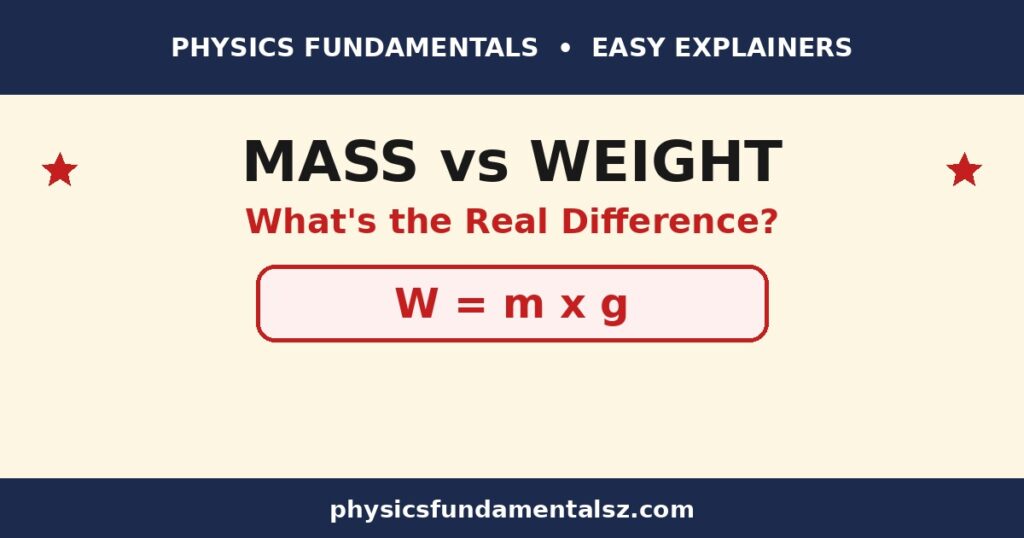
Mass and weight describe two different ideas. Mass tells you how much matter an object contains. Weight tells you how strongly gravity pulls on that matter.
This guide explains the difference between mass and weight in plain language. You will learn the definitions, the formulas, the units, and the classic examples that examiners love.
You will also learn why your mass stays the same on the Moon while your weight drops sharply. By the end, you will never mix the two up again.
Quick Answer: What Is the Difference Between Mass and Weight?
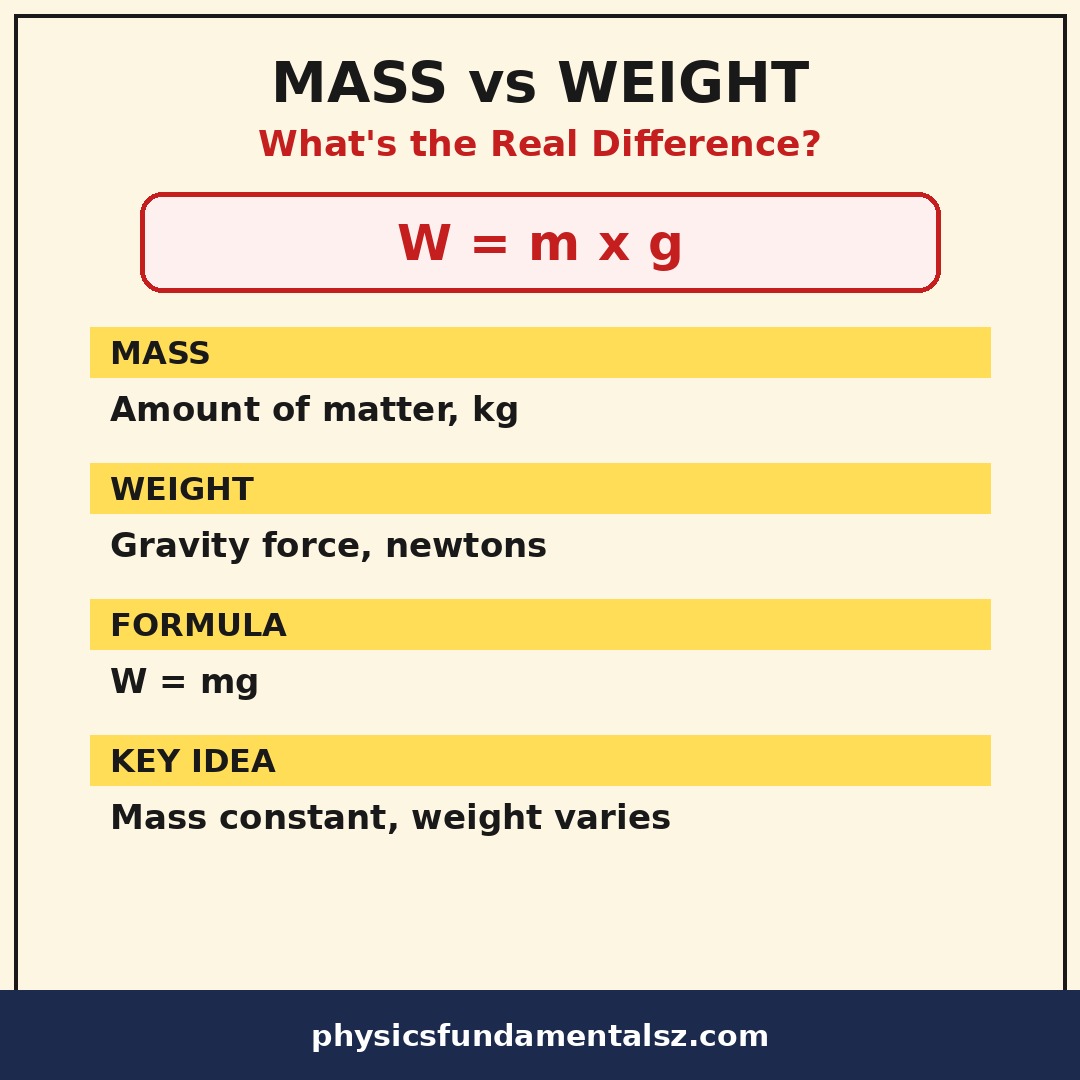
Mass is the amount of matter in an object. It is measured in kilograms and never changes with location.
Weight is the force of gravity acting on that mass. It is measured in newtons and changes with the strength of gravity.
In short: mass is what an object is, and weight is what gravity does to it. A 70 kg astronaut has a mass of 70 kg on Earth, on the Moon, and in deep space. That same astronaut weighs about 686 N on Earth but only about 114 N on the Moon.
Definition Box — Mass: Mass is a measure of the amount of matter in an object. It also measures an object’s inertia, which is its resistance to a change in motion. Mass is a scalar quantity, so it has size but no direction. Its SI unit is the kilogram (kg).
Definition Box — Weight: Weight is the gravitational force exerted on an object by a planet, moon, or star. It is a vector quantity, so it has both size and direction. Its direction is always toward the centre of the attracting body. Its SI unit is the newton (N).
Key Takeaways
- Mass measures matter; weight measures gravitational force.
- Mass is a scalar measured in kilograms; weight is a vector measured in newtons.
- Your mass is the same everywhere in the universe.
- Your weight changes whenever gravity changes.
- Weight is calculated with W = mg, where g is the local gravitational field strength.
- Bathroom scales actually measure force, then convert it to a mass reading for Earth.
- In free fall, objects feel weightless even though gravity still acts on them.
- Confusing mass and weight is one of the most common errors in AP Physics 1.
What Is Mass in Physics?
Mass is one of the most basic properties of matter. Every object, from a grain of sand to a star, has mass. The more matter an object contains, the greater its mass.
Physicists define mass in two closely related ways. The first is the amount of matter in an object. The second is inertia, the natural resistance of an object to speeding up, slowing down, or changing direction.
Push a shopping trolley and you feel inertia at once. An empty trolley moves easily. A full trolley needs a much harder push to reach the same speed. The difference is mass.
Mass does not depend on where the object is. A steel block has the same mass in a classroom, on a mountaintop, on the Moon, and floating in orbit. Location changes nothing about how much matter the block contains.
That stability makes mass a reliable property for science. Chemists, engineers, and physicists all rely on mass because it stays put. If mass changed with location, every calculation in mechanics would need constant correction.
Mass as a Measure of Matter
At the atomic level, matter is built from atoms. Each atom has protons, neutrons, and electrons. Most of an atom’s mass sits in its nucleus, in the protons and neutrons.
Add more atoms and you add more mass. Remove atoms and mass falls. This is why mass feels so concrete. It counts the stuff an object is made from.
A kilogram of steel and a kilogram of feathers have the same mass. They contain the same amount of matter by this measure, even though the feathers take up far more space. Volume and mass are different properties, and students often confuse them too.
Mass as Inertia
Inertia is the reason mass matters for motion. Newton’s first law says an object keeps its state of motion unless a force acts on it. Mass sets how stubbornly the object resists that force.
Newton’s second law makes the link exact: F = ma. For a fixed force, a larger mass gains a smaller acceleration. Double the mass and the acceleration halves, if the force stays the same.
This is why a truck needs a bigger engine than a car. It is also why stopping a heavy lorry takes far longer than stopping a bicycle at the same speed. Inertia scales with mass, and mass never takes a day off.
For a deeper look at how mass controls acceleration, see our guide to Newton’s second law.
How Mass Is Measured
Scientists measure mass with a balance. A beam balance compares an unknown mass with known standard masses. When the beam sits level, the two sides have equal mass.
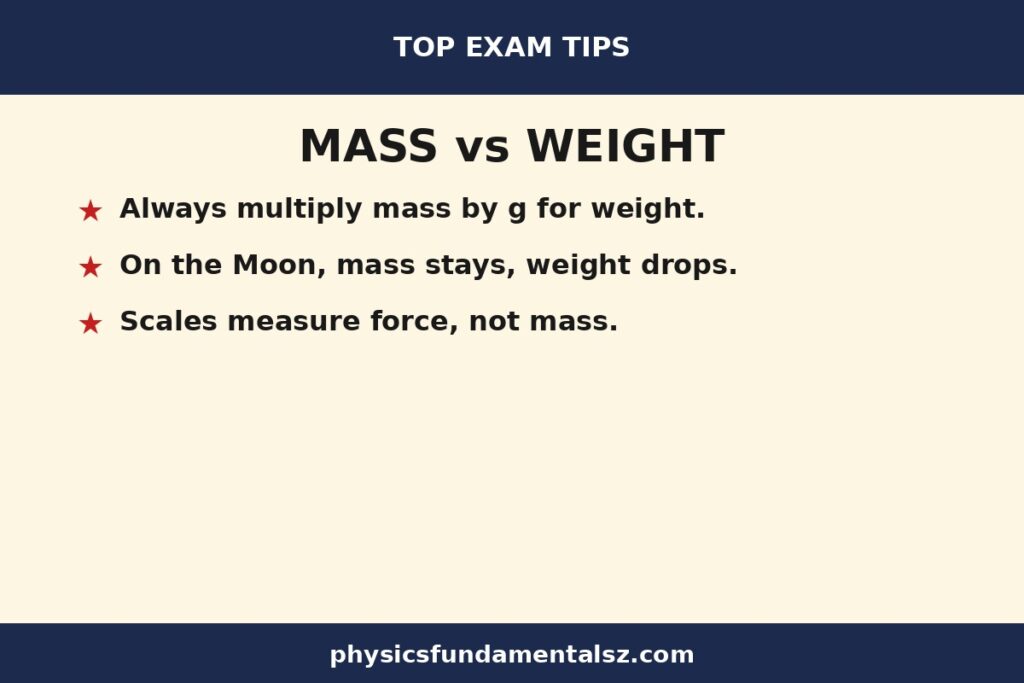
A balance works on the Moon exactly as it works on Earth. Gravity pulls on both sides equally, so the comparison still holds. That is a useful test. Any instrument that gives the same reading on the Moon measures mass, not weight.
Modern electronic balances in laboratories work the same way in principle. They are calibrated with standard masses. The reading reflects the amount of matter, not the local pull of gravity.
The standard unit of mass is the kilogram. One kilogram is defined today using the Planck constant, a fixed value in nature. Smaller masses use grams, and larger masses use tonnes. One tonne equals 1,000 kg.
| Unit | Symbol | Equal to |
|---|---|---|
| Milligram | mg | 0.001 g |
| Gram | g | 0.001 kg |
| Kilogram | kg | 1,000 g |
| Tonne | t | 1,000 kg |
What Is Weight in Physics?
Weight is a force. Specifically, it is the force with which a planet or moon pulls an object toward itself. On Earth, your weight is the pull of Earth’s gravity on your body.
Because weight is a force, it is a vector. It has a magnitude and a direction. The direction is always toward the centre of the attracting body, which is why dropped objects fall down.
Weight depends on two things: the mass of the object and the strength of gravity where it sits. Change either one and the weight changes. This is the heart of the mass versus weight distinction.
A useful comparison comes from Newton’s law of universal gravitation, which explains why gravity weakens with distance. The farther you travel from a planet, the weaker its pull becomes.
The Weight Formula: W = mg
The weight of an object is calculated with a simple formula:
W = mg
Here W is weight in newtons, m is mass in kilograms, and g is the gravitational field strength in newtons per kilogram (N/kg). On Earth’s surface, g is about 9.81 N/kg, often rounded to 10 N/kg in school problems.
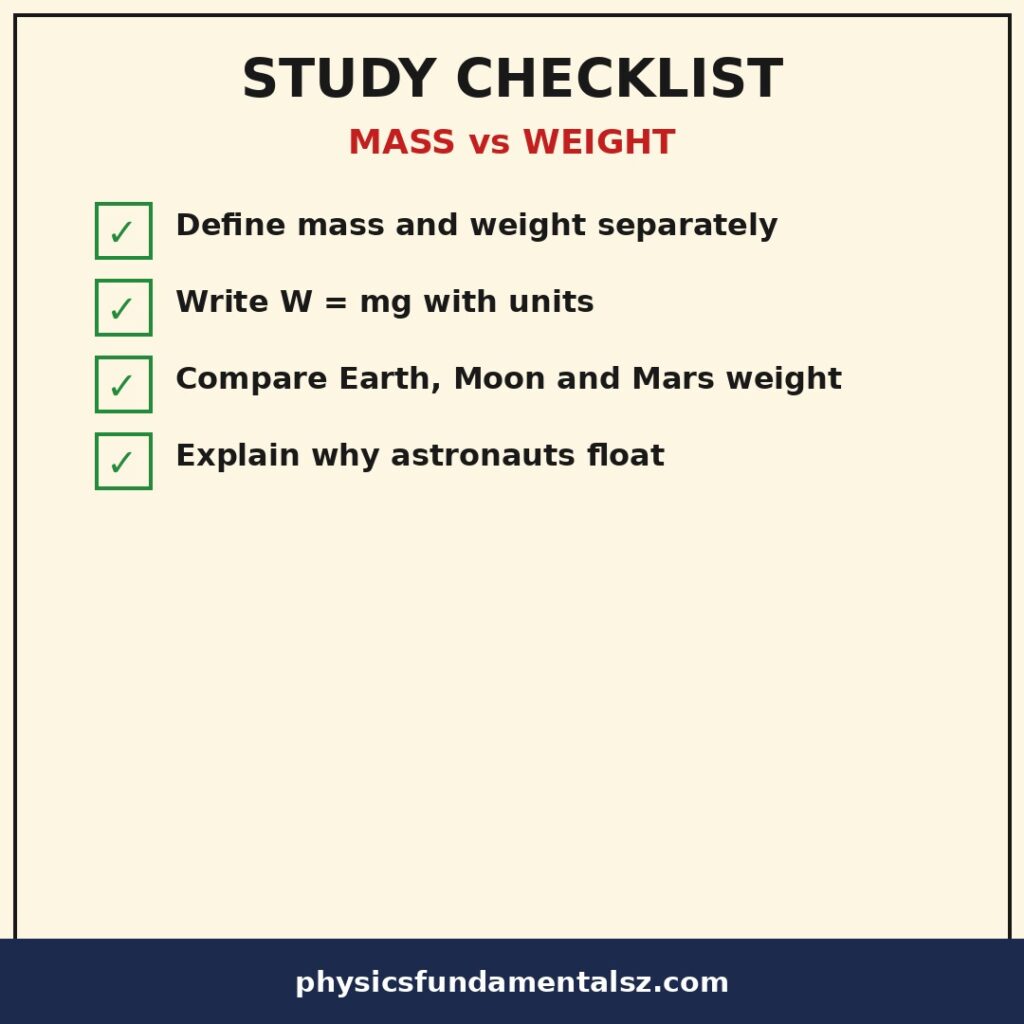
Multiply a mass of 70 kg by 9.81 N/kg and you get about 687 N. That is the weight of an average adult on Earth. The same calculation on the Moon, where g is about 1.62 N/kg, gives only about 113 N.
Note that g is also the acceleration due to gravity. The number is the same because gravity both pulls and accelerates. On Earth, a falling object speeds up by about 9.81 m/s every second, ignoring air resistance.
Why Weight Is Measured in Newtons
Forces are measured in newtons, named after Isaac Newton. One newton is the force needed to accelerate a 1 kg mass at 1 m/s². Weight is a force, so it belongs in newtons.
Saying “I weigh 70 kg” is technically wrong in physics. Seventy kilograms is a mass. A correct statement is “My mass is 70 kg” or “My weight is about 687 N.” Examiners notice this distinction, and AP Physics questions test it directly.
Everyday language will not change. Shops, doctors, and gyms will keep talking about weight in kilograms. In a physics answer, though, the correct unit earns the mark.
Gravitational Field Strength Around the Solar System
Gravity is not the same everywhere. Larger planets pull harder. Smaller moons pull less. The table below shows approximate surface gravity values used in school physics.
| Body | g (N/kg) | Weight of a 70 kg person (N) |
|---|---|---|
| Earth | 9.81 | 687 |
| Moon | 1.62 | 113 |
| Mars | 3.71 | 260 |
| Jupiter | 24.79 | 1,735 |
| Sun | 274 | 19,180 |
| Mercury | 3.70 | 259 |
| Venus | 8.87 | 621 |
These values are approximate and rounded for classroom use. Real surface gravity varies slightly with altitude and local geology. The pattern, however, is clear. Weight follows gravity, not the person.
NASA explains planetary gravity and how it shapes space exploration on its space science pages. The variation in g is exactly why mission planners calculate weight separately for every destination.
Mass vs Weight: The Complete Comparison
The table below puts every key difference in one place. Use it for revision, and use it to check your own answers before an exam.
| Feature | Mass | Weight |
|---|---|---|
| Definition | Amount of matter in an object | Gravitational force on an object |
| Quantity type | Scalar (magnitude only) | Vector (magnitude and direction) |
| SI unit | Kilogram (kg) | Newton (N) |
| Symbol | m | W |
| Changes with location? | No, constant everywhere | Yes, depends on gravity |
| Zero in space? | Never zero for real objects | Nearly zero far from any planet |
| Measured with | Balance | Spring scale or force meter |
| Formula | m = F / a | W = mg |
| Depends on | Amount of matter | Mass and gravitational field strength |
| Effect of gravity | None | Directly proportional to g |
Scalar vs Vector: Why Direction Matters
Mass has no direction. Saying an object has a mass of 5 kg is complete. There is nothing more to add.
Weight always points somewhere. On Earth it points down, toward Earth’s centre. On the Moon it points toward the Moon’s centre. Problems that involve weight as part of a force diagram must show that arrow.
This links to the wider idea of vectors and scalars. Our guide to vectors and scalars explains how direction changes the way quantities add and resolve.
Why Mass Never Changes but Weight Does
Imagine carrying a rock from Earth to the Moon. The rock loses no atoms on the journey. Its matter stays the same, so its mass stays the same.
Gravity, however, is weaker on the Moon. The Moon is smaller and less massive than Earth, so its pull is about one sixth as strong. The rock’s weight drops to about one sixth of its Earth value.
Go farther still, into deep space far from any star or planet. Gravity becomes so weak that weight is effectively zero. The rock still has the same mass. It still resists being pushed, and it still needs a force to accelerate it.
That thought experiment captures the whole topic. Mass travels with the object. Weight belongs to the place.
Mass vs Weight Examples in Everyday Life
Everyday life is full of mass and weight confusion. Sorting the examples below will make the ideas stick far better than definitions alone.
Bathroom Scales: What Do They Really Measure?
A bathroom scale is a spring scale. It measures the force pressing down on it, which is your weight. It then divides that force by Earth’s g and displays the result in kilograms.
The display looks like a mass reading. It is really a weight reading in disguise. The conversion only works because g is nearly constant across Earth’s surface.
Take the same scale to the Moon and it would read about one sixth of your mass. The scale is not broken. It is still measuring force correctly, but the conversion assumes Earth’s gravity.
A balance, by contrast, would read your true mass anywhere. It compares masses directly, so gravity cancels out. That difference is a favourite exam question.
Why Astronauts Float but Still Have Mass
Astronauts aboard the International Space Station appear weightless. They float, and objects drift beside them. It is tempting to say they have no weight and no mass in orbit.
Both claims are wrong. Astronauts keep their full mass. They also still feel most of Earth’s gravity, about 90 percent of surface gravity at orbital altitude. They feel weightless because they are in continuous free fall around Earth.
Free fall means falling toward Earth without hitting it. The station and everything inside it fall together. With no floor pushing back, there is no sensation of weight.
Mass shows itself the moment an astronaut pushes off a wall. A heavy colleague is just as hard to shove in orbit as on Earth. Inertia does not switch off in space.
Khan Academy explains this idea clearly in its lesson on mass and weight. The distinction between apparent weightlessness and true zero gravity is a key AP Physics idea.
Weighing on the Moon
A 60 kg student weighs about 589 N on Earth. On the Moon, the same student weighs about 97 N. The mass stays 60 kg in both places.
Moon walking looks bouncy for exactly this reason. Each step needs less force to lift the body, but the body’s inertia is unchanged. Astronauts had to relearn how to move because their mass still resisted changes in motion.
Mission planners used these numbers for real decisions. Lifting a mass on the Moon needs less force, but stopping it still needs the same care. Inertia and weight tell different stories, and both matter.
Worked Examples: Calculating Weight From Mass
Worked examples turn the formula into a skill. Each example below shows the full method: write the formula, substitute values, and state the answer with the correct unit.
Example 1: Weight of a Student on Earth
Question: A student has a mass of 55 kg. Calculate the weight on Earth. Use g = 9.81 N/kg.
Solution:
W = mg = 55 × 9.81 = 539.55 N.
The student’s weight is about 540 N. The mass is 55 kg, and that mass does not change.
Check: The answer is in newtons, which is correct for a force. A common error is to answer “55 N” by copying the mass. Always multiply by g.
Example 2: Weight of the Same Student on the Moon
Question: Calculate the same student’s weight on the Moon, where g = 1.62 N/kg.
Solution:
W = mg = 55 × 1.62 = 89.1 N.
The weight falls from about 540 N to about 89 N. The ratio is the same as the ratio of g values, roughly one sixth.
Check: Mass is still 55 kg. Only the weight changed, because only gravity changed.
Example 3: Finding Mass From Weight
Question: An object weighs 450 N on Earth. What is its mass? Use g = 9.81 N/kg.
Solution:
Rearrange W = mg to give m = W / g = 450 / 9.81 = 45.9 kg.
The mass is about 46 kg. This is the reverse calculation, and it appears often in exam questions.
Check: The answer is in kilograms, which is correct for mass. Dividing a force by g always gives mass.
Example 4: Weight on Mars
Question: A rover has a mass of 900 kg. Calculate its weight on Mars, where g = 3.71 N/kg. How does it compare with its weight on Earth?
Solution:
On Mars: W = 900 × 3.71 = 3,339 N.
On Earth: W = 900 × 9.81 = 8,829 N.
The rover weighs less than half as much on Mars, but its mass is 900 kg in both places. Engineers design rover wheels and suspension for the mass and inertia, not only for the weight.
Example 5: Weight at Altitude
Question: A climber with mass 80 kg stands on a mountain where g = 9.78 N/kg. What is the climber’s weight, and why is it slightly less than at sea level?
Solution:
W = 80 × 9.78 = 782.4 N, compared with 784.8 N at sea level.
The difference is tiny, about 2 N. Gravity weakens with distance from Earth’s centre, so g drops slightly with altitude. The mass is unchanged at 80 kg.
Practice Problems With Answers
Try these without looking at the answers first. Show your working, and always include the unit.
- A bag of rice has a mass of 5 kg. What is its weight on Earth? Answer: 49 N.
- A crate weighs 196 N on Earth. What is its mass? Answer: 20 kg.
- A 12 kg toolbox is taken to the Moon. What is its weight there? Answer: 19.4 N.
- A planet has g = 12 N/kg. What does a 3 kg rock weigh there? Answer: 36 N.
- An object weighs 0 N in deep space. What can you say about its mass? Answer: Its mass is unchanged; only the gravitational force is near zero.
Mass, Weight, and Gravity: How They Connect
Gravity is the link between mass and weight. Without gravity, there is no weight. Without mass, gravity has nothing to pull.
Newton’s law of universal gravitation says every mass attracts every other mass. The force depends on both masses and on the distance between them. Your weight on Earth is the gravitational attraction between your mass and Earth’s mass.
This also explains why weight changes with altitude and location. Move farther from Earth’s centre and the attraction weakens. Stand on a denser rock formation and local gravity rises slightly. The changes are small on Earth, but the principle is exact.
The Physics Classroom gives a clear treatment of this relationship in its lesson on mass versus weight. It stresses that weight is a force and mass is not, which is the cleanest summary of the topic.
Weight, Gravity, and the Normal Force
When you stand on a floor, two forces act on you. Gravity pulls you down with your weight. The floor pushes you up with a normal force. When the two are equal, you stay still.
A scale placed under your feet measures the normal force, not gravity directly. In most situations the two are equal, so the scale reading is correct. In an accelerating lift, they differ, and the scale reading changes.
Going up in a lift, you feel heavier. The floor must push harder to accelerate you upward. Going down, you feel lighter. Your real weight never changed during the ride. Only the normal force changed.
Apparent Weight and Weightlessness
Apparent weight is what a scale reads. Real weight is mg, always. The two match when you stand still on solid ground. They part company whenever you accelerate.
In free fall, apparent weight is zero. A scale falling with you reads nothing, because there is no contact force. Skydivers experience this before their parachutes open, and astronauts live it in orbit.
True weightlessness, far from all gravity, is different. There the gravitational force itself is near zero. Apparent weightlessness in orbit is a trick of falling together. Both feel the same, but the physics differs.
Our guide to free fall and terminal velocity explores what happens when gravity acts without a floor to push back.
Common Misconceptions About Mass and Weight
Misconceptions survive because everyday language reinforces them. Clearing them now prevents errors in harder topics later.
Misconception 1: Mass and Weight Are the Same Thing
This is the most common error. The words sound alike in daily use, and scales display kilograms. In physics they are different quantities with different units.
Test yourself with one question. Does it change on the Moon? If yes, it is weight. If no, it is mass. That test never fails.
Misconception 2: Objects Have No Mass in Space
Objects in space keep all their mass. A spacecraft in orbit is just as hard to accelerate as the same spacecraft on the launch pad, ignoring air resistance.
Astronauts train for this. Moving a heavy module in orbit needs slow, careful forces. The module’s weight is tiny, but its inertia is enormous. Confusing the two is dangerous in real missions.
Misconception 3: Weightlessness Means No Gravity
The space station orbits only about 400 km above Earth. Gravity there is still about 90 percent of surface gravity. Astronauts float because they are falling, not because gravity vanished.
If gravity truly vanished, the station would fly off in a straight line. Its curved orbit is proof that gravity still grips it. Weightlessness in orbit is free fall, not zero gravity.
Misconception 4: Heavier Objects Fall Faster
In a vacuum, all objects fall with the same acceleration. A hammer and a feather hit the ground together on the Moon, as Apollo 15 demonstrated. Mass cancels out of the falling equation.
On Earth, air resistance makes light objects fall more slowly. That is a force effect, not a gravity effect. Remove the air and the difference disappears.
Misconception 5: Kilograms Measure Weight
Kilograms measure mass. Pounds are also a mass unit in everyday use, though the pound-force is a separate force unit. In SI physics, weight is always in newtons.
Exam questions often give mass in kilograms and ask for weight. The correct move is to multiply by g and answer in newtons.
Forgetting g is the classic lost mark.
Mass and Weight in AP Physics
AP Physics 1 tests mass and weight in several contexts. The ideas appear in dynamics, gravitation, and circular motion. Students who master them early save time later.
What Examiners Expect
Examiners expect you to state definitions precisely. Mass is the amount of matter, or a measure of inertia. Weight is the gravitational force on a mass. Mixing the words in a written answer costs marks even when the calculation is right.
Calculations usually need W = mg. You may need to rearrange it to find mass or g. You may also need to compare weights on different planets using a table of g values.
Free-response questions often ask about apparent weight in a lift or in orbit. The expected answer names the normal force and explains why the scale reading differs from mg.
Typical Exam Questions
A common question gives a mass on Earth and asks for its weight on another planet. The method is always the same: keep the mass, change g, multiply.
Another common question shows a person in an accelerating lift and asks how the scale reading changes. The method is to draw a free-body diagram, apply Newton’s second law, and solve for the normal force.
A third type asks whether mass changes in orbit. The answer is no, with inertia as the reason. The explanation should mention that mass is a property of the object, not of its location.
Mistakes to Avoid
Never answer a weight question in kilograms. Never answer a mass question in newtons. Never say mass changes on the Moon.
Always show g in your working. Writing “W = 55 × 9.81” is clearer than writing a bare number. Examiners award method marks, and clear working earns them.
Check direction when weight appears in a force diagram. Weight points down, toward the planet. Forgetting the arrow is a vector error, not a small slip.
Mass and Weight Beyond Earth
The distinction matters far beyond the classroom. Engineers, pilots, and mission planners live with it every day.
Spacecraft Design
Spacecraft mass sets the fuel needed for every burn. The rocket equation depends on mass, not weight. A spacecraft that weighs little on the Moon still needs the same push to change its velocity.
Landing systems, by contrast, care about weight. Legs, parachutes, and airbags must handle the force of landing under local gravity. Designers calculate both quantities separately for every mission.
Aviation and Engineering
Aircraft payloads are specified by mass. Fuel calculations use mass because the aircraft’s inertia matters for take-off and landing. Structural loads, however, are forces, and they depend on weight plus acceleration.
Bridge engineers think the same way. The mass of traffic sets the inertia, but the weight sets the downward force on the structure. Both enter the design, in different equations.
Everyday Engineering
Lifts, cranes, and elevators are rated by load. The rating is a mass, but the cables feel a force. Engineers multiply by g and add a safety factor for acceleration. The distinction is built into every safety standard.
How Mass and Weight Relate to Other Physics Ideas
Mass and weight connect to almost every mechanics topic. Seeing the links helps the whole subject fit together.
Mass appears in momentum. Our guide to momentum in physics shows that momentum is mass times velocity. A heavier object carries more momentum at the same speed.
Mass appears in kinetic energy too. The guide to kinetic energy explains that energy scales with mass and with the square of speed. Doubling mass doubles the energy, but doubling speed quadruples it.
Weight appears in work. Lifting an object against gravity does work equal to weight times height. The guide to work and power builds on this idea, and the guide to work done in physics goes further.
Mass also appears in gravitation. The guide to gravitational fields shows how mass creates the field that produces weight. The
same mass that resists acceleration also attracts other masses.
Frequently Asked Questions
What is the simple difference between mass and weight?
Mass is the amount of matter in an object, measured in kilograms. Weight is the force of gravity on that mass, measured in newtons. Mass stays the same everywhere, while weight changes with gravity.
Is mass the same as weight?
No. Mass and weight are different quantities. Mass is a scalar property of an object. Weight is a vector force caused by gravity. They are linked by W = mg, but they are not the same thing.
What is the formula for mass and weight?
Weight is calculated with W = mg. Mass can be found with m = W / g. Gravitational field strength g can be found with g = W / m. All three forms come from the same equation.
What is the unit of mass and weight?
Mass is measured in kilograms (kg). Weight is measured in newtons (N). Grams and tonnes are also mass units. Never give a weight in kilograms in a physics answer.
Does mass change on the Moon?
No. Mass is the same on the Moon as on Earth. Only weight changes, because the Moon’s gravity is weaker. A 60 kg astronaut has a mass of 60 kg on both bodies.
Does weight change on the Moon?
Yes. Weight on the Moon is about one sixth of weight on Earth. The Moon’s gravitational field strength is about 1.62 N/kg, compared with 9.81 N/kg on Earth.
What is my weight if my mass is 70 kg?
Multiply by Earth’s g: 70 × 9.81 = 686.7 N. Your weight is about 687 N. Your mass is 70 kg. Both statements are correct, and they describe different things.
What is the difference between mass and weight for kids?
Mass is how much stuff is in something. Weight is how hard gravity pulls that stuff down. A toy keeps the same mass on the Moon, but it weighs much less there because the Moon pulls less hard.
Why do scales measure weight in kilograms?
Scales measure force and convert it using Earth’s gravity. The display shows the mass that would produce that force on Earth. The conversion is convenient, but it hides the physics.
Can an object have mass but no weight?
Yes. Far from any planet or star, gravity is so weak that weight is effectively zero. The object’s mass is unchanged. It still resists acceleration and still needs force to move.
Can an object have weight but no mass?
No. Weight is gravity acting on mass. With no mass, there is nothing for gravity to pull. Light has energy and momentum but no rest mass, and it does not have weight in this sense.
What is the difference between mass, weight, and volume?
Mass is the amount of matter. Weight is the gravitational force on that matter. Volume is the space the matter occupies. A kilogram of steel and a kilogram of feathers share mass but differ greatly in volume.
Is weight a force?
Yes. Weight is a force, measured in newtons. It is the gravitational force exerted on an object. Like all forces, it can cause acceleration and it has direction.
Why does weight point downward?
Weight points toward the centre of the attracting body. On Earth, that direction is down. The direction is built into the idea of weight as a vector force.
What happens to weight in free fall?
In free fall, apparent weight is zero because there is no normal force. Real weight, mg, still acts and causes the fall. Skydivers and astronauts in orbit both experience apparent weightlessness.
What is the difference between mass and weight in AP Physics?
AP Physics treats mass as inertia and weight as mg. Questions test whether students keep the two separate in definitions, units, and calculations. The lift and orbit questions are the classic tests.
How do you measure mass and weight?
Mass is measured with a balance that compares masses. Weight is measured with a spring scale or force meter that measures force. A balance works on the Moon; a spring scale gives a different reading there.
Does mass increase with speed?
In everyday physics, mass is treated as constant. At speeds close to light speed, relativity says energy and momentum behave differently, but rest mass stays the same. School and AP questions treat mass as fixed.
What is gravitational field strength?
Gravitational field strength, g, is the force per unit mass at a point in a gravitational field. On Earth it is about 9.81 N/kg. It equals the acceleration of a freely falling object at that point.
Why is g different on different planets?
Gravity depends on a planet’s mass and radius. Larger, denser planets pull harder at their surfaces. Smaller planets pull less. The value of g follows from Newton’s law of universal gravitation.
Conclusion
Mass and weight are partners, not twins. Mass is the matter in an object. Weight is gravity’s pull on that matter.
Remember the two tests. Mass is measured in kilograms and never changes with location. Weight is measured in newtons and changes whenever gravity changes.
Use W = mg with care, show your working, and always check the unit. Do that, and the mass versus weight questions in class and in exams will become easy marks.
For more mechanics, read our guides to speed and velocity and torque in physics. Each one builds on the force ideas you have just mastered.