What Is Torque in Physics? Formula, Examples & How to Calculate It
Quick answer: Torque is the rotational equivalent of force — it measures how effectively a force causes an object to rotate about an axis. It is calculated as τ = rF sinθ, where r is the distance from the pivot, F is the applied force, and θ is the angle between them. Torque is measured in newton-meters (N·m). Pushing a door far from its hinges creates more torque than pushing near the hinges, which is why the same force can feel effortless or impossible depending on where you apply it.
Introduction
You already understand torque intuitively, even if you have never heard the word. You know to grab a wrench at the far end of the handle when a bolt refuses to budge. You know to push a heavy door near its outer edge, not next to the hinges. You know that a short screwdriver strips screws while a long one turns them with ease.
Every one of those instincts is your brain doing torque physics. What is torque in physics? It is the precise, mathematical version of that instinct: a quantity that captures not just how hard you push, but where and at what angle you push relative to a pivot point. And that extra information matters enormously. The same 100-newton push can produce a huge rotation or almost none at all, depending on where it lands.
In this guide, you will learn the torque definition, the torque formula, how to calculate torque step by step with worked examples, how torque direction works, what net torque and rotational equilibrium mean, and how torque connects to Newton’s second law for rotation. We will also cover the most common mistakes students make and exactly how torque shows up on the AP Physics 1 exam. By the end, torque will feel as natural as force itself.
What Is Torque? The Definition
Definition box: Torque (symbol τ, the Greek letter tau) is a measure of the tendency of a force to cause rotation about an axis. It depends on three things: the magnitude of the force, the distance from the axis of rotation to the point where the force is applied, and the angle between the force and the line connecting the pivot to that point. Its SI unit is the newton-meter (N·m).
HyperPhysics, the widely used physics reference from Georgia State University, defines torque as “an influence which tends to change the rotational motion of an object,” quantified as torque = force applied × lever arm (hyperphysics.phy-astr.gsu.edu).
Think of torque as force’s rotational twin. Force changes how fast something moves in a straight line; torque changes how fast something spins. Just as a bigger force produces a bigger linear acceleration, a bigger torque produces a bigger angular acceleration — the rate at which spin speeds up or slows down.
The key insight that makes torque different from force is the pivot point (also called the axis of rotation or fulcrum). Force is force no matter where it is applied to an object, but torque only exists relative to a chosen axis. A push on a door has one torque about the hinges and a completely different torque about the doorknob. Always ask: “torque about what point?” before calculating anything.
The Torque Formula Explained
The full torque formula is:
τ = r F sinθ
Let us unpack every symbol, because each one carries physical meaning that students need for both intuition and exams:
| Symbol | Name | What it means | Units |
|---|---|---|---|
| τ | Torque | The “twisting strength” of the force about the axis | N·m (newton-meters) |
| r | Position vector / lever arm distance | Distance from the pivot to the point where the force is applied | m (meters) |
| F | Applied force | How hard you push or pull | N (newtons) |
| θ | Angle | The angle between the r vector (pivot → force point) and the force vector | degrees or radians |
The Lever Arm: The Most Important Idea
The lever arm is the perpendicular distance from the axis of rotation to the line of action of the force — that is, the line along which the force points. HyperPhysics emphasizes this definition: the lever arm is “the perpendicular distance from the axis of rotation to the line of action of the force” (hyperphysics.phy-astr.gsu.edu).
Why does only the perpendicular part matter? Imagine pushing straight into a door’s hinges, directly toward the pivot. The door does not rotate at all — your force’s line of action passes right through the axis, so the lever arm is zero and the torque is zero. Now push perpendicular to the door at its outer edge, and it swings easily. Same force, wildly different torque, because the geometry changed.
This is exactly what the sinθ term captures:
- θ = 90° (force perpendicular to the line from the pivot): sin 90° = 1, so τ = rF — maximum torque. This is the everyday case: pushing a door square-on, pulling a wrench at a right angle.
- θ = 0° or 180° (force pointing directly toward or away from the pivot): sin θ = 0, so τ = 0 — no rotation at all, no matter how hard you push.
- Any other angle: only the perpendicular component of the force, F sinθ, contributes to rotation. The parallel component just squeezes or stretches along the line toward the pivot.
Memory hook: torque is “twisting force.” Longer arm plus more perpendicular force equals more twist. That single sentence solves half of all torque intuition questions.
Torque Is a Vector
Like force, torque has a direction — but its direction is defined by the right-hand rule, which takes a moment to visualize. Point the fingers of your right hand along r (from pivot toward the force’s application point), then curl them toward F (the force direction). Your thumb points along the torque vector.
For the flat, two-dimensional problems you will meet in AP Physics 1, this simplifies beautifully:
- Counterclockwise rotation → torque points out of the page (toward you) → conventionally positive (+).
- Clockwise rotation → torque points into the page (away from you) → conventionally negative (−).
You do not need the full 3D cross product (τ = r × F) for most high-school problems. Just decide clockwise or counterclockwise, assign the sign, and add.
How to Calculate Torque: Worked Examples
Worked Example 1: Tightening a Bolt with a Wrench
Problem: You push down on the end of a 0.35 m wrench with a force of 80 N, perpendicular to the handle. What torque do you apply to the bolt?
Solution:
- Identify the values: r = 0.35 m, F = 80 N, θ = 90° (perpendicular).
- Write the formula: τ = rF sinθ.
- Substitute: τ = (0.35 m)(80 N)(sin 90°) = (0.35)(80)(1).
- Calculate: τ = 28 N·m.
That is a realistic lug-nut torque — car wheel nuts are typically tightened to around 100–140 N·m, which is why mechanics use longer breaker bars or apply more force.
Worked Example 2: Pushing a Door at an Angle
Problem: You push on a door 0.80 m from its hinges with a force of 60 N, but your push makes a 30° angle with the door (you are pushing partly into the door, not square-on). What is the torque about the hinges?
Solution:
- Identify the values: r = 0.80 m, F = 60 N, θ = 30°.
- Write the formula: τ = rF sinθ.
- Substitute: τ = (0.80 m)(60 N)(sin 30°) = (0.80)(60)(0.5).
- Calculate: τ = 24 N·m.
Notice what happened: because only half the force (sin 30° = 0.5) acts perpendicular to the door, you get the same torque as a 30 N push applied square-on. This is why pushing a door at a glancing angle feels so ineffective — and why the perpendicular push is always the goal.
Expert tip: When a problem says “at an angle θ to the rod” or “to the door,” that angle is measured between the force vector and the line from the pivot. Double-check which angle the problem gives you — some give the angle to the perpendicular instead, and using the wrong one is the single most common torque calculation error.
Which Wrench Wins? A Conceptual Check
Two people try to loosen the same stuck bolt. Person A uses a 0.20 m wrench and pushes with 150 N. Person B uses a 0.45 m wrench and pushes with 70 N. Both push perpendicular to their handles. Who produces more torque?
- Person A: τ = (0.20)(150) = 30 N·m.
- Person B: τ = (0.45)(70) = 31.5 N·m.
Person B wins — barely — despite pushing with less than half the force. The longer lever arm more than compensates. This is the entire reason breaker bars exist, and it is a favorite AP-style conceptual question: torque rewards distance from the pivot as much as it rewards force.
Torque Direction: Clockwise vs Counterclockwise
Direction matters because real situations involve multiple torques competing. A seesaw has a child on each side. A door has you pushing and friction resisting. To find what actually happens, you add torques — and you can only add them if you track their signs.
The convention used throughout physics:
- Counterclockwise torque: positive (+)
- Clockwise torque: negative (−)
Picture a horizontal rod pivoted at its center. Push down on the right end: the right side goes down, the rod rotates clockwise, so that torque is negative. Push down on the left end: the left side goes down, the rod rotates counterclockwise, so that torque is positive.
The net torque is the algebraic sum:
τ_net = τ₁ + τ₂ + τ₃ + …
(keeping the signs). If τ_net is positive, the object angularly accelerates counterclockwise; if negative, clockwise; if zero, its rotation does not change.
Common mistake: Students often compute every torque’s magnitude correctly but forget the signs, then wonder why their “net torque” is wrong. Assign +/− the moment you draw each force, before doing any arithmetic.
Net Torque and Static Equilibrium
An object is in static equilibrium — perfectly still, not translating and not rotating — when two conditions hold simultaneously:
- Net force = 0 (no linear acceleration): ΣF = 0
- Net torque = 0 (no angular acceleration): Στ = 0
The second condition is what makes a balanced seesaw, a steady bookshelf, or a crane holding a load without tipping. Forces can be perfectly balanced and the object can still spin if the torques do not cancel. Imagine pushing left on the top of a box and right on the bottom with equal forces: net force is zero, but the box rotates. Torque equilibrium is a separate, independent requirement.
A subtle and powerful fact: if the net force is zero, the net torque is the same about any pivot point you choose. That means for equilibrium problems, you can pick the pivot strategically — usually at the location of an unknown force, so that force contributes zero torque (r = 0) and drops out of your equation. This one trick simplifies nearly every statics problem you will ever meet.
Worked Example 3: Balancing a Seesaw
Problem: A 30 kg child sits 2.0 m to the left of a seesaw’s pivot. Where must a 45 kg child sit on the right side to balance the seesaw?
Solution:
- Set up the equilibrium condition: For balance, Στ = 0. Take counterclockwise as positive.
- Torque from the 30 kg child: The child’s weight is F = mg = (30 kg)(9.8 m/s²) = 294 N, acting downward 2.0 m left of pivot. A downward force on the left causes counterclockwise rotation → positive. τ₁ = +(2.0 m)(294 N) = +588 N·m.
- Torque from the 45 kg child: Weight = (45)(9.8) = 441 N downward at unknown distance d to the right. Downward on the right causes clockwise rotation → negative. τ₂ = −(d)(441 N).
- Equilibrium: 588 − 441d = 0 → d = 588/441 = 1.33 m.
The heavier child sits closer to the pivot — exactly what you see on every playground. (Quick check: 30 kg × 2.0 m = 60 kg·m and 45 kg × 1.33 m ≈ 60 kg·m. The mass × distance products match, which is the real content of the balance condition.)
Torque vs Force: What Is the Difference?
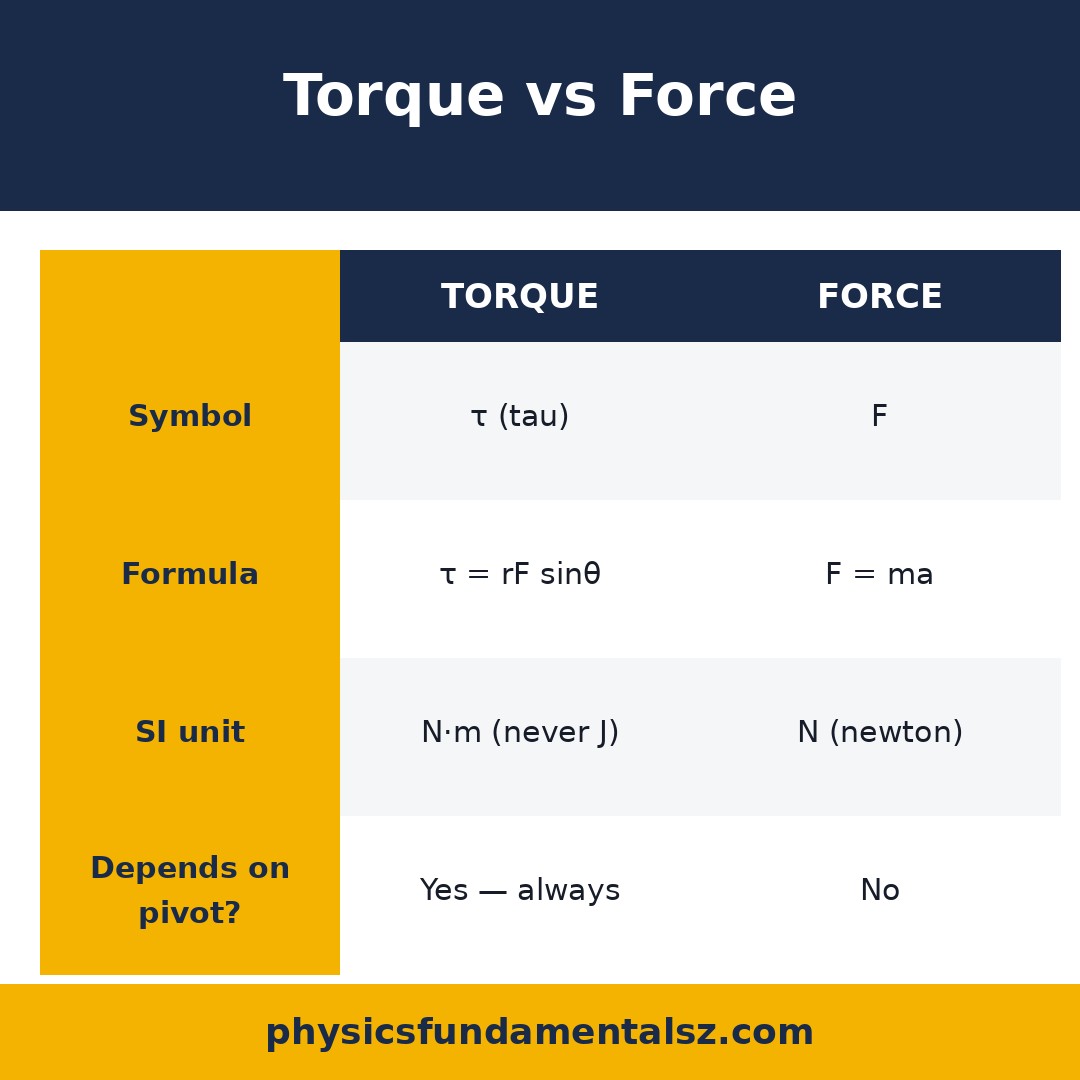
Students often blur these together. This table draws the line sharply:
| Feature | Force | Torque |
|---|---|---|
| Symbol | F | τ (tau) |
| What it changes | Linear motion (velocity) | Rotational motion (angular velocity) |
| Formula | F = ma | τ = rF sinθ (and τ = Iα) |
| SI unit | Newton (N) | Newton-meter (N·m) |
| Depends on point of application? | No — same push anywhere on a rigid body gives the same net force | Yes — torque is always measured about a specific axis |
| Zero when… | No push at all | Force is zero, r is zero, or force points along the r direction (θ = 0°/180°) |
| Everyday example | Pushing a shopping cart forward | Turning a steering wheel |
The unit trap: N·m looks exactly like the joule (J = N·m), the unit of energy and work. They are not interchangeable. Torque is a vector describing a twist; energy is a scalar describing a capacity to do work. Physicists deliberately write torque as N·m and never as joules to keep the concepts separate. Writing “28 J of torque” on an exam will cost you the mark — write “28 N·m.”
Torque and Newton’s Second Law for Rotation
Just as F = ma governs linear motion, there is a rotational twin:
τ_net = I α
where I is the moment of inertia and α (alpha) is the angular acceleration in rad/s².
Moment of inertia is the rotational analog of mass — it measures how much an object resists changes to its spin. But unlike mass, it depends not just on how much matter there is, but on where it sits relative to the axis. Mass far from the axis counts enormously; mass near the axis barely matters. This is why a figure skater spins faster pulling her arms in, and why a sledgehammer is easy to rotate when held near the head but unwieldy when held at the far end of the handle.
OpenStax College Physics develops this analogy explicitly: “torque is analogous to force, angular acceleration is analogous to translational acceleration, and mr² is analogous to mass,” giving the general relationship τ_net = Iα as “the rotational analog to Newton’s second law” (openstax.org).
Common moments of inertia (all for uniform objects):
| Object | Axis | Moment of inertia |
|---|---|---|
| Hoop / thin ring | Central axis | I = MR² |
| Solid disk / cylinder | Central axis | I = ½MR² |
| Solid sphere | Through center | I = ⅖MR² |
| Thin rod | Through center | I = (1/12)ML² |
| Thin rod | Through one end | I = (1/3)ML² |
| Point mass | At distance r | I = mr² |
Notice the rod: rotating about its end gives four times the moment of inertia of rotating about its center. Same rod, same mass — completely different resistance to spinning, purely because of mass distribution.
Worked Example 4: Angular Acceleration of a Disk
Problem: A uniform solid disk (M = 60 kg, R = 1.2 m) is free to rotate about its central axis. You apply a constant 120 N force tangentially at the rim. What is the disk’s angular acceleration?
Solution:
- Torque: The force is tangential, so θ = 90°. τ = rF = (1.2 m)(120 N) = 144 N·m.
- Moment of inertia: For a solid disk about its center, I = ½MR² = ½(60 kg)(1.2 m)² = ½(60)(1.44) = 43.2 kg·m².
- Angular acceleration: α = τ/I = 144/43.2 = 3.33 rad/s².
For perspective, OpenStax works a similar real example: a father pushing a playground merry-go-round with 250 N at the edge (r = 1.50 m) of a 50.0-kg disk produces τ = 375 N·m and α = 6.67 rad/s² — and notes the angular acceleration drops when a child sits on it, because the moment of inertia grows (openstax.org).
The Rotational–Linear Analogy (Worth Memorizing)
| Linear quantity | Rotational analog | Relationship |
|---|---|---|
| Position x | Angle θ | — |
| Velocity v | Angular velocity ω | v = rω |
| Acceleration a | Angular acceleration α | a = rα |
| Mass m | Moment of inertia I | I = Σmr² |
| Force F | Torque τ | τ = rF sinθ |
| Newton’s 2nd law F = ma | τ_net = Iα | — |
| Momentum p = mv | Angular momentum L = Iω | — |
| Kinetic energy ½mv² | Rotational KE ½Iω² | — |
This table is a cheat code for the AP exam: almost every rotational formula is the linear formula with the rotational twin substituted in.
Real-World Applications of Torque
Torque is not an abstract classroom invention. It runs the modern world:
- Car engines: Engine specs quote torque (e.g., 400 N·m) because torque at the wheels is what actually accelerates the car. Horsepower tells you how fast the engine can sustain work; torque tells you how hard it can twist the drivetrain from a standstill. That is why diesel trucks with modest horsepower but huge torque tow heavy trailers effortlessly.
- Wrenches and lug nuts: A longer handle multiplies your force into more torque — the worked example above shows a 0.35 m wrench turning 80 N into 28 N·m.
- Doors and hinges: Hinges are the pivot; the handle sits as far from them as possible to maximize r. Ever tried pushing a door an inch from the hinges? That is life with a tiny lever arm.
- Bicycles: Gears trade torque for speed. Low gear gives high torque at the wheel for climbing hills; high gear gives low torque but high speed on flats. Your legs produce roughly constant force — the gears decide what it becomes.
- Cranes and construction: A crane’s counterweight exists purely to balance torques. The load’s torque about the tower (huge r, huge F) must be canceled by the counterweight’s torque on the other side, or the crane tips.
- Seesaws and playgrounds: The balance condition τ₁ = τ₂ from our worked example, lived out by every child.
- Bottle caps and jars: The cap’s radius is your lever arm. Rubber grippers do not just add friction — they let your whole hand apply force at the full radius instead of slipping.
- Wind turbines: Wind force on the blades creates torque about the hub, which the generator converts into electricity. Longer blades mean a bigger lever arm and more torque from the same wind.
Friction connection: Whenever brakes stop a spinning wheel, friction supplies the stopping torque. Our guide on static vs kinetic friction explains which friction regime acts in rolling versus skidding — the distinction decides how much braking torque a tire can actually deliver.
Machines connection: Pulleys and gears redirect force, and belt drives explicitly trade torque for speed. See how to calculate mechanical advantage of a pulley for the force-multiplication side of the same coin.
Torque on the AP Physics 1 Exam
Torque is not a side topic on AP Physics 1 — it is an entire unit. Unit 5: Torque and Rotational Dynamics accounts for 10–15% of the multiple-choice section, according to the College Board’s official course framework (apcentral.collegeboard.org). On a 50-question multiple-choice section, that is roughly 5–8 questions, before counting free-response.
What the exam actually tests:
- Calculating torque from force, lever arm, and angle (τ = rF sinθ) — the single most tested skill.
- Net torque and rotational equilibrium — “which of these objects is in equilibrium?” style questions.
- τ = Iα and moment of inertia reasoning — often qualitative (“the mass moves outward, so the angular acceleration decreases”).
- Connecting rotation to translation — rolling without slipping, where torque from friction causes angular acceleration while net force causes linear acceleration.
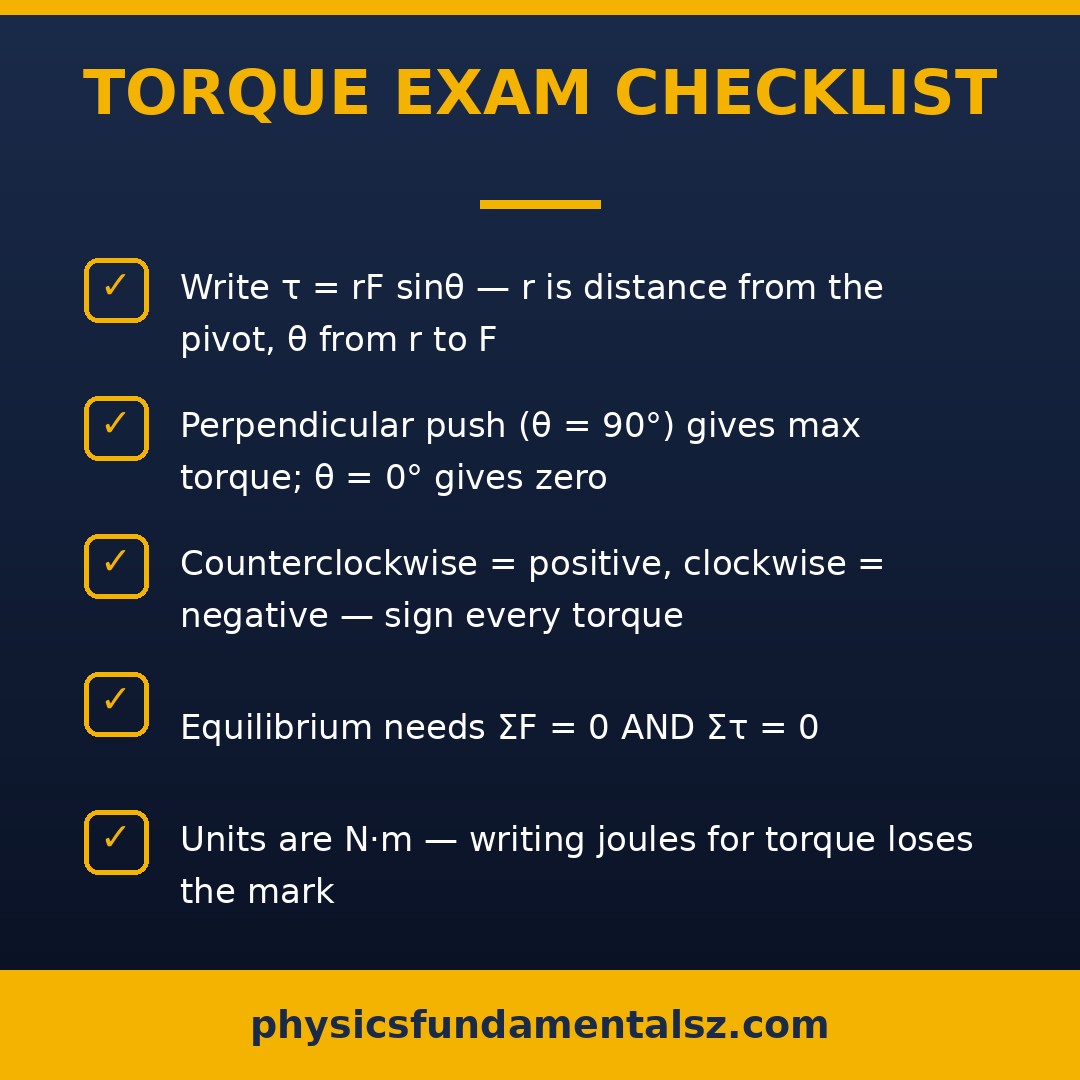
Exam strategy: When a free-response problem involves rotation, your first three moves should be (1) choose and label a pivot, (2) list every force and its lever arm with a +/− sign, (3) write Στ = Iα (or Στ = 0 for equilibrium). Students who skip the sign step lose more points than students who misremember formulas.
Common Mistakes to Avoid
- Using r instead of the lever arm. The formula needs the perpendicular distance, r sinθ — not the straight-line distance from pivot to force point. If the force is not perpendicular, you must include sinθ.
- Measuring θ from the wrong reference. θ is the angle between the r vector and the F vector, tail to tail. If the problem gives the angle between the force and the perpendicular to the rod, you need cosθ instead — or the complement of the angle.
- Forgetting torque’s sign. Every torque in a net-torque sum needs a + (counterclockwise) or − (clockwise). Unsigned magnitudes added together give nonsense.
- Writing torque in joules. N·m and J are dimensionally identical but conceptually different. Torque is always N·m, never J.
- Forgetting that torque depends on the pivot. “What is the torque?” is an incomplete question — always confirm about which axis before answering.
- Ignoring the weight of extended objects. In equilibrium problems, a uniform beam’s weight acts at its center of mass (the midpoint) and creates its own torque. Forgetting it is the classic seesaw-problem error.
- Mixing up τ = rF sinθ with τ = Iα. The first calculates torque from forces; the second relates net torque to angular acceleration. They answer different questions — use the first to find torques, the second to find motion.
Expert Tips
- Choose your pivot to kill unknowns. In static equilibrium, place the pivot at the point where the most annoying unknown force acts. Its lever arm becomes zero, it vanishes from the torque equation, and you solve for everything else first.
- Check signs with the “which way would it turn” test. Before trusting any net-torque calculation, imagine each force acting alone and ask which way it would rotate the object. If your signs disagree with your imagination, the signs are wrong.
- Lever-arm-first thinking beats formula-first thinking. Sketch the line of action of the force, drop a perpendicular from the pivot to that line, and see the lever arm. Students who draw this make far fewer angle errors than students who hunt for θ in the problem statement.
- Dimensional check everything. Torque must come out in N·m (kg·m²/s²). If your units reduce to newtons or joules, you dropped or added something.
- For “maximum torque” questions, the answer is always θ = 90°. Any AP or exam question asking for the angle that maximizes torque for a given force and distance has exactly one answer: perpendicular.
Frequently Asked Questions
What is torque in simple words?
Torque is a twisting force — it measures how strongly a push or pull makes something rotate around a pivot. It depends on how hard you push, how far from the pivot you push, and the angle of your push.
What is the formula for torque?
The torque formula is τ = rF sinθ, where r is the distance from the pivot to where the force is applied (in meters), F is the force (in newtons), and θ is the angle between them. When the force is perpendicular (θ = 90°), it simplifies to τ = rF.
What is the SI unit of torque?
The SI unit of torque is the newton-meter (N·m). Although this is dimensionally the same as the joule, torque is never expressed in joules — the two quantities describe different physical ideas.
What is the difference between torque and force?
Force changes linear motion (F = ma); torque changes rotational motion (τ = Iα). Force is the same wherever it is applied to a rigid body, but torque always depends on the chosen pivot point and the angle of application.
What is the difference between torque and moment?
In physics, “moment of force” is simply another name for torque — they are the same quantity. (Do not confuse it with “moment of inertia,” which is the rotational analog of mass.)
How do you calculate torque on a wrench?
Multiply the wrench length (in meters) by the applied force (in newtons) and by sinθ, where θ is the angle between the handle and your push. For a perpendicular push: torque = length × force. Example: 0.35 m × 80 N = 28 N·m.
Why does a longer wrench give more torque?
Torque equals force times lever arm (τ = rF). A longer wrench increases r, the distance from the pivot (bolt), so the same force produces proportionally more torque. Doubling the handle length doubles the torque.
What angle gives maximum torque?
90 degrees — when the force is perpendicular to the line from the pivot. At θ = 0° or 180° (pushing directly toward or away from the pivot), torque is zero.
Can torque be zero even if a force is applied?
Yes, in three cases: (1) the force is zero, (2) the force is applied exactly at the pivot (r = 0), or (3) the force’s line of action passes through the pivot (θ = 0° or 180°, so sinθ = 0).
What is net torque?
Net torque is the vector (signed) sum of all torques acting on an object about an axis: τ_net = τ₁ + τ₂ + … Counterclockwise torques are positive and clockwise torques are negative by convention.
What is torque in a car engine?
Engine torque is the twisting force the engine applies to the crankshaft, measured in N·m (or lb-ft). It determines how hard the car can accelerate from rest and how much it can tow. More torque at low RPM means stronger pulling power.
What is the right-hand rule for torque?
Point your right fingers along r (pivot → force point), curl them toward F (force direction); your thumb points along the torque vector. Out of the page means counterclockwise (positive); into the page means clockwise (negative).
What is static equilibrium in terms of torque?
An object is in static equilibrium when both net force and net torque are zero (ΣF = 0 and Στ = 0). Zero net force alone is not enough — unbalanced torques would still make it spin.
How is torque related to angular acceleration?
Through the rotational form of Newton’s second law: τ_net = Iα, where I is moment of inertia and α is angular acceleration. Net torque causes angular acceleration exactly as net force causes linear acceleration.
What is moment of inertia?
Moment of inertia (I) is the rotational analog of mass — it measures resistance to changes in rotation. It depends on both mass and how that mass is distributed: I = Σmr², so mass farther from the axis counts much more.
Does torque have direction?
Yes. Torque is a vector. In two-dimensional problems its direction is described as clockwise or counterclockwise (equivalently, into or out of the page via the right-hand rule).
Why is torque measured in N·m but not joules?
Both are kg·m²/s² dimensionally, but the joule measures energy (a scalar — capacity to do work) while the newton-meter for torque measures a twisting effect (a vector). Using N·m for torque keeps the concepts distinct.
What is an example of torque in everyday life?
Opening a door (hinges = pivot, handle = maximum lever arm), using a wrench, pedaling a bicycle (pedal crank), turning a steering wheel, and a seesaw balancing — all are torque in action.
Is torque on the AP Physics 1 exam?
Yes — Unit 5: Torque and Rotational Dynamics is 10–15% of the AP Physics 1 multiple-choice section, covering τ = rF sinθ, net torque, equilibrium, moment of inertia, and τ = Iα.
How do you increase torque without pushing harder?
Increase the lever arm (push farther from the pivot), push at 90° to maximize sinθ, or use a gear/pulley system that multiplies torque. All three appear constantly in tools and machines.
Conclusion
Torque is one of those physics ideas that feels obvious once it clicks — and the click comes from a single sentence: torque is force times lever arm, and only the perpendicular part counts. Everything else in this guide is that idea, unfolded: the formula τ = rF sinθ, the sign conventions that let torques add, the equilibrium condition Στ = 0 that balances seesaws and cranes, and the rotational Newton’s law τ = Iα that governs everything from merry-go-rounds to car engines.
The next time a bolt will not move, you will know exactly why reaching for the longer wrench works — and you will be able to prove it with numbers. That is the difference between intuition and physics: physics lets you calculate the intuition.
Keep learning: torque is the gateway to all of rotational dynamics. From here, explore how pulleys multiply force — where the same lever-arm logic trades force for distance — or dig into static vs kinetic friction to see what supplies (and limits) the torques that brake a spinning wheel.