Difference Between Frequency and Wavelength: A Clear Guide With Examples
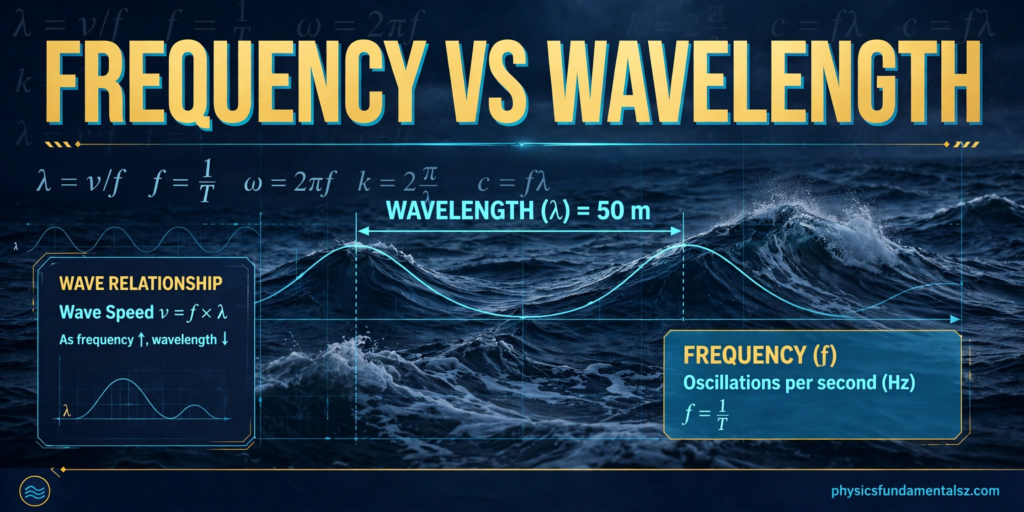
Frequency and wavelength are the two quantities students mix up most often in wave physics. They sound related, they appear in the same equation, and they both describe a wave. Yet they measure completely different things: one counts how often something happens, and the other measures how long something is.
This guide draws the difference sharply, then shows how the two quantities connect through wave speed. You will get clear definitions, units, worked calculations, real examples from sound, light, and water, a comparison table, and the mistakes that cost marks in exams.
Frequency: How Often a Wave Repeats
Frequency is the number of complete waves, or complete cycles, that pass a fixed point every second. If ten wave crests pass a buoy in one second, the frequency is ten per second. If a guitar string vibrates back and forth 440 times per second, its frequency is 440 per second.
The unit of frequency is the hertz, symbol Hz, named after Heinrich Hertz (Britannica on wavelength and frequency). One hertz means one cycle per second. A frequency of 440 Hz means 440 cycles per second. A radio station broadcasting at 100 megahertz is sending out 100 million cycles per second.
Frequency is a property of the source, not of the medium. A tuning fork that vibrates at 440 Hz keeps vibrating at 440 Hz whether its sound travels through air, water, or a steel rail. The source sets the rhythm, and the rhythm does not change when the wave enters a new material. This fact is the key to many exam questions, so hold onto it.
Think of frequency as tempo. A drummer sets the tempo of a song. The room does not change the tempo, the instruments do not change the tempo, and the distance to the listener does not change the tempo. Frequency is the tempo of a wave.
In everyday life, frequency decides pitch for sound and colour for light. Higher frequency sound waves sound higher pitched: a soprano sings at higher frequencies than a bass. Higher frequency light waves look bluer: blue light has a higher frequency than red light. Your ear and your eye are, in effect, frequency detectors.
Wavelength: How Long One Wave Is
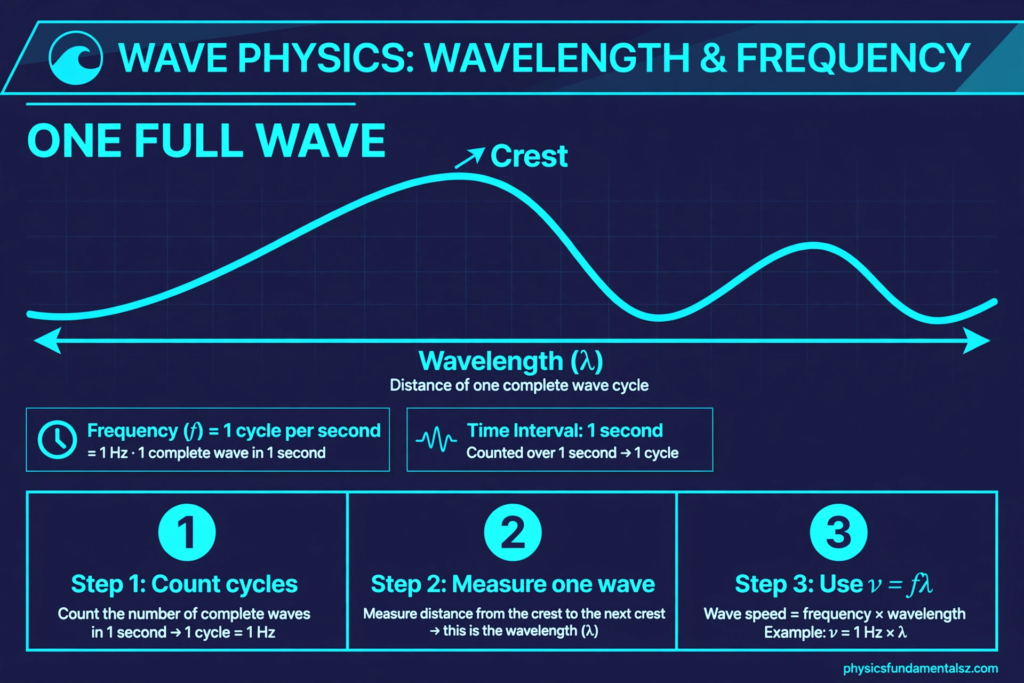
Wavelength is the distance between two identical points on consecutive waves. The most common choices are crest to crest or trough to trough, but any pair of matching points works: one compression to the next compression in a sound wave, or one point at maximum displacement to the next identical point.
The symbol for wavelength is the Greek letter lambda, and the unit is the metre, like any other length. Wavelengths vary enormously across physics. A typical sound wave in air has a wavelength of a few centimetres to a few metres. Visible light has a wavelength of roughly 400 to 700 nanometres, far too small to see directly. A radio wave can have a wavelength of several metres, and a water wave in the ocean can stretch for hundreds of metres.
Unlike frequency, wavelength is not fixed by the source alone. It depends on both the frequency and the speed of the wave in the medium. When a wave enters a new medium and changes speed, its frequency stays the same, so its wavelength must change to compensate. This is why light bends when it enters water: its speed drops, its wavelength shortens, and the wave changes direction.
Think of wavelength as stride length. A runner’s stride length depends on how fast they run and how often they step. Change the speed while keeping the stepping rate fixed, and the stride length changes. Frequency is the stepping rate; wavelength is the stride length; wave speed is the running speed.
The Core Difference at a Glance
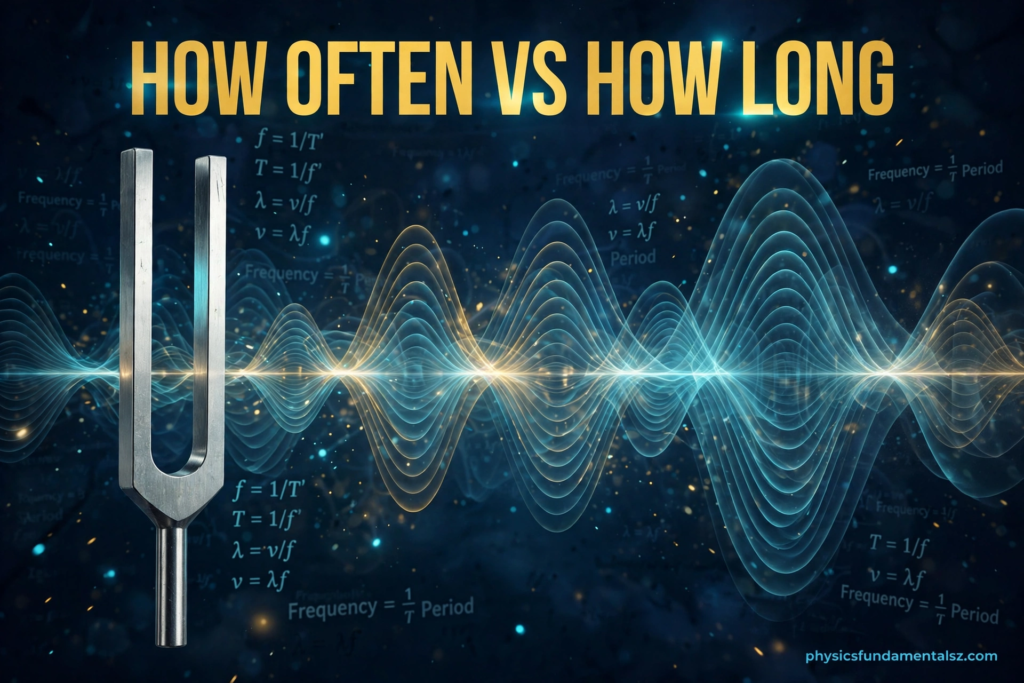
The difference can be stated in one sentence: frequency counts cycles per second, while wavelength measures the length of one cycle in metres. Frequency answers “how often?” Wavelength answers “how long?”
That distinction shows up in their units. Frequency is measured in hertz, which is cycles per second, a rate. Wavelength is measured in metres, a distance. A quantity measured in hertz can never be a wavelength, and a quantity measured in metres can never be a frequency. Checking units is a fast way to catch a mix-up before it costs marks.
The two quantities also behave differently when a wave changes medium. Frequency stays constant, because the source keeps vibrating at the same rate. Wavelength changes, because the wave speed changes. Speed also changes. Only frequency is immune to the medium change.
A useful analogy is a line of people walking through a doorway. The rate at which people arrive at the door, the frequency, is set by how fast they walk towards it in a line. If they slow down after passing through, they bunch closer together, so the spacing between people, the wavelength, shrinks, even though the arrival rate stays the same. The people are the wave crests, the doorway is the boundary, and the bunching is exactly what happens to a wave entering a slower medium.
The Wave Equation: v = fλ
Frequency and wavelength are linked by the wave equation, v = fλ, where v is wave speed, f is frequency, and λ is wavelength. This single equation is the workhorse of wave physics, and almost every numerical question about frequency and wavelength runs through it.
The equation makes intuitive sense. In one second, a wave advances by its speed, v metres. In that same second, f complete waves pass a point. Each wave is λ metres long. So the total distance covered in one second, v, equals the number of waves, f, times the length of each wave, λ. Speed equals frequency times wavelength.
The equation also shows the inverse relationship that defines the topic (HyperPhysics on frequency and wavelength). For waves travelling at a fixed speed, frequency and wavelength are inversely proportional. Double the frequency and the wavelength halves. Halve the frequency and the wavelength doubles. Their product always equals the wave speed.
Be careful with the condition “at a fixed speed.” The inverse relationship holds only when v is constant. If a wave changes medium, v changes, f stays fixed, and λ changes in proportion to v. Students who blindly write “higher frequency means shorter wavelength” without checking whether the speed is the same can be caught out by questions where the medium changes.
Units matter in the wave equation. Speed must be in metres per second, frequency in hertz, and wavelength in metres. If a wavelength is given in centimetres or nanometres, convert it to metres first. If a frequency is given in kilohertz or megahertz, convert it to hertz first. Most wave equation errors are unit conversion errors, not physics errors.
Worked Examples: Using v = fλ
Here is a first example. A sound wave in air travels at 340 metres per second and has a frequency of 850 Hz. What is its wavelength?
Rearrange the wave equation: λ equals v divided by f. Substituting gives 340 divided by 850, which equals 0.40 metres. The wavelength is 40 centimetres. Check the units: metres per second divided by per second gives metres, which is correct for a wavelength.
Here is a second example, in the other direction. A water wave has a wavelength of 2.5 metres and travels at 5.0 metres per second. What is its frequency?
Rearrange again: f equals v divided by λ. Substituting gives 5.0 divided by 2.5, which equals 2.0 Hz. Two complete waves pass a fixed point every second. Notice that the numbers are small and friendly, which is typical of water wave problems, but the method is identical to the sound example.
Here is a third example, using light. Red light has a wavelength of about 650 nanometres in a vacuum, where it travels at 3.00 times 10 to the power 8 metres per second. What is its frequency?
Convert the wavelength first: 650 nanometres equals 650 times 10 to the power minus 9 metres, or 6.50 times 10 to the power minus 7 metres. Then f equals v divided by λ, which is 3.00 times 10 to the power 8 divided by 6.50 times 10 to the power minus 7, giving about 4.62 times 10 to the power 14 Hz. That is an enormous number, which is why light frequencies are usually quoted in terahertz, but the calculation itself is just the same division.
A fourth example tests the medium-change rule. A sound wave of frequency 500 Hz travels from air, where its speed is 340 metres per second, into water, where its speed is 1,480 metres per second. What happens to its wavelength?
In air, λ equals 340 divided by 500, which is 0.68 metres. In water, the frequency is still 500 Hz, because the source has not changed, but the speed is now 1,480 metres per second, so λ equals 1,480 divided by 500, which is 2.96 metres. The wavelength more than quadruples, because the speed more than quadruples, while the frequency stays put. Any answer that keeps the wavelength at 0.68 metres in water has missed the central idea.
Period: The Third Quantity in the Family
Frequency has a close relative called period, symbol T, which is the time taken for one complete cycle. Period and frequency are reciprocals: T equals 1 divided by f, and f equals 1 divided by T. A wave with a frequency of 2 Hz has a period of 0.5 seconds, because each cycle takes half a second.
Students sometimes confuse period with wavelength, because both describe “one wave.” The difference is what is being measured: period measures one wave in time, wavelength measures one wave in space. Period is measured in seconds, wavelength in metres. Keeping the units in mind separates them instantly.
The wave equation can also be written with period: v equals λ divided by T. That version says the same thing in different words: a wave travels one wavelength in one period, so its speed is wavelength divided by period. Either form is fine, but the f version, v = fλ, is the one examiners use most often.
A practical tip: if a question gives you the time for ten oscillations, divide by ten to get the period, then take the reciprocal to get the frequency. Many questions give a time for several cycles rather than one, precisely to test whether you make that division.
Frequency and Wavelength in Sound
Sound gives the most intuitive examples of the frequency-wavelength difference, because you can hear frequency directly as pitch. A low note from a bass guitar might have a frequency of around 80 Hz and a wavelength in air of about 4.3 metres. A high note from a piccolo might have a frequency of around 2,000 Hz and a wavelength of about 17 centimetres. Same medium, same speed, very different frequencies and wavelengths.
Musical instruments exploit the relationship deliberately. Shorten a guitar string and you shorten the wavelength that fits on it, which raises the frequency and the pitch. Lengthen an organ pipe and you lengthen the wavelength, which lowers the frequency and the pitch. Every wind and string instrument is a device for controlling wavelength in order to control frequency.
The human ear hears frequencies from roughly 20 Hz to 20,000 Hz (Khan Academy on wavelength and frequency). The corresponding wavelengths in air run from about 17 metres down to about 1.7 centimetres. Sounds below 20 Hz are called infrasound and are felt more than heard; elephants communicate with infrasound over long distances. Sounds above 20,000 Hz are ultrasound, used in medical imaging and in bat navigation. The ear’s range is a frequency range, but each frequency corresponds to a definite wavelength through the wave equation.
For more on how sound waves behave, see our guide to sound waves and frequency, and for the wave types that carry sound, see transverse and longitudinal waves.
Frequency and Wavelength in Light
Light shows the same relationship across a far wider range. The visible spectrum runs from violet light, with a wavelength near 400 nanometres and a frequency near 7.5 times 10 to the power 14 Hz, to red light, with a wavelength near 700 nanometres and a frequency near 4.3 times 10 to the power 14 Hz. Violet has the shorter wavelength and the higher frequency; red has the longer wavelength and the lower frequency. The product of frequency and wavelength is the speed of light in both cases.
Beyond the visible spectrum, the electromagnetic spectrum stretches from gamma rays, with wavelengths smaller than an atom, to radio waves, with wavelengths longer than a building. All of these are the same kind of wave, travelling at the same speed in a vacuum, differing only in frequency and wavelength. The spectrum is really a single line, ordered by frequency, and wavelength is just the same line read backwards.
Colour is the eye’s response to frequency, not to wavelength directly, though the two are linked in a given medium. When light enters the eye from air, it slows down and its wavelength shortens, but its frequency stays the same, and the colour you see stays the same. If colour depended on wavelength alone, objects would change colour when viewed underwater. They do not, which is neat evidence that frequency is the quantity the eye really detects.
Our guide to refraction of light explains what happens to wavelength when light changes medium, and our Doppler effect guide shows how motion changes the frequency an observer measures.
Comparison Table
| Feature | Frequency | Wavelength |
|---|---|---|
| Definition | Number of cycles per second | Distance between identical points on consecutive waves |
| Symbol | f | λ (lambda) |
| Unit | Hertz (Hz) | Metre (m) |
| Measures | A rate, how often | A length, how long |
| Set by | The source | Source and medium together |
| Changes in a new medium? | No, stays constant | Yes, changes with wave speed |
| Sound example | 440 Hz for concert A | 0.77 m for concert A in air |
| Light example | 4.6 × 10^14 Hz for red light | 650 nm for red light |
| Related quantity | Period T = 1/f | Wave number, cycles per metre |
Read the table row by row when revising. The “changes in a new medium” row is the one examiners probe most, and the “set by” row is the one students forget most. If you can reproduce this table from memory, you can answer most short-answer questions on the topic.
What Happens When a Wave Changes Medium?
This section deserves emphasis, because it is where the difference between frequency and wavelength becomes a testable prediction rather than a definition.
When a wave crosses into a new medium, three things happen, and only one of them stays the same. The wave speed changes, because the medium’s properties are different. The wavelength changes, in proportion to the speed change. The frequency does not change, because the source continues to vibrate at the same rate, and the boundary cannot create or destroy wave cycles.
Imagine waves arriving at a boundary at a rate of ten per second. Ten waves per second must leave the boundary into the new medium, because waves cannot pile up at the boundary forever. The rate is therefore fixed at ten per second on both sides. If the waves travel faster on the far side, they spread further apart, so the wavelength grows. If they travel slower, they bunch closer, so the wavelength shrinks. Frequency is the conserved quantity; wavelength is the flexible one.
Refraction is the visible consequence for light. When light enters glass from air, it slows down, its wavelength shortens, and the wave changes direction unless it hits the boundary head-on. When it leaves the glass, it speeds up again and its wavelength lengthens back. The colour stays the same throughout, because the frequency never changed.
The same rule applies to sound entering water, to seismic waves entering different rock layers, and to water waves entering shallow water. Whenever a question mentions a boundary or a change of medium, your first thought should be: frequency constant, wavelength changes with speed.
Common Mistakes
The first mistake is swapping the definitions. Frequency is not a length, and wavelength is not a rate. If your answer to a frequency question is in metres, you have calculated a wavelength. If your answer to a wavelength question is in hertz, you have calculated a frequency. Unit checks catch both errors in seconds.
The second mistake is assuming wavelength stays constant across a medium change. It does not. Frequency is the constant; wavelength follows the speed. Write “f constant” in the margin of any refraction or boundary question as a reminder.
The third mistake is forgetting unit conversions. Nanometres, centimetres, kilohertz, and megahertz must all be converted to metres and hertz before using v = fλ. A wavelength of 500 nanometres entered as 500 into the equation gives a nonsense answer, and examiners set such traps deliberately.
The fourth mistake is confusing period and wavelength. Period is the time for one cycle, measured in seconds. Wavelength is the length of one cycle, measured in metres. They are linked through wave speed, not interchangeable.
The fifth mistake is stating the inverse relationship without its condition. Frequency and wavelength are inversely proportional only at constant wave speed. In a question where the medium changes, the correct statement is that frequency stays fixed and wavelength changes in proportion to speed.
The sixth mistake is misreading graphs. On a displacement-distance graph, the distance between crests is the wavelength. On a displacement-time graph, the time between crests is the period, and frequency is its reciprocal. Students who read wavelength off a time graph, or period off a distance graph, lose easy marks. Always check the horizontal axis label first.
Reading Frequency and Wavelength From Graphs
Graphs are the fastest way examiners test whether you really know the difference, so practise reading them until it is automatic.
A displacement-distance graph shows the shape of a wave frozen at one instant. The horizontal axis is distance along the wave. The distance between two neighbouring crests on this graph is the wavelength. The height of a crest above the equilibrium line is the amplitude. This graph tells you nothing directly about frequency, because time does not appear on it.
A displacement-time graph shows the motion of one single point on the wave over time. The horizontal axis is time. The time between two neighbouring crests on this graph is the period. Frequency is one divided by that period. This graph tells you nothing directly about wavelength, because distance does not appear on it.
To find wave speed from graphs, you need both: wavelength from the distance graph and frequency from the time graph, combined with v = fλ. Questions that give you both graphs are really asking you to read each one correctly and then multiply. Read the axes, measure crest to crest, and keep the two quantities in their separate columns until the final step.
Another graph type shows frequency against wavelength for waves of a fixed speed. That graph is a hyperbola, because f equals v divided by λ. As wavelength grows, frequency falls, and the curve flattens towards both axes without ever reaching them. Recognising that shape is a quick check: if a question asks what happens to frequency when wavelength doubles at constant speed, the answer is that frequency halves, and the graph confirms it visually.
Frequency, Wavelength, and Energy
For mechanical waves, energy depends mainly on amplitude and frequency, not directly on wavelength. A louder sound has a larger amplitude. A higher-pitched sound of the same amplitude carries more energy per second, because the source does more work per second to sustain the faster vibration.
For light and other electromagnetic waves, the connection is sharper. The energy of a single photon is proportional to its frequency, through Planck’s relation E = hf, where h is Planck’s constant. Higher frequency light therefore carries more energy per photon. Ultraviolet light, with its high frequency and short wavelength, can damage skin and break chemical bonds. Infrared light, with its lower frequency and longer wavelength, is felt mainly as heat. The wavelength tells you where the light sits in the spectrum; the frequency tells you how much punch each photon packs.
This is why frequency, not wavelength, is the fundamental quantity in quantum physics. When light enters a new medium, its wavelength changes but its photon energy stays the same, because its frequency stays the same. Energy conservation and frequency conservation go together, which is a deep hint that frequency is the more fundamental property of a wave.
Students sometimes ask whether a long wavelength means a weak wave. It does not, by itself. A long-wavelength radio wave can carry a powerful signal, and a short-wavelength gamma ray can be faint if few photons arrive. Wavelength describes the spacing of the wave; amplitude and frequency describe its strength. Keep those ideas separate.
Applications: From Radios to Medical Imaging
Radio communication is organised by frequency. Stations are licensed a frequency band, and your radio tunes to a frequency, not a wavelength, even though engineers often quote the wavelength band as well. The familiar FM band, around 88 to 108 megahertz, corresponds to wavelengths of about 3 metres. The AM band, around 1 megahertz, corresponds to wavelengths of about 300 metres. Longer wavelengths diffract around hills and follow the Earth’s curvature better, which is one reason AM signals travel further at night.
Mobile phones use frequencies around a few gigahertz, with wavelengths of a few centimetres. Those short wavelengths suit small antennas, because an efficient antenna is typically a fraction of a wavelength long. The move to higher frequencies in 5G networks allows faster data rates but shorter range, because higher frequency waves are blocked more easily by buildings and absorbed more by rain. Frequency, wavelength, and engineering trade-offs are inseparable.
Medical ultrasound uses frequencies of a few megahertz, far above hearing, with wavelengths of a fraction of a millimetre in tissue. Short wavelengths give fine resolution, allowing scanners to distinguish small structures. The trade-off is penetration: higher frequencies are absorbed more quickly, so deep imaging uses lower frequencies and accepts coarser resolution. Every ultrasound setting is a compromise between wavelength, resolution, and depth.
Astronomers use frequency and wavelength across the whole spectrum. Redshift, the stretching of light from distant galaxies to longer wavelengths and lower frequencies, reveals that the universe is expanding. The cosmic microwave background, the afterglow of the Big Bang, is detected as microwaves with a wavelength of a few millimetres. Without the frequency-wavelength relationship, modern cosmology would be impossible.
Exam Technique: Frequency vs Wavelength Questions
Exam questions on this topic fall into a few predictable patterns, and recognising the pattern tells you the method.
Pattern one is a straight calculation: given two of v, f, and λ, find the third. Convert units, rearrange v = fλ, substitute, and check that the answer’s unit matches the quantity asked for. Show the rearrangement; examiners award method marks even when the arithmetic slips.
Pattern two is a medium-change question: a wave moves from one medium to another, and you are asked what happens to f, λ, and v. The answer structure is always the same: frequency unchanged, speed changes to the new medium’s value, wavelength changes in proportion to speed. State all three explicitly, even if the question only asks about one, because the reasoning earns marks.
Pattern three is a comparison question: two waves, one with double the frequency, or one with half the wavelength, at the same speed. Use proportional reasoning: at constant speed, doubling frequency halves wavelength. No calculator is needed, and the question is testing understanding, not arithmetic.
Pattern four is a graph question: read wavelength from a distance graph and period from a time graph, then combine them. Label each reading as you take it, so you do not swap them in the final calculation.
Pattern five is a definition question: define frequency and wavelength, and state their units. The safest definitions are the ones used in this article: frequency is the number of cycles per second, measured in hertz; wavelength is the distance between identical points on consecutive waves, measured in metres. Short, precise definitions score full marks; vague ones do not.
Frequently Asked Questions
What is the main difference between frequency and wavelength?
Frequency is how many wave cycles pass a point each second, measured in hertz. Wavelength is the distance between two identical points on consecutive waves, measured in metres. Frequency is a rate, wavelength is a length, and they are linked by wave speed through v = fλ.
Are frequency and wavelength inversely proportional?
Yes, but only when wave speed is constant. At a fixed speed, doubling frequency halves wavelength, because their product must stay equal to the speed. When a wave changes medium, speed changes too, so the simple inverse rule no longer applies on its own; frequency stays constant instead.
Does frequency change when a wave enters a new medium?
No. Frequency is set by the source and stays the same across a boundary. What changes is the wave speed, and therefore the wavelength. This is why light keeps its colour when it enters water or glass, even though its wavelength shortens.
Is wavelength the same as amplitude?
No. Wavelength is the horizontal distance between crests, a length along the wave. Amplitude is the vertical height of a crest above the equilibrium position, a measure of how much the medium is displaced. A wave can have a long wavelength and a small amplitude, or a short wavelength and a large amplitude; the two are independent.
Which has higher frequency, red light or blue light?
Blue light has the higher frequency and the shorter wavelength. Red light has the lower frequency and the longer wavelength. In a vacuum both travel at the speed of light, so the product of frequency and wavelength is the same for both colours.
How do you calculate wavelength from frequency?
Use λ = v / f. Divide the wave speed by the frequency, making sure speed is in metres per second and frequency is in hertz, so the answer comes out in metres. For light in a vacuum, use v = 3.00 × 10^8 metres per second.
Conclusion
Frequency and wavelength are easy to confuse and easy to separate, once you hold the right picture. Frequency counts cycles per second and is set by the source. Wavelength measures one cycle in metres and changes whenever wave speed changes. Their product is wave speed, and that single equation, v = fλ, unlocks calculations, graph questions, and medium-change problems alike.
The habit that will serve you best is the unit check. Hertz means frequency. Metres mean wavelength. Seconds mean period. If your answer’s unit does not match the quantity you were asked for, you have swapped something, and you can fix it before handing in your work.
Keep that distinction clear, remember that frequency survives a change of medium while wavelength does not, and the whole topic becomes a set of variations on one idea. That is the difference between frequency and wavelength, and it is one of the most useful distinctions in all of wave physics.
Sources for further reading: OpenStax University Physics: Wave speed and frequency, HyperPhysics: Frequency and wavelength, Khan Academy: Wavelength and frequency, Britannica: Wavelength.