Wave Superposition: Adding Waves, Phase & Interference Patterns
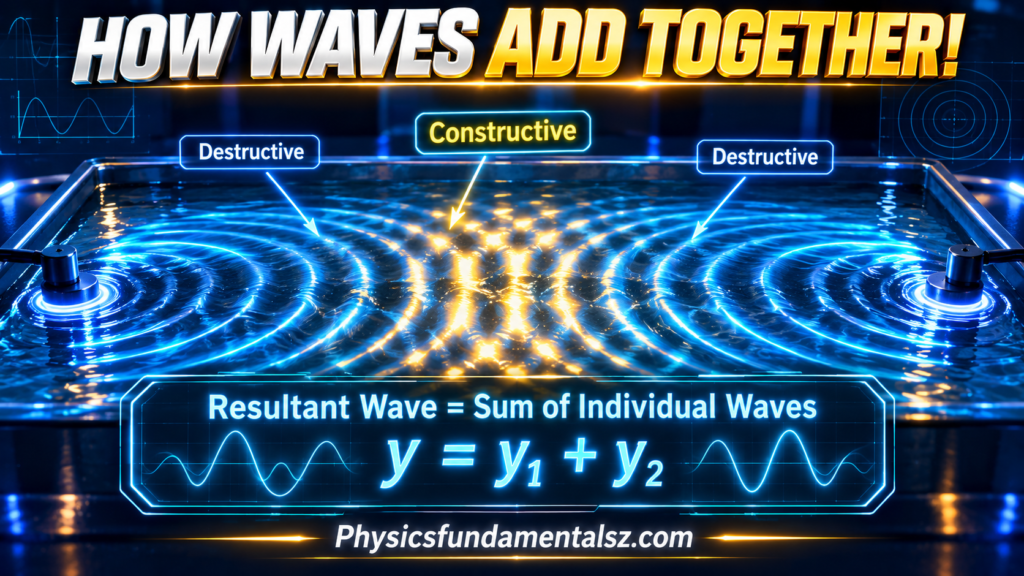
Drop two pebbles into a still pond at the same time and watch what happens where the ripples meet.
The water does not choose one ripple over the other. Instead, at every point where the waves overlap, the surface simply adds the two disturbances together.
This simple act of addition is called wave superposition, and it is one of the most powerful ideas in all of physics.
It explains why noise cancelling headphones work, why a soap bubble shows swirling colors, why guitar strings ring at specific notes, and why two radio stations can share the same room without turning into noise.
Table of Contents
What Is Wave Superposition?
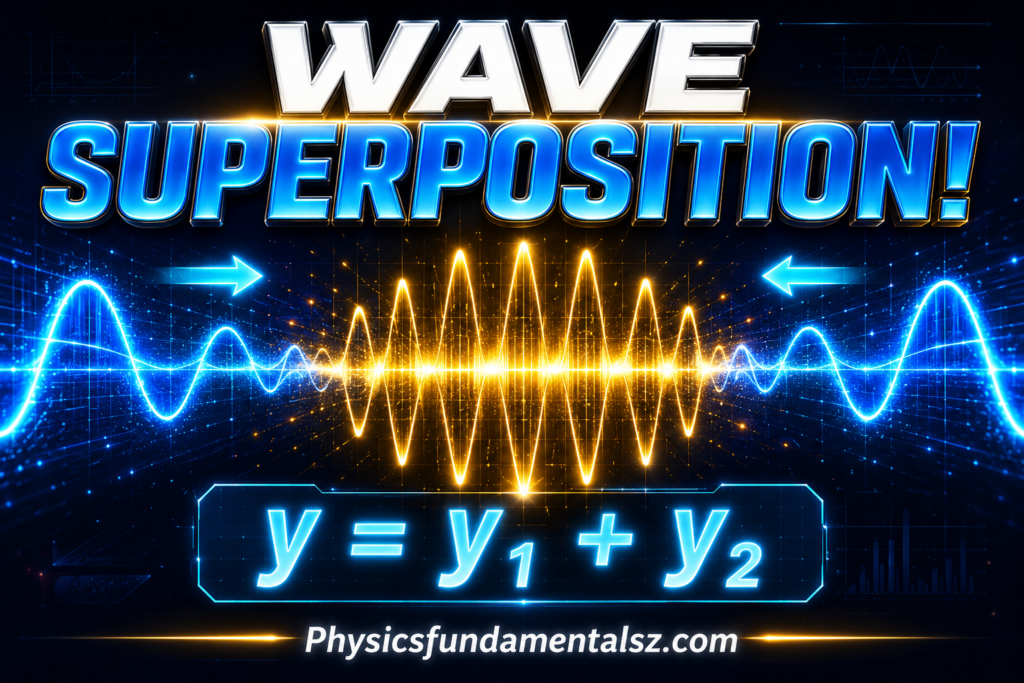
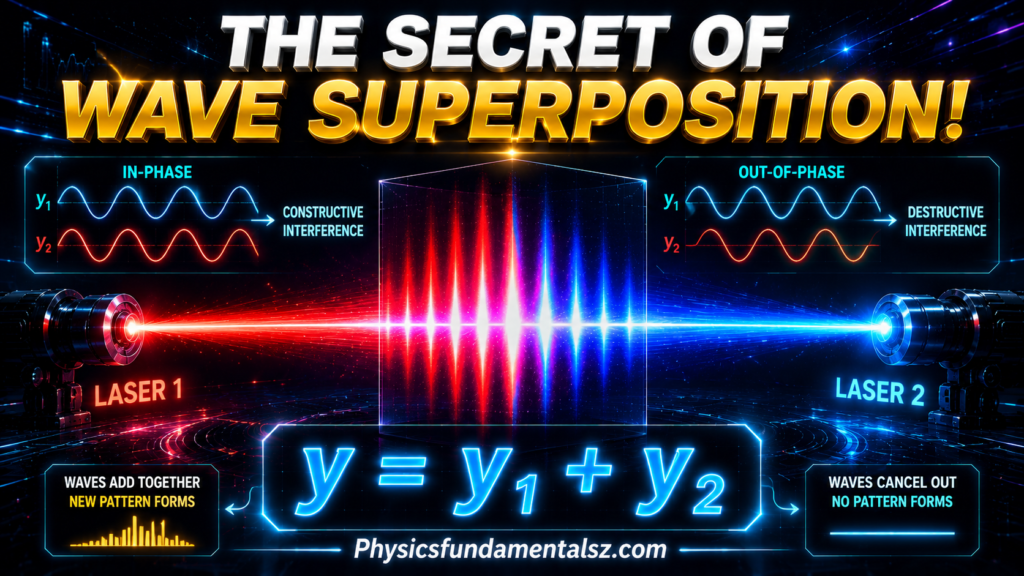
The principle of wave superposition states that when two or more waves overlap in the same medium at the same point, the resulting displacement is simply the sum of the individual displacements.
Nothing collides, nothing gets destroyed, and the waves do not interact with each other directly. They pass through one another and continue on their way completely unchanged, as if the other wave had never been there.
Mathematically, if u1(x,t) and u2(x,t) are two solutions to the wave equation, then their sum, u1(x,t) + u2(x,t), is also a valid solution. This works because the wave equation is linear, so any combination of solutions is itself a solution. That single fact is why wave superposition applies to so many different systems: water waves, sound waves, waves on a string, and the electromagnetic waves that make up visible light, as explained in our guide on the speed of light.
Two everyday consequences follow directly from this principle:
- An unlimited number of waves can pass through the same point in space at the same time without disturbing one another.
- Each wave keeps its own identity. A radio antenna can pick out one station’s frequency even though hundreds of other signals are passing through it at that exact moment.
How Phase Difference Determines the Result
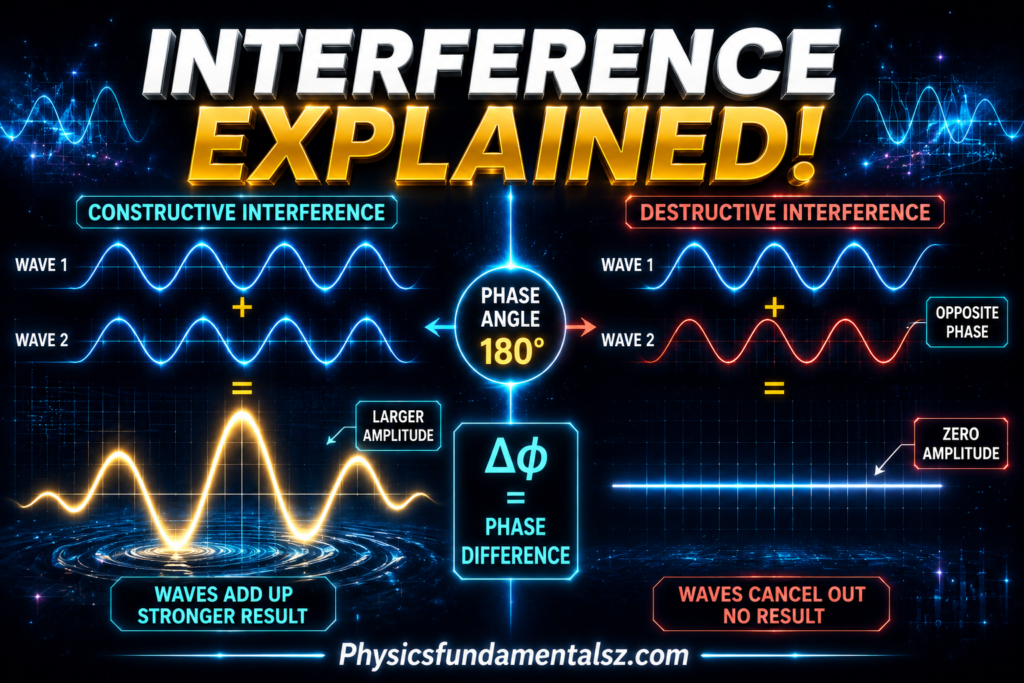
Not every case of wave superposition looks the same. The outcome depends almost entirely on the phase difference between the two waves, meaning how aligned or misaligned their crests and troughs are when they meet.
In-Phase Waves and Constructive Interference
When two waves of the same frequency arrive at a point with their crests lined up and their troughs lined up, they are said to be in phase, with a phase difference of zero. Adding them together produces a new wave with a larger amplitude, equal to the sum of the two individual amplitudes. If the waves are identical, the result has exactly twice the amplitude of either one alone. This outcome is called constructive interference, and it is the reason two speakers playing the same note in the same spot can sound noticeably louder than either speaker alone.
Out-of-Phase Waves and Destructive Interference
When two waves are exactly out of phase, with a phase difference of 180 degrees, the crest of one wave lines up with the trough of the other. Adding them together causes the disturbances to cancel. If the two waves have equal amplitude, the cancellation is complete and the medium stays flat, as though no wave were there at all. This is destructive interference, and it is the exact principle that noise cancelling headphones use: a microphone picks up outside noise, and the headphones generate an inverted copy of that same sound wave to cancel it out before it reaches your ear.
Partial Interference: Everything In Between
Most real situations are not perfectly in phase or perfectly out of phase. When the phase difference falls somewhere between 0 and 180 degrees, the result is partial interference, where the combined wave is neither fully reinforced nor fully cancelled. The general rule connects the path difference between two waves to whether they interfere constructively or destructively: a path difference equal to a whole number of wavelengths produces constructive interference, while a path difference equal to a half-integer number of wavelengths produces destructive interference.
Interference Patterns in Real Life
When multiple coherent waves overlap continuously, they do not just add up once. They create a stable interference pattern, a repeating arrangement of regions where the waves reinforce each other and regions where they cancel.
This is visible almost anywhere waves overlap:
- Ripples from two stones dropped near each other form a crisscross pattern of high and low peaks on the water’s surface.
- Sound waves from two speakers playing the same tone create loud spots and quiet spots as you walk across a room.
- A thin film of oil or a soap bubble produces swirling rainbow colors because light waves reflecting off the top and bottom surfaces interfere constructively for some wavelengths and destructively for others, closely related to the bending of light covered in our article on reflection and refraction.
The clearest demonstration of an interference pattern is the classic double slit experiment, where light passing through two closely spaced slits produces alternating bright and dark bands on a screen. The bright bands mark constructive interference, and the dark bands mark destructive interference, both arising purely from wave superposition.
Standing Waves: Superposition With Reflections
One of the most important special cases of wave superposition happens when a wave reflects off a boundary and overlaps with itself. Picture a string fixed at both ends. A wave traveling to the right reflects off the fixed end and travels back to the left, continuously interfering with the original wave. The result of this ongoing superposition is a standing wave, a pattern that appears to oscillate in place rather than travel.
A standing wave has fixed points called nodes, where the two overlapping waves always cancel and the string never moves, and points called antinodes, where the waves always reinforce and the string oscillates with maximum amplitude. Standing waves are the reason musical instruments produce specific notes rather than random noise. A guitar string, an organ pipe, and a drumhead all rely on wave superposition to lock in stable oscillation patterns at particular frequencies.
Beats: Superposition of Waves With Different Frequencies
So far, most of these examples assume the two waves share the same frequency. But wave superposition also applies when frequencies are close but not identical, and the result is a phenomenon called beats.
When two waves of slightly different frequency overlap, their combined amplitude rises and falls periodically, producing a throbbing or pulsing loudness in sound waves. The rate of this pulsing is the beat frequency, calculated as the absolute difference between the two individual frequencies:
Beat frequency = |f1 minus f2|
Musicians use beats constantly when tuning an instrument. Two strings that are slightly out of tune produce an audible wobble, and adjusting the tension until the beats slow down and disappear confirms the strings are now playing the exact same frequency.
Wave Superposition and Energy Conservation
A common question is whether destructive interference destroys energy, since the medium appears to sit motionless where waves cancel. It does not. Wave superposition redistributes energy rather than eliminating it. Where destructive interference produces a quiet, low-amplitude region, constructive interference nearby produces a louder, high-amplitude region. Averaged across the whole interference pattern, the total energy always matches the combined energy of the individual waves, which is consistent with how energy behaves in every other area of mechanics, including the ideas covered in our guide to kinetic energy.
Wave Superposition in Light: Diffraction and Colors
Wave superposition is not limited to mechanical waves like sound or water. Light itself is a wave, and it follows exactly the same rules. When light waves bend around obstacles or pass through narrow openings, a process called diffraction, the diffracted waves overlap and interfere just like ripples on a pond. This overlapping is what produces the rainbow sheen on a CD’s surface, the colored rings in a soap film, and the fringe patterns seen in precision optical instruments.
Because visible light is an electromagnetic wave traveling at a fixed speed in a vacuum, understanding wave superposition in optics connects directly back to the fundamental behavior of light described in our full breakdown of the speed of light, and to how light bends when it crosses between materials, explained in our article on reflection and refraction.
Quantum Superposition: A Different Kind of Superposition
The word superposition also shows up in quantum mechanics, and while it shares its name and some mathematics with classical wave superposition, the physical picture is stranger. In quantum physics, a particle such as an electron can exist in a superposition of multiple states or locations at once, and this superposition only resolves into a single definite outcome when a measurement is made. This idea underlies phenomena like electron diffraction and forms one of the foundational pillars of modern physics, alongside relativity and atomic structure, both covered broadly in our complete physics fundamentals guide.
Worked Examples
Example 1: Constructive or Destructive Interference
Two speakers emit identical sound waves with a wavelength of 0.4 meters. A listener stands 3.8 meters from one speaker and 2.6 meters from the other. Does the listener experience constructive or destructive interference?
Path difference = 3.8 minus 2.6 = 1.2 meters Number of wavelengths = 1.2 divided by 0.4 = 3.0, a whole number
Since the path difference equals a whole number of wavelengths, the two waves arrive in phase, producing constructive interference. The listener hears a reinforced, louder sound at that spot.
Example 2: Beat Frequency
A tuning fork produces a tone at 440 Hz, while a piano key produces a tone at 444 Hz. What does a listener hear?
Beat frequency = |440 minus 444| = 4 Hz
The listener hears a combined tone near 442 Hz, the average of the two frequencies, with its loudness pulsing four times per second. As the piano is tuned closer to 440 Hz, the beat frequency drops until the pulsing disappears entirely.
Common Mistakes When Learning Wave Superposition
A few misunderstandings come up again and again when students first meet wave superposition, so it is worth addressing them directly.
Mistake 1: Assuming waves physically collide. Waves do not bounce off each other the way billiard balls do. During wave superposition, each wave passes straight through the region where they overlap and continues on its original path afterward, completely unaffected by having met the other wave. The overlap only changes what the medium looks like at that moment, not the waves themselves.
Mistake 2: Confusing amplitude addition with intensity addition. Wave superposition adds displacements, or amplitudes, not intensities or loudness directly. Because intensity is proportional to amplitude squared, doubling the amplitude through constructive interference actually quadruples the intensity, not just doubles it. This distinction matters a lot in problems involving sound level or light brightness.
Mistake 3: Forgetting that interference requires coherence. Two waves only produce a stable, observable interference pattern if they are coherent, meaning they maintain a constant phase relationship over time. Two independent light bulbs, for example, do not produce a visible interference pattern because their light waves are emitted randomly and the phase relationship shifts too quickly to observe. This is why demonstrations of light interference typically use lasers or carefully split beams from a single source.
Mistake 4: Thinking destructive interference means the waves disappear. As covered above, destructive interference cancels displacement at a specific point, but the energy carried by both waves is still present in the system as a whole. It simply shows up somewhere else in the interference pattern rather than at that particular point.
Keeping these four points straight makes it much easier to work through interference and superposition problems without second-guessing the underlying physics.
Frequently Asked Questions (FAQs)
Does wave superposition break the conservation of energy?
No. Wave superposition redistributes energy across the interference pattern rather than creating or destroying it. Regions of destructive interference lose amplitude, while nearby regions of constructive interference gain it, and the total energy across the full pattern stays constant.
Does wave superposition only apply to waves in the same medium?
Superposition applies whenever two or more waves occupy the same space at the same time, regardless of their source, as long as the medium behaves linearly. This includes water waves, sound waves, waves on a string, and electromagnetic waves like light, all of which obey the same linear wave equation.
What is the difference between interference and diffraction?
Diffraction describes how a wave bends or spreads out after passing through an opening or around an obstacle. Interference describes what happens when two or more of those spreading waves overlap and combine through superposition. Diffraction produces the multiple overlapping waves, and interference is the result of superposing them.
Key Takeaways
Wave superposition is the simple but far-reaching idea that overlapping waves add together point by point.
Phase difference determines whether that addition reinforces the waves through constructive interference, cancels them through destructive interference, or lands somewhere in between.
The same principle explains standing waves on a guitar string, beats when tuning an instrument, the colors in a soap bubble, and the bright and dark fringes in a double slit experiment.
Once the core rule clicks, that overlapping waves simply add, the rest of wave physics starts to feel a lot less mysterious. For more on how waves and light behave, browse the full Waves and Optics collection on Physics Fundamentals.