Snell’s Law: n₁sinθ₁ = n₂sinθ₂, Derivation & Total Internal Reflection
Look at a straw standing in a glass of water and it appears to snap sideways right where it meets the water’s surface. That bend is not an illusion or a trick of the glass.
It is Snell’s Law in action, the simple equation that governs exactly how light changes direction every time it crosses from one transparent material into another.
Snell’s Law explains why a pool looks shallower than it really is, why a diamond sparkles the way it does, why fiber optic cables can carry the entire internet without losing their signal, and why a prism splits white light into a rainbow.
Table of Contents
What Is Snell’s Law?
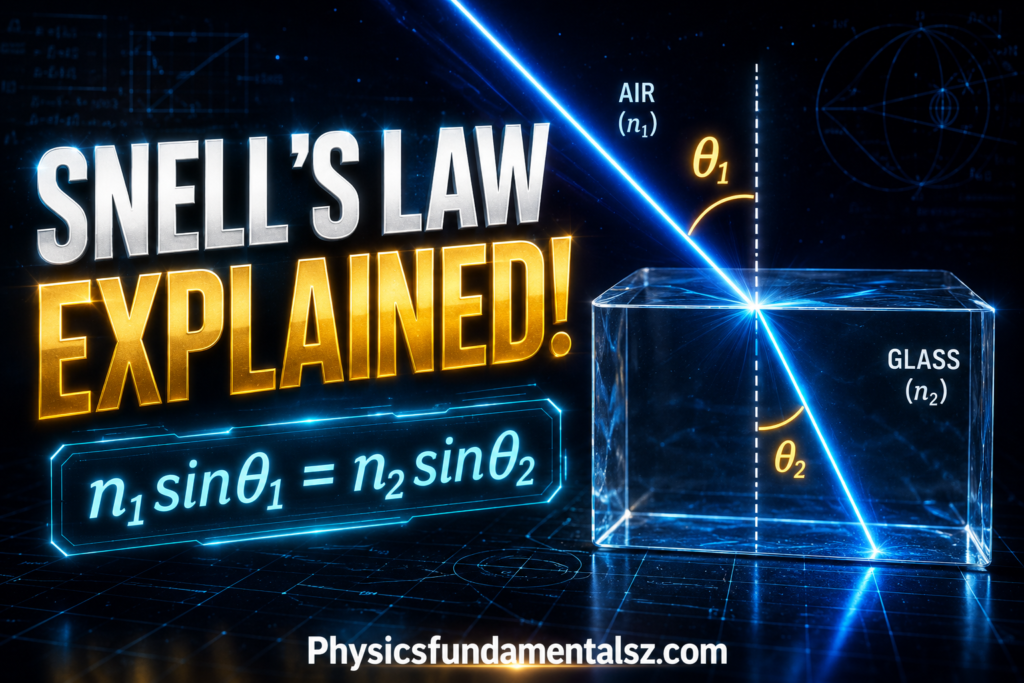
Snell’s Law is the mathematical relationship that describes how a ray of light bends, or refracts, when it passes from one medium into another with a different refractive index. It is written as:
n1 sinθ1 = n2 sinθ2
Here, n1 is the refractive index of the first medium, θ1 is the angle of incidence measured from the normal, the imaginary line perpendicular to the boundary, n2 is the refractive index of the second medium, and θ2 is the angle of refraction, also measured from the normal.
The refractive index of a material is a measure of how much it slows down light compared to a vacuum. Air has a refractive index very close to 1, water is about 1.33, and typical glass is around 1.5. The larger the refractive index, the slower light travels through that medium, and the more sharply a ray bends when it enters it.
Where Does n1sinθ1 = n2sinθ2 Come From?
Snell’s Law is not an arbitrary rule. It follows directly from a basic requirement of wave physics: when a wave crosses a boundary between two media, its frequency cannot change, but its speed and wavelength can. Since the two media transmit light at different speeds, related to the speed of light in a vacuum by v = c divided by n, the wavefronts must bend to stay continuous across the boundary.
Deriving Snell’s Law from Huygens’s Principle
Huygens’s principle treats every point on a wavefront as a source of tiny secondary wavelets that spread outward and combine to form the next wavefront. Picture a flat wavefront approaching a boundary at an angle.
One edge of the wavefront reaches the boundary first and starts generating wavelets in the second medium, where the wave travels at a new speed v2, while the other edge is still travelling through the first medium at speed v1.
Because one edge slows down or speeds up before the other, the wavefront pivots, and the direction of travel bends. Working through the geometry of this pivoting wavefront leads directly to:
sinθ1 divided by sinθ2 = v1 divided by v2 = n2 divided by n1
Rearranging this ratio gives the familiar form n1 sinθ1 = n2 sinθ2. This derivation is powerful because it shows Snell’s Law is really a direct consequence of the wave nature of light, the same wave behavior that produces reflection and refraction effects throughout optics.
Deriving Snell’s Law from Fermat’s Principle
A second, equally elegant derivation comes from Fermat’s principle of least time, which states that light travels between two points along the path that takes the least time, not necessarily the shortest distance.
Since light moves slower in a denser medium, the fastest path is not a straight line but a bent one that spends less time in the slower medium. Minimizing the total travel time between a point in medium 1 and a point in medium 2, using basic calculus, produces exactly the same relationship, n1 sinθ1 = n2 sinθ2.
The fact that two completely different starting principles, one based on waves and one based on time minimization, arrive at the identical formula is part of why Snell’s Law is considered such a fundamental result in optics.
How Light Bends: Reading the Angles
Snell’s Law predicts the direction of bending as well as its size, and the direction always follows one simple pattern.
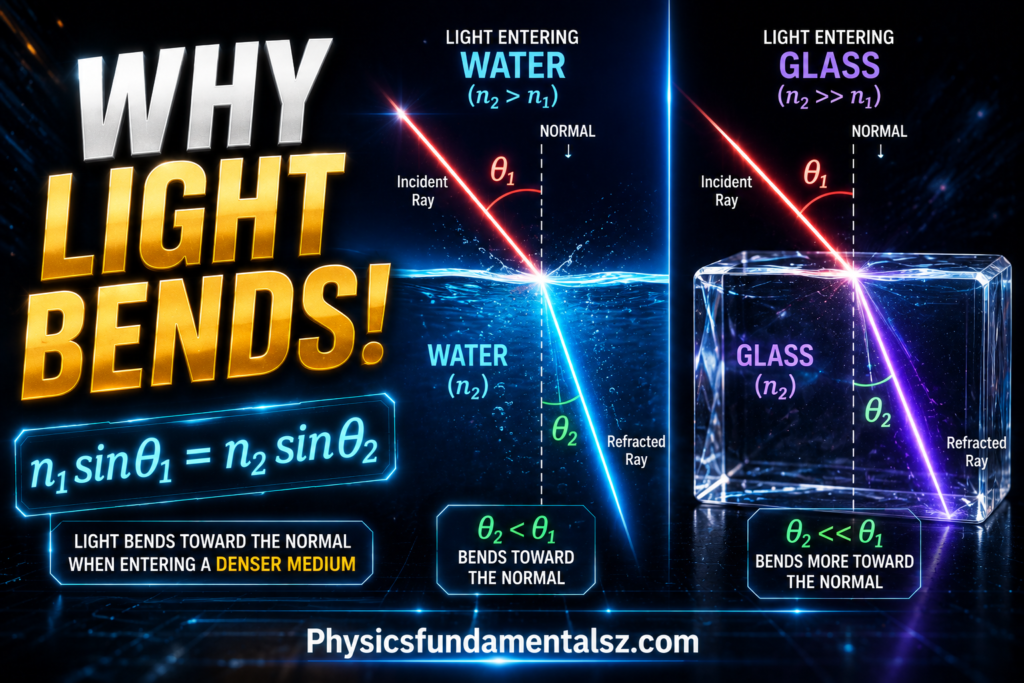
- When light travels from a less dense medium into a more dense medium, meaning n2 is greater than n1, the light slows down and bends toward the normal, so θ2 is smaller than θ1.
- When light travels from a more dense medium into a less dense medium, meaning n2 is smaller than n1, the light speeds up and bends away from the normal, so θ2 is larger than θ1.
This is exactly why the straw in a glass of water looks bent. Light leaving the submerged part of the straw bends away from the normal as it exits the water and enters the air, shifting the apparent position of that part of the straw relative to where it actually is. For a broader look at how light bounces and bends more generally, see our full guide to reflection and refraction.
Worked Example: Applying Snell’s Law
A ray of light travels from air, n1 = 1.00, into glass, n2 = 1.50, striking the surface at an angle of incidence of 40 degrees. Find the angle of refraction.
n1 sinθ1 = n2 sinθ2 1.00 times sin(40°) = 1.50 times sinθ2 1.00 times 0.643 = 1.50 times sinθ2 sinθ2 = 0.643 divided by 1.50 = 0.429 θ2 = sin inverse(0.429) = approximately 25.4°
The light bends toward the normal as expected, since it is entering a denser medium, dropping from a 40 degree angle of incidence down to about a 25.4 degree angle of refraction.
Total Internal Reflection
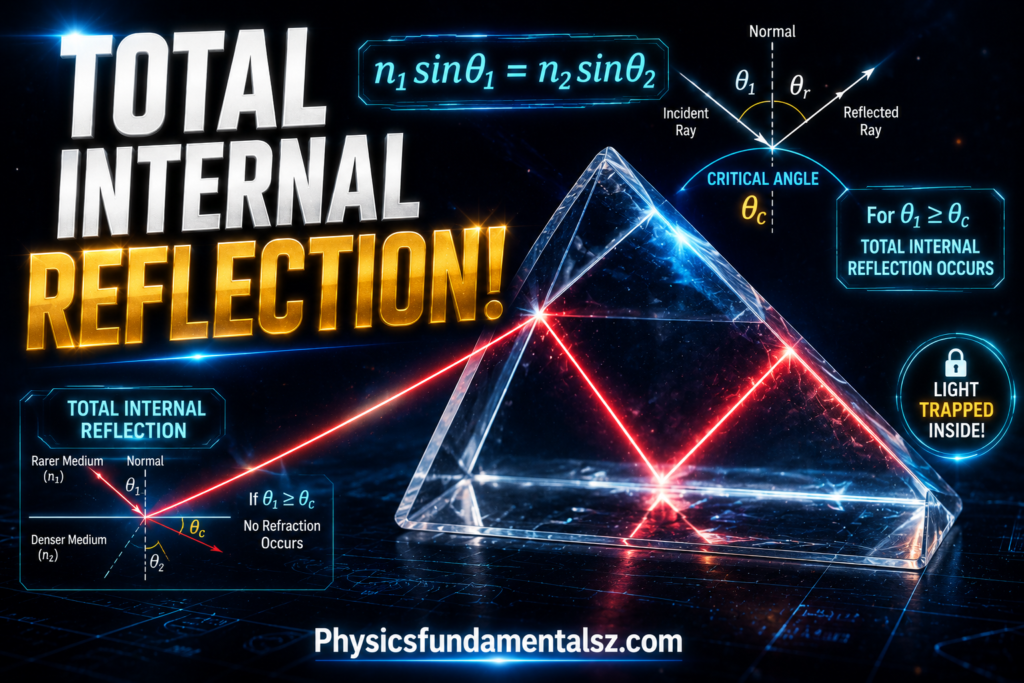
Snell’s Law also predicts a fascinating limiting case. When light travels from a denser medium into a less dense one, meaning n1 is greater than n2, there exists a specific angle of incidence, called the critical angle, beyond which the light stops refracting out of the medium entirely and instead reflects completely back inside it. This phenomenon is called total internal reflection.
Finding the Critical Angle
The critical angle occurs at the exact point where the angle of refraction reaches 90 degrees, meaning the refracted ray travels along the boundary itself rather than into the second medium. Setting θ2 equal to 90 degrees in Snell’s Law, where sin(90°) equals 1, gives:
n1 sin(θc) = n2 sin(θc) = n2 divided by n1 θc = sin inverse(n2 divided by n1)
For any angle of incidence greater than this critical angle, no light escapes into the second medium at all. All of it reflects back into the first medium, following the ordinary law of reflection.
Where Total Internal Reflection Shows Up
Total internal reflection is not just a theoretical curiosity. It is the working principle behind several everyday and high-tech applications:
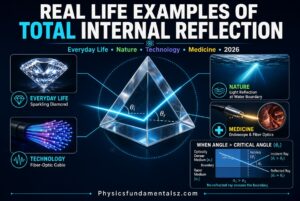
- Fiber optic cables rely on total internal reflection to keep light bouncing along the inside of a thin glass or plastic fiber for kilometers with almost no signal loss, which is how modern internet and telephone networks move data at enormous speed.
- Diamonds are cut with precise angles specifically so that light entering the top undergoes total internal reflection multiple times before exiting, which is a major reason diamonds appear so bright and sparkly compared to other gemstones with lower refractive indices.
- Binoculars and periscopes often use prisms instead of mirrors, since total internal reflection reflects light more efficiently and without the tarnishing or coating problems that traditional mirrors can develop over time.
- Mirages on a hot road are a natural example of a related bending effect, where light refracts through layers of air at different temperatures and densities, eventually curving enough to appear as a reflection on the road surface.
Snell’s Law and the Behavior of Light
Snell’s Law is one piece of a much larger picture describing how electromagnetic waves interact with matter. Since refraction depends on how fast light travels through a given medium, and that speed is always a fraction of light’s speed in a vacuum, Snell’s Law connects directly back to the fundamental constant discussed in our article on the speed of light. For a broader foundation covering waves, optics, and the rest of core physics, see our complete physics fundamentals guide.
Snell’s Law and Dispersion: Why Prisms Split Light into Colors
Snell’s Law explains not just that light bends, but also why a prism splits white light into a rainbow of colors. The refractive index of most transparent materials is not perfectly constant. It varies slightly depending on the wavelength of the light passing through, a property called dispersion. Violet light, with its shorter wavelength, experiences a slightly higher refractive index in glass than red light, with its longer wavelength.
Because Snell’s Law depends directly on the refractive index, this small difference means each color bends by a slightly different angle when passing through the same boundary. White light entering a glass prism, which contains a mix of every visible wavelength, separates into its component colors as each wavelength refracts at its own distinct angle, spreading into the familiar red-through-violet spectrum by the time it exits the prism. The same dispersion effect, combined with reflection inside water droplets, is responsible for rainbows appearing after rain, and it is also why camera lenses and telescopes must be corrected for chromatic aberration, the slight color fringing caused by different wavelengths focusing at slightly different points.
Snell’s Law in Everyday Optical Instruments
Beyond fiber optics and diamonds, Snell’s Law quietly governs the behavior of nearly every optical device built to focus, bend, or redirect light.
- Eyeglasses and contact lenses use precisely shaped refracting surfaces to bend incoming light so it focuses correctly on the retina, correcting for nearsightedness, farsightedness, or astigmatism.
- Camera lenses stack multiple curved glass elements, each refracting light according to Snell’s Law, to bring a sharp image into focus on the sensor.
- The human eye itself uses the cornea and the lens, both refracting incoming light according to the same n1sinθ1 = n2sinθ2 relationship, to form an image on the retina.
- Microscopes and telescopes rely on carefully calculated refraction at every lens surface to magnify distant or tiny objects without distorting the image.
A handful of errors show up repeatedly when students first start working with Snell’s Law, so it is worth calling them out directly.
Mistake 1: Measuring the angle from the surface instead of the normal. Every angle in Snell’s Law, both the angle of incidence and the angle of refraction, is measured from the normal line, the imaginary line perpendicular to the boundary, not from the boundary surface itself. Measuring from the surface instead of the normal will give a value that is off by 90 degrees.
Mistake 2: Mixing up n1 and n2. It is easy to accidentally swap which medium is which, especially in multi-step problems involving several boundaries in a row, such as light passing through a glass block and back into air. Always label which medium the light starts in and which it is entering before plugging numbers into the formula.
Mistake 3: Forgetting that total internal reflection only happens going from dense to less dense. Total internal reflection can only occur when light is moving from a higher refractive index medium into a lower one. It is impossible for light travelling from air into glass or water, since there is no critical angle in that direction, the light always refracts through into the denser medium.
Mistake 4: Assuming the bending is exaggerated or arbitrary. The amount of bending predicted by Snell’s Law is precise and repeatable for a given pair of materials and a given angle. It is a rigorous mathematical result, not just a qualitative description of light bending toward or away from the normal.
Common Mistakes When Applying Snell’s Law
A handful of errors show up repeatedly when students first start working with Snell’s Law, so it is worth calling them out directly.
Mistake 1: Measuring the angle from the surface instead of the normal. Every angle in Snell’s Law, both the angle of incidence and the angle of refraction, is measured from the normal line, the imaginary line perpendicular to the boundary, not from the boundary surface itself. Measuring from the surface instead of the normal will give a value that is off by 90 degrees.
Mistake 2: Mixing up n1 and n2. It is easy to accidentally swap which medium is which, especially in multi-step problems involving several boundaries in a row, such as light passing through a glass block and back into air. Always label which medium the light starts in and which it is entering before plugging numbers into the formula.
Mistake 3: Forgetting that total internal reflection only happens going from dense to less dense. Total internal reflection can only occur when light is moving from a higher refractive index medium into a lower one. It is impossible for light travelling from air into glass or water, since there is no critical angle in that direction, the light always refracts through into the denser medium.
Mistake 4: Assuming the bending is exaggerated or arbitrary. The amount of bending predicted by Snell’s Law is precise and repeatable for a given pair of materials and a given angle. It is a rigorous mathematical result, not just a qualitative description of light bending toward or away from the normal.
Frequently Asked Questions (FAQs)
What happens to the frequency of light when it refracts?
The frequency of light stays exactly the same as it crosses a boundary between two media. Only the speed and wavelength change, since frequency is determined by the light source, not by the medium the wave happens to be travelling through at that moment.
Can Snell’s Law apply to waves other than light?
Yes. Snell’s Law applies to any wave crossing a boundary between two media with different propagation speeds, including sound waves and seismic waves used in geophysics to study rock layers beneath the Earth’s surface.
Is there a critical angle when light goes from air into water?
No. A critical angle and total internal reflection only exist when light moves from a denser medium into a less dense one. Since air has a lower refractive index than water, light travelling from air into water always refracts through the surface and never reflects internally.
Key Takeaways
Snell’s Law, n1sinθ1 = n2sinθ2, is the precise mathematical rule that governs how light bends whenever it crosses between two transparent media, and it follows directly from the wave nature of light through both Huygens’s principle and Fermat’s principle of least time.
Light bends toward the normal when entering a denser medium and away from the normal when entering a less dense one, and beyond the critical angle in the reverse direction, it undergoes total internal reflection instead of refracting at all.
That single equation quietly powers fiber optic communication, the sparkle of a cut diamond, and the humble bent-straw trick in a glass of water. For more on how light and other waves behave, browse the full Waves and Optics collection on Physics Fundamentals.