Thermal Expansion: Formula ΔL = αL₀ΔT, Types & Worked Examples

Heat a metal rod and it grows longer. Cool it down and it shrinks back.
This everyday behavior is called thermal expansion, and it is one of the most practical ideas in all of physics because it shows up in railway tracks, bridges, thermometers, engines, and even the pipes in your house.
Table of Contents
What Is Thermal Expansion?

Thermal expansion is the increase in the length, area, or volume of a material caused by an increase in temperature. When a substance is heated, its particles vibrate faster and push each other slightly farther apart. Since the material is made up of countless atoms all expanding this vibration space at once, the whole object grows in size.
This is the same underlying idea covered in the kinetic theory of gases, where faster-moving particles create more pressure and, in solids and liquids, more space between neighboring atoms. Thermal expansion is essentially a mechanical consequence of the heat transfer that raises a material’s internal energy.
Almost every material expands when heated and contracts when cooled, though the amount of expansion is different for every substance. Metals expand quite noticeably, glass expands very little, and gases expand the most of all, since gas particles are already far apart and only loosely bound.
The Thermal Expansion Formula: ΔL = αL₀ΔT
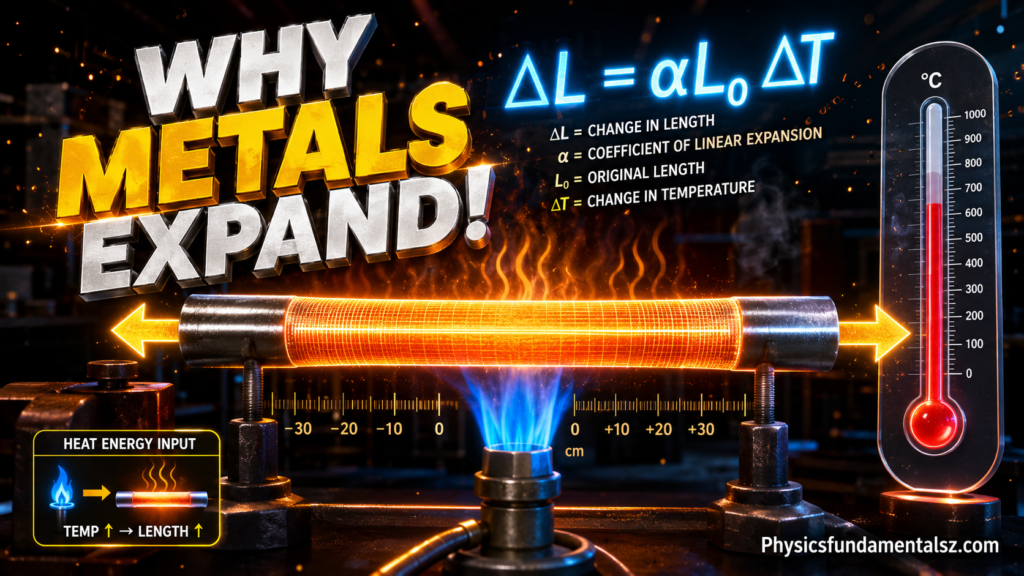
The most common version of the thermal expansion equation describes how much a solid’s length changes with temperature. It is written as:
ΔL = αL₀ΔT
This is known as the linear thermal expansion formula, and it is the starting point for understanding every other type of thermal expansion.
Understanding Each Term in the Formula
- ΔL is the change in length of the object, measured in meters or centimeters.
- α (alpha) is the coefficient of linear thermal expansion, a property that depends on the material.
- L₀ is the original length of the object before heating.
- ΔT is the change in temperature, calculated as the final temperature minus the initial temperature.
Rearranging this thermal expansion equation lets you solve for any one variable if you know the other three. For instance, if you need to find the coefficient of thermal expansion for an unknown material, you can rearrange it to α = ΔL / (L₀ΔT).
Coefficient of Thermal Expansion (α) Explained
The coefficient of thermal expansion is a number that tells you how much a specific material expands per degree of temperature change. It is usually expressed in units of inverse Kelvin (K⁻¹) or inverse degrees Celsius (°C⁻¹), since both units represent the same size of temperature step.
Different materials have very different expansion coefficients:
- Steel has an α of about 12 × 10⁻⁶ per °C
- Aluminum has an α of about 23 × 10⁻⁶ per °C
- Glass has an α of about 9 × 10⁻⁶ per °C
- Concrete has an α of about 12 × 10⁻⁶ per °C
Because these values are so small, thermal expansion is often not visible over short lengths and small temperature ranges, but it becomes very significant over long distances such as railway tracks, bridges, and pipelines, or under large temperature swings.
Types of Thermal Expansion
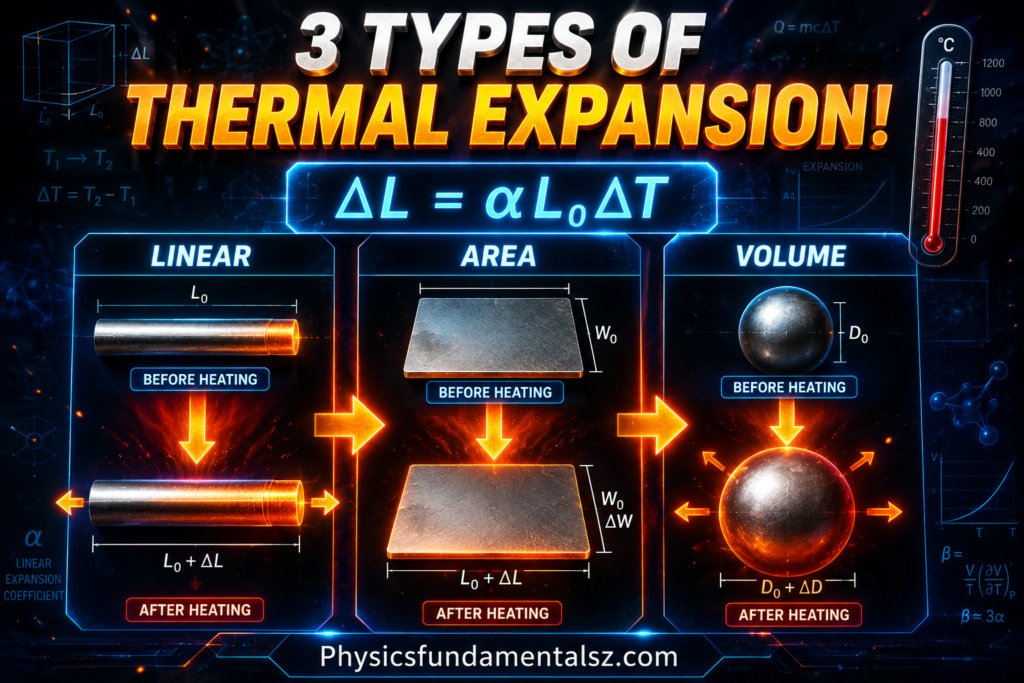
Thermal expansion is not limited to length. Depending on the shape and dimensions involved, there are three recognized types of thermal expansion: linear, area, and volume expansion.
Linear Expansion
Linear expansion refers to the change in a single dimension, usually the length of a rod, wire, rail, or beam. This is exactly what the formula ΔL = αL₀ΔT describes. Linear expansion is the simplest and most commonly tested type of thermal expansion in physics courses, since only one dimension needs to be tracked.
Area (Superficial) Expansion
Area expansion, sometimes called superficial expansion, describes how the surface area of a flat object changes with temperature. Since area involves two dimensions, the area expansion formula uses a coefficient that is roughly twice the linear coefficient:
ΔA = 2αA₀ΔT
This approximation works well for small temperature changes and is used for metal plates, sheets, and washers that expand outward in every direction along their surface.
Volume (Cubical) Expansion
Volume expansion, also known as cubical expansion, applies to the three-dimensional expansion of solids, liquids, and gases. Because volume involves three dimensions, the volume expansion formula uses a coefficient roughly three times the linear coefficient for solids:
ΔV = βV₀ΔT, where β ≈ 3α
For liquids and gases, a separate volumetric coefficient (β) is usually measured directly rather than derived from a linear coefficient, since liquids and gases do not have a fixed shape. This concept connects directly with the ideal gas law, which describes how the volume of a gas responds to changes in both temperature and pressure.
Why Does Thermal Expansion Happen?
At the microscopic level, atoms in a solid are held in place by intermolecular bonds that behave a bit like tiny springs. At any temperature above absolute zero, these atoms vibrate around a fixed equilibrium position. As covered in the first law of thermodynamics, adding heat energy to a system increases its internal energy, and in a solid this extra energy increases the amplitude of atomic vibration.
The key detail is that the bonds between atoms are not perfectly symmetric. It takes more energy to push two atoms closer together than it does to pull them slightly farther apart, so as vibration amplitude increases, the average distance between atoms increases too. Multiply that tiny shift by billions of atoms in a row, and the object measurably grows in size. This asymmetry is also why materials with weaker or more asymmetric bonding, like most metals, tend to have larger expansion coefficients than tightly bonded materials like diamond.
Worked Examples of Thermal Expansion
The best way to master the thermal expansion formula is to work through real numbers. Below are three worked examples covering linear, area, and volume expansion.
Example 1: Linear Expansion of a Steel Rod
A steel rod is 2 meters long at 20°C. If the temperature rises to 70°C, find the change in length. Steel has α = 12 × 10⁻⁶ per °C.
Given: L₀ = 2 m, ΔT = 70°C − 20°C = 50°C, α = 12 × 10⁻⁶ /°C
Solution: ΔL = αL₀ΔT ΔL = (12 × 10⁻⁶)(2)(50) ΔL = 0.0012 m, or 1.2 mm
The rod grows by 1.2 millimeters, a small but real amount that engineers must account for in long steel structures such as bridges and railway tracks.
Example 2: Area Expansion of a Metal Plate
An aluminum plate has an area of 0.5 m² at 25°C. Find the new area if it is heated to 125°C. Aluminum has α = 23 × 10⁻⁶ per °C.
Given: A₀ = 0.5 m², ΔT = 125°C − 25°C = 100°C, α = 23 × 10⁻⁶ /°C
Solution: ΔA = 2αA₀ΔT ΔA = 2(23 × 10⁻⁶)(0.5)(100) ΔA = 0.0023 m²
New area = A₀ + ΔA = 0.5 + 0.0023 = 0.5023 m²
The plate’s surface area increases by 0.0023 m², a small percentage change that still matters in precision manufacturing and aerospace components.
Example 3: Volume Expansion of a Liquid
A container holds 1 liter of a liquid with a volumetric expansion coefficient β = 950 × 10⁻⁶ per °C. If the liquid is heated from 15°C to 65°C, find the increase in volume.
Given: V₀ = 1 L, ΔT = 65°C − 15°C = 50°C, β = 950 × 10⁻⁶ /°C
Solution: ΔV = βV₀ΔT ΔV = (950 × 10⁻⁶)(1)(50) ΔV = 0.0475 L, or 47.5 mL
This is why sealed containers and fuel tanks are never filled completely. This example also connects to how specific heat capacity determines how much energy is needed to raise that liquid’s temperature by 50°C in the first place.
Real-World Applications of Thermal Expansion
Thermal expansion is not just a textbook formula. It directly shapes how engineers design roads, buildings, and machines.
Railway Tracks and Bridges
Railway tracks and steel bridges are built with small expansion gaps between sections. Without these gaps, thermal expansion in hot weather would cause the rails to buckle and bend, a failure that has caused real derailments. The internal stresses created when expansion is restricted are closely related to the ideas covered in stress, strain, and Young’s modulus, since a constrained material under thermal expansion behaves like one under mechanical compression.
Bimetallic Strips and Thermostats
A bimetallic strip is made of two different metals, each with a different coefficient of thermal expansion, bonded together. When heated, one metal expands faster than the other, causing the strip to bend. This simple application of the thermal expansion formula is the basis for many mechanical thermostats, temperature switches, and fire alarms.
Thermal Expansion Tanks
In water heating and hydraulic systems, thermal expansion tanks absorb the extra volume created when liquid is heated, preventing dangerous pressure buildup inside sealed pipes. This is a direct real-world use of the volume expansion formula, ΔV = βV₀ΔT, applied at a household and industrial scale.
Thermal Expansion vs Thermal Contraction
Thermal contraction is simply the reverse process: a material shrinks in length, area, or volume when its temperature decreases. The same formula applies, just with a negative ΔT, which produces a negative ΔL, ΔA, or ΔV. Almost all common materials that expand on heating will contract by the same proportional amount on cooling, which is why the coefficient of thermal expansion is treated as a single constant across a normal working temperature range.
A few unusual materials, most notably water between 0°C and 4°C, actually contract slightly when heated within that narrow range before expanding normally above it. This anomalous behavior is a well-known exception discussed alongside standard thermal expansion theory.
Common Mistakes When Solving Thermal Expansion Problems
Students frequently lose marks on thermal expansion questions for a few avoidable reasons:
- Mixing up units of α. Always confirm whether the coefficient is given per °C or per K, since a mismatch with the temperature unit in ΔT will produce a wrong answer, even though the numerical size of one degree Celsius equals one Kelvin.
- Forgetting the factor of 2 or 3. Area expansion uses 2α and volume expansion uses 3α for solids. Using the linear coefficient directly in an area or volume formula is one of the most common thermal expansion mistakes.
- Using the wrong original value. L₀, A₀, and V₀ must always be the value before heating, not after.
- Ignoring restrained expansion. If an object cannot physically expand because it is fixed in place, the formula still predicts how much it “would” expand, but that prevented expansion instead produces internal stress rather than a change in size.
Frequently Asked Questions (FAQs)
What is the formula for thermal expansion?
The linear thermal expansion formula is ΔL = αL₀ΔT, where α is the coefficient of linear expansion, L₀ is the original length, and ΔT is the change in temperature.
What are the three types of thermal expansion?
The three types of thermal expansion are linear expansion (change in length), area expansion (change in surface area), and volume expansion (change in volume).
Does every material expand when heated?
Almost every material expands when heated, though the rate differs by material. A small number of substances, like water in a specific temperature range, show unusual behavior and can contract slightly instead.
What units does the coefficient of thermal expansion use?
The coefficient of thermal expansion is measured in inverse Kelvin (K⁻¹) or inverse degrees Celsius (°C⁻¹).
Conclusion
Thermal expansion explains why bridges have expansion joints, why glass jars are easier to open under hot water, and why liquids need extra space in a sealed container.
Once you understand the core formula, ΔL = αL₀ΔT, and how it scales up into area and volume expansion, you can apply the same logic to nearly any material or engineering problem involving temperature change.
To keep building your understanding of heat and energy, explore heat transfer, the ideal gas law, and specific heat capacity, or try the physics calculators to solve your own thermal expansion problems step by step.