Buoyancy & Archimedes’ Principle: F = ρVg Formula & Worked Examples
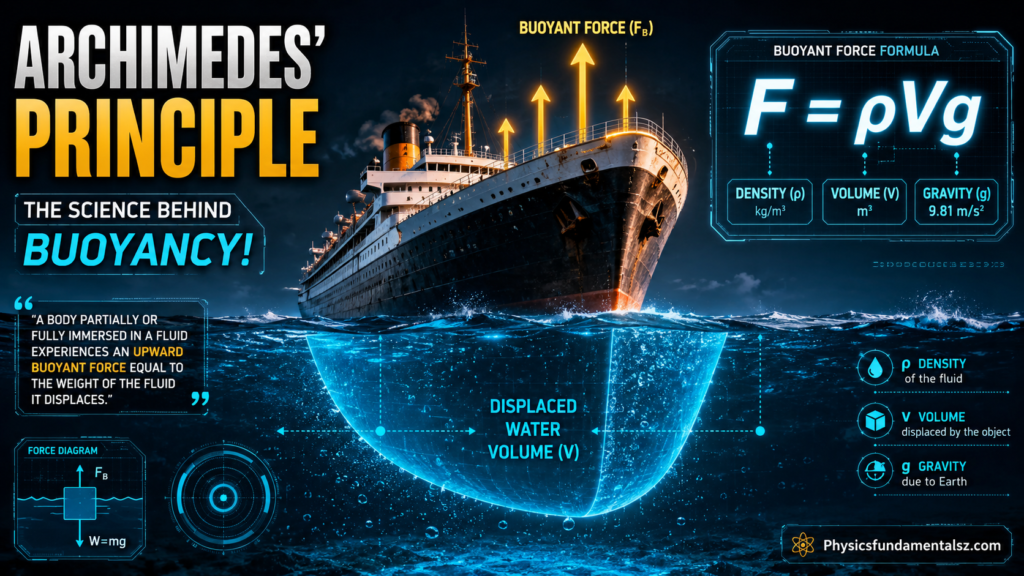
Drop a steel needle in water and it sinks. Drop a steel ship into the same water and it floats.
Both objects are made of the same dense metal, yet one goes straight to the bottom and the other carries thousands of tons of cargo across oceans. The answer to this puzzle is buoyancy, and the law that explains it precisely is Buoyancy & Archimedes’ Principle.
Table of Contents
What Is Buoyancy?

Buoyancy is the upward force that a fluid exerts on any object placed inside it, whether that object is fully submerged or only partly immersed. This upward push is often called the buoyant force or upthrust, and it exists because a fluid pushes harder on the bottom of an object than on its top.
Every fluid, whether it is water, oil, or air, is made of particles in constant motion, and those particles collide with any surface placed inside the fluid. Since pressure in a fluid increases with depth, the pressure pushing up on the bottom face of a submerged object is always greater than the pressure pushing down on its top face. That pressure difference produces a net upward force: buoyancy. If you want the full derivation of how pressure changes with depth, our guide on pressure in fluids covers the P = ρgh relationship that buoyancy is built on.
Archimedes’ Principle Explained
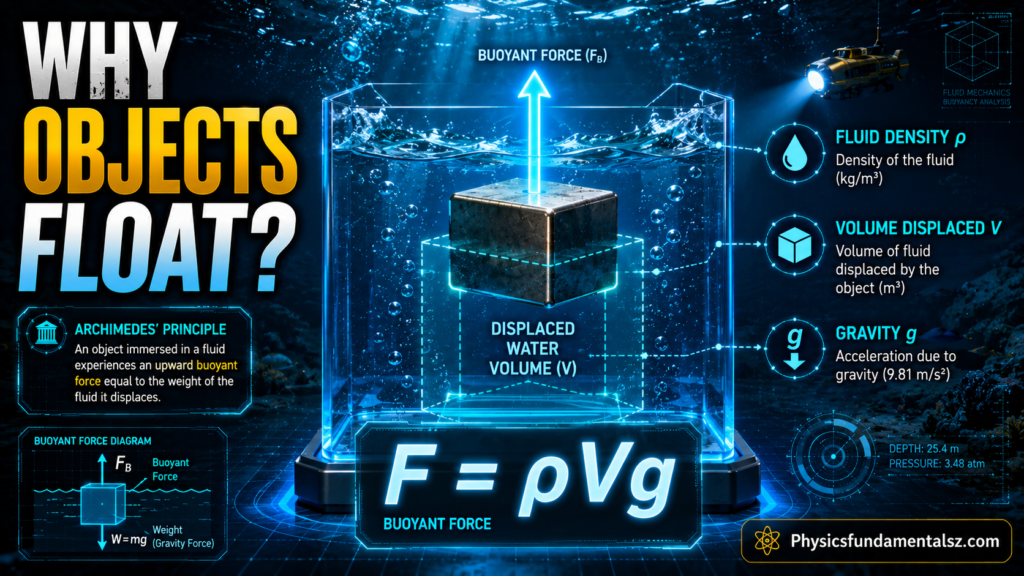
Archimedes’ principle states that the buoyant force acting on an object submerged in a fluid, whether partially or fully, is equal to the weight of the fluid that the object displaces.
This idea is credited to the Greek mathematician Archimedes of Syracuse around 246 BC, supposedly discovered while he stepped into a bath and noticed the water level rise. The legend says he ran through the streets shouting “Eureka,” meaning “I have found it.” Whether or not the bathtub story is exactly true, the underlying discovery was real and became one of the earliest quantitative laws in physics.
The genius of Archimedes’ principle is that it turns a hard problem (the exact pressure at every point on a submerged object’s surface) into a simple one: just weigh the fluid that got pushed out of the way. That single insight is what allows engineers to calculate buoyant force without needing to know the object’s exact shape.
The Buoyancy Formula: F = ρVg
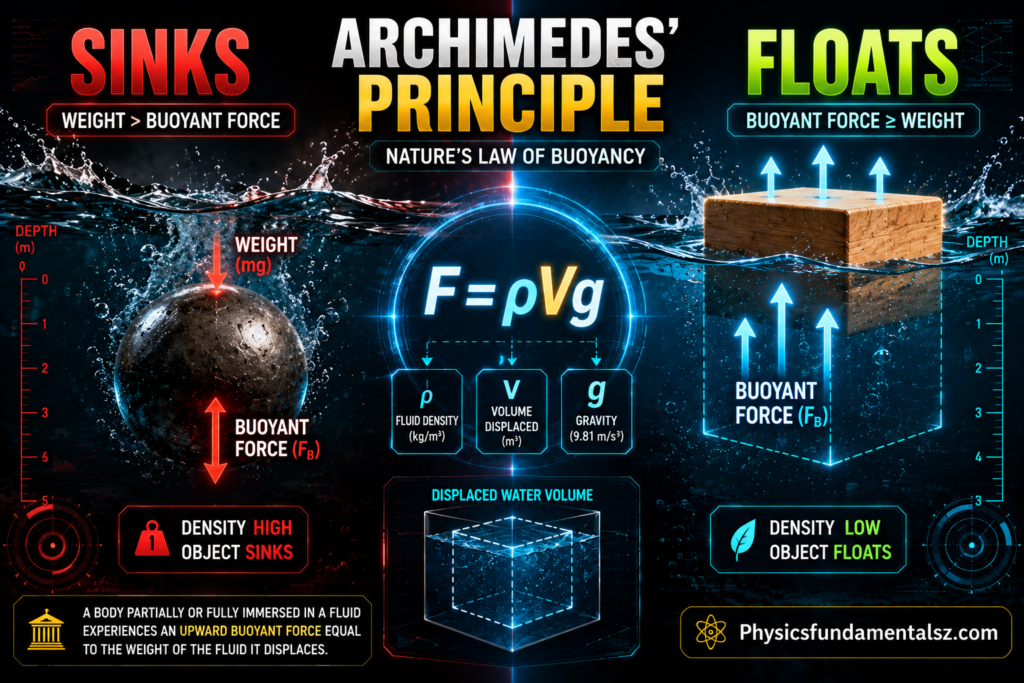
The buoyant force is calculated using the equation:
F = ρVg
Where:
- F is the buoyant force, measured in newtons (N)
- ρ (rho) is the density of the fluid the object is immersed in, measured in kg/m³
- V is the volume of fluid displaced by the object, measured in m³
- g is the acceleration due to gravity, approximately 9.8 m/s² on Earth
Notice that the formula depends on the density of the fluid and the volume displaced, not on the mass or material of the object itself. This is the key to understanding why a heavy steel ship floats: what matters is how much water it pushes out of the way, not how much the ship itself weighs.
Where the Formula Comes From
The buoyancy formula follows directly from hydrostatic pressure. Consider a rectangular block fully submerged in a fluid at rest. The pressure at the bottom face is greater than the pressure at the top face because the bottom sits deeper in the fluid. Multiplying that pressure difference by the surface area of the block gives a net upward force, and working through the algebra shows that this force always equals the weight of the fluid volume the block occupies, or ρVg. This is the same pressure logic used to explain hydraulic systems in our article on pressure in fluids, just applied to a submerged object instead of a container wall.
Why Objects Float or Sink
Whether an object floats, sinks, or hovers at a constant depth depends entirely on comparing the buoyant force to the object’s weight, or equivalently, comparing the object’s density to the density of the fluid.
Objects That Sink
If an object’s density is greater than the fluid’s density, its weight is larger than the maximum buoyant force the fluid can generate, even when fully submerged. The net force points downward, so the object sinks. A steel ball dropped in water sinks because steel (about 7,850 kg/m³) is far denser than water (1,000 kg/m³).
Objects That Float
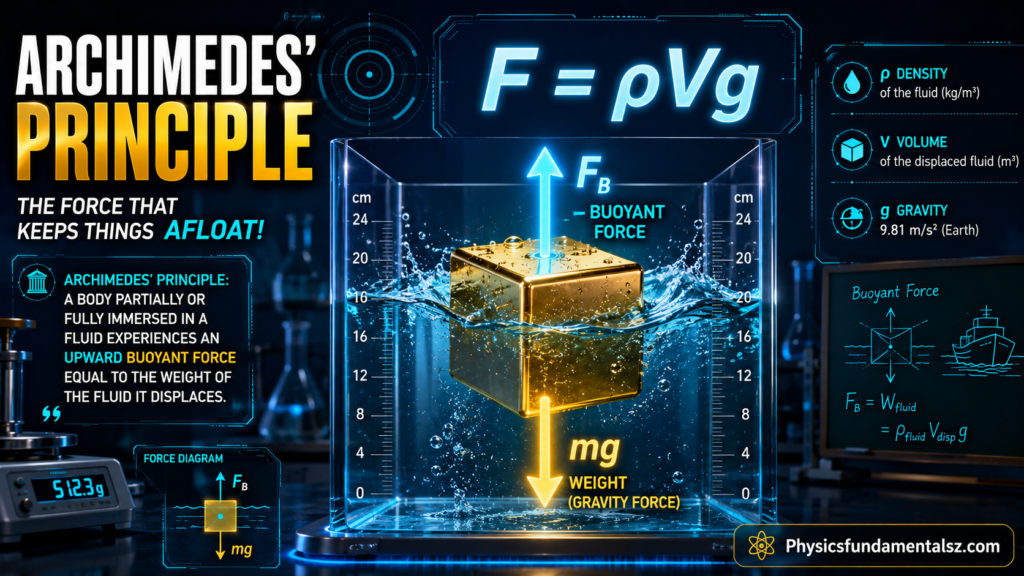
If an object’s average density is less than the fluid’s density, it will rise until only part of it is submerged, at which point the volume of displaced fluid produces a buoyant force exactly equal to the object’s weight. This is why a steel ship floats even though solid steel sinks: the ship’s hull encloses a large volume of air, which lowers the average density of the entire ship far below the density of water. This distribution of mass and force is closely related to how Newton’s laws of motion describe equilibrium, since a floating object is a textbook case of balanced forces with zero net acceleration.
Neutral Buoyancy
If an object’s density exactly equals the fluid’s density, the buoyant force exactly balances gravity at any depth, and the object neither rises nor sinks. This is the condition scuba divers try to achieve underwater, and it is also how fish use their swim bladders to hover at a chosen depth without swimming.
Apparent Weight and Fluid Displacement
A useful consequence of Archimedes’ principle is the idea of apparent weight. When an object is submerged, it feels lighter than it does in air, because buoyancy partially cancels gravity. The apparent weight is calculated as:
Apparent weight = True weight − Buoyant force
This is why lifting a rock underwater feels easier than lifting it on land, and it is the basis of the classic method for testing whether a crown is pure gold: compare its weight in air to its weight submerged in water, and use the difference to calculate its volume and density.
Worked Examples
Example 1: Finding the Buoyant Force on a Submerged Block
A rectangular block has a volume of 0.02 m³ and is fully submerged in water, which has a density of 1,000 kg/m³. Find the buoyant force acting on it.
Using F = ρVg:
F = 1,000 kg/m³ × 0.02 m³ × 9.8 m/s²
F = 196 N
The water pushes upward on the block with a force of 196 newtons.
Example 2: Determining Whether an Object Floats
A block of wood has a mass of 5 kg and a volume of 0.008 m³. Water has a density of 1,000 kg/m³. Will the block float or sink?
First, find the wood’s density:
ρ_wood = mass / volume = 5 kg / 0.008 m³ = 625 kg/m³
Since 625 kg/m³ is less than water’s density of 1,000 kg/m³, the block floats.
Example 3: Calculating the Submerged Volume of a Floating Object
The same wood block from Example 2 floats in water. What volume of the block is submerged below the surface?
For a floating object, the buoyant force must equal the object’s weight:
ρ_water × V_submerged × g = mass × g
1,000 × V_submerged = 5
V_submerged = 0.005 m³
Since the total volume of the block is 0.008 m³, this means 0.005 m³, or 62.5 percent of the block, sits underwater, while the remaining 37.5 percent stays above the surface. This same percentage explains why roughly 90 percent of an iceberg lies hidden below the waterline, since ice is only slightly less dense than seawater.
Example 4: Apparent Weight of a Submerged Object
A metal object weighs 50 N in air. When fully submerged in water, it displaces 0.003 m³ of water. Find its apparent weight underwater.
First, find the buoyant force:
F = ρVg = 1,000 kg/m³ × 0.003 m³ × 9.8 m/s² = 29.4 N
Apparent weight = True weight − Buoyant force
Apparent weight = 50 N − 29.4 N = 20.6 N
The object feels like it weighs only 20.6 N while submerged, even though its actual weight in air is 50 N.
Real World Applications of Archimedes’ Principle
Archimedes’ principle is not confined to textbooks. It governs the design and behavior of a wide range of everyday technology:
- Ships and boats. Hulls are shaped to displace a large volume of water relative to the ship’s total weight, keeping the average density of the vessel below that of water, even though the hull material itself is denser.
- Submarines. Ballast tanks let a submarine control its own average density by flooding with seawater to sink or expelling water with compressed air to rise, allowing precise control over depth and neutral buoyancy.
- Hot air balloons. The same principle applies to gases. Heating the air inside a balloon lowers its density below that of the surrounding cooler air, so the balloon experiences a net upward buoyant force and rises.
- Hydrometers. These instruments measure the density of a liquid, such as battery acid or wine, by observing how deep a weighted float sits in the fluid, since a denser liquid provides more buoyant force and lets the float ride higher.
- Fish and swim bladders. Fish adjust the volume of gas in their swim bladder to fine tune their average density and hover at any chosen depth without expending energy swimming.
Frequently Asked Questions (FAQs)
What is the difference between buoyancy and Archimedes’ principle?
Buoyancy is the general phenomenon of an upward force acting on an object in a fluid. Archimedes’ principle is the specific quantitative law that tells you exactly how large that force is: equal to the weight of the fluid displaced.
Does Archimedes’ principle apply to gases as well as liquids?
Yes. Archimedes’ principle applies to any fluid, which includes both liquids and gases. This is exactly why hot air balloons and helium balloons rise through air, using the same F = ρVg formula with the density of air in place of the density of water.
Why do heavy ships made of steel float?
A ship floats because its hull encloses a large volume of air, which reduces the average density of the entire vessel, hull plus enclosed air, well below the density of water. Archimedes’ principle only cares about the total volume displaced and the fluid’s density, not the density of the building material alone.
Does the shape of an object affect buoyant force?
Shape does not directly appear in the formula F = ρVg, but shape strongly affects how much volume an object displaces and whether it stays stable while floating. Two objects with the same volume displace the same amount of fluid and feel the same buoyant force, regardless of their shape.
What happens to buoyant force at greater depths?
For a fully submerged object of fixed volume in an incompressible fluid like water, buoyant force stays constant with depth because the displaced volume does not change. However, for compressible fluids or flexible objects, increasing pressure at depth can shrink the volume, which reduces the buoyant force.
Key Takeaways: Buoyancy and Archimedes’ Principle
- Buoyancy is the upward force a fluid exerts on any object placed inside it, caused by increasing pressure with depth.
- Archimedes’ principle states that buoyant force equals the weight of fluid displaced by the object.
- The buoyancy formula is F = ρVg, where ρ is fluid density, V is displaced volume, and g is gravitational acceleration.
- An object floats if its average density is less than the fluid’s density, sinks if greater, and achieves neutral buoyancy if the two are equal.
- Apparent weight underwater equals true weight minus buoyant force, which explains why submerged objects feel lighter.
- Archimedes’ principle explains ships, submarines, hot air balloons, hydrometers, and how fish control their depth.
Understanding buoyancy builds directly on the fluid pressure concepts covered in our guide to pressure in fluids, and it connects back to the force and motion principles in our complete physics fundamentals guide. For a related look at how objects behave as they fall or settle through a fluid, see our explainer on terminal velocity.