Centre of Gravity vs Centre of Mass: Definition & Applications
Push a pencil off the edge of a table slowly and there is a precise point at which it tips over and falls.
Watch a tightrope walker shift a long pole side to side to stay balanced, or notice why a race car hugs the ground while an SUV is far more likely to roll over in a sharp turn. All of these situations come down to one single concept: the centre of gravity.
The centre of gravity is one of the most fundamental ideas in classical mechanics, yet it is also one of the most misunderstood, largely because it is so often confused with a closely related idea, the centre of mass.
Table of Contents
What Is Centre of Gravity?
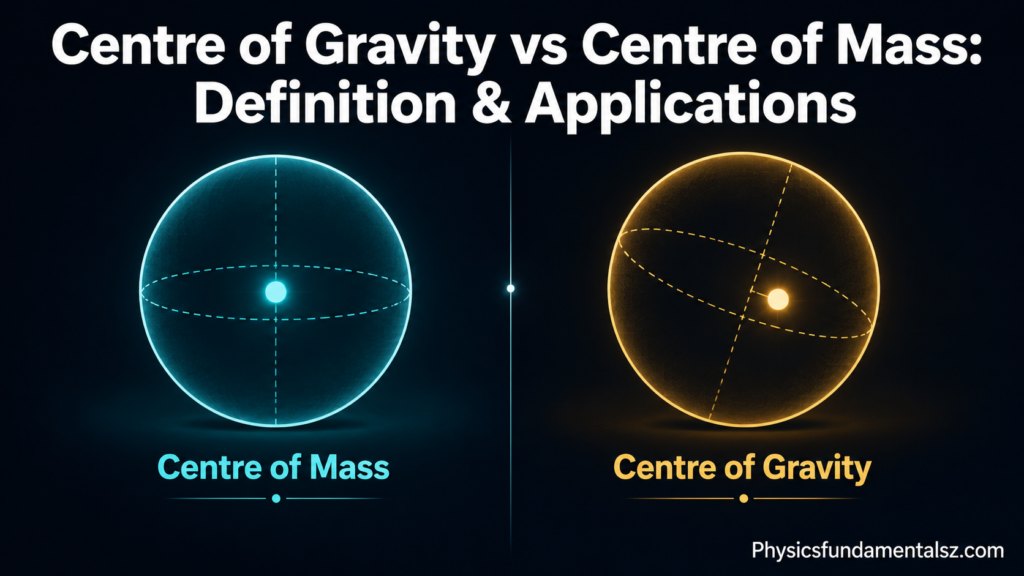
The centre of gravity is the point in an object where its entire weight can be considered to act, as if all of the object’s weight were concentrated at that single location. It is not a physical part of the object itself. It is a calculated point, and in some cases, such as a hollow ring or a boomerang, that point can even lie outside the object’s physical material entirely.
Every rigid body has exactly one centre of gravity, and its location depends on how mass is distributed throughout the object. For a symmetrical object made of a single uniform material, such as a solid sphere or a rectangular block, the centre of gravity sits exactly at the geometric centre. For an irregular or non-uniform object, such as a hammer with a heavy metal head and a light wooden handle, the centre of gravity shifts noticeably toward the heavier section.
Understanding the centre of gravity requires the same foundational ideas used throughout kinematics and dynamics, particularly how forces act on extended bodies rather than single points, a concept explored further in our guide to Newton’s laws of motion.
Centre of Gravity Formula
The centre of gravity along a single axis can be calculated using the following formula:
x_cg = (m₁x₁ + m₂x₂ + m₃x₃ + … ) / (m₁ + m₂ + m₃ + …)
Where:
- x_cg is the position of the centre of gravity
- m₁, m₂, m₃ are the individual masses (or weights) of each part of the object
- x₁, x₂, x₃ are the positions of each mass relative to a chosen reference point
This is essentially a weighted average: heavier sections of an object pull the centre of gravity toward themselves, just as a heavier child sitting further from the pivot of a seesaw shifts the balance point in their direction. For an object treated more generally as a system of particles, the same underlying logic scales up directly from the approach used to calculate the centre of mass of any system.
For more complex or irregular shapes, engineers often use calculus, breaking the object into infinitely small sections, multiplying each by its position, and integrating over the entire volume. In practice, though, most everyday and classroom problems only require the simple weighted-average version of the formula above.
Centre of Gravity vs Centre of Mass: What’s the Real Difference?
This is where most confusion happens, and understandably so, because in almost every situation you will encounter, the two points are in the exact same location. Here is the actual distinction:
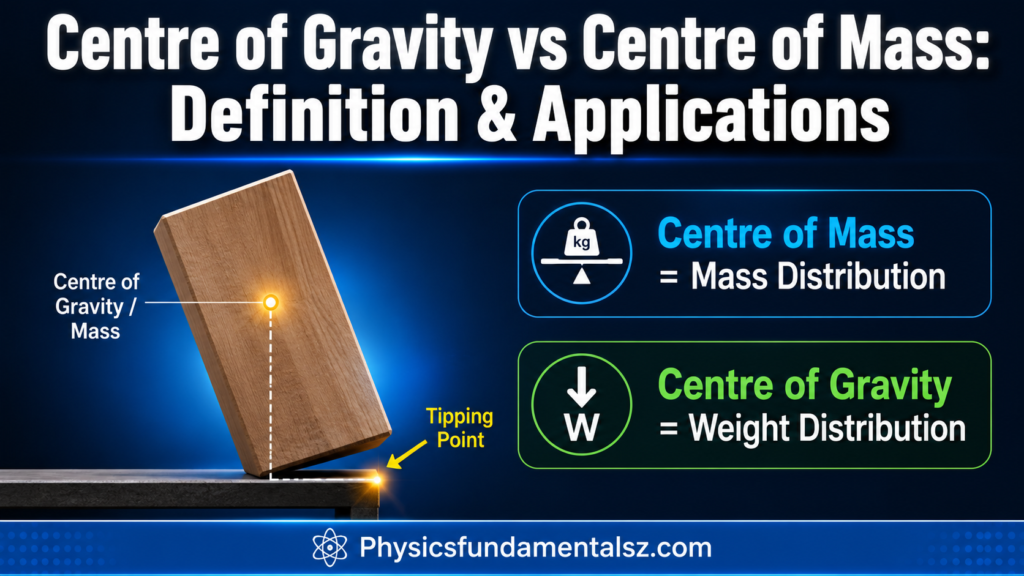
- Centre of mass is the average position of all the mass in an object, and it depends purely on how mass is distributed. It has nothing to do with gravity at all.
- Centre of gravity is the average position of an object’s weight, and weight depends on the local strength of gravity acting on each part of the object.
In a uniform gravitational field, where gravity has the same strength and direction everywhere across the object (which is true for almost every object near Earth’s surface), the centre of gravity and centre of mass are identical. This is why the two terms get used interchangeably so often, and why most textbooks and classroom problems never bother separating them.
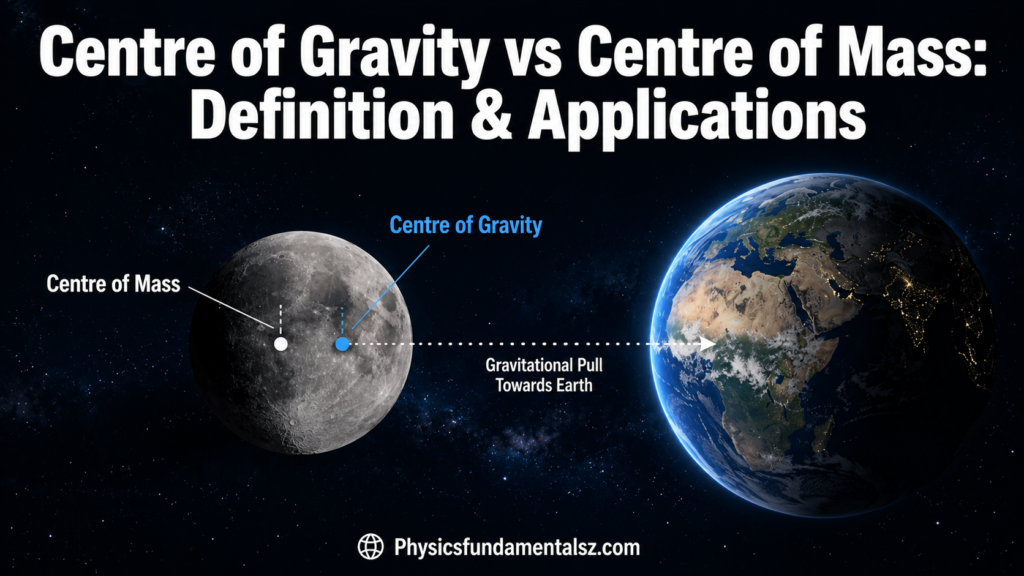
The difference only becomes meaningful when gravity is not uniform across an object, which typically only matters for very large bodies. The clearest example is the Moon: its centre of mass is close to its geometric centre, but its centre of gravity is shifted slightly toward Earth, because the side of the Moon facing Earth experiences a marginally stronger gravitational pull than the far side.
| Aspect | Centre of Mass | Centre of Gravity |
|---|---|---|
| Depends on | Distribution of mass only | Distribution of weight (mass and local gravity) |
| Affected by gravity | No | Yes |
| Location in uniform gravity | Same as centre of gravity | Same as centre of mass |
| Location in non-uniform gravity | Stays fixed relative to the object’s mass | Can shift slightly toward the stronger gravitational source |
| Common use | Preferred term in physics and kinematics | Common in engineering, aviation, and everyday stability problems |
Centre of Gravity vs Centroid
Another term that often gets mixed up with centre of gravity is the centroid. The centroid is a purely geometric concept, the average position of all the points that make up a shape, with no reference to mass or weight at all. For a uniform, homogeneous object, the centroid, the centre of mass, and the centre of gravity all sit at exactly the same point. For a non-uniform object, such as a shape made of two different materials, the centroid stays fixed based on geometry alone, while the centre of gravity shifts toward whichever section is heavier.
Why Centre of Gravity Determines Stability
One of the most practical uses of centre of gravity is predicting whether an object will stay balanced or tip over. An object remains stable as long as its centre of gravity stays directly above its base of support. The moment the centre of gravity shifts beyond the edge of that base, gravity produces a torque that rotates the object, and it topples.
This single idea explains a huge range of everyday and engineering situations:
1. Why Race Cars Sit Low to the Ground
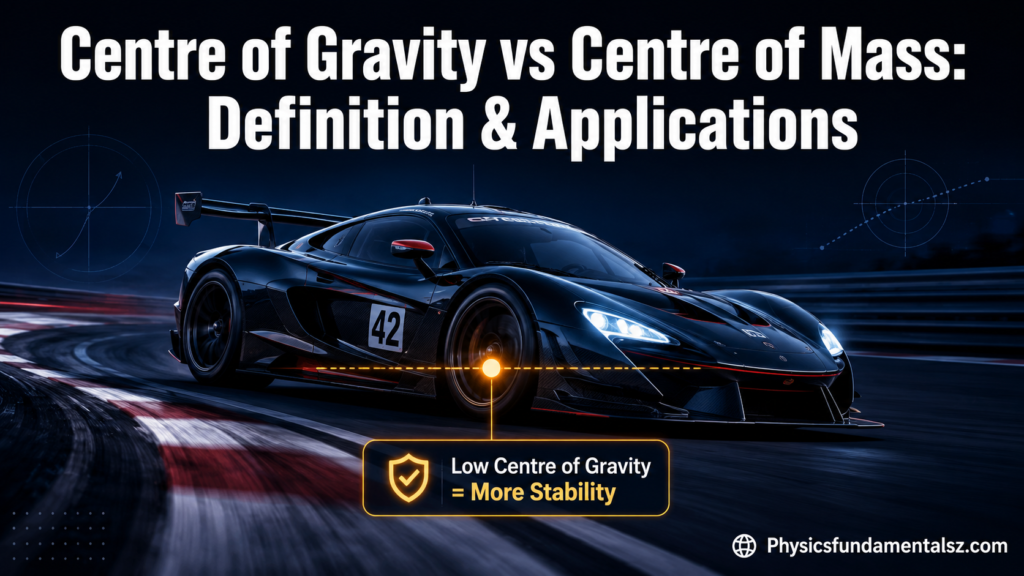
Race cars are deliberately designed with a very low centre of gravity. A lower centre of gravity means the car can lean further, and corner faster, before its centre of gravity shifts far enough to pass beyond the wheelbase and cause a rollover. This is directly tied to how forces act on a turning vehicle, the same circular motion principles covered in centripetal and centrifugal force analysis.
2. Why SUVs Are More Prone to Rollovers
SUVs and trucks sit higher off the ground, giving them a higher centre of gravity. In a sharp turn, this higher centre of gravity shifts sideways more easily relative to the vehicle’s narrower base, making it more likely to tip beyond its base of support and roll over compared to a lower, wider vehicle taking the exact same turn.
3. Why Tightrope Walkers Use Long Poles
A tightrope walker holding a long pole is deliberately lowering and widening their effective centre of gravity. The pole’s weight, distributed far to either side, shifts the combined centre of gravity of the walker-and-pole system lower and keeps it more easily positioned above the narrow rope, making balance far easier to maintain.
4. Why a Bottle Tips Over More Easily When Nearly Empty vs Full
A tall, narrow bottle that is completely empty has a centre of gravity higher up, closer to the middle of its height, making it easier to tip with a small push. A bottle filled with liquid has a lower centre of gravity, closer to its base, making it noticeably more stable and harder to knock over, since its centre of gravity has to shift much further sideways before passing beyond its base of support.
How to Find the Centre of Gravity Experimentally
For a flat, irregular object, the centre of gravity can be found using a simple plumb-line method:
- Suspend the object freely from a single point near its edge.
- Attach a plumb line (a weight hanging from a string) to that same suspension point and let it hang straight down.
- Mark the straight vertical line traced by the plumb line across the object.
- Repeat the process by suspending the object from a different point.
- The intersection of the two marked lines is the object’s centre of gravity.
This works because, when an object hangs freely from any single point, its centre of gravity always settles directly beneath that suspension point due to gravity’s pull. Two such lines from two different suspension points will always intersect exactly at the centre of gravity.
Centre of Gravity in Motion
The centre of gravity is not just important for stationary, balanced objects. It plays a central role in describing motion as well. Whenever an object moves through the air, whether it is a thrown ball, a diver, or a spinning gymnast, its centre of gravity follows a smooth, predictable path, typically a parabola under gravity alone, even if the rest of the object’s shape is twisting, rotating, or changing entirely.
This is the same principle used to simplify projectile motion problems: instead of tracking every part of a complex, rotating object, physicists track the motion of its centre of gravity alone, then treat the rest of the object’s rotation as a separate, additional effect layered on top. This directly connects to the equations used in projectile motion range calculations, and to the constant-acceleration motion described by the SUVAT equations, both of which assume motion is being tracked at a single representative point, effectively the object’s centre of gravity.
Even in free fall, where every part of an object accelerates downward at the same rate, the centre of gravity remains the natural reference point for describing the object’s overall trajectory, a concept tied closely to our guide on free fall and gravity.
Common Misconceptions
Misconception 1: Centre of gravity and centre of mass are always different things. In nearly every practical situation on Earth, they are identical. The distinction only matters in genuinely non-uniform gravitational fields, which is rare outside of astronomy and advanced engineering.
Misconception 2: The centre of gravity must be located inside the object. This is false. Irregularly shaped or hollow objects, such as a ring, a horseshoe, or a boomerang, can have a centre of gravity located entirely outside their physical material.
Misconception 3: A lower centre of gravity always means a slower or less capable design. In reality, a lower centre of gravity is a deliberate design choice in situations demanding stability and speed, such as race cars, sports cars, and even some aircraft designs, precisely because it allows for sharper turns and higher stability without tipping.
Frequently Asked Questions (FAQs)
Is centre of gravity the same as centre of mass?
In a uniform gravitational field, which describes almost every everyday object near Earth’s surface, yes, the two points are identical. They only differ in a non-uniform gravitational field, which typically only becomes noticeable for extremely large bodies like planets or moons.
What is the centre of gravity formula?
The centre of gravity along one axis is calculated as the weighted average of each mass’s position: x_cg = (m₁x₁ + m₂x₂ + …) divided by the total mass (m₁ + m₂ + …). Heavier sections pull the centre of gravity toward their own position.
Why does a lower centre of gravity make an object more stable?
A lower centre of gravity means the object has to tilt much further before its centre of gravity shifts beyond its base of support. This gives it a wider margin before gravity’s torque causes it to topple, which is why low, wide objects resist tipping far better than tall, narrow ones.
Can the centre of gravity be outside an object?
Yes. Any object with an irregular, hollow, or curved shape, such as a horseshoe, a boomerang, or a doughnut, can have its centre of gravity located in the empty space at the object’s centre, entirely outside the physical material itself.
How is centre of gravity used in vehicle design?
Vehicle designers deliberately position the engine, chassis, and heavy components as low as possible to lower the vehicle’s centre of gravity. This increases stability during turns and reduces the risk of rollovers, which is why race cars sit extremely low while taller vehicles like SUVs are more prone to tipping in sharp turns.
Final Thoughts
The centre of gravity is far more than a textbook definition. It is the single point that determines whether a structure stands or falls, why certain vehicles corner safely while others roll over, and how a tightrope walker manages to stay balanced dozens of feet in the air.
While it is often treated as identical to centre of mass, and for nearly all everyday purposes it truly is, understanding the subtle distinction between the two deepens your grasp of how gravity, mass, and stability interact.
To build further on these foundations, explore our detailed guide on centre of mass, revisit the basics of Newton’s laws of motion, or work through real problems using our calculators page to calculate centre of gravity, centre of mass, and motion under gravity step by step.