Centripetal vs Centrifugal Force: What’s Real & What’s Not
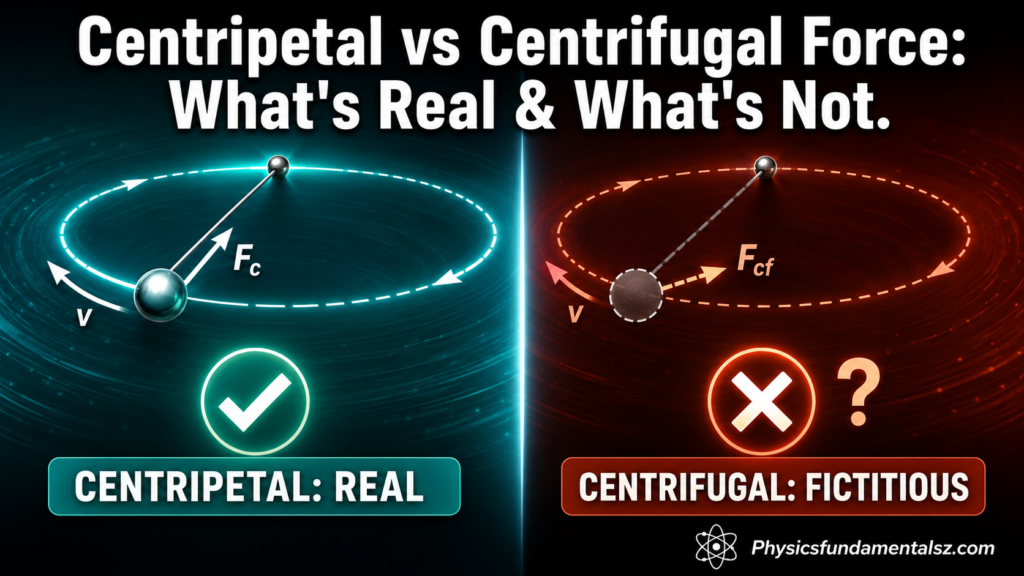
Spin a bucket of water fast enough in a vertical circle and the water stays in, even upside down. Ride a merry-go-round and you feel yourself being pulled outward. Both moments involve the same pair of ideas that confuse almost every physics student at some point: centripetal and centrifugal force.
They sound alike, they are connected mathematically, and they are used almost interchangeably in casual speech. In physics, though, they describe two very different things: one is a real, measurable force, and the other is a sensation created by your frame of reference.
Table of Contents
What Is Centripetal Force?

Centripetal force is the real force that acts on any object moving in a circular path, and it always points toward the center of that circle. Without it, an object in motion would simply travel in a straight line, following Newton’s first law of inertia, which is covered in more depth in our guide to Newton’s laws of motion.
Centripetal force is not a new, separate type of force. It is a role played by whichever real force happens to be pulling an object toward the center of its circular path. That force could be:
- Gravity, keeping the Moon in orbit around Earth
- Tension, keeping a ball on a string moving in a circle
- Friction, keeping a car’s tires gripping the road through a turn
- Normal force, pressing a rider into the wall of a spinning fairground ride
Centripetal Force Formula
The centripetal force formula is:
F = mv² / r
Where:
- F is the centripetal force, measured in newtons
- m is the mass of the object, in kilograms
- v is the object’s tangential velocity, in metres per second
- r is the radius of the circular path, in metres
This formula shows that centripetal force increases with the square of the velocity, so doubling an object’s speed around a curve quadruples the force needed to keep it on that path. It also shows that a tighter turn (smaller radius) demands a larger force at the same speed. This is exactly why race cars slow down before sharp bends and why understanding vectors and direction matters so much in circular motion, a topic explored further in our article on vectors and scalars.
What Is Centrifugal Force?
Centrifugal force is the apparent outward force felt by an object moving along a curved path, but it is not a true force in the Newtonian sense. Instead, it is what physicists call a fictitious or pseudo-force, one that only appears when you are observing motion from inside a rotating reference frame.
Imagine sitting in a car that suddenly turns sharply to the left. You feel your body pushed to the right, toward the outside of the turn. Nothing physically pushed you outward. What actually happened is that your body’s inertia tried to keep moving in a straight line while the car turned underneath and around you. From inside the car (the rotating frame), it feels like an outward force. From outside the car, looking down from above (an inertial frame), there is no outward force at all, only your body attempting to continue in a straight line while the seatbelt and door supply the real inward, centripetal force.
Centrifugal Force Formula
Centrifugal force uses the same mathematical form as centripetal force, just applied in the opposite direction within a rotating frame:
F꜀ = mv² / r (directed outward, in the rotating frame)
The magnitude is identical to the centripetal force acting in the inertial frame. This is one reason the two ideas get confused so often: the numbers match, only the direction and the frame of reference differ.
Centripetal vs Centrifugal Force: Key Differences
| Aspect | Centripetal Force | Centrifugal Force |
|---|---|---|
| Nature | Real force | Fictitious (pseudo) force |
| Direction | Toward the center of the circle | Away from the center (apparent) |
| Frame of reference | Observed from an inertial (non-rotating) frame | Only appears in a rotating (non-inertial) frame |
| Cause | Provided by gravity, tension, friction, or normal force | Arises from inertia, the tendency to resist a change in motion |
| Example | Gravity pulling a satellite toward Earth | The sensation of being flung outward on a spinning ride |
Why Only One Force Is “Real”
This is the part that trips up most students, so it is worth slowing down on. In physics, whether a force is “real” depends on whether it can be traced back to a physical interaction, gravity, electromagnetism, tension in a rope, friction between surfaces, or a normal force from a surface pushing back.
Centripetal force always fits that description. You can point to the specific physical cause every single time.
Centrifugal force cannot be traced to any physical interaction. It exists only because you have chosen to describe motion from within a rotating system instead of from a stationary, external viewpoint. Switch your viewpoint back to an inertial frame, standing outside the spinning system, and the centrifugal force vanishes completely, while the object’s inertia and the real centripetal force fully explain its motion.
This distinction matters because it connects directly to how displacement, velocity, and acceleration are defined for any object in motion, the same foundational quantities used throughout kinematics, including the SUVAT equations used for motion under constant acceleration.
Everyday Examples of Centripetal and Centrifugal Force

1. A Car Turning a Corner
As a car turns, friction between the tires and the road supplies the centripetal force, pulling the car toward the center of the curve. Passengers inside feel pushed toward the outside of the turn, which is the sensation commonly called centrifugal force. If the road is too slippery, or the car goes too fast for the curve’s radius, friction cannot supply enough centripetal force, and the car skids outward in a straight line rather than following the curve.
2. A Spinning Fairground Ride
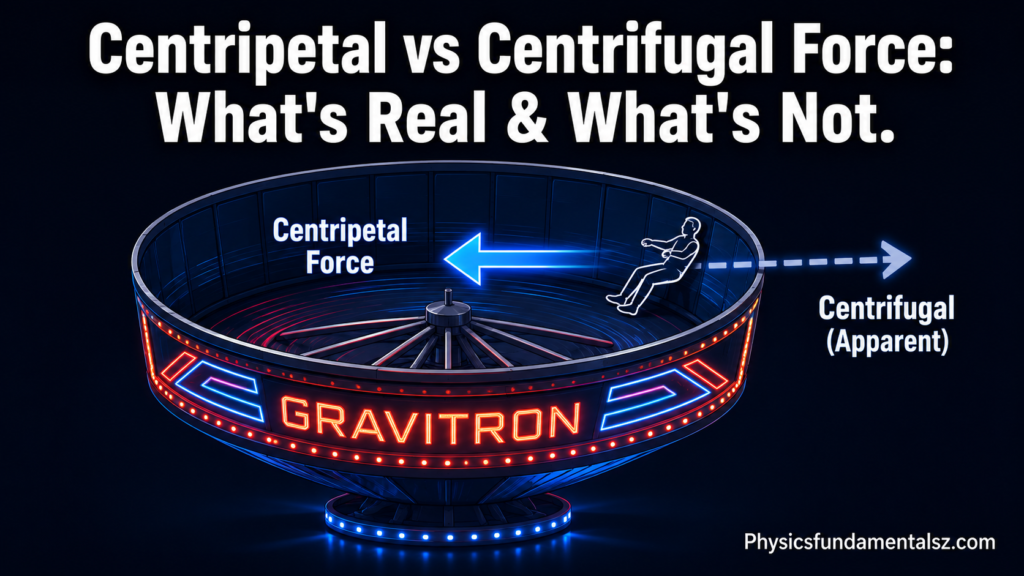
On rides like the Gravitron, riders are pressed against the outer wall. The wall supplies a real, inward normal force, which is the centripetal force keeping riders moving in a circle. What riders feel, the sensation of being pinned outward, is the centrifugal effect experienced only because they are inside the rotating frame of the ride itself.
3. Satellites and Orbital Motion
A satellite orbiting Earth is continuously falling toward the planet due to gravity, which acts as the centripetal force. There is no real outward force balancing gravity. The satellite does not fly off into space only because gravity constantly redirects its velocity inward, keeping it on a curved path rather than a straight line. This same interplay between gravity and motion appears in our guide to free fall and gravity, which explains how gravitational acceleration behaves when nothing opposes it.
4. Washing Machine Spin Cycle
During the spin cycle, water is forced outward through holes in the drum while clothes are held in place by the drum wall, which supplies the centripetal force. The clothes do not actually get pushed outward, they simply continue moving in a straight line at each instant until the drum wall redirects them, which appears from inside the drum as an outward, centrifugal effect.
Centripetal Acceleration
Because centripetal force causes an object to continuously change direction, it produces centripetal acceleration, even when the object’s speed stays constant. This is a key idea that often surprises students: acceleration does not always mean speeding up or slowing down. It can mean a change in direction alone.
The formula for centripetal acceleration is:
a = v² / r
This acceleration always points toward the center of the circular path, matching the direction of the centripetal force. Understanding acceleration as a vector quantity, with both magnitude and direction, ties directly back to the concepts covered in our article on vectors and scalars, since circular motion cannot be fully understood using scalar speed alone.
Common Misconceptions

Misconception 1: Centrifugal force pushes objects away from the center. In reality, nothing pushes the object anywhere. The object’s own inertia keeps it moving in a straight line, and it only appears to be pushed outward because the observer is rotating along with the system.
Misconception 2: Centripetal and centrifugal forces cancel each other out, keeping an object in place. There is no real outward force to cancel. The object stays on its circular path purely because centripetal force continuously redirects it. If centripetal force disappeared entirely, the object would fly off in a straight line, tangent to the circle at that instant, not outward along the radius.
Misconception 3: Centrifugal force is fake and therefore unimportant. Even though it is not a true force, centrifugal force is still a genuinely useful concept in engineering and physics, particularly when analyzing systems from a rotating frame, such as designing centrifuges or understanding forces on rotating machinery. It is fictitious in the Newtonian sense, but it is not meaningless.
How This Connects to Broader Kinematics
Circular motion, and the centripetal vs centrifugal distinction within it, is really a special case of the same kinematics principles used throughout classical mechanics. The same reasoning about frames of reference, inertia, and real versus apparent forces recurs when studying terminal velocity, where forces balance to produce constant speed, and in projectile motion range, where an object’s velocity vector changes shape and direction under a single constant force, gravity.
Even topics like the centre of mass connect back here, since the centre of mass of a rotating system is the point around which circular motion is actually calculated in real engineering problems, from spinning wheels to orbiting bodies.
Frequently Asked Questions (FAQs)
Is centrifugal force ever real?
Centrifugal force is only ever “real” in the sense of being a useful mathematical tool within a rotating, non-inertial frame of reference. From any inertial (non-rotating) frame, it does not exist as a physical force, only inertia and the true centripetal force are needed to explain the motion.
What is the main difference between centripetal and centrifugal force?
Centripetal force is a real force directed toward the center of a circular path, provided by gravity, tension, friction, or a normal force. Centrifugal force is an apparent outward force that only appears when observing motion from inside a rotating frame of reference.
Do centripetal and centrifugal forces have the same magnitude?
Yes, mathematically they share the same formula, F = mv² / r, but they act in opposite directions and are calculated from different frames of reference. One is a genuine physical interaction, the other is an effect of inertia observed from a rotating viewpoint.
Why do I feel pushed outward in a turning car if centrifugal force is not real?
Your body’s inertia is trying to keep moving in a straight line while the car turns beneath and around you. From inside the car, that resistance to changing direction feels like an outward push, even though no real force is pushing you outward. The real force at play is the inward centripetal force supplied by friction and the car’s structure.
Can you calculate centripetal force without knowing the object’s velocity?
Not directly using F = mv² / r, since velocity is required. However, if angular velocity is known instead, the formula can be rewritten as F = mω²r, where ω is the angular velocity in radians per second, giving an alternative way to calculate the same force.
Final Thoughts
Understanding centripetal vs centrifugal force comes down to one core idea: real forces cause motion, while apparent forces are simply what inertia looks like from inside a moving, rotating system.
Centripetal force is the true, physical pull toward the center that keeps anything, from planets to fairground rides, moving in a circle. Centrifugal force is the outward sensation created purely by your frame of reference, useful for calculations and intuition, but not a force in its own right.
Once this distinction is clear, circular motion stops being confusing and starts fitting neatly alongside everything else in kinematics, from vectors and Newton’s laws to the equations of motion used throughout classical mechanics.
For more foundational concepts that build toward this topic, explore our guides on Newton’s laws of motion, vectors and scalars, and the SUVAT equations, or check our calculators page to work through circular motion problems step by step.