Terminal Velocity: Why Objects Stop Accelerating & Calculations
Terminal velocity is the constant speed an object reaches when the pulling force of gravity is fully balanced by the resisting force of drag. Once that balance is reached, the object stops speeding up and falls, or sinks, at a steady rate.
A common question is whether terminal velocity changes as an object goes deeper into water. The short answer is that it barely changes in most everyday cases, but the physics behind that answer is more interesting than a simple yes or no.
We will also cover the terminal velocity formula, real world examples, and the key factors that control how fast something falls or sinks.
Table of Contents
What Is Terminal Velocity?
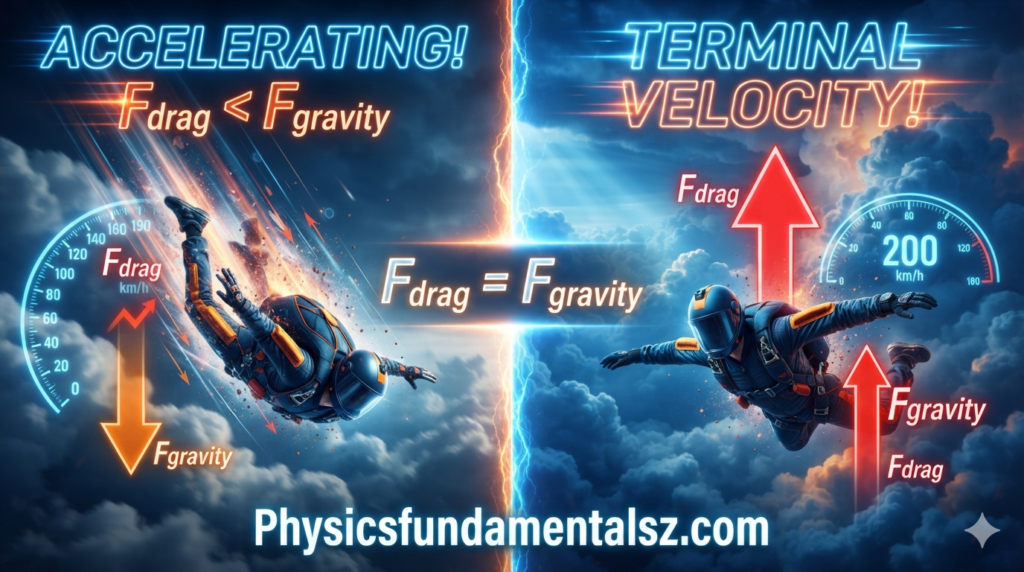
Terminal velocity is the maximum speed a falling or sinking object reaches once the drag force acting against it equals its weight. At that point, the net force on the object is zero, so its acceleration is also zero.
This is one of the clearest real world demonstrations of Newton’s second law in action. If you want a refresher on how force, mass, and acceleration relate to each other, our Newton’s Laws of Motion guide walks through the full breakdown.
Before terminal velocity is reached, an object still accelerates, just more slowly as drag builds up. After it is reached, speed stays constant unless something in the surrounding fluid changes.
The Terminal Velocity Formula
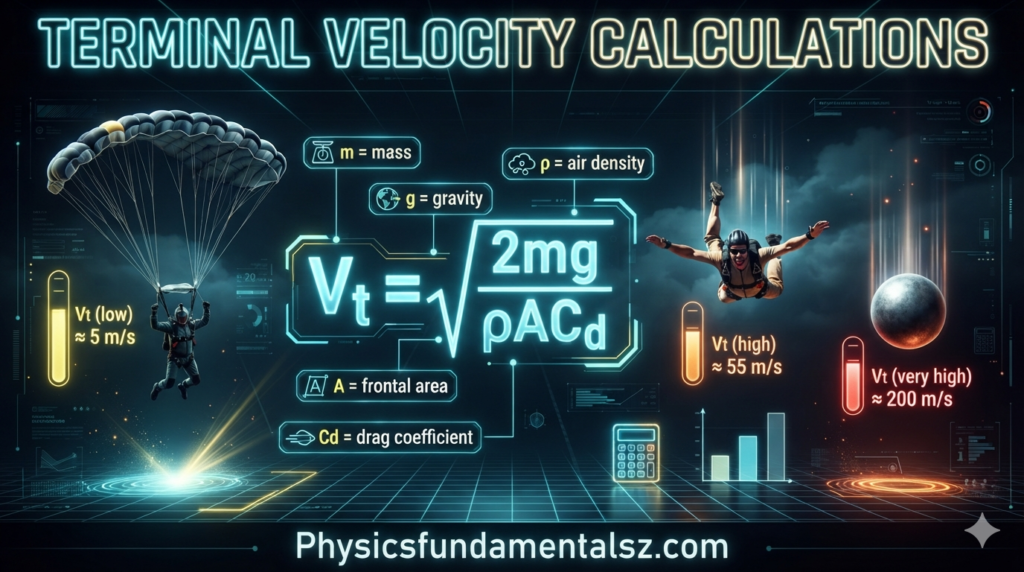
The standard terminal velocity formula for an object falling through a fluid is:
v_t = sqrt( (2mg) / (ρ × Cd × A) )
Here, m is the mass of the object, g is gravitational acceleration, ρ is the density of the fluid, Cd is the drag coefficient, and A is the cross sectional area facing the flow.
Because velocity has both a magnitude and a direction, terminal velocity is technically a vector quantity. Our guide on vectors and scalars explains this distinction in more detail if you want the full picture.
Terminal Velocity in Air vs Terminal Velocity in Water
Terminal velocity in air is much higher than terminal velocity in water for the same object. Air is roughly 800 times less dense than water, so it offers far less resistance.
A skydiver reaches around 195 kilometers per hour in a belly to earth position through air. The same size object sinking through water would reach a dramatically lower terminal speed because water pushes back far harder.
This difference comes down entirely to fluid density and drag, both of which sit directly in the terminal velocity formula above.
Does Terminal Velocity Change With Depth in Water?
For most objects sinking in the ocean or a lake, terminal velocity stays close to constant once it is first reached, because the two main variables in the formula, fluid density and drag coefficient, barely shift with depth.
That said, the answer is not a flat no. There are specific situations where depth genuinely does affect the speed at which something sinks.
Why Water Density Barely Changes With Depth
Water is nearly incompressible, so its density increases only slightly as pressure rises with depth. Even at extreme ocean depths, water density rises by only a small percentage compared to the surface.
Because density sits inside the terminal velocity formula, a small change in density produces an even smaller change in terminal velocity, since velocity depends on the square root of density.
In practical terms, this means an object sinking from the surface to a moderate depth will barely notice any change in the surrounding water’s resistance.
How Pressure Affects a Sinking Object
While water pressure increases significantly with depth, this pressure acts fairly evenly on a solid, rigid object and does not create extra drag by itself. Pressure squeezes an object from all directions rather than slowing its fall.
What actually controls sinking speed is drag from the object moving through the fluid, not the surrounding pressure itself. This is a common misconception worth clearing up.
Rigid objects like a steel ball or a rock will keep a fairly steady terminal velocity throughout most of their descent for exactly this reason.
When Terminal Velocity Actually Does Change Underwater
Terminal velocity can change with depth in a few real situations. If the sinking object is compressible, such as certain plastics, foams, or biological material, increasing pressure can shrink its volume and change its buoyancy and drag profile.
Temperature also changes with depth in oceans, and colder water is slightly denser and more viscous, which can subtly increase drag and slow terminal velocity further down.
Turbulence, currents, and changes in water salinity at different depths can also cause small shifts in an object’s sinking speed, even if the core physics stays the same.
The Physics Behind Terminal Velocity

Understanding terminal velocity fully means looking at the three forces constantly acting on a falling or sinking object: gravity, drag, and buoyancy.
Gravity vs Drag Force
Gravity pulls every object downward with a constant force equal to its mass multiplied by gravitational acceleration. Drag force, on the other hand, increases as speed increases, since faster movement pushes more fluid out of the way per second.
As the object speeds up, drag grows until it exactly cancels gravity’s pull. At that instant, terminal velocity is reached and acceleration drops to zero, which lines up directly with Newton’s second law of motion.
Buoyancy’s Role in Underwater Terminal Velocity
In water, a third force matters just as much as gravity and drag: buoyancy. Buoyancy pushes upward with a force equal to the weight of the fluid the object displaces.
An object’s effective downward force in water is its weight minus buoyancy, not its full weight as in air. This is why the same object sinks far more slowly in water than it falls in air, even beyond what density alone would suggest.
Dense, compact objects like a coin or a metal weight have low buoyancy relative to their weight, so they sink steadily. Lighter or more porous objects can have buoyancy close to their weight, producing very low terminal velocities.
Newton’s Laws and Terminal Velocity
Every part of this process traces back to Newton’s second law, force equals mass times acceleration. When the net force on an object becomes zero, acceleration becomes zero too, and that is the exact moment terminal velocity begins.
If you want to see how this same law explains motion in other contexts, our full Newton’s Laws of Motion article covers all three laws with worked examples.
Terminal Velocity Examples in Real Life
Terminal velocity shows up constantly in everyday physics, both in air and in water.
Skydivers Reaching Terminal Velocity in Air
A skydiver in free fall accelerates quickly at first, then levels off at a near constant speed once drag balances their weight. Changing body position, like spreading arms and legs versus diving head first, changes surface area and therefore changes terminal velocity significantly.
Objects Sinking in the Ocean
A dense object dropped into the ocean accelerates briefly, then reaches a steady sinking speed that stays fairly constant across most of its descent, as covered above. Marine researchers use this principle to estimate how quickly debris, sediment, or biological material settles toward the seafloor.
Raindrops and Terminal Velocity
Raindrops reach terminal velocity almost immediately because of their small size and low mass. This is why rain falls at a fairly predictable, gentle speed rather than accelerating endlessly from cloud height.
Factors That Affect Terminal Velocity
Several variables control how fast an object reaches terminal velocity and how fast that terminal speed actually is.
| Factor | Effect on Terminal Velocity |
|---|---|
| Object mass | Higher mass increases terminal velocity |
| Cross sectional area | Larger area increases drag, lowering terminal velocity |
| Fluid density | Denser fluid increases drag, lowering terminal velocity |
| Drag coefficient (shape) | Streamlined shapes lower drag, raising terminal velocity |
| Buoyancy in water | Higher buoyancy lowers effective weight, lowering terminal velocity |
| Depth in water | Minimal effect in most cases, slight decrease possible with colder, denser water |
How to Calculate Terminal Velocity
To calculate terminal velocity, you need the object’s mass, the fluid’s density, its drag coefficient, and its cross sectional area, then plug them into the formula covered earlier in this guide.
This calculation is really an application of balancing forces, the same core idea used throughout mechanics problems involving motion and energy. If you want to see how energy and work connect to changing speeds, our Work-Energy Theorem guide is a useful next read.
For a broader refresher on how force, motion, and acceleration fit together across physics as a whole, our Physics Fundamentals guide ties these core concepts into one complete overview.
A Worked Terminal Velocity Example
Imagine a small steel ball with a mass of 0.5 kilograms sinking in water. Using a fluid density of 1000 kg per cubic meter, a drag coefficient of 0.47 for a sphere, and a cross sectional area of about 0.008 square meters, plugging these values into the formula gives a terminal velocity of roughly 4 to 5 meters per second.
Change any single variable, and the result shifts immediately. A larger cross sectional area lowers terminal velocity, while a heavier mass raises it, which is exactly why shape and weight matter so much in real world sinking and falling problems.
This same balancing act applies whether you are solving a textbook problem or estimating how fast an object will settle in open water.
Common Misconceptions About Terminal Velocity
A few myths about terminal velocity tend to stick around, even though the physics is well understood.
Myth: Heavier Objects Always Fall Faster
Mass alone does not decide falling speed. A heavy, compact object usually has a higher terminal velocity than a light, spread out object, but shape and surface area matter just as much as mass in the formula.
Myth: Terminal Velocity Means an Object Stops Accelerating Forever
Terminal velocity only holds as long as conditions stay the same. If an object changes orientation, enters a different fluid, or experiences a shift in temperature or density, its terminal velocity can change again.
Myth: Deeper Water Always Means Slower Sinking
As covered earlier in this guide, depth by itself has only a minor effect on terminal velocity for most rigid objects. The bigger factors are almost always drag, buoyancy, and the object’s own shape and density.
Frequently Asked Questions (FAQs)
Does terminal velocity increase with depth in water?
In most cases, no, terminal velocity stays close to constant with depth because water density changes only slightly as depth increases.
What is terminal velocity in simple terms?
It is the constant top speed a falling or sinking object reaches once drag and buoyancy fully balance out gravity’s pull.
Why is terminal velocity lower in water than in air?
Water is far denser than air, so it produces much more drag and buoyancy, slowing objects down significantly compared to falling through air.
Can terminal velocity ever change during a fall?
Yes, if the object’s shape, orientation, or the surrounding fluid’s density or temperature changes, terminal velocity can shift up or down.
Does pressure alone slow down a sinking object?
Not directly. Pressure acts evenly around a solid object, while drag from movement through the fluid is what actually resists its motion.
What factors affect an object’s terminal velocity?
Mass, shape, surface area, fluid density, drag coefficient, and buoyancy all influence how fast an object reaches terminal velocity.
Conclusion
Terminal velocity is the point where gravity and drag cancel out, leaving an object moving at a constant, unchanging speed. In water, this speed stays fairly steady with depth in most everyday situations, since water’s density changes only slightly as pressure rises.
Real change in underwater terminal velocity tends to come from compressible materials, shifting temperature, or changing water conditions rather than pressure itself. Understanding gravity, drag, and buoyancy together gives a much clearer picture than looking at depth or pressure alone.
Whether you are studying a skydiver in the sky or an object sinking toward the ocean floor, the same core physics principles apply.
Once you understand how these forces balance, terminal velocity stops feeling like a strange exception and starts feeling like a natural, predictable result of the laws of motion.