Work-Energy Theorem: Complete Guide with Formula, Derivation, and Examples
The work-energy theorem is one of the most useful shortcuts in classical mechanics. Instead of tracking forces and accelerations at every instant, it lets you connect work done on an object directly to the change in its kinetic energy.
If you are still building intuition around force and motion, it helps to first review Newton’s Laws of Motion, since the work-energy theorem is derived directly from Newton’s second law.
Table of Contents
What Is the Work-Energy Theorem?
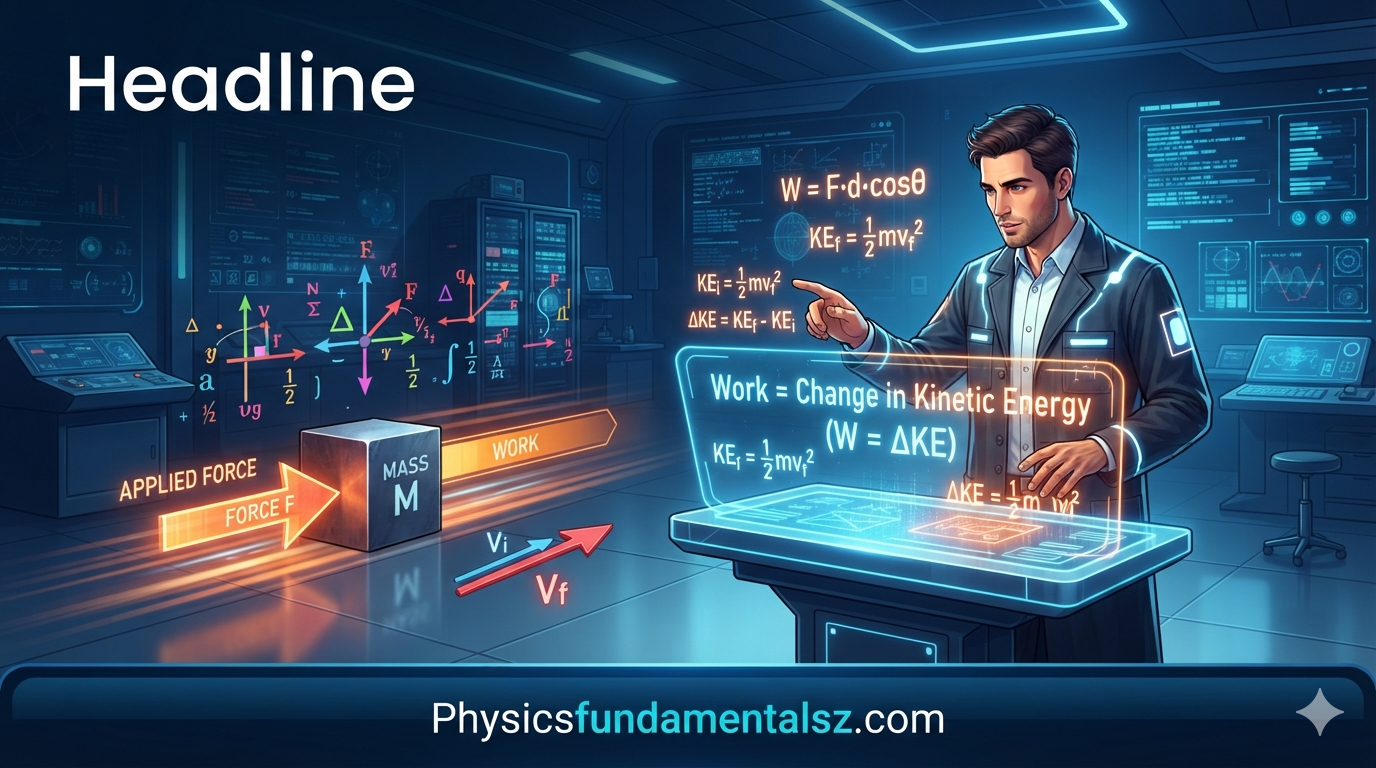
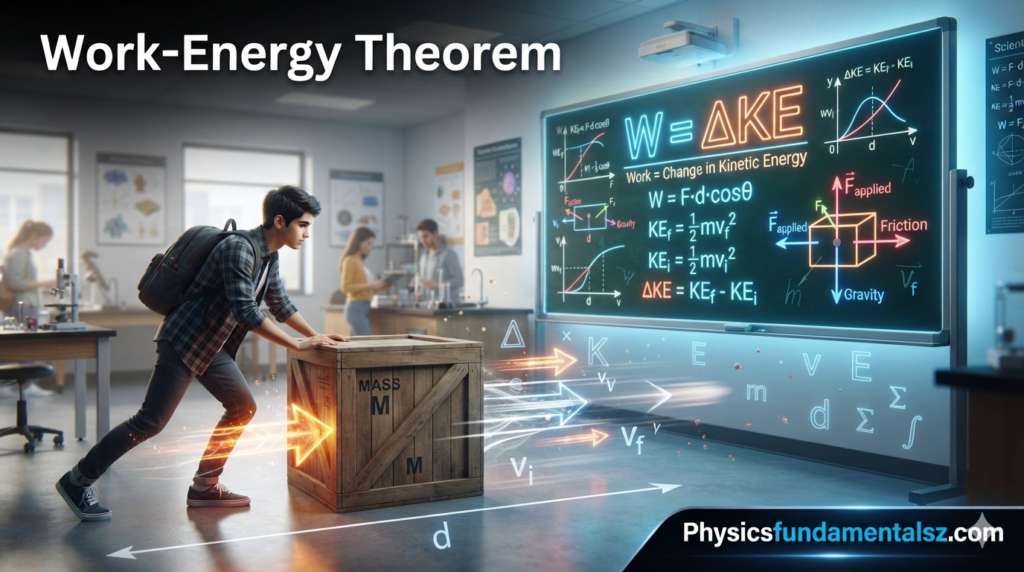
The work-energy theorem states that the net work done on an object by all the forces acting on it is equal to the change in the object’s kinetic energy. In simple terms, when you push, pull, or otherwise apply a net force to an object over a distance, the energy you transfer shows up as a change in how fast that object is moving.
This is a core idea in the broader topic of energy in physics. Work and kinetic energy are two sides of the same coin: work is the process of transferring energy, and kinetic energy is the energy an object has because it is moving.
A key point students often miss: the theorem applies only to the net work, meaning the combined effect of every force acting on the object, not the work done by a single force in isolation.
Work-Energy Theorem Formula
The standard work-energy theorem formula is written as:
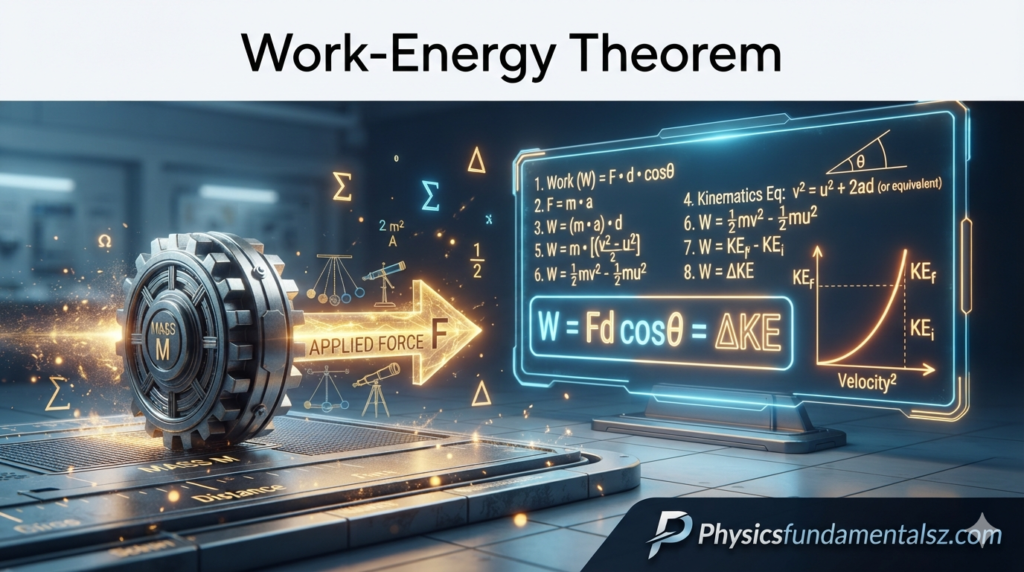
W = ΔKE = KEf − KEi = ½mv²f − ½mv²i
Where:
- W is the net work done on the object
- KEf is the final kinetic energy
- KEi is the initial kinetic energy
- m is the mass of the object
- vf is the final velocity
- vi is the initial velocity
This formula tells you that if you know the work done on an object, you can find its change in speed without ever calculating acceleration directly. That is what makes the work-energy theorem so practical for solving real problems quickly.
Work-Energy Theorem Derivation
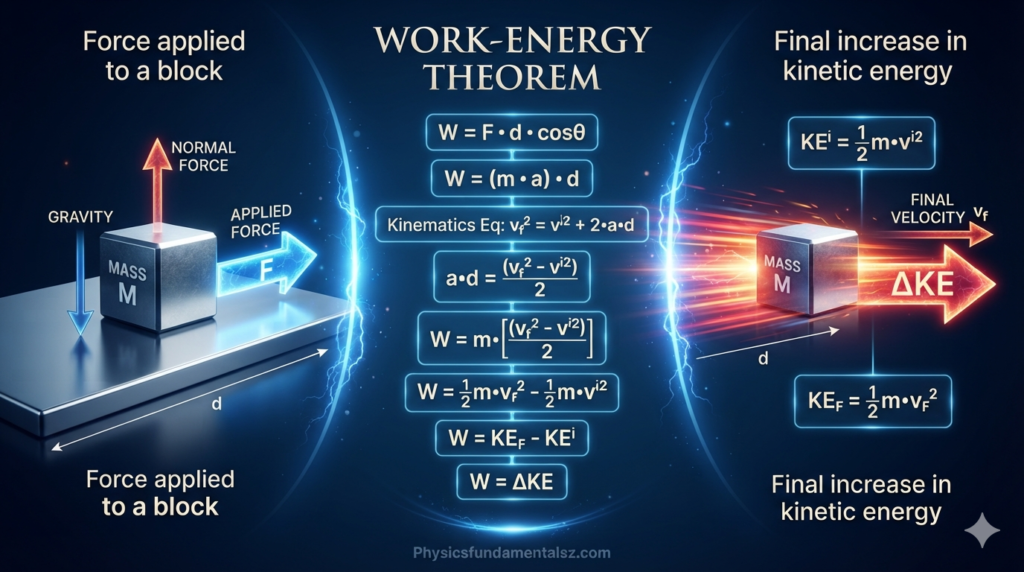
The work-energy theorem derivation starts from Newton’s second law, F = ma. Consider a particle of mass m moving under a constant net force F, causing a displacement d.
Step 1: Start with Newton’s second law. F = ma
Step 2: Use the kinematic relation that connects velocity, acceleration, and displacement (the same relation used throughout kinematics): v²f = v²i + 2ad
Step 3: Solve for acceleration. a = (v²f − v²i) / 2d
Step 4: Substitute this value of a back into F = ma. F = m × (v²f − v²i) / 2d
Step 5: Multiply both sides by displacement d to get work (since work equals force times displacement). F × d = ½m(v²f − v²i)
Step 6: The left-hand side, F × d, is the definition of work. The right-hand side is the change in kinetic energy. W = ½mv²f − ½mv²i = ΔKE
This confirms the work-energy theorem: work done equals the change in kinetic energy. While this derivation assumes a constant force, the theorem generalizes to variable forces as well, which is covered in the next section.
Work-Energy Theorem for Variable Force
Many real-world forces are not constant. Spring forces, air resistance, and gravitational forces near large distances all change with position. For a variable force, the work-energy theorem is derived using calculus rather than simple algebra.
Work done by a variable force is found by integrating the force over displacement:
W = ∫ F(x) dx, evaluated from the initial position to the final position
Once this integral is calculated, it still equals the change in kinetic energy:
∫ F(x) dx = ½mv²f − ½mv²i
This version of the theorem is essential in more advanced mechanics problems, such as analyzing springs (which follow Hooke’s Law) or objects experiencing drag.
Work-Energy Theorem Examples
Working through examples is the fastest way to understand how the formula behaves in practice.
Example 1: Constant Force on a Flat Surface
A 5 kg block starts at rest and is pushed with a constant net force of 20 N over a distance of 4 meters. Find its final velocity.
Work done: W = F × d = 20 × 4 = 80 J
Using the work-energy theorem: W = ½mv²f − ½mv²i
Since the block starts at rest, vi = 0, so: 80 = ½(5)v²f v²f = 32 vf ≈ 5.66 m/s
Example 2: Object Already in Motion
A 2 kg object moving at 3 m/s is acted on by a net force that does 20 J of work in the direction of motion. Find its final speed.
Initial KE = ½(2)(3)² = 9 J Final KE = Initial KE + Work = 9 + 20 = 29 J 29 = ½(2)v²f v²f = 29 vf ≈ 5.39 m/s
Example 3: Friction and the Work-Energy Theorem
A 10 kg box slides across a rough floor at 6 m/s and comes to rest after 3 meters due to friction. Find the friction force.
Initial KE = ½(10)(6)² = 180 J Final KE = 0 J (object stops) Work done by friction = ΔKE = 0 − 180 = −180 J
Since W = F × d: −180 = F × 3 F = −60 N
The negative sign shows that friction acts opposite to the direction of motion, removing kinetic energy from the system rather than adding to it.
Applications of the Work-Energy Theorem
The work-energy theorem shows up across nearly every branch of classical mechanics:
Projectile motion: When analyzing objects launched into the air, the theorem can be combined with concepts from projectile motion to find speed at any point in the trajectory without solving separately for horizontal and vertical components.
Braking and stopping distance: Vehicle safety engineers use the theorem to calculate stopping distances, since the work done by braking friction must remove all of a car’s kinetic energy.
Roller coasters and inclined planes: The theorem simplifies problems where gravity, friction, and normal force all act together, since only the net work matters.
Springs and elastic systems: Combined with the variable-force version of the theorem, it explains how energy is stored and released in springs.
Collisions: While the work-energy theorem itself does not directly describe momentum transfer, it is often used alongside conservation of momentum to fully analyze collisions, since momentum and kinetic energy behave differently depending on whether a collision is elastic or inelastic.
Work-Energy Theorem for Rotational Motion

The work-energy theorem is not limited to objects moving in a straight line. It extends naturally to rotating bodies through the concept of rotational kinetic energy.
For a rigid body rotating about a fixed axis, the theorem takes this form:
W = ΔKErot = ½Iω²f − ½Iω²i
Where I is the moment of inertia of the object and ω represents angular velocity. Instead of force and linear displacement, this version uses torque and angular displacement, since torque plays the same role for rotation that force plays for straight-line motion. This is why the theorem is sometimes introduced alongside topics like circular motion, where a body’s rotational speed changes due to an applied torque rather than a linear push.
Real-Life Examples of the Work-Energy Theorem
Beyond textbook problems, the work-energy theorem explains everyday physical situations:
A hammer striking a nail: The work done by the swinging hammer converts into kinetic energy at the point of impact, which is then transferred into the nail as it is driven into the wood.
An arrow leaving a bow: The bowstring does work on the arrow over the draw length, and that work becomes the arrow’s kinetic energy the moment it leaves the bow.
A skater gliding to a stop: Friction between skates and ice does negative work on the skater, gradually reducing kinetic energy until the skater comes to rest.
A falling object: As an object falls, gravity does positive work on it, and the work-energy theorem shows exactly how much kinetic energy it gains as it speeds up.
These situations all follow the same core relationship: whatever net work is done on an object, that same amount shows up as a change in its kinetic energy, whether the object speeds up, slows down, or changes direction.
Work-Energy Theorem in Class 9 and Class 11 Physics
The work-energy theorem appears at different depths depending on the level of study.
In Class 9 physics, students are typically introduced to the basic idea: work done on an object changes its kinetic energy, usually explored through simple examples involving pushing or lifting objects with a constant force.
In Class 11 physics, the treatment becomes more rigorous. Students learn the full derivation from Newton’s second law, apply the theorem to variable forces using calculus, and use it to solve problems involving friction, inclined planes, and springs. This deeper version of the theorem also connects directly to the broader principle of conservation of energy, which is typically introduced in the same unit.
Regardless of the level, the underlying formula, W = ΔKE, stays exactly the same. Only the complexity of the forces and scenarios involved changes as the topic advances.
Work-Energy Theorem vs Conservation of Energy
Students frequently confuse the work-energy theorem with the law of conservation of energy. They are related but not identical.
The work-energy theorem deals specifically with kinetic energy and the net work done by all forces, including non-conservative forces like friction. Conservation of energy is a broader principle stating that total energy in an isolated system, kinetic plus potential plus other forms, remains constant over time.
In short: the work-energy theorem is a specific tool for tracking kinetic energy changes, while conservation of energy is the general law that the work-energy theorem is built from.
Common Mistakes When Applying the Work-Energy Theorem
- Using work from a single force instead of net work. The theorem only holds when you account for the combined work of every force acting on the object.
- Forgetting the sign of work. Forces like friction or air resistance do negative work, which must be subtracted, not added.
- Mixing up displacement and distance. Work depends on displacement in the direction of the force, not total distance traveled, especially in curved paths.
- Applying the constant-force formula to a variable force. Situations involving springs or changing forces require the integral form of the theorem.
- Ignoring direction in vector problems. Since work is a scalar derived from a dot product, only the component of force parallel to displacement contributes.
Work-Energy Theorem Practice Problems
Try solving these on your own before checking the method used in the examples above:
- A 3 kg object accelerates from 2 m/s to 8 m/s. How much net work was done on it?
- A cyclist and bike with a combined mass of 80 kg slow from 12 m/s to 4 m/s due to braking. How much work did the brakes do?
- A spring exerts a variable force on a 1 kg cart, doing 45 J of work as the cart moves from rest. What is the cart’s final speed?
Working through these reinforces both the formula and the derivation logic covered earlier in this guide.
Frequently Asked Questions (FAQs)
What is the work-energy theorem in simple words?
It states that the work done on an object equals the change in its kinetic energy, connecting the force applied over a distance to how much the object’s speed changes.
Does the work-energy theorem apply to all forces?
Yes, but only when you use the net force, meaning the combined effect of every force acting on the object, including friction, gravity, and applied forces.
What is the SI unit of work in the work-energy theorem?
Work and kinetic energy are both measured in joules (J), the same unit used throughout mechanics and energy calculations.
Can the work-energy theorem be negative?
Yes. Negative work means kinetic energy decreases, which happens when forces like friction or air resistance oppose the direction of motion.
How is the work-energy theorem different from Newton’s second law?
Newton’s second law relates force to acceleration at an instant, while the work-energy theorem is derived from it and relates work over a displacement to the resulting change in kinetic energy.
Final Thoughts
The work-energy theorem bridges the gap between force-based analysis and energy-based analysis in classical mechanics.
Once you are comfortable with the formula and derivation, it becomes one of the fastest tools for solving motion problems, especially when acceleration is not constant or not directly given.
To build a stronger foundation before tackling more advanced energy problems, review the fundamentals of kinematics and explore more topics in classical mechanics.