Why Is Projectile Motion a Parabola?
Toss a ball, fire a cannon, or spray water from a hose, and the path always bends into the same graceful arch. That curve is a parabola, and it is no coincidence. The reason reveals one of the most powerful ideas in mechanics: that two-dimensional motion is really just two independent one-dimensional motions happening at once.
The key insight: independence of motions
Once a projectile leaves your hand and air resistance is ignored, only one force acts on it — gravity, pulling straight down. Crucially, gravity has no horizontal component. This splits the motion cleanly into two parts that do not interfere with each other:
- Horizontally: no force acts, so the horizontal velocity stays constant.
- Vertically: gravity acts, so the vertical velocity changes at a constant rate g ≈ 9.8 m/s².
This is the famous principle that horizontal and vertical motion are independent. Galileo grasped it four centuries ago, and it is the entire secret behind the parabola.
A bullet fired horizontally and a bullet dropped from the same height hit the ground at the same instant. Gravity governs their vertical fall identically, completely indifferent to any horizontal speed.
Writing down the two motions
Suppose a projectile is launched with horizontal velocity uₓ and vertical velocity u_y. Using the SUVAT equations for each direction separately, the position at time t is:
The horizontal equation is linear in time — equal steps each second. The vertical equation has a t² term, the signature of constant acceleration. These two together completely describe the flight.
Why the path is a parabola
To find the shape of the trajectory, we eliminate time. From the horizontal equation, t = x / uₓ. Substitute this into the vertical equation:
Look at the structure: y depends on x and on x². An equation of the form y = a·x − b·x² is precisely the definition of a parabola. There is nothing else it could be. The constant horizontal motion supplies the x, the constant vertical acceleration supplies the x², and a parabola is the inevitable result.
What controls the shape
The launch angle sets the balance between horizontal and vertical velocity, and so reshapes the parabola:
- A steep launch gives a tall, narrow arch with long hang time but little range.
- A shallow launch gives a flat, stretched arc that lands quickly.
- A launch at 45° gives the maximum horizontal range on level ground, splitting the velocity equally between up and along.
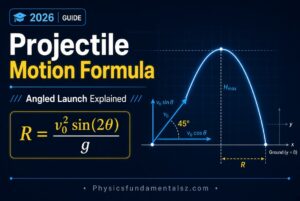
For a projectile launched at speed u and angle θ over flat ground, the range is:
Because sin 2θ peaks at θ = 45°, that angle throws the furthest. The factor u² also shows that doubling launch speed quadruples the range. You can experiment with these numbers using our projectile motion calculator.
The role of symmetry
A parabola is perfectly symmetric, and so is ideal projectile flight. The time to rise to the peak equals the time to fall back down. The launch speed equals the landing speed. The angle going up equals the angle coming down. This symmetry is a direct consequence of gravity being constant and the horizontal motion being undisturbed.
When reality bends the curve
The parabola is an idealisation. In the real world, air resistance pushes back against the motion, draining horizontal speed faster than vertical speed and pulling the descending half of the path steeper than the rising half. The true trajectory of a real cannonball or a fast cricket ball is therefore a lopsided curve, falling short of the ideal parabola. Over very large distances the Earth’s curvature and varying gravity matter too. But for a thrown stone or a kicked football, the parabola is an excellent and beautiful approximation, flowing directly from Newton’s laws.
Frequently asked questions
Why don’t horizontal and vertical motions affect each other?
Because gravity points only downward, it can only change vertical velocity. There is no horizontal force (ignoring air), so horizontal velocity stays constant. The two directions are governed by completely separate equations.
Is the real path of a thrown ball exactly a parabola?
Only in the idealised case with no air resistance and uniform gravity. Real projectiles experience drag, which makes the descending arc steeper than the rising arc, so the true path is slightly asymmetric.
Why is 45° the best angle for distance?
Because range depends on sin 2θ, which reaches its maximum at θ = 45°. That angle splits the launch velocity evenly between staying airborne (vertical) and covering ground (horizontal). On uneven ground or with air resistance, the optimal angle shifts slightly lower.