What Is Electric Field in Physics? Definition, Formula, Examples

Imagine you hold a charged balloon near your hair and the hair rises toward it without anything touching it. Something invisible is reaching across the gap and pulling. That invisible influence is what physicists call an electric field.
In this article, you will learn what an electric field is, how to picture it, how to calculate it, and where it shows up in everyday life.

What Is an Electric Field? A Simple Definition
An electric field is the region around a charged object in which another charged object experiences an electric force.
That is the core definition, and it is worth reading slowly. A charged object does not just sit quietly in space. It changes the space around itself. Any other charge placed in that changed region feels a push or a pull, even before the two objects touch.
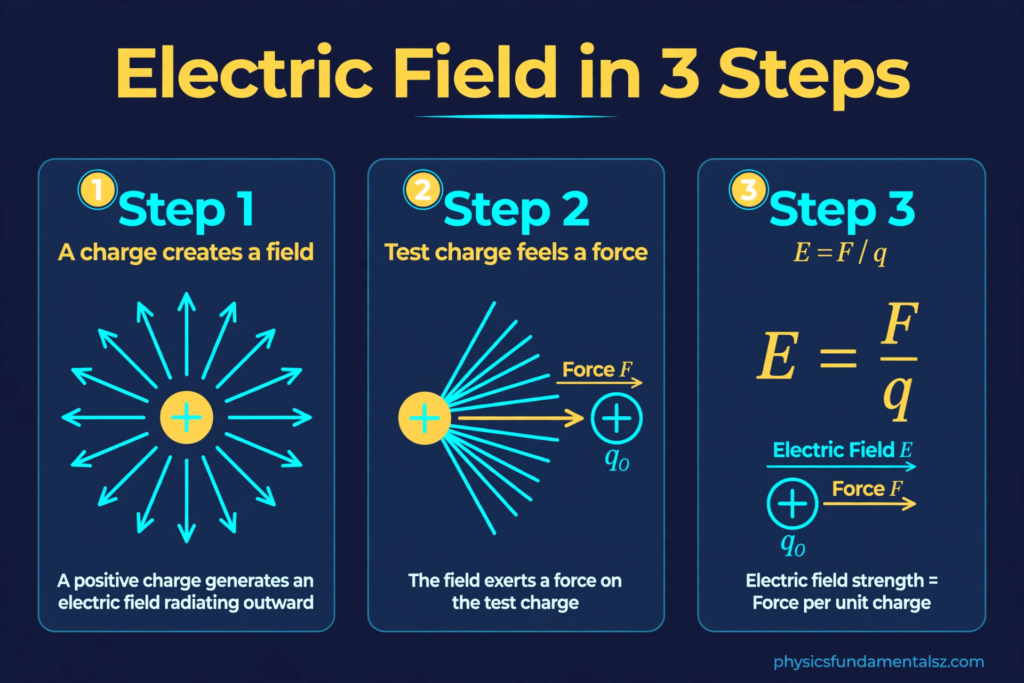
Physicists describe this with a simple test idea. Suppose you have a source charge, call it Q. It creates an electric field all around itself. Now bring in a tiny positive test charge, call it q. The test charge is kept so small that it does not disturb the field it is measuring. The force on that test charge tells you how strong the field is at that point, and the direction of the force tells you the direction of the field.
This gives the defining formula for electric field strength, also called electric field intensity: E = F / q, where F is the force on the test charge q. A large force means a strong field; almost no force means a weak field. The field exists whether or not a test charge is there to feel it — the test charge only reveals it.
Electric field is a vector: it has magnitude and direction, and both can change with position. By convention, its direction at a point is the direction of the force on a positive test charge there.
The Field Concept Versus Action at a Distance
Before the field concept, physicists struggled with a puzzle. How can one charge push another charge across empty space without touching it? This was called action at a distance, and it felt mysterious. It sounded as if a charge could reach out instantly and affect something far away, with nothing in between.
Michael Faraday, working in the nineteenth century, offered a better picture. He suggested that a charge fills the space around itself with something real, a field, and that field then acts locally on any charge placed in it. James Clerk Maxwell later turned Faraday’s picture into precise mathematical equations.
In the field picture, the interaction happens in two steps: the source charge creates a field, and that field exerts a force on any other charge in it. Nothing jumps across empty space. This also explains why electric effects take time to travel and why light can be understood as a travelling electromagnetic field.
A useful analogy is a stretched trampoline. Place a heavy ball in the middle and the surface dips, and a marble rolled nearby curves toward the dip, not because the ball grabs it, but because the surface itself has changed. The electric field plays a similar role: it is the changed condition of space around a charge, and other charges respond to that condition.
Electric Field Lines: How to Picture a Field
Electric field lines, also called lines of force, let us draw a field. Each line’s tangent shows the field direction at that point, and the spacing shows strength: close lines mean a strong field, widely spaced lines a weak one. They follow a set of rules worth learning for exams.
First, field lines start on positive charges and end on negative charges. A line leaving an isolated positive charge goes outward in all directions and, in principle, ends at infinity or on a distant negative charge. A line approaching an isolated negative charge comes inward from all directions.
Second, the number of lines leaving or entering a charge is proportional to the size of the charge. A charge of +2Q has twice as many lines as a charge of +Q. This rule lets diagrams show relative charge sizes at a glance.
Third, field lines never cross each other. If two lines crossed, the field at the crossing point would have to point in two directions at once, which is impossible. A single point has a single field direction.
Fourth, field lines never form closed loops on their own in electrostatics. They begin and end on charges. Closed loops appear for magnetic fields, but not for electrostatic fields, and mixing the two up is a common mistake.
Fifth, field lines are drawn perpendicular to the surface of a conductor in electrostatic equilibrium. Inside a conductor in equilibrium, the electric field is zero, and any field just outside the surface must meet it at a right angle. This rule explains why charge gathers on sharp points and why a hollow conductor shields its interior.
Sixth, field lines are closer together near a charge and spread out farther away. This matches the fact that the field of a point charge weakens with distance. A diagram with evenly spaced lines everywhere would wrongly suggest a uniform field.
Picture a single positive point charge: its field lines radiate outward in all directions. A negative charge has lines pointing inward. Put a positive and a negative charge near each other and the lines curve from the positive to the negative, bunching in the gap where the field is strongest. In exams, count the line density, check the arrow directions, and check that lines start and end correctly.
The Formula for Electric Field: E = F/q and E = kQ/r²
The definition E = F/q is general. It works for any field, however complicated. But for the special and very common case of a single point charge, we can combine it with Coulomb’s law to get a more practical formula.
Coulomb’s law says that the force between two point charges Q and q separated by distance r is:
F = kQq / r²
Here k is Coulomb’s constant, approximately 8.99 × 10^9 N·m²/C². It is also written as 1 / (4πε₀), where ε₀ is the permittivity of free space, about 8.85 × 10^-12 C²/(N·m²).
Now divide both sides by the test charge q, using the definition E = F/q:
E = kQ / r²
This is the electric field strength at a distance r from a point charge Q. It tells you several important things at once.
The field is proportional to the source charge Q. Double the charge, and the field at the same distance doubles. The field falls off as the square of the distance. Double the distance, and the field drops to one quarter of its value. Triple the distance, and it drops to one ninth. This inverse-square behaviour is why electric effects weaken so quickly with distance, and it mirrors the inverse-square behaviour of gravity.
The direction depends on the sign of Q. If Q is positive, the field points radially away from Q. If Q is negative, the field points radially toward Q. The magnitude formula gives a positive number either way, so you must add the direction separately from the sign of the charge.
Do not confuse the two charges: in E = F/q, q is the test charge feeling the force, while in E = kQ/r², Q is the source charge creating the field and r is the distance from it to the measurement point.
For a deeper look at the force law behind this formula, see this explanation of Coulomb’s law — Coulomb’s law gives you the force; the field formula divides that force by the test charge to describe the field itself.
Note what the field formula does not depend on: the test charge. The ratio F/q comes out the same for any small test charge, which is why the field describes the space around the source, not the object dropped into it.
Units of Electric Field: N/C and V/m
The SI unit of electric field strength is the newton per coulomb, written N/C. This follows directly from E = F/q: force in newtons divided by charge in coulombs.
There is a second, equivalent unit: the volt per metre, written V/m. This comes from the relationship between field and potential, which we will discuss later. One volt per metre equals one newton per coulomb, and you can use either unit depending on the problem.
In practice, N/C is more natural when you are thinking about forces on charges. V/m is more natural when you are thinking about voltage across a gap. For example, the field between two parallel plates separated by distance d with voltage V across them is E = V/d, which comes out naturally in volts per metre.
For scale, the fair-weather field near Earth’s surface is roughly 100 N/C, directed downward. In a thunderstorm, fields can reach millions of volts per metre, strong enough to ionise air and trigger lightning.
Always check the unit: an answer for E in newtons or coulombs alone signals an error.
Uniform Versus Non-Uniform Electric Fields
Not all fields vary from point to point. Some are uniform, meaning the field has the same magnitude and the same direction everywhere in a region. Others are non-uniform, meaning the strength or direction changes with position.
The classic uniform field is the field between two oppositely charged parallel plates, far from the edges. Inside that region, the field lines are parallel, equally spaced, and point straight from the positive plate to the negative plate. A charge placed anywhere between the plates feels the same force, which makes calculations simple: F = qE, with E constant.
Real plates have edge effects. Near the edges, the lines bulge outward and the field weakens slightly. Exam problems usually tell you to ignore edge effects and treat the central region as uniform, unless they explicitly ask about fringing fields.
A point charge gives the classic non-uniform field. Its lines spread out radially, so the field weakens with distance and changes direction from point to point. The field near a charged sphere, outside the sphere, behaves like a point-charge field. The field near a dipole is also non-uniform, and more complicated, as we will see next.
The distinction matters because in a uniform field a charged particle accelerates at a constant rate, while in a non-uniform field its acceleration changes along the path.
The gravitational comparison helps: near Earth’s surface, gravity is approximately uniform at about 9.8 N/kg, while far from Earth it is radial and weakening. Electric fields behave the same way.
Electric Field Around Point Charges, Dipoles, and Charged Plates
Field Around a Single Point Charge
We have already described this case: radial lines, strength kQ/r², direction away from a positive charge and toward a negative charge. The field is strongest close to the charge and fades with distance. At very large distances, it becomes negligible, though mathematically it never quite reaches zero.
Note that the field is undefined exactly at the charge itself, where r = 0 would make kQ/r² infinite; in exams you always calculate it at some distance away.
Field of an Electric Dipole
An electric dipole is a pair of equal and opposite charges, +Q and -Q, separated by a small distance. The water molecule is a famous natural dipole, and many molecules behave like dipoles because their charge distribution is uneven.
The field pattern of a dipole is distinctive. Lines leave the positive charge, curve around, and enter the negative charge. On the axis beyond either charge, the field points along the axis. At the midpoint between the charges, the fields from the two charges reinforce each other, pointing from the positive toward the negative charge.
Far from a dipole, the field falls off roughly as 1/r³ rather than 1/r², because the positive and negative charges almost cancel from far away. Dipoles also explain why neutral objects are attracted to charged ones: a charged rod polarises a piece of paper, creating tiny dipoles whose nearer ends feel a stronger force, giving a net attraction.
Field Between Charged Plates: The Parallel-Plate Capacitor
Two parallel conducting plates, one positively charged and one negatively charged, with equal magnitude of charge, create a nearly uniform field between them. Each plate alone would create a field, and between the plates the two contributions add up, while outside the plates they largely cancel. The result is a strong, uniform field inside and almost no field outside.
The magnitude of the field between the plates depends on the charge density on the plates. If each plate has surface charge density σ, meaning charge per unit area, the field between them is E = σ/ε₀, directed from the positive plate to the negative plate. Equivalently, if the voltage across the plates is V and their separation is d, then E = V/d.
This arrangement is a capacitor, and it is one of the most important devices in electronics. Capacitors store energy in the electric field between their plates. When you charge a capacitor, you are building up a field. When you discharge it, the field collapses and releases that energy.
Capacitors appear in camera flashes, power supplies, and countless circuits, and how much charge they store for a given voltage follows directly from the field between the plates.
For a related field concept, compare this with the explanation of what a magnetic field is — Magnetic field lines form closed loops and have no starting or ending charges, which is a sharp contrast with electric field lines.
Superposition: Adding Fields from Multiple Charges
Real situations rarely involve a single charge. Most problems give you two or more charges and ask for the net field at a point. The principle of superposition tells you how to handle this: the net electric field at a point is the vector sum of the fields due to each charge separately.
Superposition is powerful because it lets you break a hard problem into easy pieces. Calculate the field from each charge on its own, then add the vectors, paying attention to direction. The charges do not interfere with each other’s fields. Each contributes independently, and the total is the sum.
Vector addition is where students lose marks. You cannot simply add magnitudes unless the fields point in the same direction. If they point in opposite directions, you subtract. If they point at an angle, you must resolve into components, usually along x and y axes, add the components separately, and then combine them with Pythagoras’ theorem to get the magnitude and use trigonometry for the direction.
A worked strategy helps: draw the charges and the point, draw an arrow for each field (away from positive, toward negative), resolve into components if needed, sum them, then find the resultant’s magnitude and direction.
Symmetry often simplifies the work: if two equal charges sit symmetrically about a point, their perpendicular components may cancel. Superposition also applies to continuous distributions, such as a charged rod, by imagining many tiny point charges and adding their contributions.
Worked Numerical Examples with Steps
Example 1: Field Due to a Point Charge
Question: What is the electric field strength 0.30 m from a point charge of +6.0 × 10^-6 C?
Solution: Use E = kQ/r², with k = 8.99 × 10^9 N·m²/C², Q = 6.0 × 10^-6 C, and r = 0.30 m.
First, square the distance: r² = (0.30)² = 0.090 m². Next, multiply k by Q: (8.99 × 10^9) × (6.0 × 10^-6) = 5.39 × 10^4. Finally, divide: E = 5.39 × 10^4 / 0.090 = 6.0 × 10^5 N/C, to two significant figures.
Direction: because the source charge is positive, the field points radially away from the charge. Answer: 6.0 × 10^5 N/C, away from the charge.
That scale is reasonable, because k is very large; a tiny result here would suggest a powers-of-ten error.
Example 2: Force on a Charge in a Uniform Field
Question: An electron, charge -1.60 × 10^-19 C, is placed in a uniform electric field of 2.0 × 10^3 N/C pointing to the right. What force acts on the electron, and in which direction?
Solution: Use F = qE. The magnitude is |q| × E = (1.60 × 10^-19) × (2.0 × 10^3) = 3.2 × 10^-16 N.
Direction needs care. The field points right, which is the direction a positive charge would be pushed. An electron is negative, so it feels a force in the opposite direction: to the left. Answer: 3.2 × 10^-16 N to the left.
This sign trap appears in many exams: positive charges move with the field, negative charges against it, so keep the sign explicit in F = qE.
Example 3: Field Between Parallel Plates
Question: Two parallel plates are 0.020 m apart, with a voltage of 400 V across them. What is the electric field between the plates? What force acts on a proton, charge +1.60 × 10^-19 C, placed between them?
Solution: Use E = V/d = 400 / 0.020 = 20,000 V/m, which is 2.0 × 10^4 N/C. The field points from the positive plate to the negative plate.
The force on the proton is F = qE = (1.60 × 10^-19) × (2.0 × 10^4) = 3.2 × 10^-15 N, in the direction of the field, from the positive plate toward the negative plate.
If a problem gives voltage and separation, E = V/d is the fastest route; if it gives charge and distance, use E = kQ/r².
Electric Field Versus Electric Potential
Students often confuse electric field with electric potential, because both describe the effect of charges and both appear in similar problems. They are related, but they are different quantities.
Electric field is a vector. It tells you the force per unit charge at a point. Electric potential, usually written V, is a scalar. It tells you the potential energy per unit charge at a point. You can think of field as describing the push, and potential as describing the height of the landscape that the push comes from.
The two are connected by a precise relationship. In one dimension, the field is the negative rate of change of potential with distance: E = -dV/dx. In words, the field points from high potential toward low potential, and it is stronger where the potential changes rapidly with distance. Between parallel plates, this reduces to the familiar E = V/d, with the field pointing from the higher-potential plate to the lower-potential plate.
The gravitational analogy helps: field strength is force per unit mass, while potential is energy per unit mass, related to height. A ball rolls downhill, and likewise positive charges move from high to low electric potential, while negative charges move the other way.
Potentials, being scalars, also add by simple arithmetic, while fields need vector addition — which often makes potential calculations easier.
If you want to build intuition for the scalar side of this pair, read the guide to what potential energy means in physics — Potential energy is the stored-energy idea that electric potential generalises to charges.
A final distinction: the field can be zero at a point while the potential is non-zero there, and vice versa in different arrangements. Zero field means no force, not zero potential energy. For example, at the midpoint between two equal positive charges, the fields cancel and the net field is zero, but the potential there is high, because bringing a positive test charge to that point from infinity takes work against both repulsive fields.
Common Mistakes and Exam Traps
The first trap is the direction rule for negative charges. The field direction is defined by the force on a positive test charge. A negative charge placed in the field feels a force opposite to the field direction. Forgetting this flips your answer.
The second trap is confusing the test charge with the source charge. In E = F/q, q is the small charge feeling the force. In E = kQ/r², Q is the charge creating the field. Swapping them gives a wrong formula and a wrong physical picture.
The third trap is adding field magnitudes as if they were scalars. Fields are vectors. Two equal fields in opposite directions cancel to zero. Two equal fields in the same direction double. Two fields at right angles combine by Pythagoras, not by simple addition. Always draw arrows before adding.
The fourth trap is drawing field lines that cross, or lines that start and end on the wrong charges, or closed loops for an electrostatic field. Check every diagram against the rules: start on positive, end on negative, never cross, denser where stronger.
The fifth trap is assuming the field inside a conductor is non-zero. In electrostatic equilibrium, the field inside a conductor is zero. Free charges in the conductor rearrange until they cancel any internal field. This is why a car can partly shield you in a thunderstorm, and why the field inside a hollow charged conductor is zero.
The sixth trap is mixing up field and potential. Remember: field is force per charge, a vector; potential is energy per charge, a scalar. A question asking for the direction of motion of a charge needs the field. A question asking for the work done moving a charge usually needs a potential difference.
The seventh trap is mishandling units and powers of ten. Microcoulombs (10^-6 C), nanocoulombs (10^-9 C), centimetres versus metres, and the large value of k all invite slips. Convert everything to SI base units before substituting, and check that the final unit is N/C or V/m.
The eighth trap is using E = V/d outside a uniform field. That formula applies between parallel plates or in any region where the field is uniform. It does not apply at a general distance from a point charge, where you need E = kQ/r². Matching the formula to the situation is essential.
Real-World Uses of Electric Fields
Electric fields are not an abstract exam topic. They run machines you use every day, and understanding them explains how those machines work.
Capacitors are the most direct application. A capacitor stores energy in the field between its plates. When a camera flash fires, a capacitor discharges rapidly through the flash tube, releasing its stored field energy as a burst of light. In power supplies, capacitors smooth out voltage fluctuations by storing and releasing charge as needed.
Photocopiers and laser printers use electric fields to move toner. A drum is given a charge, light discharges selected areas to form an image pattern, and charged toner particles are attracted to the remaining charged regions by the field. The toner is then transferred to paper and fused with heat. Every page you print this way is a controlled exercise in electrostatics.
Inkjet printers use fields in a different way. Tiny droplets of ink are given a charge as they leave the nozzle, then pass between deflection plates. The field between the plates steers each droplet to the correct spot on the page. Varying the field varies the deflection, building up text and images dot by dot.
Lightning rods protect buildings using field behaviour at sharp points. Charge concentrates at a sharp tip, creating a very strong local field that ionises the surrounding air. This provides a preferred path for lightning current to reach the ground safely, rather than passing through the building. The rod does not attract lightning from miles away, as popular myth suggests; it gives a discharge a safe, controlled route when a strike is already likely nearby.
Van de Graaff generators demonstrate fields dramatically. A moving belt carries charge up to a hollow metal dome, building up a large charge and a strong field around it. Hair stands on end near the dome because each strand becomes charged and repels its neighbours, following the field lines outward. The same principle, scaled up, appears in particle accelerators, where fields accelerate charged particles to high speeds for research and medical use.
Electrostatic precipitators clean industrial exhaust using fields. Particles in smoke are given a charge, then pass through a strong field that drives them onto collecting plates. The cleaned gas passes on, and the collected dust is removed. Without this application, many factories would release far more particulate pollution.
Even touchscreens rely on fields: a capacitive screen maintains a weak field, and your conductive finger disturbs it at the touch point. In laboratories, the same idea separates charged molecules: electrophoresis drags DNA fragments through a gel by size.
For a sense of how fields interact with circuits, it helps to know the basic current-voltage relationship described in the guide to Ohm’s law — Fields drive charges, charges make currents, and Ohm’s law connects those currents to voltage and resistance.
Frequently Asked Questions
What is an electric field in simple words?
An electric field is the invisible region around a charged object where another charge feels a force. You can think of it as the charge’s sphere of influence. The field exists even when no other charge is present to feel it. Source: Khan Academy
What is the formula for electric field?
The general definition is E = F/q, where F is the force on a test charge q. For a point charge Q at distance r, the field is E = kQ/r², where k is Coulomb’s constant, about 8.99 × 10^9 N·m²/C². Between parallel plates with voltage V and separation d, the field is E = V/d.
What is the SI unit of electric field?
The SI unit is the newton per coulomb (N/C). The equivalent unit volt per metre (V/m) is also used, especially for fields between plates. One N/C equals one V/m.
What is the direction of the electric field?
The field at a point points in the direction of the force on a positive test charge at that point. It points away from positive charges and toward negative charges. Negative charges placed in the field feel a force opposite to the field direction.
Can electric field lines cross each other?
No. Field lines never cross. At any point, the field has only one direction, so two lines cannot pass through the same point in different directions. If a diagram shows crossing lines, it is wrong.
What is the difference between electric field and electric potential?
Electric field is a vector giving force per unit charge. Electric potential is a scalar giving potential energy per unit charge. The field points from high potential to low potential and is stronger where potential changes fastest with distance.
Is the electric field inside a conductor zero?
Yes, in electrostatic equilibrium the electric field inside a conductor is zero. Free charges in the conductor move until they cancel any internal field. The field just outside the conductor’s surface is perpendicular to the surface.
Why does electric field decrease with distance?
For a point charge, the field spreads over an ever-larger sphere as distance increases, so its strength falls as 1/r². Doubling the distance reduces the field to one quarter. This inverse-square fall-off is a direct consequence of Coulomb’s law.
Conclusion
An electric field is the region around a charge in which other charges feel a force, described by E = F/q in general and E = kQ/r² for a point charge. Field lines make the idea visible: they start on positive charges, end on negative charges, never cross, and crowd together where the field is strong. Uniform fields between plates and non-uniform fields around point charges and dipoles cover most problems you will meet, and superposition lets you combine contributions from many charges by vector addition.
If you remember one picture, make it this: a charge changes the space around itself, and that changed space then pushes or pulls any charge placed in it. Hold onto that picture, practise the worked examples, watch out for the sign and vector traps, and electric field problems become a matter of careful, step-by-step calculation rather than guesswork.