What Is Capacitance in Physics? Formula, Capacitors, and Examples
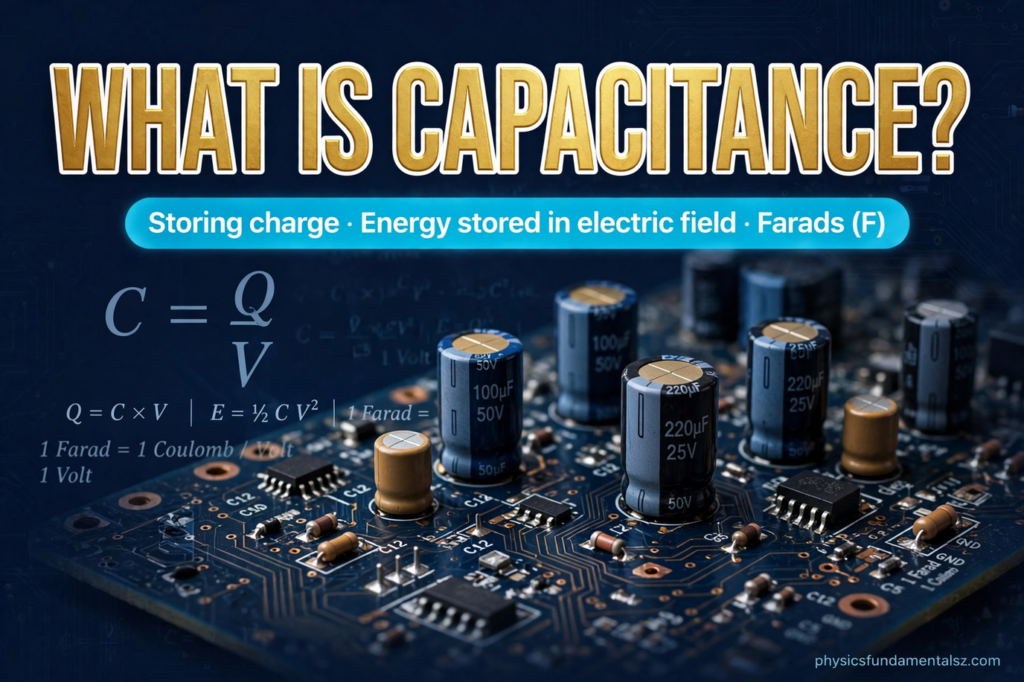
A capacitor can store electric charge and release it in a sudden burst, like a tiny rechargeable reservoir for electricity. That ability, measured as capacitance, sits inside almost every electronic device you own. Camera flashes, phone power circuits, defibrillators, and touch screens all rely on it.
In this guide, you will learn what capacitance means, how it is calculated, and what changes it. You will meet parallel plate capacitors, dielectrics, and combinations in series and parallel. Worked examples, graphs, and a large FAQ section will help you use the formulas confidently rather than memorising them blindly.
Definition box: Capacitance is the ability of a conductor or system of conductors to store electric charge per unit potential difference. It is defined by C = Q / V, where C is capacitance in farads, Q is the magnitude of charge stored on one plate in coulombs, and V is the potential difference between the plates in volts.
The Basic Idea: Charge Storage
Imagine two metal plates facing each other, separated by a small gap. Connect them briefly to a battery, and charge flows: one plate gains positive charge, the other gains an equal negative charge. Disconnect the battery, and the charges stay put, held by their mutual attraction across the gap.
The system now stores both charge and energy. Reconnect the plates through a wire, and charge rushes back, producing a brief current. That discharge can be fast and powerful, which is why capacitors are useful for flashes and pulsed power, even though they store less total energy than batteries.
Capacitance measures how much charge a system stores for each volt applied. A high-capacitance system stores a large charge at a modest voltage. A low-capacitance system stores only a small charge, even at a high voltage.
The Formula C = Q / V, Symbol by Symbol
C is capacitance, measured in farads, symbol F, named after Michael Faraday. One farad is a very large capacitance, so practical capacitors are usually measured in microfarads, nanofarads, or picofarads. A 100 microfarad capacitor stores 100 millionths of a coulomb per volt.
Q is the magnitude of charge on one plate, measured in coulombs. In a capacitor, the two plates carry equal and opposite charges, so Q means the charge on either plate, not the sum of both. Adding both plates would double-count and give a wrong answer.
V is the potential difference between the plates, measured in volts. It is set by the charging source, such as a battery, and by the charge already stored. As charge builds up, the voltage rises in proportion, provided capacitance stays constant.
Rearranging the definition gives two useful forms: Q = CV and V = Q / C. The first predicts charge from voltage and capacitance. The second predicts voltage from charge and capacitance. All three forms describe the same proportional relationship.
What Capacitance Depends On: The Parallel Plate Capacitor
The simplest capacitor is two parallel plates of area A, separated by distance d, with a material between them. Its capacitance is C = epsilon A / d, where epsilon is the permittivity of the material between the plates. This formula reveals exactly what a designer can change.
Larger plate area increases capacitance, because more charge can spread over a larger surface. Smaller separation increases capacitance, because opposite charges attract more strongly across a narrower gap. A material with higher permittivity also increases capacitance, because it reduces the effective field for a given charge.
In a vacuum, epsilon is epsilon0, about 8.85 × 10^-12 F/m. In other materials, epsilon equals epsilon_r times epsilon0, where epsilon_r is the relative permittivity or dielectric constant. Air has a dielectric constant close to 1, while water is around 80, and some ceramics exceed 1,000.
| Change | Effect on capacitance | Reason |
|---|---|---|
| Larger plate area A | Increases | More surface for charge |
| Smaller separation d | Increases | Stronger attraction across gap |
| Higher dielectric constant | Increases | Material weakens internal field |
| Larger separation d | Decreases | Weaker attraction, lower charge per volt |
For the theory behind fields between plates, HyperPhysics explains capacitance and parallel plates. A classroom introduction is available from Khan Academy on capacitors and capacitance.
Dielectrics: Insulators That Boost Capacitance
A dielectric is an insulating material placed between capacitor plates. When the capacitor charges, the dielectric polarises: its molecules align slightly with the field, creating an opposing field inside the material. The net field between the plates therefore falls for the same plate charge.
Since voltage equals field times separation, the voltage also falls for the same charge. Capacitance, defined as charge divided by voltage, therefore rises. Inserting a dielectric of constant kappa multiplies capacitance by kappa, provided it fills the gap completely.
Dielectrics offer a second benefit: they allow plates to sit closer together without sparking across the gap. Every dielectric has a breakdown field strength, beyond which it conducts and the capacitor fails. Choosing a dielectric balances capacitance gain against voltage rating and safety.
Common dielectrics include air, paper, mica, ceramic, and plastic films. Electrolytic capacitors use a thin oxide layer as the dielectric, achieving very high capacitance in a small volume. Supercapacitors go further, using porous electrodes and ionic layers to reach thousands of farads.
Charging and Discharging: The Q-V Graph
Plotting charge Q against voltage V for a capacitor gives a straight line through the origin. The gradient of that line is capacitance C. A steeper line means a larger capacitance, storing more charge per volt.
The area under the Q-V graph up to a given charge gives the energy stored. For the straight-line region, that area is a triangle, giving E = (1/2) QV. Substituting Q = CV gives the familiar forms E = (1/2) C V^2 and E = Q^2 / (2C). All three forms are equivalent, and choosing the right one depends on which quantities are known.
When a capacitor charges through a resistor, the charge does not rise instantly. It approaches its final value exponentially, with a time constant tau = RC. After one time constant, the charge reaches about 63 percent of its final value. After five time constants, it is effectively fully charged.
Discharging follows the same exponential pattern in reverse. Current starts high and falls as the voltage drops. This predictable timing makes resistor-capacitor circuits useful for timers, filters, and smoothing power supplies.
Capacitors in Series and Parallel
Capacitors in Parallel
When capacitors are connected in parallel, they share the same voltage, and their charges add. The total capacitance is therefore the sum: C_total = C1 + C2 + … Parallel connection increases total capacitance, like increasing total plate area.
For two capacitors of 10 microfarads and 20 microfarads in parallel, the total is 30 microfarads. At 12 V, the combination stores Q = CV = 30 × 10^-6 × 12 = 360 microcoulombs. Each capacitor stores charge in proportion to its own capacitance.
Capacitors in Series
When capacitors are connected in series, they share the same charge, and their voltages add. The total capacitance follows the reciprocal rule: 1/C_total = 1/C1 + 1/C2 + … Series connection decreases total capacitance, like increasing plate separation.
For two capacitors of 10 microfarads and 20 microfarads in series, 1/C_total = 1/10 + 1/20 = 3/20, so C_total = 6.67 microfarads. The combination stores less charge at a given voltage than either capacitor alone, but it can withstand a higher total voltage.
| Arrangement | Same quantity | Adds | Total capacitance |
|---|---|---|---|
| Parallel | Voltage V | Charge Q | Sum of capacitances |
| Series | Charge Q | Voltage V | Reciprocal sum |
Notice that this pattern is the reverse of resistors, and the same as springs in an earlier sense. For capacitors, parallel adds directly, series adds reciprocally. For resistors, series adds directly, parallel adds reciprocally. Remembering the physical reason, shared voltage versus shared charge, prevents confusion.
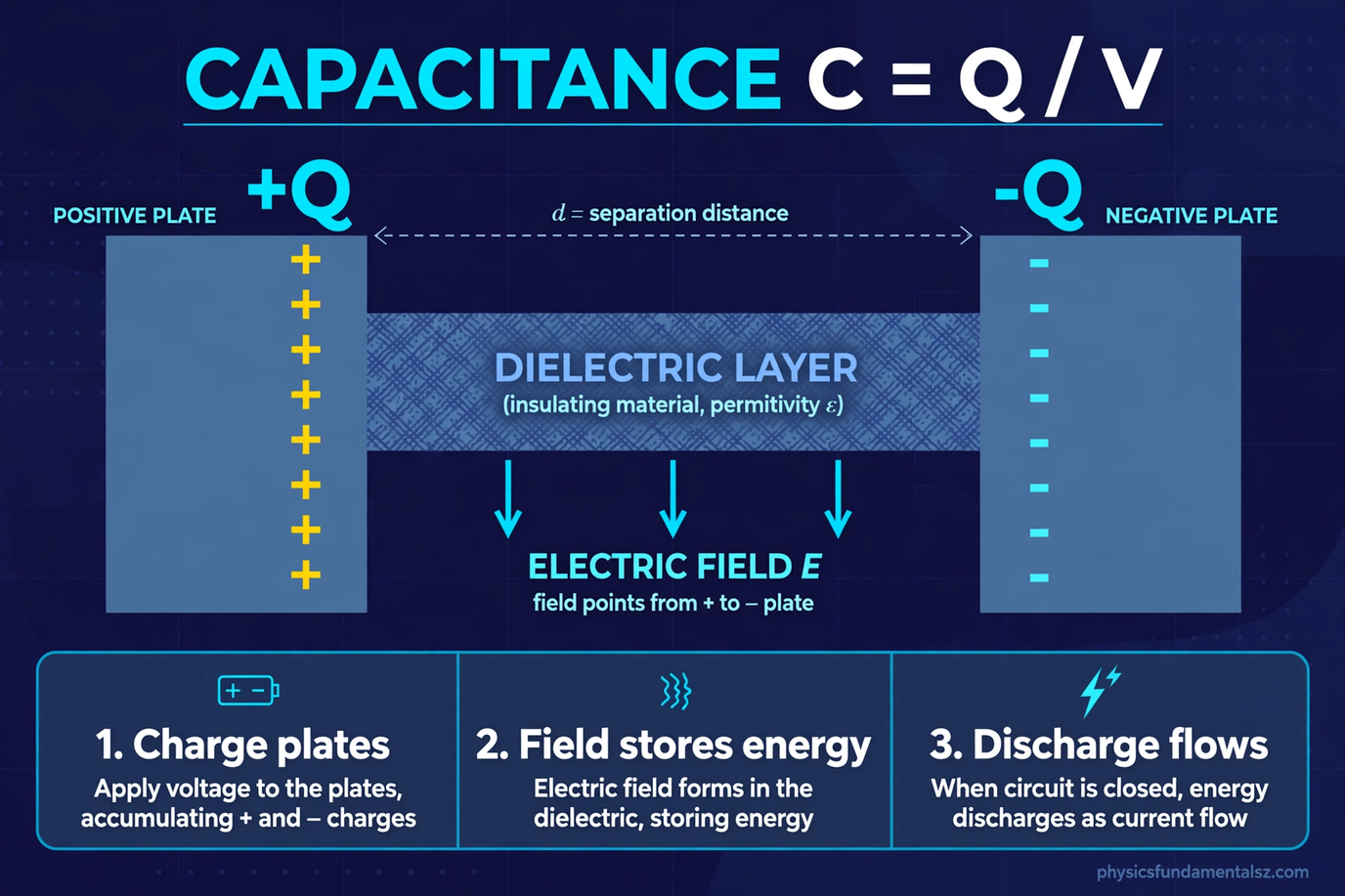
Alt text: Labelled diagram of a parallel plate capacitor showing plates, dielectric, charge, and a 3-step strip.
Energy Stored in a Capacitor
A charged capacitor stores energy in the electric field between its plates. That energy can be calculated from any of the three equivalent formulas, depending on the data given. If voltage and capacitance are known, use E = (1/2) C V^2. If charge and voltage are known, use E = (1/2) QV.
The squared dependence on voltage is important for safety and design. Doubling the voltage quadruples the stored energy, even though the charge only doubles. High-voltage capacitors therefore demand respect, because they can release significant energy quickly, even after a device is switched off.
Capacitor energy differs from battery energy in an important way. Batteries store energy chemically and release it slowly over hours. Capacitors store energy electrically and release it in seconds or less. That is why capacitors suit camera flashes and defibrillators, while batteries suit phones and laptops.
This stored energy is a form of electric potential energy, related to the general concept of potential energy. The field between the plates is also closely related to Coulomb’s law, which describes forces between charges.
Worked Examples
Example 1: Finding Capacitance
A capacitor stores 60 microcoulombs of charge when connected to a 12 V battery. Find its capacitance. Using C = Q / V gives C = 60 × 10^-6 / 12 = 5.0 × 10^-6 F, or 5.0 microfarads. The micro prefix must be handled carefully, or the answer will be off by a factor of a million.
Example 2: Parallel Plate Capacitor
Parallel plates each have area 0.020 m^2 and separation 1.0 mm, with air between them. Find the capacitance, using epsilon0 = 8.85 × 10^-12 F/m. Using C = epsilon0 A / d gives C = 8.85 × 10^-12 × 0.020 / 0.001 = 1.77 × 10^-10 F, about 177 pF. This small value is typical for air-spaced plates of this size.
Example 3: Adding a Dielectric
The capacitor in Example 2 is filled with a dielectric of relative permittivity 4.0. What is the new capacitance? Capacitance scales by the dielectric constant, so C = 4.0 × 177 pF = 708 pF. The voltage for the same charge would fall by the same factor, because V = Q / C.
Example 4: Energy Stored
A 100 microfarad capacitor is charged to 20 V. How much energy is stored? Using E = (1/2) C V^2 gives E = 0.5 × 100 × 10^-6 × 400 = 0.020 J. That is a small energy in everyday terms, but released in a millisecond it gives a power of 20 W, enough for a bright flash.
Example 5: Capacitors in Series and Parallel
Three capacitors of 6 microfarads each are connected first in parallel, then in series. Find each total. In parallel, totals add: 6 + 6 + 6 = 18 microfarads. In series, reciprocals add: 1/C = 1/6 + 1/6 + 1/6 = 3/6, so C = 2 microfarads. The same three components give totals differing by a factor of nine.
Example 6: Charge Sharing
A 10 microfarad capacitor charged to 12 V is connected in parallel with an uncharged 20 microfarad capacitor. Find the final voltage, ignoring losses. Total charge is Q = 10 × 12 = 120 microcoulombs. Total capacitance is 30 microfarads. Final voltage is V = Q / C = 120 / 30 = 4.0 V. Charge redistributes until voltages equalise.
Capacitance in Circuits
Capacitors block steady direct current once charged, because no charge can cross the insulating gap. They pass alternating current, however, because charge sloshes back and forth on the plates as voltage alternates. The opposition to alternating current is called capacitive reactance, Xc = 1 / (2 pi f C).
Higher frequency or higher capacitance gives lower reactance, so more alternating current flows. This frequency dependence makes capacitors ideal for filters. A low-pass filter passes low frequencies and blocks high ones, while a high-pass filter does the opposite.
In power supplies, large capacitors smooth the output after rectification. They charge during voltage peaks and discharge during troughs, reducing ripple. Without smoothing capacitors, many electronic devices would hum, flicker, or reset under load.
Capacitors also set timing in resistor-capacitor circuits. The time constant RC determines how quickly a circuit responds, which is useful for camera timers, debouncing switches, and generating pulses. Changing either R or C tunes the timing predictably.
Real-World Applications
Camera flashes store energy slowly in a capacitor, then release it in a brilliant burst lasting thousandths of a second. The capacitor, not the battery, delivers the peak power. Recharging the flash takes a few seconds while the battery refills the capacitor.
Defibrillators use the same principle at a larger scale. A capacitor charges to a high voltage, then discharges through paddles or pads to reset a heart rhythm. The stored energy, typically hundreds of joules, must be delivered in a controlled, timed pulse.
Touch screens use capacitance to detect fingers. A finger near the screen changes the local capacitance of a grid of electrodes. The device measures those changes and calculates touch position. This is why gloves, which insulate the finger, often fail to work on capacitive screens.
Power-factor correction capacitors improve efficiency in factories and power grids. Inductive motors draw lagging current, and capacitors supply leading current to compensate. The result is less wasted capacity in cables and transformers, and lower electricity costs for large users.
Supercapacitors bridge the gap between capacitors and batteries. They store far more charge than ordinary capacitors, using porous electrodes with enormous surface area. They charge in seconds and survive hundreds of thousands of cycles, making them useful for buses, cranes, and backup power.
Capacitance vs Other Storage: A Comparison
| Device | Stores | Release speed | Typical use |
|---|---|---|---|
| Capacitor | Charge in electric field | Very fast | Flash, filter, timing |
| Supercapacitor | Charge in ionic layers | Fast | Regenerative braking, backup |
| Battery | Chemical energy | Slow, steady | Phones, cars, laptops |
| Inductor | Energy in magnetic field | Fast, current-based | Filters, power conversion |
This table helps explain why engineers choose different storage for different jobs. No single device is best for every purpose. Capacitors win on speed and cycle life, batteries win on total energy, and supercapacitors sit between them.

Alt text: Photographic composite showing electronic capacitors on a circuit board.
Common Mistakes to Avoid
A frequent mistake is using total charge on both plates instead of charge on one plate. The definition uses Q for one plate, because the plates carry equal and opposite charges. Summing both gives twice the correct capacitance.
Another mistake is mixing up series and parallel rules for capacitors and resistors. Capacitors in parallel add directly, while resistors in parallel add reciprocally. Writing the physical reason beside each formula, shared voltage versus shared current, helps keep them straight.
Unit prefixes cause many errors. Microfarads, nanofarads, and picofarads differ by factors of a thousand, and forgetting a conversion ruins an otherwise correct method. Convert all capacitances to farads before calculating, or keep prefixes consistent throughout.
Students also forget that inserting a dielectric changes voltage, not just capacitance, when charge is fixed. If a charged capacitor is disconnected, charge stays constant, so adding a dielectric lowers voltage. If it stays connected to a battery, voltage stays constant, so adding a dielectric increases charge.
Finally, remember that capacitance is a property of the system, not of the charge or voltage alone. Doubling the voltage doubles the charge, but capacitance stays the same, provided geometry and dielectric do not change. A Q-V graph through the origin captures this constancy.
How Capacitance Links to Other Physics Topics
Capacitance connects electrostatics, circuits, and energy in one concept. The field between plates comes from Coulomb’s law applied to many charges. The behaviour in circuits connects to Ohm’s law through resistor-capacitor timing.
Alternating-current behaviour connects to electromagnetic induction, because inductors and capacitors together determine resonance. The difference between conductors and insulators explains why dielectrics insulate while plates conduct.
Understanding these links turns capacitance from an isolated formula into a hub topic. It appears in exam questions about circuits, energy, fields, and waves, often in combination. Revising it alongside its neighbours therefore pays off more than revising it alone.
Types of Capacitors and How to Choose One
Different jobs need different capacitors, so manufacturers offer many types. Ceramic capacitors are small, cheap, and non-polarised, making them ideal for high-frequency circuits and decoupling. Film capacitors use plastic dielectrics and offer stable values with low losses, suitable for audio and precision circuits.
Electrolytic capacitors achieve high capacitance in a small package by using a very thin oxide dielectric. They are polarised, so they must be connected the right way round, and they suit power-supply smoothing. Tantalum capacitors are a compact electrolytic variant, used where space is tight and reliability matters.
Variable capacitors allow capacitance to be tuned, historically by rotating interleaved plates in radios. Modern tuning often uses varactor diodes, whose capacitance changes with applied voltage. Supercapacitors, already mentioned, use porous carbon electrodes to reach enormous effective areas and therefore enormous capacitances.
| Type | Dielectric | Strength | Typical use |
|---|---|---|---|
| Ceramic | Ceramic | Small, cheap, high frequency | Decoupling, RF circuits |
| Film | Plastic film | Stable, low loss | Audio, precision timing |
| Electrolytic | Oxide layer | Very high capacitance | Power smoothing |
| Tantalum | Tantalum oxide | Compact, reliable | Portable electronics |
| Supercapacitor | Ionic double layer | Huge capacitance, fast charge | Backup, braking |
Choosing a capacitor means balancing capacitance, voltage rating, size, cost, and stability. A capacitor rated below the circuit voltage may fail, while an oversized one wastes space and money. Temperature range matters too, because capacitance drifts with temperature in some types.
Measuring capacitance in the laboratory can be done several ways. A direct meter gives a quick reading, while a Q-V plot gives capacitance as a gradient and reveals non-linearity. An RC timing measurement gives capacitance from the time constant, provided resistance is known accurately. Comparing methods and explaining any disagreement is good experimental practice.
Safety deserves emphasis in any practical work with capacitors. Large or high-voltage capacitors should be discharged through a resistor, never shorted with a wire, because a direct short can produce a violent spark. After discharge, terminals should be checked with a meter before handling. These habits protect both people and equipment.
Practice Questions With Short Answers
A capacitor stores 40 microcoulombs at 8 V. What charge does it store at 16 V? Since charge is proportional to voltage at fixed capacitance, doubling voltage doubles charge to 80 microcoulombs. Capacitance itself remains 5 microfarads throughout.
Two identical capacitors are connected in parallel, then the same pair is reconnected in series. How do the totals compare? Parallel gives twice one capacitor, series gives half one capacitor, so the parallel total is four times the series total. This factor of four is a useful check in any such problem.
A dielectric is inserted into a disconnected, charged capacitor. What happens to capacitance, voltage, and stored energy? Capacitance increases by the dielectric constant, voltage falls by the same factor, and stored energy falls, because work is done polarising the dielectric. Energy is not conserved in this step unless the insertion work is counted.
A 1,000 microfarad capacitor and a 10 microfarad capacitor are charged to the same voltage. Which stores more energy? The larger capacitor stores one hundred times more energy, because energy scales with capacitance at fixed voltage. This is why smoothing capacitors in power supplies are large.
Frequently Asked Questions
What is capacitance in simple words?
Capacitance is a measure of how much electric charge a system can store for each volt applied to it. A higher capacitance means more stored charge at the same voltage. It is defined by C = Q / V and measured in farads.
What is the unit of capacitance?
The unit of capacitance is the farad, symbol F, named after Michael Faraday. One farad equals one coulomb per volt. Practical capacitors are usually rated in microfarads, nanofarads, or picofarads.
What is a capacitor?
A capacitor is a device that stores electric charge and energy in an electric field. It usually consists of two conducting plates separated by an insulator called a dielectric. When connected to a voltage, opposite charges build up on the plates.
What is the formula for capacitance?
The defining formula is C = Q / V, where Q is charge on one plate and V is potential difference. For parallel plates, C = epsilon A / d, where A is plate area, d is separation, and epsilon is permittivity. Both formulas describe the same property.
What increases capacitance?
Capacitance increases with larger plate area, smaller plate separation, and higher dielectric constant. Adding capacitors in parallel also increases total capacitance. Each change allows more charge to be stored per volt.
What is a dielectric?
A dielectric is an insulating material placed between capacitor plates. It polarises in the electric field, reducing the net field and voltage for a given charge. This increases capacitance by a factor equal to its dielectric constant.
How do capacitors store energy?
Capacitors store energy in the electric field between their plates. The energy equals (1/2) C V^2, or equivalently (1/2) QV. It is released when the plates are connected through a circuit, producing a current.
Do capacitors block direct current?
Yes, once charged, a capacitor blocks steady direct current, because charge cannot cross the insulating gap. It passes alternating current, because charge moves back and forth on the plates. This property makes capacitors useful in filters.
What is the time constant of an RC circuit?
The time constant is tau = RC, where R is resistance and C is capacitance. It measures how quickly a capacitor charges or discharges through a resistor. After one time constant, charge reaches about 63 percent of its final value.
How do you combine capacitors in series?
For capacitors in series, add reciprocals: 1/C_total = 1/C1 + 1/C2 + … The total is smaller than any individual capacitor. Series capacitors share the same charge, and their voltages add.
How do you combine capacitors in parallel?
For capacitors in parallel, add directly: C_total = C1 + C2 + … The total is larger than any individual capacitor. Parallel capacitors share the same voltage, and their charges add.
What is the difference between a capacitor and a battery?
A capacitor stores energy electrically and releases it very quickly, but holds relatively little total energy. A battery stores energy chemically and releases it slowly over a long time. Capacitors suit flashes and filters, batteries suit sustained power.
What is a supercapacitor?
A supercapacitor is a high-capacitance device using porous electrodes and ionic layers. It stores far more charge than an ordinary capacitor and charges in seconds. It is used for regenerative braking, backup power, and grid stabilisation.
Can capacitance be negative?
No, capacitance for a passive capacitor is positive, because charge and voltage rise together. Some active circuits can mimic negative capacitance over a limited range, but that is an effective circuit behaviour, not a property of a simple capacitor.
Why are capacitors dangerous even when switched off?
A charged capacitor can retain its charge after a device is switched off. Touching its terminals can discharge that energy through the body, causing a shock. High-voltage capacitors in old televisions and power supplies deserve particular caution.
What happens if a capacitor is connected backwards?
Polarised capacitors, such as electrolytics, must be connected with the correct polarity. Reversing them can damage the dielectric, cause overheating, or make the capacitor fail. Non-polarised capacitors, such as ceramics, can be connected either way.
How is capacitance measured?
Capacitance is measured with a capacitance meter or a multimeter with a capacitance range. The meter applies a known signal and measures the response. In a laboratory, capacitance can also be found from Q-V graphs or RC time constants.
What is capacitive reactance?
Capacitive reactance, Xc = 1 / (2 pi f C), is the opposition a capacitor offers to alternating current. It falls with higher frequency and higher capacitance. At zero frequency, direct current, reactance is infinite, so no steady current flows.
Key Takeaways
- Capacitance is C = Q / V, measured in farads; Q is charge on one plate.
- For parallel plates, C = epsilon A / d: area up, separation down, dielectric up.
- Parallel capacitors add directly; series capacitors add reciprocally.
- Stored energy is (1/2) C V^2, released quickly compared with batteries.
- RC time constant tau = RC governs charging and discharging speed.
Capacitance in Everyday Devices
Open almost any electronic device and you will find capacitors doing quiet, essential jobs. In a phone charger, they smooth the rectified mains voltage into steady direct current. In a radio, they tune circuits to a chosen station by resonating with an inductor. In a computer, thousands of tiny capacitors decouple power lines, absorbing sudden current demands.
Even devices without obvious electronics use capacitance. A microphone with a capacitive element converts sound vibrations into changing capacitance, then into an electrical signal. A proximity sensor in a tap or lift detects a hand by its effect on a local electric field. Recognising these examples helps students see capacitance as a working technology, not just an exam formula.
Conclusion
Capacitance turns a simple pair of plates into one of electronics’ most versatile tools. It stores charge, smooths power, sets timing, filters signals, and detects touch. The core ideas are few: charge per volt, area and separation, dielectrics, and series-parallel rules.
Keep the distinctions clear: charge on one plate, not both; shared voltage in parallel, shared charge in series; energy squared in voltage. With those ideas, and the worked examples in this guide, you can tackle capacitor problems with confidence. Keep a summary card with C = Q/V, the parallel plate formula, and the energy formulas, and revisit it before tests. Next, explore series and parallel circuits and alternating and direct current to see capacitors in full circuit context.


