What Is Hooke’s Law? Formula, Spring Constant, and Examples
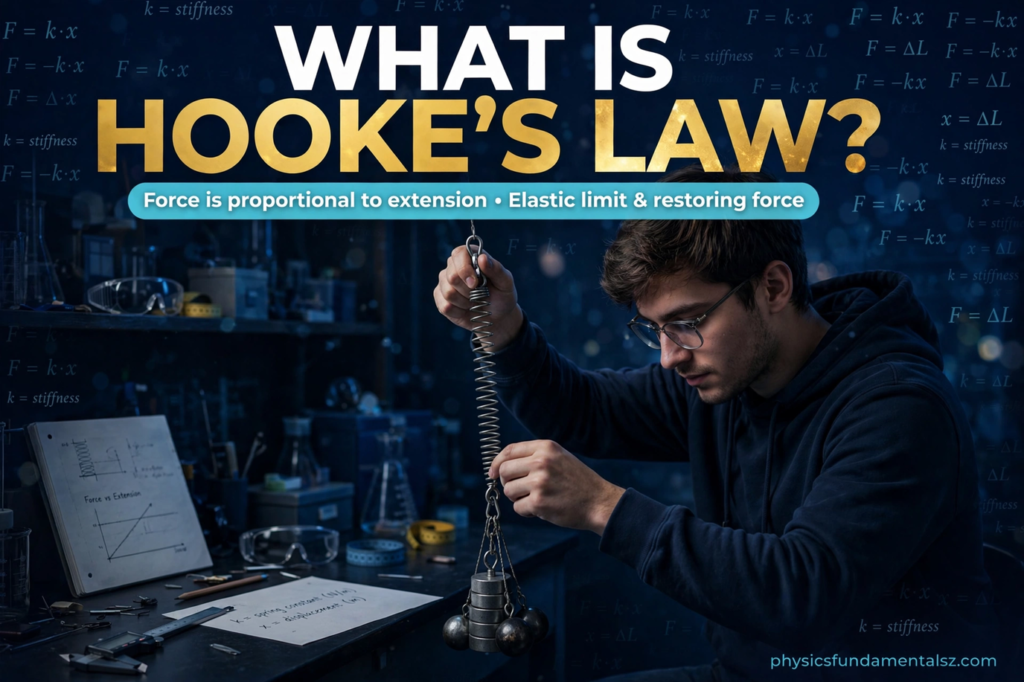
Stretch a spring a little, and it pulls back gently. Stretch it twice as far, and it pulls back twice as hard. That simple proportional relationship is Hooke’s law, and it governs springs, rubber bands, bungee cords, and even the tiny vibrations of atoms in a solid. It is one of the first laws students meet in mechanics, yet it reaches surprisingly far.
In this guide, you will learn what Hooke’s law states, what the spring constant really means, and where the law stops working. You will work through the force-extension graph, the energy stored in a stretched spring, and combinations of springs in series and parallel. Worked examples and a large FAQ section will help you answer exam questions without guessing.
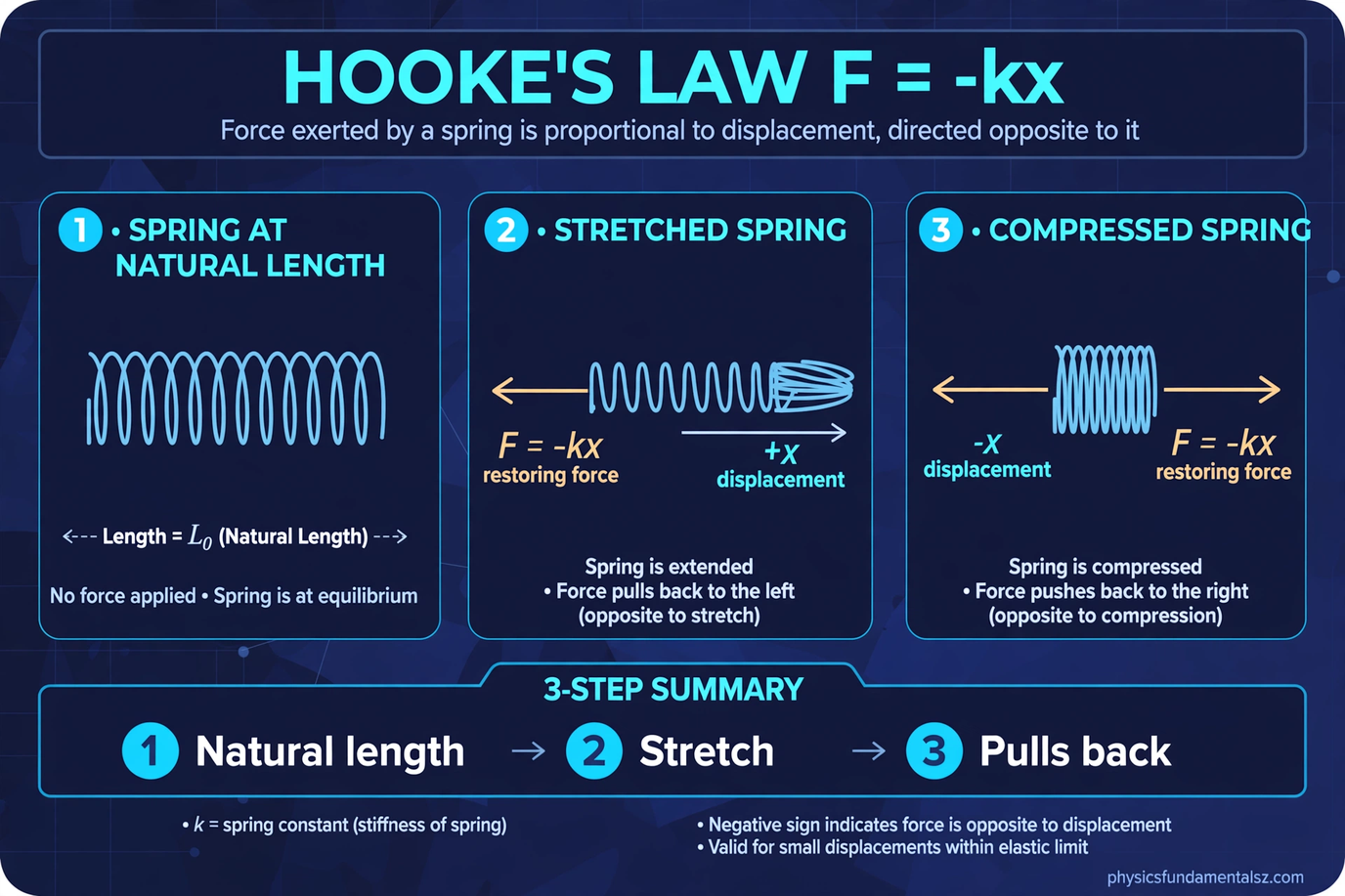
Definition box: Hooke’s law states that, within the elastic limit, the force needed to extend or compress a spring is directly proportional to the extension or compression. The law is written as F = -kx, where F is the restoring force, x is the displacement from equilibrium, and k is the spring constant. The minus sign shows that the restoring force acts opposite to the displacement.
The Basic Idea in Plain Language
A spring at rest sits at its natural length, also called its equilibrium position. Pull one end, and the spring resists. Push it in, and it pushes back. In both cases, the spring tries to return to its natural length. That restoring tendency is the heart of Hooke’s law.
For small stretches, the resistance grows in exact proportion to the stretch. Doubling the extension doubles the force. Tripling it triples the force. This proportionality is what makes springs useful as measuring devices, shock absorbers, and timing elements.
The proportionality does not last forever. Stretch a spring too far, and it will not return fully to its original length. It has passed its elastic limit. Beyond that point, Hooke’s law no longer applies, and the material may deform permanently or break.
Who Was Robert Hooke?
Robert Hooke, an English scientist working in the seventeenth century, first published the law in 1678. He had announced it earlier in 1676 as an anagram, a common practice at the time for protecting priority while work was still in progress. The decoded phrase read, in Latin, “as the extension, so the force.”
Hooke was a remarkably broad scientist, contributing to microscopy, astronomy, and the theory of elasticity. His spring law grew from practical questions about how materials respond to loads. It remains one of the most durable empirical laws in physics, still taught and used more than three centuries later.
For background on elasticity and materials, HyperPhysics covers Hooke’s law and elasticity with clear diagrams. A good classroom treatment is also available from Khan Academy on springs and Hooke’s law.
The Formula, Symbol by Symbol
F = -kx
F is the restoring force exerted by the spring, measured in newtons. It is the force the spring applies to whatever is stretching it, not the applied pulling force, though the two are equal in magnitude at equilibrium. The minus sign is essential: it records direction, not just size.
x is the displacement from the spring’s natural length, measured in metres. A positive x means extension in one direction, while a negative x means compression. In many school problems, only magnitudes are used, and the law appears simply as F = kx.
k is the spring constant, also called the stiffness, measured in newtons per metre. A large k means a stiff spring that needs a large force for a small stretch. A small k means a soft spring that stretches easily under a light load.
Units and Dimensional Sense
Checking units is a quick way to catch errors. Force in newtons equals k in newtons per metre multiplied by x in metres, so the metres cancel correctly. If a spring constant is given in N/cm, convert it to N/m before using metres for extension. Mixing centimetres and metres is one of the most common sources of wrong answers.
A spring constant of 200 N/m means that a 1 N force produces an extension of 0.005 m, or 5 mm. A 10 N force produces 50 mm. This direct scaling is exactly what proportionality means, and it makes rough checks easy.
What the Spring Constant Depends On
The spring constant is not a universal constant like the speed of light. It is a property of a particular spring, set by its material, shape, and size. A thicker wire makes a stiffer spring, because more material resists bending. A larger coil diameter makes a softer spring, because each turn bends more easily.
The number of coils also matters. More coils in series share the total extension, so a longer spring with more turns is softer than a short one made from the same wire. Cutting a spring in half therefore doubles its spring constant, a result that surprises many students until they think it through.
Temperature can change k slightly, because material stiffness varies with temperature. In most school problems, temperature is ignored and k is treated as fixed. In precision instruments, however, temperature compensation matters, and special alloys are chosen for stable stiffness.
| Factor | Effect on spring constant k |
|---|---|
| Thicker wire | Increases k, stiffer spring |
| Larger coil diameter | Decreases k, softer spring |
| More coils | Decreases k, softer spring |
| Stiffer material | Increases k |
| Shorter spring, same wire | Increases k |
The Force-Extension Graph
The Straight-Line Region
Plotting applied force against extension gives a straight line through the origin while Hooke’s law holds. The gradient of that line is the spring constant k. A steeper line means a stiffer spring, and a shallower line means a softer spring.
This graph is a powerful tool because it turns a law into a picture. Any point on the straight section satisfies F = kx. Reading force and extension from the axes and dividing gives k directly. Exam questions often ask for k from such a graph rather than from a formula.
Elastic Limit and Beyond
At the elastic limit, the graph begins to curve away from the straight line. The material still returns to its original length if the load is removed, but only up to this point in the strict sense used by many textbooks. Beyond the elastic limit, permanent deformation sets in.
Further loading reaches the yield point, then the ultimate strength, and finally fracture. A rubber band stretched far beyond its limit stays longer than before, or snaps. A metal spring overloaded in the same way may keep a permanent set, meaning it never fully recovers.
Loading and Unloading: Hysteresis
Some materials, notably rubber, do not follow the same path when unloading as when loading. The unloading curve falls below the loading curve, forming a loop called a hysteresis loop. The area inside the loop represents energy lost as heat during the cycle.
Metal springs in their elastic region show almost no hysteresis, which is why they make good precision instruments. Rubber bands and tyres show noticeable hysteresis, which is why repeated stretching warms them. This difference matters in engineering design, not just in theory.
Elastic Potential Energy in a Spring
Work must be done to stretch a spring, and that work is stored as elastic potential energy. Because the force grows from zero to F as the spring stretches, the average force during stretching is F/2. Multiplying average force by extension gives the stored energy.
The result is E = (1/2) k x^2, or equivalently E = (1/2) F x. This energy can be recovered when the spring returns to its natural length, for example in a catapult, a spring-loaded toy, or a watch mechanism. It is a form of potential energy, stored by position and deformation rather than by height.
The squared dependence on x is important. Doubling the extension quadruples the stored energy, even though the force only doubles. That is why a spring stretched twice as far feels disproportionately more energetic when released.
On a force-extension graph, the stored energy equals the area under the line up to that extension. For the straight-line region, that area is a triangle with base x and height F, giving (1/2) F x. This graphical method works even when the graph curves, provided the area is measured correctly.
Hooke’s Law and Simple Harmonic Motion
A mass attached to a spring and displaced from equilibrium experiences a restoring force proportional to displacement. That is exactly the condition for simple harmonic motion. The mass oscillates back and forth with a period that depends on mass and spring constant, but not on amplitude, provided Hooke’s law holds.
The period is T = 2 pi sqrt(m / k), where m is the oscillating mass and k is the spring constant. A stiffer spring gives a shorter period and faster oscillation. A heavier mass gives a longer period and slower oscillation. This formula is widely used in vibration analysis and in laboratory measurements of k.
This connection makes Hooke’s law a gateway to oscillation physics. For a full treatment of oscillations, see simple harmonic motion explained. The same restoring-force idea also appears in pendulums, though the geometry differs.
Alt text: Labelled diagram of Hooke’s law showing a spring at natural length, stretched, and compressed, with a 3-step strip.
Springs in Series and Parallel
Springs in Series
When springs are joined end to end, the same force acts through each spring, but their extensions add. The combination is therefore softer than any single spring in the chain. The effective spring constant follows 1/k_total = 1/k1 + 1/k2 + …
For two identical springs of constant k in series, the effective constant is k/2. Each spring stretches by half the total extension under the same force. This is why a long spring made of many coils is softer than a short one.
Springs in Parallel
When springs sit side by side and share a load, their extensions are equal, but their forces add. The combination is stiffer than any single spring. The effective constant follows k_total = k1 + k2 + …
For two identical springs of constant k in parallel, the effective constant is 2k. Each spring carries half the load for the same extension. Car suspensions use parallel and combined arrangements to tune ride stiffness.
| Arrangement | Force | Extension | Effective k for two equal springs |
|---|---|---|---|
| Series | Same through each | Adds | k/2 |
| Parallel | Adds | Same for each | 2k |
This series-parallel pattern mirrors electrical circuits in reverse, which is a useful memory aid. In circuits, resistors in series add directly, while in springs, stiffness in series adds reciprocally. Keeping the physical reasoning in mind prevents reliance on a memorised formula alone.
Worked Examples
Example 1: Finding the Extension
A spring has k = 150 N/m. A force of 12 N stretches it within its elastic limit. Find the extension. Using F = kx gives x = F / k = 12 / 150 = 0.080 m, or 8.0 cm. The answer is in metres first, then converted to centimetres for readability.
Example 2: Finding the Spring Constant From a Graph
A force-extension graph shows a force of 20 N at an extension of 0.25 m, on a straight line through the origin. Find k. The gradient is force divided by extension: k = 20 / 0.25 = 80 N/m. Any other point on the straight section should give the same value, within measurement error.
Example 3: Elastic Potential Energy
A spring with k = 400 N/m is stretched by 0.10 m. How much elastic potential energy is stored? Using E = (1/2) k x^2 gives E = 0.5 × 400 × 0.01 = 2.0 J. Doubling the extension to 0.20 m would store 8.0 J, showing the squared dependence clearly.
Example 4: A Hanging Mass
A mass of 0.50 kg hangs at rest from a vertical spring with k = 100 N/m. Find the extension at equilibrium. At rest, the spring force balances weight: kx = mg. So x = mg / k = (0.50 × 9.81) / 100 = 0.049 m, about 4.9 cm. Using g = 10 m/s^2 gives 5.0 cm, close enough for an estimate.
Example 5: Springs in Parallel
Two springs with k1 = 60 N/m and k2 = 90 N/m support a load in parallel. Find the effective spring constant. Adding gives k_total = 60 + 90 = 150 N/m. A 30 N load would therefore produce an extension of 30 / 150 = 0.20 m, shared equally by both springs.
Example 6: Cutting a Spring
A spring of constant k is cut into two equal halves. What is the spring constant of each half? Each half needs the same force to produce half the extension of the whole spring. Since k = F / x, halving x while keeping F fixed doubles k. Each half therefore has constant 2k.
Hooke’s Law Beyond Springs
Hooke’s law in its general form applies to many materials under small deformations. Stretching a wire, compressing a rubber block, or bending a beam all show proportional behaviour within limits. Engineers express this with stress and strain rather than force and extension.
Stress is force per unit area, and strain is fractional change in length. For many materials, stress is proportional to strain, with the constant of proportionality called Young’s modulus. This is Hooke’s law rewritten for bulk materials, and it allows engineers to predict how bridges, buildings, and aircraft parts will flex under load.
The same idea appears at the atomic scale. Atoms in a solid sit in equilibrium positions, held by interatomic forces. Small displacements produce restoring forces roughly proportional to displacement, which explains why solids vibrate and why sound travels through them. Hooke’s law is therefore a macroscopic shadow of microscopic restoring forces.
Real-World Applications
Vehicle suspensions use springs and dampers to absorb bumps while keeping tyres in contact with the road. The spring stores energy from a bump, and the damper dissipates it, preventing endless bouncing. Spring rates are tuned to balance comfort against handling.
Weighing scales, both spring balances and many bathroom scales, rely on calibrated springs. A known spring constant converts extension into force, and force into mass through weight. Modern digital scales use strain gauges instead, but the principle of proportional deformation remains.
Seismometers, watches, mattresses, trampolines, and prosthetic limbs all use spring behaviour. In each case, the designer chooses k to match the expected loads and desired response. Too stiff, and the device feels harsh or insensitive. Too soft, and it bottoms out or oscillates too slowly.
Bungee jumping offers a dramatic illustration. The cord stretches in proportion to the jumper’s weight, up to its design limit, then pulls the jumper back. Engineers must keep the stretch well within the elastic region and account for energy, not just force. A cord that obeyed Hooke’s law perfectly would still need careful length calculations for safety.

Alt text: Photographic composite showing a spring experiment with weights and a stretched spring.
Common Mistakes to Avoid
The minus sign in F = -kx is often dropped or misunderstood. It does not mean the force is negative in size. It means the restoring force points opposite to the displacement. When only magnitudes are needed, F = kx is fine, but direction must be stated separately.
Another mistake is applying Hooke’s law beyond the elastic limit. Once the graph curves, F = kx no longer holds, and energy calculations using (1/2) k x^2 also fail. Always check whether the problem states that the spring is within its elastic limit.
Unit errors are equally common. Extensions given in centimetres or millimetres must be converted to metres when k is in N/m. Likewise, a spring constant in N/cm must be converted before use with metre extensions. A quick unit check at the end of every calculation catches most of these slips.
Students also confuse the spring constant with force itself. The spring constant is a property of the spring, measured in N/m. Force is the result of stretching that spring, measured in N. Saying “the spring constant is 20 N” is a category error, and examiners notice it.
Finally, remember that extension means change in length, not total length. If a spring of natural length 20 cm stretches to 28 cm, the extension is 8 cm, not 28 cm. Problems sometimes give total length deliberately to test this distinction.
How to Solve Hooke’s Law Problems Step by Step
First, identify what is given and what is asked: force, extension, spring constant, mass, or energy. Second, convert all lengths to metres and all forces to newtons. Third, check whether the spring is within its elastic limit, so that Hooke’s law applies.
Fourth, choose the right relation: F = kx for force and extension, E = (1/2) k x^2 for energy, or the series-parallel rules for combinations. Fifth, solve algebraically before substituting numbers, where possible. Sixth, check the answer for sense: a stiffer spring should stretch less, and a larger force should store more energy.
This routine also helps with related topics. Kinetic energy explains what happens when stored spring energy is released as motion. Elastic and inelastic collisions show what happens when spring-like behaviour meets impact. Newton’s third law explains why the spring pulls equally on both ends.
Measuring the Spring Constant in the Laboratory
A classic school experiment measures k by hanging masses from a spring and recording extension. The spring is clamped vertically, and its natural length is marked against a ruler. Masses are added one at a time, and the new length is recorded after each addition. Extension is the new length minus the natural length, never the total length itself.
Plotting force, calculated as mg, against extension should give a straight line through the origin. The gradient of the best-fit line gives k, and the scatter of points around the line reveals measurement uncertainty. Repeating readings and using a pointer or marker reduces parallax error, which is the main source of inaccuracy in this experiment.
An alternative method uses oscillation. A known mass is set oscillating vertically, and the period is timed over many cycles. Using T = 2 pi sqrt(m / k), the spring constant can be calculated from period and mass. Timing twenty oscillations rather than one reduces the effect of reaction time, and the result can be compared with the static method.
Both methods assume the spring’s own mass is negligible and that oscillations stay small. A heavy spring adds effective mass to the system, and large amplitudes may leave the linear region. Good experimental write-ups state these assumptions explicitly and explain how each was controlled.
Practice Questions With Short Answers
A spring stretches by 6 cm under a 9 N load. What force stretches it by 10 cm, within the elastic limit? Since force is proportional to extension, the force scales by 10/6, giving 15 N. No spring constant calculation is needed, though finding k = 150 N/m first gives the same result.
A mass-spring system has a period of 1.0 s. If the mass is quadrupled, what happens to the period? Period depends on the square root of mass, so quadrupling mass doubles the period to 2.0 s. This square-root dependence is easy to forget under exam pressure, so it deserves deliberate practice.
Two identical springs are used first in series, then in parallel, with the same load. Which arrangement stretches more? The series arrangement stretches four times as much as the parallel arrangement. Series halves the effective constant, parallel doubles it, and the ratio between them is therefore four.
A spring is stretched by 0.20 m and stores 4.0 J. How much energy is stored at 0.10 m? Energy depends on extension squared, so halving extension quarters the energy to 1.0 J. Force, by contrast, would only halve, from its original value to half.
Frequently Asked Questions
What is Hooke’s law in simple words?
Hooke’s law says that a spring’s pull-back force grows in proportion to how far it is stretched or compressed. Double the stretch, and the force doubles, as long as the elastic limit is not passed. Beyond that limit, the simple proportionality breaks down.
What is the formula for Hooke’s law?
The formula is F = -kx, where F is the restoring force, k is the spring constant, and x is the displacement from natural length. The minus sign shows that the force opposes the displacement. For magnitudes only, the formula is often written as F = kx.
What is the spring constant?
The spring constant, k, measures how stiff a spring is, in newtons per metre. A high k means a stiff spring that resists stretching strongly. A low k means a soft spring that stretches easily under a small force.
What is the elastic limit?
The elastic limit is the maximum extension after which a material no longer returns fully to its original shape. Within the elastic limit, Hooke’s law applies and deformation is reversible. Beyond it, permanent deformation occurs.
What is the difference between elastic and plastic deformation?
Elastic deformation is reversible: the material returns to its original shape when the load is removed. Plastic deformation is permanent: the material keeps a changed shape after unloading. Hooke’s law describes elastic behaviour only.
How do you calculate extension from Hooke’s law?
Rearrange F = kx to give x = F / k, using force in newtons and k in newtons per metre. The result is in metres, so convert to centimetres if needed. Always check that the spring is within its elastic limit first.
What is elastic potential energy in a spring?
Elastic potential energy is the energy stored when a spring is stretched or compressed. It equals (1/2) k x^2, where x is the extension from natural length. It can also be written as (1/2) F x, using the force at that extension.
Why is there a minus sign in F = -kx?
The minus sign records direction, showing that the restoring force opposes displacement. If a spring is stretched to the right, it pulls to the left. If it is compressed to the left, it pushes to the right.
Do all springs obey Hooke’s law?
All real springs obey Hooke’s law only within their elastic limit and for moderate extensions. Beyond that limit, the force-extension relationship curves and becomes non-linear. Some materials, like rubber, show non-linear behaviour even earlier.
What happens if you stretch a spring too far?
Stretching beyond the elastic limit causes permanent deformation, so the spring stays longer than before. Stretching further can reach the breaking point, where the spring snaps. Neither outcome is described by Hooke’s law.
How do springs in series differ from springs in parallel?
Springs in series share the same force and add their extensions, making a softer combination. Springs in parallel share the same extension and add their forces, making a stiffer combination. For two equal springs, series gives k/2 and parallel gives 2k.
What is the period of a mass on a spring?
The period is T = 2 pi sqrt(m / k), where m is the mass and k is the spring constant. It does not depend on amplitude, provided Hooke’s law holds. A stiffer spring or lighter mass gives a shorter period.
What is Young’s modulus?
Young’s modulus is the material version of Hooke’s law, relating stress to strain. Stress is force per unit area, and strain is fractional extension. It allows engineers to predict deformation in wires, beams, and structures.
Can Hooke’s law apply to compression?
Yes, Hooke’s law applies to compression as well as extension, within the elastic limit. Compressing a spring by x produces a restoring force of magnitude kx in the opposite direction. The same formula and graph apply, with compression shown as negative displacement.
Why does cutting a spring in half double its spring constant?
Each half needs the same force to produce half the total extension of the whole spring. Since k equals force divided by extension, halving extension doubles k. This follows directly from the definition of the spring constant.
What is hysteresis in springs?
Hysteresis is the difference between loading and unloading curves for a material. Rubber shows a clear loop, with energy lost as heat each cycle. Ideal metal springs in their elastic region show almost no hysteresis.
How is Hooke’s law used in real life?
Hooke’s law is used in vehicle suspensions, weighing scales, seismometers, watches, and mattresses. Designers choose spring constants to match loads and desired responses. It also underpins vibration analysis and materials engineering.
Does temperature affect Hooke’s law?
Temperature can change a material’s stiffness slightly, so k varies a little with temperature. School problems usually ignore this effect and treat k as constant. Precision instruments may use temperature-stable alloys to minimise drift.
Key Takeaways
- Hooke’s law is F = -kx, valid within the elastic limit.
- The spring constant k, in N/m, measures stiffness; the graph gradient gives k.
- Elastic potential energy is (1/2) k x^2, equal to the area under the force-extension graph.
- Series springs soften a system, parallel springs stiffen it.
- A mass on a spring oscillates with period T = 2 pi sqrt(m / k).
Conclusion
Hooke’s law earns its place at the start of mechanics because it is simple, testable, and widely useful. It turns a familiar experience, stretching a spring, into a precise proportional law. It also opens the door to energy, oscillations, and materials science, all from one short equation.
Remember the limits as well as the law itself. Proportionality holds only within the elastic limit, units must match, and extension means change in length. With those cautions, F = -kx will serve you in laboratory work, exam questions, and engineering problems alike. Keep a summary card with the formula, the energy relation, and the series-parallel rules, and revisit it before tests. For your next step, explore simple harmonic motion and potential energy to see where spring physics leads.