What Is the Doppler Effect? Explained With Examples and Formula

You have heard the Doppler effect, even if you never knew its name. An ambulance siren rises in pitch as it rushes toward you, then suddenly drops as it passes and pulls away. The siren never changes — your ears tell you otherwise, because the sound waves themselves are being squeezed and stretched by motion.
The same effect changes the colour of light from distant galaxies, lets police radar measure your speed, helps doctors image blood flow, and guides weather forecasters tracking storms. It is one of the most widely used phenomena in all of physics.
In this guide, you will learn what the Doppler effect is, why it happens, the formulas for sound and light, worked examples with full solutions, and the real-world applications that depend on it every day.
What Is the Doppler Effect? The Simple Definition
The Doppler effect is the change in frequency (and wavelength) of a wave when there is relative motion between the wave’s source and the observer.
When a source moves toward you, the waves bunch up: each new wave is emitted from a position closer to you than the last, so the waves arrive more frequently. Higher frequency means higher pitch for sound, and a shift toward the blue end of the spectrum for light.
When a source moves away from you, the waves spread out: each new wave starts farther from you, so they arrive less frequently. Lower frequency means lower pitch for sound, and a shift toward the red end of the spectrum for light.
The effect is named after Christian Doppler, an Austrian physicist who described it in 1842. It was first tested experimentally in 1845, in a wonderfully direct way: a train carried a group of trumpet players past a station, while musicians with perfect pitch on the platform noted how the trumpet’s pitch changed as the train approached and receded. The pitch shift was exactly as Doppler predicted.
A Quick Answer for Exams
If an exam asks you to define the Doppler effect in one sentence, use this: the Doppler effect is the apparent change in frequency of a wave caused by relative motion between the source and the observer. Approaching motion raises the observed frequency; receding motion lowers it.
Why the Doppler Effect Happens: Waves Bunching Up
The mechanism is easiest to see with sound. Imagine a stationary ambulance with its siren on. It emits sound waves at a steady rate — say, 800 waves per second. Those waves spread out in circles, evenly spaced, like ripples from a stone dropped in a pond.
Now the ambulance starts driving toward you. It still emits 800 waves per second, but between one wave and the next, the ambulance has moved forward. So each new wave starts from a position closer to you, and the waves pile up in front of the ambulance. The distance between successive wave crests — the wavelength — shrinks.
Since wave speed is constant in a given medium (v = fλ), a shorter wavelength means a higher frequency. More waves hit your ear per second, so you hear a higher pitch.
Behind the ambulance, the opposite happens. Each new wave starts from a position farther along the road, so the waves stretch out. Longer wavelength means lower frequency, and you hear a lower pitch.
The same bunching and stretching applies to any wave — sound, water waves, light — whenever the source and observer move relative to each other.

The Doppler Effect Formula for Sound
For sound waves travelling through air, the observed frequency depends on the speeds of the source and the observer, as well as the speed of sound itself. The general formula is:
f’ = f × (v + vo) / (v − vs)
Where:
- f’ is the observed frequency
- f is the source frequency
- v is the speed of sound in the medium (about 343 m/s in air at 20°C)
- vo is the speed of the observer toward the source (positive if moving toward, negative if moving away)
- vs is the speed of the source toward the observer (positive if moving toward, negative if moving away)
How to Remember the Signs
The sign convention trips up many students. Use this memory aid: motion toward means a higher frequency. So:
- If the observer moves toward the source, add vo to the numerator (bigger numerator, higher frequency).
- If the source moves toward the observer, subtract vs in the denominator (smaller denominator, higher frequency).
- Motion away reverses both signs.
A simpler way to think about it: the top of the fraction gets bigger when the observer moves toward the source, and the bottom gets smaller when the source moves toward the observer. Both effects raise the observed frequency, exactly as they should.
Special Cases
Most exam questions use one of these simpler versions:
- Moving source, stationary observer: f’ = f × v / (v − vs)
- Stationary source, moving observer: f’ = f × (v + vo) / v
- Source moving away: f’ = f × v / (v + vs)
- Observer moving away: f’ = f × (v − vo) / v
If both source and observer are moving, use the full formula and be careful with the signs.
Worked Examples: Sound Doppler Effect Calculations
Worked Example 1: Ambulance Approaching
An ambulance siren emits a frequency of 800 Hz. The ambulance approaches a stationary observer at 30 m/s. The speed of sound in air is 343 m/s. Calculate the frequency heard by the observer.
Step 1: Identify the case.
Moving source, stationary observer, source approaching. Use f’ = f × v / (v − vs).
Step 2: Substitute the values.
f’ = 800 × 343 / (343 − 30) = 800 × 343 / 313 = 800 × 1.0958 = 876.7 Hz.
The observer hears 877 Hz, noticeably higher than the 800 Hz the siren actually produces.
Worked Example 2: Ambulance Receding
The same ambulance passes the observer and now moves away at 30 m/s. Calculate the frequency heard.
Step 1: The source is now moving away, so the sign flips.
f’ = f × v / (v + vs).
Step 2: Substitute.
f’ = 800 × 343 / (343 + 30) = 800 × 343 / 373 = 800 × 0.9196 = 735.7 Hz.
The observer now hears 736 Hz. The sudden drop from 877 Hz to 736 Hz as the ambulance passes is the pitch change everyone recognises — a drop of about 141 Hz in an instant, even though the siren itself never changed.
Worked Example 3: Observer Moving Toward a Stationary Source
A cyclist rides toward a stationary church bell ringing at 500 Hz, at a speed of 10 m/s. The speed of sound is 343 m/s. What frequency does the cyclist hear?
Step 1: Moving observer, stationary source.
f’ = f × (v + vo) / v.
Step 2: Substitute.
f’ = 500 × (343 + 10) / 343 = 500 × 353 / 343 = 500 × 1.0292 = 514.6 Hz.
The cyclist hears 515 Hz. Notice that the observer’s motion raises the frequency by a smaller factor than the same speed of source motion would — a subtle asymmetry that appears because sound travels through a medium (air), and the medium defines a preferred frame of reference.
Worked Example 4: Both Source and Observer Moving
A car horn sounds at 400 Hz. The car moves toward a pedestrian at 20 m/s, while the pedestrian walks toward the car at 2 m/s. The speed of sound is 343 m/s. What frequency does the pedestrian hear?
Step 1: Use the full formula.
f’ = f × (v + vo) / (v − vs) = 400 × (343 + 2) / (343 − 20) = 400 × 345 / 323 = 400 × 1.0681 = 427.2 Hz.
The pedestrian hears 427 Hz.
Practice Questions (Answers Below)
- A train horn sounds at 600 Hz and moves away from a stationary observer at 25 m/s. What frequency is heard? (Speed of sound: 343 m/s.)
- Why does the pitch of a passing siren drop suddenly rather than gradually?
- A source and observer move apart at the same speed. Is the observed frequency higher or lower than the source frequency?
Answers: (1) f’ = 600 × 343 / (343 + 25) = 600 × 343 / 368 = 559 Hz. (2) Because the sign of the source’s velocity flips the instant it passes: the waves go from bunching up in front of the source to stretching out behind it, with no gradual transition. (3) Lower — receding motion stretches the waves and reduces the frequency, regardless of which one is moving.
The Doppler Effect for Light: Redshift and Blueshift
Light also shows the Doppler effect, but with an important difference: light needs no medium. It travels through empty space at the same speed for every observer, so the sound formula does not apply directly. Instead, the relativistic Doppler formula is used.
For speeds much less than the speed of light — which covers almost all everyday and astronomical cases except the most extreme — the approximation is simple:
Δλ / λ = v / c
Where Δλ is the change in wavelength, λ is the original wavelength, v is the relative speed along the line of sight, and c is the speed of light (3.00 × 10⁸ m/s).
Redshift and Blueshift
When a light source moves away from us, its light is stretched to longer wavelengths — shifted toward the red end of the spectrum. This is called redshift. When a source moves toward us, its light is compressed to shorter wavelengths — shifted toward the blue end. This is called blueshift.
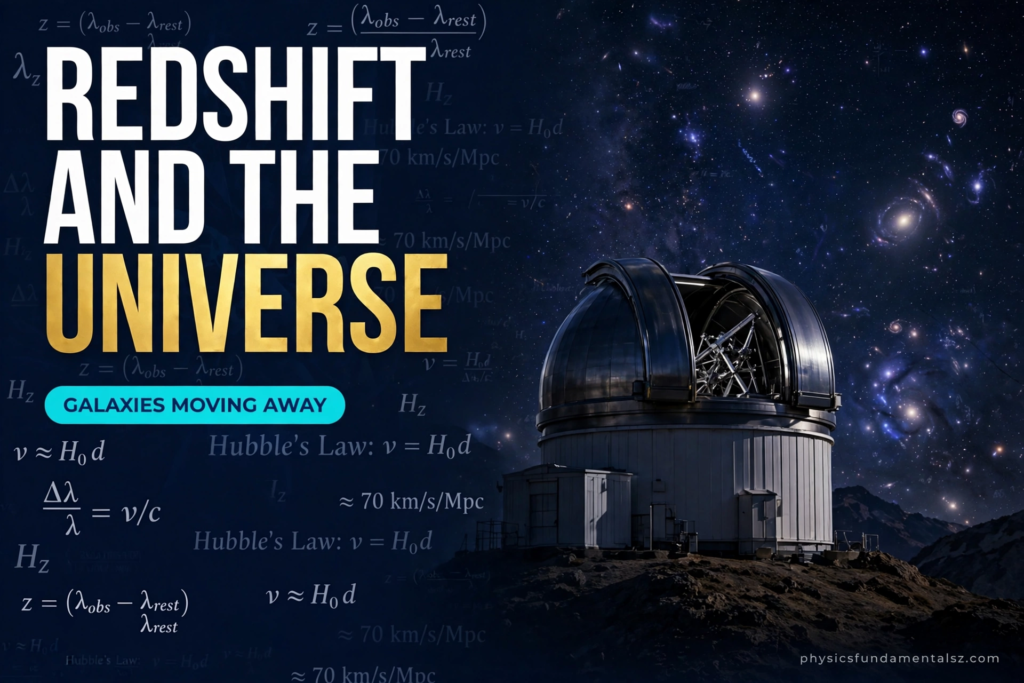
These shifts are the tools of modern astronomy. The light from almost every distant galaxy is redshifted, and the more distant the galaxy, the larger the redshift. This was Edwin Hubble’s great discovery in 1929: the universe is expanding, carrying galaxies away from each other, and the redshift of a galaxy tells us how fast it is receding. NASA’s overview of Hubble’s discovery of the expanding universe explains how those redshift measurements were made, and Khan Academy’s Doppler effect explainer covers the wave mathematics behind it.
The cosmic microwave background — the faint glow left over from the early universe — is the most extreme redshift of all: light that started as intense visible and ultraviolet radiation has been stretched by the expansion of space itself into microwaves.
Why Light’s Doppler Effect Is Different From Sound’s
With sound, it matters whether the source moves or the observer moves, because the air provides a fixed reference frame. With light, there is no medium and no preferred frame — only the relative motion matters. This is a direct consequence of Einstein’s special relativity, and it is why the light Doppler formula is symmetric in a way the sound formula is not.
At everyday speeds, the light Doppler shift is far too small to notice. A car approaching at 30 m/s shifts visible light by only about one part in ten million. That is why you never see the Doppler effect in headlights, but astronomers can measure it precisely in starlight.
Real-World Applications of the Doppler Effect
Police Radar and Speed Cameras
A radar gun sends out radio waves toward a moving car. The waves reflect off the car and return to the gun, shifted in frequency by the Doppler effect — once for the car acting as a moving observer, and once for the car acting as a moving source. The gun measures the frequency shift and converts it directly into the car’s speed. Because radio waves travel at the speed of light, the shift is tiny, but modern electronics measure it with ease.
Weather Radar
Meteorologists use Doppler radar to track storms. The radar sends out pulses and measures the Doppler shift of the reflections from raindrops. Drops moving toward the radar station shift the signal one way; drops moving away shift it the other. This reveals wind speed and direction inside a storm, including the rotation that signals a tornado forming. Doppler radar has saved countless lives by giving advance warning of severe weather.
Medical Ultrasound: Doppler Imaging
Doctors use the Doppler effect to measure blood flow without surgery. An ultrasound probe sends sound waves into the body, and the waves reflect off moving red blood cells. The frequency shift of the reflected waves reveals the speed and direction of blood flow.
This is how doctors check for blocked arteries, monitor a baby’s heartbeat during pregnancy, and detect deep vein thrombosis. Colour Doppler ultrasound even paints the flow on screen: red for blood moving toward the probe, blue for blood moving away — a direct visualisation of the Doppler shift.
Astronomy and the Expanding Universe
As mentioned above, redshift measurements underpin modern cosmology. By measuring the redshift of a galaxy’s spectral lines — the characteristic fingerprints of elements like hydrogen and calcium — astronomers determine its recession speed. Combined with distance measurements, this gives the Hubble constant and the age of the universe.
Closer to home, the Doppler effect reveals exoplanets. A star with an orbiting planet wobbles slightly as the planet’s gravity tugs it, and that wobble shows up as a tiny, periodic Doppler shift in the star’s light. The radial velocity method has discovered hundreds of exoplanets this way.
Navigation and Satellite Tracking
GPS satellites and deep-space probes use Doppler tracking. Ground stations measure the Doppler shift of a spacecraft’s radio signal to determine its velocity along the line of sight with extraordinary precision. This is how NASA tracks probes billions of kilometres away and steers them into orbit around other planets.
Everyday Sound: Sirens, Trains, and Racing Cars
The classic siren example is the Doppler effect in its purest form. Race fans hear it at every grand prix: an engine’s note rises as the car approaches the stand and falls as it speeds away. The same physics makes a passing train’s whistle drop in pitch, and makes the sound of a low-flying aircraft change as it passes overhead.
Sonic Booms: When the Source Outruns Its Own Waves
What happens when a source moves faster than the waves it emits? For sound, this means travelling faster than the speed of sound — supersonic flight.
When a source moves at exactly the speed of sound, the waves pile up directly in front of it, creating a wall of compressed air. When it moves faster, the waves cannot keep up at all, and they form a cone-shaped shock wave trailing behind the source. This is the Mach cone, and when it sweeps past an observer, they hear a sonic boom — a sharp crack, not a continuous roar, because the boom is the arrival of the shock front itself.
The Mach number measures how fast an object moves relative to the speed of sound: Mach 1 is the speed of sound, Mach 2 is twice it. Supersonic aircraft, bullets, and even the tip of a cracking whip all produce shock waves this way. The whip crack is literally a tiny sonic boom: the tip of the whip briefly exceeds the speed of sound.
The Doppler formula breaks down at and beyond Mach 1 — the denominator (v − vs) goes to zero or negative — which is nature’s way of telling you the physics has changed. Supersonic motion needs shock-wave physics, not the ordinary Doppler formula.
The Doppler Effect vs Other Wave Phenomena
Students sometimes confuse the Doppler effect with related wave effects. The table below separates them.
| Phenomenon | What changes | Caused by |
|---|---|---|
| Doppler effect | Observed frequency/wavelength | Relative motion of source and observer |
| Refraction | Wave speed and direction | Wave entering a different medium |
| Diffraction | Wave spreading | Wave passing an edge or slit |
| Interference | Amplitude pattern | Two or more waves overlapping |
| Resonance | Amplitude builds up | Driving frequency matching natural frequency |
The key distinction is that the Doppler effect requires motion. Refraction, diffraction, and interference all happen with stationary sources. If a question mentions a moving source or observer and asks about a frequency change, it is almost certainly the Doppler effect.
For a deeper look at how waves bend when they change medium, see our guide to what refraction of light is, and for the general properties of waves, our explainer on the difference between transverse and longitudinal waves.
Common Mistakes Students Make
Mistake 1: Thinking the Source Frequency Changes
It does not. The ambulance siren always produces 800 Hz. The Doppler effect changes the frequency the observer measures, not the frequency the source emits. This is the single most common misconception, and examiners test it directly.
Mistake 2: Getting the Signs Wrong
The sign convention in the sound formula is the biggest source of lost marks. Remember: motion toward raises the frequency. The observer’s speed adds to the numerator when moving toward the source; the source’s speed subtracts from the denominator when moving toward the observer. Work through the signs slowly, and check your answer makes sense: approaching should give a higher frequency than the source frequency.
Mistake 3: Using the Speed of Sound in the Wrong Medium
The speed of sound depends on the medium and temperature: about 343 m/s in air at 20°C, but about 1,480 m/s in water and over 5,000 m/s in steel. Use the value the question gives you, or the standard air value if none is given.
Mistake 4: Applying the Sound Formula to Light
Light needs no medium and always travels at c, so the sound formula does not apply. For light, use the redshift relation Δλ/λ = v/c (for speeds much less than c), or the full relativistic formula for speeds approaching c.
Mistake 5: Confusing Redshift With the Object Actually Turning Red
Redshift means the spectrum shifts toward longer wavelengths. A star’s light can be redshifted without the star looking visibly red to your eye — the shift is measured in its spectral lines, not in its apparent colour. The same applies to blueshift.
Mistake 6: Forgetting That Both Source and Observer Can Move
If both are moving, you need the full formula with both vo and vs. Using only one of them gives the wrong answer. Always list what is moving and in which direction before choosing your formula.
The Doppler Effect in Astronomy: A Deeper Look
Astronomers measure Doppler shifts using spectroscopy. Every element absorbs and emits light at specific wavelengths, creating a unique pattern of spectral lines — a fingerprint. When a star moves, its entire fingerprint shifts: toward the red if receding, toward the blue if approaching.
By comparing the observed lines with laboratory measurements, astronomers calculate the star’s radial velocity — its speed along the line of sight. This technique has revealed binary star systems (two stars orbiting each other, their lines shifting back and forth), the rotation of galaxies, and the expansion of the universe itself.
One of the most dramatic results came from studying distant supernovae. Their redshifts showed that the universe’s expansion is not slowing down under gravity, as expected, but accelerating — driven by what we now call dark energy. The Doppler effect, first demonstrated with trumpets on a train, led to one of the biggest discoveries in the history of cosmology.
For a related conservation-law story in fluid flow, see Bernoulli’s principle explained.
The Doppler Effect in Everyday Technology You Already Use
Beyond radar guns and telescopes, the Doppler effect quietly works inside technologies you use without thinking about it. Automatic door openers in supermarkets use microwave Doppler sensors: they emit microwaves and detect the frequency shift caused by a person walking toward the door, triggering it to open. The same sensors appear in security alarms, detecting intruders by the motion-induced shift in reflected microwaves.
In aviation, Doppler navigation systems help aircraft measure their ground speed, even over a featureless ocean where there are no landmarks. In oceanography, acoustic Doppler current profilers measure water currents by bouncing sound waves off tiny particles drifting in the water and reading the shift. Even the humble baseball radar gun at a stadium is a Doppler device, measuring a pitcher’s fastball the same way a police radar measures a car.
Perhaps the most futuristic application is Doppler lidar for wind energy. Wind turbines use lidar beams to measure the wind speed ahead of the blades, adjusting their pitch in real time for maximum efficiency. The measurement is pure Doppler shift, applied to laser light scattered by dust particles in the air.
Frequently Asked Questions
1. What is the Doppler effect in simple words?
It is the change in pitch of a sound (or colour of light) when the source and observer move toward or away from each other. Approaching motion raises the frequency; receding motion lowers it.
2. Who discovered the Doppler effect?
Christian Doppler, an Austrian physicist, described it in 1842. It was confirmed experimentally in 1845 using trumpeters on a moving train.
3. What is the Doppler effect formula?
The general formula is f’ = f × (v + vo) / (v − vs), where v is the speed of sound, vo is the observer’s speed toward the source, and vs is the source’s speed toward the observer.
4. Why does an ambulance siren sound higher as it approaches?
Because the ambulance’s motion bunches the sound waves up in front of it, shortening the wavelength and raising the frequency heard by an observer in front.
5. Why does the pitch drop suddenly when the siren passes?
Because the source’s motion flips from toward to away in an instant. The waves go from bunched up to stretched out, so the observed frequency drops sharply with no gradual transition.
6. What is redshift?
Redshift is the shift of light toward longer, redder wavelengths when the source moves away from the observer. It is the light version of the pitch drop of a receding siren.
7. What is blueshift?
Blueshift is the shift of light toward shorter, bluer wavelengths when the source moves toward the observer. It is the light version of the pitch rise of an approaching siren.
8. How do police use the Doppler effect?
Radar guns send radio waves at a car and measure the Doppler shift of the reflected waves. The shift is proportional to the car’s speed, so the gun displays the speed directly.
9. How does Doppler ultrasound work in medicine?
An ultrasound probe sends sound waves into the body, and the waves reflect off moving blood cells. The frequency shift reveals the speed and direction of blood flow, helping doctors find blockages and monitor pregnancies.
10. Does the Doppler effect apply to light?
Yes. Light from a receding source is redshifted and from an approaching source is blueshifted. Astronomers use this to measure the speeds of stars and galaxies.
11. What is a sonic boom?
A sonic boom is the shock wave produced when an object travels faster than the speed of sound. The sound waves pile up into a cone-shaped front, and an observer hears a sharp crack as the front passes.
12. Does the source frequency change in the Doppler effect?
No. The source always emits the same frequency. Only the frequency measured by the observer changes, because of the relative motion.
13. Why is the sound Doppler formula different from the light Doppler formula?
Because sound travels through a medium (air), which provides a reference frame, while light travels through empty space at the same speed for all observers. Light’s formula comes from special relativity and depends only on relative motion.
14. What is the Doppler effect used for in weather forecasting?
Doppler radar measures the shift of radio waves reflected by raindrops, revealing wind speed and direction inside storms and giving early warning of tornadoes.
15. Can the Doppler effect be used to find exoplanets?
Yes. A planet’s gravity makes its star wobble, and that wobble shows up as a tiny periodic Doppler shift in the star’s light. Measuring the shift reveals the planet’s presence and mass.
Key Takeaways
- The Doppler effect is the change in observed wave frequency caused by relative motion between source and observer.
- Approaching motion raises the frequency (higher pitch, blueshift); receding motion lowers it (lower pitch, redshift).
- For sound: f’ = f × (v + vo) / (v − vs). For light at low speeds: Δλ/λ = v/c.
- The source frequency never changes — only what the observer measures changes.
- Applications include radar speed guns, weather radar, medical ultrasound, astronomy, and spacecraft tracking.
Conclusion
The Doppler effect is a perfect example of how a simple idea — waves bunching up when their source moves — can reach into almost every corner of science. It measures the speed of cars, watches the blood in your veins, tracks storms before they strike, and tells us that the universe itself is expanding.
If you are studying for an exam, remember the core logic rather than memorising every special case: motion toward the observer compresses waves and raises frequency; motion away stretches waves and lowers frequency. Get the signs right in the sound formula, remember that light needs the relativistic version, and never claim the source frequency itself changes.
For more wave physics, read our guides to what refraction of light is and the difference between transverse and longitudinal waves, and for the rotational side of motion, see what centripetal force is.