What Is Density in Physics? Formula, Units, and Worked Examples
A kilogram of steel and a kilogram of feathers have the same mass. Hold them, though, and they feel nothing alike. The steel is small and heavy in the hand. The feathers fill a huge bag.
The difference is density. Density tells you how much mass is packed into a given volume. Steel packs its mass tightly. Feathers spread theirs thinly.
This guide explains what density is in physics, in plain language. You will learn the formula, the units, and how to calculate density step by step.
You will also learn why some objects float and others sink, and how density is used in science, engineering, and everyday life. Worked examples and exam tips complete the guide.
Quick Answer: What Is Density in Physics?
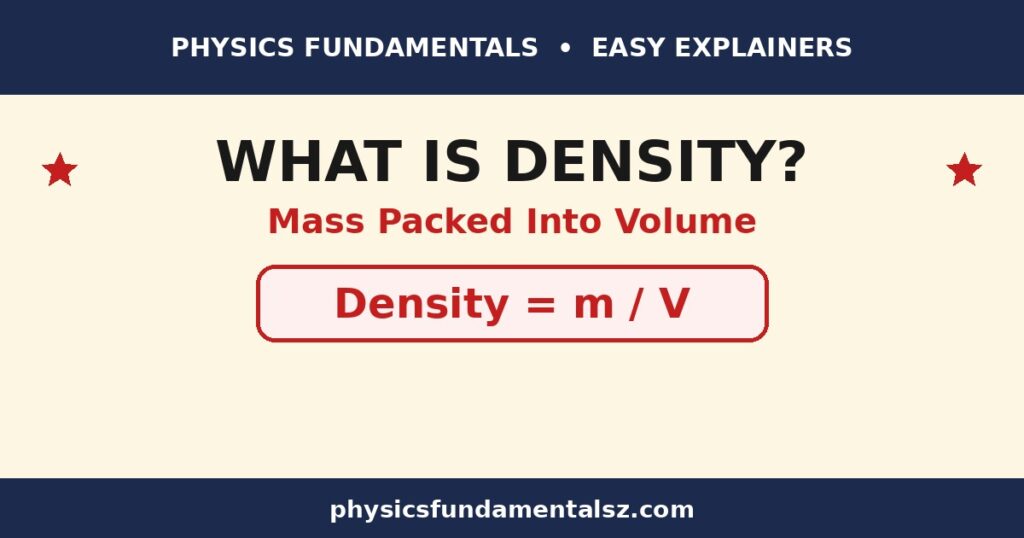
Density is mass per unit volume. It tells you how much mass sits in each cubic metre, or each cubic centimetre, of a material.
The formula is density = mass ÷ volume, written as ρ = m / V. The Greek letter rho (ρ) stands for density.
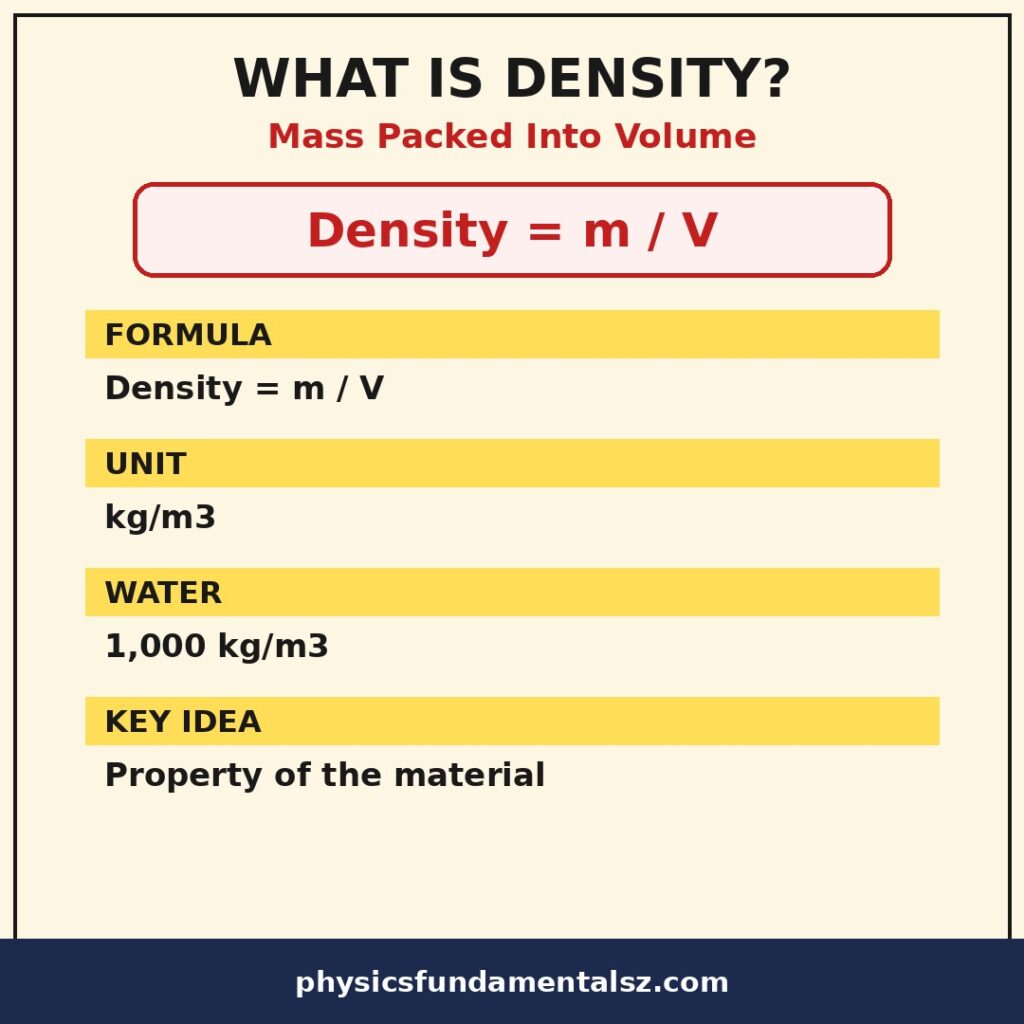
In short: a dense material packs a lot of mass into a small space. A less dense material spreads the same mass over a larger space. Water has a density of 1,000 kg/m³, so anything denser than water tends to sink in it.
Definition Box — Density: Density is the mass of a substance per unit volume. It is a property of the material itself, not of the size of the sample. Density is a scalar quantity. Its SI unit is the kilogram per cubic metre (kg/m³).
Formula: ρ = m / V, where ρ is density, m is mass, and V is volume. Rearranged: m = ρV and V = m / ρ. The density triangle below shows all three forms at a glance.
Key Takeaways
- Density = mass ÷ volume (ρ = m / V).
- The SI unit of density is kg/m³; g/cm³ is common in school work.
- Density is a property of the material, not the sample size.
- A larger sample of the same material has the same density.
- Objects denser than a fluid sink in it; objects less dense float.
- Density changes with temperature because volume changes with temperature.
- Water is unusual: ice is less dense than liquid water, so ice floats.
- Always convert units before calculating: mass in kg, volume in m³, for kg/m³.
The Density Formula Explained
The density formula is one of the simplest in physics. It divides two quantities you already know: mass and volume.
ρ = m / V
Read it as “rho equals mass over volume.” Mass goes on top, volume below. The result tells you the mass in each unit of volume.
If a block has a mass of 200 kg and a volume of 0.1 m³, its density is 200 ÷ 0.1 = 2,000 kg/m³. Each cubic metre of that material would contain 2,000 kg of mass.
The formula also rearranges two ways. To find mass, multiply density by volume: m = ρV. To find volume, divide mass by density: V = m / ρ. All three forms are the same relationship, viewed from different sides.
The Density Triangle
Students often draw a triangle to remember the three forms. Write m at the top and ρ and V at the bottom corners. Cover the quantity you want, and the remaining two show the calculation.
Cover m, and you see ρ × V. Cover ρ, and you see m ÷ V. Cover V, and you see m ÷ ρ. The triangle is a memory aid, not a separate formula.
Draw it in the margin of an exam paper if it helps. The method is fast, and it prevents the most common error: dividing the wrong way round.
What Each Symbol Means
The symbol ρ is the Greek letter rho. It always stands for density in physics. Do not confuse it with p, which usually stands for momentum or pressure.
The symbol m stands for mass, in kilograms. The symbol V stands for volume, in cubic metres. Keep the symbols straight and the units will follow.
Density itself has no direction. It is a scalar, like mass and temperature. You never draw an arrow for density.
Units of Density
Density units combine a mass unit with a volume unit. The SI unit is the kilogram per cubic metre, kg/m³. It is the unit examiners expect in formal answers.
School work also uses grams per cubic centimetre, g/cm³. It suits small laboratory samples. Water has a density of 1 g/cm³, which makes the numbers easy.
Converting Between kg/m³ and g/cm³
The conversion is a clean factor of 1,000. One g/cm³ equals 1,000 kg/m³. To convert from g/cm³ to kg/m³, multiply by 1,000. To convert the other way, divide by 1,000.
Water: 1 g/cm³ = 1,000 kg/m³. Aluminium: 2.70 g/cm³ = 2,700 kg/m³. Gold: 19.3 g/cm³ = 19,300 kg/m³.
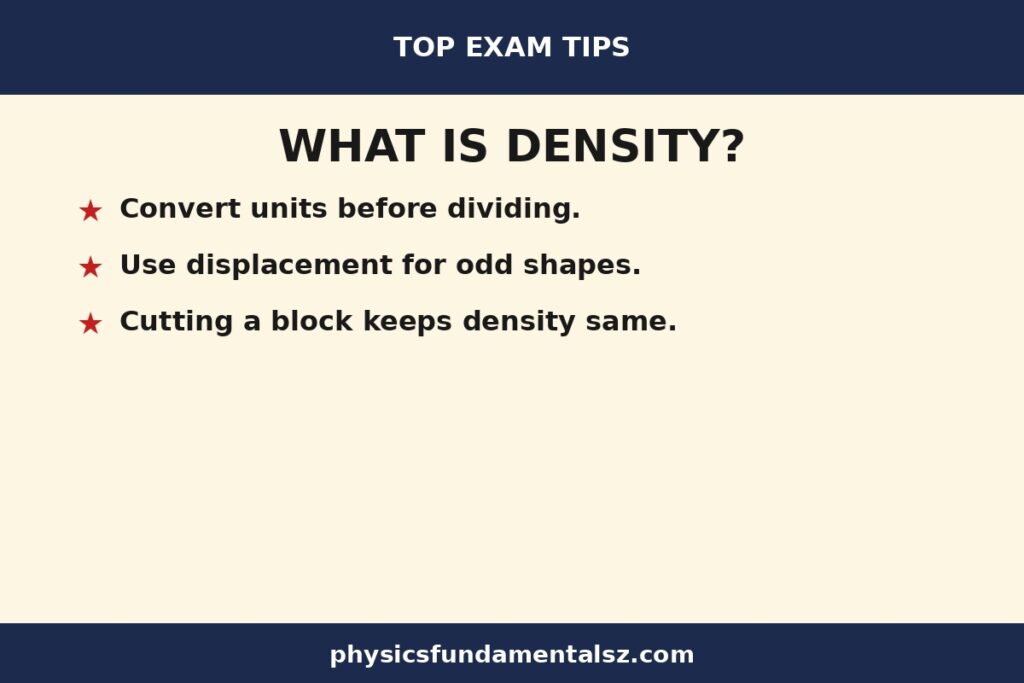
Students lose marks by mixing the two systems in one calculation. Pick one system, convert everything into it, then calculate. Never divide kilograms by cubic centimetres and call the answer kg/m³.
| Quantity | SI unit | School unit | Conversion |
|---|---|---|---|
| Mass | kilogram (kg) | gram (g) | 1 kg = 1,000 g |
| Volume | cubic metre (m³) | cubic centimetre (cm³) | 1 m³ = 1,000,000 cm³ |
| Density | kg/m³ | g/cm³ | 1 g/cm³ = 1,000 kg/m³ |
Why the SI Unit Matters
The SI system keeps every derived unit consistent. Using kg and m³ gives density in kg/m³ with no extra factors. Using g and cm³ gives g/cm³, which is fine, but mixing the two creates errors.
AP Physics and A-level papers accept either unit if it is stated. The safest habit is to convert to SI at the start of a calculation. It matches every other mechanics formula you will use.
Density Is a Property of the Material
Density belongs to the material, not to the object. Cut a block of iron in half and each half has the same density as the whole block. The mass halves and the volume halves, so the ratio stays fixed.
This is what makes density useful for identification. An unknown metal can be identified by measuring its density and comparing it with a table. Gold, lead, and aluminium each have a distinct density, and no sample size changes that.
The same logic applies to liquids. A drop of mercury and a litre of mercury share the same density. The litre has more mass and more volume, in the same proportion.
Density Does Not Depend on Sample Size
Imagine two cubes of copper, one twice the size of the other. The larger cube has twice the mass and twice the volume. Divide mass by volume for each, and the answers match.
Students sometimes think a bigger object must be denser. It is not. Bigger means more mass and more volume together. Density is the ratio, and the ratio is fixed for a pure material.
Alloys and mixtures complicate the picture slightly. Their density depends on the mix. Pure substances and single materials are the clean cases examiners use.
Density and Purity
Because density is fixed for a pure material, it is a purity test. Gold mixed with cheaper metals has a lower density than pure gold. Jewellers and assayers have used this test for centuries.
The story of Archimedes and the crown is the famous example. Asked to test a crown without damaging it, Archimedes measured the water it displaced. The volume, combined with the mass, gave the density, and the density exposed the fraud.
The tale may be legend, but the method is real. Density testing is still used for metals, gems, and coins today.
Densities of Common Materials
The table below lists approximate densities for materials students meet most often. Values vary slightly with temperature and purity, so treat them as typical values.
| Material | Density (kg/m³) | Density (g/cm³) |
|---|---|---|
| Air (at sea level) | 1.2 | 0.0012 |
| Ice (0 °C) | 917 | 0.917 |
| Water (4 °C) | 1,000 | 1.00 |
| Seawater | 1,025 | 1.025 |
| Olive oil | 920 | 0.92 |
| Mercury | 13,600 | 13.6 |
| Aluminium | 2,700 | 2.70 |
| Iron | 7,870 | 7.87 |
| Copper | 8,960 | 8.96 |
| Lead | 11,340 | 11.34 |
| Gold | 19,300 | 19.3 |
| Wood (oak) | 700 | 0.70 |
| Glass | 2,500 | 2.50 |
| Plastic (polythene) | 950 | 0.95 |
The spread is enormous. Gold is more than fifteen thousand times denser than air. That range is why density is such a powerful sorting tool.
For authoritative reference values, the NIST materials data and standard physics textbooks agree closely on these figures. OpenStax University Physics also tabulates densities in its chapter on fluid mechanics.
How to Calculate Density Step by Step
Calculating density takes four steps. Follow them in order, and check the units at each step.
- Find the mass. Weigh the object, or read the mass from the question. Record it in kilograms for SI answers.
- Find the volume. Measure the sides for a regular shape, or use water displacement for an irregular shape.
- Convert units. Make mass and volume match the density unit you want. Kilograms with cubic metres gives kg/m³.
- Divide and state the unit. Density = mass ÷ volume. Write the answer with kg/m³ or g/cm³.
Finding Volume of Regular Shapes
A cuboid has volume = length × width × height. A cube has volume = side³. A cylinder has volume = πr²h, where r is the radius and h is the height.
Measure each length in the same unit. Mixing centimetres and metres is the classic volume error. Convert first, then multiply.
A sphere has volume = (4/3)πr³. Spheres appear in density questions about ball bearings and planets, so the formula is worth knowing.
Finding Volume by Displacement
Irregular objects cannot be measured with a ruler. The displacement method solves the problem. Fill a measuring cylinder with water, note the level, then lower the object in and note the new level.
The rise in level equals the object’s volume. If the level rises from 50 cm³ to 73 cm³, the volume is 23 cm³. The method works for any shape that sinks and does not dissolve.
This is the modern version of Archimedes’ insight. It is also the method used in school practical exams, so practise it until it is automatic.
Measuring Density in a School Practical
A typical practical asks for the density of a metal block. Weigh the block on a balance. Measure its sides with a ruler. Calculate the volume. Divide mass by volume.
The result should match the known density of the metal. Errors come from measurement, not from the formula. A ruler reading off by a millimetre changes the volume, and the density shifts with it.
Repeat measurements and average them. Good technique, more than clever maths, is what earns practical marks.
Worked Examples: Density Calculations
Each example shows the full method. Read the question, write the formula, substitute values, and state the answer with its unit.
Example 1: Density of a Metal Block
Question: A metal block has a mass of 540 g and a volume of 200 cm³. Calculate its density in g/cm³. What metal might it be?
Solution:
ρ = m / V = 540 ÷ 200 = 2.7 g/cm³.
The density matches aluminium. The block is probably aluminium, though other tests would confirm it.
Check: The units match: grams divided by cubic centimetres gives g/cm³. No conversion was needed.
Example 2: Density in SI Units
Question: A block has a mass of 2.7 kg and a volume of 0.001 m³. Calculate its density in kg/m³.
Solution:
ρ = 2.7 ÷ 0.001 = 2,700 kg/m³.
This is the same material as Example 1, expressed in SI units. The two answers are equivalent: 2.7 g/cm³ = 2,700 kg/m³.
Check: Multiplying 2.7 by 1,000 converts g/cm³ to kg/m³. The answers agree.
Example 3: Finding Mass From Density and Volume
Question: A tank holds 0.5 m³ of oil with a density of 920 kg/m³. What is the mass of the oil?
Solution:
m = ρV = 920 × 0.5 = 460 kg.
Check: The answer is a mass, in kilograms. Multiplying density by volume always gives mass.
Example 4: Finding Volume From Mass and Density
Question: A gold bar has a mass of 1.93 kg. Gold has a density of 19,300 kg/m³. What is the volume of the bar?
Solution:
V = m / ρ = 1.93 ÷ 19,300 = 0.0001 m³, or 100 cm³.
Check: Gold is very dense, so a large mass occupies a small volume. The tiny answer makes sense.
Example 5: Density of an Irregular Object
Question: A stone has a mass of 120 g. Lowered into a measuring cylinder, it raises the water level from 80 cm³ to 110 cm³. Calculate the stone’s density.
Solution:
Volume = 110 − 80 = 30 cm³.
ρ = 120 ÷ 30 = 4.0 g/cm³.
Check: The volume is the change in level, not the final level. Using 110 cm³ would give a wrong, much lower density.
Example 6: Comparing Two Materials
Question: Object A has mass 300 g and volume 100 cm³. Object B has mass 300 g and volume 150 cm³. Which is denser, and by how much?
Solution:
A: ρ = 300 ÷ 100 = 3.0 g/cm³. B: ρ = 300 ÷ 150 = 2.0 g/cm³.
Object A is denser by 1.0 g/cm³. Equal mass, smaller volume, higher density. The comparison shows why density is a ratio, not a single measurement.
Practice Problems With Answers
Try these before checking the answers. Show the formula, the substitution, and the unit.
- Mass 800 g, volume 400 cm³. Density? Answer: 2.0 g/cm³.
- Mass 5 kg, volume 0.002 m³. Density? Answer: 2,500 kg/m³.
- Density 1,000 kg/m³, volume 2 m³. Mass? Answer: 2,000 kg.
- Mass 39.5 g, density 7.9 g/cm³. Volume? Answer: 5.0 cm³.
- A liquid has mass 250 g and volume 200 cm³. Will it float on water? Answer: Density 1.25 g/cm³, denser than water, so it sinks.
Density, Floating, and Sinking
Density explains floating better than weight does. A heavy ship floats. A tiny pebble sinks. Weight alone cannot explain that. Density can.
An object floats in a fluid when its average density is less than the fluid’s density. It sinks when its average density is greater. The comparison is always between the object and the fluid.
Why Ships Float
A steel ship is mostly hollow. Its average density counts the steel, the air inside, the cargo, and the crew together. That average is less than the density of water, so the ship floats.
The steel alone is far denser than water. A solid steel block sinks at once. Shape and hollowness change the average density, and the average is what the water feels.
This links to buoyancy. Our guide to buoyant force works through the upthrust calculation, and the guide to Archimedes’ principle explains the displaced-fluid rule behind it.
Why Ice Floats
Ice is less dense than liquid water. Water expands when it freezes, so the same mass takes up more volume. Density falls, and ice floats.
This quirk protects aquatic life. Ice forms a layer on the surface of a lake, insulating the water below. Fish survive winter under the ice because the densest water sinks to the bottom.
Most substances contract when they freeze. Water is unusual, and the exception matters for climate, ecology, and everyday life.
Submarines and Density Control
A submarine controls its average density with ballast tanks. Filling the tanks with water raises the average density, and the submarine sinks. Blowing the water out with compressed air lowers the density, and it rises.
Neutral buoyancy is the balance point. The submarine’s average density equals the water’s density, and it hovers at a fixed depth. Small adjustments hold it there.
Fish do the same thing with swim bladders. They adjust the volume of gas in the bladder, changing their average density without changing their mass.
Hot Air Balloons and Density
Hot air is less dense than cold air. Heating the air in a balloon makes it expand, so the same mass occupies more volume. The balloon’s average density falls below the surrounding air, and it rises.
The lift depends on the temperature difference. A hotter balloon lifts more, up to the limits of the fabric. The physics is density all the way down.
Density and Layering Liquids
Pour oil on water and it floats. Oil is less dense than water, so it forms a layer on top. Pour honey into the same glass and it sinks to the bottom. Honey is denser than water.
Layered liquids make a density column. Each liquid sits at the level its density dictates. The column is a visual table of densities, and it is a popular classroom demonstration.
How Density Changes With Temperature and Pressure
Density is not perfectly fixed. It changes when temperature or pressure changes the volume. Mass stays the same, so any volume change moves the density.
Temperature Effects
Heating most materials makes them expand. The mass is unchanged, but the volume grows, so the density falls. Cooling reverses the process.
This is why hot air rises and cold air sinks. It is also why the density values in tables are quoted at a stated temperature. Water’s density is 1,000 kg/m³ at 4 °C, where it is densest, and slightly less at other temperatures.
Our guide to thermal expansion covers the expansion side of this story in detail.
Pressure Effects
Solids and liquids barely change volume under pressure. Their densities are treated as constant in school physics. Gases are different. Squeezing a gas into a smaller volume raises its density sharply.
The atmosphere shows the effect. Air at sea level is denser than air on a mountaintop. The weight of the air above compresses the air below, raising its density.
Density in Gases
Gas density depends on temperature, pressure, and the gas itself. The ideal gas law links all three. Our guide to the ideal gas law works through the relationship.
A classroom rule of thumb: at the same temperature and pressure, a heavier gas is denser. Carbon dioxide is denser than air, so it pools in low places. Helium is far less dense, so balloons rise.
Density in Real Life and Engineering
Density shapes design choices across science and industry. The examples below show how widely the idea reaches.
Materials Selection
Engineers pick materials by density as well as strength. Aircraft use aluminium and composites because they are strong for their mass. A denser material would need more fuel to lift.
Bridges and buildings balance density against cost and strength. Concrete is dense and cheap. Steel is denser and stronger. The choice depends on the job.
Cooking and Food Science
Oil floats on soup because it is less dense. Cream rises in milk for the same reason. Cooks skim fat from stock by exploiting density, and salad dressing separates into layers when left standing.
Baking uses density too. A batter that traps air is less dense and rises better. The texture of bread is a density story told in crumbs.
Medicine and Biology
Blood tests use density. A centrifuge spins blood samples, and the denser red cells settle below the plasma. The separation is density in action.
Bone density scans measure the mass of mineral per volume of bone. Low density signals osteoporosis. The same word, the same formula, applied to health.
Geology and Earth Science
Earth’s layers are sorted by density. The dense iron core sits at the centre. The lighter rocky mantle surrounds it. The lightest crust floats on top.
Volcanoes and plate tectonics follow the same logic. Dense oceanic plates sink beneath lighter continental plates. The planet is a density column on a grand scale.
Everyday Objects
A life jacket is filled with low-density foam. Its average density, with the wearer, stays below water’s density, so it floats. A diver’s weight belt adds dense lead to raise the average density and allow sinking.
Even a simple object like a bottle tells the story. A full bottle of water sinks slowly. An empty, sealed bottle floats because the air inside lowers its average density.
Density and Pressure in Fluids
Density and pressure are partners in fluid physics. The pressure at a depth in a fluid depends on the fluid’s density, gravity, and depth: P = ρgh.
A denser fluid produces more pressure at the same depth. Mercury barometers work because mercury is very dense, so a short column balances the atmosphere. Water would need a column ten times taller.
Our guide to pressure in fluids develops the pressure formula and its applications. Density is the input, and pressure is the output.
Density and the Centre of Mass
Density also affects balance. An object with uneven density has its centre of mass shifted toward the denser part. Our guide to the centre of mass explains how that shift changes stability.
A loaded ship illustrates the point. Heavy cargo low in the hold keeps the centre of mass low and the ship stable. The same cargo stacked high raises the centre of mass and risks capsizing. Density distribution matters, not just average density.
Common Misconceptions About Density
Density attracts confident errors. Clearing them now saves trouble in fluids and thermodynamics later.
Misconception 1: Heavy Objects Always Sink
Heavy is not dense. A ship is heavy and floats. A pebble is light and sinks. Floating depends on the density comparison with the fluid, not on weight alone.
Misconception 2: Density and Weight Are the Same
Weight is a force, measured in newtons. Density is mass per volume, measured in kg/m³. They share the mass idea, but they are different quantities. Mass is measured in kilograms, weight in newtons, and density in kilograms per cubic metre.
Misconception 3: Density Changes When You Cut an Object
Cutting changes mass and volume together. The ratio stays the same for a uniform material. Each piece has the original density.
Misconception 4: All Metals Are Denser Than Water
Most metals are, but not all. Lithium, sodium, and potassium are less dense than water and float, reacting as they do. The rule is a tendency, not a law.
Misconception 5: Density and Thickness Are the Same
Thickness is a length. Density is mass per volume. A thick sheet of foam can be less dense than a thin sheet of steel. The words sound similar in everyday speech, but the physics differs completely.
Misconception 6: Hot Objects Are Always Less Dense
Hot objects expand and usually become less dense, but water near freezing breaks the pattern. Water is densest at 4 °C, not at 0 °C. The exception is real and examinable.
Density in AP Physics and Exams
AP Physics 1 and 2 both use density. It appears in fluids, thermodynamics, and gravitation. The calculations are short, but the unit work is strict.
What Examiners Expect
Examiners expect the formula stated, values substituted with units, and the answer in the correct density unit. A bare number earns little. Working earns method marks even when the final answer slips.
Questions often combine density with buoyancy. A typical question gives an object’s mass and volume, asks for its density, then asks whether it floats in a named fluid. The second part is a comparison, not a new calculation.
Typical Exam Questions
A common question asks for the density of a block from its mass and dimensions. The method is volume first, then division. Another asks for the mass of a liquid from its density and the volume of a container.
A harder type gives a density in g/cm³ and asks for SI units. The conversion factor of 1,000 is the whole question. Students who convert at the start get it right. Students who convert at the end often forget.
Mistakes to Avoid
Never divide volume by mass. Never mix grams with cubic metres. Never forget the unit. Never use the final water level instead of the rise in a displacement question.
Check the size of the answer. A density of 0.002 kg/m³ for a metal is impossible, and a density of 50,000 kg/m³ is impossible too. Real material densities sit in a known range, and the table above is a good sanity check.
Khan Academy covers the same ground in its lesson on density and specific gravity. The lesson stresses unit conversion, which is where most marks are lost.
Frequently Asked Questions
What is density in simple words?
Density is how much mass is packed into a space. A small, heavy object is dense. A large, light object is not dense. It is mass divided by volume.
What is the formula for density?
Density = mass ÷ volume, or ρ = m / V. Mass is in kilograms, volume is in cubic metres, and density comes out in kg/m³.
What is the SI unit of density?
The SI unit is the kilogram per cubic metre, kg/m³. Grams per cubic centimetre, g/cm³, is also widely used. One g/cm³ equals 1,000 kg/m³.
How do you calculate density?
Weigh the object to find its mass. Measure or displace to find its volume. Convert the units to match, then divide mass by volume. State the answer with its unit.
What is the density of water?
Pure water has a density of 1,000 kg/m³, or 1 g/cm³, at 4 °C. At room temperature it is very slightly less, about 997 kg/m³. School questions use 1,000 kg/m³.
What is the density of air?
Air at sea level has a density of about 1.2 kg/m³. It falls with altitude as pressure drops. Hot air is less dense than cold air at the same pressure.
Why do objects float?
Objects float when their average density is less than the fluid’s density. The fluid pushes up with a force equal to the weight of fluid displaced. If that push beats the object’s weight, it floats.
Why does ice float on water?
Ice is less dense than liquid water. Water expands when it freezes, so the same mass takes more space. The density drops to about 917 kg/m³, below water’s 1,000 kg/m³.
Does density change with size?
No. Density is a property of the material. A bigger sample has more mass and more volume, in the same ratio. Cutting an object in half leaves the density unchanged.
What is the difference between density and mass?
Mass is the amount of matter in an object, measured in kilograms. Density is mass per unit volume, measured in kg/m³. Mass grows with sample size; density does not.
What is the difference between density and weight?
Weight is the gravitational force on a mass, measured in newtons. Density is mass per volume. Weight changes with gravity; density does not, except through volume changes.
What is relative density or specific gravity?
Relative density compares a material’s density with water’s density. It has no unit. A relative density below 1 means the material floats on water; above 1 means it sinks.
How does temperature affect density?
Heating usually expands a material, raising volume and lowering density. Cooling does the reverse. Water is the main exception near freezing, where it is densest at 4 °C.
What is the densest material?
Osmium is the densest naturally occurring element, at about 22,590 kg/m³. Iridium is close behind. Among common materials, gold and lead are dense, but osmium beats them both.
Can density be negative?
No. Mass and volume are both positive, so their ratio is positive. A negative density has no physical meaning for ordinary matter.
How is density used in everyday life?
Density sorts materials, explains floating, guides engineering, and tests purity. Ships, balloons, submarines, and life jackets all rely on density control.
What is the density triangle?
The density triangle is a memory aid. Mass sits at the top, density and volume at the bottom. Covering one quantity shows the calculation for it: m = ρV, ρ = m/V, V = m/ρ.
How do you find the volume of an irregular object?
Use water displacement. Note the water level in a measuring cylinder, add the object, and note the new level. The rise equals the object’s volume.
Why is density important in physics?
Density links mass, volume, pressure, and buoyancy. It appears in fluids, thermodynamics, and Earth science. It is one of the few quantities that identifies a material from a simple measurement.
What is the density of gold?
Gold has a density of about 19,300 kg/m³, or 19.3 g/cm³. Its high density is a classic purity test: fake gold is usually far less dense.
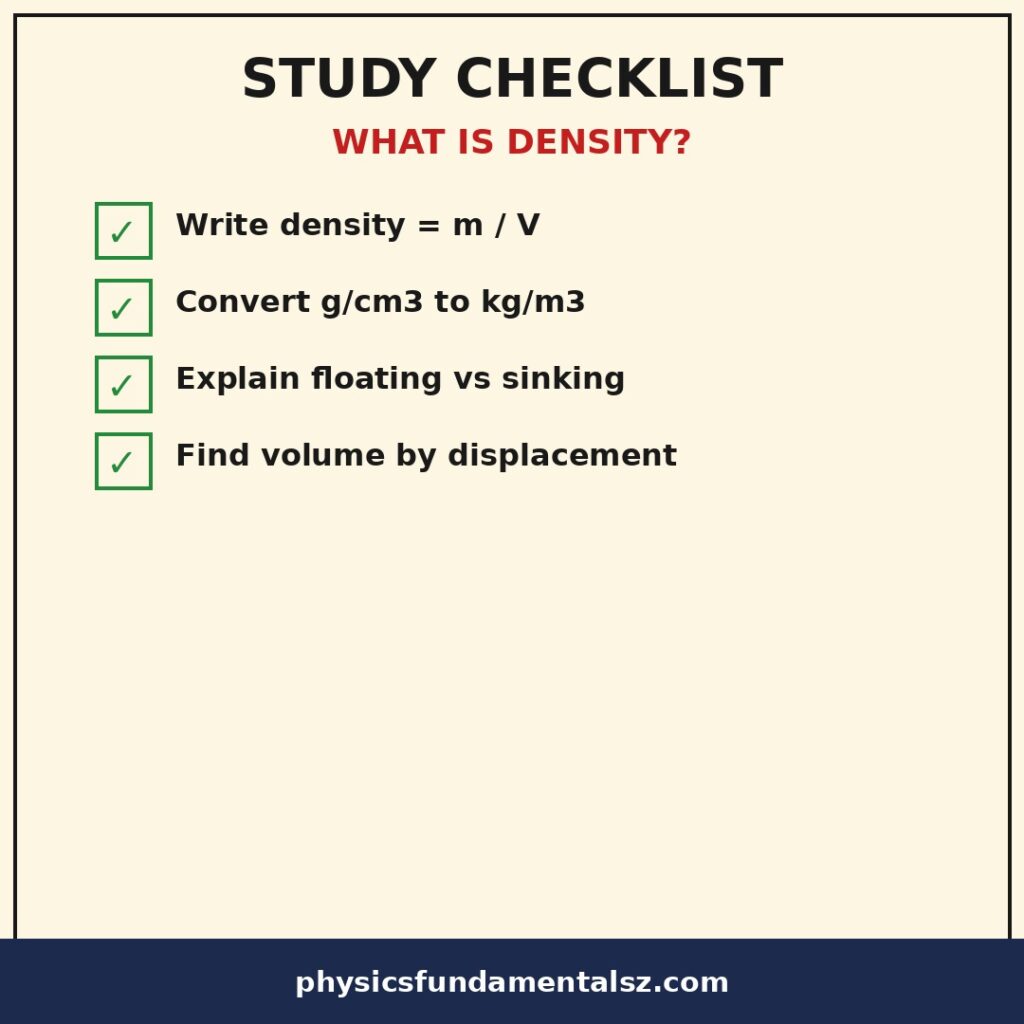
Conclusion
Density is mass per unit volume. The formula is short, the units are strict, and the applications are everywhere.
Remember the method: find mass, find volume, convert units, divide. Remember the idea: density belongs to the material, not the sample.
Watch for density in daily life. Floating, sinking, rising balloons, and layered liquids all run on the same ratio. Master it, and fluids and thermodynamics become far easier.
For more mechanics, read our guides to kinetic energy and momentum in physics. Density will meet you again in fluids, and you will be ready for it.