What Is Momentum in Physics? Definition, Formula & Examples
Quick Answer
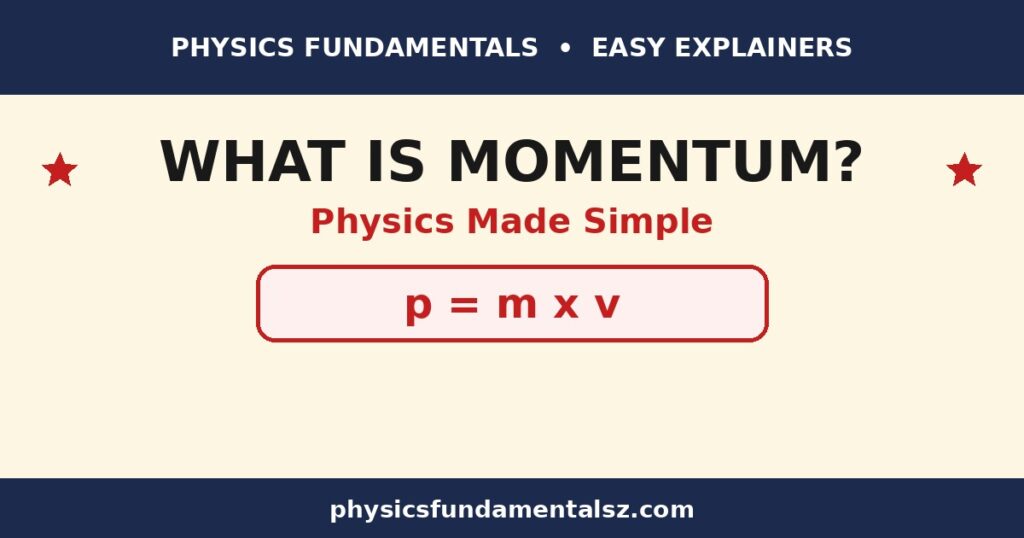
Momentum in physics is the quantity of motion an object has, calculated by multiplying its mass by its velocity. Because velocity has direction, momentum is a vector quantity that points in the same direction as the motion. A heavy object moving slowly and a light object moving fast can therefore have the same momentum.
Definition Box
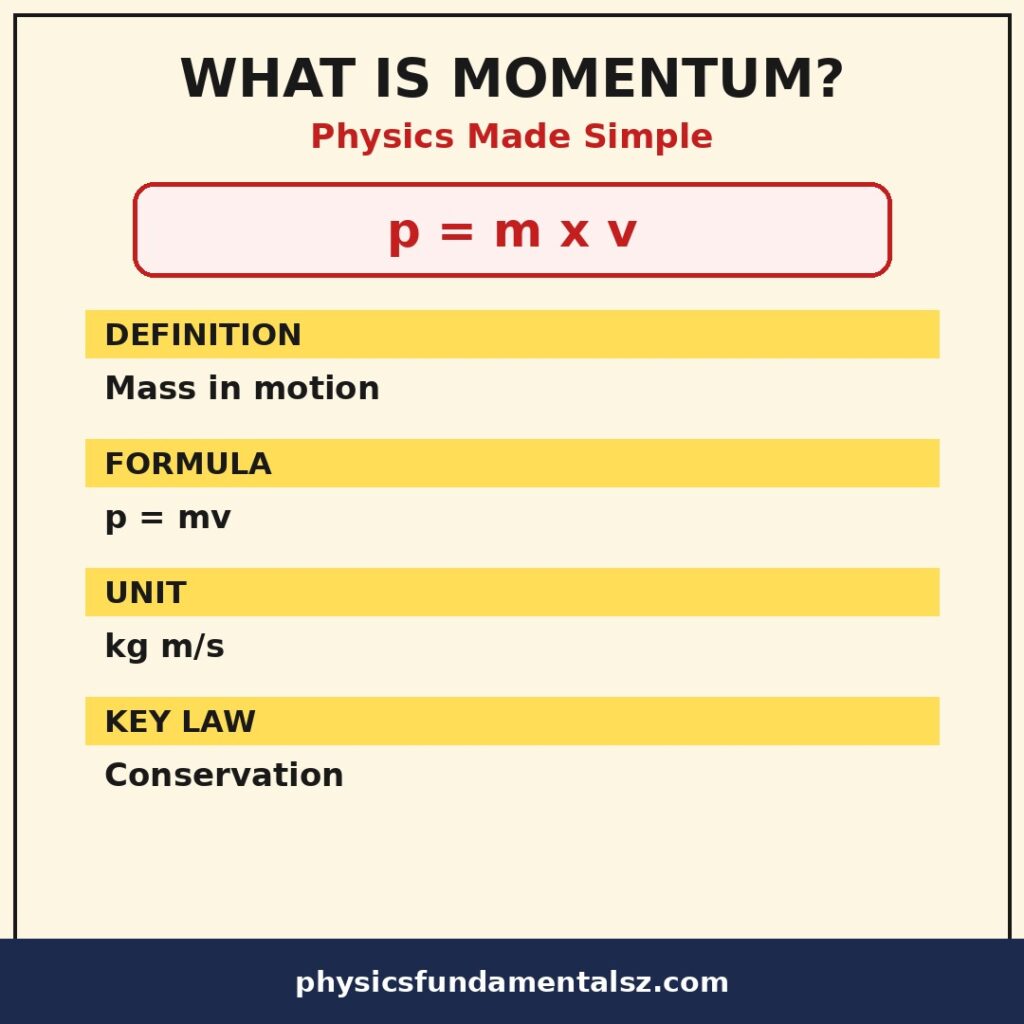
In formal terms, linear momentum is defined as the product of mass and velocity, written as p = mv. The symbol p stands for momentum, m stands for mass, and v stands for velocity. Its SI unit is the kilogram metre per second, written as kg m/s.
Key Takeaways
- Momentum depends on both mass and velocity, so changing either one changes momentum.
- Momentum is a vector, meaning direction matters as much as size in every calculation.
- In a closed system with no outside force, total momentum stays constant before and after an interaction.
- Impulse, which equals force multiplied by time, produces exactly the change in momentum it causes.
- Momentum and kinetic energy are different quantities, even though both describe a moving object.
What Is Momentum in Physics?
Momentum describes how hard it is to stop a moving object. A rolling bowling ball is harder to stop than a rolling tennis ball at the same speed because its larger mass gives it more momentum. A fast car is also harder to stop than the same car crawling slowly because its higher velocity gives it more momentum.
Physicists use momentum because it captures motion in a way that mass alone or speed alone cannot. Speed tells us how fast something moves, but it says nothing about how much matter is moving. Mass tells us how much matter is present, but it says nothing about whether that matter is moving at all.
Momentum combines those two ideas into one measurable quantity. That combination turns out to be extremely useful because it is conserved in many situations where other quantities are not. When objects collide, push apart, or explode, tracking momentum often reveals what happens next.
Students sometimes confuse momentum with a force or with energy, but it is neither. Force causes a change in momentum, while energy describes the capacity to do work. Momentum itself is simply the state of motion an object already possesses at a given instant.
Momentum as a Vector Quantity
Momentum is a vector because velocity is a vector. This means momentum has both magnitude and direction, and the direction is always the direction of motion. An object moving east has eastward momentum, while the same object moving west has westward momentum.
Direction becomes crucial when two objects move toward each other. Their momenta do not simply add as plain numbers because opposite directions partly cancel. In one-dimensional problems, physicists handle this by giving one direction a positive sign and the opposite direction a negative sign.
In two dimensions, momentum must be split into components, usually along the x-axis and the y-axis. Each component is conserved separately in a closed system, which allows complex collisions to be solved step by step. Vector diagrams help students visualise these components before doing any algebra.
A common error is to ignore signs and add magnitudes together. That mistake can turn a collision problem into a wrong answer even when the formula is correct. Always draw an arrow for the direction of motion first, then assign signs consistently.
The Momentum Formula: p = mv
The formula for linear momentum is short, powerful, and easy to remember. It states that momentum equals mass multiplied by velocity, written as p = mv. Each symbol has a fixed meaning that must not be swapped with another quantity.
Mass is measured in kilograms in the SI system. Velocity is measured in metres per second, with direction included. Multiplying them gives momentum in kilogram metres per second, the standard unit used in textbooks and examinations.
Rearranging the formula is often necessary in exam questions. Velocity can be found by dividing momentum by mass, using v = p divided by m. Mass can be found by dividing momentum by velocity, using m = p divided by v.
Dimensional checking is a fast way to catch mistakes. If a calculation produces momentum in kilograms alone, or in metres per second alone, something has gone wrong. The unit must always combine mass and velocity together.
The formula applies to a single object at a single instant. For a system of several objects, each object has its own momentum, and the total is the vector sum of the individual momenta. That total is the quantity conserved in collisions and explosions.
Units of Momentum
| Quantity | Symbol | SI Unit | Unit Symbol |
|---|---|---|---|
| Mass | m | kilogram | kg |
| Velocity | v | metre per second | m/s |
| Momentum | p | kilogram metre per second | kg m/s |
| Impulse | J | newton second | N s |
One newton second is exactly equal to one kilogram metre per second. That equivalence is not a coincidence, because impulse and change in momentum are the same physical quantity. Examiners often accept either unit for impulse, but momentum itself should be given in kg m/s.
Students should avoid inventing units such as kilogram metres or metres per kilogram. Those units belong to other quantities and will lose marks. Writing the unit correctly also helps when checking whether an answer is reasonable in size.
How Mass and Velocity Affect Momentum
Doubling mass while keeping velocity constant doubles momentum. Doubling velocity while keeping mass constant also doubles momentum. Doubling both at once multiplies momentum by four, because the formula multiplies the two factors together.
This proportional behaviour makes estimation easy. A truck moving at highway speed has enormously more momentum than a bicycle at the same speed. A bullet has small mass but very high velocity, so its momentum is still large enough to be dangerous.
Linear Momentum vs Angular Momentum
Linear momentum describes motion along a straight line. Angular momentum describes rotation about a point or axis. Both are conserved under the right conditions, but they describe different kinds of motion.
A rolling wheel has both types at once. Its centre of mass moves forward with linear momentum, while its parts rotate around its centre with angular momentum. Treating only one type would give an incomplete picture of the wheel.
Angular momentum depends on moment of inertia and angular velocity, rather than mass and linear velocity directly. A figure skater spinning faster when pulling in their arms is a classic example of angular momentum conservation. Their moment of inertia decreases, so their angular velocity increases to keep the product constant.
Linear momentum is the focus of most introductory collision problems. Angular momentum appears when rotation, torque, or spinning objects enter the question. The two quantities have different units and should never be added together.
For readers who want to explore rotation further, the concept of torque in physics explains how a turning force changes angular motion. Torque plays a role in rotation similar to the role force plays in linear motion.
| Feature | Linear Momentum | Angular Momentum |
|---|---|---|
| Motion type | Straight-line motion | Rotation about an axis |
| Formula | p = mv | L = I times angular velocity |
| Depends on | Mass and velocity | Moment of inertia and angular velocity |
| Conserved when | No net external force | No net external torque |
| Typical example | A car moving along a road | A spinning ice skater |
Impulse and the Impulse-Momentum Theorem
Impulse is the product of force and the time for which that force acts. It is written as J = F times change in time, where J stands for impulse. Impulse is also a vector, pointing in the direction of the force.
The impulse-momentum theorem states that impulse equals the change in momentum of an object. In symbols, J equals change in p, which equals final momentum minus initial momentum. This theorem connects force, time, and motion in one clear relationship.
A large force acting for a short time can produce the same impulse as a small force acting for a long time. That trade-off explains many safety designs in everyday life. Extending the time of an impact reduces the average force needed to produce the same change in momentum.
Airbags, crumple zones, and padded landing mats all work on this principle. They do not change the total momentum that must be removed to stop a person or vehicle. They spread that change over a longer time, so the peak force drops to a safer level.
Catching a fast ball with a relaxed hand follows the same idea. Pulling the hand back as the ball arrives increases the stopping time. The force on the hand falls, even though the ball loses exactly the same momentum.
Graphically, impulse equals the area under a force-time graph. A tall, narrow spike and a low, wide rectangle can enclose the same area and therefore cause the same momentum change. Exam questions often test this graphical interpretation directly.
Impulse Formula and Units
| Quantity | Symbol | Formula | SI Unit |
|---|---|---|---|
| Impulse | J | F times time interval | N s |
| Change in momentum | Change in p | Final p minus initial p | kg m/s |
| Average force | F average | Change in p divided by time | N |
| Time interval | Change in t | Final time minus initial time | s |
Because one newton second equals one kilogram metre per second, impulse and momentum change share the same size in SI units. That equality makes unit checking straightforward in multi-step problems. If impulse is calculated in newton seconds, it can be compared directly with a momentum change in kg m/s.
Students should be careful with the sign of impulse. A force opposing motion produces a negative impulse in the direction of motion. That negative impulse reduces momentum, which is exactly what stopping requires.
Conservation of Momentum
The law of conservation of momentum states that total momentum stays constant in a closed system. A closed system is one with no net external force acting on it. Internal forces between objects inside the system may redistribute momentum, but they cannot change the total.
This law is one of the most reliable tools in mechanics. It holds for collisions, explosions, recoil, and rocket motion, provided external forces are negligible during the interaction. It also holds in two dimensions when each component is treated separately.
External forces such as friction, gravity, or air resistance can change total momentum over time. In many textbook problems, the collision happens so quickly that external impulses are tiny compared with internal impulses. Physicists then treat momentum as approximately conserved during the brief interaction.
The law does not say that each object keeps its own momentum. Objects routinely gain or lose momentum when they interact. The law says only that gains and losses balance exactly, so the vector sum remains unchanged.
Newton’s third law explains why this balance must occur. When object A pushes object B, object B pushes back on A with equal and opposite force for the same time. The impulses are therefore equal and opposite, and the momentum changes cancel perfectly.
When Conservation Applies
- A closed system has no net external force, so total momentum is conserved exactly.
- A brief collision can be treated as conserved when external impulses are negligible during the impact.
- An explosion conserves total momentum, even though kinetic energy usually increases from stored energy.
- Recoil problems conserve momentum when the system starts at rest and no external horizontal force acts.
- Momentum is conserved separately along each axis in two-dimensional problems.
When Conservation Does Not Apply Simply
An object sliding with friction loses momentum to the ground and surrounding system. A ball falling under gravity gains downward momentum continuously from the gravitational force. In both cases, the system must be widened to include Earth before conservation becomes exact again.
Exam questions often hide an external force in the wording. A car braking on a road, a person jumping from the ground, or a ball bouncing with air resistance all involve external impulses. Students must read carefully before assuming conservation applies to a narrow system alone.
If an external force acts, momentum still changes predictably through impulse. The change equals the external impulse, so the
problem remains solvable. Conservation is simply the special case where that external impulse is zero.
Elastic vs Inelastic Collisions
Collisions are classified by what happens to kinetic energy, not by what happens to momentum. Momentum is conserved in both elastic and inelastic collisions in a closed system. Kinetic energy is conserved only in a perfectly elastic collision.
In an elastic collision, objects bounce apart without permanent deformation or heat loss. Total kinetic energy before the collision equals total kinetic energy after it. Real collisions are never perfectly elastic, but some come close, such as collisions between steel balls or gas molecules.
In an inelastic collision, some kinetic energy transforms into heat, sound, or deformation. Objects may stick together or change shape, but momentum still balances exactly. A car crash is a classic inelastic collision because much kinetic energy becomes deformation and heat.
A perfectly inelastic collision is the extreme case where objects stick together after impact. They move as one combined mass with a single final velocity. This case is often the easiest to solve because only one unknown final velocity remains.
Students should never assume kinetic energy conservation unless the question states the collision is elastic. Assuming it in an inelastic problem leads to extra equations that contradict the true physics. Momentum conservation alone is usually enough for perfectly inelastic problems.
For a detailed side-by-side explanation, see this guide to the elastic vs inelastic collision difference. It clarifies which quantities survive each type of collision and why that distinction matters in exam answers.
| Feature | Elastic Collision | Inelastic Collision | Perfectly Inelastic Collision |
|---|---|---|---|
| Momentum conserved | Yes | Yes | Yes |
| Kinetic energy conserved | Yes | No | No |
| Objects after collision | Separate | Separate or deformed | Stick together |
| Final velocities | Usually two unknowns | Usually two unknowns | One shared velocity |
| Example | Billiard balls | A car crash | A bullet embedding in a block |
Solving Collision Problems Step by Step
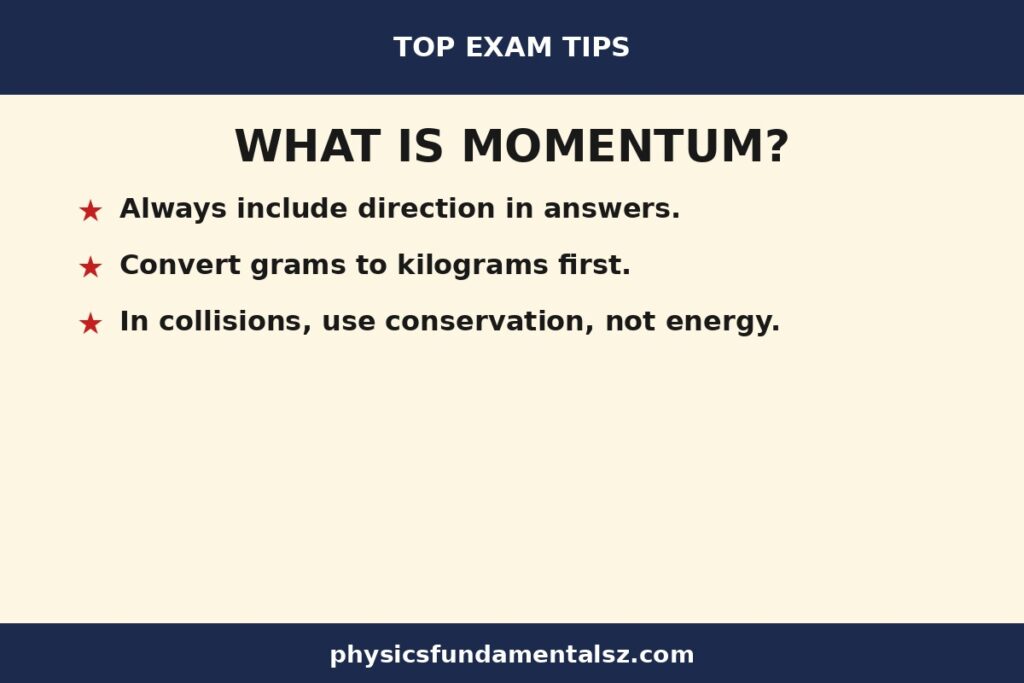
First, draw the situation before and after the collision with arrows for velocity. Second, choose a positive direction and assign signs to every velocity. Third, write the conservation equation with total momentum before equal to total momentum after.
Fourth, add a kinetic energy equation only if the collision is stated to be elastic. Fifth, solve the equations together, checking signs and units at each stage. Sixth, interpret the final sign, because a negative velocity means motion in the opposite direction to the chosen positive direction.
Many students skip the diagram and lose marks through sign errors. A simple sketch takes seconds and prevents the most common mistake in collision problems. It also makes two-dimensional problems far easier to organise.
Momentum vs Kinetic Energy vs Force
Momentum, kinetic energy, and force are related but distinct. Force is the rate of change of momentum, expressed as F equals change in p divided by change in time. Kinetic energy is one half times mass times velocity squared, written as KE equals one half m v squared.
Momentum depends on velocity to the first power, while kinetic energy depends on velocity squared. Doubling velocity doubles momentum but quadruples kinetic energy. That difference has real consequences in crashes, where speed matters far more for energy than for momentum alone.
Momentum is a vector, while kinetic energy is a scalar with no direction. Two objects moving in opposite directions can cancel in momentum but add in kinetic energy. That contrast often appears in exam questions designed to test whether students confuse the two quantities.
Force is also a vector, but it is not a property an object carries in the way momentum is. Force describes an interaction between objects at a moment in time. Momentum describes the motion an object already has, whether or not a force is currently acting.
The relationship between kinetic energy in physics and momentum is useful for conversions. Momentum can be written in terms of kinetic energy and mass, and kinetic energy can be written in terms of momentum and mass. Those forms appear in advanced problems where one quantity is given and the other is needed.
| Quantity | Symbol | Vector or Scalar | Formula | SI Unit |
|---|---|---|---|---|
| Momentum | p | Vector | p = mv | kg m/s |
| Kinetic energy | KE | Scalar | KE = one half m v squared | J |
| Force | F | Vector | F = change in p divided by change in time | N |
| Velocity | v | Vector | v = displacement divided by time | m/s |
| Mass | m | Scalar | Measured directly | kg |
Why the Distinction Matters in Exams
A question about stopping distance usually involves energy and work, not momentum alone. A question about stopping time usually involves impulse and momentum. Choosing the wrong quantity leads to a wrong method, even if the numbers are substituted correctly.
A question about a collision usually starts with momentum conservation. A question about how much energy is lost in that collision needs kinetic energy calculations before and after. Both quantities are needed, but each answers a different part of the question.
Worked Examples: Step by Step
Worked examples show how the formula works with real numbers. Each example states the given data, applies p = mv, and checks the unit and direction. Following the same steps every time prevents sign and unit errors.
Example 1: A Running Student
A student of mass 60 kg runs east at 5 m/s. Her momentum is mass multiplied by velocity, giving 60 times 5. Her momentum is therefore 300 kg m/s east.
- Given: mass 60 kg, velocity 5 m/s east.
- Calculation: p = 60 times 5 = 300.
- Answer: 300 kg m/s east.
Example 2: A Moving Car
A car of mass 1200 kg travels north at 20 m/s. Its momentum is 1200 times 20, which equals 24000. Its momentum is therefore 24000 kg m/s north.
- Given: mass 1200 kg, velocity 20 m/s north.
- Calculation: p = 1200 times 20 = 24000.
- Answer: 24000 kg m/s north.
Example 3: Finding Velocity from Momentum
A ball has momentum 40 kg m/s and mass 8 kg. Velocity equals momentum divided by mass, giving 40 divided by 8. The ball therefore moves at 5 m/s in the direction of its momentum.
- Given: momentum 40 kg m/s, mass 8 kg.
- Calculation: v = 40 divided by 8 = 5.
- Answer: 5 m/s in the momentum direction.
Example 4: Impulse Stops a Ball
A ball of mass 0.5 kg moving at 10 m/s is caught and brought to rest in 0.2 s. Its initial momentum is 5 kg m/s, and its final momentum is zero, so the change is 5 kg m/s. Average force equals change in momentum divided by time, giving 5 divided by 0.2, which is 25 N opposite the motion.
- Given: mass 0.5 kg, velocity 10 m/s, stopping time 0.2 s.
- Calculation: change in p = 5, force = 5 divided by 0.2 = 25.
- Answer: 25 N opposite the original motion.
Example 5: Perfectly Inelastic Collision
A trolley of mass 4 kg moving at 3 m/s collides with a stationary trolley of mass 2 kg, and they stick together. Total momentum before is 12 kg m/s, and total mass after is 6 kg. Final velocity equals 12 divided by 6, giving 2 m/s in the original direction.
- Given: 4 kg at 3 m/s, 2 kg at rest, stuck together.
- Calculation: total p = 12, total mass = 6, v = 12 divided by 6 = 2.
- Answer: 2 m/s in the original direction.
Example 6: Recoil of a Gun
A gun and bullet system starts at rest, so total momentum is zero. When the bullet moves forward, the gun must move backward so the total remains zero. This recoil explains why shooters feel a backward push, and the same principle drives rockets forward by expelling gas backward.
Readers who want guided practice can work through the momentum lessons from Khan Academy and the reference tables at HyperPhysics. Both sources present the same formulas used here, with additional diagrams and practice problems for revision.
Real-World Applications of Momentum
Sports
A cricket bat, tennis racket, or football boot changes a ball’s momentum through impulse. A longer contact time with a follow-through reduces peak force, while a short sharp hit produces a larger force. Coaches use this idea when teaching timing, because the same impulse can be delivered gently or sharply depending on contact time.
Heavier players in rugby or American football are harder to stop because their momentum is larger at the same speed. Tackling technique therefore focuses on reducing the opponent’s momentum safely, often by wrapping and driving through the tackle. Protective padding extends impact time, which lowers the force on the body.
Rockets and Space
Rockets work by conservation of momentum in its purest form. Hot gas expelled backward at high velocity carries backward momentum, so the rocket gains equal forward momentum. No air or ground is needed to push against, which is why rockets work in the vacuum of space.
NASA explains rocket propulsion through Newton’s laws, showing how thrust arises from expelling mass. Spacecraft also use momentum in docking, course corrections, and gravitational assists around planets. Each manoeuvre changes momentum through a controlled impulse from thrusters.
Car Safety
Seat belts, airbags, and crumple zones all extend the time over which momentum changes in a crash. A longer stopping time means a smaller average force on the occupants, even though the total momentum change is unchanged. Engineers design crumple zones to deform gradually, absorbing energy while spreading the impulse over time.
This is why a crash into a soft barrier is safer than a crash into a rigid wall at the same speed. The rigid wall stops the car almost instantly, producing a huge force. The soft barrier allows a longer stopping distance and time, reducing the force that reaches the people inside.
Everyday Motion and Industry
Conveyor belts, pile drivers, and demolition equipment all rely on momentum transfer. A pile driver drops a heavy mass onto a pile, and its large momentum drives the pile into the ground. A hammer works similarly, using a short impulse to deliver a large force to a nail.
Even walking depends on momentum exchange with the ground. Each foot pushes backward on Earth, and Earth pushes forward on the walker with equal and opposite impulse. The walker gains forward momentum, while Earth’s recoil is far too small to notice because its mass is enormous.
Common Mistakes to Avoid
- Treating momentum as a scalar and adding magnitudes without signs for opposite directions.
- Using speed instead of velocity and forgetting that direction is part of the answer.
- Confusing momentum with kinetic energy, force, or weight in word problems.
- Assuming kinetic energy is conserved in an inelastic collision.
- Forgetting to convert grams to kilograms or kilometres per hour to metres per second.
- Giving momentum without a unit, or with the wrong unit such as joules.
- Applying conservation to an open system with a clear external force, such as friction or gravity acting over time.
AP Physics Exam Tips
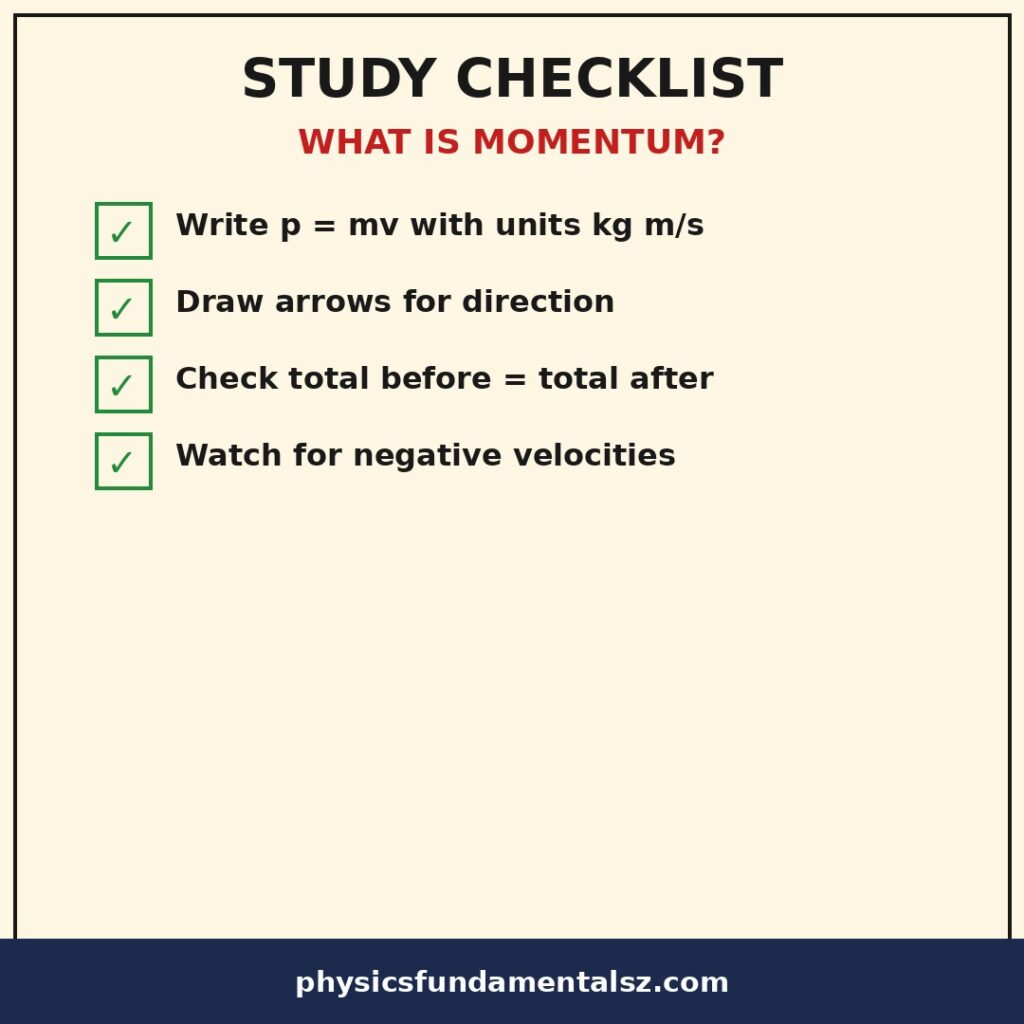
- Always write p = mv first, then substitute numbers with units shown.
- Draw a before-and-after diagram and label the positive direction before calculating.
- Check whether the collision is elastic, inelastic, or perfectly inelastic from the wording.
- Use momentum conservation first, then add kinetic energy only when elasticity is stated.
- In two-dimensional problems, conserve momentum separately along each axis.
- For impulse questions, look for force, time, or a force-time graph and use area under the graph.
- Verify the final answer by checking sign, unit, and whether the size is reasonable.
- The Britannica entry on momentum gives a concise definition that matches the AP wording closely.
Frequently Asked Questions
What is momentum in physics in simple words?
Momentum is the quantity of motion an object has, found by multiplying its mass by its velocity. A heavier or faster object has more momentum and is harder to stop.
What is the formula for momentum?
The formula is p = mv, where p is momentum, m is mass, and v is velocity. Its SI unit is kg m/s.
Is momentum a vector or a scalar?
Momentum is a vector because velocity is a vector. It has both magnitude and direction, and opposite directions must be given opposite signs.
What is the SI unit of momentum?
The SI unit is the kilogram metre per second, written as kg m/s. One newton second equals the same quantity, which is why impulse uses that unit.
Can momentum be zero?
Yes, momentum is zero when an object is at rest, because velocity is zero. A system can also have zero total momentum when equal momenta cancel in opposite directions.
Can momentum be negative?
Momentum can be negative in a calculation when it points opposite the chosen positive direction. The negative sign shows direction only, not a smaller physical quantity.
What is conservation of momentum?
Conservation of momentum means total momentum stays constant in a closed system with no net external force. Internal interactions redistribute momentum but do not change the total.
What is impulse in physics?
Impulse is force multiplied by the time it acts, and it equals the change in momentum. A longer impact time therefore reduces the average force for the same momentum change.
What is the difference between momentum and kinetic energy?
Momentum is a vector equal to mass times velocity, while kinetic energy is a scalar equal to one half mass times velocity squared. Doubling velocity doubles momentum but quadruples kinetic energy.
What is the difference between momentum and force?
Momentum describes motion an object already has, while force describes an interaction that changes that motion. Force equals the rate of change of momentum over time.
What happens to momentum in an elastic collision?
Momentum is conserved in an elastic collision, and kinetic energy is also conserved. Objects bounce apart without loss of kinetic energy to heat or deformation.
What happens to momentum in an inelastic collision?
Momentum is still conserved in an inelastic collision, but some kinetic energy becomes heat, sound, or deformation. Objects may deform or stick together, depending on the collision type.
What is angular momentum?
Angular momentum describes rotational motion and depends on moment of inertia and angular velocity. It is conserved when no net external torque acts on the system.
Does a stationary object have momentum?
No, a stationary object has zero momentum because its velocity is zero. It can still gain momentum quickly when a force acts on it.
Why do airbags reduce injury?
Airbags extend the time over which a person’s momentum changes in a crash. That longer time lowers the average force, even though the total momentum change stays the same.
How does a rocket move in space?
A rocket expels gas backward, giving that gas backward momentum. The rocket gains equal forward momentum, so it accelerates without pushing against air or ground.
What is the momentum of a photon?
A photon has no rest mass but still carries momentum related to its energy and wavelength. That concept belongs to modern physics and lies beyond the classical formula p = mv.
How do you solve momentum problems?
Draw before-and-after diagrams, choose a positive direction, and write total momentum before equal to total momentum after. Add a kinetic energy equation only when the collision is stated to be elastic.
Conclusion
Momentum in physics is a simple idea with wide power. It combines mass and velocity into one vector quantity, explains collisions and recoil, and stays conserved in closed systems. Mastering p = mv, impulse, and conservation gives students a reliable method for a large part of mechanics.
Students should practise with varied numbers, signs, and collision types until the method feels automatic. That practice builds confidence for class tests and AP Physics exams alike. With clear diagrams, correct units, and careful direction signs, momentum problems become some of the most predictable marks available.