What Is Kinetic Energy? Formula, Examples & Everyday Uses
Quick answer: Kinetic energy is the energy an object has because it is moving. It is calculated as KE = ½mv², where m is the mass of the object and v is its speed. Kinetic energy is measured in joules (J). Because speed is squared, doubling an object’s speed quadruples its kinetic energy — which is why a car crash at 60 mph is far more than twice as destructive as one at 30 mph.
Introduction
Every time something moves, it carries energy with it. A rolling bowling ball carries enough energy to scatter ten pins. A speeding bullet carries enough energy to punch through wood. A gust of wind carries enough energy to spin a turbine and power a house. That energy of motion has a name: kinetic energy.
You already have a strong intuition for kinetic energy, even if you have never written down the formula. You know that a fastball hurts more than a gently tossed ball. You know that a truck rolling downhill is harder to stop than a bicycle. You know that falling from a greater height hurts more, because you hit the ground moving faster. Each of those instincts is your brain estimating kinetic energy.
In this guide, you will learn the kinetic energy definition, the kinetic energy formula and where it comes from, how to calculate kinetic energy step by step with worked examples, the difference between kinetic energy and momentum, the work-energy theorem that ties kinetic energy to forces, and the most common mistakes students make with this topic. We will also show how kinetic energy appears on the AP Physics 1 exam and how it connects to the other energy ideas you have already met, such as work and power. By the end, kinetic energy will feel as natural as speed itself.
What Is Kinetic Energy? The Definition
Definition box: Kinetic energy (symbol KE or K) is the energy possessed by an object due to its motion. Any object with mass that is moving has kinetic energy. The faster it moves, or the more massive it is, the more kinetic energy it carries. Its SI unit is the joule (J), the same unit used for work and all other forms of energy.
Khan Academy introduces kinetic energy as “the energy an object has due to its motion,” noting that it depends on both the mass and the speed of the object (khanacademy.org). HyperPhysics, the physics reference from Georgia State University, gives the same idea in equation form: kinetic energy equals one-half the mass times the square of the velocity (hyperphysics.phy-astr.gsu.edu).
Two features of this definition deserve emphasis. First, kinetic energy is a scalar quantity: it has a magnitude but no direction. A car moving north at 20 m/s has exactly the same kinetic energy as a car moving south at 20 m/s. Direction simply does not enter the calculation. Second, kinetic energy is always zero or positive. Because speed is squared in the formula, a negative velocity still gives a positive kinetic energy. An object at rest has zero kinetic energy, and there is no such thing as negative kinetic energy.
It is also worth noting that kinetic energy depends on your frame of reference. A passenger sitting still inside a moving train has zero kinetic energy relative to the train, but a large kinetic energy relative to someone standing on the platform. This is not a contradiction: kinetic energy, like velocity itself, is measured relative to a chosen frame. In school problems, the frame is almost always the ground, unless the question says otherwise.
The Kinetic Energy Formula
The formula for the kinetic energy of an object moving in a straight line is:
KE = ½mv²
Where:
- KE = kinetic energy, measured in joules (J)
- m = mass of the object, measured in kilograms (kg)
- v = speed of the object, measured in meters per second (m/s)
Notice what the formula tells you. Kinetic energy is directly proportional to mass: double the mass at the same speed, and you double the kinetic energy. But kinetic energy is proportional to the square of speed: double the speed, and you quadruple the kinetic energy. Triple the speed, and you multiply the kinetic energy by nine. This squared dependence is the single most important thing to remember about kinetic energy, and it explains many real-world surprises, from braking distances to crash damage.
Where does ½mv² come from?
The formula is not an arbitrary definition. It comes directly from the work-energy theorem. Imagine pushing an object of mass m with a constant net force F over a distance d, starting from rest. By Newton’s second law, F = ma. The work done is W = Fd. Using the kinematic equation v² = 2ad for an object starting from rest, we can write d = v²/(2a). Substituting:
W = Fd = (ma)(v²/2a) = ½mv²
The work you did has become the object’s kinetic energy. That is why the one-half appears: it falls out of the kinematics of constant acceleration. You do not need to reproduce this derivation on most exams, but knowing it exists helps you remember that kinetic energy and work share the same unit, the joule, for a deep reason — work is literally the transfer of energy, and kinetic energy is the energy of motion that results.
Units check
Always check your units. Mass in kilograms times speed squared in (m/s)² gives kg·m²/s², which is exactly the definition of one joule. If you plug in mass in grams or speed in km/h, your answer will be wrong by a large factor. Convert first: 1 km/h = 0.278 m/s, and 1 gram = 0.001 kg. On exams, the most common unit error in kinetic energy problems is forgetting to convert km/h to m/s.
Types of Kinetic Energy
Not all motion is motion in a straight line. Physics recognizes several forms of kinetic energy, and the AP Physics 1 course focuses mainly on the first two.
Translational kinetic energy
This is the kinetic energy of an object moving from one place to another, given by KE = ½mv². A sprinting athlete, a flying baseball, and a rolling car all have translational kinetic energy. When a textbook problem simply says “kinetic energy” without qualification, it almost always means translational kinetic energy.
Rotational kinetic energy
A spinning object has kinetic energy even if its center of mass is not moving. A spinning flywheel, a rotating ceiling fan, and a figure skater doing a spin all carry rotational kinetic energy, given by KE_rot = ½Iω², where I is the moment of inertia and ω is the angular velocity. You met moment of inertia and torque in the study of rotation — torque is the rotational equivalent of force, and it changes rotational kinetic energy just as force changes translational kinetic energy. If you have not yet studied rotation, you can safely focus on translational kinetic energy for now and return to this section later.
Other forms
At a microscopic level, the random motion of particles is what we experience as temperature: the thermal energy of a hot object is, in a sense, the kinetic energy of its atoms and molecules. Vibrational kinetic energy appears in oscillating systems such as a plucked guitar string or a mass on a spring at the moment it passes through equilibrium. These microscopic forms matter in thermodynamics
and waves, but in mechanics problems the two categories above cover nearly everything.
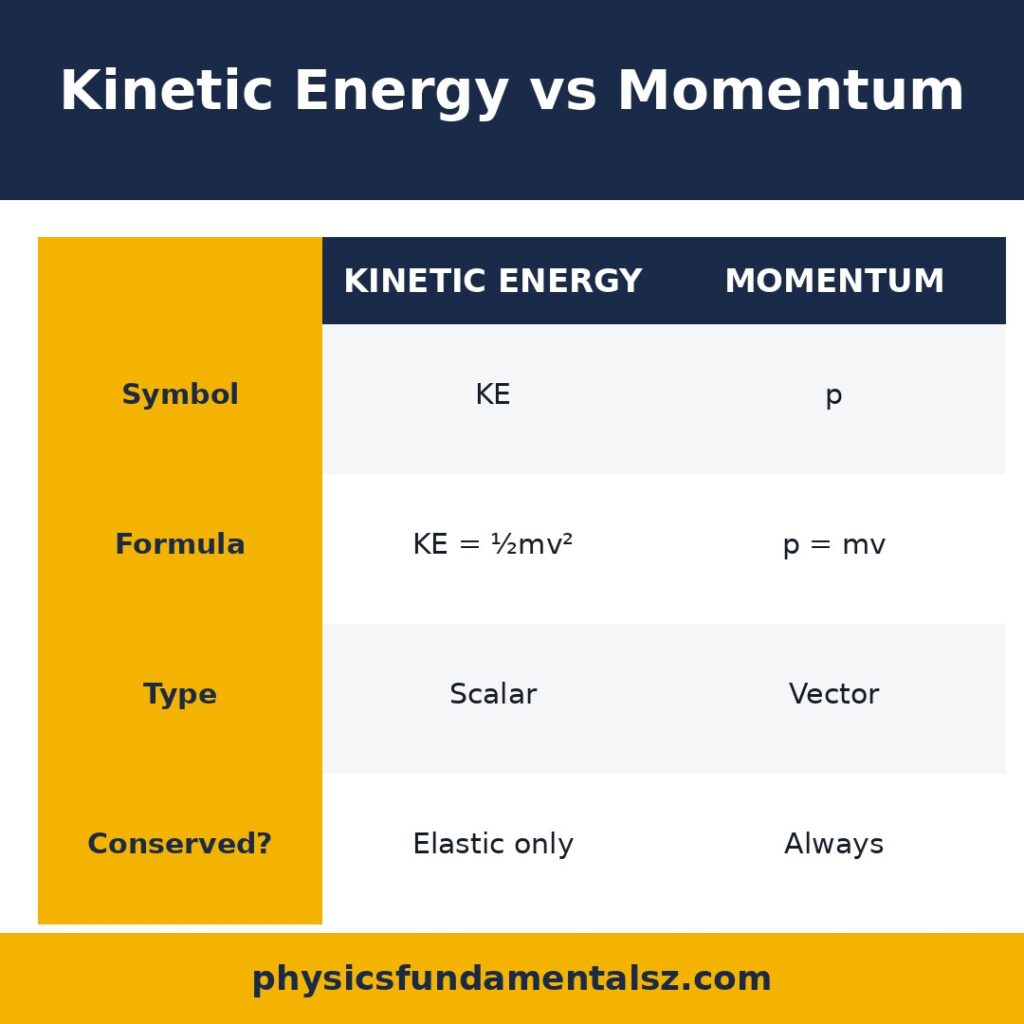
Kinetic Energy vs Momentum: Do Not Confuse Them
Students constantly mix up kinetic energy and momentum, because both depend on mass and velocity. The differences matter enormously, and exam questions are designed to catch the confusion.
| Quantity | Kinetic energy | Momentum |
|---|---|---|
| Symbol | KE | p |
| Formula | ½mv² | mv |
| Type | Scalar (no direction) | Vector (has direction) |
| Depends on speed | Squared (v²) | Linear (v) |
| Conserved in collisions? | Only in elastic collisions | Always (isolated system) |
| Unit | Joule (J) | kg·m/s |
Consider two objects: a 2 kg ball moving at 10 m/s and a 10 kg ball moving at 2 m/s. Their momenta are 20 kg·m/s in both cases — identical. But their kinetic energies are very different: the light, fast ball has ½(2)(10²) = 100 J, while the heavy, slow ball has ½(10)(2²) = 20 J. Same momentum, five times the kinetic energy. This is why a fast, light object can do far more damage than a slow, heavy one with the same momentum.
The conservation rules differ too. Momentum is conserved in every collision in an isolated system — elastic, inelastic, or anything in between. Kinetic energy is conserved only in elastic collisions. That is exactly why the distinction between elastic and inelastic collisions matters, and it is worth reading our guide on the difference between elastic and inelastic collisions alongside this one.
The Work-Energy Theorem
The work-energy theorem is the bridge between forces and kinetic energy. It states:
W_net = ΔKE = KE_final − KE_initial
In words: the net work done on an object equals the change in its kinetic energy. If the net work is positive, the object speeds up. If the net work is negative — as with friction slowing a sliding box — the object slows down. If the net work is zero, the speed stays the same.
This theorem is a problem-solving shortcut of enormous power. Many problems that look like they require kinematics — a block sliding down a ramp, a car braking to a stop, a pendulum swinging — become one-line calculations with the work-energy theorem. Instead of tracking acceleration over time, you compare energies at the start and end.
A classic example: a car of mass 1,000 kg moving at 20 m/s brakes to a stop. The change in kinetic energy is 0 − ½(1,000)(20²) = −200,000 J. The brakes therefore did −200,000 J of work. If you know the braking force, you can immediately find the stopping distance: d = W/F. This is far quicker than solving the kinematics, and it is the method exam mark schemes usually expect.
Note the connection to work and power: work is the transfer of energy, power is the rate at which that transfer happens, and kinetic energy is the energy an object gains or loses in the process. Our guide on the difference between work and power in physics explains that trio in detail.
Worked Examples
Example 1: A running student
A 60 kg student runs at 8 m/s. What is her kinetic energy?
KE = ½mv² = ½(60)(8²) = ½(60)(64) = 1,920 J.
That is roughly the energy needed to lift a 60 kg person about 3 meters — a reminder that everyday motion involves thousands of joules.
Example 2: A car at highway speed
A 1,200 kg car travels at 30 m/s (about 108 km/h). Find its kinetic energy.
KE = ½(1,200)(30²) = ½(1,200)(900) = 540,000 J = 540 kJ.
Now halve the speed to 15 m/s. KE = ½(1,200)(225) = 135,000 J. Half the speed gives one-quarter of the energy — the squared dependence in action. This is why speed limits matter so much for safety: the energy that must be absorbed in a crash grows far faster than the speed.
Example 3: Comparing two balls
Ball A has mass 0.5 kg and speed 20 m/s. Ball B has mass 2 kg and speed 10 m/s. Which has more kinetic energy?
KE_A = ½(0.5)(400) = 100 J. KE_B = ½(2)(100) = 100 J. They are equal. Ball B is four times as massive but half as fast, and since speed is squared, the two effects exactly cancel. This is a favorite exam trick: always compute, never guess from mass or speed alone.
Example 4: Stopping distance from kinetic energy
A 900 kg car moving at 25 m/s brakes with a constant force of 4,500 N. How far does it travel before stopping?
Initial KE = ½(900)(625) = 281,250 J. By the work-energy theorem, the work done by the brakes equals the change in kinetic energy: −Fd = 0 − 281,250, so d = 281,250/4,500 = 62.5 m. Notice that we never needed the time or the acceleration — energy did the whole job.
Example 5: A falling object (energy conservation)
A 2 kg ball is dropped from a height of 10 m. Ignoring air resistance, what is its speed just before hitting the ground?
The ball loses gravitational potential energy mgh = (2)(9.8)(10) = 196 J, which becomes kinetic energy. So ½(2)v² = 196, giving v² = 196 and v = 14 m/s. This is the conservation of mechanical energy: potential energy converts to kinetic energy as the object falls, and the total stays constant. The same idea explains pendulums, roller coasters, and bouncing balls.
Kinetic Energy in Everyday Life
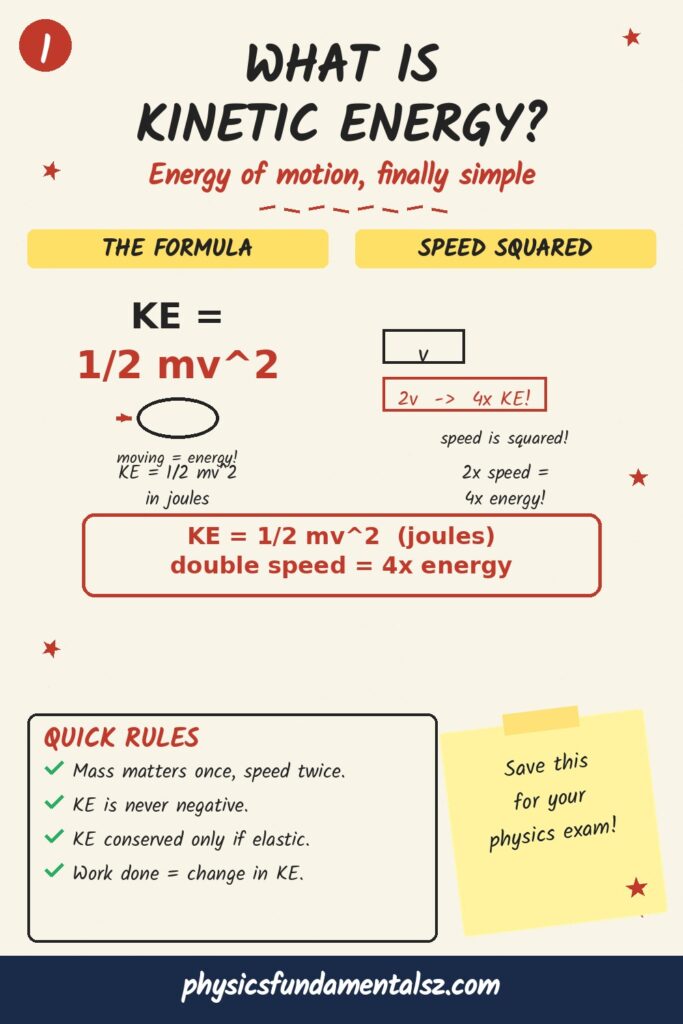
Kinetic energy is not an abstract exam topic; it shapes the world around you. Vehicle safety engineering is built around it: crumple zones, airbags, and seatbelts all exist to absorb kinetic energy gradually rather than all at once, because it is the sudden transfer of energy — not the energy itself — that injures people. That is also why doubling your speed quadruples your stopping distance in an emergency.
Renewable energy is kinetic energy harvesting. Wind turbines convert the kinetic energy of moving air into electricity. Hydroelectric dams convert the kinetic energy of falling water. Even a bicycle dynamo converts a little of the wheel’s kinetic energy into light.
In sports, kinetic energy explains why technique matters. A golf club head moving slightly faster delivers dramatically more energy to the ball, because of the v² term. A boxer’s punch gains power far more from speed than from arm mass. And in spaceflight, kinetic energy explains why reaching orbit is so expensive: a spacecraft must be accelerated to about 7.9 km/s, and the energy required grows with the square of that enormous speed.
Common Mistakes to Avoid
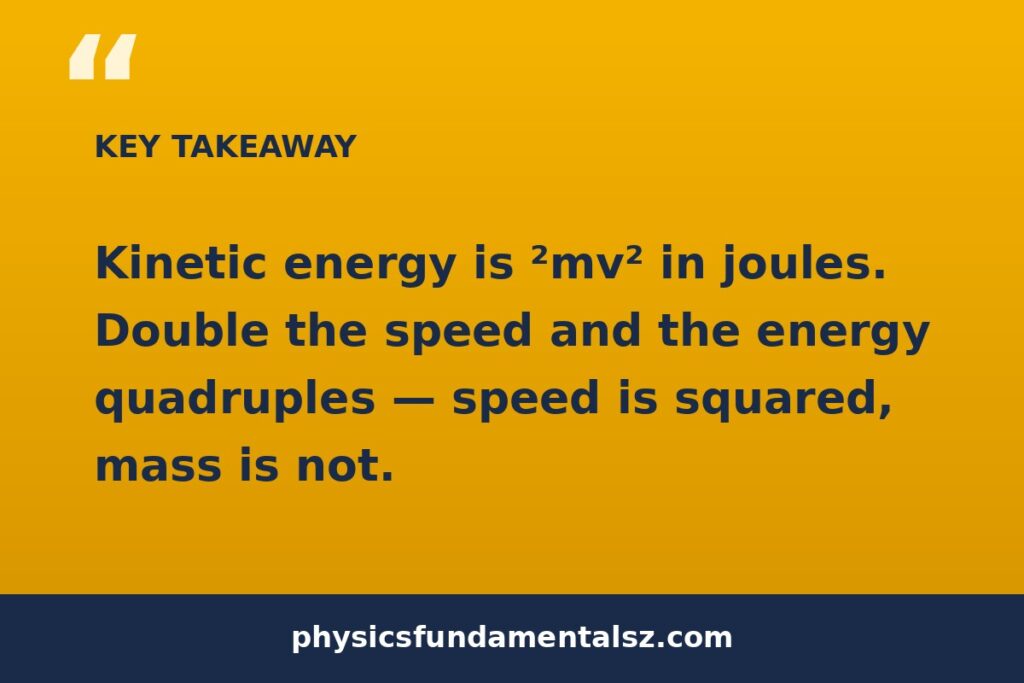
- Forgetting to square the speed. Writing KE = ½mv instead of ½mv² is the single most common error. Always square v before multiplying.
- Using km/h without converting. Speed must be in m/s. Divide km/h by 3.6 to get m/s.
- Using weight instead of mass. Weight in newtons is mg, not m. If a problem gives weight, divide by g = 9.8 m/s² to get mass first.
- Treating kinetic energy as a vector. Kinetic energy has no direction. If your answer is negative, you have made an arithmetic error — check your work.
- Assuming kinetic energy is conserved in collisions. It is not, except in elastic collisions. Momentum is the quantity that is always conserved.
- Confusing kinetic energy with potential energy. Kinetic energy belongs to motion; potential energy belongs to position or configuration. A ball held at the top of a hill has potential energy, not kinetic energy — until you drop it.
- Dropping the one-half. The ½ is part of the formula, not optional decoration. Leaving it out doubles your answer.
Kinetic Energy on the AP Physics 1 Exam
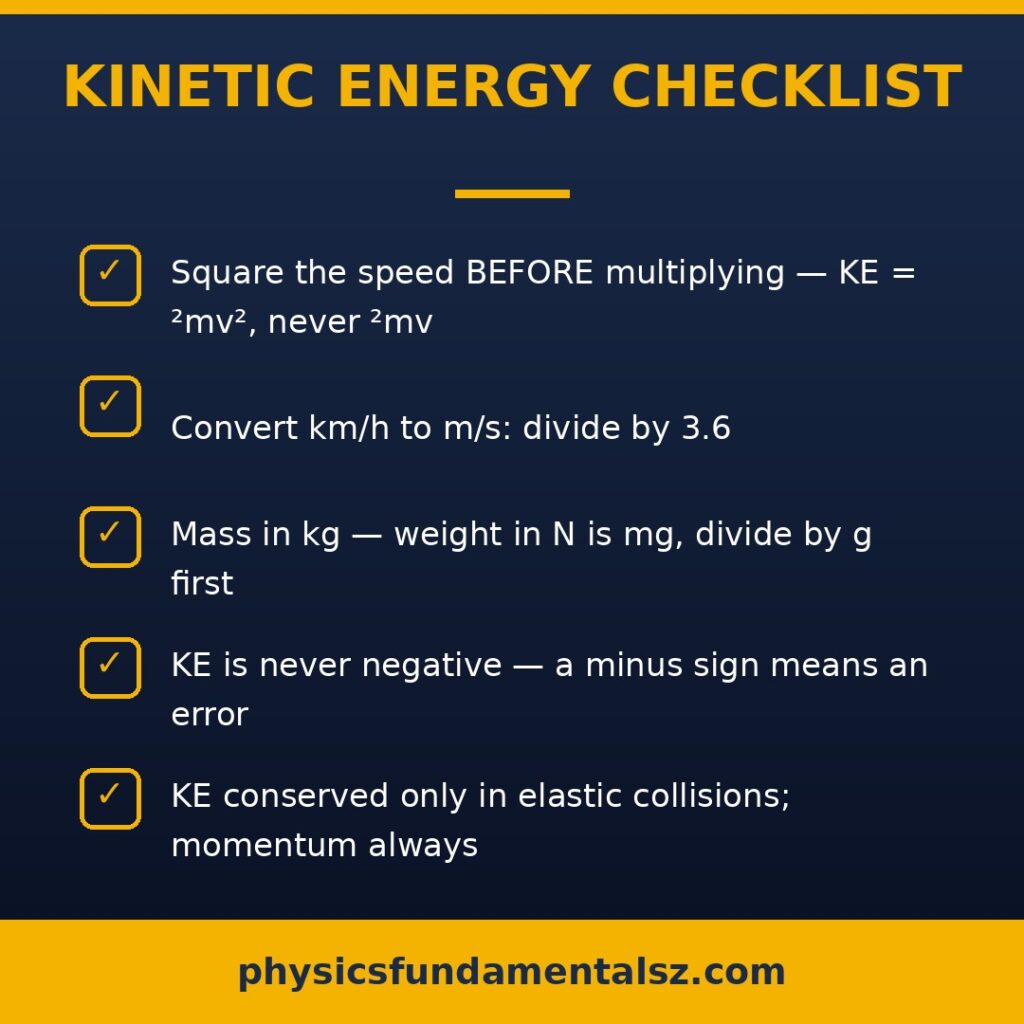
Kinetic energy appears in AP Physics 1 Unit 3 (Work, Energy, and Power) and returns in Unit 4 (Linear Momentum) and Unit 5 (Torque and Rotational Motion). Expect questions that ask you to calculate kinetic energy from mass and speed, use the work-energy theorem to find a speed or a distance, compare kinetic energies before and after a collision, and interpret energy bar charts. Energy bar charts are a favorite: you must show kinetic energy growing as potential energy shrinks, with the total bar staying constant when no non-conservative forces act.
A reliable exam strategy: whenever a problem gives you forces and distances, or heights and speeds, think energy first. Energy methods are usually shorter than kinematics, and they avoid the sign errors that creep into long kinematic solutions. Also remember that on free-response questions, you must show the formula, substitute with units, and give the final answer with the correct unit — a bare number earns partial credit at best.
Kinetic Energy of a System, Not Just a Single Object
So far we have talked about the kinetic energy of one object. Real problems often involve systems: two carts on a track, a person jumping off a boat, or an exploding firework that splits into fragments. The total kinetic energy of a system is simply the sum of the kinetic energies of its parts: add ½mv² for each object, and you have the system’s total. But there is a subtlety that catches students out: the total kinetic energy of a system depends on the frame of reference, while the change in kinetic energy caused by internal forces does not.
Consider an ice skater pushing off a wall. In the ground frame, the skater gains kinetic energy while the wall and Earth gain a negligible amount in the opposite direction. In the skater’s own frame, things look different. Yet the work done by the push, and the energy transferred, is consistent once you account for every part of the system. This is why exam questions always specify the system and the frame, even if only implicitly: “a block slides on a frictionless surface” means the ground frame and a system consisting of the block alone, unless stated otherwise.
Another important case is internal energy conversion. When a compressed spring launches a ball, the spring’s elastic potential energy becomes the ball’s kinetic energy, and the total mechanical energy stays constant if friction is negligible. When a chemical explosive detonates, chemical potential energy becomes kinetic energy of the fragments plus heat and sound. In every case, energy is conserved overall; kinetic energy is just one account in the ledger, and it grows whenever another account shrinks.
A particularly instructive example is the ballistic pendulum, a classic exam problem. A bullet embeds itself in a hanging block. During the impact, momentum is conserved but kinetic energy is not — much of it becomes deformation and heat. After the impact, the combined block swings upward, and mechanical energy is conserved during the swing: kinetic energy converts to gravitational potential energy. Solving the problem requires two stages, each with its own conservation law, and students who try to apply energy conservation to the impact stage get the wrong answer. The lesson generalizes: always ask which conservation law applies to which stage of a problem.
Kinetic Energy, Braking Distance, and Road Safety
The squared dependence of kinetic energy on speed has a direct, life-or-death consequence on the road. The work-energy theorem tells us that the stopping distance of a vehicle is proportional to its kinetic energy divided by the braking force. If the braking force is roughly constant, doubling the speed quadruples the stopping distance. This is not a theoretical curiosity: a car travelling at 30 mph might stop in about 14 meters, but at 60 mph the stopping distance is roughly four times that, before even counting the driver’s reaction distance, which itself doubles with speed.
This is why speed limits in residential areas are set low, and why the difference between 30 mph and 40 mph in a neighborhood is far more dangerous than it feels from behind the wheel. At 40 mph, a car carries nearly 80 percent more kinetic energy than at 30 mph, and a pedestrian struck at that speed faces a dramatically higher risk of fatal injury — not because the car is a little faster, but because the energy to be absorbed has grown so much.
Engineers fight this squared growth with design. Crumple zones extend the distance over which a crash happens, which reduces the average force for the same energy absorbed, since work equals force times distance. Airbags extend the time and distance over which an occupant decelerates. Seatbelts spread the force across the strongest parts of the body. None of these devices reduce the car’s kinetic energy; they manage how that energy is transferred, and that management is the difference between walking away and serious injury.
The same physics governs sports safety. A cricket helmet, a bicycle helmet, and the padding in a boxing glove all work by increasing the distance and time over which kinetic energy is absorbed, lowering the peak force. Understanding kinetic energy therefore does more than pass exams: it explains the safety rules of everyday life.
Frequently Asked Questions
1. What is kinetic energy in simple words?
Kinetic energy is the energy of motion. Anything that is moving — a car, a ball, a river — has kinetic energy, and the faster or heavier it is, the more it has.
2. What is the formula for kinetic energy?
KE = ½mv², where m is mass in kilograms and v is speed in meters per second. The answer comes out in joules.
3. What is the unit of kinetic energy?
The joule (J). One joule equals one kilogram-meter squared per second squared (kg·m²/s²). Kilojoules (kJ) are used for larger energies.
4. Can kinetic energy be negative?
No. Kinetic energy is always zero or positive, because speed is squared in the formula. An object at rest has zero kinetic energy.
5. Does kinetic energy have direction?
No. Kinetic energy is a scalar quantity. Two objects moving in opposite directions at the same speed have the same kinetic energy.
6. What happens to kinetic energy when speed doubles?
It quadruples, because kinetic energy depends on the square of speed. Tripling the speed multiplies kinetic energy by nine.
7. What happens to kinetic energy when mass doubles?
It doubles, because kinetic energy is directly proportional to mass at a fixed speed.
8. What is the difference between kinetic energy and momentum?
Kinetic energy is ½mv², a scalar measured in joules; momentum is mv, a vector measured in kg·m/s. Momentum is always conserved in collisions, while kinetic energy is conserved only in elastic collisions.
9. What is the difference between kinetic energy and potential energy?
Kinetic energy is energy of motion; potential energy is stored energy due to position or configuration, such as height above the ground or a stretched spring.
10. What is the work-energy theorem?
It states that the net work done on an object equals its change in kinetic energy: W_net = ΔKE. Positive net work speeds an object up; negative net work slows it down.
11. Is kinetic energy conserved in a collision?
Only in elastic collisions. In inelastic collisions, some kinetic energy becomes heat, sound, or deformation energy, while momentum is still conserved.
12. What is rotational kinetic energy?
The kinetic energy of a spinning object, given by ½Iω², where I is the moment of inertia and ω is the angular velocity. A spinning wheel has rotational kinetic energy even if it is not moving anywhere.
13. How do you calculate kinetic energy from speed in km/h?
First convert km/h to m/s by dividing by 3.6. For example, 72 km/h = 20 m/s. Then use KE = ½mv².
14. Does a heavier object always have more kinetic energy?
No. A light, fast object can have more kinetic energy than a heavy, slow one, because speed is squared while mass is not. Always compute both.
15. What is kinetic energy at rest?
Zero. An object that is not moving has no kinetic energy, regardless of its mass.
16. How is kinetic energy related to temperature?
Temperature is a measure of the average kinetic energy of the particles in a substance. Hotter objects have faster-moving particles and therefore more microscopic kinetic energy.
17. Why do car crashes at high speed cause so much more damage?
Because the kinetic energy that must be absorbed grows with the square of speed. Doubling speed quadruples the energy the car’s structure and occupants must absorb.
18. What is an example of kinetic energy in daily life?
A rolling bowling ball, a flowing river, wind turning a turbine, a cyclist speeding downhill, and a thrown baseball are all everyday examples of kinetic energy.
Conclusion
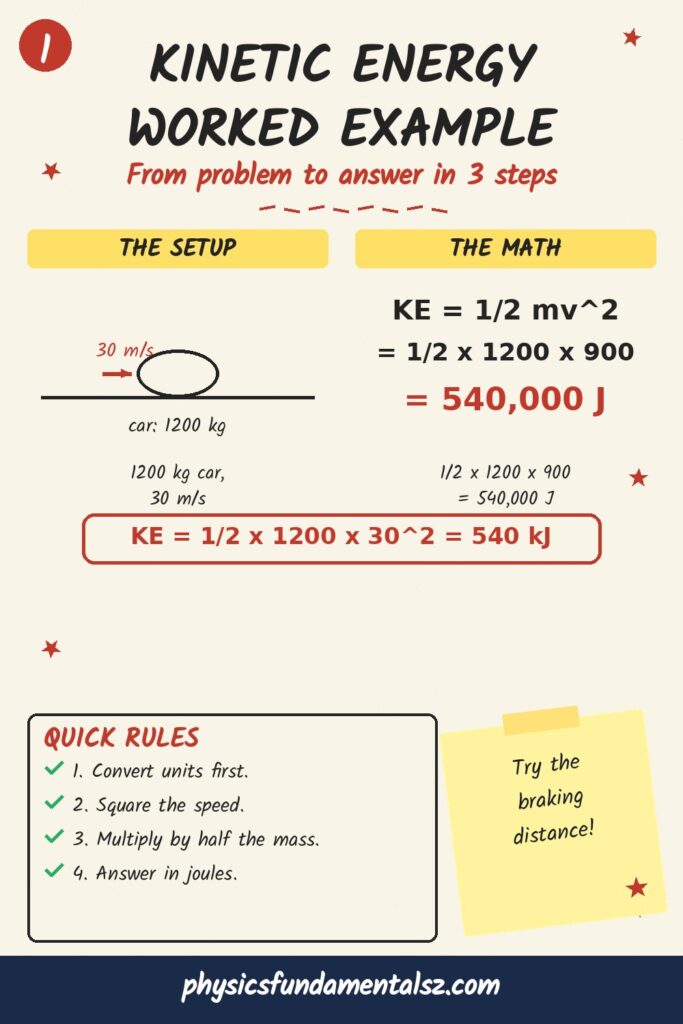
Kinetic energy is one of the most useful ideas in all of physics. With a single short formula, KE = ½mv², you can explain why speeding is dangerous, how brakes stop a car, why a fastball hurts, and how energy flows through collisions, falls, and machines. Remember the two keys: kinetic energy grows linearly with mass but with the square of speed, and the work-energy theorem lets you trade forces and distances for speeds and energies whenever that is easier.
Keep Learning
- What Is Torque in Physics? Formula, Examples & How to Calculate It — torque is the rotational counterpart of force, and it changes rotational kinetic energy.
- Elastic vs Inelastic Collision Difference — see when kinetic energy survives a collision and when it does not.
- Difference Between Work and Power in Physics — work transfers energy, power measures how fast, and kinetic energy is what changes.
- Speed vs Velocity: Differences, Formulas & Solved Examples — speed is the v in ½mv², so getting it right matters.