Work vs Power in Physics: Differences, Formulas & Solved Examples
Quick answer: Work is the amount of energy transferred when a force moves an object — calculated as W = Fd cosθ and measured in joules. Power is the rate at which that work is done — calculated as P = W/t and measured in watts. Lifting a heavy box to a shelf always takes the same work, but lifting it in 2 seconds demands twice the power of lifting it in 4 seconds. Work answers “how much energy?”; power answers “how fast?”
Introduction
In everyday language, “work” means effort and “power” means strength, and people use them almost interchangeably. Physics refuses to be that sloppy. In physics, work and power are two precisely defined, precisely different quantities — and confusing them leads to some of the most persistent misconceptions in all of mechanics, from “I carried this heavy bag for an hour, so I did a lot of work” (you did zero, as we will see) to mixing up kilowatts and kilowatt-hours on an electricity bill (a mistake that costs real money).
The difference between work and power in physics is also one of the highest-yield topics you can study: it sits at the heart of AP Physics 1 Unit 3 (Work, Energy, and Power), which the College Board weights at 18–23% of the multiple-choice section — the joint-largest unit on the exam (apcentral.collegeboard.org). This guide gives you both ideas from the ground up: definitions, formulas, units, six worked examples with real numbers, the work–energy connection, electrical power, and every trap the exam sets.
What Is Work in Physics?
Definition box: In physics, work is done when a force causes a displacement of an object. It measures energy transfer: W = F d cosθ, where F is the magnitude of the force, d is the displacement, and θ is the angle between the force and displacement vectors. The SI unit of work is the joule (J). One joule is the work done when a 1-newton force moves an object 1 meter in the force’s direction.
Two conditions must both hold for work to be done: a force must act, and the object must move (with at least some component of motion along the force). Miss either one and the physics work is zero — no matter how tired you feel.
HyperPhysics states it plainly: “Work refers to an activity involving a force and movement in the direction of the force. A force of 20 newtons pushing an object 5 meters in the direction of the force does 100 joules of work” (hyperphysics.phy-astr.gsu.edu).
The cosθ Term: Only the Parallel Part Counts
Just as torque uses only the perpendicular component of force, work uses only the parallel component. The cosθ factor filters out any part of the force that does not point along the motion:
- θ = 0° (push in the direction of motion): cos 0° = 1 → W = Fd — full work. Pushing a box across the floor.
- θ = 90° (force perpendicular to motion): cos 90° = 0 → W = 0 — no work at all. Carrying a bag horizontally: your upward force is perpendicular to the horizontal displacement.
- θ = 180° (force opposing motion): cos 180° = −1 → negative work. Friction and braking forces do negative work, removing energy from the object.
Three Famous Zero-Work Situations
These are exam classics precisely because they violate everyday intuition:
- Pushing a wall that does not move. You exert a large force, your muscles burn energy — but d = 0, so W = F × 0 = 0. (Your muscles do internal biochemical work, but physics work on the wall is zero.)
- Carrying a heavy bag horizontally at constant speed. The lifting force is vertical; the displacement is horizontal. θ = 90°, cosθ = 0, so the carrying force does zero work. (Gravity also does zero work here for the same reason.)
- A satellite in circular orbit. Gravity pulls toward Earth; the satellite moves tangentially — always perpendicular. Gravity does zero work on a circular orbit, which is why the satellite never speeds up or slows down.
Positive vs negative work: When you lift a box, you do positive work on it (force and displacement both upward). Gravity simultaneously does negative work on it (force downward, displacement upward). The box gains gravitational potential energy equal to the net work — which previews the work–energy theorem below.
What Is Power in Physics?
Definition box: Power is the rate at which work is done — or equivalently, the rate at which energy is transferred or converted. P = W / t, where W is work (or energy transferred) and t is the time taken. The SI unit of power is the watt (W): one watt equals one joule per second (1 W = 1 J/s).
HyperPhysics again: “Power is the rate of doing work or the rate of using energy, which are numerically the same. If you do 100 joules of work in one second (using 100 joules of energy), the power is 100 watts” (hyperphysics.phy-astr.gsu.edu).
Power tells you nothing about how much energy moved — only how fast. A 100-watt light bulb and a 100-watt laptop charger transfer energy at the same rate; leave the bulb on ten times longer and it uses ten times the energy. Students who grasp this one sentence stop confusing watts with joules forever.
The Second Power Formula: P = Fv
When a constant force F pushes an object moving at velocity v (force parallel to velocity), power can be written as:
P = F v
This follows directly: P = W/t = Fd/t = F(d/t) = Fv. It is enormously useful because it connects power to instantaneous speed rather than total time — the formula behind every “engine power at cruising speed” calculation:
- A car engine overcoming 900 N of drag at 25 m/s must deliver P = 900 × 25 = 22,500 W (about 30 hp) continuously, just to maintain speed.
- A cyclist climbing at 5 m/s against 200 N of combined resistance needs P = 200 × 5 = 1,000 W — which is why only elite sprinters can hold it.
Note the deep parallel with torque: just as torque rewards lever arm, power rewards speed. Same force at twice the speed demands twice the power.
Work vs Power: The Complete Comparison
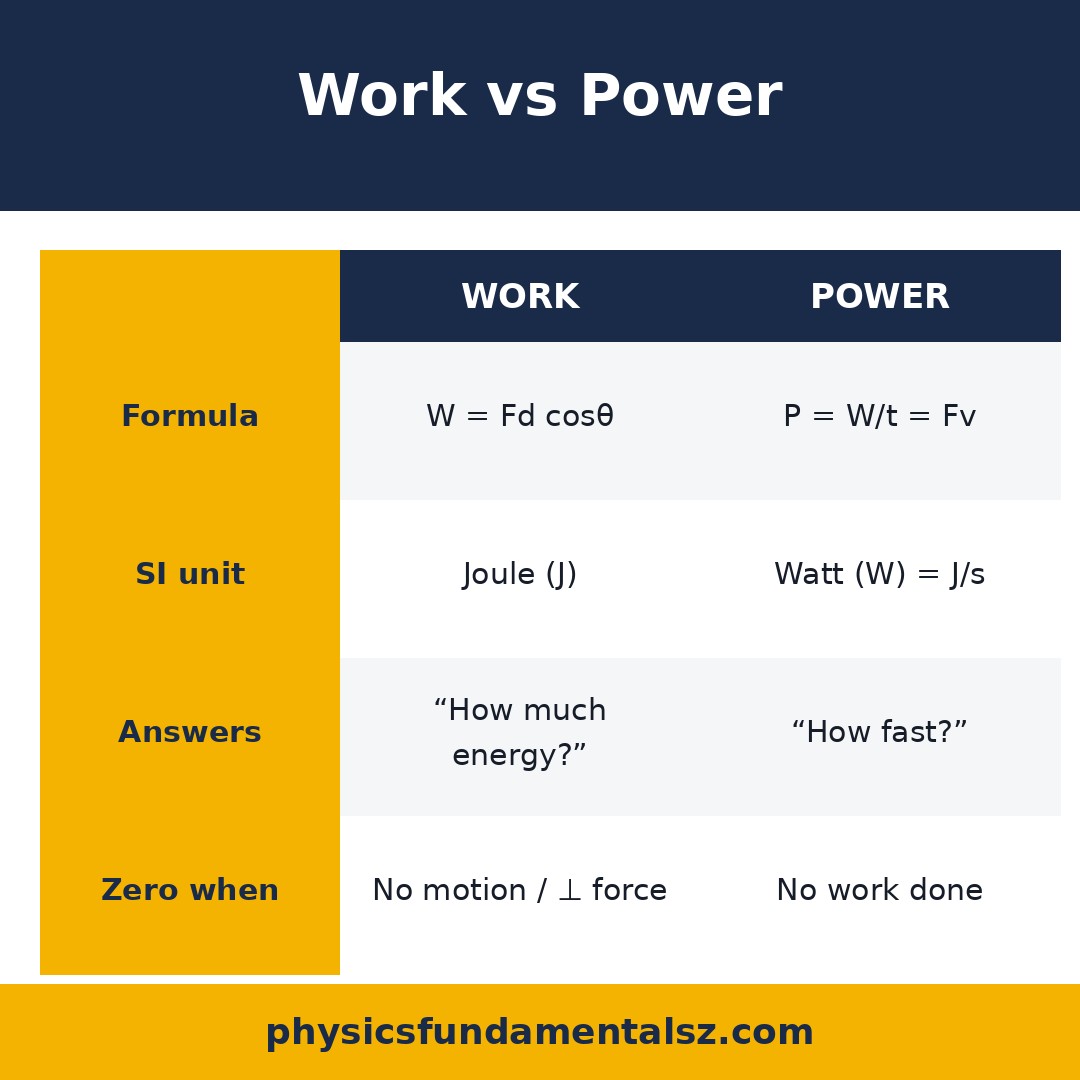
| Feature | Work | Power |
|---|---|---|
| Symbol | W | P |
| Definition | Energy transferred by a force acting through a displacement | Rate at which work is done / energy transferred |
| Formula | W = F d cosθ | P = W/t = Fv |
| SI unit | Joule (J) | Watt (W) = J/s |
| Answers the question | “How much energy?” | “How fast?” |
| Depends on time? | No | Yes — fundamentally |
| Scalar or vector? | Scalar | Scalar |
| Can be negative? | Yes (force opposes motion) | Yes (if work is negative, e.g., braking) |
| Zero when… | No displacement, or force ⊥ displacement | No work done (or infinite time) |
| Everyday example | Lifting a box to a shelf: always the same joules | Lifting it fast vs slow: different watts, same joules |
| Electrical analog | Energy in kWh on your bill | Power in kW of the appliance |
Units: Joules vs Watts (and the Horsepower Detour)
Getting units right is half the battle:
- Joule (J): the unit of work and energy. 1 J = 1 N·m = the energy to lift a ~100 g apple about 1 meter.
- Watt (W): the unit of power. 1 W = 1 J/s. A typical LED bulb: ~10 W. A microwave: ~1,000 W. A human athlete at peak: ~1,000–2,000 W for seconds.
- Kilowatt (kW): 1,000 W. Car engines are often quoted in kW outside the US.
- Horsepower (hp): the traditional engine unit. 1 hp = 746 W exactly. (It originated with James Watt estimating the work rate of brewery horses — marketing is older than physics.)
- Kilowatt-hour (kWh): this is the trap — it is a unit of energy, not power. 1 kWh = 1,000 W × 3,600 s = 3.6 million joules. Your electricity bill charges per kWh because it charges for energy used, not the rate.
The kW vs kWh distinction deserves its own warning: a 2 kW heater run for 3 hours consumes 6 kWh of energy. Saying “the heater used 2 kilowatts per hour” is meaningless — kilowatts already are a rate. Exam questions and utility bills both exploit this confusion, so nail it now: power × time = energy.
Unit shortcut for checking work: work must reduce to N·m = kg·m²/s². Power must reduce to J/s = kg·m²/s³. If your answer’s units do not match, the setup is wrong — no exceptions.
Worked Examples: Work
Worked Example 1: Pushing a Box (The Straightforward Case)
Problem: You push a 40 kg box across a floor with a constant horizontal force of 60 N for 8.0 m. How much work do you do?
Solution:
W = Fd cosθ = (60 N)(8.0 m)(cos 0°) = 480 × 1 = 480 J.
Straightforward — but note what we ignored: the box’s weight (vertical, perpendicular to motion, zero work) and normal force (same). Only the horizontal push contributes.
Worked Example 2: Pushing at an Angle (The Mower Problem)
Problem: You push a lawn mower with 150 N of force directed 40° below the horizontal, pushing it 20 m across the yard. How much work do you do?
Solution:
Only the horizontal component drives the mower forward:
W = Fd cosθ = (150 N)(20 m)(cos 40°) = 3,000 × 0.7660 = 2,298 J ≈ 2.30 kJ.
The vertical component (150 × sin 40° ≈ 96 N downward) presses the mower into the grass — it does zero work because there is no vertical displacement, though it does increase friction. AP free-response problems love asking about both components: one does work, the other does not.
Worked Example 3: Zero Work — Carrying the Groceries
Problem: You carry a 12 kg bag of groceries 25 m horizontally to your car, holding it at constant height. How much work does your lifting force do on the bag?
Solution:
Your upward force (F = mg = 12 × 9.8 = 117.6 N) is perpendicular to the horizontal displacement: θ = 90°, cosθ = 0.
W = (117.6 N)(25 m)(0) = 0 J.
Your arms get tired because muscles consume chemical energy to maintain tension — but physics work on the bag is exactly zero. (Gravity also does zero work for the same perpendicularity reason.) If instead you lifted the bag 1.0 m vertically into the trunk, you would do W = (117.6)(1.0) = 117.6 J of positive work.
Worked Examples: Power
Worked Example 4: The Weightlifter
Problem: A weightlifter raises a 100 kg barbell 2.0 m overhead in 1.5 s. (a) How much work is done? (b) What is the average power output?
Solution:
(a) The lifting force equals the weight: F = mg = (100)(9.8) = 980 N upward, displacement 2.0 m upward.
W = Fd = (980 N)(2.0 m) = 1,960 J.
(b) P = W/t = 1,960/1.5 = 1,307 W ≈ 1.31 kW.
In horsepower: 1,307/746 ≈ 1.75 hp — a human briefly out-powering a small lawnmower engine. Elite Olympic lifters exceed 3,000 W in the explosive phase.
Worked Example 5: Engine Power from Force and Speed (P = Fv)
Problem: A car cruises at a constant 25 m/s (90 km/h). Aerodynamic drag and rolling resistance total 900 N opposing the motion. What power must the engine deliver to maintain speed?
Solution: At constant speed, the engine’s forward force exactly balances the 900 N resistance.
P = Fv = (900 N)(25 m/s) = 22,500 W = 22.5 kW ≈ 30 hp.
This is continuous power just to hold speed — accelerating or climbing needs more. It also shows why fuel economy collapses at high speed: drag grows roughly with v², so the power demand (Fv) grows roughly with v³. Doubling your speed demands roughly eight times the power.
Worked Example 6: Kilowatt-Hours on the Electricity Bill
Problem: A 2.0 kW space heater runs for 3.0 hours. (a) How much energy does it consume in kWh? (b) In joules?
Solution:
(a) Energy = power × time = (2.0 kW)(3.0 h) = 6.0 kWh.
(b) 6.0 kWh × 3.6 × 10⁶ J/kWh = 2.16 × 10⁷ J = 21.6 MJ.
At a typical rate of $0.15/kWh, that evening of heating costs $0.90 — a concrete reminder that the bill charges for energy (kWh), while the heater’s power rating (kW) only tells you the rate.
The Stair-Climb Test (Try It Yourself)
Run up a flight of stairs and you can measure your own power output. A 65 kg person climbing 3.0 m vertically in 5.0 s:
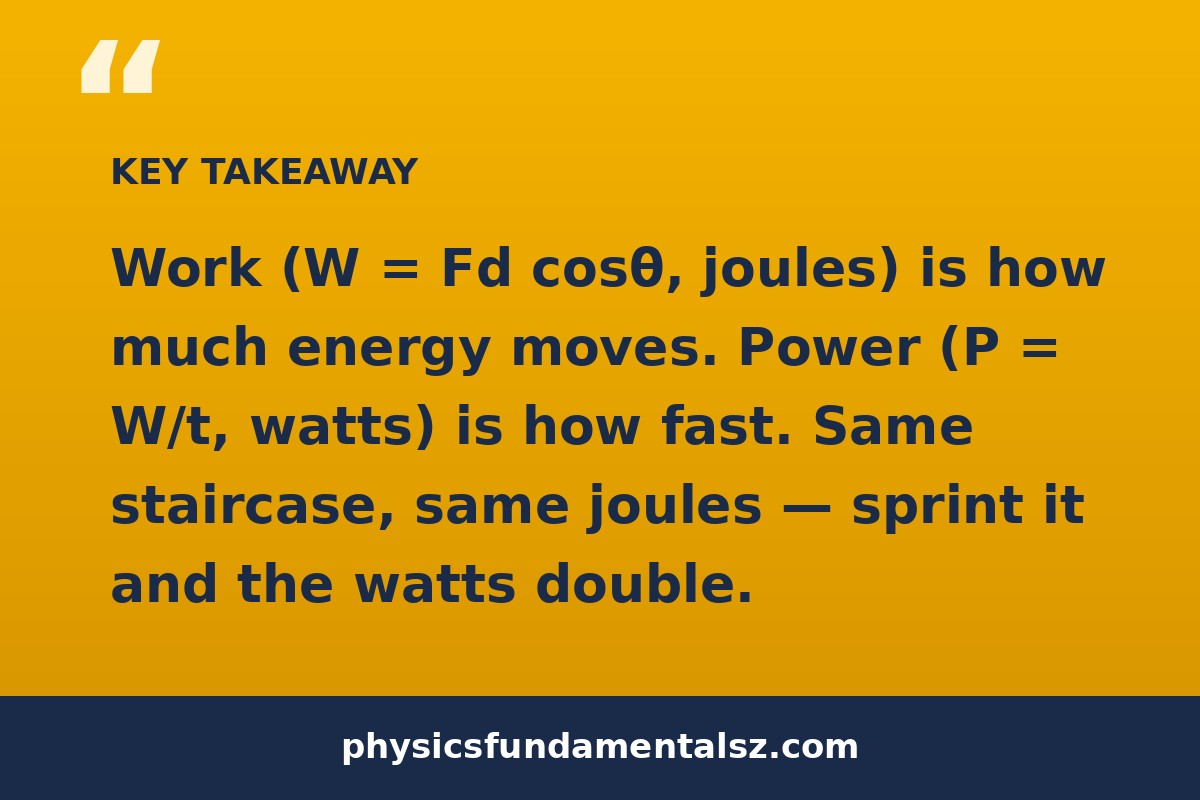
W = mgh = (65)(9.8)(3.0) = 1,911 J; P = 1,911/5.0 = 382 W — about half a horsepower of sustained human power. Sprint it in 2.5 s and you double the power with identical work. Same energy, different rate: the entire work-vs-power distinction in one staircase.
The Work–Energy Connection
Work is not just “force times distance” — it is the mechanism by which energy moves. The work–energy theorem states:
W_net = ΔKE = KE_final − KE_initial
The net work done on an object equals its change in kinetic energy. Push a box and do +480 J of net work on it, and its kinetic energy rises by exactly 480 J. Friction does −200 J on it, and the net gain is 280 J. Every work problem is secretly an energy problem.
HyperPhysics frames energy as “the capacity for doing work” and “the currency for performing work” — to do 100 joules of work you must expend 100 joules of energy (hyperphysics.phy-astr.gsu.edu). This is why work and energy share the joule: they are two sides of the same transaction.
Gravitational potential energy fits the same pattern: lifting a mass m through height h requires work W = mgh against gravity, and that work is stored as potential energy PE = mgh. Lower the mass and gravity does the work back. Our kinetic energy calculator guide walks through the KE = ½mv² side of this energy ledger with worked numbers.
Electrical Power: P = IV
Work and power are not confined to mechanics. In electric circuits, the power delivered to a component is:
P = I V = I²R = V²/R
where I is current and V is voltage. A 60 W bulb at 120 V draws I = P/V = 0.5 A; its filament resistance is R = V²/P = 240 Ω. The same “rate of energy transfer” idea, applied to charges instead of boxes.
This is the power behind every circuit you will analyze — and it is why our comparison of series vs parallel circuits matters for power: components in parallel each see the full voltage, so each dissipates its full rated power, while in series the voltage (and therefore the power) divides.
Machines, Mechanical Advantage, and Power
Simple machines — levers, pulleys, gears — seem to cheat: a pulley system lets you lift 600 N with 150 N of pull. But machines never create energy; they trade force for distance. Our pulley mechanical advantage guide proves the books balance: with MA = 4, you pull 4× the rope to lift the load 1× the height, so input work (150 N × 4 m) equals output work (600 N × 1 m) = 600 J.
Power obeys the same conservation. An ideal machine transmits power unchanged: P_in = P_out. Pull the rope twice as fast and the load rises twice as fast — the rate of energy transfer is preserved even as force and speed trade off. Real machines lose some power to friction (that is what efficiency measures), but no machine ever outputs more power than it takes in. Claims otherwise are perpetual-motion fantasies, and the work–power framework is exactly what exposes them.
Work and Power on the AP Physics 1 Exam
Unit 3: Work, Energy, and Power carries 18–23% of the AP Physics 1 multiple-choice section — tied for the heaviest-weighted unit on the entire exam (apcentral.collegeboard.org). Expect:
- Work calculations with angled forces (W = Fd cosθ) — the single most drilled skill.
- Zero/negative work identification — “which force does no work?” appears nearly every year.
- Power from work and time, and P = Fv at constant velocity — often combined with energy in multi-step free responses.
- Work–energy theorem applications — W_net = ΔKE used to find speeds without kinematics.
- The kW/kWh distinction in energy-context questions.
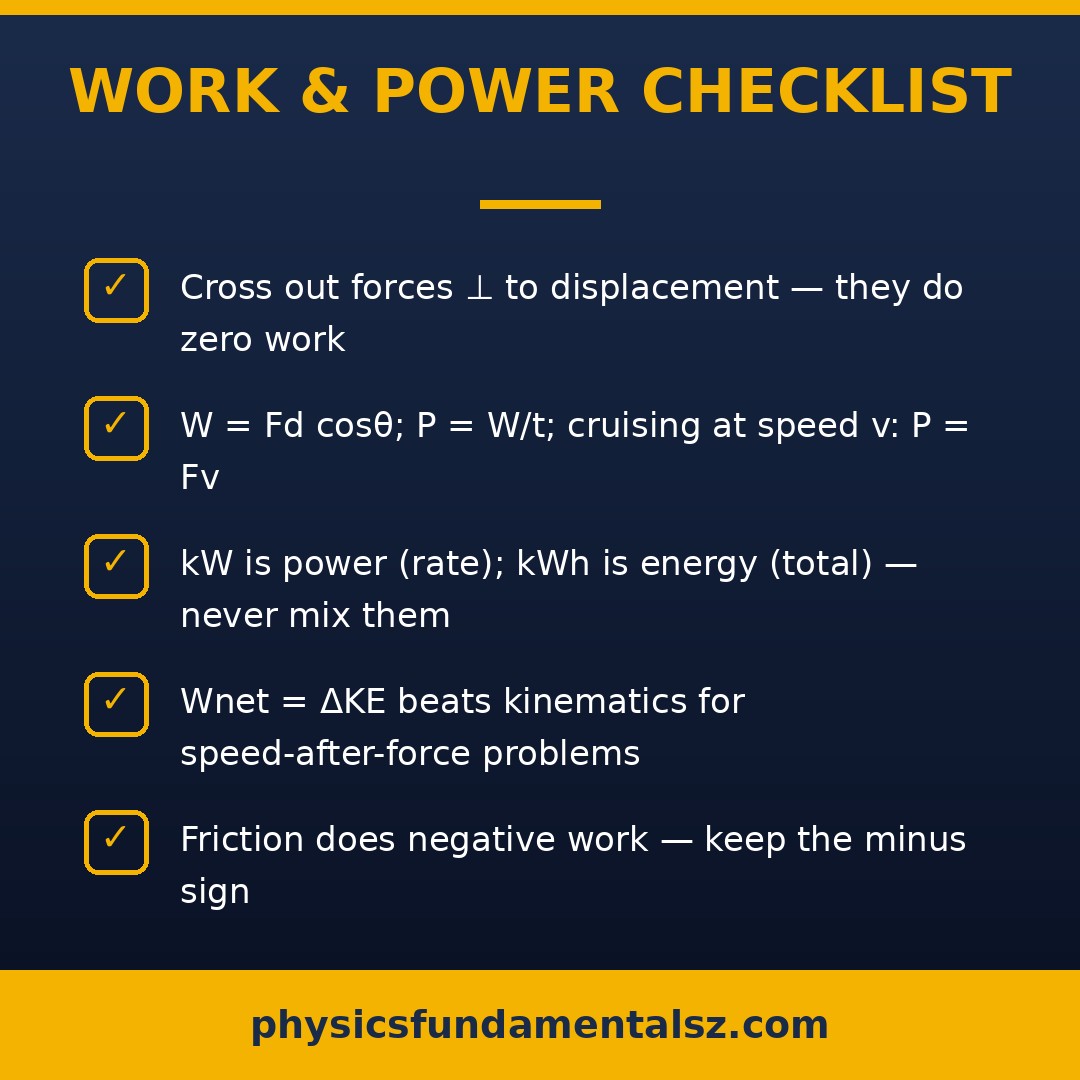
Exam strategy: For any work/power free response, start by listing every force and asking of each: “does it act along the displacement?” Cross out perpendicular forces (zero work) immediately — this alone eliminates most wrong-answer traps. Then compute net work, and reach for W_net = ΔKE before touching kinematics; it is almost always shorter.
Common Mistakes to Avoid
- Saying work was done when nothing moved. No displacement → no work, regardless of effort. Pushing the wall: 0 J.
- Ignoring the angle. Only F cosθ contributes. Forgetting cosθ when the force is angled is the most common arithmetic error in the unit.
- Confusing kW and kWh. Kilowatts measure power (rate); kilowatt-hours measure energy (total). A “2 kW heater running 3 hours” uses 6 kWh — never “2 kW per hour.”
- Thinking power is a kind of force. Power is energy per time. A powerful engine and a strong force are related (P = Fv) but not the same thing.
- Using W = Fd for non-constant forces. The simple formula needs constant force. For varying forces (springs!), use energy methods or integration — W = ½kx² for a spring, not Fd.
- Sign errors with negative work. Friction and drag do negative work. Dropping the minus sign breaks every energy balance that follows.
- Mixing up work and torque units. Both reduce to N·m dimensionally, but work/energy is expressed in joules while torque stays in newton-meters. Writing torque in joules (or work in N·m) signals a conceptual error to any grader.
Expert Tips
- The perpendicular scan: Before calculating, scan every force and cross out any perpendicular to the displacement. What remains is your entire work calculation — usually just one or two terms.
- Energy first, kinematics last. If a problem asks for a speed after a force acts over a distance, W_net = ΔKE almost always beats v² = v₀² + 2aΔx. It skips acceleration entirely.
- P = Fv is the cruise-control formula. Any “maintain constant speed against resistance” question is P = Fv in disguise. Spot the pattern and the answer is one multiplication.
- Track units as a built-in error check. Final answer in J/s but you expected watts? Same thing — but if you get kg·m/s when computing work, you multiplied force by velocity instead of distance.
- For “compare the power” questions, hold work constant mentally. Same work in less time = more power, always. Most comparison questions reduce to comparing times.
Frequently Asked Questions
What is the difference between work and power in physics?
Work (W = Fd cosθ, joules) is the amount of energy transferred by a force acting through a displacement. Power (P = W/t, watts) is the rate at which that work is done. Same work can be done at high power (fast) or low power (slow).
What is the formula for work in physics?
W = F d cosθ, where F is the force in newtons, d is the displacement in meters, and θ is the angle between them. For a force parallel to displacement, this simplifies to W = Fd. The unit is the joule (J).
What is the formula for power in physics?
P = W / t (work divided by time), equivalently P = F v for a constant force parallel to velocity. The unit is the watt (W), where 1 W = 1 J/s.
What is the SI unit of work and power?
Work and energy: the joule (J). Power: the watt (W), defined as one joule per second. Never confuse the two — a watt is a rate, a joule is an amount.
Can work be zero even when a force is applied?
Yes — when there is no displacement (pushing an immovable wall) or when the force is perpendicular to the displacement (carrying a bag horizontally, a satellite in circular orbit). In both cases W = Fd cosθ gives zero.
What is negative work?
Work is negative when the force opposes the displacement (θ = 180°, cosθ = −1). Friction, air resistance, and braking forces do negative work — they remove kinetic energy from the object.
Is power the rate of doing work?
Exactly. That is the definition: power = work/time = energy transferred/time. Doing 100 J of work in 1 s is 100 W; the same 100 J over 10 s is 10 W.
What is the difference between watts and joules?
A joule measures an amount of energy; a watt measures the rate of energy transfer (joules per second). A 60 W bulb uses 60 joules every second it is on.
What is a kilowatt-hour?
A unit of energy, not power: 1 kWh = 1,000 W sustained for one hour = 3.6 × 10⁶ J. Electricity bills charge per kWh because they charge for total energy consumed.
How are work, energy, and power related?
Work is the transfer of energy (W = ΔE in the relevant form), and power is the rate of that transfer (P = W/t). The work–energy theorem ties them together: net work equals change in kinetic energy (W_net = ΔKE).
What is 1 horsepower in watts?
1 hp = 746 W. It is a traditional unit of power still used for engines, originating from James Watt’s estimate of a brewery horse’s sustained work rate.
Does a more powerful machine do more work?
Not necessarily — it does work faster. A 2,000 W motor and a 200 W motor can both lift the same load the same height (same work); the 2,000 W motor just finishes ten times sooner. Machines cannot output more work (or power) than they take in.
What is the work-energy theorem?
W_net = ΔKE: the net work done on an object equals its change in kinetic energy. It lets you find speeds from forces and distances without using kinematics — a staple of AP Physics problem-solving.
How do you calculate power from force and velocity?
Use P = Fv when the force is parallel to the velocity. Example: overcoming 900 N of drag at 25 m/s requires P = 900 × 25 = 22,500 W (≈30 hp).
Why does carrying a bag horizontally do no work?
Your upward lifting force is perpendicular (θ = 90°) to the horizontal displacement, so cosθ = 0 and W = 0. Your muscles still burn chemical energy maintaining the grip, but no physics work is done on the bag.
What is electrical power?
P = IV = I²R = V²/R — the rate at which an electrical component converts electrical energy to heat, light, or motion. It is the same power concept applied to charge flow instead of mechanical motion.
Do simple machines change the work required?
No. A pulley with mechanical advantage 4 lets you pull with ¼ the force, but you must pull 4× the distance — input work equals output work (ideally). Machines trade force for distance; power in equals power out.
Is work a scalar or vector?
Work is a scalar — it has magnitude but no direction (though its sign, positive or negative, matters). Power is also a scalar.
What is an example of work vs power in real life?
Climbing stairs: a 65 kg person gaining 3 m of height always does ~1,911 J of work against gravity. Climbing in 5 s demands ~382 W; sprinting up in 2.5 s demands ~764 W. Same work, double the power.
Are work and power on the AP Physics 1 exam?
Yes — Unit 3: Work, Energy, and Power is 18–23% of the multiple-choice section, the joint-largest unit. Master W = Fd cosθ, P = W/t = Fv, zero/negative work cases, and the work–energy theorem.
Conclusion
Work and power are the “how much” and “how fast” of energy — two ideas that share a formula family but answer completely different questions. W = Fd cosθ tallies the energy transferred; P = W/t (or P = Fv) clocks the rate. The stair-climb test says it all: the same staircase, the same joules, but walk it or sprint it and the watts double.
Carry three things from this guide into every problem: scan for perpendicular forces (they do zero work), reach for W_net = ΔKE before kinematics, and never confuse kW with kWh. Do that, and Unit 3’s 18–23% of the AP exam becomes the most reliable points on the paper.
Keep learning: work is energy in transit — see the energy side in our kinetic energy calculator guide, the force-multiplying machines that trade work’s terms in pulley mechanical advantage, and the electrical form of power in series vs parallel circuits.