Elastic vs Inelastic Collision: Differences, Formulas & Worked Examples
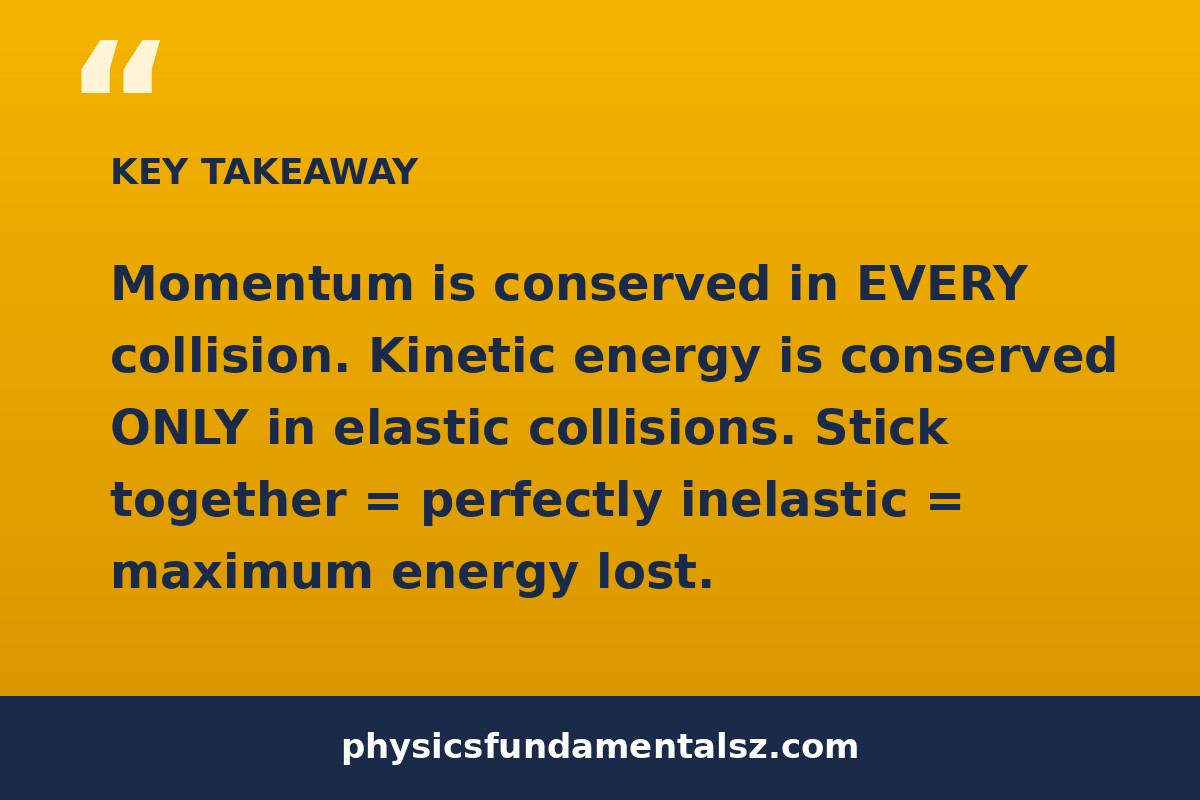
Quick answer: The difference between elastic and inelastic collision comes down to kinetic energy. In an elastic collision, both momentum and kinetic energy are conserved — objects bounce apart with no energy lost. In an inelastic collision, momentum is still conserved, but kinetic energy is not — some converts to heat, sound, or deformation. A perfectly inelastic collision is the extreme case where objects stick together, losing the maximum possible kinetic energy.
Introduction
Watch a trick-shot pool player and you are watching a near-perfect elastic collision: the cue ball strikes, stops dead, and the target ball rockets away with almost all the energy. Now watch a car crash test: two vehicles crumple, stick, and slide together, and a huge fraction of the motion’s energy vanishes into bent metal and heat. Both events obey the same conservation of momentum — yet their outcomes could not look more different.
The difference between elastic and inelastic collision types is one of the most tested ideas in AP Physics 1’s momentum unit, and it is also one of the most misunderstood. Students memorize “elastic conserves kinetic energy” without grasping why that matters, or they assume momentum must be lost when energy is lost. This guide fixes that from the ground up: clear definitions, the conservation laws that govern each type, the coefficient of restitution, full formula derivations, five worked examples with real numbers, and the exam strategies that turn collision problems into easy points.
What Is a Collision in Physics?
Before comparing types, nail down the setup. A collision is any short, intense interaction in which two or more objects exert large forces on each other for a brief time — a bat hitting a ball, two cars crashing, a bullet embedding in wood, even gas molecules bouncing off each other.
Physicists analyze collisions with two tools:
- Conservation of momentum: In a closed system (no net external force), total momentum before equals total momentum after. This holds for every collision type, no exceptions.
- Kinetic energy accounting: Track what happens to the energy of motion. This is what distinguishes collision types.
The bridge between them is impulse: during the brief contact, each object experiences a force F for a time Δt, changing its momentum by Δp = FΔt. Newton’s third law guarantees the two objects’ momentum changes are equal and opposite — which is exactly why total momentum is conserved. Our guide to the conservation of momentum formula derives this from scratch if you want the full foundation.
Definition box: A closed (isolated) system is a group of objects with no net external force acting on it during the interaction. Momentum conservation applies to closed systems. In real collisions, gravity and friction act, but because the collision forces are so much larger and the contact time so short, treating the colliding objects as a closed system during impact is an excellent approximation.
What Is an Elastic Collision?
Definition box: An elastic collision is a collision in which both momentum and kinetic energy are conserved. The objects bounce apart, and the total kinetic energy after the collision equals the total kinetic energy before it. No energy is converted to heat, sound, or permanent deformation.
Truly perfect elastic collisions only happen between subatomic particles. But many everyday collisions come remarkably close: billiard balls, a Newton’s cradle, steel ball bearings, gas molecules in kinetic theory. OpenStax College Physics notes that “truly elastic collisions can only be achieved with subatomic particles,” while macroscopic examples like “two steel blocks on ice” or “carts with spring bumpers on an air track” are nearly elastic (openstax.org).
Key properties of elastic collisions:
- Momentum conserved: m₁v₁ + m₂v₂ = m₁v₁’ + m₂v₂’
- Kinetic energy conserved: ½m₁v₁² + ½m₂v₂² = ½m₁v₁’² + ½m₂v₂’²
- Objects separate after impact (they do not stick)
- No permanent deformation, no heat, no sound energy lost
- Reversible in principle — run the film backward and it still obeys physics
The equal-mass special case (exam favorite): When two equal masses collide elastically head-on and one is initially at rest, they exchange velocities — the moving one stops dead and the stationary one takes off at the original speed. This is exactly what you see in a perfect pool break, and it falls straight out of the formulas (see Worked Example 2).
What Is an Inelastic Collision?
Definition box: An inelastic collision is a collision in which momentum is conserved but kinetic energy is not. Some kinetic energy is transformed into other forms — heat, sound, or the energy of permanent deformation. The objects may bounce apart or deform, but they do not stick together (that stricter case has its own name).
Most real-world collisions are inelastic to some degree. A basketball bouncing on pavement loses a little energy as heat and sound with every bounce (that is why each bounce is lower). A car crash converts enormous kinetic energy into crumpled metal. A clay ball thudding into a wall converts nearly all its kinetic energy into deformation and heat.
Key properties of inelastic collisions:
- Momentum conserved: m₁v₁ + m₂v₂ = m₁v₁’ + m₂v₂’ (unchanged — this always holds)
- Kinetic energy not conserved: KE_after < KE_before
- The “lost” kinetic energy is not destroyed — it becomes thermal energy, sound, or deformation energy (total energy is always conserved; only kinetic energy drops)
- Objects separate, but slower and “deader” than in the elastic case
The critical misconception to kill: losing kinetic energy does not mean losing momentum. Momentum depends on mass and velocity (p = mv); kinetic energy depends on mass and velocity squared (KE = ½mv²). When objects deform or stick, velocity redistributes in a way that preserves total mv but reduces total ½mv². They are different quantities with different conservation rules, and the AP exam loves testing whether you know that.
Perfectly Inelastic Collisions: The Extreme Case
Definition box: A perfectly inelastic collision is an inelastic collision in which the objects stick together after impact and move as a single combined mass. It loses the maximum possible kinetic energy consistent with momentum conservation.
Because there is only one final velocity to find, the math collapses to a single clean equation:
m₁v₁ + m₂v₂ = (m₁ + m₂)v_f
Classic examples: a bullet embedding in a wooden block (the ballistic pendulum), two train cars coupling, a meteorite sticking into the ground, two football players tackling and falling as one, clay blobs merging mid-air.
Why “maximum energy loss”? Think of it this way: the more the objects’ relative motion is eliminated, the more kinetic energy disappears. Sticking together eliminates all relative motion — the objects share one velocity — so no collision type can lose more kinetic energy than this while still conserving momentum. Any separation afterward would carry away extra kinetic energy.
Elastic vs Inelastic Collision: The Complete Comparison
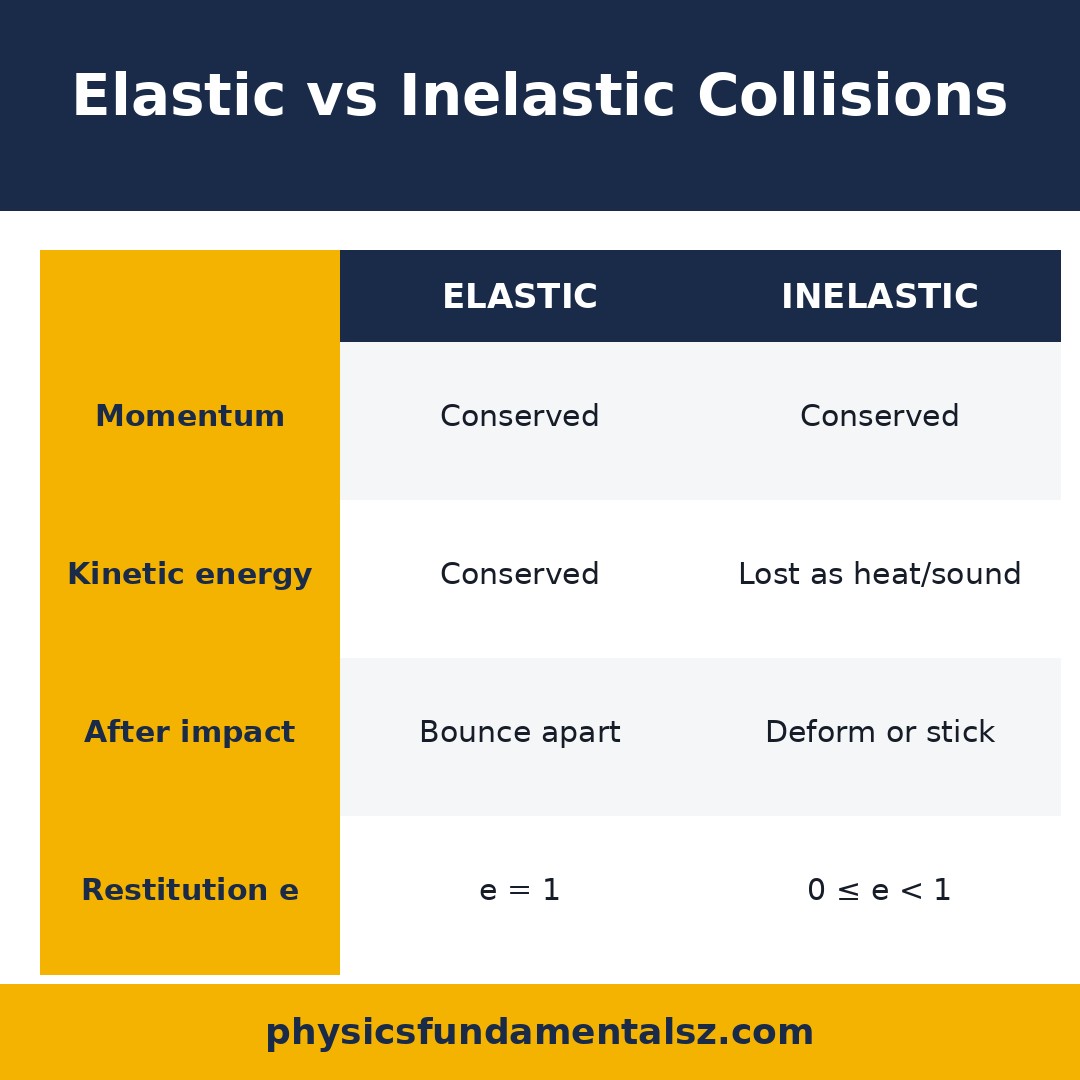
| Feature | Elastic Collision | Inelastic Collision | Perfectly Inelastic Collision |
|---|---|---|---|
| Momentum conserved? | Yes | Yes | Yes |
| Kinetic energy conserved? | Yes | No (some lost) | No (maximum lost) |
| Objects after impact | Bounce apart | Bounce apart or deform | Stick together, one combined mass |
| Deformation | None | Some (temporary or permanent) | Maximum (permanent) |
| Heat/sound produced | Negligible | Yes | Yes, the most |
| Reversible? | Yes, in principle | No | No |
| Real-world examples | Billiard balls, Newton’s cradle, gas molecules | Car crash, bouncing basketball, hammer on nail | Bullet in block, train cars coupling, clay blobs merging |
| Coefficient of restitution (e) | e = 1 | 0 < e < 1 | e = 0 |
| Equations needed | Momentum + KE (two equations) | Momentum only | Momentum only (simplified) |
| Typical exam use | Pool-ball and particle problems | Crash and bounce problems | “Stick together” problems |
The Coefficient of Restitution: Measuring Bounciness
Physicists quantify how elastic a collision is with the coefficient of restitution, e:
e = (relative speed of separation) / (relative speed of approach)
- e = 1 → perfectly elastic (objects separate at the same relative speed they approached)
- e = 0 → perfectly inelastic (zero separation speed — they stick)
- 0 < e < 1 → somewhere in between (most real collisions)
For a ball bouncing off a stationary floor, this simplifies beautifully. Drop a ball from height h₁; it rebounds to height h₂. Since impact speed v = √(2gh), the ratio of speeds equals the square root of the ratio of heights:
e = √(h₂ / h₁)
A superball might have e ≈ 0.9; a lump of clay has e ≈ 0. Sports engineers tune e precisely — a basketball must rebound to a regulated height, and golf’s “trampoline effect” rules literally cap the coefficient of restitution of drivers.
Energy connection: the fraction of kinetic energy retained in a bounce equals e². So a ball with e = 0.8 keeps only 64% of its kinetic energy per bounce — which is why bounce heights decay so fast. (See Worked Example 4.)
The Formulas, Derived and Ready to Use
Perfectly inelastic (stick together)
m₁v₁ + m₂v₂ = (m₁ + m₂)v_f — solve directly for v_f. One equation, one unknown.
Elastic collision in one dimension
Two unknowns (v₁’, v₂’) need two equations — momentum and kinetic energy:
- m₁v₁ + m₂v₂ = m₁v₁’ + m₂v₂’
- ½m₁v₁² + ½m₂v₂² = ½m₁v₁’² + ½m₂v₂’²
Solving these simultaneously gives the standard results (with v₂ = 0, the common “target at rest” case):
- v₁’ = [(m₁ − m₂)/(m₁ + m₂)] v₁
- v₂’ = [2m₁/(m₁ + m₂)] v₁
Sanity checks worth memorizing:
- Equal masses (m₁ = m₂): v₁’ = 0, v₂’ = v₁ — they exchange velocities.
- Light hits heavy (m₁ ≪ m₂): v₁’ ≈ −v₁ (bounces straight back), v₂’ ≈ 0 (heavy object barely moves). Think ping-pong ball vs bowling ball.
- Heavy hits light (m₁ ≫ m₂): v₁’ ≈ v₁ (plows through nearly unaffected), v₂’ ≈ 2v₁ (light object shoots off at nearly twice the speed). Think bowling ball vs ping-pong ball.
These three limiting cases answer a huge fraction of qualitative AP questions without any algebra.
Worked Examples
Worked Example 1: Perfectly Inelastic — Two Carts Stick Together
Problem: A 2.0 kg cart moving at 4.0 m/s collides head-on with a stationary 3.0 kg cart, and they stick together. Find (a) their final velocity and (b) the kinetic energy lost.
Solution:
(a) Final velocity:
m₁v₁ + m₂v₂ = (m₁ + m₂)v_f
(2.0)(4.0) + (3.0)(0) = (5.0)v_f
8.0 = 5.0v_f → v_f = 1.6 m/s
(b) Kinetic energy accounting:
KE_before = ½(2.0)(4.0)² = 16 J
KE_after = ½(5.0)(1.6)² = ½(5.0)(2.56) = 6.4 J
KE lost = 16 − 6.4 = 9.6 J — a full 60% of the kinetic energy converted to heat, sound, and deformation, while momentum (8.0 kg·m/s) is perfectly conserved.
Worked Example 2: Elastic — Equal Masses Exchange Velocities
Problem: A 2.0 kg billiard ball moving at 3.0 m/s strikes an identical stationary ball in an elastic head-on collision. Find both final velocities.
Solution: Use the elastic formulas with m₁ = m₂ = 2.0 kg, v₁ = 3.0 m/s, v₂ = 0:
v₁’ = [(2.0 − 2.0)/(2.0 + 2.0)](3.0) = 0 m/s
v₂’ = [2(2.0)/(4.0)](3.0) = 3.0 m/s
The incoming ball stops dead; the target ball departs at exactly 3.0 m/s. Check: momentum before = 6.0 kg·m/s, after = 6.0 kg·m/s ✓. KE before = ½(2)(9) = 9 J, after = 9 J ✓. This velocity exchange is the signature of equal-mass elastic collisions — and the reason pool trick shots work.
Worked Example 3: Elastic — Light Object Hits Heavy Object (Real Textbook Numbers)
Problem: A 0.500 kg object moving at 4.00 m/s collides elastically with a 3.50 kg object at rest. Find both final velocities.
Solution: This is the exact scenario worked in OpenStax College Physics (Section 8.4), and it is worth seeing because the small object rebounds:
v₁’ = [(0.500 − 3.50)/(0.500 + 3.50)](4.00) = (−3.00/4.00)(4.00) = −3.00 m/s
v₂’ = [2(0.500)/(4.00)](4.00) = (1.00/4.00)(4.00) = 1.00 m/s
The 0.500 kg object bounces backward at 3.00 m/s while the heavy 3.50 kg object lumbers forward at just 1.00 m/s. Check momentum: before = 2.00 kg·m/s; after = (0.5)(−3.00) + (3.5)(1.00) = −1.50 + 3.50 = 2.00 ✓. Check KE: before = 4.00 J; after = ½(0.5)(9.00) + ½(3.5)(1.00) = 2.25 + 1.75 = 4.00 J ✓ (openstax.org).
Worked Example 4: Coefficient of Restitution from Bounce Heights
Problem: A ball is dropped from 2.00 m and rebounds to 1.28 m. Find e and the fraction of kinetic energy retained per bounce.
Solution:
e = √(h₂/h₁) = √(1.28/2.00) = √0.64 = 0.80
Fraction of KE retained = e² = 0.64 (64%).
So each bounce keeps less than two-thirds of the energy — after three bounces the ball retains only 0.64³ ≈ 26% of its original energy. This is why a “bouncy” ball with e = 0.8 still dies out quickly, and why the e² relationship is an exam favorite.
Worked Example 5: Ballistic Pendulum (Two-Stage Problem)
Problem: A 0.020 kg bullet moving at 300 m/s embeds in a 4.98 kg wooden block suspended as a pendulum. How high does the block rise?
Solution: This is a two-stage problem — the AP exam’s favorite format.
Stage 1 (perfectly inelastic collision): momentum conserved during the split-second impact.
(0.020)(300) + 0 = (0.020 + 4.98)v_f → 6.0 = 5.0v_f → v_f = 1.2 m/s
Stage 2 (swing upward): now mechanical energy is conserved as kinetic converts to gravitational potential.
½mv² = mgh → h = v²/(2g) = (1.2)²/(2 × 9.8) = 1.44/19.6 = 0.073 m ≈ 7.3 cm
The trap: students try to use energy conservation across the collision — but the collision is perfectly inelastic, so kinetic energy is massively lost (from 900 J to just 3.6 J). Momentum for the impact, energy for the swing. Getting the two stages’ rules right is the entire skill.
Real-World Examples by Collision Type
Nearly elastic:
- Billiard balls — the classic; collisions between polished phenolic-resin balls lose only a few percent of kinetic energy.
- Newton’s cradle — the desk toy is a visual proof of momentum and energy conservation working together; only one ball swings out because that is the unique outcome satisfying both.
- Gas molecules — kinetic theory treats molecular collisions as elastic, which is why ideal gases do not spontaneously cool down.
- Subatomic particle scattering — Rutherford’s gold-foil experiment analyzed alpha particles bouncing elastically off nuclei.
Inelastic:
- Car crashes — crumple zones are designed to be inelastic: converting kinetic energy into deformation over a longer time reduces the peak force on passengers (impulse = FΔt).
- Sports impacts — a baseball compressing against a bat, a tennis ball flattening on strings, a boxer’s glove absorbing a punch.
- Bouncing balls — every real bounce is inelastic; the lost fraction is exactly 1 − e² per bounce.
Perfectly inelastic:
- Ballistic pendulum — the classic lab for measuring bullet speeds.
- Train cars coupling — the clunk you hear is kinetic energy becoming heat and sound.
- Tackling in football — two players becoming one sliding mass.
- Meteorite impacts — maximum energy deposition into the ground (which is why they make craters, not bounces).
See our conservation of momentum real-life examples for 15 everyday demonstrations of the momentum side of these collisions — from gun recoil to rocket launches.
Elastic vs Inelastic Collisions on the AP Physics 1 Exam
Collisions live in Unit 4: Linear Momentum, which the College Board weights at 10–15% of the multiple-choice section (apcentral.collegeboard.org). Collision-type questions appear in both multiple-choice and free-response, and they test a short list of skills:
- Classifying collision type from a description (“the cars stick together” → perfectly inelastic; “the ball rebounds with no energy loss” → elastic).
- Applying the right conservation law to the right stage — the ballistic-pendulum pattern (momentum during impact, energy after) is a perennial free-response structure.
- Qualitative limiting cases — “a light object strikes a heavy stationary object elastically; what happens?” (It rebounds at nearly its original speed.)
- Energy accounting — calculating the fraction of kinetic energy lost, or explaining where it went.
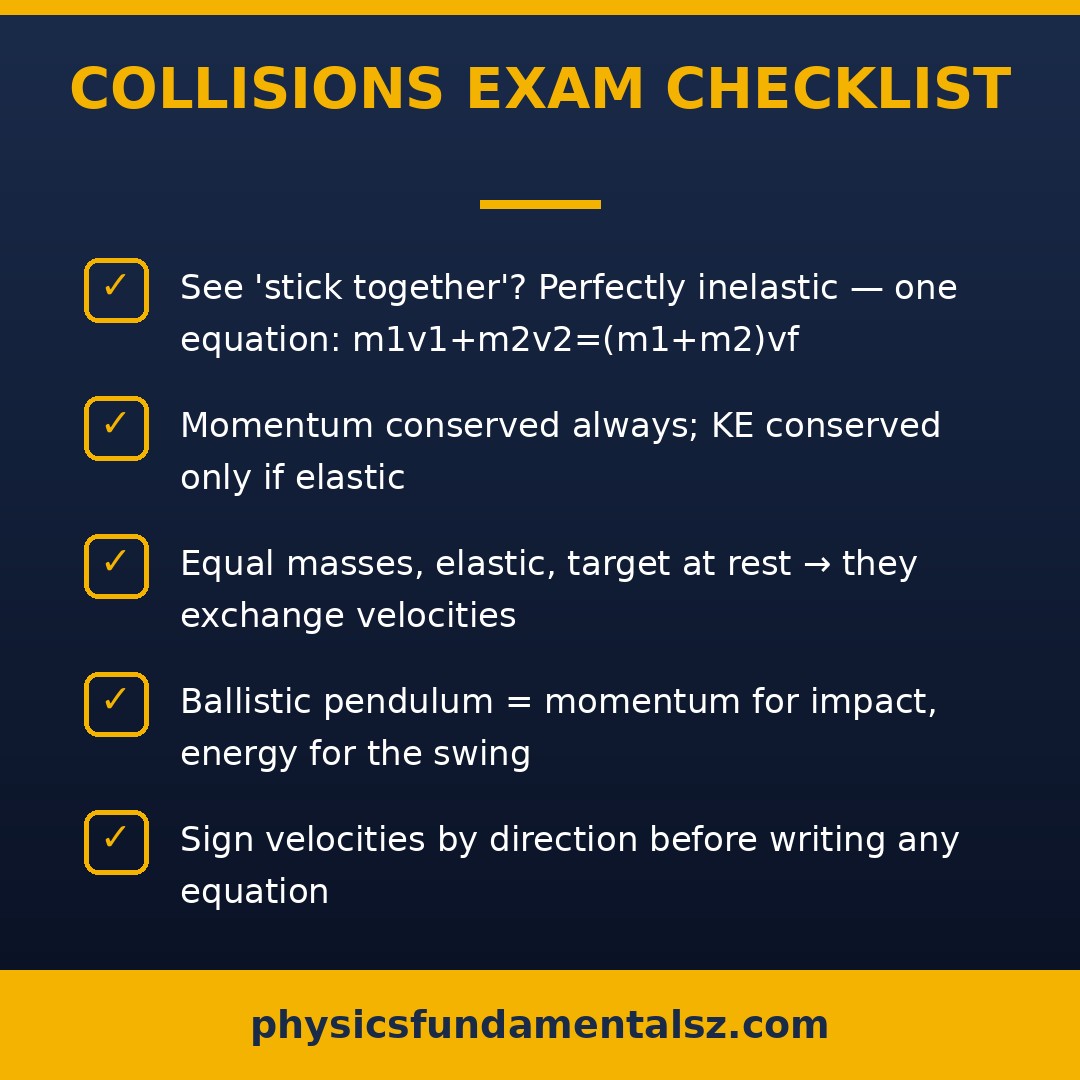
Exam strategy: The moment you read a collision problem, write two labels: “p: conserved ✓” and “KE: ?”. Then let the problem tell you whether KE is conserved (elastic), partially lost (inelastic), or maximally lost (stick together). That two-second decision picks your equations before you do any algebra — and most lost points in this unit come from using energy equations in inelastic collisions, not from arithmetic.
Common Mistakes to Avoid
- Assuming kinetic energy is always conserved. It is conserved only in elastic collisions. In every other case, some becomes heat, sound, or deformation.
- Assuming momentum is lost when kinetic energy is lost. Momentum is conserved in all collision types in a closed system. Energy loss never implies momentum loss.
- Using energy conservation across a perfectly inelastic impact. The ballistic-pendulum trap: 900 J → 3.6 J in our example. Momentum first, energy only after.
- Forgetting that momentum is a vector. In head-on collisions, assign + and − directions before writing the conservation equation. A sign error flips the physics.
- Mixing up “inelastic” and “perfectly inelastic.” All perfectly inelastic collisions are inelastic, but not all inelastic collisions stick together. Read the problem’s wording carefully.
- Treating e = 1 as achievable macroscopically. Real collisions always have e < 1. If a problem says “elastic,” it means treat as elastic — an idealization.
- Applying collision formulas in two dimensions without components. Momentum is conserved per axis. Break velocities into x and y components first, then apply the one-dimensional machinery to each axis separately.
- Forgetting external impulses. If friction or gravity acts significantly during the collision, the system is not closed. (Usually the collision is so brief that external impulses are negligible — but check.)
Expert Tips
- The “stick together” scan: Before reading numbers, scan the problem for the words stick, couple, embed, merge, or move as one. Any of them means perfectly inelastic — one equation, one unknown, done.
- Limiting-case reasoning beats algebra for qualitative questions. Memorize the three elastic special cases (equal masses exchange; light rebounds off heavy; heavy plows through light) and you can answer most conceptual questions in seconds.
- Energy-loss fraction is often the real question. When asked “what fraction of kinetic energy is lost,” compute KE_before and KE_after separately and take the ratio — do not try to derive a shortcut formula under exam pressure.
- Draw before/after diagrams with velocity arrows. Label every mass and every velocity (before: v₁, v₂; after: v₁’, v₂’) on the diagram. Half of all sign errors disappear when the arrows are drawn.
- Check your answer against intuition. If your “elastic collision” result shows kinetic energy increasing, you made an algebra error — KE can never increase in a passive collision.
Frequently Asked Questions
What is the difference between elastic and inelastic collision?
In an elastic collision, both momentum and kinetic energy are conserved — objects bounce apart with no energy lost. In an inelastic collision, momentum is conserved but kinetic energy is not; some converts to heat, sound, or deformation.
Is momentum conserved in an inelastic collision?
Yes. Momentum is conserved in every collision type — elastic, inelastic, and perfectly inelastic — as long as the system is closed (no net external force). Only kinetic energy conservation varies by type.
What is a perfectly inelastic collision?
A collision in which the objects stick together after impact and move as one combined mass. It loses the maximum possible kinetic energy while still conserving momentum. Formula: m₁v₁ + m₂v₂ = (m₁ + m₂)v_f.
What are examples of elastic collisions?
Billiard balls colliding, Newton’s cradle balls, gas molecules bouncing off each other, and subatomic particle scattering. All are nearly elastic — perfect elasticity exists only at the subatomic scale.
What are examples of inelastic collisions?
Car crashes (kinetic energy becomes crumpled metal and heat), a basketball bouncing (each bounce lower than the last), a hammer striking a nail, and clay balls sticking together (perfectly inelastic).
How do you tell if a collision is elastic or inelastic?
Check kinetic energy: compute total KE before and after. If it is unchanged, the collision is elastic. If it decreased, it is inelastic. If the objects stuck together, it is perfectly inelastic.
What is the coefficient of restitution?
The coefficient of restitution (e) measures collision bounciness: e = (relative speed of separation)/(relative speed of approach). e = 1 is perfectly elastic, e = 0 is perfectly inelastic, and real collisions fall between.
Can kinetic energy increase in a collision?
Not in a passive collision — it can only stay the same (elastic) or decrease (inelastic). It can increase only if there is an internal energy source, like an explosion (which is why explosions are analyzed with momentum, not energy, conservation).
Why do objects stick together in perfectly inelastic collisions?
“Sticking together” is the defining idealization — it represents the case where all relative motion between the objects is eliminated, which is also the case of maximum kinetic energy loss. Real examples include bullets embedding in wood and train cars coupling.
What is the formula for elastic collision?
Two equations: momentum conservation (m₁v₁ + m₂v₂ = m₁v₁’ + m₂v₂’) and kinetic energy conservation (½m₁v₁² + ½m₂v₂² = ½m₁v₁’² + ½m₂v₂’²). With the target at rest, these solve to v₁’ = [(m₁−m₂)/(m₁+m₂)]v₁ and v₂’ = [2m₁/(m₁+m₂)]v₁.
Do equal masses exchange velocities in elastic collisions?
Yes — when two equal masses collide elastically head-on with one initially at rest, the moving mass stops dead and the stationary mass takes off at the original velocity. This is the physics behind pool trick shots.
Where does the lost kinetic energy go in an inelastic collision?
It transforms into thermal energy (heat from deformation and friction), sound energy, and the energy stored in permanent deformation. Total energy is always conserved — only the kinetic portion decreases.
What happens when a light object hits a heavy object elastically?
The light object rebounds at nearly its original speed (v₁’ ≈ −v₁) while the heavy object barely moves (v₂’ ≈ 0). Think of a ping-pong ball bouncing off a bowling ball.
What happens when a heavy object hits a light object elastically?
The heavy object plows through nearly unaffected (v₁’ ≈ v₁) while the light object shoots forward at nearly twice the heavy object’s speed (v₂’ ≈ 2v₁). Think of a bowling ball striking a ping-pong ball.
Is a car crash elastic or inelastic?
Inelastic — typically close to perfectly inelastic in severe crashes. Enormous kinetic energy converts into deformation (crumple zones are engineered for exactly this), heat, and sound. Momentum, however, is conserved through the crash.
How is the ballistic pendulum analyzed?
In two stages: (1) the bullet embedding is a perfectly inelastic collision — use momentum conservation to find the combined velocity; (2) the upward swing conserves mechanical energy — convert that velocity to height via ½mv² = mgh. Never use energy conservation across the impact itself.
What is internal kinetic energy?
The sum of the kinetic energies of all objects in the system. An elastic collision is formally defined as one that conserves internal kinetic energy — the system’s total kinetic energy measured in any inertial frame.
Can momentum be conserved if kinetic energy is not?
Yes — this is precisely what defines an inelastic collision. Momentum (p = mv) and kinetic energy (KE = ½mv²) are different quantities with different conservation rules; velocity can redistribute among masses to preserve total mv while reducing total ½mv².
Are collisions on the AP Physics 1 exam?
Yes — collision analysis is central to Unit 4: Linear Momentum (10–15% of multiple choice). Expect classification questions, ballistic-pendulum-style two-stage free responses, and qualitative limiting-case questions.
What is the most common mistake in collision problems?
Using energy conservation in an inelastic collision — especially across a “stick together” impact. The rule: momentum governs the collision; energy governs what happens before and after.
Conclusion
The difference between elastic and inelastic collision types is really a question about energy bookkeeping. Momentum is the reliable constant — conserved in every collision, the anchor of every solution. Kinetic energy is the variable — conserved only when the collision is elastic, partially lost when it is inelastic, maximally lost when objects stick together.
Once you internalize that split, collision problems stop being formula hunts and start being accounting exercises: label what is conserved, write the equations, check the energy. The five worked examples above cover every pattern the AP exam throws at you — perfectly inelastic sticking, equal-mass exchange, light-on-heavy rebound, coefficient of restitution, and the two-stage ballistic pendulum.
Keep learning: collisions are momentum conservation in action. Master the foundation with the conservation of momentum formula and its 15 real-life examples, and use our kinetic energy calculator guide to speed up the energy side of every collision problem.