How to Calculate Decibel Levels from Sound Intensity: Formula, Steps, and Worked Examples 2026
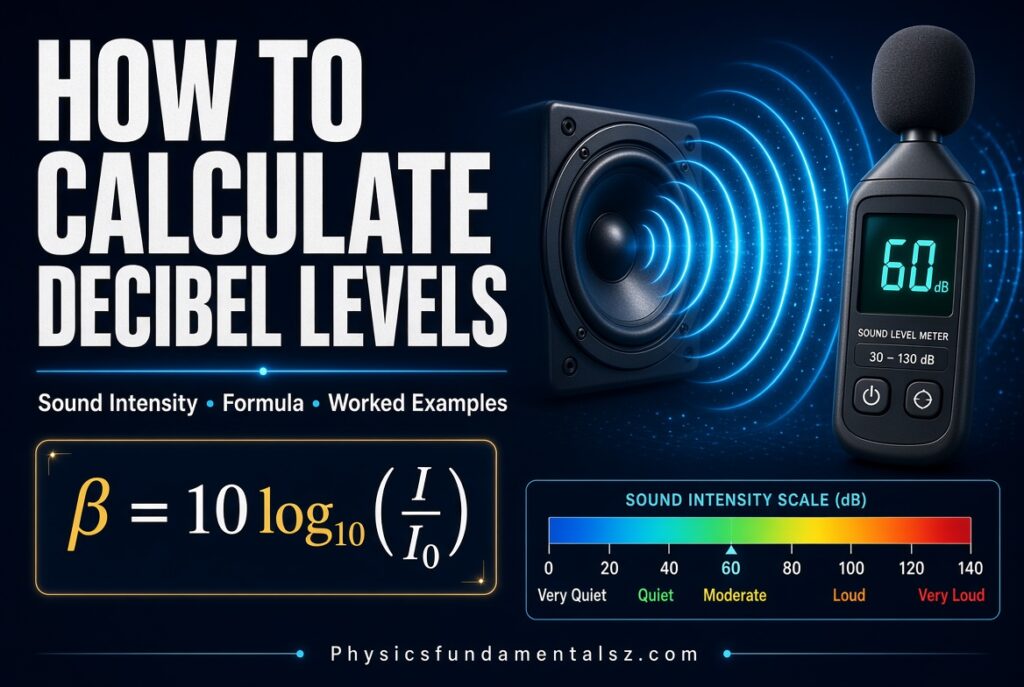
How to Calculate Decibel Levels from Sound Intensity involves using a logarithmic formula to express sound intensity in decibels (dB). This calculation helps quantify the strength of sound by comparing its intensity with a standard reference intensity.
Sound intensity measures the sound energy passing through a unit area per second, while the decibel scale expresses this intensity as a logarithmic value.
The formula is used to calculate the sound intensity level, where represents the measured sound intensity and is the reference intensity, typically in air.
This relationship is used in acoustics, physics, environmental noise measurement, and sound engineering to compare sound levels across a wide range of intensities.
Table of Contents
The Decibel Formula for Sound Intensity
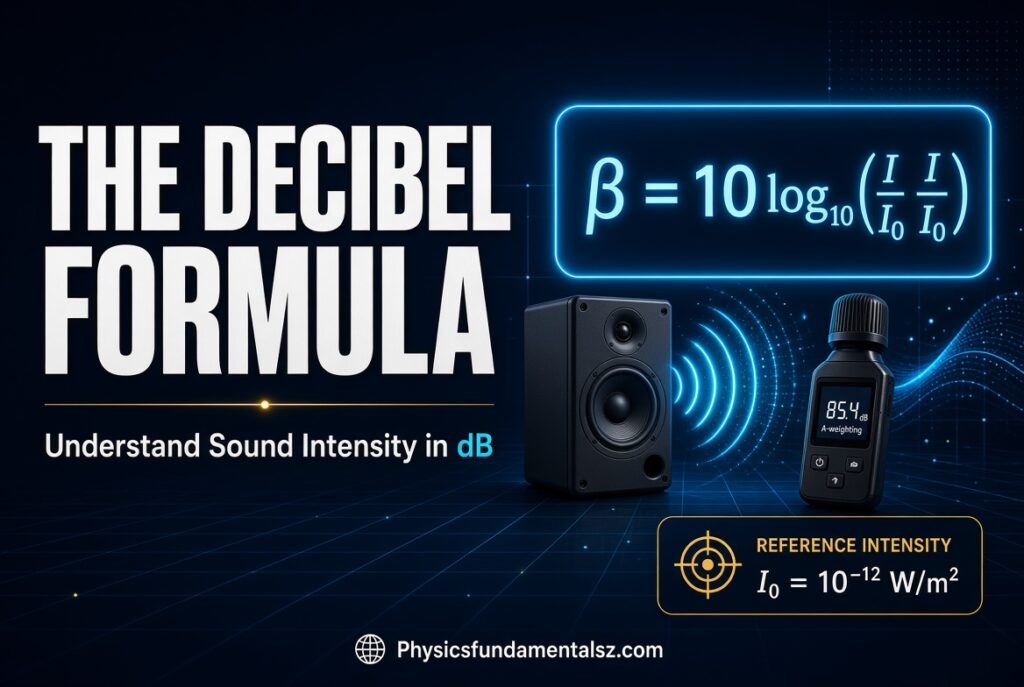
The sound intensity level formula is β = 10 × log₁₀(I / I₀). Here, β is the level in decibels, I is the measured sound intensity in watts per square meter (W/m²), and I₀ is the reference intensity of 1 × 10⁻¹² W/m².
Use it any time you know the intensity and want the decibel level. If you know the decibel level and want the intensity, rearrange it to I = I₀ × 10^(β / 10).
Key Takeaways
- The standard reference intensity is I₀ = 1 × 10⁻¹² W/m², the threshold of hearing at 1,000 Hz.
- Every increase of 10 dB means the intensity is 10 times larger.
- Every increase of 3 dB means the intensity roughly doubles.
- Doubling your distance from a point source lowers the level by about 6 dB.
- Decibel values cannot be added directly. You must convert them to intensities first.
- A sound with an intensity equal to I₀ has a level of exactly 0 dB.
What Is Sound Intensity?
Sound intensity is the amount of sound power that passes through a given area. It tells you how much acoustic energy flows through a surface every second. The SI unit is watts per square meter (W/m²).
Imagine a speaker playing in an open field. The sound spreads outward in all directions. The farther away you stand, the more area the same power is spread across, so the intensity at your position drops.
Sound Intensity Formula in Terms of Power and Area
The basic definition is I = P / A. Here, P is the acoustic power in watts and A is the area in square meters that the sound passes through, perpendicular to its direction of travel.
For example, if 0.002 W of acoustic power passes through a window of 0.5 m², the intensity is 0.004 W/m². Intensity is always about power per unit area.
Sound Intensity vs. Sound Power vs. Sound Pressure
These three terms are often mixed up, but they describe different things. Knowing the difference prevents the most common calculation errors.
| Quantity | What it measures | Unit | Depends on distance? |
|---|---|---|---|
| Sound power | Total acoustic energy emitted per second by a source | Watts (W) | No |
| Sound intensity | Acoustic power passing through a unit area | W/m² | Yes |
| Sound pressure | Pressure variation caused by the sound wave | Pascals (Pa) | Yes |
Sound power belongs to the source. Intensity and pressure belong to a location in space. That is why the same loudspeaker produces different intensities at 1 meter and 10 meters.
Typical Sound Intensity Values
Human hearing handles a staggering range of intensities. The quietest sound you can hear has an intensity near 10⁻¹² W/m². Sounds near the threshold of pain carry about 1 W/m².
That is a ratio of one trillion to one. Writing such numbers on a linear scale would be impractical, which is the reason the decibel exists.
What Is a Decibel?
A decibel is one-tenth of a bel. It is a logarithmic unit that expresses the ratio of two values of a physical quantity, most often power or intensity. It is not an absolute unit like a meter or a kilogram.
A decibel value always compares something to a reference. In sound intensity calculations, that reference is the threshold of hearing.
Why the Decibel Scale Is Logarithmic
Human hearing responds to sound roughly in proportion to the logarithm of intensity. A sound with ten times more intensity does not feel ten times louder. It feels moderately louder.
A logarithmic scale matches that behavior and compresses the enormous range of intensities into numbers between 0 and about 140. This makes charts, standards, and everyday conversation far easier.
The Bel and the Decibel
The bel is named after Alexander Graham Bell. One bel equals a tenfold increase in power. A decibel is one-tenth of a bel, which is why the formula contains the factor of 10.
Engineers found the bel too coarse for practical work. Using tenths of a bel gave a convenient resolution, since a change of about 1 dB is close to the smallest change most listeners can notice.
Decibels Are a Ratio, Not a Direct Measurement
A level of 60 dB does not mean 60 units of anything. It means the intensity is 10⁶ times the reference intensity. The number only has meaning because the reference is agreed upon.
This is why decibel notation often carries a suffix, such as dB SPL, dBA, or dB re 10⁻¹² W/m². The suffix tells you what reference or weighting was used.
The Reference Intensity and the Threshold of Hearing
The reference intensity I₀ is the anchor of the whole system. It is defined as 1 × 10⁻¹² W/m², which approximates the faintest tone a young, healthy listener can detect at 1,000 Hz.
Standards bodies such as ISO and ANSI publish these reference values so that measurements agree worldwide. Without a shared reference, a decibel figure would be meaningless.
Why 1 × 10⁻¹² W/m² Is Used
Researchers measured the quietest sound that typical young adults could hear at 1,000 Hz, a frequency where human hearing is highly sensitive. The result was adopted as the zero point.
At other frequencies, the ear is less sensitive. A tone at 50 Hz needs far more intensity to be heard, so it can have a positive decibel level and still be inaudible.
What Happens When Intensity Equals I₀
If I equals I₀, the ratio is 1. The base-10 logarithm of 1 is 0, so the level is 0 dB. This does not mean there is no sound. It means the sound is exactly at the reference level.
Can Decibel Levels Be Negative?
Yes. If the intensity is smaller than I₀, the ratio is less than 1 and its logarithm is negative. For instance, I = 1 × 10⁻¹³ W/m² gives a level of −10 dB.
Negative levels are common in laboratory acoustics and in very quiet environments, such as an anechoic chamber. They are physically meaningful, even though they fall below the average hearing threshold.
The Sound Intensity Level Formula Explained
The formula β = 10 × log₁₀(I / I₀) has three parts. First, the ratio I / I₀ compares your sound to the reference. Second, the logarithm converts that ratio into an exponent. Third, the factor of 10 converts bels into decibels.
Every step in a calculation follows this structure. Once you see it, even complicated problems become routine.
Symbols and Units
| Symbol | Meaning | Unit |
|---|---|---|
| β (or L_I) | Sound intensity level | dB |
| I | Measured sound intensity | W/m² |
| I₀ | Reference intensity, 1 × 10⁻¹² | W/m² |
| log₁₀ | Common logarithm (base 10) | None |
Some textbooks use β, others use L or L_I. They all mean the same quantity. The key is that the logarithm must be base 10, not the natural logarithm.
Rearranged Formula: Finding Intensity from Decibels
Start with β = 10 × log₁₀(I / I₀). Divide both sides by 10 to get β / 10 = log₁₀(I / I₀). Raise 10 to the power of each side to get 10^(β / 10) = I / I₀.
The final form is I = I₀ × 10^(β / 10). This is the reverse conversion, and it is just as important as the forward one.
Why the Factor Is 10 and Not 20
Intensity is proportional to power, so the formula uses 10 × log. Sound pressure is related to intensity by a square, since intensity is proportional to pressure squared. That is why the pressure formula uses 20 × log.
Using 20 × log with intensity is one of the most frequent mistakes. A good rule is that power-like quantities use 10, while field-like quantities such as pressure and voltage use 20.
How to Calculate Decibel Levels from Sound Intensity Step by Step
Follow the same five steps for every problem. Working in this order avoids almost every common error.
Step 1: Write Down the Sound Intensity
Record the intensity I in watts per square meter. If it is given in other units, such as milliwatts per square centimeter, convert it before continuing.
Remember that 1 mW/cm² equals 10 W/m². Unit errors at this stage ruin the entire result.
Step 2: Divide by the Reference Intensity
Compute the ratio I / I₀ using I₀ = 1 × 10⁻¹² W/m². Dividing by 10⁻¹² is the same as multiplying by 10¹², which makes the arithmetic simple.
For instance, I = 3 × 10⁻⁶ W/m² divided by 10⁻¹² gives a ratio of 3 × 10⁶.
Step 3: Take the Base-10 Logarithm
Press the log key on your calculator, not ln. The log of 3 × 10⁶ is log(3) + 6, which is about 0.4771 + 6 = 6.4771.
You can split any number written in scientific notation this way. The exponent becomes the whole-number part of the answer.
Step 4: Multiply by 10
Multiply the logarithm by 10. In the example above, 10 × 6.4771 gives 64.77 dB.
Step 5: Round and Add the Unit
Report the result with a sensible number of significant figures and write dB. Most textbook problems expect one decimal place, so 64.8 dB would be a fine answer here.
Quick Method Using Powers of Ten
When the intensity is an exact power of ten, there is a shortcut. The level is 10 times the exponent difference. If I = 10⁻⁵ W/m² and I₀ = 10⁻¹² W/m², the exponent difference is 7, so the level is 70 dB.
This shortcut is useful for checking more complex answers. It also builds intuition about the scale.
Worked Examples: From Intensity to Decibels
Practice is the fastest way to master the method. The examples below progress from simple to more demanding.
Example 1: Intensity of 3.0 × 10⁻⁶ W/m²
Find the decibel level of a sound with I = 3.0 × 10⁻⁶ W/m².
The ratio is 3.0 × 10⁻⁶ / 10⁻¹² = 3.0 × 10⁶. The logarithm is 6.477. Multiplying by 10 gives a level of about 64.8 dB, similar to a normal conversation.
Example 2: Intensity of 1 × 10⁻⁴ W/m²
Find the level of a sound with I = 1 × 10⁻⁴ W/m².
The ratio is 10⁸. The logarithm is exactly 8. The level is 80 dB, comparable to heavy city traffic heard from inside a car.
Example 3: A Very Quiet Sound at 5 × 10⁻⁹ W/m²
The ratio is 5 × 10³, or 5,000. The logarithm of 5,000 is about 3.699. Multiplying by 10 gives roughly 37.0 dB.
This is close to the level of a quiet library or a quiet bedroom at night.
Example 4: A Sound Below the Threshold of Hearing
An instrument detects I = 2 × 10⁻¹³ W/m². The ratio is 0.2. The logarithm of 0.2 is about −0.699, so the level is approximately −7.0 dB.
A negative answer is not a mistake. It simply means the intensity is below the reference.
Example 5: Intensity at the Threshold of Pain
A sound has an intensity of 1 W/m². The ratio is 10¹², and the logarithm is 12. The level is 120 dB.
This is the level at which sound begins to cause pain in most people, and short exposure can already damage hearing.
How to Convert Decibels Back to Sound Intensity
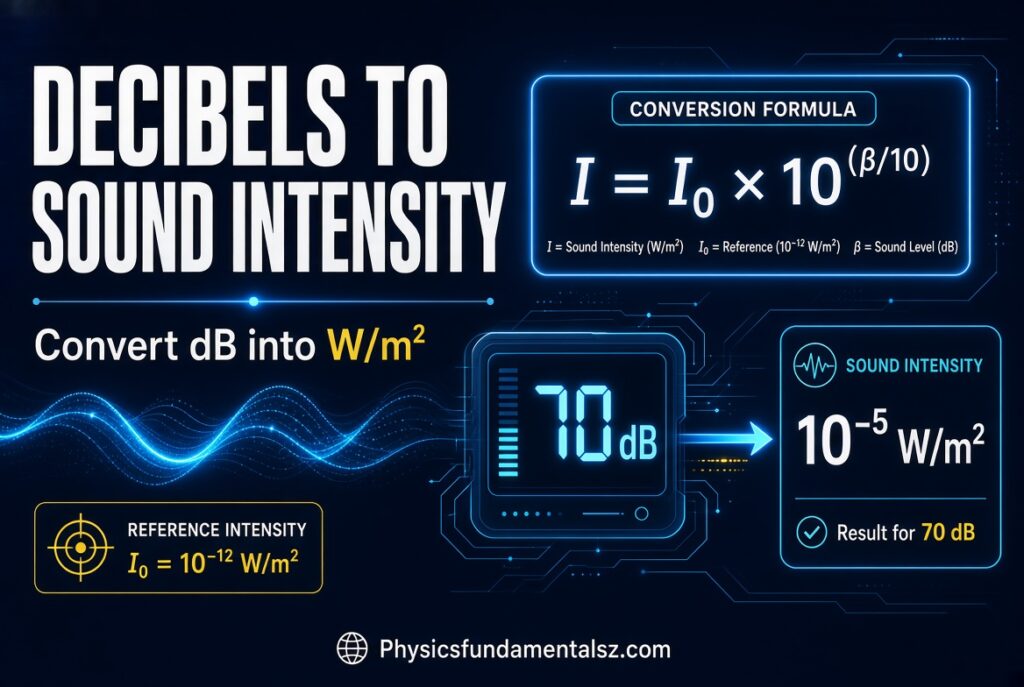
Sometimes you measure the level with a sound level meter and need the intensity. This is common in acoustic design and in physics homework.
The method mirrors the forward calculation. You divide the level by 10, raise 10 to that power, and multiply by the reference intensity.
Step-by-Step Method
Use I = 1 × 10⁻¹² × 10^(β / 10). Divide β by 10 first. Then use the 10^x key on your calculator. Finally, multiply the result by 10⁻¹².
Check the answer with the quick rule. Each 10 dB corresponds to a factor of 10 in intensity.
Example 6: Intensity at 75 dB
Divide 75 by 10 to get 7.5. Compute 10^7.5, which is about 3.162 × 10⁷. Multiply by 10⁻¹² to get 3.16 × 10⁻⁵ W/m².
Example 7: Intensity at 95 dB
Divide 95 by 10 to get 9.5. Compute 10^9.5, which is about 3.162 × 10⁹. Multiply by 10⁻¹² to get 3.16 × 10⁻³ W/m².
Notice that 95 dB is 10 dB above 85 dB and 20 dB above 75 dB. The intensity grows by 10 and 100 times respectively.
Example 8: Intensity at 0 dB and 130 dB
At 0 dB, 10⁰ = 1, so I = 10⁻¹² W/m². At 130 dB, 10¹³ × 10⁻¹² = 10 W/m².
These two values mark the extremes of the typical hearing range.
Decibel Levels and Sound Intensity Reference Table
This table shows common sounds along with their approximate decibel levels and intensities. Real-world values vary with distance and conditions, so treat them as typical figures.
| Sound level (dB) | Intensity (W/m²) | Typical example |
|---|---|---|
| 0 | 1 × 10⁻¹² | Threshold of hearing |
| 10 | 1 × 10⁻¹¹ | Rustling leaves |
| 20 | 1 × 10⁻¹⁰ | Quiet recording studio |
| 30 | 1 × 10⁻⁹ | Whisper |
| 40 | 1 × 10⁻⁸ | Quiet residential area |
| 50 | 1 × 10⁻⁷ | Light rain, quiet office |
| 60 | 1 × 10⁻⁶ | Normal conversation |
| 70 | 1 × 10⁻⁵ | Vacuum cleaner |
| 80 | 1 × 10⁻⁴ | Busy traffic |
| 90 | 1 × 10⁻³ | Lawn mower |
| 100 | 1 × 10⁻² | Subway train |
| 110 | 1 × 10⁻¹ | Rock concert |
| 120 | 1 | Threshold of pain |
| 130 | 10 | Jackhammer at close range |
| 140 | 100 | Jet engine at close range |
Notice how every row multiplies the intensity by exactly 10. The decibel column rises in equal steps, while the intensity column climbs by powers of ten.
How to Read the Table
Find the decibel value you need and read across to get the intensity. For values between rows, use the formula. For example, 65 dB lies halfway between 60 and 70 dB on the decibel scale, but its intensity is 10^6.5 × 10⁻¹², which is about 3.16 × 10⁻⁶ W/m².
The midpoint on the decibel scale is therefore not the midpoint in intensity. This is a direct consequence of the logarithm.
How to Calculate the Change in Decibels Between Two Sound Intensities
You do not always need an absolute level. Often you only want to know how much louder one sound is than another. In that case, the reference intensity cancels out.
The formula is Δβ = β₂ − β₁ = 10 × log₁₀(I₂ / I₁). You only need the ratio of the two intensities.
Why the Reference Intensity Cancels
Write both levels using the standard formula. Subtract them, and the I₀ terms disappear because log(I₂/I₀) − log(I₁/I₀) equals log(I₂/I₁).
This is helpful in field work. You can compare two measurements without worrying about the exact reference value.
Example 9: Intensity Increases 50 Times
A factory adds machinery, and the intensity at a workstation rises from I to 50 I. The change is 10 × log₁₀(50) = 10 × 1.699 = 17.0 dB.
If the original level was 70 dB, the new level is 87.0 dB.
Example 10: Intensity Falls to One Quarter
After installing sound-absorbing panels, the intensity drops to 0.25 of its former value. The change is 10 × log₁₀(0.25) = 10 × (−0.602) = −6.0 dB.
A negative change means the sound is quieter.
Decibel Rules of Thumb Every Student Should Know
A few memorized relationships let you estimate answers without a calculator. They also help you catch mistakes in longer calculations.
| Intensity ratio | Change in level |
|---|---|
| 1× (no change) | 0 dB |
| 2× | +3.01 dB (about +3 dB) |
| 4× | +6.02 dB (about +6 dB) |
| 5× | +6.99 dB (about +7 dB) |
| 10× | +10 dB |
| 100× | +20 dB |
| 1,000× | +30 dB |
| 1,000,000× | +60 dB |
| 0.5× | −3.01 dB |
| 0.1× | −10 dB |
The 3 dB Rule
Doubling the intensity adds about 3 dB. This is because 10 × log₁₀(2) equals 3.01. Halving it subtracts about 3 dB.
Two identical machines running together produce a level 3 dB higher than one machine alone.
The 10 dB Rule
Multiplying the intensity by 10 always adds exactly 10 dB. Dividing by 10 subtracts exactly 10 dB.
This rule is the backbone of mental estimates. A level of 90 dB carries 10 times the intensity of 80 dB and 100 times the intensity of 70 dB.
Combining Rules to Estimate Quickly
You can build any ratio from 2 and 10. For example, 20 times is 2 × 10, so the change is 3 + 10 = 13 dB. For 400 times, use 4 × 100, which gives 6 + 20 = 26 dB.
These shortcuts are accurate to within a fraction of a decibel, which is enough for most estimates.
Decibel Level and Loudness: What Do the Numbers Mean to Your Ears?
Decibels measure physical intensity, not the sensation of loudness. The two are related but not identical. Perceived loudness depends on frequency, duration, and the listener.
A widely used rule of thumb says that a 10 dB increase sounds about twice as loud to most people. This is an approximation, not a law of physics.
Why 3 dB Is Barely Noticeable
A 3 dB change doubles the intensity, yet most listeners can only just notice it. A change of 1 dB is usually below the threshold of noticeable difference for ordinary sounds.
This shows how compressive the ear is. Large physical changes produce modest sensory changes.
Loudness Units: Phons and Sones
Phons and sones are separate units that account for how the ear responds to different frequencies. A phon scale matches decibel values at 1,000 Hz and adjusts for other frequencies.
For basic intensity-to-decibel calculations, you do not need them. They matter when you evaluate loudness for human perception rather than physical energy.
How Distance Changes Sound Intensity and Decibel Level
Sound spreads out as it travels. For a small source in open air, the energy spreads over the surface of a sphere. Intensity therefore drops with the square of the distance.
This relationship is known as the inverse square law. It is crucial when you predict levels at a distance.
The Inverse Square Law Formula
For a point source radiating power P equally in all directions, the intensity at distance r is I = P / (4π r²). The denominator is the surface area of a sphere with radius r.
If you know the source power and the distance, you can compute intensity directly, then convert to decibels.
The Distance Ratio Formula
To compare two distances, use I₂ / I₁ = (r₁ / r₂)². Putting this into the decibel formula gives Δβ = 20 × log₁₀(r₁ / r₂).
Notice the factor of 20. It appears here because intensity depends on the square of distance, which pulls a factor of 2 out of the logarithm.
The 6 dB Rule for Doubling Distance
When you double the distance from a point source in free field, the intensity falls to one quarter. That is a drop of 6.02 dB.
Tripling the distance lowers the level by about 9.5 dB. Moving ten times farther lowers it by 20 dB.
Example 11: Intensity from a 0.5 W Source at 2 m
A small speaker radiates 0.5 W of acoustic power equally in all directions. Find the intensity and level at 2 m.
The intensity is I = 0.5 / (4π × 2²) = 0.5 / 50.27 = 9.95 × 10⁻³ W/m². The ratio to I₀ is 9.95 × 10⁹. The logarithm is about 9.998, so the level is roughly 100.0 dB.
Example 12: The Same Source at 4 m
Doubling the distance to 4 m divides the intensity by 4, giving 2.49 × 10⁻³ W/m². The level drops by 6.02 dB to about 94.0 dB.
You can confirm this directly. The ratio is 2.49 × 10⁹, and 10 × log₁₀ of that is about 93.96 dB.
Example 13: Finding the Distance for a Target Level
Suppose a source produces 100 dB at 2 m, and you want to know where it falls to 80 dB. The drop is 20 dB, which corresponds to a tenfold increase in distance.
The answer is 20 m, assuming free-field conditions with no reflections or absorption.
Limits of the Inverse Square Law
The law assumes a point source, open space, and no obstacles. Real environments rarely meet these conditions.
Indoors, walls and ceilings reflect sound and keep levels higher than the law predicts. Outdoors, air absorption, wind, temperature gradients, and ground effects change the result at longer distances.
Line Sources and Plane Waves
Not every source spreads spherically. A long line of traffic behaves like a line source, and the sound spreads cylindrically. In that case the level falls about 3 dB per doubling of distance.
A plane wave in a duct barely loses intensity with distance at all. Always check the geometry before applying a rule.
The Relationship Between Sound Intensity Level and Sound Pressure Level
Sound level meters do not measure intensity directly. Most of them measure sound pressure and report a sound pressure level (SPL). Understanding how SPL relates to intensity lets you move between the two.
The SPL formula is L_p = 20 × log₁₀(p / p₀), where p is the root-mean-square pressure and p₀ = 20 µPa is the reference pressure.
How Intensity and Pressure Are Connected
For a plane progressive wave, intensity and pressure are linked by I = p² / (ρ × c). Here, ρ is the density of the medium and c is the speed of sound in it.
The product ρc is called the characteristic acoustic impedance. For air at about 20 °C, it is roughly 413 Pa·s/m.
Why SIL and SPL Are Nearly Equal in Air
The reference values were chosen so that p₀² / I₀ = (20 × 10⁻⁶)² / 10⁻¹² = 400. That is very close to the impedance of air under typical conditions.
As a result, the intensity level and the sound pressure level in air differ by less than 0.2 dB in most real situations. For everyday work, they are treated as equal.
Example 14: Level from Sound Pressure
A microphone records an RMS pressure of 2 Pa. The SPL is 20 × log₁₀(2 / 0.00002) = 20 × log₁₀(100,000) = 20 × 5 = 100 dB.
An intensity calculation gives nearly the same result. I = 4 / 413 ≈ 9.7 × 10⁻³ W/m², which corresponds to about 99.9 dB.
Sound Intensity Level vs. Sound Pressure Level vs. Sound Power Level
| Term | Formula | Reference value |
|---|---|---|
| Sound intensity level (L_I) | 10 log₁₀(I / I₀) | 10⁻¹² W/m² |
| Sound pressure level (L_p) | 20 log₁₀(p / p₀) | 20 µPa in air |
| Sound power level (L_W) | 10 log₁₀(W / W₀) | 10⁻¹² W |
Sound power level describes the source itself. It does not change with distance, which makes it useful when comparing machines, appliances, and fans.
How to Add Decibel Levels from Multiple Sound Sources
Decibels are logarithmic, so you cannot add them like ordinary numbers. Two 60 dB sources do not make 120 dB. They make about 63 dB.
The correct approach is to convert each level to intensity, add the intensities, and convert the total back to decibels.
The Formula for Adding Decibels
L_total = 10 × log₁₀(10^(L₁/10) + 10^(L₂/10) + … + 10^(Lₙ/10))
Each term inside the brackets is proportional to the intensity of one source. The sum is proportional to the total intensity.
Example 15: Two Equal Sources
Two machines each produce 70 dB. Each contributes 10⁷ in relative intensity, so the sum is 2 × 10⁷. The level is 10 × log₁₀(2 × 10⁷) = 10 × 7.301 = 73.0 dB.
Whenever two equal sources combine, add 3 dB.
Example 16: Two Different Sources
A pump produces 80 dB and a fan produces 75 dB at the same position. Relative intensities are 10⁸ and 10^7.5, which equals 1 × 10⁸ and 3.16 × 10⁷.
The sum is 1.316 × 10⁸. The level is 10 × log₁₀(1.316 × 10⁸) = 81.2 dB.
The quieter source adds only 1.2 dB. This shows why the loudest source dominates the total.
Example 17: Three Sources
Three machines produce 85 dB, 88 dB, and 90 dB. Convert each: 3.16 × 10⁸, 6.31 × 10⁸, and 1.00 × 10⁹.
The sum is 1.947 × 10⁹. The combined level is 10 × log₁₀(1.947 × 10⁹) = 92.9 dB.
Shortcut Table for Adding Two Levels
When the two levels differ by a known amount, add the following correction to the higher level.
| Difference between the two levels | Add to the higher level |
|---|---|
| 0 dB | 3.0 dB |
| 1 dB | 2.5 dB |
| 2 dB | 2.1 dB |
| 3 dB | 1.8 dB |
| 4 dB | 1.5 dB |
| 5 dB | 1.2 dB |
| 6 dB | 1.0 dB |
| 8 dB | 0.6 dB |
| 10 dB | 0.4 dB |
| 15 dB | 0.1 dB |
If the difference is 10 dB or more, the quieter source barely changes the total. This is a useful fact in noise control. Reducing a minor source rarely helps when one source dominates.
How to Subtract Decibel Levels and Remove Background Noise
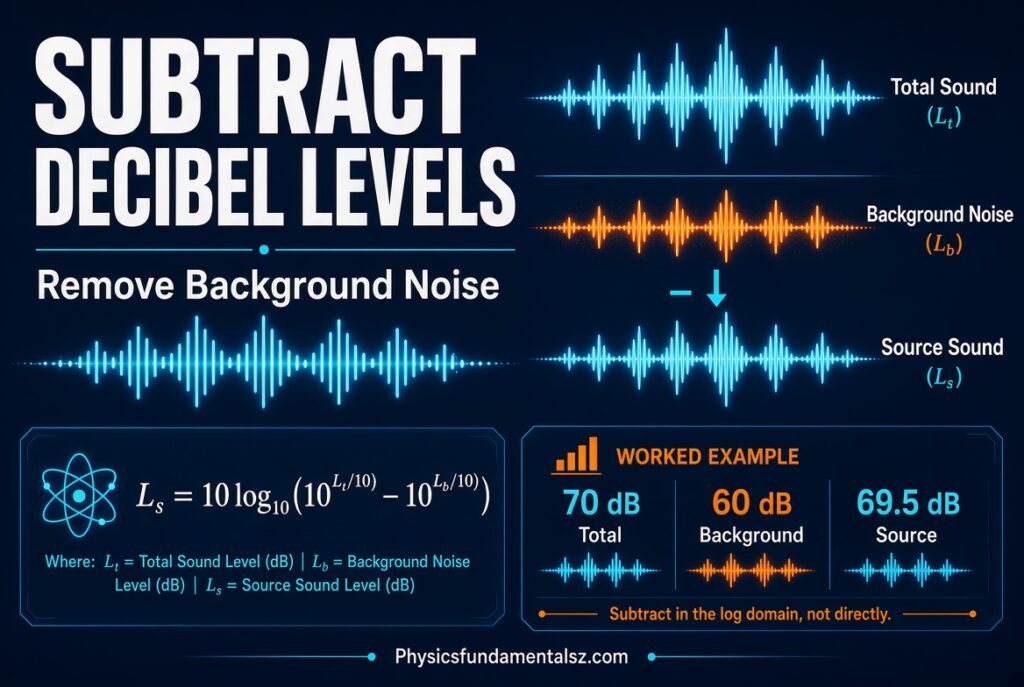
Sometimes you measure a total level and need to remove the background noise to find the contribution of a single source. The method mirrors addition.
Convert both levels to relative intensities, subtract the background from the total, and convert back to decibels.
The Formula for Subtracting Decibels
L_source = 10 × log₁₀(10^(L_total/10) − 10^(L_background/10))
This works only if the total is larger than the background. If they are nearly equal, the result is unreliable.
Example 18: Correcting for Background Noise
A machine running in a room gives a total reading of 90 dB. With the machine off, the background is 85 dB.
The relative intensities are 10⁹ and 3.16 × 10⁸. The difference is 6.84 × 10⁸, and the level is 88.4 dB. The machine alone produces about 88.4 dB.
When Background Correction Is Not Valid
Standards generally recommend that the source level exceeds the background by at least 3 dB for a correction to be used, and many methods prefer 10 dB. A smaller gap means the measurement is dominated by background noise.
Average Sound Levels: Equivalent Continuous Level (L_eq)
When sound varies over time, a simple arithmetic average of decibel values gives the wrong answer. Acoustics uses the equivalent continuous sound level, L_eq, which averages the intensity and then converts to decibels.
The formula is L_eq = 10 × log₁₀((1/n) × Σ 10^(Lᵢ/10)) for equal time intervals.
Example 19: Two Exposure Periods
A worker spends 4 hours at 80 dB and 4 hours at 90 dB. The relative intensities are 10⁸ and 10⁹. Their average is 5.5 × 10⁸.
The L_eq is 10 × log₁₀(5.5 × 10⁸) = 87.4 dB. The simple average of 85 dB underestimates the true exposure.
Why Loud Events Dominate the Average
Because the scale is logarithmic, brief intense sounds carry a large share of the energy. A few minutes of very loud noise can outweigh hours of quiet.
This is why occupational standards focus on peaks and on time-weighted averages rather than on simple means.
Sound Power Level: Calculating Decibels from Source Power
Sound power level describes how much acoustic power a source emits. It is useful because it does not depend on where you stand.
The formula is L_W = 10 × log₁₀(W / W₀), where W is the acoustic power in watts and W₀ = 10⁻¹² W.
Example 20: Power Level of a Machine
A small machine emits 0.01 W of acoustic power. The ratio is 10¹⁰, so the sound power level is 100 dB re 10⁻¹² W.
Converting Power Level to Intensity Level at a Distance
For a point source in free field, the intensity level at distance r is approximately L_I = L_W − 10 × log₁₀(4π r²). For r in meters, this is L_I = L_W − 20 × log₁₀(r) − 10.99.
At 1 meter, the level is about 11 dB lower than the power level. At 10 meters, it is about 31 dB lower.
Example 21: Level at 10 m for a 100 dB Power Source
Use L_I = 100 − 20 × log₁₀(10) − 10.99. That gives 100 − 20 − 10.99, which is 69.0 dB.
This matches a direct calculation: I = 0.01 / (4π × 100) = 7.96 × 10⁻⁶ W/m², which gives about 69.0 dB.
How to Calculate Decibel Levels from Sound Intensity Using a Scientific Calculator
Most scientific calculators handle this calculation in a few key presses. The exact sequence depends on the model, but the logic is the same.
Always check that you are using the base-10 logarithm key, labeled log. The natural logarithm key, labeled ln, gives the wrong answer.
Intensity to Decibels
Enter the intensity divided by 1E-12. Press log. Multiply the result by 10. For I = 4.5 × 10⁻⁷ W/m², the ratio is 4.5 × 10⁵, the logarithm is 5.653, and the level is 56.5 dB.
Many calculators accept scientific notation with an EXP or EE key. Use it instead of typing long strings of zeros.
Decibels to Intensity
Divide the decibel value by 10. Press 10^x. Multiply by 1E-12. For 63 dB, 10^6.3 is about 1.995 × 10⁶, so the intensity is 2.0 × 10⁻⁶ W/m².
Common Calculator Pitfalls
Parentheses matter. Type 10 × log(I ÷ 1E-12), not 10 × log(I) ÷ 1E-12. Missing brackets are the number one cause of wrong answers on tests.
Also check that your calculator is not in a mode that displays results as fractions or engineering notation, which can hide the digits you need.
How to Calculate Decibels from Sound Intensity in Excel and Google Sheets
Spreadsheets are ideal for converting long lists of measurements. A single formula can process hundreds of rows at once.
Put the intensity values in column A, starting in cell A2. The reference intensity can be typed directly into the formula.
Excel Formula for Intensity to Decibels
Use =10*LOG10(A2/1E-12) and drag the formula down the column. Excel and Google Sheets both accept this syntax.
If you prefer to store the reference in a cell, put 1E-12 in cell D1 and use =10*LOG10(A2/$D$1).
Excel Formula for Decibels to Intensity
Use =1E-12*10^(A2/10). The caret symbol raises 10 to the power of the decibel value divided by 10.
Excel Formula for Adding Decibels
To add levels in cells A2 to A4, use =10*LOG10(SUMPRODUCT(10^(A2:A4/10))). This converts each level to intensity, sums them, and converts back.
Never use =SUM(A2:A4) for decibel values. That formula gives a meaningless result.
Excel Formula for Distance Change
To find the new level at distance r₂ when you know the level at r₁, use =A2-20*LOG10(r2/r1). Replace r1 and r2 with cell references.
How to Calculate Decibels from Sound Intensity in Python
Python is convenient for engineering scripts and data analysis. The math module provides the base-10 logarithm.
Basic Conversion Functions
import math

I0 = 1e-12  # reference intensity in W/m^2

def intensity_to_db(I):
    return 10 * math.log10(I / I0)

def db_to_intensity(db):
    return I0 * 10 ** (db / 10)

print(intensity_to_db(3.0e-6))   # 64.77
print(db_to_intensity(75))       # 3.16e-05
Adding Multiple Levels
def add_levels(levels):
    total = sum(10 ** (L / 10) for L in levels)
    return 10 * math.log10(total)

print(add_levels([85, 88, 90]))  # 92.89
Level at a Distance from a Point Source
def level_at_distance(power_watts, r):
    I = power_watts / (4 * math.pi * r ** 2)
    return intensity_to_db(I)

print(level_at_distance(0.5, 2))  # about 99.98
Always test your functions with known cases, such as 10⁻⁶ W/m² giving exactly 60 dB.
Common Mistakes When Calculating Decibel Levels from Sound Intensity
Most errors fall into a handful of categories. Knowing them in advance saves time and points.
Mistake 1: Using the Wrong Multiplier
Using 20 × log with intensity doubles the answer. Remember that 10 is for intensity and power, while 20 is for pressure and voltage.
Mistake 2: Forgetting the Reference Intensity
Taking 10 × log₁₀(I) without dividing by I₀ gives a meaningless value. For I = 10⁻⁶, that error gives −60 dB instead of 60 dB.
Mistake 3: Using the Natural Logarithm
The key labeled ln calculates base e. Using it multiplies the result by about 0.434. Always use the log key for base 10.
Mistake 4: Adding Decibels Arithmetically
Two 80 dB sounds do not equal 160 dB. They equal about 83 dB. Convert to intensity, add, and convert back.
Mistake 5: Mixing Up Units
Intensity must be in W/m². If you start with W/cm², multiply by 10,000. If you start with mW/m², divide by 1,000.
Mistake 6: Confusing Sound Power and Sound Intensity
Power is a property of the source. Intensity depends on position. Dividing power by area is what links them.
Mistake 7: Ignoring Distance Effects
A level quoted at 1 meter is not the level at 10 meters. Always check the distance at which a rating applies.
Mistake 8: Rounding Too Early
Round only at the end. Rounding the logarithm to one digit before multiplying by 10 can shift the final answer by several tenths of a decibel.
Weighted Decibels: dBA, dBC, and Why They Differ from Intensity Level
The intensity level formula treats every frequency equally. Human ears do not. We hear mid-range frequencies better than very low or very high ones.
Weighting filters adjust the measurement to reflect this. They are applied to sound pressure measurements, not to the raw intensity formula.
A-Weighting (dBA)
A-weighting reduces the contribution of low and very high frequencies. It approximates how the ear responds to moderate sound levels. Environmental and workplace noise limits are usually given in dBA.
C-Weighting (dBC)
C-weighting is flatter and keeps more low-frequency content. It is used for loud sounds and for measuring peak levels.
Z-Weighting
Z-weighting means zero weighting. It reports the level without frequency adjustment and is close to the basic physical intensity level.
When to Use Each
Use the plain formula for physics problems and acoustic design. Use dBA when you evaluate hearing risk or compare with legal noise limits.
Real-World Applications of Decibel Calculations from Sound Intensity
Decibel calculations appear well beyond the physics classroom. They guide decisions in health, engineering, and entertainment.
Hearing Protection and Occupational Safety
In the United States, the National Institute for Occupational Safety and Health (NIOSH) recommends a limit of 85 dBA for an 8-hour workday. It uses a 3 dB exchange rate, meaning every 3 dB increase halves the allowed time.
The Occupational Safety and Health Administration (OSHA) sets a permissible exposure limit of 90 dBA for 8 hours, with a 5 dB exchange rate. OSHA requires a hearing conservation program when exposure reaches 85 dBA.
Example 22: Allowed Exposure Time Under the NIOSH Rule
Starting at 85 dBA for 8 hours, each 3 dB increase halves the time. At 88 dBA, the limit is 4 hours. At 91 dBA, it is 2 hours. At 100 dBA, it is about 15 minutes.
The 3 dB exchange rate matches the physics, because 3 dB corresponds to a doubling of intensity and therefore a doubling of energy per unit time.
Audiology
Audiologists use decibel scales to describe hearing thresholds and hearing loss. Their audiograms use hearing level units that are referenced to average normal hearing at each frequency.
Architectural Acoustics
Designers calculate how walls, floors, and windows reduce sound. The transmission loss of a partition is the difference in decibels between the incident and transmitted intensities.
A wall with a transmission loss of 40 dB reduces the transmitted intensity by a factor of 10,000.
Audio Engineering and Music Production
Sound engineers use decibels to set mixing levels, calibrate speakers, and plan live-sound coverage. A large venue is often designed using the 6 dB loss per distance doubling to place speakers.
Environmental Noise Assessment
Planners estimate the noise from highways, airports, and construction sites using source power and distance calculations. They then compare results with community noise guidelines.
Consumer Devices and Safety
Headphones, hearing aids, and smartphone apps report decibel values to warn users about harmful volumes. Knowing the underlying formula helps you interpret those readings.
Safe Listening: How Sound Intensity Relates to Hearing Damage
Risk depends on both intensity and duration. A moderate sound over many hours can do as much harm as a very loud sound for a brief time.
Every 10 dB increase means 10 times the intensity, so the energy reaching the ear rises quickly with level.
Intensity at Common Risk Levels
| Level (dBA) | Intensity (W/m²) | Practical meaning |
|---|---|---|
| 70 | 1 × 10⁻⁵ | Generally considered safe for long periods |
| 85 | 3.2 × 10⁻⁴ | Start of risk for prolonged daily exposure |
| 100 | 1 × 10⁻² | Hearing damage possible within minutes |
| 110 | 1 × 10⁻¹ | Damage possible in a very short time |
| 120 | 1 | Pain threshold; immediate risk |
Practical Safety Tips
- Keep headphone volume at a level where you can still hear people speaking nearby.
- Use earplugs or earmuffs at concerts, in workshops, and around power tools.
- Take quiet breaks after loud exposure.
- Use a sound level meter or a calibrated app to check levels you are unsure about.
Measuring Sound Intensity in Practice
Calculating intensity from a formula is one task. Measuring it in a real room is another. The tools and limits are different.
Sound Level Meters
A sound level meter measures sound pressure with a microphone and reports a level in dB SPL, often with A- or C-weighting. Class 1 and Class 2 meters follow the IEC 61672 standard for accuracy.
Sound Intensity Probes
An intensity probe uses two closely spaced microphones to measure the flow of acoustic energy directly. It also shows the direction of the energy flow, which helps locate noise sources.
Calibration
A calibrator produces a known tone, often 94 dB at 1,000 Hz, which corresponds to a pressure of 1 Pa. Calibrating before and after a measurement session ensures reliable data.
Sources of Measurement Error
- Reflections from nearby walls or objects
- Background noise close to the signal level
- Wind noise on the microphone
- Incorrect weighting or time setting
- Distance errors when comparing sources
Practice Problems with Answers
Try these before looking at the solutions. They cover every skill discussed above.
Problem 1
A sound has an intensity of 2.0 × 10⁻⁵ W/m². What is its level in decibels?
Answer: The ratio is 2.0 × 10⁷. The logarithm is 7.301, so the level is 73.0 dB.
Problem 2
What intensity corresponds to 55 dB?
Answer: 10^5.5 = 3.162 × 10⁵. Multiply by 10⁻¹² to get 3.16 × 10⁻⁷ W/m².
Problem 3
By how many decibels does the level rise if the intensity increases 1,000 times?
Answer: 10 × log₁₀(1,000) = 30 dB.
Problem 4
A sound level is 68 dB at 3 m from a point source. What is the level at 12 m?
Answer: The distance ratio is 4. The change is 20 × log₁₀(4) = 12.04 dB. The new level is 55.96 dB, or about 56.0 dB.
Problem 5
Two sources produce 78 dB and 78 dB. What is the combined level?
Answer: Equal sources add 3.01 dB, so the total is 81.0 dB.
Problem 6
A speaker emits 2 W of acoustic power. What is the level at 5 m in free field?
Answer: I = 2 / (4π × 25) = 6.37 × 10⁻³ W/m². The ratio is 6.37 × 10⁹, and the logarithm is 9.804. The level is 98.0 dB.
Problem 7
The total noise in a room is 82 dB, and the background is 76 dB. What is the level of the source alone?
Answer: 10^8.2 = 1.585 × 10⁸ and 10^7.6 = 3.981 × 10⁷. The difference is 1.187 × 10⁸. The level is 80.7 dB.
Problem 8
A noise lasts 2 hours at 95 dB and 6 hours at 75 dB. Find the 8-hour L_eq.
Answer: Weighted intensity is (2 × 10^9.5 + 6 × 10^7.5) / 8. That equals (6.325 × 10⁹ + 1.897 × 10⁸) / 8 = 8.14 × 10⁸. The L_eq is 89.1 dB.
Problem 9
A wall reduces intensity to 0.0001 of the incident value. What is its transmission loss?
Answer: TL = 10 × log₁₀(1 / 0.0001) = 40 dB.
Problem 10
A sound at 100 dB falls to 70 dB after passing through a barrier. By what factor did the intensity drop?
Answer: The drop is 30 dB, which is a factor of 1,000.
Why Decibel Calculations Matter for Students and Professionals
The ability to move between intensity and decibels is a foundation skill. It appears in high school physics, college acoustics, engineering design, and public health.
Mastering it also strengthens your understanding of logarithms, exponents, and scientific notation, which are used throughout science.
Connections to Other Logarithmic Scales
The decibel is one of several logarithmic scales. The pH scale for acidity and the Richter scale for earthquakes follow similar ideas. Each compresses a large range into a manageable set of numbers.
Building Intuition with Reference Points
Memorize a few anchor points. 0 dB is the threshold of hearing, 60 dB is conversation, 85 dB is the start of risk, and 120 dB is the threshold of pain. Every other value can be placed around these.
Decibels in Other Fields: Power Ratios and Voltage Ratios
The decibel is used in electronics, telecommunications, and audio engineering as well as in acoustics. The same logic applies, but you must choose the right multiplier.
Seeing these parallels helps you remember why the intensity formula uses 10 and the pressure formula uses 20.
Power Ratio Formula
For electrical or acoustic power, use dB = 10 × log₁₀(P₂ / P₁). Sound intensity is power per unit area, so it follows the same rule.
Voltage and Pressure Ratio Formula
For voltage, current, or sound pressure, use dB = 20 × log₁₀(V₂ / V₁). Power in a resistor is proportional to voltage squared, and intensity is proportional to pressure squared.
Squaring a quantity inside a logarithm doubles the multiplier, which explains the factor of 20.
Quick Comparison
| Quantity type | Examples | Multiplier | Doubling gives |
|---|---|---|---|
| Power-like | Intensity, acoustic power, electrical power | 10 | +3 dB |
| Field-like | Sound pressure, voltage, current | 20 | +6 dB |
Sound Intensity in Water and Other Media
Sound travels in liquids and solids as well as in air. The intensity formula is the same, but the reference values and impedances differ.
Underwater acoustics normally uses a reference pressure of 1 µPa instead of 20 µPa. As a result, a decibel value in water cannot be compared directly with one in air.
Why Water Levels Look Higher
The difference in reference pressure alone adds about 26 dB to the number. The different impedance of water changes the relation between pressure and intensity further.
Always check the stated reference before comparing two decibel figures from different media.
Characteristic Impedance Values
| Medium | Approximate characteristic impedance (Pa·s/m) |
|---|---|
| Air at 20 °C | About 413 |
| Fresh water | About 1.48 × 10⁶ |
| Steel | About 4.7 × 10⁷ |
A higher impedance means that, for the same intensity, the pressure in the medium is greater.
Why the Decibel Formula Works: The Logic Behind the Logarithm
The formula is not arbitrary. It comes from the way human senses respond to physical stimuli and from the way logarithms turn multiplication into addition.
Understanding this logic makes the rules of thumb feel natural instead of memorized.
The Weber–Fechner Idea
Nineteenth-century researchers found that the smallest noticeable change in a stimulus is roughly a fixed percentage of its current size. A small change is easy to notice in a quiet room but impossible to notice next to a jackhammer.
Equal ratios of intensity therefore feel like equal steps in sensation. A logarithmic scale turns equal ratios into equal steps, which is exactly what the decibel does.
Multiplication Becomes Addition
A key property of logarithms is that log(a × b) = log(a) + log(b). If a sound becomes 10 times stronger and then 10 times stronger again, the intensity grows 100 times, but the level simply rises by 10 dB twice.
This property explains why gains and losses in a chain of components can be added in decibels. A wall that cuts 20 dB followed by a second wall that cuts 15 dB reduces the sound by 35 dB in total.
Why Base 10 Is Used
Base 10 matches our number system and scientific notation. The logarithm of 10⁻⁶ is simply −6, which makes mental calculation easy.
From Bels to Decibels in Three Lines
Define the level in bels as log₁₀(I / I₀). Multiply by 10 to get tenths of a bel, which are decibels. The result is 10 × log₁₀(I / I₀).
A Complete Multi-Step Example from Source Power to Safe Exposure Time
Real problems often chain several ideas together. This example combines power, distance, decibels, and exposure limits in one calculation.
The Problem
A piece of equipment radiates 0.2 W of acoustic power evenly in all directions in an open yard. A worker stands 1.5 m away. Find the level and estimate whether it breaks the NIOSH 85 dBA guideline for an 8-hour shift. Treat the level as dBA for this estimate.
Step 1: Find the Intensity
Use I = P / (4π r²). The area is 4π × 1.5² = 28.27 m². The intensity is 0.2 / 28.27 = 7.07 × 10⁻³ W/m².
Step 2: Convert to Decibels
The ratio to the reference is 7.07 × 10⁹. The logarithm is 9.849. Multiplying by 10 gives 98.5 dB.
Step 3: Compare with the Guideline
The level exceeds 85 dBA by 13.5 dB. Using the 3 dB exchange rate, that is 4.5 halvings of the 8-hour allowance, so the permitted time is about 8 / 2^4.5, which is roughly 21 minutes.
Step 4: Find the Distance for a Safe Level
To reach 85 dB, the level must fall by 13.5 dB. The required distance ratio is 10^(13.5 / 20) = 4.73. The worker must stand about 1.5 × 4.73 = 7.1 m away, in ideal free-field conditions.
In practice, a worker would use hearing protection or the source would be enclosed, because real yards include reflections and other noise.
Frequently Misunderstood Ideas About Decibels
A few myths cause repeated confusion. Clearing them up improves both accuracy and understanding.
Myth: Decibels Are an Absolute Unit
Decibels express a ratio. Without a reference, a number such as 60 dB has no definite physical meaning.
Myth: 0 dB Means Silence
0 dB means the sound is at the reference intensity. Truly silent conditions do not exist in normal environments, and levels below 0 dB are measurable in specialized chambers.
Myth: Twice the Decibels Means Twice as Loud
A level of 80 dB is not twice as loud as 40 dB. It is 10,000 times more intense and, by the common rule of thumb, about 16 times as loud.
Myth: Decibel Readings Can Be Averaged Directly
Averaging decibel values gives an answer that is too low whenever the sound level varies. The correct method averages intensities first.
Myth: A Quiet Source Can Be Ignored Completely
Quiet sources matter when they are close to the level of the main source. When two levels are within a few decibels, both contribute noticeably to the total.
Step-by-Step Summary: Which Formula Should You Use?
Use this decision guide to choose the right calculation quickly.
| Situation | Formula to use |
|---|---|
| You know intensity and need the level | β = 10 log₁₀(I / 10⁻¹²) |
| You know the level and need intensity | I = 10⁻¹² × 10^(β/10) |
| You know two intensities and need the difference | Δβ = 10 log₁₀(I₂ / I₁) |
| You know source power and distance | I = P / (4π r²), then convert |
| Distance changes from r₁ to r₂ | Δβ = −20 log₁₀(r₂ / r₁) |
| You need to add several levels | 10 log₁₀(Σ 10^(Lᵢ/10)) |
| You need to remove background noise | 10 log₁₀(10^(L_t/10) − 10^(L_b/10)) |
| You know sound pressure | L_p = 20 log₁₀(p / 20 µPa) |
| You have levels that vary over time | L_eq = 10 log₁₀(mean of 10^(Lᵢ/10)) |
Tips for Getting Decibel Calculations Right Every Time
Small habits make a large difference. They help during exams and in professional work.
Sanity-Check Every Answer
Compare your result with the reference table. A normal conversation should come out near 60 dB, and a jet engine near 130 dB. A result of 600 dB or −40 dB for an ordinary sound signals an error.
Write Units at Every Step
Carry W/m² through the calculation. This catches unit mix-ups before they spread.
Use Scientific Notation
Writing intensities as numbers times powers of ten makes the logarithm easy to split. The exponent gives you the integer part, and the coefficient gives you the decimal part.
Keep Extra Digits Until the End
Hold at least four significant figures in intermediate steps. Round only the final level.
Estimate First, Then Calculate
Use the 3 dB and 10 dB rules to predict the answer. If the calculator disagrees by a large amount, recheck your entries.
Frequently Asked Questions (FAQs)
How do you calculate decibel levels from sound intensity?
Divide the sound intensity by 1 × 10⁻¹² W/m², take the base-10 logarithm of the result, and multiply by 10. The formula is β = 10 log₁₀(I / I₀).
What is the formula for sound intensity level?
The formula is β = 10 × log₁₀(I / I₀). Here, I is the intensity in W/m² and I₀ is 1 × 10⁻¹² W/m².
What is the reference intensity for decibels?
The standard reference intensity is 1 × 10⁻¹² W/m². It approximates the quietest sound that a healthy young person can hear at 1,000 Hz.
How do you convert decibels to sound intensity?
Use I = 1 × 10⁻¹² × 10^(dB / 10). For 60 dB, the intensity is 10⁻¹² × 10⁶ = 1 × 10⁻⁶ W/m².
How much does the decibel level increase when intensity doubles?
It increases by about 3 dB. The exact value is 10 × log₁₀(2), which equals 3.01 dB.
What happens to the decibel level when intensity increases tenfold?
The level rises by exactly 10 dB. A hundredfold increase adds 20 dB, and a thousandfold increase adds 30 dB.
Why do we use a logarithmic scale for sound?
The ear responds to sound roughly in proportion to the logarithm of intensity. A logarithmic scale also compresses a range of one trillion to one into numbers between 0 and about 140.
What is the difference between sound intensity and sound pressure level?
Intensity is power per unit area, measured in W/m². Sound pressure level compares the pressure variation with 20 µPa and uses a factor of 20 instead of 10. In air, the two levels are nearly equal.
Why is the multiplier 10 for intensity but 20 for pressure?
Intensity is proportional to the square of pressure. Taking the logarithm of a squared quantity brings down a factor of 2, which turns 10 into 20.
Can a decibel value be negative?
Yes. A negative value means the intensity is below the reference of 10⁻¹² W/m². For example, 10⁻¹³ W/m² corresponds to −10 dB.
What does 0 dB mean?
0 dB means the intensity equals the reference intensity. It is the approximate threshold of hearing at 1,000 Hz, not a state of silence.
How do you add two decibel levels?
Convert each level to intensity using 10^(L/10), add the results, and convert the sum back with 10 × log₁₀. Two equal levels combine to give 3 dB more than either one.
What is 60 dB plus 60 dB?
The combined level is about 63 dB. Adding two equal sound levels always raises the total by 3 dB.
How much does the sound level drop when you double the distance?
For a point source in free field, the level drops by about 6 dB. This follows from the inverse square law.
How do you find sound intensity from power and distance?
Use I = P / (4π r²) for a point source radiating in all directions. Then convert the intensity to decibels with the standard formula.
How loud is a sound with an intensity of 1 W/m²?
It has a level of 120 dB, which is near the threshold of pain. Short exposure at this level can damage hearing.
What is the intensity of a 90 dB sound?
The intensity is 1 × 10⁻³ W/m². You get this by using I = 10⁻¹² × 10^(90/10) = 10⁻¹² × 10⁹.
What is the difference between dB and dBA?
The dB value from the intensity formula treats all frequencies equally. The dBA value applies A-weighting, which reduces the contribution of very low and very high frequencies to match human hearing.
How do you calculate the difference in decibels between two intensities?
Use Δβ = 10 × log₁₀(I₂ / I₁). The reference intensity cancels, so only the ratio matters.
What is a safe decibel level for hearing?
NIOSH recommends keeping exposure below 85 dBA over an 8-hour day. Lower levels, around 70 dBA or less, are generally considered safe for long periods.
How many decibels is a normal conversation?
Normal conversation is about 60 dB, which corresponds to an intensity of about 1 × 10⁻⁶ W/m².
Can I calculate decibels from sound intensity in Excel?
Yes. Use =10LOG10(A2/1E-12), where A2 contains the intensity in W/m². The reverse conversion is =1E-1210^(A2/10).
What is the difference between sound power level and sound intensity level?
Sound power level describes the total acoustic power of a source and does not depend on distance. Sound intensity level describes the power passing through a unit area at a specific location and changes with distance.
Why can’t you average decibel values directly?
Decibels are logarithmic, so an arithmetic average underestimates the true energy. Average the intensities first, then convert the result back to decibels.
Does the decibel formula work in water?
The mathematical form is the same, but water uses a reference pressure of 1 µPa and has a different impedance. Decibel values in water and air are therefore not directly comparable.
Conclusion
Calculating decibel levels from sound intensity comes down to one idea and one formula. Compare the intensity with the reference value of 10⁻¹² W/m², take the base-10 logarithm, and multiply by 10.
From that single step you can answer many practical questions. You can convert decibels back to intensity, predict the effect of distance, combine several sources, and judge whether a sound is safe for your hearing.
Remember the anchor facts. A 10 dB rise means ten times the intensity, 3 dB means double, and 6 dB corresponds to doubling the distance in free field. Keep adding levels through intensity, never by simple arithmetic.
With a few practice problems and the reference tables above, these calculations become fast and reliable. Whether you study physics, design quiet spaces, or protect your hearing at work, the decibel formula is a tool you can use with confidence.