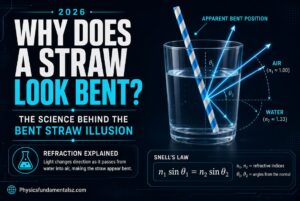
Real Life Examples of Total Internal Reflection: Everyday Life, Nature, Technology, and Medicine 2026
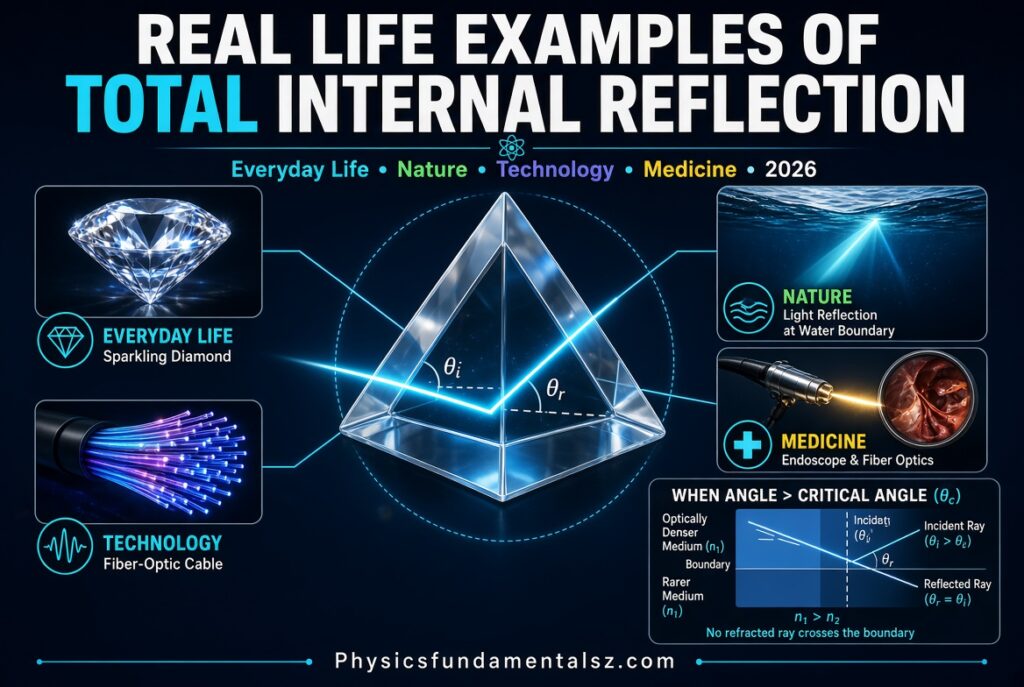
Real life examples of total internal reflection are all around you, from the sparkle of a diamond ring to the internet cable that delivers this page. Total internal reflection happens when light hits the boundary of a denser and a rarer material at a steep angle and bounces back completely instead of passing through.
You can see it when you look up at the surface of a pool from underwater and find a silvery mirror. You can see it in the bright glints on air bubbles, in a glowing stream of water lit by a laser, and in the bend-and-bounce of light inside a glass of water.
It also powers technology you may use daily. Fiber-optic cables, binoculars, car rain sensors, fingerprint scanners, and medical endoscopes all depend on it.
Table of Contents
What Are Real Life Examples of Total Internal Reflection?
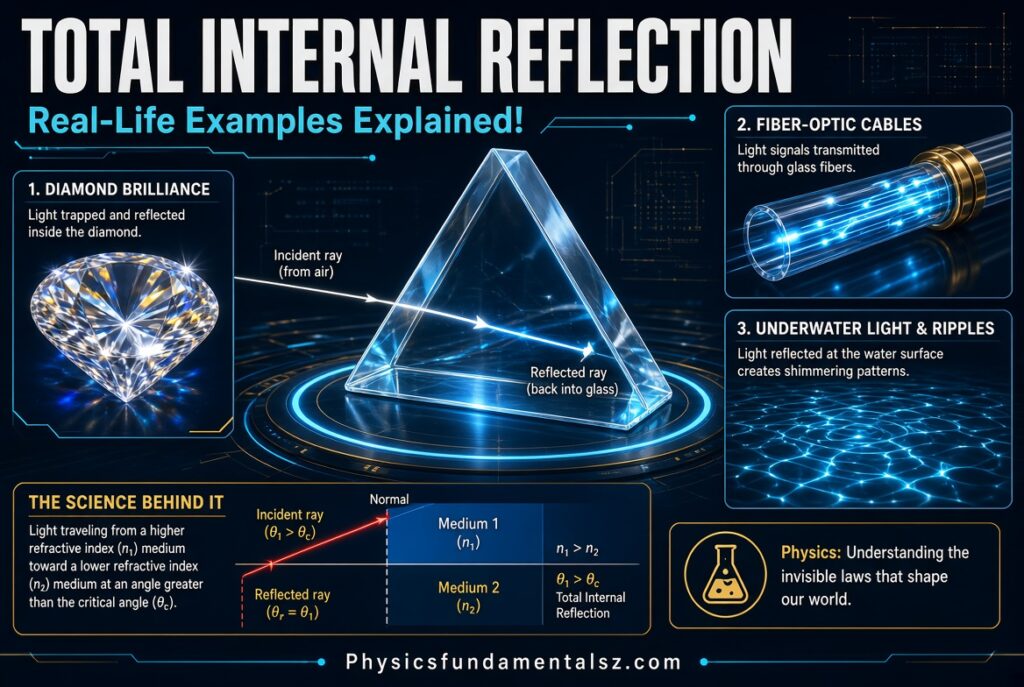
The most common real life examples of total internal reflection are optical fibers, diamonds, prisms in binoculars and periscopes, air bubbles and fish tanks viewed from certain angles, the mirror-like surface seen from underwater, and medical endoscopes.
| Example | Where You See It | Why TIR Happens |
|---|---|---|
| Optical fibers | Internet cables, endoscopes, decorative lamps | Light stays trapped in a high-index core |
| Diamonds | Jewelry | Very small critical angle (about 24°) |
| Prisms | Binoculars, periscopes, cameras | Light hits glass-air face at 45° |
| Underwater surface | Pools, lakes, aquariums | Water-to-air angle beyond about 49° |
| Air bubbles | Water, drinks, ice | Water-to-air boundary at steep angles |
| Laser in water stream | Science demos, lighted fountains | Light bounces along the water jet |
| Reflectors | Bicycles, road signs, vehicles | Corner-cube prisms send light back |
| Rain sensors | Car windshields | Water on glass disrupts TIR |
| Fingerprint scanners | Phones, door locks | Ridges disturb TIR |
Key Takeaways
- Total internal reflection needs light to travel from a denser medium to a rarer medium.
- The angle of incidence must be larger than the critical angle.
- No light is lost to refraction at the boundary, so reflection is nearly perfect.
- It is the working principle behind fiber optics, prisms, and many sensors.
- Some popular “examples,” such as rainbows, are not true total internal reflection.
What Is Total Internal Reflection?
Total internal reflection, often shortened to TIR, is the complete reflection of light back into a medium when it strikes the boundary with a less dense medium at a large enough angle. Nothing escapes through the boundary.
The word “internal” means the reflection happens inside the denser material. The word “total” means all of the light is reflected.
Simple Definition
Imagine shining a flashlight upward from underwater. At small angles, most of the light exits into the air. At a large enough angle, none of it exits, and the water surface acts like a perfect mirror.
That mirror-like behavior is total internal reflection.
Why It Happens: Light Bends Away From the Normal
When light goes from a denser medium (like water) into a rarer one (like air), it bends away from the normal line. As the angle of incidence grows, the bent ray moves closer and closer to the surface.
At one special angle, the bent ray runs exactly along the surface. Beyond that angle, there is no bent ray possible, so all the light must reflect.
Light Speed and Refractive Index
Light moves slower in glass and water than in air. The refractive index, n, tells you how much slower: n = c / v, where c is the speed of light in vacuum and v is the speed in the material.
A higher refractive index means a denser optical medium. Total internal reflection always starts from the side with the higher index.
Conditions Required for Total Internal Reflection
Total internal reflection needs two conditions at the same time. If either one is missing, some light will pass through.
Condition 1: Light Goes From a Denser to a Rarer Medium
The light must travel from a higher refractive index to a lower refractive index. Examples include glass to air, water to air, and diamond to air.
Light going from air into glass can never undergo total internal reflection.
Condition 2: The Angle of Incidence Exceeds the Critical Angle
The angle of incidence, measured from the normal, must be greater than the critical angle for that pair of materials. At exactly the critical angle, the refracted ray grazes the boundary.
Beyond the critical angle, the refracted ray disappears and the reflection is total.
Quick Condition Checklist
- Is the light moving toward a lower refractive index? If not, TIR is impossible.
- Is the angle of incidence larger than the critical angle? If not, TIR does not occur.
- Is the boundary clean and smooth? Dirt or water on it can spoil the effect.
Critical Angle Formula and How to Calculate It
The critical angle is the smallest angle of incidence in the denser medium that produces total internal reflection. It is found from Snell’s law.
Snell’s law states n₁ × sin θ₁ = n₂ × sin θ₂. At the critical angle, the refracted angle is 90°, so sin 90° = 1.
The Formula
The critical angle is given by sin θc = n₂ / n₁, where n₁ is the refractive index of the denser medium and n₂ is the refractive index of the rarer medium.
For a boundary with air (n ≈ 1.00), this simplifies to sin θc = 1 / n.
Critical Angles of Common Materials (Against Air)
| Material | Refractive Index (approx.) | Critical Angle (approx.) |
|---|---|---|
| Water | 1.33 | 48.8° |
| Acrylic (plexiglass) | 1.49 | 42.2° |
| Crown glass | 1.50 | 41.8° |
| Cubic zirconia | 2.15 | 27.7° |
| Diamond | 2.42 | 24.4° |
The higher the refractive index, the smaller the critical angle, and the easier it is to trap light.
Solved Example 1: Critical Angle of Glass
Find the critical angle for light going from glass (n = 1.5) to air.
sin θc = 1 / 1.5 = 0.6667. Taking the inverse sine gives θc ≈ 41.8°.
Any ray inside the glass that hits the glass-air surface at more than 41.8° is totally reflected.
Solved Example 2: Critical Angle of Water
Find the critical angle for water (n = 1.33) to air.
sin θc = 1 / 1.33 = 0.7519, so θc ≈ 48.8°.
This number explains the mirror-like surface you see from underwater, which is covered later.
Solved Example 3: Critical Angle of Diamond
Find the critical angle for diamond (n = 2.42) to air.
sin θc = 1 / 2.42 = 0.4132, so θc ≈ 24.4°.
This small angle is the reason diamonds can trap and recycle so much light.
Solved Example 4: Glass to Water
Find the critical angle for light going from glass (n = 1.5) to water (n = 1.33).
sin θc = 1.33 / 1.5 = 0.8867, so θc ≈ 62.5°.
Notice it is larger than the glass-to-air value, because water is closer in index to glass than air is.
Real Life Examples of Total Internal Reflection in Nature
Nature produces total internal reflection without any human design. Water, ice, and air boundaries do most of the work.
The Mirror-Like Surface Seen From Underwater
If you look up at the water surface from below, you see two different things. Straight up, you can see the sky through a circular window.
Outside that window, the surface looks like a silvery mirror reflecting the pool bottom or the underwater scene. This reflection is total internal reflection.
Snell’s Window Explained
Because light from the whole sky above is squeezed into a cone by refraction, an underwater observer sees the entire sky inside a circle. This circle is often called Snell’s window.
The cone’s half-angle equals the critical angle of water, about 48.8°. The full cone is about 97.5°.
Solved Example 5: Size of the Bright Circle From an Underwater Light
A small lamp sits 2.0 m below the surface of calm water. Find the radius of the circle on the surface through which light can escape.
Light escapes only if its angle of incidence is less than 48.8°. The radius is r = h × tan θc = 2.0 × tan 48.8° ≈ 2.0 × 1.14 ≈ 2.3 m.
Outside that circle, the light is totally reflected back into the water.
Why Fish Can See the Sky Only in a Circle
For the same reason, a fish looking upward sees the world above in a circle roughly 97° wide. Beyond the edge of the circle, the surface mirrors the underwater environment.
This is one reason underwater photographers often describe a bright circle with a dark ring around it when they shoot upward.
Air Bubbles in Water
Air bubbles under water shine like silver beads. Light traveling in the water hits the bubble’s surface at angles that are often greater than the critical angle.
Because air is optically rarer than water, much of the light is reflected back. That is why bubbles look bright and metallic.
Bubbles in Ice and Cracks in Ice
Clear ice contains tiny bubbles and cracks that look white and silvery. Light enters the ice and reflects off the air-ice boundaries, often by total internal reflection.
Many tiny reflecting surfaces together make ice look cloudy or white.
Dewdrops and Raindrops on Leaves
Droplets on a leaf catch and reflect light at many angles. Part of the sparkle you see comes from internal reflection inside the droplet.
Only some of this is true total internal reflection. Many rays are only partly reflected, which is why drops look like lenses and not perfect mirrors.
Animal Examples: Fish Scales and Shiny Skins
Some sources describe the shimmering look of certain fish as total internal reflection. In reality, most fish shine because of layered, mirror-like crystal structures in their skin, which reflect light by thin-film interference and reflection.
Total internal reflection can contribute to underwater glimmer, but fish skin is mostly a different optical effect.
Natural Light Pipes in Ice and Plants
Long, clear ice crystals and certain plant tissues can guide light along their length. Light that enters one end can travel a long distance because it keeps hitting the walls at steep angles.
Some researchers study this in plant stems and polar ice, though it is a specialist topic.
Is a Mirage an Example of Total Internal Reflection?
Many textbooks list a mirage as total internal reflection, but this needs a careful explanation. A mirage is better described as continuous refraction.
On a hot road, the air near the ground is hotter and less dense than the air above. Light from the sky bends gradually upward as it passes through layers of different refractive index.
What Actually Happens
The bending is gradual, not a single sudden boundary. The ray curves upward and reaches your eye, so you see an image of the sky on the road that looks like a pool of water.
Some simple explanations compare this to total internal reflection because the ray appears to bounce off the hot layer. The full physics is refraction through a smooth gradient of index.
How to Describe It in an Exam
If a question lists a mirage as an example of total internal reflection, you can write it as the answer expected by the textbook. In a careful explanation, add that the curved path is caused by refraction through layers of air with changing density.
That shows you know both the exam answer and the real physics.
Is a Rainbow Total Internal Reflection?
A rainbow is not a true example of total internal reflection, even though many websites list it. Inside a raindrop, light refracts, reflects once off the back surface, and refracts again as it leaves.
The reflection at the back of the drop happens at an angle of about 40°, which is less than the critical angle of 48.8° for water to air. So the reflection is partial, not total.
Why the Mistake Is Common
Rainbows involve internal reflection, and the word “internal” invites the confusion. The color separation comes from dispersion, which is refraction that depends on wavelength.
Light is not trapped by total internal reflection in a rainbow.
Real Life Examples of Total Internal Reflection in Everyday Life
You do not need a laboratory to see total internal reflection. Many household objects and common situations show it.
A Glass of Water Seen From Below
Hold a clear glass of water slightly above eye level and look at the water surface from below through the side. At a steep angle, the surface looks like a bright mirror.
Move your head and the mirror effect appears and disappears, because you are crossing the critical angle.
Drinking Glasses and Clear Bottles
Clear drinking glasses sometimes show bright, mirror-like streaks along their walls. Light trapped inside the glass bounces off the inner surfaces.
The effect is stronger in thick glass with smooth surfaces.
Windows and Wet Windshields
A wet window or windshield can look mirror-like at a grazing angle. Water, glass, and air create several boundaries, and light reflects between them.
This effect is a major idea behind the car rain sensors described later.
Water Streams and Laser Demonstrations
A thin stream of water can carry light along its curve. When a laser beam enters the stream at the source, the light bounces along the inside surface by total internal reflection.
This demo is popular in classrooms, and similar lighting effects appear in decorative fountains. The optics department at the University of Arizona uses a laser waterfall demo to explain the idea.
Safety Note for Laser Demonstrations
Never point a laser at a person or an animal, and never look into the beam. Use a low-power classroom laser pointer under adult supervision.
Acrylic Rods and Light Pipes
Clear acrylic rods carry light from one end to the other. The sides look dark, but the far end glows bright, because the light is trapped by total internal reflection.
Light pipes in gadgets, such as indicator lights, use the same effect.
Decorative Fiber-Optic Lamps
Novelty lamps with thin plastic strands show a tiny glowing dot at the tip of each strand. Light enters at the base, travels along the fiber by total internal reflection, and exits at the tip.
If you bend the strand gently, the light follows the curve.
Cut Glass and Crystal
Faceted glass and crystal glassware shine because light enters, reflects at several internal faces, and comes out in new directions. Some of those reflections are total internal reflections.
The effect is much weaker than in diamond, because glass has a lower refractive index.
Swimming Pool Edges and Shiny Underwater Surfaces
When you swim underwater and look toward the edge of the pool, the walls and surface can look like mirrors. You can see your own hands or the pool floor reflected in the surface above you.
Those reflections are a daily example of total internal reflection for swimmers.
Total Internal Reflection in Diamonds and Jewelry
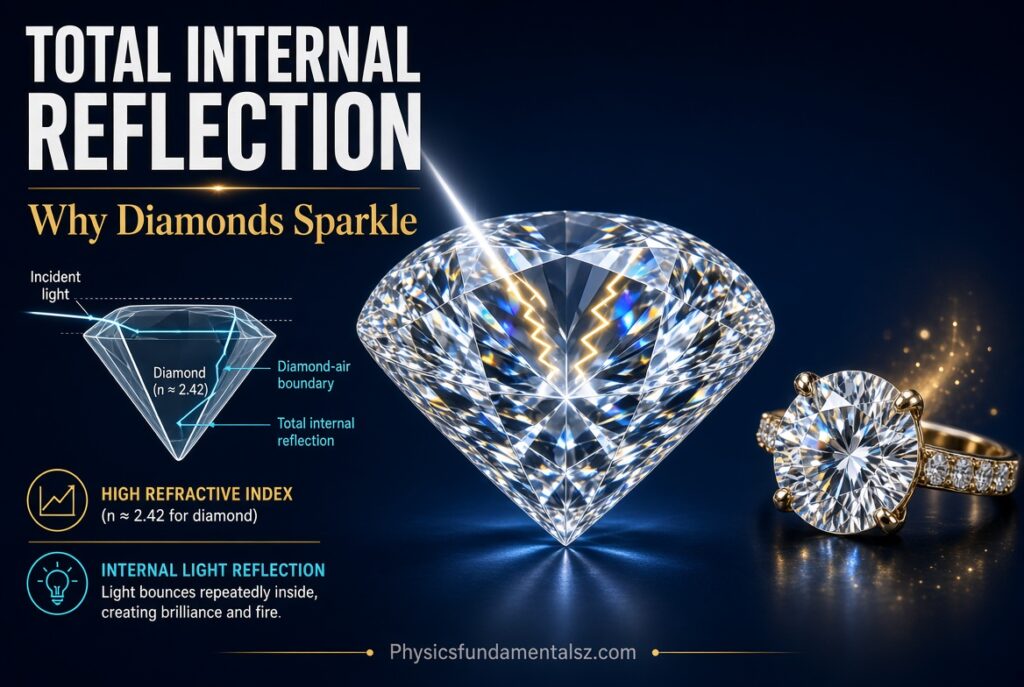
Diamonds are one of the most famous real life examples of total internal reflection. Their brilliance depends on how light is trapped and sent back toward your eye.
The effect comes from a high refractive index and careful cutting.
Why Diamonds Sparkle
Diamond has a refractive index of about 2.42, which gives a critical angle of only about 24.4° against air. This is much smaller than glass, so light inside a diamond hits most internal faces beyond the critical angle.
Light that enters through the top (the crown) travels down, reflects off the lower faces (the pavilion), and exits back through the top.
The Role of the Cut
A well-cut diamond is shaped so that light hits the pavilion facets at angles above the critical angle. This sends the light back up and out through the top.
If the cut is too shallow or too deep, light leaks out through the bottom or sides, and the stone looks dull. That is why cut quality matters as much as size.
Diamond vs Glass vs Cubic Zirconia
| Material | Refractive Index | Critical Angle | Brilliance |
|---|---|---|---|
| Ordinary glass | 1.50 | 41.8° | Low |
| Cubic zirconia | 2.15 | 27.7° | High |
| Diamond | 2.42 | 24.4° | Very high |
A smaller critical angle means more rays are totally reflected, so the stone appears brighter.
Dispersion and “Fire”
Diamonds also have high dispersion, which splits white light into spectral colors. Combined with total internal reflection, this creates colored flashes known as fire.
Brilliance and fire are separate effects, but both depend on light bouncing inside the stone.
Total Internal Reflection in Optical Fibers
Optical fibers are the most important technological example of total internal reflection. They guide light over long distances with very little loss.
Without this effect, modern internet, phone, and cable networks would not work as they do.
How an Optical Fiber Is Built
A fiber has three main parts:
- The core, a thin glass or plastic strand with a higher refractive index.
- The cladding, a layer around the core with a slightly lower refractive index.
- The coating, a protective outer layer.
Light travels in the core and is kept there by reflection at the core-cladding boundary.
How Light Travels Inside a Fiber
Light enters one end at a small angle to the fiber’s axis. It hits the core-cladding boundary at an angle greater than the critical angle and reflects totally.
It then zigzags down the fiber, bouncing again and again, until it reaches the other end.
Solved Example 6: Critical Angle in a Fiber
A fiber has a core index of 1.48 and a cladding index of 1.46. Find the critical angle at the core-cladding boundary.
sin θc = 1.46 / 1.48 = 0.9865, so θc ≈ 80.6°.
Rays must hit the boundary at more than 80.6° from the normal, meaning they travel almost parallel to the fiber’s axis.
Solved Example 7: Acceptance Angle and Numerical Aperture
Using the same fiber, find the numerical aperture and the acceptance angle in air.
Numerical aperture = √(n₁² − n₂²) = √(1.48² − 1.46²) = √(2.1904 − 2.1316) = √0.0588 ≈ 0.243.
The maximum acceptance angle is sin⁻¹(0.243) ≈ 14.0°. Light entering within this cone is guided along the fiber.
Solved Example 8: Travel Time in a Fiber
How long does light take to travel 100 km through a core of index 1.48?
The speed in the core is v = c / n = 3.0 × 10⁸ / 1.48 ≈ 2.03 × 10⁸ m/s.
Time = 100,000 / 2.03 × 10⁸ ≈ 4.9 × 10⁻⁴ s, about 0.49 milliseconds.
Applications of Optical Fibers
- Internet and broadband connections.
- Telephone and cable television networks.
- Undersea cables linking continents.
- Medical endoscopes and surgical tools.
- Industrial inspection of pipes and engines.
- Sensors for temperature, strain, and pressure.
- Decorative lighting and fiber-optic displays.
Why Fibers Beat Copper Wires for Data
Fibers carry data as light, which resists electrical interference and loses little signal over distance. They can also carry a huge amount of data through one thin strand.
Submarine fiber cables carry the bulk of international data traffic.
Step-Index and Graded-Index Fibers
In a step-index fiber, the refractive index changes sharply between core and cladding. In a graded-index fiber, the core index decreases smoothly from the center outward.
Graded-index fibers bend light gradually and reduce signal spreading in multimode transmission.
Why Fibers Still Lose Some Light
Real fibers lose a little light through absorption, scattering, and tight bends. If a fiber is bent too sharply, rays may hit the boundary below the critical angle and escape.
Installers follow minimum bend-radius rules to avoid this.
Total Internal Reflection in Prisms
Glass prisms use total internal reflection as a near-perfect mirror. They are used in many optical instruments because they reflect more reliably than coated metal mirrors.
The key is a 45°-45°-90° prism made of glass.
Why a Right-Angled Prism Works
Light enters the prism face at 90° (no bending) and travels to the long face. It hits that face at 45°, which is greater than the critical angle of 41.8° for glass.
So it reflects totally and turns by 90°. With a second prism or a different arrangement, the light can be turned 180°.
Solved Example 9: Does TIR Occur in a Prism?
A ray inside a glass prism (n = 1.5) hits a glass-air surface at 45°. Does total internal reflection occur?
The critical angle is 41.8°. Since 45° is greater than 41.8°, the ray is totally reflected.
Solved Example 10: What If the Prism Is Placed in Water?
Now the same prism is placed in water (n = 1.33). The critical angle becomes 62.5°, as calculated earlier.
Since 45° is less than 62.5°, total internal reflection does not occur, and some light leaks out into the water.
Types of Prism Deflection
| Prism Arrangement | Turns Light By | Typical Use |
|---|---|---|
| Single right-angle prism | 90° | Periscopes, cameras |
| Right-angle prism (hypotenuse as entry) | 180° | Reversing and retroreflecting |
| Porro prism pair | 180° | Binoculars |
| Roof or Dove prisms | Image inversion or rotation | Instruments, rotation optics |
Total Internal Reflection in Periscopes
A periscope lets you see over or around obstacles. Many simple periscopes use two right-angle prisms instead of mirrors.
Light enters the top prism, turns down by total internal reflection, and then turns again in the bottom prism toward your eye.
Why Prisms Instead of Mirrors?
Prisms reflect nearly all light, while mirrors lose some to absorption. Prisms also do not tarnish or lose their reflective coating.
That makes them reliable in submarines and other harsh environments.
Total Internal Reflection in Binoculars and Cameras
Binoculars use prisms to fold the light path. This keeps them compact and flips the image upright.
Without the prisms, the image from a simple lens system would be upside down and reversed.
Porro Prisms and Roof Prisms
Porro prisms use two right-angle prisms to send light on a zigzag path. Roof prisms produce a straighter, slimmer barrel.
Both rely on internal reflections at glass-air boundaries.
Pentaprisms in SLR Cameras
Single-lens reflex cameras use a pentaprism or a pentamirror to turn the upside-down image from the lens into an upright view in the viewfinder. Many pentaprisms use total internal reflection at some of their faces.
Total Internal Reflection in Retroreflectors
A retroreflector sends light straight back to its source. You see them as bicycle reflectors, road signs, and safety vests.
They are one of the most common everyday examples of this phenomenon.
Corner-Cube Prisms
A corner-cube reflector has three surfaces at right angles. Light entering the front is reflected from each of the three surfaces and returns parallel to the incoming ray.
Many of these devices rely on total internal reflection at the back surfaces.
Where You Find Them
- Bicycle and car rear reflectors.
- Road signs and lane markers.
- Safety clothing and tape.
- Surveying instruments.
- Laser ranging targets, including those placed on the Moon.
Why They Look Bright at Night
Headlights shine light at the reflector. The reflector sends it back toward the car, and the driver sees a bright point.
A flat mirror would send the light off in another direction.
Total Internal Reflection in Medicine
Medicine uses total internal reflection mainly through fiber optics. These tools allow doctors to look inside the body without major surgery.
The light travels through thin, flexible fibers and carries images or illumination.
Endoscopes
An endoscope is a flexible tube with bundles of optical fibers. One bundle brings light to the area, and another carries the image back to the doctor.
Doctors use endoscopes to look at the stomach, colon, lungs, and joints.
Laparoscopy and Minimally Invasive Surgery
Laparoscopes and arthroscopes use fiber optics or small cameras with fiber illumination. Surgeons can work through tiny cuts, which usually means less pain and faster recovery.
Dental and Surgical Light Guides
Fiber-optic light guides carry bright light to the tip of dental handpieces and surgical tools. The light source stays away from the patient, so the tip stays cool.
Laser Delivery Through Fibers
Medical lasers can be sent through optical fibers to treat tissue precisely. The fiber carries the energy by total internal reflection to the exact spot.
Why Fibers Suit Medical Use
They are thin, flexible, and free of electrical hazards. They also deliver light without heat at the tip, depending on the system.
Total Internal Reflection in Everyday Technology and Sensors
Beyond fibers and prisms, total internal reflection hides inside many devices. Often it works through a related effect called frustrated total internal reflection.
What Is Frustrated Total Internal Reflection?
When light undergoes total internal reflection, a tiny electromagnetic field, called the evanescent wave, extends a short distance into the rarer medium. If another medium touches the surface within that distance, it can absorb or scatter the light.
This “frustrates” the total reflection, so some light is lost. Sensors detect that change.
Car Rain Sensors
Many cars use an infrared light and a detector aimed at the windshield. When the glass is dry, the light reflects totally at the glass-air surface and returns to the detector.
When raindrops land on the glass, they change the boundary, and less light returns. The system detects the drop and turns on the wipers.
Optical Fingerprint Scanners
In many fingerprint readers, a finger rests on a glass prism. The ridges of the finger touch the glass and disturb total internal reflection, while the valleys do not.
The sensor sees a dark and bright pattern that matches the ridges, which becomes the fingerprint image.
Multi-Touch Tables and Screens
Some touch tables send infrared light into a sheet of acrylic, where it is trapped by total internal reflection. When a finger touches the surface, light escapes at that point and a camera detects it.
This design lets large screens track many touches at once.
Liquid-Level Sensors
A prism-tipped sensor can detect whether it is in air or liquid. In air, light reflects totally at the prism’s face and returns to the detector.
In liquid, the critical angle changes and light leaks out, so the signal drops. These sensors are used in tanks and appliances.
Refractometers
A refractometer measures the refractive index of a liquid by finding the critical angle. Food and beverage makers use it to estimate sugar content, and others use it to check the concentration of solutions.
The instrument shines light into a prism and finds the angle where total reflection begins.
LED Lenses and Light Guides
Many flashlights, car lights, and LED lamps use a lens shape that directs side-going light forward by total internal reflection. This is called a TIR lens or collimator.
Backlights in flat screens also use light guides, where light travels along a plastic sheet and is released in a controlled way.
Fluorescence Microscopy With TIRF
In total internal reflection fluorescence microscopy, scientists use the evanescent wave to light up only a very thin layer next to a glass slide. This lets them study cell membranes with little background glow.
Surface Plasmon Resonance Sensors
Some biosensors use total internal reflection at a thin metal film to detect molecules sticking to a surface. A change in the reflected light shows that binding has occurred.
These sensors are used in biochemistry and drug research.
The Evanescent Wave: What Happens During Total Reflection
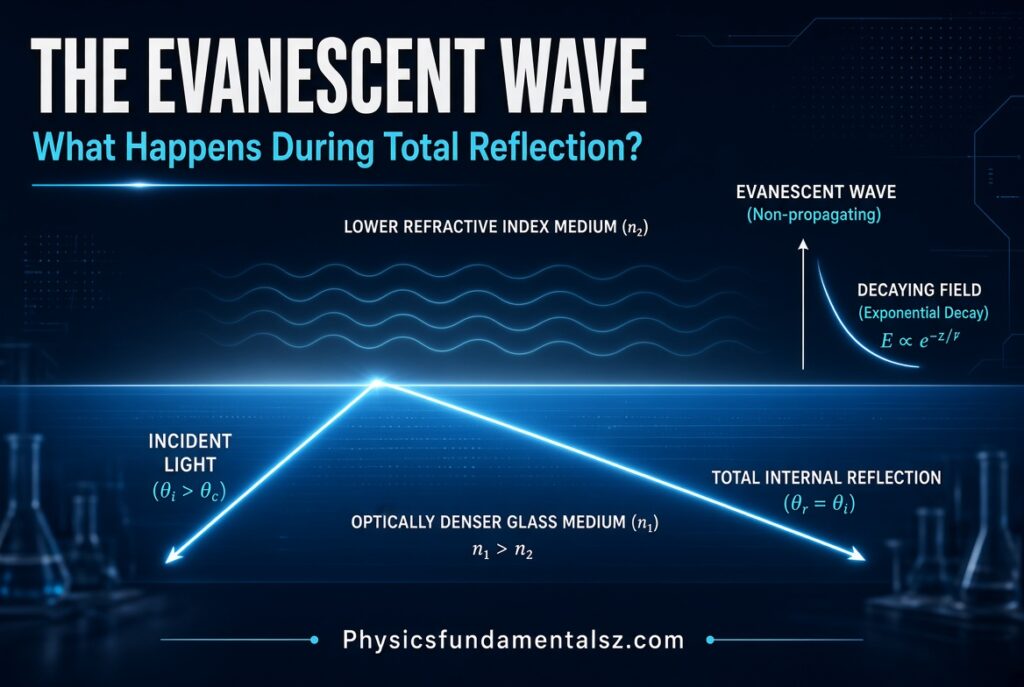
Total internal reflection does not mean the light field stops sharply at the boundary. A fast-fading field leaks a short distance into the second medium.
This field does not carry energy away when nothing is there to absorb it.
Penetration Depth Formula
The intensity of the evanescent wave falls off exponentially. The distance at which it drops to 1/e of its value is d = λ / (4π √(n₁² sin²θ − n₂²)).
Here λ is the wavelength in vacuum, n₁ is the denser index, n₂ is the rarer index, and θ is the angle of incidence.
Solved Example 11: Penetration Depth
Light of wavelength 500 nm goes from glass (n₁ = 1.52) to water (n₂ = 1.33) at an incidence angle of 70°. Find the penetration depth.
First, n₁ sin θ = 1.52 × 0.9397 ≈ 1.428, and its square is about 2.040. Subtract n₂² = 1.769 to get 0.271, whose square root is about 0.521.
Then d = 500 / (4π × 0.521) ≈ 500 / 6.55 ≈ 76 nm. The field reaches only a tiny fraction of a wavelength-scale distance.
Total Internal Reflection vs Reflection vs Refraction
These three terms are often confused. They describe different things that can happen when light meets a boundary.
| Feature | Regular Reflection | Refraction | Total Internal Reflection |
|---|---|---|---|
| What happens | Light bounces off a surface | Light passes through and bends | Light bounces back completely |
| Needs two media | Not necessarily | Yes | Yes |
| Direction of travel | Any | Any | Denser to rarer only |
| Angle condition | None | None | Incidence beyond critical angle |
| Light lost | Some absorbed or transmitted | Some reflected | Almost none |
| Example | Plane mirror | Straw bent in water | Optical fiber |
Total Internal Reflection vs a Silvered Mirror
A normal mirror uses a metal coating, which absorbs a small share of light. Total internal reflection from glass is nearly lossless.
However, a mirror works at every angle, while total internal reflection works only beyond the critical angle.
Is Total Internal Reflection Perfect?
In theory it reflects all the light. In practice, dirt, scratches, and absorption in the material cause tiny losses.
For that reason, engineers call it nearly perfect.
Common Misconceptions About Total Internal Reflection
Many online articles and even some textbooks repeat mistakes about this topic. The table below clears up the most common ones.
| Myth | Fact |
|---|---|
| Rainbows are total internal reflection | Rainbows use refraction, dispersion, and partial internal reflection |
| Mirages are simple total internal reflection | Mirages come from gradual refraction through air layers |
| TIR can happen from air into glass | It happens only from a denser medium to a rarer one |
| TIR works at any angle | The angle must exceed the critical angle |
| Light stops at the boundary | A faint evanescent wave extends a short distance |
| Fish shine only because of TIR | Fish scales mostly shine due to layered reflective structures |
| Diamonds sparkle because they are hard | They sparkle because of high refractive index and cut |
Mistakes Students Make in Total Internal Reflection Problems
Exam questions on this topic are predictable. Avoiding these mistakes can save marks.
Mistake 1: Using the Wrong Index in the Formula
The critical angle uses sin θc = n₂ / n₁, with the rarer index on top. Putting the denser index on top gives a number above 1, which is impossible.
Mistake 2: Measuring Angles From the Surface
All angles in optics are measured from the normal, not from the surface. A ray at 30° to the surface has an incidence angle of 60°.
Mistake 3: Applying TIR to Light Entering Glass
If light moves from air to glass, total internal reflection cannot occur. Always check the direction first.
Mistake 4: Forgetting the Medium Around the Object
A prism in air and the same prism in water have different critical angles. Always use the correct surrounding medium.
Mistake 5: Calling Any Reflection “Total Internal”
A mirror reflection or a partial reflection from glass is not total internal reflection. The conditions must be satisfied.
Total Internal Reflection in Different Settings: A Quick Map
The same physics appears in many places. This table groups real life examples by setting so you can find the one you need.
| Setting | Examples | Denser Medium | Rarer Medium |
|---|---|---|---|
| Nature | Underwater mirror, bubbles, Snell’s window | Water or ice | Air |
| Home | Light pipes, fiber lamps, glassware | Glass or plastic | Air |
| Jewelry | Diamond, cubic zirconia | Gemstone | Air |
| Transport | Reflectors, rain sensors, LED lamps | Glass or plastic | Air |
| Communication | Fiber-optic cables | Fiber core | Cladding |
| Medicine | Endoscopes, laser delivery fibers | Fiber core | Cladding |
| Security | Fingerprint scanners | Glass prism | Air or skin ridges |
| Science | Refractometers, TIRF microscopes | Glass | Liquid or sample |
The Pattern to Remember
Every example has the same three parts: a dense material that holds the light, a boundary with a rarer material, and an angle beyond the critical angle. If you can name those three parts, you can explain the example.
Why Some Surfaces Show Total Internal Reflection and Others Do Not
Not every glass surface acts like a mirror. The surrounding material and the angle decide whether the light stays inside.
The Effect of the Outside Medium
A glass rod in air has a critical angle of about 41.8°. The same rod in water has a critical angle of about 62.5°, so fewer rays are trapped.
This is why fiber cores need a cladding with a carefully chosen index and why wet or dirty fibers can leak light.
The Effect of Dirt, Oil, and Water Films
A drop of water, a fingerprint, or a layer of oil on a glass surface raises the outside index. This lowers the chance of total internal reflection at that spot.
You can see this when a clean acrylic rod glows at the end but leaks light where you grip it with oily fingers.
The Effect of Bending
If you bend a light guide too sharply, rays hit the boundary at smaller angles. Some fall below the critical angle and escape.
That is why a fiber-optic lamp strand glows brighter at sharp bends or kinks.
The Effect of Wavelength
The refractive index changes slightly with color, so the critical angle also changes slightly. Blue light and red light have slightly different critical angles in glass.
For most everyday examples, the difference is too small to notice.
Total Internal Reflection in Communication Systems
Communication is the biggest real-world use of total internal reflection by volume. Optical fibers carry phone calls, video, and internet data as pulses of light.
How Data Travels as Light
A transmitter turns electrical signals into light pulses, often using a laser or LED. The pulses move along the fiber by total internal reflection and reach a receiver that converts them back to electrical signals.
The whole trip can span hundreds of kilometers with amplifiers along the way.
Single-Mode and Multimode Fibers
| Feature | Single-Mode Fiber | Multimode Fiber |
|---|---|---|
| Core size | Very small | Larger |
| Light paths | One main path | Many paths |
| Typical use | Long-distance links | Short-distance networks |
| Signal spreading | Low | Higher |
Why Fiber Cables Resist Interference
Light signals are not affected by electromagnetic noise from power lines or motors. This makes fiber links reliable in factories, hospitals, and power stations.
Fiber at Home
Many homes now receive internet through fiber lines. The final connection may end at a small box on a wall, where light signals turn into electrical ones.
Total Internal Reflection in Scientific Instruments
Laboratories use total internal reflection to measure and see things that are hard to detect any other way.
Abbe Refractometer
An Abbe refractometer places a liquid sample against a glass prism and finds the critical angle by looking for the boundary between a bright and a dark region. The critical angle gives the refractive index, which relates to concentration.
Food labs use it for sugar content in juices and syrups.
Spectroscopy With Attenuated Total Reflection
Attenuated total reflection, or ATR, spectroscopy presses a sample against a crystal. The evanescent wave interacts with a thin layer of the sample, and the lost light reveals its chemical makeup.
ATR makes it easy to test solids and liquids without special preparation.
Fluorescence Imaging With TIRF
TIRF microscopes light up only about 100 nanometers or so near the glass surface. Biologists use them to watch single molecules and cell membrane activity.
The thin lit layer keeps the background dark, so details stand out.
Total Internal Reflection and Safety
Because total internal reflection can trap and focus light, it deserves some respect.
Laser Safety
Lasers used with fibers, prisms, or water streams can send concentrated beams over long distances. Treat them as hazardous, and avoid any reflection into eyes.
Fiber End Faces
Light from a fiber end can be invisible and still harmful, especially infrared in communication systems. Never look into the end of a live fiber.
Handling Prisms and Glass
Prisms and crystals can have sharp edges. Handle them by the sides, and clean them gently to avoid scratches that reduce reflection.
How to Explain Total Internal Reflection in One Minute
If you need a quick explanation for a class, a presentation, or a younger student, this short script works well.
The Short Version
“Light slows down when it goes into glass or water. When it tries to leave at a steep angle, it bends so much that it cannot get out. Instead, it bounces back inside. That bounce is total internal reflection.”
A Simple Analogy
Think of a car driving from pavement onto sand at a slant. The wheel that hits the sand first slows down, so the car turns. If the angle is steep enough, the car cannot turn enough to go forward and bounces along the edge.
The analogy is not perfect, but it shows why a change in speed changes direction.
Three Questions to Test Understanding
- Which medium has the higher refractive index?
- Is the angle of incidence larger than the critical angle?
- Is the light moving from the denser to the rarer medium?
If all three answers are yes, total internal reflection happens.
Advantages and Limits of Using Total Internal Reflection
Engineers choose total internal reflection when it fits the job. It has clear strengths and limits.
| Advantages | Limits |
|---|---|
| Almost no light lost at the boundary | Works only beyond the critical angle |
| No metal coating needed | Needs a denser to rarer boundary |
| Does not tarnish or wear off | Dirt or water on the surface can disturb it |
| Works across a range of colors | Bends in fibers can cause leaks |
| Cheap in glass and plastic parts | Limited field of view for a given prism size |
A Short History of Total Internal Reflection Discoveries
The idea behind total internal reflection is old, but its uses grew slowly. Understanding the history helps explain why the effect matters so much today.
Early Observations of Light Bending
Scientists studied refraction for centuries before Snell’s law was formally described in the early 1600s. Once the law was known, total internal reflection followed as a natural consequence at large angles.
Johannes Kepler is often credited with an early description of the effect in the 1600s.
The Light Fountain Demonstrations
In the 1840s and 1850s, Daniel Colladon in Geneva and John Tyndall in London demonstrated that light could follow a curved jet of water. These lighted fountains showed that light could be guided by total internal reflection.
The demonstration is still used in classrooms today.
From Glass Rods to Modern Fibers
In the twentieth century, researchers built thin glass fibers to carry light. Early fibers lost too much light to be useful for long distances.
In the 1960s, Charles Kao and colleagues showed that purer glass could make long-distance communication possible. Kao received a share of the 2009 Nobel Prize in Physics for this work.
Easy Experiments to See Total Internal Reflection at Home
You can see total internal reflection with simple items. These experiments are safe when done with care.
Experiment 1: The Laser Water Stream
Make a small hole near the bottom of a clear plastic bottle and cover it with tape. Fill the bottle with water and place a laser pointer on the opposite side so that the beam passes through the hole.
Remove the tape over a sink, and the beam will follow the curved stream of water. The light is trapped inside the stream by total internal reflection.
Experiment 2: The Underwater Mirror
Fill a clear glass tank or large clear container with water. Look up at the surface from the side at a low angle.
You will see the surface turn silver and reflect objects below it.
Experiment 3: The Bubble Shine
Place a small air bubble in a clear glass of water by pouring gently or stirring. Look at the bubble from different angles.
It will flash silver when light hits it beyond the critical angle.
Experiment 4: The Acrylic Rod Light Pipe
Shine a flashlight into one end of a clear acrylic rod in a dim room. The far end will glow, while the sides stay dim.
Bend a thin plastic strand gently and see how the light follows it.
Experiment 5: Measure the Critical Angle
Use a semicircular glass or acrylic block and a thin ray of light. Aim the ray at the curved side so that it travels toward the center of the flat face.
Rotate the block until the refracted ray just disappears along the flat surface. The angle of incidence at that moment is the critical angle.
Safety Tips
- Never point a laser at anyone’s eyes.
- Use low-power laser pointers only, with an adult present.
- Keep water away from electrical outlets.
- Clean up spills to avoid slips.
Total Internal Reflection Exam Tips
Questions on this topic follow familiar patterns. Use these habits to answer clearly and quickly.
State the Two Conditions First
Begin with “Light must travel from a denser to a rarer medium, and the angle of incidence must exceed the critical angle.” This earns marks in most definition questions.
Link the Example to the Condition
When you list an example, say which condition is satisfied. For instance, in a diamond, light travels from diamond to air at angles above 24.4°.
Draw a Clear Diagram
A diagram with the normal, the incident ray, and the reflected ray earns marks. Label the critical angle and the two media.
Keep a Table of Indices
Memorize approximate refractive indices: water 1.33, glass 1.5, diamond 2.42. They let you find critical angles quickly.
Practice Problems on Total Internal Reflection
Try these before looking at the answers. Use the refractive indices given.
Problem Set
- Find the critical angle for light going from acrylic (n = 1.49) to air.
- A ray in water hits the water-air surface at 50°. Does total internal reflection occur?
- A ray in water hits the water-air surface at 45°. Does total internal reflection occur?
- Find the critical angle for cubic zirconia (n = 2.15) to air.
- A prism of glass (n = 1.5) is in air. Does a ray hit a face at 40° undergo total internal reflection?
- A light source is 1.5 m below the surface of still water. Find the radius of the circle through which light escapes.
- Find the critical angle for light going from glass (n = 1.5) to water (n = 1.33).
- A fiber has a core index of 1.50 and a cladding index of 1.45. Find the critical angle at the core-cladding boundary.
- Find the speed of light in diamond (n = 2.42).
- Explain in two sentences why a rainbow is not an example of total internal reflection.
Answers and Short Solutions
| Problem | Answer | Short Solution |
|---|---|---|
| 1 | About 42.2° | sin θc = 1 / 1.49 = 0.671 |
| 2 | Yes | 50° is greater than 48.8° |
| 3 | No | 45° is less than 48.8° |
| 4 | About 27.7° | sin θc = 1 / 2.15 = 0.465 |
| 5 | No | 40° is less than 41.8° |
| 6 | About 1.7 m | r = 1.5 × tan 48.8° ≈ 1.5 × 1.14 |
| 7 | About 62.5° | sin θc = 1.33 / 1.5 = 0.887 |
| 8 | About 75.2° | sin θc = 1.45 / 1.50 = 0.9667 |
| 9 | About 1.24 × 10⁸ m/s | v = 3.0 × 10⁸ / 2.42 |
| 10 | See below | Back-surface reflection occurs below the critical angle |
For Problem 10, the reflection inside a raindrop hits the back surface at about 40°, less than the 48.8° critical angle. So the reflection is only partial, and the colors come from dispersion.
Total Internal Reflection Cheat Sheet
Use this table for quick revision or last-minute exam review.
| Topic | Key Point |
|---|---|
| Definition | Complete reflection of light inside a denser medium at the boundary with a rarer one |
| Condition 1 | Light moves from higher n to lower n |
| Condition 2 | Angle of incidence is greater than the critical angle |
| Critical angle formula | sin θc = n₂ / n₁ |
| Critical angle in air | sin θc = 1 / n |
| Water to air | About 48.8° |
| Glass to air | About 41.8° |
| Diamond to air | About 24.4° |
| Optical fiber | Light guided in the core by reflection at the cladding |
| Prism in air | A 45° face reflects totally in glass |
| Frustrated TIR | Touching the boundary disturbs reflection (fingerprints, touch screens, rain sensors) |
| Not true TIR | Rainbows; mirages are gradual refraction |
Frequently Asked Questions (FAQs)
What are real life examples of total internal reflection?
Common examples include optical fibers, diamonds, prisms in binoculars and periscopes, air bubbles in water, the mirror-like water surface seen from underwater, and car rain sensors.
What is total internal reflection in simple words?
It is when light inside a denser material hits the boundary with a rarer material at a steep angle and bounces back completely instead of leaving.
What are the conditions for total internal reflection?
Light must go from a denser to a rarer medium, and the angle of incidence must be larger than the critical angle.
What is the critical angle?
It is the smallest angle of incidence in the denser medium at which the refracted ray grazes the boundary. Beyond it, total internal reflection occurs.
What is the formula for the critical angle?
The formula is sin θc = n₂ / n₁, where n₁ is the denser medium’s index and n₂ is the rarer medium’s index.
Why do diamonds sparkle?
Diamond has a high refractive index and a small critical angle of about 24.4°. A good cut makes light reflect internally and exit through the top.
How does total internal reflection work in optical fibers?
Light travels in a high-index core and hits the lower-index cladding at angles beyond the critical angle. It reflects again and again along the fiber.
Why can’t total internal reflection happen from air to glass?
Total internal reflection needs light to go from a higher to a lower refractive index. Air has a lower index than glass, so the condition fails.
Is a mirage an example of total internal reflection?
Textbooks often list it that way, but the physics is gradual refraction through layers of air at different temperatures.
Is a rainbow caused by total internal reflection?
No. A rainbow involves refraction, dispersion, and a partial reflection at the back of the raindrop.
Why does water look like a mirror from underwater?
Light from underwater objects hits the surface beyond the critical angle of about 48.8°, so it reflects back into the water.
What is Snell’s window?
It is the circular view of the sky seen from underwater. Its cone angle is about 97.5°, twice the critical angle of water.
Why do air bubbles look silvery in water?
Light hits the water-air boundary at large angles and reflects strongly. That bright reflection gives bubbles a metallic look.
How do prisms use total internal reflection?
In a 45°-45°-90° glass prism, light meets the long face at 45°, which exceeds the 41.8° critical angle, so it reflects totally.
Why are prisms used in binoculars?
Prisms fold the light path and make the image upright. They reflect almost all the light without a metal coating.
How do endoscopes use total internal reflection?
They contain bundles of optical fibers that carry light into the body and bring images back out, with the light guided by internal reflection.
What is frustrated total internal reflection?
It happens when a second medium touches or comes very close to the boundary and disturbs the total reflection. Fingerprint scanners and touch tables use it.
How do car rain sensors work?
An infrared beam reflects totally inside the windshield when it is dry. Water drops reduce the reflected light, which tells the system to run the wipers.
What is the evanescent wave?
It is a thin electromagnetic field that extends a very short distance past the boundary during total internal reflection.
Does total internal reflection lose energy?
In theory, no light is lost. In practice, small losses occur from scratches, dirt, and absorption.
Can total internal reflection happen with sound or other waves?
Yes. Any wave that changes speed between two media can show a similar effect, including sound and water waves.
How can I see total internal reflection at home?
Shine a laser pointer through a water stream from a bottle, look up at the water surface from the side of a tank, or watch bubbles shine in a glass of water. Never aim a laser at eyes.
Conclusion
Real life examples of total internal reflection show that this single idea reaches far beyond the physics classroom. It explains why diamonds sparkle, why underwater surfaces look like mirrors, and why air bubbles flash silver.
It also powers fiber-optic internet, binoculars, periscopes, retroreflectors, medical endoscopes, car rain sensors, and fingerprint scanners. In every case, light moves from a denser to a rarer medium and strikes the boundary beyond the critical angle.
Remember the key formula, sin θc = n₂ / n₁, and the two conditions. Be careful with popular but misleading examples such as rainbows and mirages, which involve refraction more than true total internal reflection.
Once you can spot the denser medium, the rarer medium, and the angle, you can explain almost any total internal reflection example you meet.