The Heisenberg Uncertainty Principle

Imagine trying to pin down both where an electron is and how fast it is moving. The Heisenberg uncertainty principle says you cannot do both perfectly, no matter how clever your apparatus. This is not a failure of technology; it is a statement about the deep nature of matter itself.
What the principle actually says
Werner Heisenberg’s 1927 insight is that certain pairs of properties — called conjugate variables — cannot both have definite values simultaneously. The most famous pair is position and momentum. The more sharply defined a particle’s position, the more spread out its momentum must be, and vice versa.
The relationship is captured in a single inequality, where Δx is the uncertainty in position and Δp the uncertainty in momentum:
Here ℏ (h-bar) is the reduced Planck constant, roughly 1.05 × 10⁻³⁴ joule-seconds. It is fantastically small, which is why we never notice this limit for footballs or cars — only for electrons, atoms and photons.
It is not about disturbing the system
A common misconception is that uncertainty arises because measuring a particle inevitably bumps it. Heisenberg himself first explained it that way, using a thought experiment about a microscope. But the modern understanding is deeper: the uncertainty exists before any measurement.
A quantum particle does not possess a precise position and a precise momentum that we merely fail to read. It genuinely does not have both at once. The uncertainty is a property of reality, not of our instruments.
Why waves make this inevitable
The principle becomes intuitive once you accept that particles behave like waves. A wave with a single, pure wavelength stretches infinitely through space — it has a perfectly defined momentum but no definable location. To build a localised pulse, you must add together many waves of different wavelengths. The more localised the pulse, the wider the spread of wavelengths needed.
Since momentum is tied to wavelength through the de Broglie relation, a narrow position (few possible places) demands a broad momentum (many wavelengths). This trade-off is a property of all waves, from sound to water ripples — quantum mechanics simply applies it to matter. You can see the wave-particle link explored further in our note on wave-particle duality.
Energy and time
Position and momentum are not the only conjugate pair. Energy and time obey a similar relation:
This means a state that exists only briefly cannot have a sharply defined energy. It explains why short-lived particles have a “width” in their measured energy, and why empty space can momentarily borrow energy to create fleeting virtual particles. The shorter the time Δt, the larger the energy ΔE that nature permits to flicker into existence.
Real consequences you can see
The uncertainty principle is not abstract bookkeeping; it shapes the world we live in.
- Atoms have size. An electron cannot collapse onto the nucleus, because confining it to a tiny region would force a huge momentum and kinetic energy. The balance sets the size of every atom.
- Stars resist collapse. The same confinement pressure, applied to dense matter, helps hold up white dwarf stars against gravity.
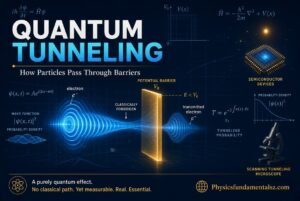
- Quantum tunnelling. Energy-time uncertainty lets particles slip through barriers they classically could not cross, which is how the Sun fuses hydrogen and how flash memory stores your photos.
How big is the effect, really?
For everyday objects the limit is utterly negligible. A 1-kilogram ball whose position you know to a millimetre has a momentum uncertainty of around 10⁻³¹ kg·m/s — undetectable. But for an electron confined to an atom a few tenths of a nanometre across, the momentum spread is enormous, giving speeds of millions of metres per second. The principle dominates the small and vanishes for the large, which is exactly why classical physics and our intuition work so well at human scales. To revisit how momentum behaves classically, see momentum and impulse.
Frequently asked questions
Could a better microscope beat the uncertainty principle?
No. The limit is not set by instrument quality. Even an ideal, non-disturbing measurement cannot extract values that the particle does not possess. The uncertainty is built into the quantum description of matter.
Does this mean physics is not deterministic?
Quantum mechanics predicts the probabilities of outcomes with exquisite precision, and the wavefunction evolves deterministically. What it does not provide is a definite simultaneous value for conjugate quantities like position and momentum.
Why don’t we notice it in daily life?
Because ℏ is extraordinarily small. The uncertainties it forces on macroscopic objects are far below anything we could ever measure, so the world looks perfectly classical at human scales.