Entropy Explained for Beginners Easy Guide 2026
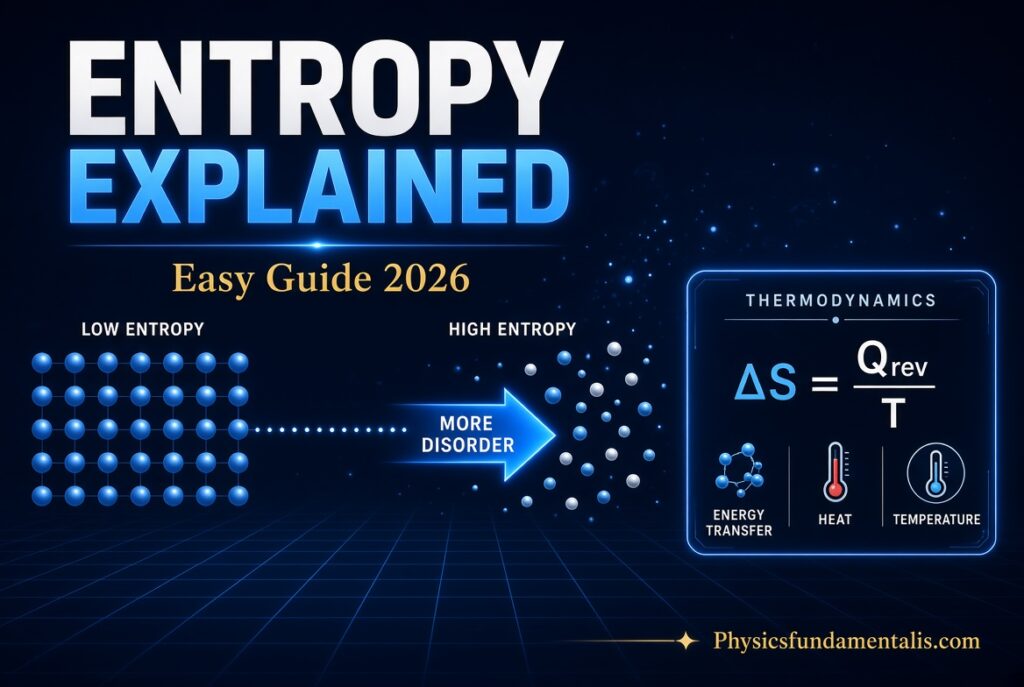
Entropy Explained for Beginners? Have you ever wondered why a hot cup of coffee always cools down, but a cold cup never warms up on its own? That everyday mystery has a name: entropy.
Table of Contents
What Is Entropy? Entropy Explained for Beginners
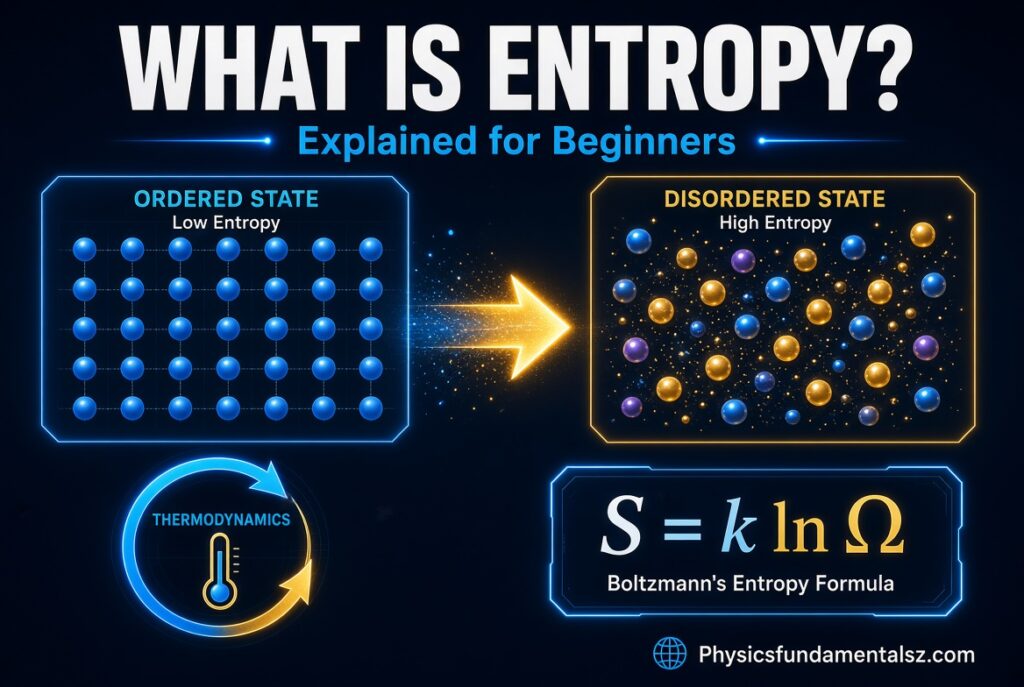
Entropy is a measure of how spread out or disordered the energy in a system is. Low entropy means energy is concentrated and organized. High entropy means energy is spread out and less useful.
In simple words, entropy tells you how many different ways a system’s particles can be arranged. The more possible arrangements, the higher the entropy.
Entropy is one of the core ideas in thermodynamics, alongside concepts like temperature and energy. Together, these ideas explain why the physical world behaves the way it does.
Why Does Entropy Matter in Physics?
Entropy explains why time seems to move in only one direction. Ice melts, coffee cools, and rooms get messy, but these processes never reverse themselves naturally.
This “one-way street” is called the arrow of time. Entropy is the reason eggs never unscramble and broken glass never reassembles on its own.
Without entropy, physicists could not explain why some processes happen easily while others never happen at all, even though both would obey the law of energy conservation.
The Second Law of Thermodynamics Explained Simply
The second law of thermodynamics states that the total entropy of an isolated system always increases over time, or at best stays the same.
Heat always flows from hot objects to cold ones, never the other way around, unless outside work is done. This single rule governs everything from refrigerators to stars.
The second law says disorder in the universe never decreases on its own. Every natural process makes the universe a little more disordered.
The Four Laws of Thermodynamics at a Glance
| Law | What It Says |
|---|---|
| Zeroth Law | Defines temperature and thermal equilibrium |
| First Law | Energy cannot be created or destroyed |
| Second Law | Entropy of an isolated system always increases |
| Third Law | Entropy approaches a minimum as temperature nears absolute zero |
Entropy and Disorder: A Simple Analogy
Picture a tidy bookshelf with every book sorted by size and color. That is a low entropy state because there is only one way to arrange it neatly.
Now imagine someone tosses all the books onto the floor. There are millions of messy arrangements possible, but only a few neat ones.
That is why messiness wins over time. Disorder is simply more statistically likely than order, not because nature “wants” chaos.
Real-Life Examples of Entropy
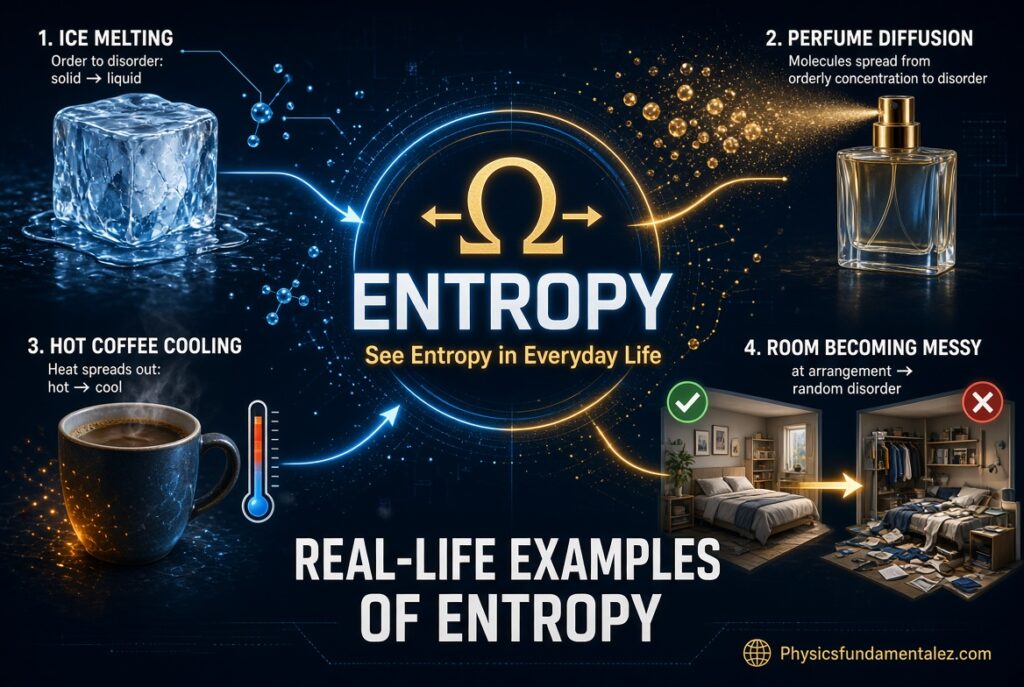
Entropy is not just a textbook idea. You can see it working around you every single day.
- Melting ice: Solid ice has ordered molecules; melted water has more freedom and higher entropy.
- Coffee cooling: Heat spreads from the hot coffee into the cooler room until both reach the same temperature.
- Ink in water: A drop of ink starts concentrated, then spreads until it fills the glass evenly.
- A messy room: There are far more disordered arrangements of your belongings than tidy ones.
- Mixing gases: Two separated gases mix into one uniform blend once you remove the barrier between them.
Entropy in Everyday Devices
Refrigerators, car engines, and air conditioners all work by moving heat and managing entropy. None of them can be perfectly efficient because some energy always becomes unusable heat.
This is why no machine, however advanced, can run forever without an energy source. Entropy sets a hard limit on efficiency.
Entropy Formula: Boltzmann’s Equation
Ludwig Boltzmann gave entropy a precise mathematical meaning using probability. His famous formula is:
S = k log W
Here, S is entropy, k is Boltzmann’s constant, and W is the number of possible microscopic arrangements (microstates) that produce the same overall (macroscopic) state.
What This Formula Actually Means
A system with more possible arrangements has higher entropy. A system with only one or two possible arrangements has very low entropy.
This is why a shuffled deck of cards has higher entropy than a perfectly ordered one. There is only one ordered sequence but billions of shuffled ones.
Entropy vs Enthalpy: What’s the Difference?
Students often confuse entropy with enthalpy because the words sound alike. They measure completely different things.
| Feature | Entropy | Enthalpy |
|---|---|---|
| Symbol | S | H |
| Measures | Disorder or randomness | Total heat content of a system |
| Units | Joules per Kelvin (J/K) | Joules (J) |
| Direction | Tends to increase over time | Can increase or decrease |
| Used In | Second law of thermodynamics | First law of thermodynamics |
Entropy in Information Theory
Entropy is not limited to physics. Claude Shannon borrowed the concept to measure uncertainty in information, which became the foundation of modern data compression.
In information theory, entropy measures how unpredictable a message is. A completely random string of letters has higher entropy than a predictable sentence.
This idea now powers technologies like file compression, error detection, and even cryptography, connecting thermodynamics to computer science in a surprising way.
Entropy and the Arrow of Time
Most laws of physics work the same whether time runs forward or backward. Entropy is different, and that difference matters enormously.
Because entropy only increases, it gives the universe a clear sense of “before” and “after.” This is often called the arrow of time.
Some physicists believe the universe began in an extremely low-entropy state right after the Big Bang, and everything since has been entropy slowly rising toward equilibrium.
Common Misconceptions About Entropy
Many beginners misunderstand what entropy actually means. Clearing up these mistakes makes the concept much easier to grasp.
- “Entropy means chaos.” Not exactly. It means the statistically most probable arrangement, which often looks disordered.
- “Entropy always decreases locally is impossible.” It is possible locally, such as in a refrigerator, as long as entropy increases elsewhere by a larger amount.
- “Life violates the second law.” Living things maintain low entropy internally by releasing heat and waste, increasing entropy in their surroundings.
- “Entropy is only about heat.” Entropy also applies to information, mixing, and probability, not just thermal energy.
How Entropy Connects to Other Physics Topics
Entropy does not exist in isolation. It ties directly into broader ideas in thermodynamics, including heat transfer, energy conservation, and molecular motion.
Understanding entropy also helps make sense of related concepts like electric current, wave behavior, and even relativity, since energy and disorder appear across nearly every branch of physics.
Key Takeaways: Entropy Explained
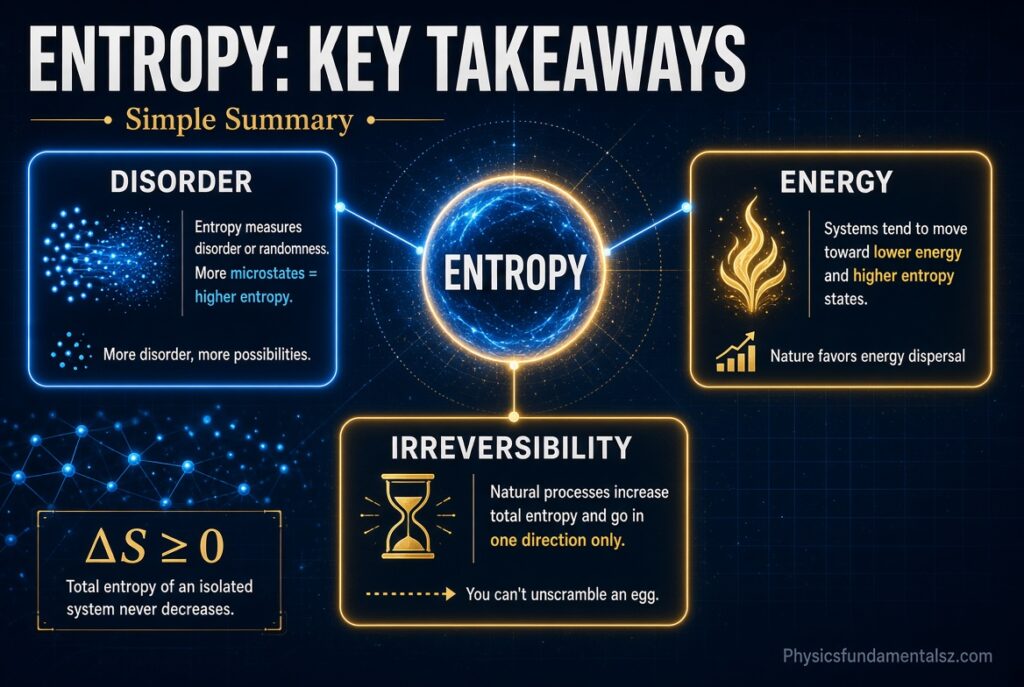
- Entropy measures how spread out or disordered energy is in a system.
- The second law of thermodynamics says entropy always increases in an isolated system.
- Higher entropy means more possible arrangements, not simply “more mess.”
- Boltzmann’s formula, S = k log W, connects entropy to probability.
- Entropy explains the arrow of time and why some processes are irreversible.
- The same concept appears in information theory, powering data compression and cryptography.
Frequently Asked Questions (FAQs)
What is entropy in simple words?
Entropy is a measure of how spread out or disordered the energy in a system is. Low entropy means order, and high entropy means disorder.
Why does entropy always increase?
Entropy increases because disordered arrangements of energy are far more statistically probable than ordered ones. Nature naturally drifts toward the most likely state.
Can entropy ever decrease?
Entropy can decrease locally, such as inside a refrigerator or a living cell, but only if entropy increases even more somewhere else in the surroundings.
What is the second law of thermodynamics in simple terms?
The second law says the total entropy of an isolated system never decreases over time. Heat always flows from hot to cold, not the reverse.
What is the difference between entropy and enthalpy?
Entropy measures disorder or randomness, while enthalpy measures the total heat content of a system. They use different symbols, units, and formulas.
Who discovered entropy?
Rudolf Clausius introduced the term entropy in 1865, and Ludwig Boltzmann later gave it a statistical, probability-based definition.
What is Boltzmann’s entropy formula?
Boltzmann’s formula is S = k log W, where S is entropy, k is Boltzmann’s constant, and W is the number of possible microscopic arrangements.
Does entropy apply outside of physics?
Yes. Entropy is also used in information theory to measure uncertainty in data, which underpins file compression and cryptography.
Why can’t ice cubes form on their own in a warm room?
Because that would require heat to flow from cold to hot and entropy to decrease spontaneously, which violates the second law of thermodynamics.
Is entropy the same as chaos?
Not exactly. Entropy refers to the most statistically probable arrangement of a system, which often appears chaotic but follows precise mathematical rules.
Does life violate the second law of thermodynamics?
No. Living organisms keep their internal entropy low by consuming energy and releasing heat and waste, which increases entropy in their environment.
What happens to entropy at absolute zero?
According to the third law of thermodynamics, entropy approaches its minimum possible value as temperature approaches absolute zero.
How does entropy relate to the arrow of time?
Entropy only increases, never decreases, in an isolated system. This one-way behavior gives the universe a clear direction from past to future.
What is a real-life example of entropy increasing?
A hot cup of coffee cooling to room temperature is a classic example, since heat spreads from the coffee into the surrounding air until both are equal.
Why is entropy important in engineering?
Entropy sets the theoretical efficiency limit for engines, refrigerators, and power plants, explaining why no machine can be perfectly efficient.
What units is entropy measured in?
Entropy is measured in joules per kelvin (J/K) in the International System of Units.
Is entropy a form of energy?
No. Entropy is not energy itself; it is a measure of how that energy is distributed and how many ways it can be arranged.
Can entropy be negative?
Entropy values depend on the reference point used, but changes in entropy can be negative locally as long as total entropy elsewhere increases more.
What is the entropy of the universe doing right now?
According to current physics, the entropy of the universe is continuously increasing as stars burn fuel, heat spreads, and matter becomes more disordered.
How is entropy taught to beginners most effectively?
Entropy is easiest to learn through everyday analogies like melting ice, spreading ink, or messy rooms, before moving on to formulas and equations.
Conclusion
Entropy might sound intimidating at first, but at its heart, it is simply a measure of how spread out energy becomes over time. Every melting ice cube and cooling cup of coffee is entropy in action.
Once you see entropy as probability rather than pure chaos, the second law of thermodynamics starts to make intuitive sense. It is one of the few laws in physics that explains why time only moves forward.
Keep exploring related topics like temperature, energy, and thermodynamics to build a complete picture of how the physical world truly works.