Mass-Energy Equivalence: E = mc² Derivation & Nuclear Applications
A tiny pinch of matter, if fully converted, could power a city for days.
That staggering fact comes from Mass-Energy Equivalence, the principle Albert Einstein captured in one of the most famous equations in science.
Table of Contents
What Is Mass Energy Equivalence?
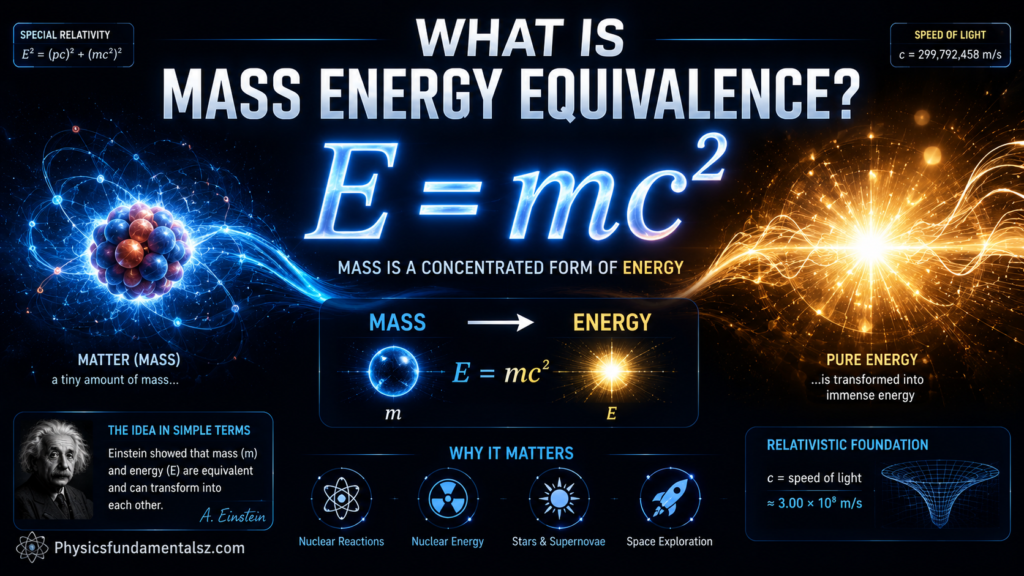
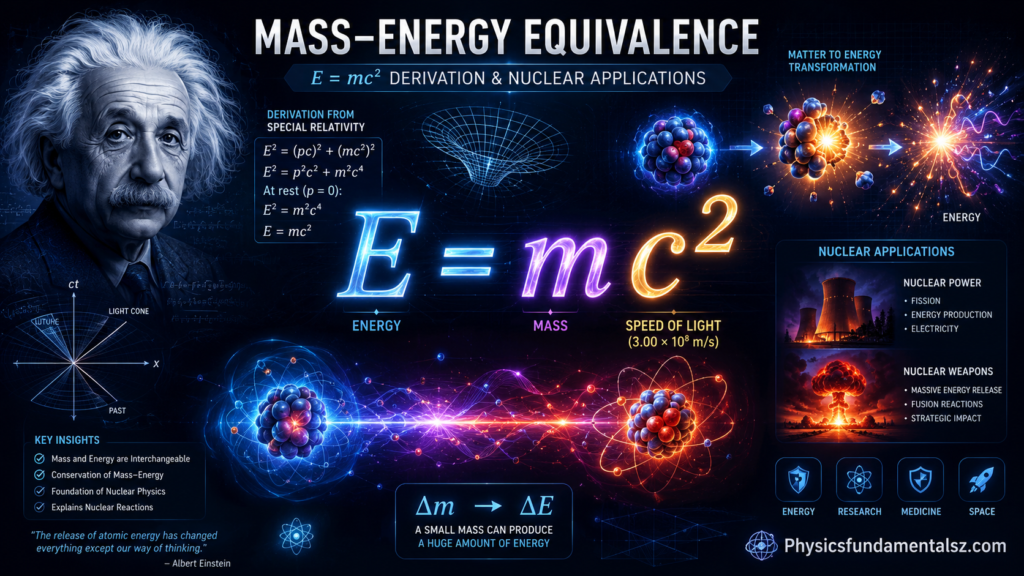
Mass energy equivalence states that mass and energy are two forms of the same underlying physical quantity.
Any object with mass has a corresponding amount of rest energy, given by Einstein’s equation E = mc².
This means mass can be converted into energy, and energy can, in principle, be converted into mass.
The Equation: E = mc²
- E stands for energy, measured in joules.
- m stands for rest mass, measured in kilograms.
- c stands for the speed of light in a vacuum, roughly 299,792,458 metres per second.
Because c² is an enormous number, even a tiny mass corresponds to an enormous amount of energy.
Where Does E = mc² Come From?
Einstein derived the relationship in 1905 as part of his special theory of relativity.
It follows from the idea that the laws of physics, and the speed of light, are the same for every observer moving at constant velocity.
Working through the consequences of that assumption, Einstein showed that an object’s energy content is tied directly to its mass.
A Simple Worked Example
Take one gram of matter, or 0.001 kilograms.
Multiplying by c², roughly 9 × 10¹⁶ m²/s², gives about 9 × 10¹³ joules of energy.
That is comparable to the energy released by a small nuclear explosion, from a mass smaller than a paperclip.
Rest Energy vs Relativistic Energy
| Concept | Formula | What It Describes |
|---|---|---|
| Rest energy | E = mc² | Energy contained in mass at rest, with no motion |
| Relativistic energy | E = γmc² | Total energy of an object moving at relativistic speed |
| Kinetic energy (relativistic) | KE = (γ − 1)mc² | Extra energy from motion, added to rest energy |
| Kinetic energy (classical) | KE = ½mv² | Approximation valid only at low speeds |
The Lorentz factor, γ, increases sharply as an object’s speed approaches the speed of light.
Why Nothing With Mass Can Reach Light Speed
As an object speeds up, more and more energy is needed to increase its velocity further.
At the speed of light itself, the energy required would become infinite, which is why no object with mass can ever reach c.
This is one of the clearest real-world consequences of mass energy equivalence.
Mass Energy Equivalence in Nuclear Reactions
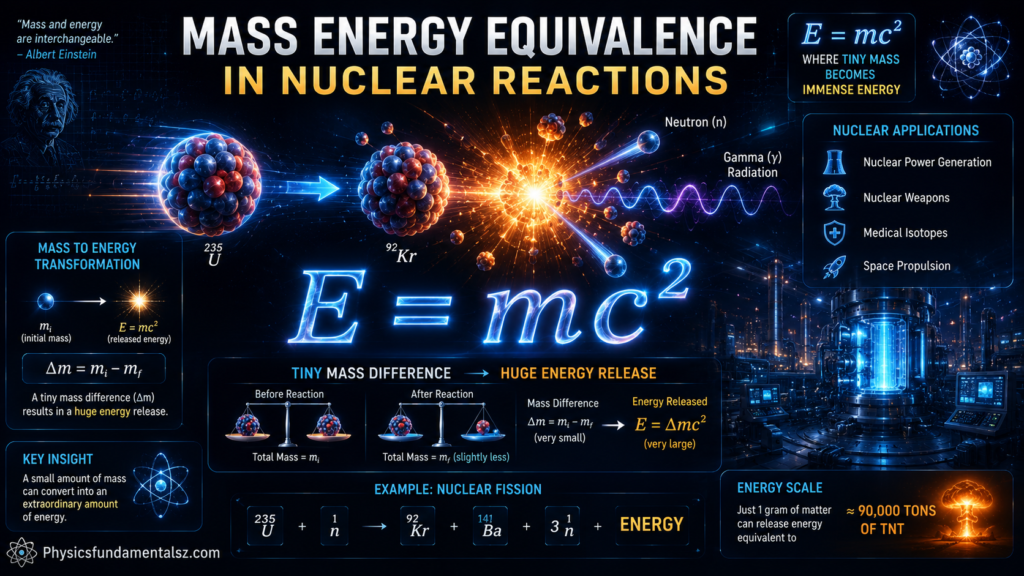
Nuclear fission and fusion both release energy by converting a small amount of mass into energy.
In fission, a heavy nucleus splits into smaller nuclei whose combined mass is slightly less than the original.
In fusion, light nuclei combine into a heavier one, again losing a tiny fraction of mass, which reappears as released energy.
Where You See This Principle at Work
- Nuclear power plants, which use controlled fission to generate electricity.
- The Sun, which powers itself through hydrogen fusion.
- Particle accelerators, where colliding particles can create new particles from pure energy.
- PET scans, which rely on the annihilation of matter and antimatter into energy.
- Nuclear weapons, which release energy through uncontrolled fission or fusion chain reactions.
Common Misconceptions About E = mc²
- Mass simply “turns into” energy in daily life. In practice, everyday chemical reactions convert far too little mass to notice.
- The equation only applies to nuclear physics. It applies to all matter, though the effect is only measurable at nuclear or relativistic scales.
- Relativistic mass is the same as rest mass. Modern physics mostly treats mass as an invariant rest mass, with γmc² describing total energy instead.
Mass Energy Equivalence vs Conservation of Mass
Classical physics assumed mass alone was always conserved in any reaction.
Special relativity refined this: it is mass-energy together that is conserved, not mass by itself.
A nuclear reaction can show a measurable mass difference, called the mass defect, precisely because that missing mass became energy.
How This Connects to Special Relativity
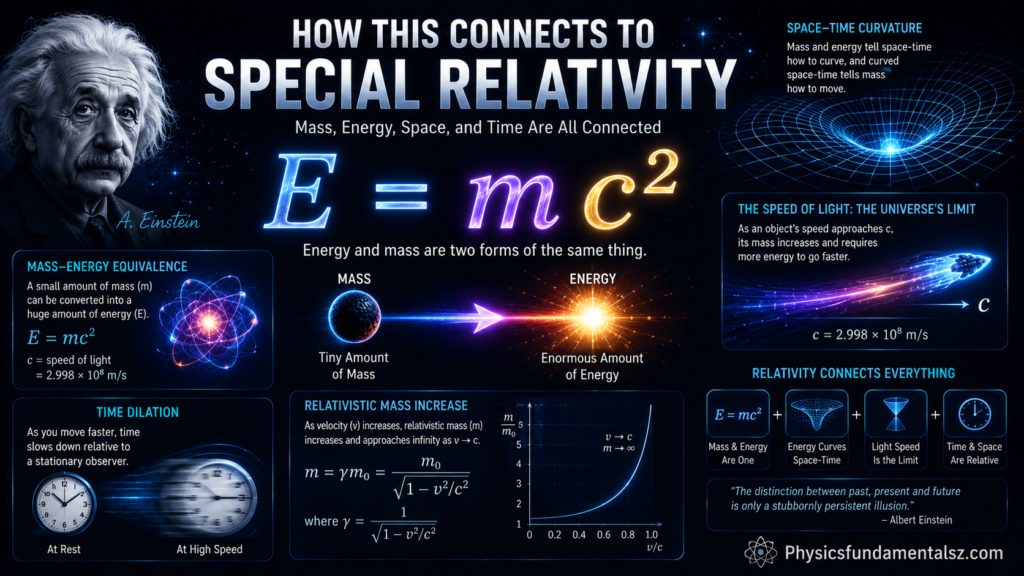
Mass energy equivalence is one part of a larger framework that also includes time dilation and length contraction.
All three effects come from the same starting point, that the speed of light is constant for every observer.
Understanding E = mc² is easier once you see it as a natural consequence of that single postulate, rather than an isolated formula.
Also Read:
- Special Relativity Explained
- Nuclear Fission and Fusion
- The Speed of Light
- Radioactive Decay
- Nuclear Decay Equations: Alpha, Beta & Gamma Decay Explained
- What Is Energy?
- Wave-Particle Duality
Frequently Asked Questions (FAQs)
What does mass energy equivalence mean in simple terms?
It means mass and energy are interchangeable, and any object with mass holds a corresponding amount of energy given by E = mc².
Who discovered mass energy equivalence?
Albert Einstein introduced the relationship in 1905 as part of his special theory of relativity.
What does each letter in E = mc² stand for?
E is energy, m is rest mass, and c is the speed of light in a vacuum.
Why is the speed of light squared in the equation?
Squaring c reflects how energy scales with mass in relativistic physics, and it is what makes even small masses correspond to huge energy values.
Can mass really be converted into energy?
Yes, this happens measurably in nuclear fission, nuclear fusion, and matter-antimatter annihilation.
Does E = mc² apply to everyday objects?
Yes in principle, but the mass converted in ordinary chemical reactions is far too small to detect.
What is the difference between rest energy and relativistic energy?
Rest energy is E = mc² for a stationary object, while relativistic energy, E = γmc², includes extra energy from motion at high speed.
Why can’t anything with mass travel at the speed of light?
The energy required to accelerate a massive object toward light speed grows without limit, making it physically impossible to reach.
What is mass defect in nuclear physics?
It is the small difference between the total mass of particles before and after a nuclear reaction, converted into released energy.
Is E = mc² only relevant to nuclear energy?
No, it also underlies particle physics, astrophysics, and technologies like PET imaging that rely on matter-energy conversion.
How much energy is in one gram of mass?
About 9 × 10¹³ joules, using E = mc² with the speed of light in metres per second.
Is relativistic mass still used in modern physics?
Most modern treatments prefer invariant rest mass, describing motion-dependent energy through the Lorentz factor instead.
How does mass energy equivalence relate to time dilation?
Both come from special relativity’s core postulate that the speed of light is constant for all observers, though they describe different effects.
Does E = mc² apply to light itself?
Light has no rest mass, but it carries energy and momentum described by a related relativistic energy-momentum equation.
Why is E = mc² considered one of the most important equations in physics?
It unified two previously separate concepts, mass and energy, and explained phenomena from stellar fusion to nuclear power.
Conclusion
Mass energy equivalence shows that mass is not separate from energy, it is another form of it, locked in place by the constant c².
From nuclear power plants to the Sun itself, E = mc² explains some of the most powerful processes in the universe with a single, elegant equation.
Explore Special Relativity Explained next to see how this idea fits into the bigger picture of Einstein’s physics.