Acceleration in Physics

Press the gas pedal and you are pushed back into your seat. Slam the brakes and you lurch forward. Turn a sharp corner and you lean. All three are acceleration — and that last one surprises people, because the car may not be changing speed at all. Acceleration is one of the most misunderstood ideas in physics, and getting it right is the key to everything that follows.
What acceleration really means
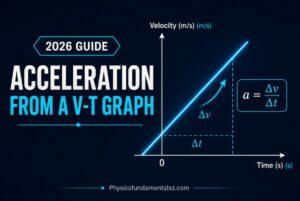
Acceleration is the rate at which velocity changes. The crucial word is velocity, not speed. Velocity is a vector: it has both a magnitude (how fast) and a direction (which way). Change either one and you are accelerating.
So there are three ways to accelerate: speed up, slow down, or change direction. A car rounding a bend at constant speed is accelerating because its direction is changing. This is why “deceleration” is just acceleration pointing opposite to the motion — physics needs no separate word for it.
Units and meaning
Since velocity is measured in meters per second and we divide by time in seconds, acceleration has units of meters per second per second, written m/s². A value of 5 m/s² means the velocity increases by 5 m/s every second. After one second you have gained 5 m/s; after two, 10 m/s; and so on.
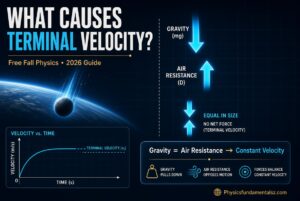
The familiar acceleration due to gravity near Earth’s surface is about 9.8 m/s² — every falling second adds roughly 9.8 m/s to a dropped object’s downward speed, ignoring air resistance.
Constant velocity means zero acceleration, even at high speed. A jet cruising at a steady 900 km/h in a straight line has no acceleration at all. It is only the change in velocity that counts — which is why you feel nothing during smooth cruising but everything during takeoff.
The link to force
Acceleration is where motion meets cause. Newton’s second law states that the acceleration of an object is proportional to the net force on it and inversely proportional to its mass:
This is why a loaded truck accelerates more sluggishly than a sports car: more mass means less acceleration for the same force. To understand the forces themselves, see Newton’s laws of motion.
Acceleration in graphs
Graphs make acceleration vivid:
- On a velocity–time graph, the slope is the acceleration. A steeper line means faster change; a flat line means constant velocity.
- The area under a velocity–time graph gives the distance traveled.
- On a position–time graph, acceleration shows up as curvature — a straight line means no acceleration, a curve means the velocity is changing.
The equations of motion
For motion with constant acceleration, a handful of equations let you predict everything. If an object starts at velocity u and accelerates uniformly at a:
The first gives the velocity after a time t; the second gives the distance covered. A third, v² = u² + 2·a·s, links velocity to distance without needing time. Together these “SUVAT” equations solve a huge range of problems, from a dropped ball to a braking train. They apply only when the acceleration stays constant; if the force changes during the motion, the acceleration changes too, and you must turn to calculus to track the velocity moment by moment. Even so, the constant-acceleration case covers an enormous fraction of everyday physics, which is why these equations are usually the first tools a student reaches for. When motion curves rather than runs straight, the relevant acceleration points toward the center — the subject of circular motion and centripetal force.
Frequently asked questions
Can something accelerate without changing speed?
Yes. An object moving in a circle at constant speed is constantly accelerating because its direction is always changing. Since velocity includes direction, any change of direction is an acceleration, even with the speed held perfectly steady.
Is deceleration a different thing from acceleration?
No. Slowing down is simply acceleration in the direction opposite to the motion. Physicists treat it as negative acceleration relative to the direction of travel; the underlying physics is identical.
Why do heavier objects need more force to accelerate?
Because of inertia, captured by F = m·a. Mass is a measure of resistance to changes in motion, so a larger mass requires a proportionally larger force to achieve the same acceleration.