Boyle’s, Charles’ & Gay-Lussac’s Gas Laws: Formulas & Examples
Push down on a bicycle pump and you feel the air push back harder the further you compress it. Leave a sealed bag of chips in a hot car and it puffs up like a balloon.
Both of these everyday moments are the gas laws in action. The gas laws are a set of physics relationships that describe exactly how pressure, volume, and temperature interact inside a fixed amount of gas, and three names sit at the center of this story: Boyle, Charles, and Gay-Lussac.
Table of Contents
What Are the Gas Laws?
The gas laws describe how a fixed mass of gas behaves when one of its physical properties changes while the others are held constant. Long before scientists understood that gases were made of countless tiny moving particles, experimenters like Robert Boyle, Jacques Charles, and Joseph Gay-Lussac discovered these relationships purely through careful measurement.
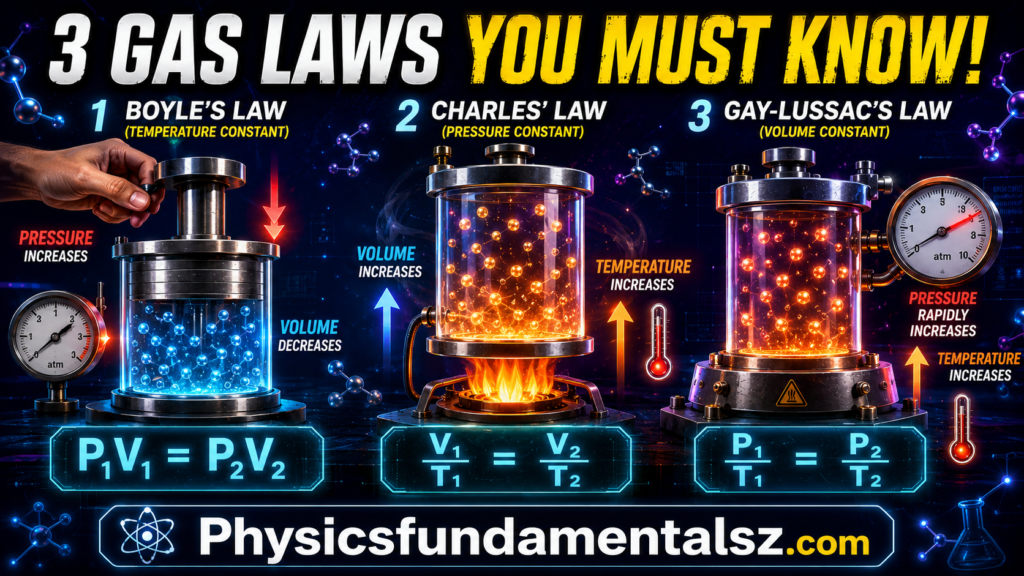
Each gas law isolates a relationship between two variables while holding a third constant. Boyle’s law connects pressure and volume at constant temperature. Charles’ law connects volume and temperature at constant pressure. Gay-Lussac’s law connects pressure and temperature at constant volume. Together, these three empirical laws form the foundation for the ideal gas law, which unifies pressure, volume, temperature, and the amount of gas into one equation.
Pressure, Volume, Temperature and Moles: The Four Variables
Every gas law problem revolves around four measurable quantities.
Pressure (P) is the force a gas exerts per unit area on the walls of its container, usually measured in atmospheres (atm), pascals (Pa), or kilopascals (kPa).
Volume (V) is the space the gas occupies, typically measured in liters or cubic meters.
Temperature (T) must always be expressed in Kelvin for gas law calculations, since Kelvin is an absolute temperature scale with no negative values, which prevents the equations from producing nonsensical results.
Amount of gas (n) is measured in moles, and it stays constant throughout Boyle’s, Charles’, and Gay-Lussac’s laws since none of these three laws involve adding or removing gas from the system.
Boyle’s Law: Pressure and Volume Relationship
Boyle’s law states that for a fixed mass of gas held at constant temperature, pressure and volume are inversely proportional. As the volume of a gas decreases, its pressure increases, and as volume increases, pressure decreases. This relationship was published by Robert Boyle in 1662 after careful experiments compressing air in a J-shaped tube.
The physical reason behind Boyle’s law is straightforward. Squeezing a gas into a smaller space forces its molecules into a tighter region, which means they collide with the container walls more frequently. More frequent collisions translate directly into higher pressure.
Boyle’s Law Formula
Boyle’s law is expressed as:
P₁V₁ = P₂V₂
Here P₁ and V₁ represent the initial pressure and volume, while P₂ and V₂ represent the final pressure and volume, with temperature and the amount of gas held constant throughout.
Worked Example of Boyle’s Law
Suppose a gas occupies 4 liters at a pressure of 2 atm. If the gas is compressed to 2 liters at constant temperature, what is the new pressure?
P₁V₁ = P₂V₂ (2 atm)(4 L) = P₂(2 L) 8 = 2P₂ P₂ = 4 atm
Halving the volume doubled the pressure, exactly as Boyle’s inverse relationship predicts.
Charles’ Law: Volume and Temperature Relationship
Charles’ law states that for a fixed mass of gas held at constant pressure, volume is directly proportional to absolute temperature. Heat a gas and it expands. Cool it down and it contracts. This relationship was discovered in the 1780s by French chemist Jacques Charles through his experiments with hot air balloons, and later refined by Joseph Gay-Lussac.
Charles’ law explains why a balloon left in a hot car expands and can even burst, and why the same balloon shrinks noticeably when brought outside on a cold winter day.
Charles’ Law Formula
Charles’ law is written as:
V₁/T₁ = V₂/T₂
Where V₁ and T₁ are the initial volume and temperature, and V₂ and T₂ are the final volume and temperature, both measured with temperature in Kelvin and pressure held constant.
Worked Example of Charles’ Law
A gas occupies 3 liters at 300 K. If the temperature rises to 450 K at constant pressure, what is the new volume?
V₁/T₁ = V₂/T₂ 3/300 = V₂/450 V₂ = (3 × 450)/300 V₂ = 4.5 L
The volume increased proportionally as temperature rose, confirming the direct relationship at the heart of Charles’ law.
Gay-Lussac’s Law: Pressure and Temperature Relationship
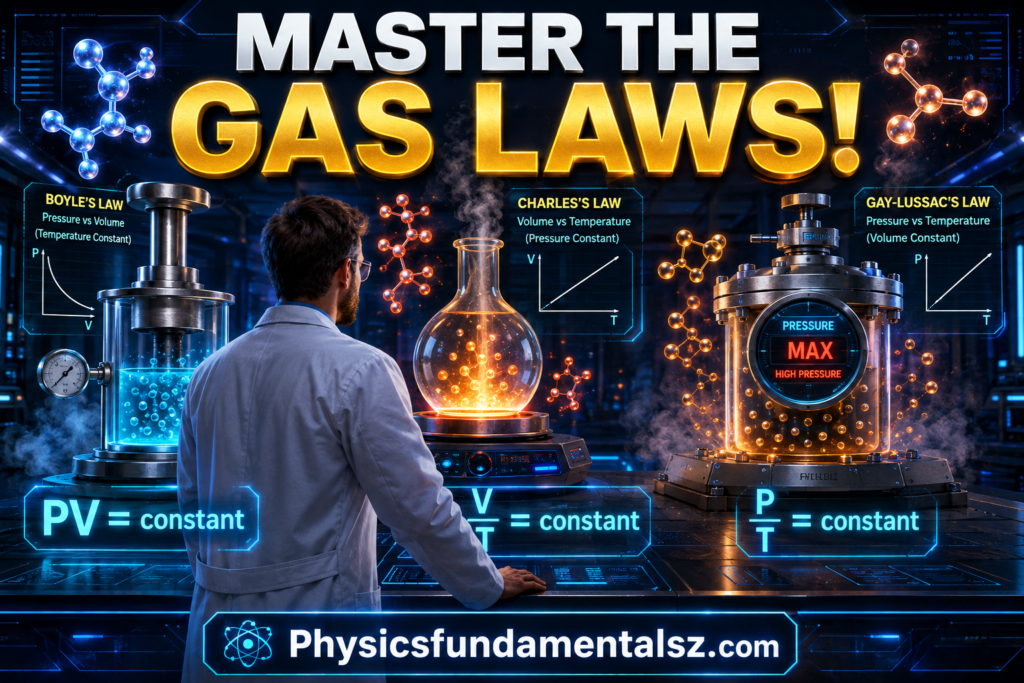
Gay-Lussac’s law states that for a fixed mass of gas held at constant volume, pressure is directly proportional to absolute temperature. Heat a sealed, rigid container of gas and the pressure inside rises steadily. Cool it down and the pressure drops. Joseph Gay-Lussac formalized this relationship in 1809 while studying how gases respond to temperature changes in fixed containers.
This law explains why aerosol cans carry warnings against being left near heat sources, and why car tires show slightly higher pressure readings after highway driving heats the air inside them.
Gay-Lussac’s Law Formula
Gay-Lussac’s law is expressed as:
P₁/T₁ = P₂/T₂
Where P₁ and T₁ are the initial pressure and temperature, and P₂ and T₂ are the final pressure and temperature, with volume and the amount of gas held constant.
Worked Example of Gay-Lussac’s Law
A rigid container holds gas at 1 atm and 250 K. If the temperature rises to 500 K, what is the new pressure?
P₁/T₁ = P₂/T₂ 1/250 = P₂/500 P₂ = (1 × 500)/250 P₂ = 2 atm
Doubling the absolute temperature doubled the pressure, exactly as this direct proportionality predicts.
The Combined Gas Law
Since Boyle’s, Charles’, and Gay-Lussac’s laws each hold one variable constant, physicists eventually combined all three relationships into a single equation that allows pressure, volume, and temperature to change simultaneously, so long as the amount of gas stays fixed.
Combined Gas Law Formula and Example
The combined gas law is written as:
(P₁V₁)/T₁ = (P₂V₂)/T₂
Suppose a gas occupies 6 liters at 2 atm and 300 K. What is its volume if the pressure rises to 3 atm and the temperature rises to 450 K?
(P₁V₁)/T₁ = (P₂V₂)/T₂ (2 × 6)/300 = (3 × V₂)/450 12/300 = 3V₂/450 0.04 × 450 = 3V₂ 18 = 3V₂ V₂ = 6 L
In this particular case, the volume ends up unchanged because the increases in pressure and temperature offset each other proportionally, a useful reminder that the combined gas law captures the interaction between all three variables at once rather than treating them in isolation.
Here is a second example that shows the combined gas law solving for a different unknown. A weather balloon contains 12 liters of gas at 1 atm and 290 K at ground level. As it rises, the pressure drops to 0.4 atm and the temperature falls to 250 K. What is the new volume of gas inside the balloon?
(P₁V₁)/T₁ = (P₂V₂)/T₂ (1 × 12)/290 = (0.4 × V₂)/250 0.0414 × 250 = 0.4V₂ 10.34 = 0.4V₂ V₂ = 25.9 L
The balloon expands to roughly 25.9 liters as it rises, since the drop in pressure dominates over the drop in temperature. This is exactly why weather balloons are launched only partially inflated on the ground, leaving room to expand as atmospheric pressure decreases with altitude, and it is also why such balloons eventually burst once they climb high enough for the internal gas volume to exceed the balloon’s structural limit.
From Combined Gas Law to Ideal Gas Law
The combined gas law describes how a fixed amount of gas behaves as conditions change, but it says nothing about how much gas is actually present. Adding the number of moles (n) into the equation produces the full ideal gas law, PV = nRT, where R is the universal gas constant.
This single equation contains Boyle’s, Charles’, and Gay-Lussac’s laws as special cases. Hold temperature and moles constant and PV = nRT reduces to Boyle’s law. Hold pressure and moles constant and it reduces to Charles’ law. Hold volume and moles constant and it reduces to Gay-Lussac’s law. This is why the ideal gas law is often described as the master equation of gas behavior, since every simpler gas law is really just a limited view of this one broader relationship.
Why Do Gases Behave This Way? The Kinetic Theory Explanation
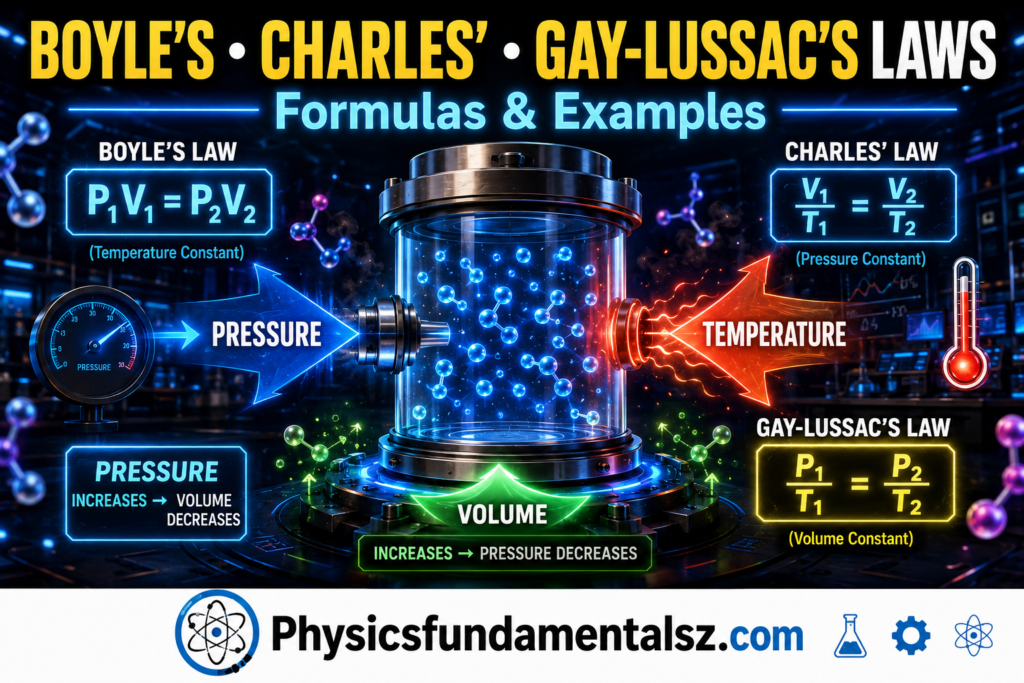
The gas laws were discovered experimentally, long before anyone understood why they worked at a molecular level. That explanation comes from the kinetic theory of gases, which models a gas as an enormous number of particles in constant, random motion, colliding elastically with each other and the container walls.
Pressure emerges from the frequency and force of these particle collisions against the walls of a container. Compressing a gas, as in Boyle’s law, packs particles closer together and increases how often they strike the walls, raising pressure. Heating a gas, as in Charles’ and Gay-Lussac’s laws, increases the average kinetic energy and speed of the particles, which in turn increases either the force of each collision or the frequency of collisions, depending on whether volume or pressure is allowed to change.
This connection between particle speed and temperature is exactly why substances with different molecular structures respond so differently to heating, a property captured by specific heat capacity. Kinetic theory turns the gas laws from a set of memorized formulas into a direct consequence of particle motion, tying together pressure, temperature, and energy into a single coherent picture.
Real World Applications of the Gas Laws
The gas laws are not confined to textbooks and laboratories. Scuba divers rely on Boyle’s law to understand how the volume of air in their lungs and equipment changes with depth and pressure underwater. Hot air balloons rise because heating the air inside them, governed by Charles’ law, expands the gas and reduces its density relative to the surrounding cooler air. Pressure cookers use Gay-Lussac’s law directly, sealing a fixed volume of steam and allowing pressure to build with temperature, which raises the boiling point of water and cooks food faster.
Weather systems, aerosol can safety warnings, tire pressure changes between summer and winter, and even the way metal containers respond to heat, a phenomenon closely tied to thermal expansion, all trace back to these same fundamental relationships between pressure, volume, and temperature.
Frequently Asked Questions (FAQs)
What is the difference between Boyle’s law and Charles’ law?
Boyle’s law relates pressure and volume at constant temperature, showing an inverse relationship where increasing pressure decreases volume. Charles’ law relates volume and temperature at constant pressure, showing a direct relationship where increasing temperature increases volume. Each law isolates a different pair of variables while holding a third one fixed.
Why must temperature be in Kelvin for gas law calculations?
Kelvin is an absolute temperature scale that starts at absolute zero, the point at which particle motion theoretically stops. Celsius and Fahrenheit include negative values, which would produce impossible negative volumes or pressures if used directly in these proportional equations. Kelvin avoids this problem entirely, which is why every gas law calculation converts temperature to Kelvin first.
What is the combined gas law used for?
The combined gas law is used whenever more than one variable, pressure, volume, or temperature, changes at the same time for a fixed amount of gas. It is especially useful in real world scenarios like scuba diving calculations or industrial processes where conditions rarely change one variable at a time.
Does Avogadro’s law fit into this picture?
Yes. Avogadro’s law states that at constant temperature and pressure, the volume of a gas is directly proportional to the number of moles present. While Boyle’s, Charles’, and Gay-Lussac’s laws all assume a fixed amount of gas, Avogadro’s law introduces the fourth variable, moles, which is exactly what allows the combined gas law to expand into the full ideal gas law, PV = nRT.
Bringing It All Together
Boyle’s, Charles’, and Gay-Lussac’s laws each describe a piece of the same underlying picture: pressure, volume, and temperature are all connected through the motion of gas particles.
Boyle’s law shows what happens when you squeeze a gas. Charles’ law shows what happens when you heat it at constant pressure. Gay-Lussac’s law shows what happens when you heat it in a sealed, fixed volume.
Combine all three and add in the amount of gas, and you arrive at the ideal gas law, the single equation that governs gas behavior across chemistry, physics, and engineering.
To continue building a complete picture of thermodynamics, explore how these gas laws connect to energy conservation in the first law of thermodynamics, and see how particle motion drives temperature and pressure in the kinetic theory of gases.