Gravitational Potential Energy: GPE = mgh Formula, Derivation & Examples
Lift a book off a table, stretch a spring, or carry water up to a rooftop tank, and in each case you are doing more than moving mass around. You are storing energy that can be released later, sometimes gently, sometimes explosively.
When that stored energy comes specifically from an object’s position in a gravitational field, it is called gravitational potential energy, and it is one of the most useful ideas in all of physics.
Gravitational potential energy (often abbreviated as GPE) connects everyday experiences, a dropped phone, a swinging pendulum, a roller coaster car at the top of a hill, to the same handful of variables and one simple formula.
Understanding it properly also opens the door to escape velocity, orbital mechanics, and the conservation of energy, some of the most elegant results in classical mechanics.
Table of Contents
What Is Gravitational Potential Energy?
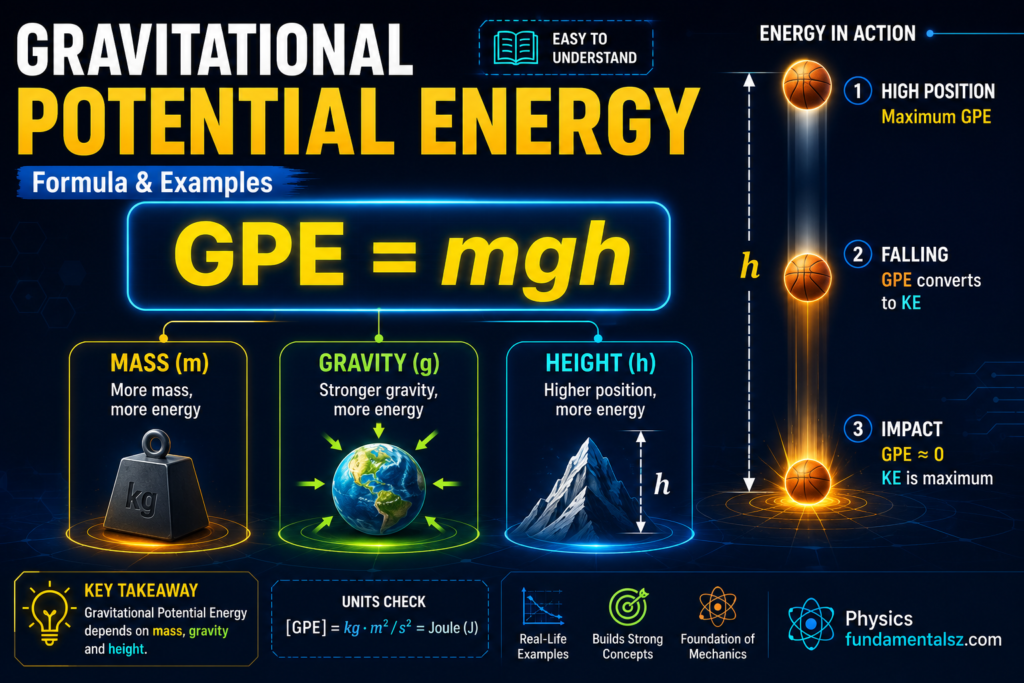
Gravitational potential energy is the energy an object possesses because of its position within a gravitational field, typically its height above the ground. It is a form of stored, or potential, energy, meaning it has not yet been converted into motion but has the capacity to do so at any moment.
Picture a ball resting on a shelf. It is not moving, so it has no kinetic energy. Yet if it rolls off the edge, it will accelerate downward, gaining speed as it falls. That gain in motion has to come from somewhere, and it comes from the gravitational potential energy the ball had while sitting on the shelf. The higher the shelf, the more energy is available to convert into motion, and the faster the ball will be moving when it hits the ground.
This is the core idea behind gravitational potential energy: height stores energy, and that energy is released as the object moves closer to the source of the gravitational pull, usually the Earth.
The Gravitational Potential Energy Formula
Near the surface of the Earth, where the strength of gravity can be treated as constant, gravitational potential energy is calculated with a short and memorable formula:
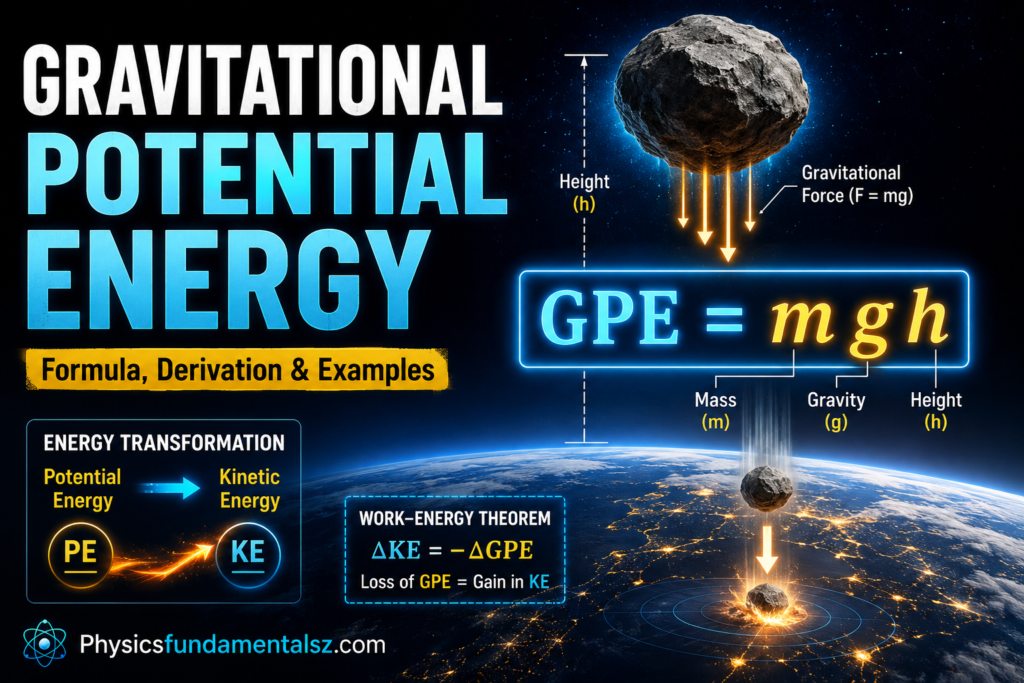
GPE = m · g · h
This is often written as U = mgh, where U represents potential energy.
Breaking Down Each Variable
- m (mass) is the mass of the object, measured in kilograms. A heavier object stores more gravitational potential energy at the same height because more mass means gravity has more to pull on.
- g (gravitational acceleration) is the acceleration due to gravity, approximately 9.8 m/s² near the Earth’s surface. This value comes from Newton’s law of universal gravitation and represents how strongly the Earth pulls on nearby objects.
- h (height) is the vertical distance of the object above a chosen reference level, measured in metres. This reference point is arbitrary. You could measure height from the floor, from sea level, or from the ground beneath a cliff, as long as you stay consistent throughout a calculation.
The unit of gravitational potential energy is the joule (J), the same unit used for all forms of energy, including kinetic energy explored in our guide to kinetic energy.
Where Does Gravitational Potential Energy Come From?
Gravitational potential energy is not stored inside the object itself. It is stored in the relationship between the object and the body creating the gravitational field, most commonly the Earth. This distinction matters because it explains why potential energy always depends on position relative to something else, never on the object in isolation.
When you lift an object, you do work against gravity. That work does not disappear. It gets converted directly into gravitational potential energy. This is a direct application of the work-energy relationship: the force you apply, multiplied by the distance you lift the object, equals the energy transferred into the gravitational field.
Key idea
Gravitational potential energy is really stored work. Every joule of energy you spend lifting an object against gravity reappears later as kinetic energy when the object falls, assuming no energy is lost to air resistance or friction.
This is also why gravitational potential energy is sometimes described as negative in more advanced treatments involving large distances, such as satellites and planetary orbits. Near Earth’s surface, though, the simple mgh formula works perfectly well and is what most students and everyday calculations rely on.
Gravitational Potential Energy and the Conservation of Energy
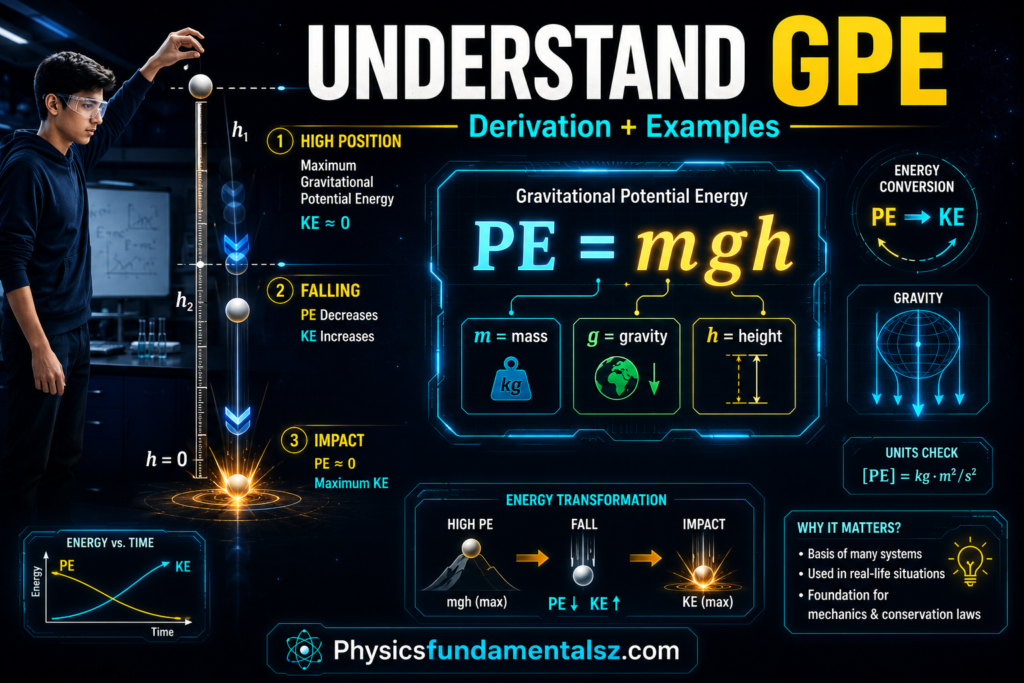
One of the most powerful uses of gravitational potential energy is in the principle of conservation of mechanical energy. In a system where only gravity acts, and there is no friction or air resistance, the total mechanical energy, the sum of gravitational potential energy and kinetic energy, stays constant.
Total mechanical energy = GPE + KE = constant
This means that as an object falls, it does not lose energy. It simply trades one form for another. Gravitational potential energy decreases as height decreases, and kinetic energy increases by exactly the same amount. At the exact moment an object reaches the ground, essentially all of its original gravitational potential energy has been converted into kinetic energy.
This trade-off explains a huge range of phenomena:
- A pendulum swings because it constantly converts gravitational potential energy at the top of its arc into kinetic energy at the bottom, and back again.
- A roller coaster car needs no engine after the initial climb because the height at the top of the first hill stores enough gravitational potential energy to power the entire ride, assuming minimal friction.
- A dam generates electricity by allowing water to fall from a height, converting gravitational potential energy into kinetic energy, which then turns turbines.
For a deeper look at how kinetic energy behaves during these transformations, including why it scales with the square of velocity, see our full breakdown of kinetic energy.
A Worked Example of Gravitational Potential Energy
Numbers make the concept concrete. Suppose a 2 kg book sits on a shelf 1.5 metres above the floor. How much gravitational potential energy does it have relative to the floor?
Using the formula:
GPE = m · g · h GPE = 2 kg × 9.8 m/s² × 1.5 m GPE = 29.4 J
The book stores 29.4 joules of gravitational potential energy relative to the floor. If it falls, this entire amount converts into kinetic energy just before impact, allowing us to calculate its final speed using the kinetic energy formula, KE = ½mv².
Rearranging for v gives a final speed of about 5.42 m/s just before the book hits the floor, a useful demonstration of how gravitational potential energy and kinetic energy connect directly through the conservation of energy. You can experiment with different masses and heights using our gravitational potential energy calculator, which instantly solves for any missing variable in the formula.
A second example shows how quickly gravitational potential energy scales with height. Imagine a 60 kg diver standing on a 10 metre platform. Their gravitational potential energy relative to the pool surface is:
GPE = m · g · h GPE = 60 kg × 9.8 m/s² × 10 m GPE = 5,880 J
Nearly six thousand joules of stored energy, all released as kinetic energy during the roughly 1.4 second fall to the water. Doubling the platform height to 20 metres would double the gravitational potential energy again, to 11,760 J, since the relationship between height and stored energy is directly proportional. This proportionality is what makes the mgh formula so quick to apply in practice, and so easy to scale for comparison problems.
Common Mistakes When Calculating Gravitational Potential Energy
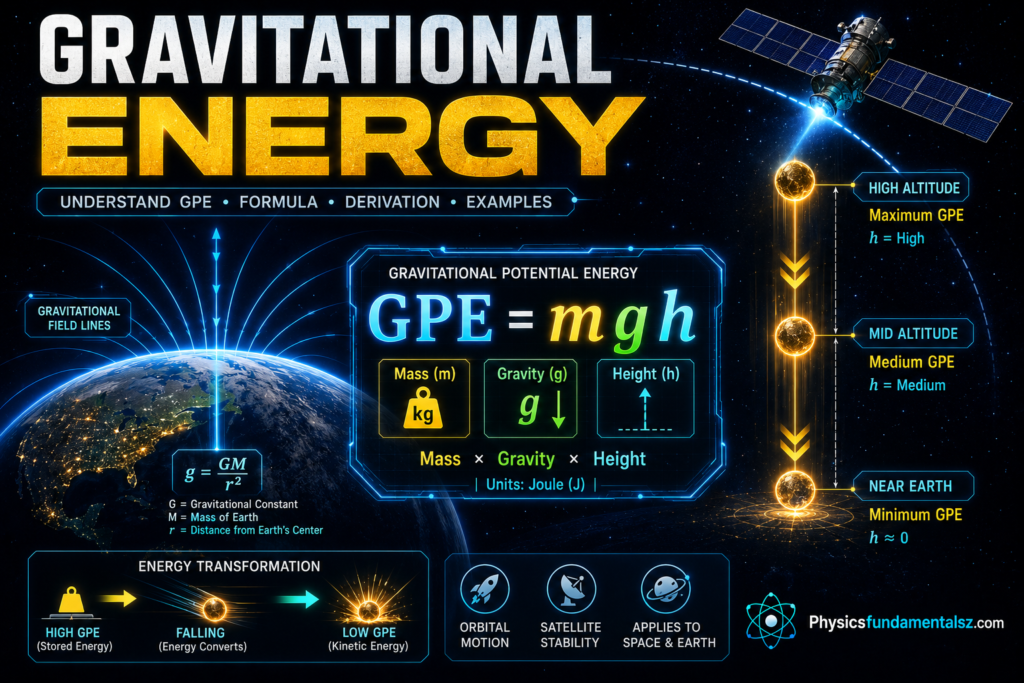
Even a simple formula like GPE = mgh trips students up in predictable ways. Being aware of these mistakes makes calculations far more reliable.
- Forgetting to choose a consistent reference height. Gravitational potential energy is always relative to a chosen zero point. If a problem involves a ball on a table and the table itself sits on a raised platform, you must decide whether height is measured from the table, the platform, or the floor, and use that same reference throughout the entire problem.
- Mixing up mass and weight. The formula requires mass in kilograms, not weight in newtons. A common error is plugging in a weight value directly instead of first converting it to mass.
- Using the wrong value of g. On Earth, 9.8 m/s² is standard, but the same formula applies on the Moon or Mars using their respective gravitational accelerations, roughly 1.6 m/s² and 3.7 m/s². Forgetting to adjust g when a problem is set on another world is a frequent source of error.
- Assuming gravitational potential energy is only about falling objects. The concept applies just as well to horizontal displacement combined with vertical lift, compressed fluids in a tank, or any scenario where height changes, not just objects in free fall.
Gravitational Potential Energy Beyond Earth’s Surface
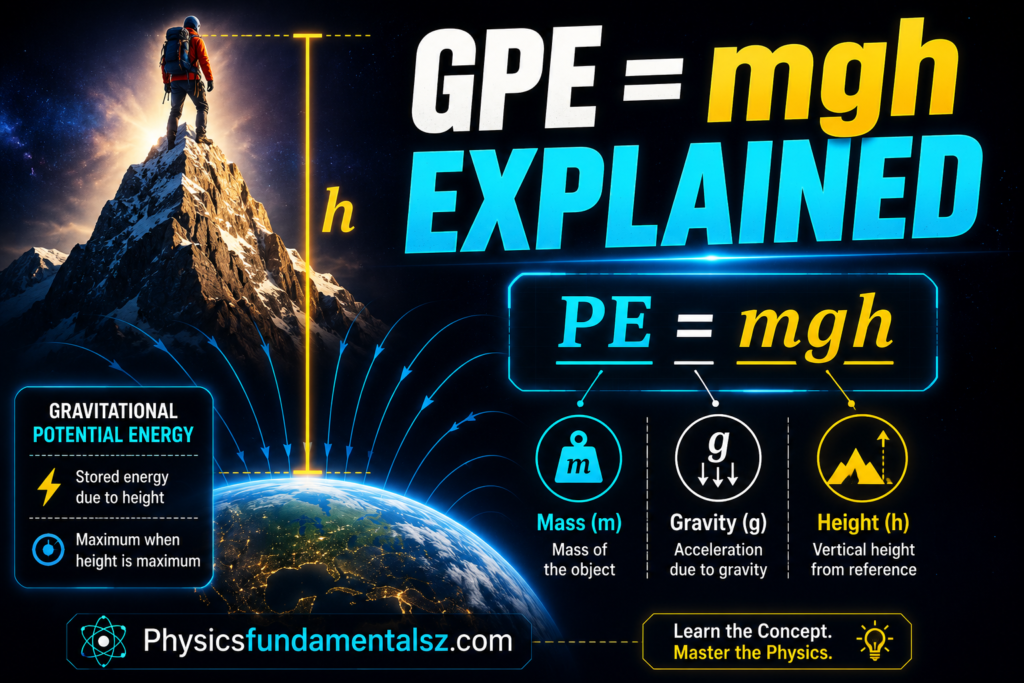
The simple mgh formula assumes gravity is constant, which is an excellent approximation near the Earth’s surface but breaks down over large distances, such as those involved in satellites, rockets, and planetary motion. Over these scales, gravity weakens with distance according to Newton’s law of universal gravitation, and gravitational potential energy must be calculated differently:
U = −G · M · m / r
Here G is the universal gravitational constant, M is the mass of the larger body such as a planet, m is the mass of the smaller object, and r is the distance between their centres. The negative sign reflects the convention that gravitational potential energy is zero at infinite distance and becomes increasingly negative as objects get closer together, since gravity is an attractive force pulling them inward.
This more general formula is essential for understanding escape velocity, the minimum speed an object needs to break free of a planet’s gravitational pull entirely. Escape velocity is found by setting the total mechanical energy of an escaping object equal to zero, balancing its kinetic energy against the gravitational potential energy holding it in place. You can explore this relationship directly using the escape velocity calculator on our physics calculators page.
Gravitational Potential Energy in Everyday Life
The concept shows up constantly, often without being noticed:
- Hydroelectric dams rely entirely on converting the gravitational potential energy of stored water into electricity.
- Elevators and cranes do work against gravity to increase an object’s gravitational potential energy, which is why lifting heavy loads requires so much power.
- Sports, from pole vaulting to ski jumping, are direct demonstrations of athletes converting muscular energy into gravitational potential energy, then releasing it as kinetic energy.
- Rollercoasters are engineered almost entirely around the trade-off between gravitational potential energy at the top of hills and kinetic energy in the valleys.
This same principle, energy conservation through the interplay of position and motion, threads through nearly every branch of classical mechanics, from momentum and impulse to rotational dynamics. For a broader overview of how these core ideas connect, see our complete guide to physics fundamentals.
Frequently Asked Questions (FAQs)
Is gravitational potential energy always positive?
Near the Earth’s surface, using the mgh formula with a ground-level reference point, gravitational potential energy is usually treated as positive for any object above that reference. However, in the more general formula used for large distances, U = −GMm/r, gravitational potential energy is defined as negative, becoming less negative as objects move farther apart and approaching zero at infinite separation.
Does gravitational potential energy depend on the path taken?
No. Gravitational potential energy depends only on the final height relative to the reference point, not on the path used to get there. Whether an object is lifted straight up or carried along a winding staircase to the same height, its gravitational potential energy is identical. This is because gravity is a conservative force.
What is the difference between gravitational potential energy and gravitational potential?
Gravitational potential energy is the total energy stored by a specific object due to its position, measured in joules. Gravitational potential is the energy stored per unit mass at a point in a gravitational field, measured in joules per kilogram. Multiplying gravitational potential by an object’s mass gives its gravitational potential energy.
Can gravitational potential energy be negative?
Yes, though the sign depends entirely on which formula and reference point are being used. With the near-surface formula GPE = mgh, choosing ground level as the reference makes any height above it positive, but an object in a hole below that reference would have negative gravitational potential energy. With the large-scale formula U = −GMm/r, potential energy is negative by convention, becoming zero only at infinite distance, reflecting the fact that gravity always pulls objects together rather than pushing them apart.
Conclusion
Gravitational potential energy is, at its heart, a story about height and work.
Every time an object is raised against gravity, energy is stored, waiting to be released the instant it is allowed to fall. From a dropped ball to a satellite escaping Earth’s pull, the same underlying formula, and the same conservation of energy, governs it all.