Escape Velocity: v = √(2GM/r) Formula, Derivation & Worked Examples
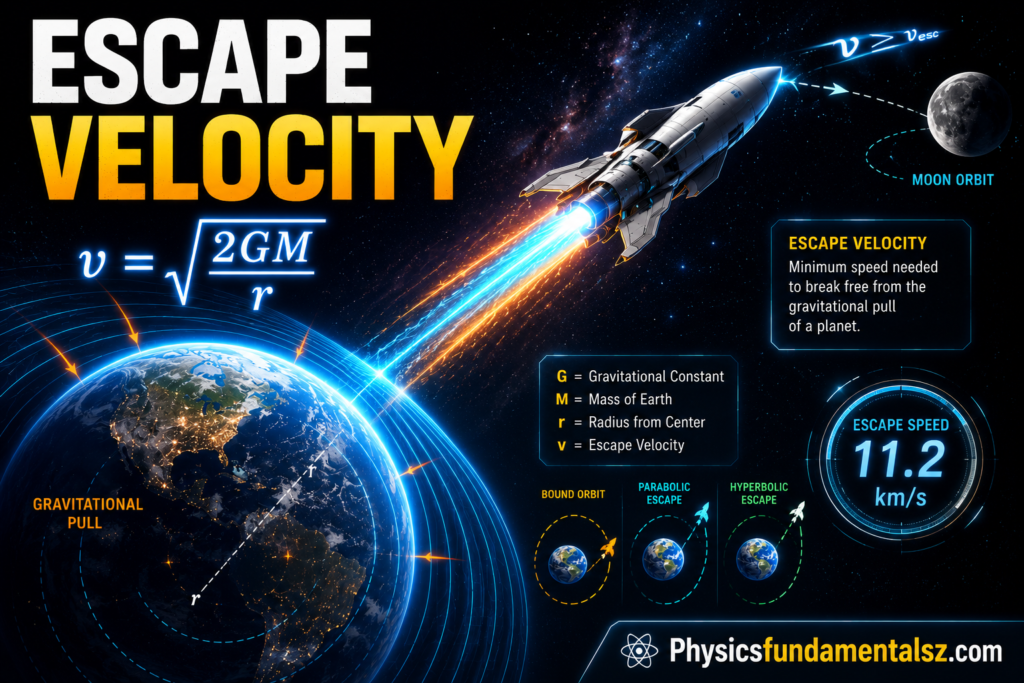
Escape velocity is one of the most fascinating ideas in classical mechanics and astrophysics.
It explains why a rocket needs a specific minimum speed to leave Earth, why the Moon cannot hold on to an atmosphere, and why nothing, not even light, can leave a black hole.
If you are new to the underlying concepts of force, energy, and motion, it helps to first review Newton’s Laws of Motion, since escape velocity is really just Newton’s laws applied to gravity on a planetary scale.
Table of Contents
What Is Escape Velocity?
Escape Velocity Definition in Simple Terms
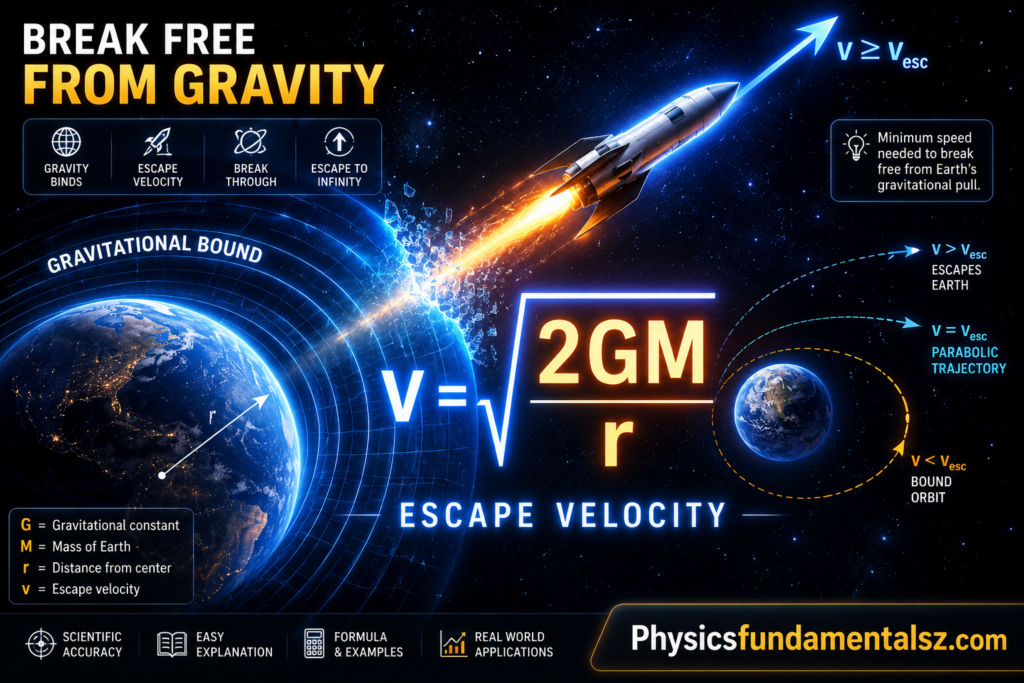
Escape velocity is the minimum speed an object needs to break free from the gravitational pull of a planet, moon, or star without any further propulsion. Once an object reaches this speed, gravity will keep slowing it down, but never enough to pull it back.
Think of throwing a ball straight up. Throw it gently and it falls back. Throw it a little harder and it goes higher before falling back. If you could throw it fast enough, it would keep going forever, slowing down due to gravity but never actually stopping and reversing direction. That specific throwing speed is the escape velocity for that location.
Escape velocity is often confused with escape speed. Technically, escape speed is the more accurate term because escape velocity does not depend on direction, only magnitude. In practice, both terms are used interchangeably in physics education and in everyday language.
Why Escape Velocity Depends on Mass and Radius
Escape velocity is not a fixed number. It changes based on two things:
- The mass of the object you are trying to escape from (a planet, moon, or star)
- The distance from the center of that object (usually its radius, if you are starting from the surface)
A more massive body pulls harder, so escape velocity increases. A larger radius means you are already farther from the center of mass, so gravity is weaker at that point and escape velocity decreases. This relationship becomes clearer once we look at the actual formula.
Escape Velocity Formula
The escape velocity formula is:
v = √(2GM / r)
Where:
- v is the escape velocity
- G is the universal gravitational constant, approximately 6.674 × 10⁻¹¹ N·m²/kg²
- M is the mass of the planet, moon, or star
- r is the distance from the center of that body to the point of escape
This formula tells us that escape velocity grows with the square root of mass and shrinks with the square root of radius. Doubling the mass of a planet increases escape velocity by a factor of about 1.41, while doubling the radius decreases it by the same factor.
Deriving the Escape Velocity Formula from Energy Conservation
The escape velocity formula comes directly from the conservation of energy, one of the most powerful ideas in physics. If you want a deeper refresher on this concept before continuing, check out What Is Energy? and the related Work-Energy Theorem, since escape velocity is essentially a direct application of these principles.
Here is the derivation, step by step:
Step 1: Set up the total energy
For an object of mass m leaving the surface of a planet of mass M and radius r, the total mechanical energy is the sum of kinetic energy and gravitational potential energy:
E_total = (1/2)mv² + (−GMm / r)
Step 2: Apply the escape condition
For the object to just barely escape, its final kinetic energy at infinite distance should be zero, and gravitational potential energy at infinite distance is also zero. So the total energy at the moment of escape must equal zero:
(1/2)mv² − GMm / r = 0
Step 3: Solve for v
(1/2)mv² = GMm / r
v² = 2GM / r
v = √(2GM / r)
Notice that the mass of the escaping object, m, cancels out completely. This means escape velocity does not depend on the mass of the rocket, satellite, or particle trying to escape. A feather and a spacecraft need the same escape velocity from the same location, ignoring air resistance.
Units of Escape Velocity
Escape velocity is measured in units of speed, typically:
- Meters per second (m/s) in SI units
- Kilometers per second (km/s) for planetary scale numbers
- Miles per hour or miles per second in some regional contexts
For reference, Earth’s escape velocity of 11.2 km/s is equivalent to roughly 40,320 kilometers per hour, or about 25,000 miles per hour.
Escape Velocity of Earth, Moon, and Other Planets
The table below shows escape velocity for several bodies in our solar system, calculated using their respective mass and radius.
| Celestial Body | Escape Velocity (km/s) | Escape Velocity (mph) |
|---|---|---|
| Mercury | 4.3 | 9,600 |
| Venus | 10.4 | 23,300 |
| Earth | 11.2 | 25,000 |
| Moon | 2.4 | 5,300 |
| Mars | 5.0 | 11,200 |
| Jupiter | 59.5 | 133,000 |
| Saturn | 35.5 | 79,400 |
| Sun | 617.5 | 1,381,000 |
Notice how the Moon’s low escape velocity of only 2.4 km/s explains why it cannot hold on to a substantial atmosphere. Gas molecules moving at typical thermal speeds easily exceed the Moon’s escape velocity and drift off into space over time. Jupiter, on the other hand, has such a high escape velocity that it retains even light gases like hydrogen and helium.
Escape Velocity vs Orbital Velocity
A common point of confusion is the difference between escape velocity and orbital velocity. Both describe motion against gravity, but they serve very different purposes. If you want to understand the underlying force that keeps satellites moving in curved paths, our guide on Circular Motion and Centripetal Force is a useful companion to this section.
Key Differences Explained
- Orbital velocity is the speed needed to maintain a stable circular orbit around a body, staying at a constant distance without falling in or flying away.
- Escape velocity is the speed needed to leave that gravitational field entirely and never return.
Mathematically, escape velocity is always exactly √2 (about 1.414) times the orbital velocity at the same altitude. This is why the escape velocity formula and the orbital velocity formula look so similar, they share the same gravitational term, but escape velocity carries the extra factor of 2 inside the square root.
For example, a satellite orbiting Earth at low altitude travels at roughly 7.8 km/s to maintain orbit. To leave Earth’s gravity entirely from that same altitude, it would need close to 11 km/s, matching the √2 relationship.
Escape Velocity and Gravitational Potential Energy
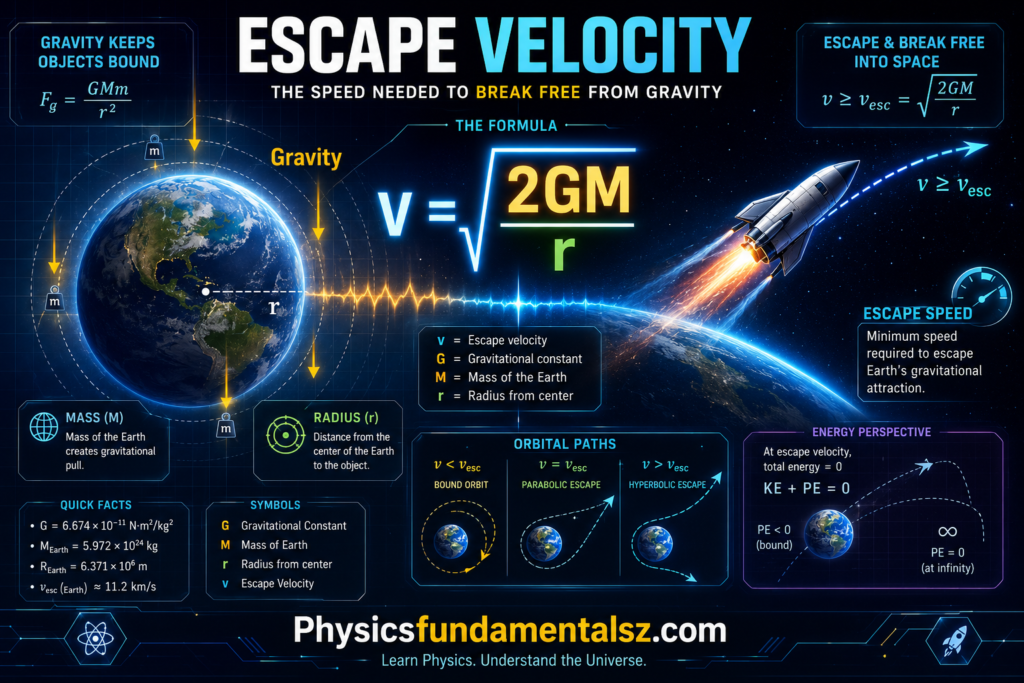
Escape velocity cannot be fully understood without gravitational potential energy, the energy an object has because of its position within a gravitational field. As an object moves farther from a planet, its gravitational potential energy increases (becomes less negative), while its kinetic energy decreases, assuming no external force acts on it.
This trade-off between kinetic and potential energy is the same conservation principle covered in our Conservation of Momentum article, though applied here to energy rather than momentum. Understanding both conservation laws together gives a much stronger foundation for topics like orbital mechanics, projectile motion, and escape velocity.
Escape Velocity and Black Holes
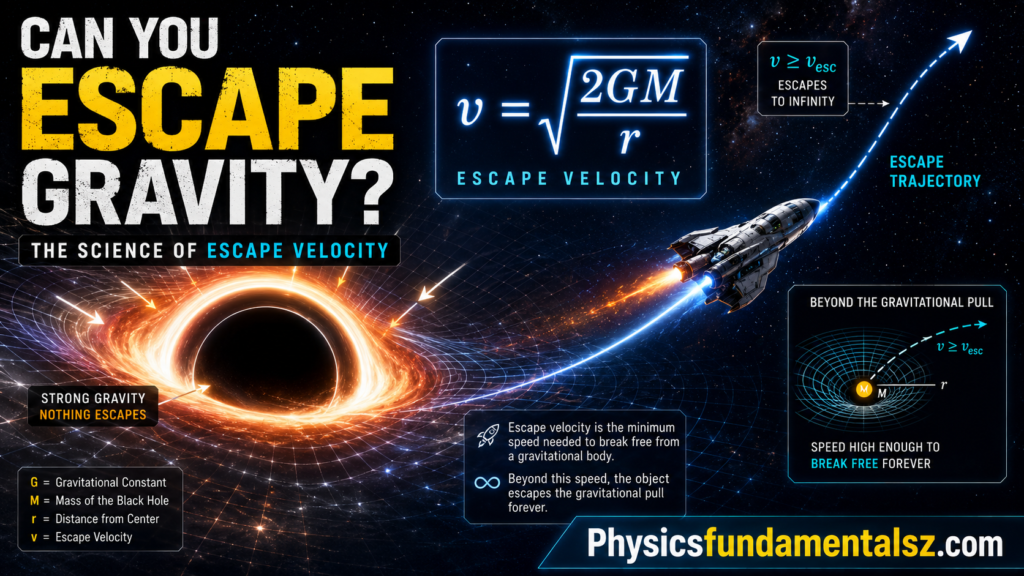
Escape velocity takes on an extreme and fascinating role when applied to black holes. A black hole is an object so dense that its escape velocity, at a certain boundary, exceeds the speed of light itself.
Event Horizon and the Speed of Light Limit
The event horizon of a black hole is the boundary at which escape velocity equals the speed of light, approximately 299,792 km/s. Beyond this boundary, nothing, not even light, has enough speed to escape the gravitational pull. This is precisely why black holes appear completely black: light itself cannot achieve escape velocity from within the event horizon.
To fully appreciate why the speed of light acts as this absolute cosmic limit, our detailed guide on the Speed of Light explains why nothing with mass can ever reach or exceed it, which ties directly into why black holes trap everything within their event horizon.
Real World Examples of Escape Velocity
Rockets and Satellites
Rockets do not actually need to reach escape velocity to enter orbit. Most satellites, including the International Space Station, orbit well below escape velocity because they are not trying to leave Earth’s gravity, only to balance it with orbital motion.
Escape velocity becomes relevant for missions heading beyond Earth orbit, such as lunar missions, interplanetary probes, or spacecraft leaving the solar system entirely, like Voyager 1 and Voyager 2. These probes had to exceed Earth’s escape velocity, and eventually the Sun’s escape velocity at their distance, to leave the solar system on a permanent trajectory.
The Karman Line and Orbital Insertion
Space officially begins at the Karman line, an altitude of about 100 kilometers above Earth’s surface. Reaching this altitude does not require escape velocity, only enough speed and angle to either fall back to Earth (a suborbital flight) or achieve stable orbit (orbital velocity). Escape velocity only becomes necessary when a spacecraft intends to leave Earth’s gravitational influence permanently.
Common Misconceptions About Escape Velocity
Misconception 1: Escape velocity means you must always maintain that speed. In reality, once an object reaches escape velocity, it can slow down as it moves farther away, since gravity weakens with distance. It simply never slows down enough to fall back.
Misconception 2: Heavier rockets need higher escape velocity. As shown in the derivation above, the mass of the escaping object cancels out of the formula entirely. Escape velocity only depends on the mass and radius of the body being escaped from, not the mass of the rocket or object leaving it.
Misconception 3: Escape velocity applies only to rockets. Escape velocity applies to anything: gas molecules in an atmosphere, ejected volcanic material, or even light near a black hole. It is a general physical threshold, not something exclusive to spacecraft.
Misconception 4: All rockets need to reach escape velocity to go to space. As explained earlier, satellites and the International Space Station orbit at speeds well below escape velocity. Escape velocity only matters for missions leaving Earth’s gravity entirely.
How to Calculate Escape Velocity: Step-by-Step Example
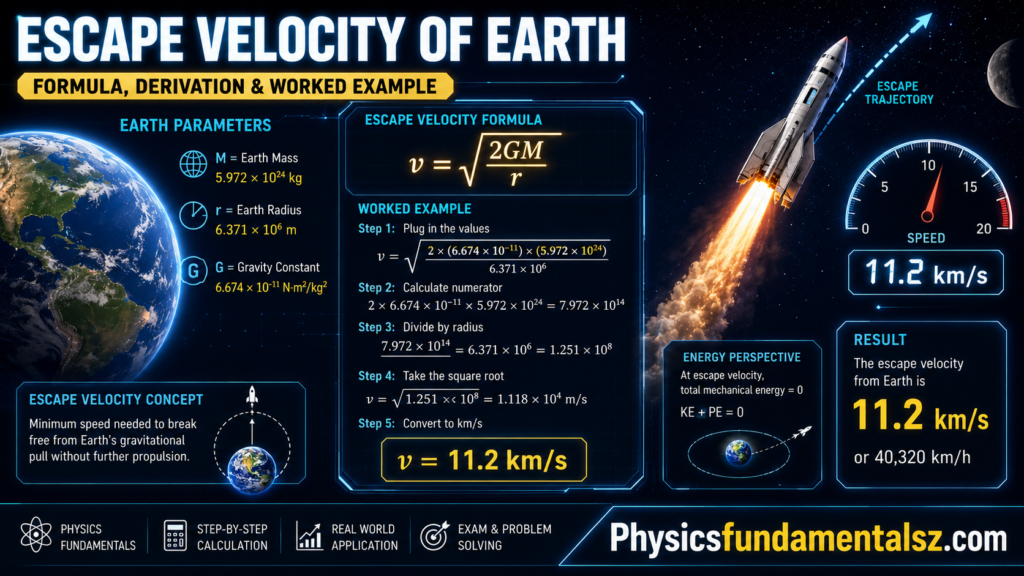
Let’s calculate the escape velocity of Earth using real numbers.
Given values:
- G = 6.674 × 10⁻¹¹ N·m²/kg²
- M (mass of Earth) = 5.972 × 10²⁴ kg
- r (radius of Earth) = 6.371 × 10⁶ m
Step 1: Plug values into the formula
v = √(2 × 6.674 × 10⁻¹¹ × 5.972 × 10²⁴ / 6.371 × 10⁶)
Step 2: Calculate the numerator
2 × 6.674 × 10⁻¹¹ × 5.972 × 10²⁴ = 7.972 × 10¹⁴
Step 3: Divide by radius
7.972 × 10¹⁴ / 6.371 × 10⁶ = 1.251 × 10⁸
Step 4: Take the square root
v = √(1.251 × 10⁸) ≈ 11,186 m/s, or about 11.2 km/s
This matches the widely cited value for Earth’s escape velocity. If you want to skip the manual math and quickly test different masses and radii, our physics calculators page includes tools that solve for escape velocity and related quantities instantly.
Frequently Asked Questions (FAQs)
What is escape velocity in simple words?
Escape velocity is the minimum speed an object needs to permanently break free from a planet or moon’s gravity without any additional propulsion after launch.
What is the escape velocity of Earth?
Earth’s escape velocity is approximately 11.2 km/s, or about 25,000 miles per hour, measured from the surface.
What is the escape velocity of the Moon?
The Moon’s escape velocity is about 2.4 km/s, much lower than Earth’s because the Moon has far less mass and a smaller radius.
Does escape velocity depend on the mass of the object escaping?
No. The mass of the escaping object cancels out in the derivation, so escape velocity depends only on the mass and radius of the body being escaped from.
Is escape velocity the same as orbital velocity?
No. Escape velocity is always √2 times greater than the orbital velocity at the same altitude. Orbital velocity keeps an object circling a body, while escape velocity lets it leave entirely.
Why can’t light escape a black hole?
Within a black hole’s event horizon, the escape velocity exceeds the speed of light. Since nothing with mass, and not even massless light, can travel faster than light speed, nothing inside the event horizon can escape.
Do rockets need to reach escape velocity to reach space?
No. Rockets only need to reach orbital velocity to stay in orbit around Earth. Escape velocity is only required for missions intended to leave Earth’s gravity permanently, such as lunar or interplanetary missions.
Final Thoughts
Escape velocity connects some of the most fundamental ideas in physics: gravity, kinetic energy, potential energy, and the conservation of energy.
Whether you are calculating the speed needed for a rocket to leave Earth, understanding why the Moon lacks an atmosphere, or exploring why black holes trap light itself, the same simple formula, v = √(2GM / r), explains it all.
To keep building your understanding of the concepts behind escape velocity, explore related topics like Newton’s Laws of Motion, What Is Energy?, and Circular Motion and Centripetal Force on Physics Fundamentals.