Potential Energy: Gravitational, Elastic & Electric Forms Explained
Potential energy is one of the first ideas every physics student meets, and it stays useful all the way from a high school classroom to advanced general physics courses.
It shows up whenever an object is lifted, stretched, compressed, or held in place by a force, and it explains why a raised object can suddenly move the moment it is released.
If you are still building your foundation, it helps to start with our guide on what energy actually is before working through the details below.
Table of Contents
What Is Potential Energy in General Physics?
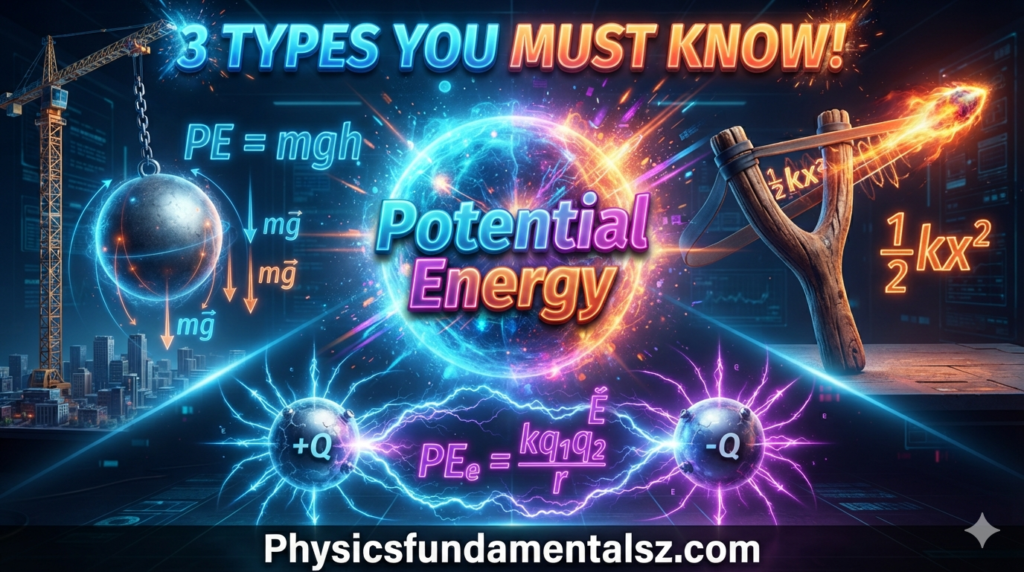
In general physics, potential energy is defined as the energy an object or system holds because of its position, shape, or state, rather than because it is moving. It is “potential” because it has the ability to do work once the object is released or allowed to change configuration. A rock sitting on a cliff edge, a stretched rubber band, and a charged battery all store potential energy that can later be converted into motion, heat, light, or another useful form.
Potential energy is a scalar quantity, meaning it has magnitude but no direction, and it is measured in joules (J) in the SI system. Unlike kinetic energy, which depends on speed, potential energy depends entirely on position or configuration relative to a chosen reference point.
The general physics definition rests on three ideas:
- A force must be acting on the object (gravity, a spring, an electric field, and so on).
- The object must be able to move under that force.
- The energy is stored, not currently being used, until the object actually moves.
This is why potential energy is often introduced right alongside Newton’s laws of motion, since the forces described in those laws are exactly what create and release potential energy.
Potential Energy Formula (General Physics Equations)
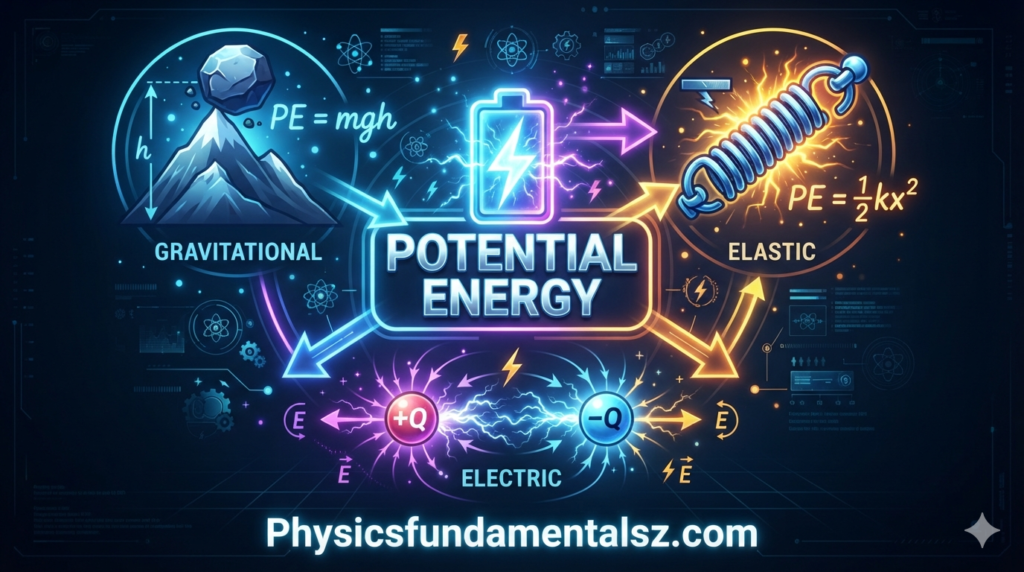
There is no single universal formula for potential energy because it depends on the type of force involved. Below are the main formulas used across general physics.
Gravitational Potential Energy Formula
The most common form taught in introductory courses is gravitational potential energy near Earth’s surface:
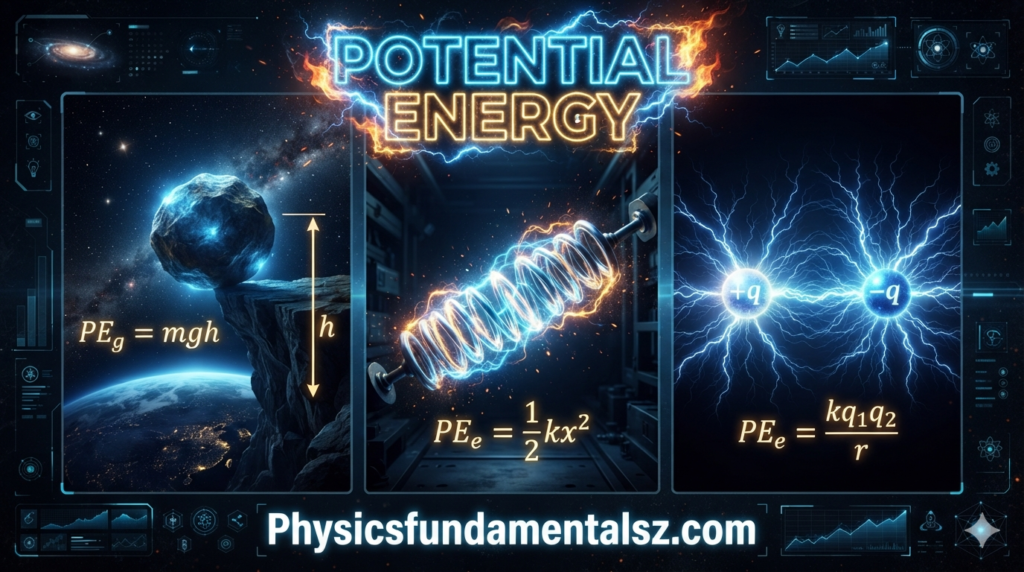
PE = mgh
Where:
- PE = gravitational potential energy (joules)
- m = mass of the object (kilograms)
- g = acceleration due to gravity (9.8 m/s² on Earth)
- h = height above a reference point (meters)
This formula assumes a uniform gravitational field, which is a reasonable approximation for everyday heights but not for objects far from Earth, such as satellites, where a more general inverse-square version of the formula is used instead.
Elastic Potential Energy Formula
For springs and stretchy materials, general physics uses:
PE = ½kx²
Where k is the spring constant (a measure of stiffness, in N/m) and x is the displacement from the spring’s natural length (in meters). This formula comes directly from Hooke’s Law and describes energy stored in compressed or stretched materials.
Electric Potential Energy Formula
For charged particles, general physics defines electric potential energy as:
PE = kQq/r
Where k is Coulomb’s constant, Q and q are the two charges involved, and r is the distance between them. This version behaves similarly to gravitational potential energy but applies to electric fields instead of gravitational fields.
Each of these formulas answers the same basic question in a different context: how much energy is stored because of position or configuration.
Types of Potential Energy in General Physics
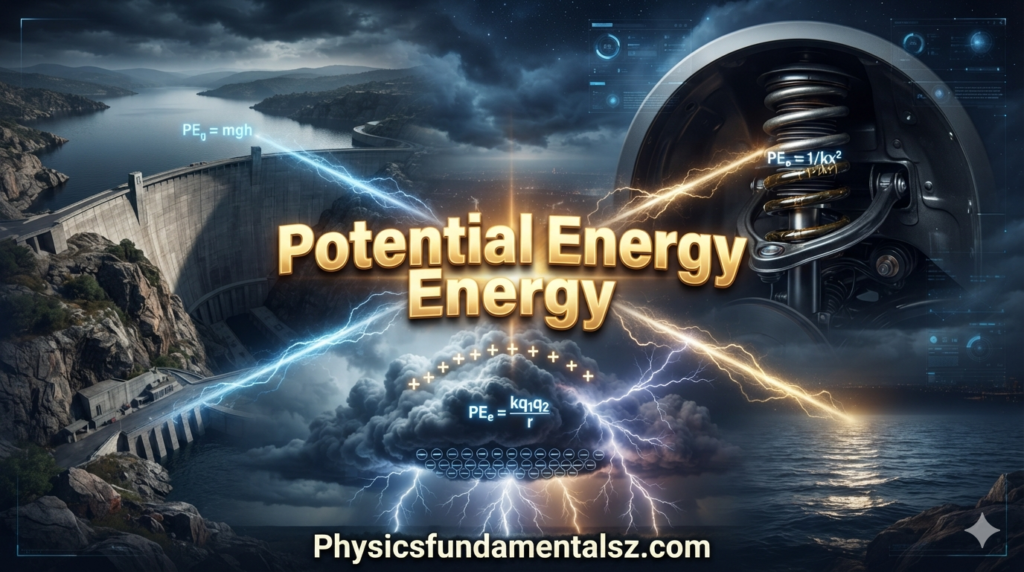
General physics recognizes several distinct types of potential energy, each tied to a different kind of force.
Gravitational Potential Energy
This is energy stored because of an object’s height above the ground or another reference surface. A book on a high shelf, water held behind a dam, and a person standing at the top of a staircase all possess gravitational potential energy. The higher the object and the greater its mass, the more energy is stored.
Elastic (Spring) Potential Energy
Elastic potential energy is stored in objects that can stretch or compress, such as springs, rubber bands, and bows. The energy exists only while the object is deformed from its natural shape, and it releases the moment the object is allowed to return to that shape.
Chemical Potential Energy
Chemical potential energy is stored in the bonds between atoms and molecules. Food, batteries, and fuel all rely on chemical potential energy, which converts into heat, light, or kinetic energy through chemical reactions such as combustion or digestion.
Electric Potential Energy
Electric potential energy exists because of the position of charged particles relative to one another. Two like charges pushed close together store energy that is released when they are allowed to move apart, while opposite charges store energy when pulled apart.
Nuclear Potential Energy
Nuclear potential energy is stored within the nucleus of an atom, held together by the strong nuclear force. This is the type of potential energy released in nuclear fission and fusion reactions, and it is far more concentrated than chemical potential energy.
Magnetic Potential Energy
Less commonly discussed at the introductory level but still important in general physics, magnetic potential energy is stored in the position of magnetic materials or moving charges within a magnetic field.
Potential Energy vs Kinetic Energy
Potential energy and kinetic energy are the two main categories of mechanical energy, and general physics constantly moves between them.
| Feature | Potential Energy | Kinetic Energy |
|---|---|---|
| Depends on | Position, shape, or state | Speed and mass |
| Formula (common form) | PE = mgh | KE = ½mv² |
| Present when object is | At rest or moving | Only moving |
| Example | Ball held at height | Ball falling through the air |
A useful way to picture the relationship is a roller coaster. At the top of the first hill, the cars have maximum gravitational potential energy and very little kinetic energy. As the cars descend, that stored potential energy converts into kinetic energy, and the cars speed up. At the bottom of the hill, potential energy is at its lowest while kinetic energy is at its highest. This constant exchange is central to understanding motion in general physics, and it connects directly to ideas covered in our guide on projectile motion, where objects continuously trade potential energy for kinetic energy as they rise and fall.
Potential Energy and the Work-Energy Theorem
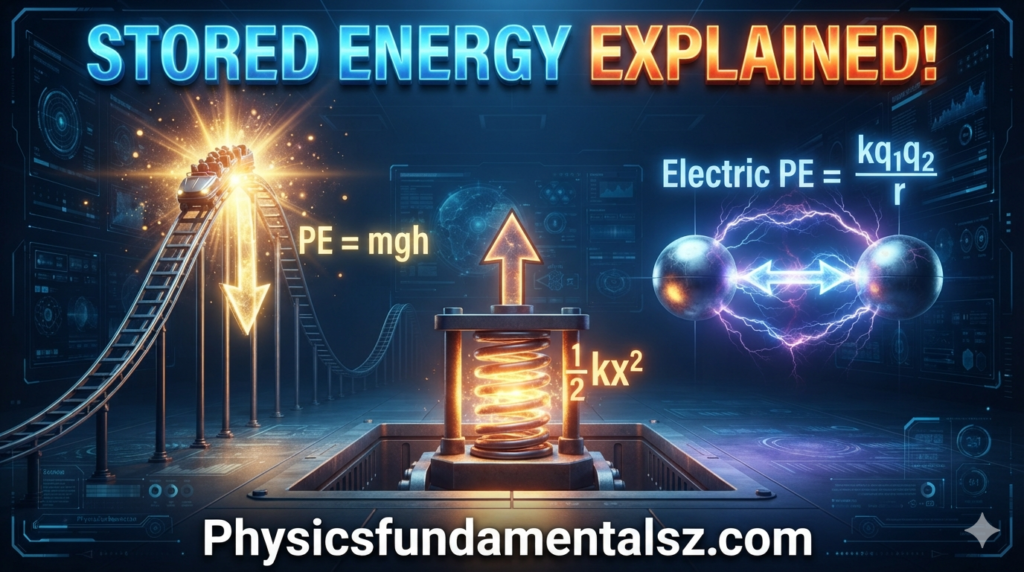
Potential energy is closely tied to the concept of work in physics. Work is done on an object whenever a force moves it through a distance, and that work is what actually stores or releases potential energy. Lifting a box against gravity does work on the box and increases its gravitational potential energy by exactly the amount of work performed.
This relationship is formalized in the work-energy theorem, which states that the net work done on an object equals its change in kinetic energy. Since potential energy converts into kinetic energy as an object moves, the two ideas work together to explain motion in any general physics problem. For a full derivation and worked examples, see our dedicated guide to the work-energy theorem.
Conservation of Energy and Potential Energy
One of the most important principles connected to potential energy is the law of conservation of energy, which states that energy cannot be created or destroyed, only converted from one form to another. In a closed system with no friction or air resistance, the total mechanical energy (the sum of potential and kinetic energy) remains constant.
This can be written as:
PE_initial + KE_initial = PE_final + KE_final
This principle allows physicists to solve motion problems without tracking forces at every single instant. Instead of calculating acceleration continuously, you can compare the total energy at two points in time. This is the same underlying logic used in momentum problems, where quantities are conserved across a system, similar to how conservation of momentum works for colliding objects.
In real systems, some energy is always lost to friction, air resistance, or heat, which is why a swinging pendulum eventually slows down and a bouncing ball never returns to its original height. General physics typically starts with idealized, frictionless systems before introducing these real-world losses.
Real-World Examples of Potential Energy
Potential energy is not just a textbook concept. It appears constantly in everyday life and engineering:
- Hydroelectric dams store gravitational potential energy in raised water, which converts into kinetic energy and then electrical energy as it flows downward through turbines.
- Archery bows store elastic potential energy when drawn back, releasing it as kinetic energy in the arrow.
- Batteries store chemical potential energy that converts into electrical energy to power devices.
- Roller coasters convert gravitational potential energy into kinetic energy repeatedly throughout a ride.
- Trampolines store elastic potential energy in stretched springs and fabric, converting it back into kinetic energy that launches a person upward.
Each of these examples follows the same underlying pattern found across general physics: energy is stored due to position or configuration, then released and converted into another useful form.
How to Calculate Potential Energy (Step-by-Step)
Solving a general physics potential energy problem usually follows the same process:
- Identify the type of potential energy involved (gravitational, elastic, electric, and so on).
- Choose a reference point. For gravitational potential energy, this is often the ground or the lowest point in the problem.
- Select the correct formula based on the type of potential energy.
- Plug in known values, making sure units are consistent (kilograms, meters, seconds).
- Solve for the unknown, whether that is potential energy itself, height, mass, or spring displacement.
Example problem: A 2 kg object is lifted 5 meters above the ground. What is its gravitational potential energy?
Using PE = mgh: PE = (2 kg)(9.8 m/s²)(5 m) PE = 98 joules
If you want to check calculations like this instantly, our physics calculators include tools that solve for potential energy, kinetic energy, and related variables automatically, showing every step of the formula used.
Common Mistakes When Studying Potential Energy in General Physics
Students studying potential energy in general physics tend to run into a handful of recurring errors:
- Forgetting to define a reference point. Potential energy is always relative. Height must be measured from a clearly stated reference, or the answer becomes meaningless.
- Mixing up mass and weight. The formula PE = mgh uses mass in kilograms, not weight in newtons.
- Assuming potential energy is always positive. Depending on the chosen reference point, potential energy can be negative, particularly in gravitational and electric potential energy problems involving large distances.
- Confusing potential energy with force. Potential energy describes stored energy, while force describes a push or pull. They are related through work, but they are not the same quantity.
- Ignoring energy losses. Real systems lose some energy to friction and air resistance, so total mechanical energy is not always perfectly conserved outside idealized problems.
Avoiding these mistakes makes it much easier to move on to more advanced topics in classical mechanics, including rotational energy, orbital mechanics, and oscillatory motion, all of which build on the same fundamentals covered here. You can explore the full sequence of topics in our classical mechanics category.
Frequently Asked Questions (FAQs)
What is potential energy in simple terms?
Potential energy is stored energy an object has because of its position, height, or shape, rather than its motion.
What is the general formula for potential energy?
The most common general physics formula is PE = mgh for gravitational potential energy, though elastic and electric potential energy use different formulas based on their respective forces.
Is potential energy the same as kinetic energy?
No. Potential energy depends on position or configuration, while kinetic energy depends on motion and speed. They convert into each other but are measured differently.
What is the unit of potential energy?
Potential energy is measured in joules (J) in the SI system, the same unit used for all forms of energy.
Can potential energy be negative?
Yes, depending on the reference point chosen, particularly in gravitational and electric potential energy calculations involving fields that extend to infinity.
Final Thoughts
Potential energy is a foundational concept in general physics that connects directly to force, work, motion, and the broader principle of energy conservation.
Whether you are calculating the energy stored in a stretched spring or the height of a falling object, the same core idea applies: energy stored because of position or state can always convert into another usable form.
Building a solid understanding of potential energy here makes it much easier to tackle related topics like Newton’s laws of motion, the work-energy theorem, and projectile motion, all of which rely on the same principles explained in this guide.