Wave-Particle Duality
Is light a wave or a stream of particles? Is an electron a tiny ball or a spreading ripple? For two centuries physicists argued, and the unsettling answer turned out to be: both, depending on how you look. This is wave-particle duality, one of the strangest and most fundamental truths in all of physics.
The old debate about light
The wave-versus-particle argument began with light. Newton favoured tiny corpuscles, while Huygens argued for waves. The wave camp seemed to win decisively in 1801 when Thomas Young showed that light passing through two slits produces an interference pattern of bright and dark bands, something only waves can do. For a closer look, see Young’s double-slit experiment.
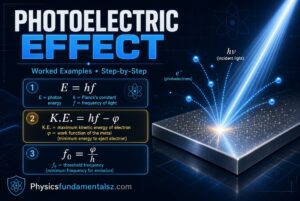
Yet a century later the photoelectric effect showed light knocking electrons off metal in a way that only made sense if light came in discrete packets, called photons. Light was a wave and a particle at once.
Photons: light as particles
Einstein proposed that light energy comes in quanta whose energy depends on frequency:
Here h is Planck’s constant and f is the frequency. A photon has no mass, yet it carries energy and momentum. In experiments like the photoelectric effect or Compton scattering, light behaves unmistakably as a particle, delivering its energy in lumps rather than spreading it smoothly.
Matter waves: particles as waves
The truly startling step came in 1924, when Louis de Broglie suggested that if waves can act like particles, then particles should act like waves. He proposed that every moving object has an associated wavelength, inversely proportional to its momentum:
For everyday objects this wavelength is unimaginably tiny and utterly unnoticeable. But for electrons it is comparable to atomic spacings, and within a few years experiments confirmed that electrons diffract and interfere exactly like waves. Today electron microscopes exploit this very wave nature to see far smaller details than light microscopes can.
Everything, light and matter alike, has both wave and particle aspects. Which one you observe depends entirely on the experiment you perform. The object does not change; the question you ask of it does.
The double-slit mystery deepens
The most profound demonstration fires electrons one at a time at a double slit. Each electron strikes the screen as a single dot, like a particle. But as thousands accumulate, the dots build up an interference pattern, like a wave. Somehow each individual electron interferes with itself, as if it passed through both slits at once.
Stranger still, if you place a detector to see which slit the electron goes through, the interference pattern vanishes and the electrons behave purely as particles. The act of measuring which-path information changes the outcome. This is not a limitation of our instruments; it is woven into the fabric of quantum reality.
Making sense of it: the wavefunction
Quantum mechanics resolves the paradox not by choosing wave or particle but by describing each system with a wavefunction, often written ψ. The wavefunction spreads through space like a wave, and its square gives the probability of finding the particle at any location. The wave is a wave of probability, not a physical ripple in a medium.
- Between measurements, the system evolves as a smooth, spreading wave.
- At the moment of measurement, it appears as a localised particle at one definite spot.
- The wave determines the odds; the particle is what you actually detect.
This probabilistic interpretation, championed by Max Born, is now the standard way physicists think about quantum objects.
Why we never see it in daily life
If everything is a wave, why does a thrown ball follow a clean path with no fuzziness? The answer lies in the de Broglie wavelength. For a baseball, λ is around 10⁻³⁴ metres, trillions of times smaller than a proton, far too small to produce any noticeable wave behaviour. Quantum weirdness is hidden not because it stops at large scales but because the wavelengths become utterly negligible.
Frequently asked questions
Is light a wave or a particle?
Both. Light propagates and interferes as a wave but exchanges energy in discrete particle-like packets called photons. Neither picture alone is complete; the full description is quantum mechanical.
Do large objects have a wavelength?
Yes, every moving object has a de Broglie wavelength given by λ = h/p. For anything bigger than a molecule, that wavelength is so vanishingly small that wave effects are completely undetectable, which is why everyday objects behave like ordinary particles.
Why does observing the double-slit experiment change the result?
Measuring which slit a particle passes through forces it to behave as a localised particle, destroying the wave interference. In quantum mechanics, obtaining which-path information is fundamentally incompatible with the wave pattern, regardless of how gently you measure.