Velocity vs Speed
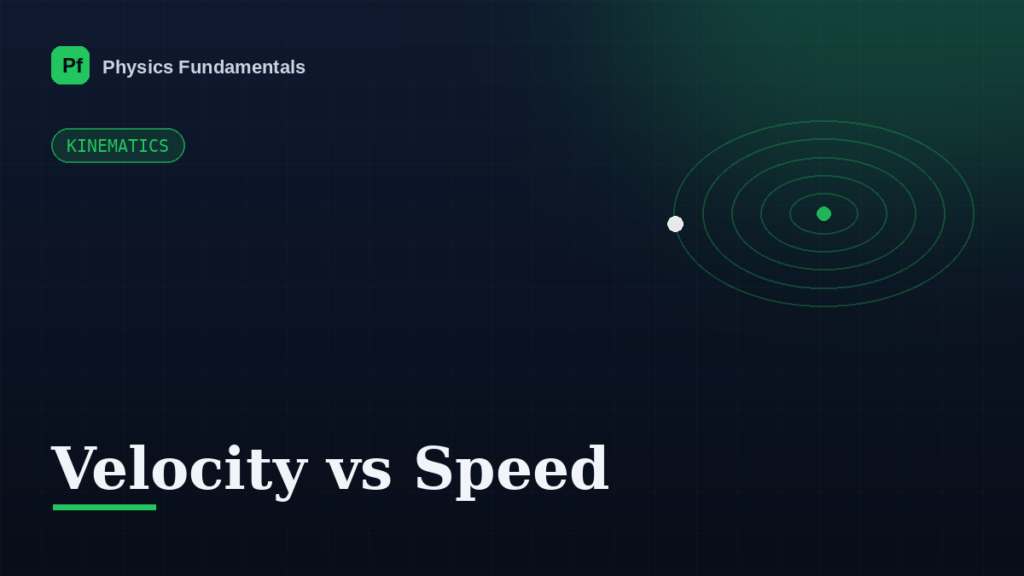
In everyday language, speed and velocity are interchangeable. In physics they are not, and the difference matters enormously. Speed tells you how fast; velocity tells you how fast and in which direction. That extra piece of information — direction — is the seed from which much of mechanics grows.
Scalars and vectors
The deepest distinction is that speed is a scalar and velocity is a vector. A scalar is a quantity with magnitude only: temperature, mass, energy. A vector has both magnitude and direction: displacement, force, velocity. This isn’t pedantry — vectors add differently from scalars, and that changes the answers you get.
- Speed: 60 km/h. Just a number with units.
- Velocity: 60 km/h due north. A number plus a direction.
Distance versus displacement
The split runs deeper than just speed and velocity. The quantities they are built from also come in scalar and vector flavours: distance is the total path length you travel, while displacement is the straight-line vector from start to finish.
Walk 3 km east then 4 km north and your distance is 7 km, but your displacement is 5 km (the hypotenuse), pointing northeast. The Pythagorean theorem gives the magnitude.
Defining the two quantities
Average speed is total distance divided by time. Average velocity is total displacement divided by time.
Run one full lap of a 400 m track in 50 seconds and your average speed is 8 m/s — but your average velocity is zero, because you finished exactly where you started. Zero displacement means zero average velocity, no matter how fast you ran.
Instantaneous versus average
Both speed and velocity come in two timescales. The average values smear over a whole journey, while the instantaneous values describe a single moment — what your speedometer reads right now. Mathematically, instantaneous velocity is the rate of change of position at an instant, the slope of a position–time graph at a point.
Crucially, the magnitude of the instantaneous velocity equals the instantaneous speed. It is only when we average over a journey with changes of direction that speed and velocity part ways. Your speedometer shows instantaneous speed; it cannot tell you your velocity because it knows nothing about direction.
Why the distinction powers physics
Velocity matters because the laws of motion are about direction as much as magnitude. Acceleration is defined as the rate of change of velocity — so changing direction at constant speed is still acceleration. A car rounding a bend at a steady 50 km/h is accelerating, because its velocity vector is turning even though its speed is fixed.
This is why a satellite in a perfectly circular orbit, moving at constant speed, is nevertheless constantly accelerating toward the planet. Its speed never changes, but its velocity is always swinging around. Without the vector idea, that statement would sound like nonsense; with it, it follows naturally from Newton’s laws.
A quick worked check
Suppose you drive 120 km north in 2 hours, then 120 km back south in 2 hours.
- Total distance: 240 km, total time: 4 hours, so average speed = 60 km/h.
- Total displacement: 0 km (you’re back home), so average velocity = 0 km/h.
The same trip yields a healthy average speed and zero average velocity. If you want to crunch your own numbers, a velocity calculator handles the vector bookkeeping for you.
Frequently asked questions
Can speed and velocity ever be equal?
Their magnitudes are equal whenever the motion is in a single straight line without reversing direction. For instantaneous values, the speed always equals the magnitude of the velocity. They diverge only when averaging over a path that bends or doubles back.
Can velocity be negative?
Yes. Because velocity is a vector, we assign signs to directions — for example, positive for rightward and negative for leftward. A negative velocity simply means motion in the chosen negative direction. Speed, being a magnitude, is never negative.
Why is changing direction a kind of acceleration?
Acceleration is the rate of change of velocity, and velocity includes direction. If your direction changes, your velocity changes, even at constant speed — so you are accelerating. This is exactly what keeps a car turning a corner or a planet circling the Sun.