Photoelectric Effect Explained: Formula, Examples, and Real Uses
Imagine shining a bright light on a metal plate and watching electrons fly off it, even though the light carries no electric charge. That surprising result is the photoelectric effect, and it changed physics forever. It showed that light does not always behave like a smooth wave. Sometimes light behaves like a stream of tiny packets of energy called photons.
In this guide, the photoelectric effect is explained from first principles, with clear definitions, the key equation, graphs, worked examples, and common exam traps. You will learn why colour matters more than brightness, what work function and threshold frequency mean, and how the same idea powers solar panels, cameras, and light sensors. By the end, you will be able to solve typical school and college problems with confidence.
Definition box: The photoelectric effect is the emission of electrons from a metal surface when light of high enough frequency falls on it. The emitted electrons are called photoelectrons. The minimum frequency that can cause emission is the threshold frequency, and the minimum energy needed to free an electron is the work function.
What Is the Photoelectric Effect?
The photoelectric effect happens when light hits a suitable material, usually a metal, and transfers enough energy to knock electrons out of its surface. Those electrons do not drift out slowly. They are ejected almost immediately, provided the light meets one crucial condition. The frequency of the light must be at or above the threshold frequency for that metal.
This point surprises many learners at first. A very bright red light may fail to eject any electrons, while a dim blue or ultraviolet light succeeds at once. Brightness increases the number of photons, not the energy of each photon. Colour, which is linked to frequency, decides the energy of each photon.
The effect is therefore a clean test of the particle model of light. A wave model predicts that brighter light, carrying more total energy, should eventually free electrons. Experiments showed otherwise. Only photons with enough individual energy can do the job, and that discovery earned Albert Einstein the Nobel Prize in Physics in 1921.
A Short History: From Hertz to Einstein
Heinrich Hertz first noticed the effect in 1887 while studying electromagnetic waves. He found that ultraviolet light falling on metal electrodes made sparks jump more easily across a gap. At the time, nobody understood why light should help an electric spark. The observation was recorded, but its meaning stayed hidden for years.
Later, Philipp Lenard studied the emitted electrons in detail and found two puzzling results. First, increasing the intensity of light increased the number of electrons, but not their maximum speed. Second, the maximum speed depended on the frequency of the light, not on its brightness. Both results contradicted the classical wave theory of light.
Einstein resolved the puzzle in 1905 by proposing that light energy comes in discrete packets, later called photons. Each photon carries energy given by Planck’s relation, E = hf, where h is Planck’s constant and f is the frequency. Robert Millikan later confirmed Einstein’s equation experimentally with careful measurements. The photoelectric effect thus became one of the founding experiments of quantum physics.
For a clear classroom introduction, see Khan Academy’s photoelectric effect lesson. For the historical and mathematical background, HyperPhysics explains the photoelectric effect with diagrams and energy relations.
Key Terms You Must Know
Photon
A photon is a quantum, or packet, of electromagnetic energy. It has no rest mass and always travels at the speed of light in a vacuum. Its energy depends only on its frequency, through E = hf. Higher frequency means a more energetic photon, whether the beam looks bright or dim.
Work Function
The work function, written as phi, is the minimum energy needed to remove an electron from the surface of a particular metal. Different metals have different work functions because their electrons are held with different strengths. Caesium has a low work function, so visible light can cause emission. Zinc has a higher work function and usually needs ultraviolet light.
Threshold Frequency
The threshold frequency, written as f0, is the lowest frequency that can eject an electron from a given metal. It is linked to the work function by phi = h f0. Light below this frequency cannot cause photoemission, no matter how intense it is or how long it shines. Light at or above this frequency can cause emission at once.
Stopping Potential
Stopping potential, written as Vs, is the reverse voltage needed to stop even the fastest photoelectrons from reaching a collecting electrode. It measures the maximum kinetic energy of the photoelectrons through the relation KEmax = eVs, where e is the elementary charge. A larger stopping potential means faster, more energetic photoelectrons.
Photoelectric Current
Photoelectric current is the flow of photoelectrons from the emitting surface to a collector, measured in a circuit. Increasing light intensity at a fixed frequency above threshold increases this current, because more photons arrive per second. Changing frequency changes the energy of each electron, but not directly the number emitted per second at fixed intensity.
| Term | Symbol | What it tells you |
|---|---|---|
| Photon energy | E = hf | Energy carried by one photon |
| Work function | phi | Minimum energy to free a surface electron |
| Threshold frequency | f0 = phi / h | Lowest frequency that causes emission |
| Maximum kinetic energy | KEmax | Energy left over after escape |
| Stopping potential | Vs | Voltage that stops the fastest electrons |
Einstein’s Photoelectric Equation
Einstein’s equation balances the energy of an incoming photon against the costs of freeing an electron. Part of the photon energy pays the work function, and any remainder becomes the electron’s kinetic energy. For the fastest electrons, which lose no extra energy inside the metal, the balance is exact.
The equation is KEmax = hf – phi. It can also be written as KEmax = hf – h f0, or as hf = phi + KEmax. When hf equals phi, the electron just escapes with zero kinetic energy. When hf is smaller than phi, no emission occurs at all.
This single equation explains all the key observations. Intensity does not appear in it, because intensity changes the photon count, not photon energy. Frequency appears directly, because it sets photon energy. The equation also predicts a straight-line graph of KEmax against frequency, with slope h and a frequency intercept at f0.
A useful companion relation connects kinetic energy to stopping potential. Since KEmax = eVs, the stopping potential also rises linearly with frequency. The graph of Vs against frequency has the same threshold intercept. These graphs are favourite exam questions because they test understanding, not just memory.
Why Intensity and Frequency Play Different Roles
Many students mix up intensity and frequency, so it helps to separate their effects clearly. Intensity is the power per unit area carried by the beam, which depends on how many photons arrive each second. Frequency is a property of each individual photon, set by the colour or type of radiation.
Increasing intensity at a frequency above threshold ejects more electrons per second, so the photoelectric current rises. The maximum kinetic energy stays the same, because each photon still carries the same energy. Increasing intensity below threshold still ejects nothing, because every photon still lacks the needed energy.
Increasing frequency, by contrast, raises the energy of every photon. The fastest electrons therefore leave with more kinetic energy, and the stopping potential increases. The current may not rise, unless the intensity is also changed. Keeping these two roles separate prevents most errors in photoelectric problems.
| Change | Effect on current | Effect on KEmax | Why |
|---|---|---|---|
| Higher intensity, f above f0 | Increases | No change | More photons, same photon energy |
| Higher intensity, f below f0 | Stays zero | No emission | Photons still too weak |
| Higher frequency, same intensity | May fall slightly | Increases | Each photon carries more energy |
| Longer wavelength | No change or falls | Decreases | Wavelength and frequency are inversely related |
The Classic Experiment, Step by Step
The classic photoelectric experiment uses a vacuum tube with two electrodes. One electrode is a clean metal plate called the emitter or cathode. The other is a collector called the anode. Light enters through a window and falls on the emitter, and a sensitive meter measures any current in the circuit.
First, the experimenter varies the intensity of monochromatic light while keeping its frequency fixed. The current rises with intensity and then levels off at a saturation value. Saturation happens when every emitted electron is collected, so adding more photons still helps only until collection is complete.
Next, the experimenter applies a reverse voltage that opposes the photoelectrons. As the reverse voltage grows, fewer electrons reach the collector, and the current falls. At the stopping potential, the current reaches zero. That voltage gives a direct measurement of the maximum kinetic energy.
Finally, the experimenter repeats the test with different frequencies. Below threshold, no current appears at any intensity or voltage setting. Above threshold, the stopping potential grows linearly with frequency. This three-part pattern is exactly what Einstein’s equation predicts, and it is why the experiment is so convincing.
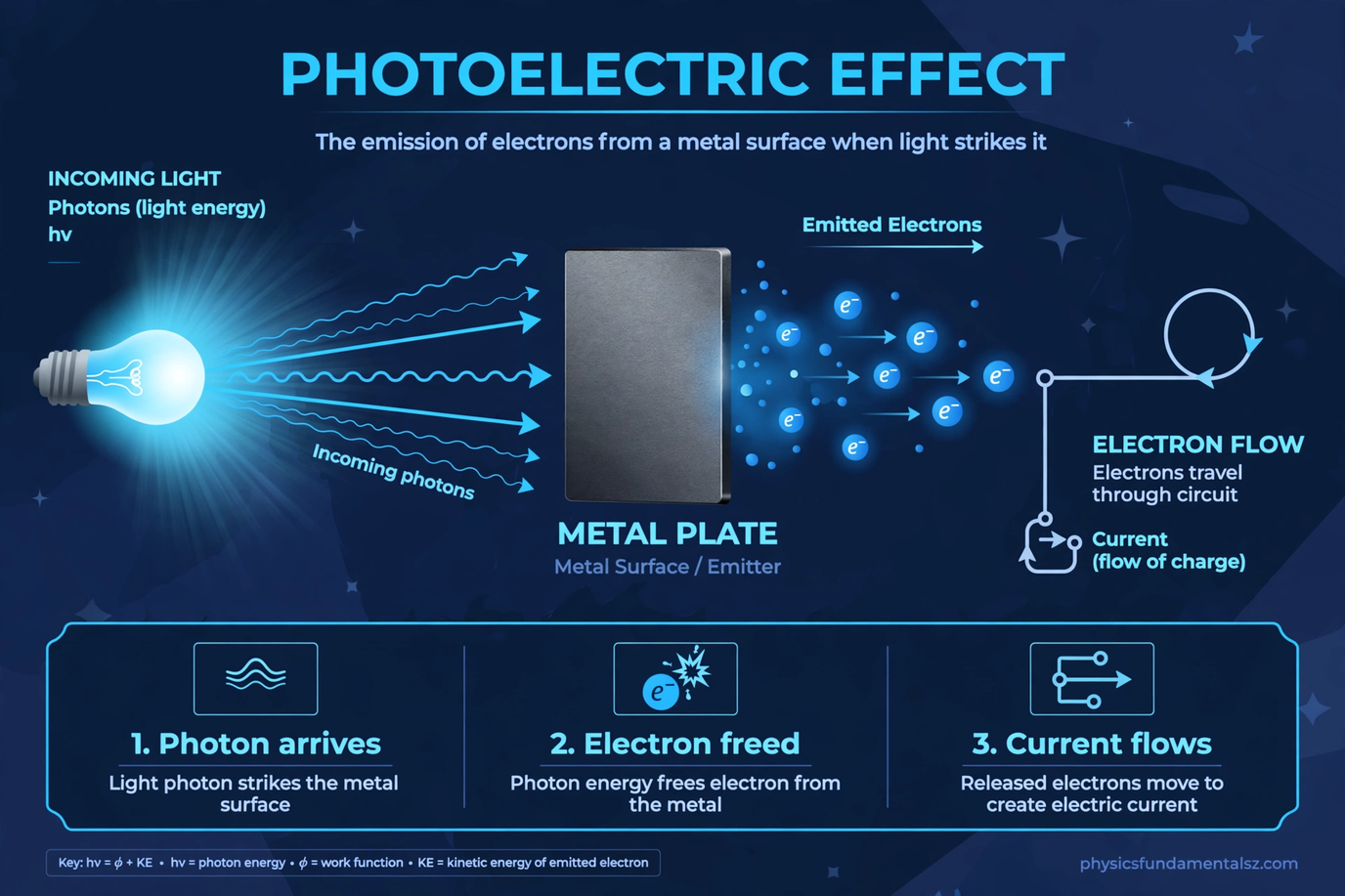
Alt text: Labelled diagram of the photoelectric effect experiment showing light, metal plate, emitted electrons, and stopping potential circuit.
Reading the Graphs Like an Examiner
Maximum Kinetic Energy Against Frequency
The graph of KEmax against frequency is a straight line that starts at the threshold frequency. Below f0, the graph stays at zero, because no electrons are emitted. Above f0, the line rises with slope equal to Planck’s constant, h. The intercept on the frequency axis is f0, and the intercept on the energy axis, if extended backwards, is negative phi.
Students often misread the slope. The slope is not the work function, and it is not the threshold frequency. The slope is Planck’s constant, which is the same for every metal. Different metals give parallel lines, shifted sideways according to their different threshold frequencies.
Stopping Potential Against Frequency
The stopping potential graph looks similar, but its slope is h divided by e. Its frequency intercept is again f0, the threshold frequency. A metal with a larger work function has a larger threshold frequency, so its line starts further to the right. Comparing two lines on the same axes therefore reveals which metal holds its electrons more tightly.
Current Against Voltage
The current-voltage graph shows how current rises from zero at the stopping potential to a plateau at saturation. Higher intensity gives a higher plateau, but the same stopping potential, provided the frequency is unchanged. Higher frequency shifts the stopping potential to a more negative value, because faster electrons need a larger opposing voltage to stop them.
A common trap is to confuse the saturation current with the stopping potential. Saturation current measures how many electrons are emitted per second. Stopping potential measures how energetic the fastest electrons are. They answer different questions, and they respond to different controls.
Worked Examples
Example 1: Finding the Maximum Kinetic Energy
A metal has a work function of 2.3 electronvolts. Light of frequency 9.0 × 10^14 Hz falls on it. Use h = 6.63 × 10^-34 J s and 1 eV = 1.60 × 10^-19 J. Find the maximum kinetic energy in electronvolts.
First, find the photon energy: E = hf = 6.63 × 10^-34 × 9.0 × 10^14 = 5.97 × 10^-19 J. Convert to electronvolts by dividing by 1.60 × 10^-19, giving about 3.73 eV. Next, subtract the work function: KEmax = 3.73 – 2.3 = 1.43 eV. The fastest photoelectrons therefore leave with about 1.4 eV of kinetic energy.
Example 2: Finding the Threshold Wavelength
A metal has a threshold frequency of 5.5 × 10^14 Hz. What is its threshold wavelength? Use c = 3.00 × 10^8 m/s. Wavelength and frequency are related by c = f lambda, so lambda0 = c / f0.
Substituting gives lambda0 = 3.00 × 10^8 / 5.5 × 10^14 = 5.45 × 10^-7 m, or 545 nm. That wavelength lies in the green part of the visible spectrum. Light with a shorter wavelength, meaning a higher frequency, will cause emission. Light with a longer wavelength will not, however bright it is.
Example 3: Finding the Stopping Potential
Photoelectrons are emitted with a maximum kinetic energy of 2.0 eV. What stopping potential is needed to halt them? The relation is KEmax = eVs, so Vs = KEmax / e. Since KEmax is already expressed in electronvolts, the stopping potential is simply 2.0 V.
This neat shortcut works because one electronvolt is the energy gained by one elementary charge moving through one volt. In exam questions, converting to joules and back is correct but slower. Recognising the electronvolt shortcut saves time and reduces arithmetic errors.
Example 4: Doubling the Intensity
Ultraviolet light above threshold shines on a metal, and the photoelectric current is measured. If the intensity is doubled while the frequency stays the same, what happens to the current and to the stopping potential? The current doubles, approximately, because twice as many photons arrive per second and eject twice as many electrons.
The stopping potential stays the same, because each photon still carries the same energy. This example captures the core distinction in one question. Intensity controls quantity, frequency controls quality, and the two must never be swapped.
The Photoelectric Effect and Wave-Particle Duality
The photoelectric effect does not prove that light is only a particle. Interference and diffraction experiments prove that light also behaves like a wave. Together, these results lead to wave-particle duality: light shows wave behaviour in some experiments and particle behaviour in others.
Electrons show the same duality in reverse. They behave like particles in collisions, yet they diffract like waves when passed through crystals. Modern physics therefore treats both light and matter with quantum models that can describe either aspect. The photoelectric effect is the clearest school-level evidence for the particle side of light.
This idea links closely to other topics on this site. For example, refraction of light explores how light bends at boundaries, a classic wave behaviour. The contrast between refraction and photoemission shows why physicists needed both models.
Real-World Applications
Solar Cells
Solar cells use a related effect, the photovoltaic effect, in semiconductors rather than metals. Photons free charge carriers inside the material, and an internal electric field separates them to drive a current. The photoelectric idea, that photon energy must exceed a threshold, still applies. It explains why solar cells respond to some wavelengths better than others.
Photocells and Light Sensors
Photocells in street lights, camera exposure meters, and automatic doors use photoemission or photoconductivity to detect light. When light falls on the sensor, the current changes, and a circuit responds. A street light can therefore switch off at dawn without any human input.
Night Vision and Photomultipliers
Photomultiplier tubes amplify tiny light signals by using photoemission followed by a cascade of secondary electrons. They are used in medical imaging, particle detectors, and astronomy, where single photons matter. Night-vision devices use similar photocathodes to turn faint light into a visible image.
Spacecraft and Dust Charging
Sunlight ejects electrons from spacecraft surfaces and from dust grains in space. This photoelectric charging can change the electric potential of a satellite and attract dust to surfaces. Engineers must account for it when designing spacecraft power and instrumentation systems.
Photoelectric Effect vs Photovoltaic Effect
These two effects are often confused, so a direct comparison helps. In the photoelectric effect, electrons are ejected from a surface into a vacuum or surrounding space. In the photovoltaic effect, charge carriers are freed inside a semiconductor and separated by a built-in field, without leaving the material.
Both effects depend on photon energy exceeding a threshold. In a metal, the threshold is the work function. In a semiconductor, the related threshold is the band gap energy. Solar panels use the photovoltaic effect, while old photocells and photomultipliers use photoemission.
| Feature | Photoelectric effect | Photovoltaic effect |
|---|---|---|
| Where it happens | Metal surface | Semiconductor junction |
| What leaves | Electrons escape the material | Carriers move inside the material |
| Threshold | Work function | Band gap energy |
| Typical use | Sensors, detectors | Solar cells |
Common Mistakes to Avoid
One frequent mistake is saying that brighter light gives photoelectrons more energy. Brightness raises the number of photons, not the energy per photon, so it raises current rather than maximum kinetic energy. Another mistake is using wavelength directly in Einstein’s equation without converting to frequency.
Students also confuse threshold frequency with the frequency of the incident light. Threshold frequency is a property of the metal, fixed unless the metal changes. Incident frequency is a property of the light, chosen by the experimenter. Emission requires incident frequency to reach or exceed threshold frequency.
A third trap is forgetting unit conversions between joules and electronvolts. Photon energies in joules are tiny numbers, often around 10^-19 J. Electronvolts give friendlier numbers, but the conversion factor must be applied consistently. Always check whether an answer in electronvolts or joules is expected.
Finally, remember that KEmax refers to the fastest electrons only. Most photoelectrons lose some energy in collisions before escaping, so they leave more slowly. The equation describes the maximum, not the average, and the stopping potential measures that maximum.
Alt text: Student experiment photo showing the photoelectric effect with light on a metal surface and emitted electrons.
How to Revise This Topic for Exams
Start by writing Einstein’s equation from memory, then label every symbol. Next, sketch the three key graphs: KEmax against frequency, stopping potential against frequency, and current against voltage. Annotate each graph with what its slope and intercepts mean.
Then practise converting between frequency, wavelength, photon energy in joules, and photon energy in electronvolts. These conversions appear in almost every photoelectric question. Finally, work through one intensity question and one frequency question side by side, and state in words why their answers differ.
Linking topics also strengthens revision. Kinetic energy explains the energy photoelectrons carry away, while potential energy helps explain the energy cost of escaping a metal. Electromagnetic induction shows another way light and electricity interact, through changing magnetic fields.
Photoelectric Effect in AP Physics
AP Physics 2 treats the photoelectric effect as evidence for the photon model and for energy conservation at the quantum scale. Questions often give a graph and ask for Planck’s constant, threshold frequency, or work function from its slope and intercepts. Other questions ask for qualitative predictions when intensity or frequency changes.
A strong AP answer always names the model being tested. Saying “the wave model predicts delayed emission and intensity-dependent energy, but experiments show immediate emission and frequency-dependent energy” earns more credit than a bare formula. It shows the reasoning behind the equation, not just the algebra.
For the official constants and unit guidance, consult NIST’s page on Planck’s constant and your course formula sheet. Using the same constants as the examiner avoids small numerical differences that can cost marks.
Practice Questions With Short Answers
Try these questions before reading the answers, and write your reasoning in words as well as numbers. The first question tests the threshold idea. Light of frequency 4.0 × 10^14 Hz falls on a metal whose threshold frequency is 6.0 × 10^14 Hz. Will any electrons be emitted if the light is made ten times brighter? No, because every photon still falls short of the work function. Brightness cannot compensate for insufficient photon energy.
The second question tests graph reading. Two metals give parallel lines on a KEmax against frequency graph, but one line starts further right. Which metal has the larger work function? The line starting further right has the larger threshold frequency, and therefore the larger work function. Parallel slopes confirm that Planck’s constant is the same for both metals.
The third question tests stopping potential. If the frequency of incident light increases while intensity stays fixed, what happens to stopping potential and to saturation current? Stopping potential increases, because faster electrons need a larger opposing voltage. Saturation current stays roughly the same, because the photon arrival rate has not changed.
The fourth question tests unit sense. A photon has energy 4.8 × 10^-19 J. Is that energy large or small in everyday terms? It is extremely small, about 3.0 eV, far below the energy of a moving cricket ball. Quantum energies look tiny because Planck’s constant is tiny, yet they control atomic-scale behaviour completely.
Frequently Asked Questions
What is the photoelectric effect in simple words?
The photoelectric effect is the ejection of electrons from a metal when light of high enough frequency hits it. Each photon must carry enough energy to free an electron. If the light frequency is too low, no electrons escape, no matter how bright the light is.
Who discovered the photoelectric effect?
Heinrich Hertz first observed it in 1887 during experiments with sparks and ultraviolet light. Albert Einstein explained it in 1905 with the photon model of light. Robert Millikan later verified Einstein’s equation with precise measurements.
What is Einstein’s photoelectric equation?
Einstein’s equation is KEmax = hf – phi, where h is Planck’s constant, f is the light frequency, and phi is the work function. It states that photon energy splits into escape energy and leftover kinetic energy. The fastest electrons take all the leftover energy as kinetic energy.
What is the work function?
The work function is the minimum energy needed to remove an electron from a metal surface. It varies between metals, so different metals need different minimum frequencies. A larger work function means a higher threshold frequency is required.
What is threshold frequency?
Threshold frequency is the lowest light frequency that can eject electrons from a given metal. It equals the work function divided by Planck’s constant. Light below this frequency cannot cause photoemission at any intensity.
Does brighter light make photoelectrons faster?
No, brighter light does not make photoelectrons faster. Brightness increases the number of photons per second, so more electrons are ejected. The speed of the fastest electrons depends on frequency, not on brightness.
Why does red light sometimes fail while blue light works?
Red light has a lower frequency than blue light, so each red photon carries less energy. If red photons fall below the metal’s threshold, they cannot free electrons. Blue photons carry more energy per photon and may exceed the threshold easily.
What is stopping potential?
Stopping potential is the reverse voltage that stops even the fastest photoelectrons from reaching the collector. It is related to maximum kinetic energy by KEmax = eVs. Measuring it gives an experimental value for the maximum kinetic energy.
Is there a time delay in the photoelectric effect?
No measurable delay occurs when the frequency is above threshold. Emission begins almost immediately, even at low intensity. This immediacy contradicts the wave model, which predicts a delay while energy accumulates.
What is the difference between photoelectric current and stopping potential?
Photoelectric current measures how many electrons are emitted per second. Stopping potential measures the maximum kinetic energy of those electrons. Intensity mainly affects current, while frequency mainly affects stopping potential.
Can the photoelectric effect happen with visible light?
Yes, for metals with low work functions, such as caesium, visible light can cause photoemission. For metals with higher work functions, ultraviolet light is needed. The deciding factor is always whether photon energy exceeds the work function.
What happens if the frequency is exactly the threshold frequency?
At exactly the threshold frequency, electrons just escape with zero kinetic energy. The photon energy exactly equals the work function, leaving nothing over. In practice, such electrons are barely detectable because they have no speed to reach a collector.
How is the photoelectric effect used in solar panels?
Solar panels use the related photovoltaic effect, where photons free carriers inside a semiconductor. The freed carriers are separated by an internal field to produce current. The threshold idea still applies, through the semiconductor band gap.
What is the relationship between wavelength and photoemission?
Wavelength and frequency are inversely related through c = f lambda. Shorter wavelengths mean higher frequencies and more energetic photons. A threshold wavelength therefore marks the longest wavelength that can still cause emission.
Why did the photoelectric effect win Einstein a Nobel Prize?
Einstein’s photon explanation resolved results that wave theory could not explain. It introduced the quantum idea that light energy is discrete, not continuous. That idea became a foundation of quantum physics and modern technology.
What are photoelectrons?
Photoelectrons are electrons ejected from a material by incident photons. They differ from ordinary conduction electrons only in how they gained their energy. Once ejected, they behave like any other free electrons in an electric field.
Does temperature affect the photoelectric effect?
Temperature has only a small effect on the basic photoelectric threshold. Heating a metal gives its electrons slightly more thermal energy, but the work function changes little. Exam questions usually ignore temperature unless they state otherwise.
What is Planck’s constant?
Planck’s constant, h, is 6.63 × 10^-34 J s, and it links photon energy to frequency through E = hf. It appears as the slope of the KEmax against frequency graph. Its tiny value explains why quantum effects are invisible in everyday life.
Key Takeaways
- The photoelectric effect is the emission of electrons when light above a threshold frequency hits a metal.
- Photon energy is E = hf, and Einstein’s equation is KEmax = hf – phi.
- Intensity controls the number of photoelectrons, while frequency controls their maximum energy.
- Stopping potential measures maximum kinetic energy through KEmax = eVs.
- Graphs of KEmax and stopping potential against frequency give h, f0, and phi.
Conclusion
The photoelectric effect looks simple in a diagram, yet it overturned a century of thinking about light. It proved that energy can arrive in packets, that colour can matter more than brightness, and that careful measurement can reveal a deeper reality. Those lessons still shape solar technology, sensors, and quantum physics today.
If you remember one equation, make it KEmax = hf – phi. If you remember one distinction, make it intensity versus frequency. With those two ideas, and the graphs that follow from them, you can explain the effect, solve its problems, and recognise its fingerprints in the technology around you. Keep exploring related wave and energy topics, such as waves and frequency and refraction, to see how the wave and particle pictures fit together.