Newton’s Third Law of Motion Explained: Action and Reaction With Examples
Every time you push something, it pushes you back. Walk, swim, drive, or launch a rocket, and the same rule applies. Newton’s third law of motion explains why.
The law is short: for every action, there is an equal and opposite reaction. Its meaning is deep, and its applications reach from walking to space travel.
This guide explains Newton’s third law of motion in plain language. You will learn the exact statement, the idea of action-reaction pairs, and the mistakes that trap students.
You will also work through examples, from rockets to rowing boats. By the end, you will spot third-law pairs everywhere.
Quick Answer: What Is Newton’s Third Law of Motion?
Newton’s third law says that when one object exerts a force on a second object, the second object exerts an equal force in the opposite direction on the first object.
The two forces are equal in size and opposite in direction. They act on different objects, so they never cancel each other out.
In short: forces always come in pairs. You cannot push without being pushed. A rocket moves forward because it pushes exhaust gas backward, and the gas pushes the rocket forward.
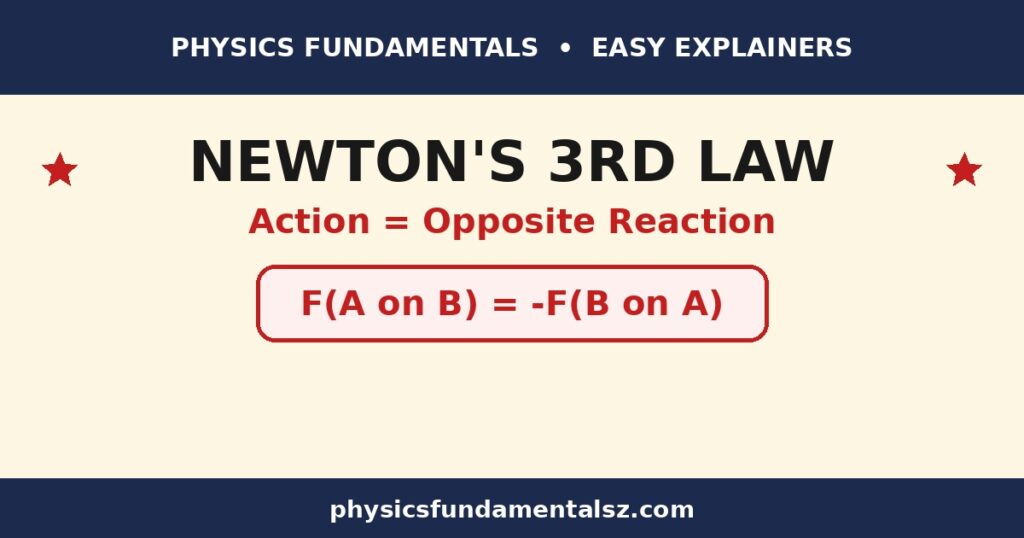
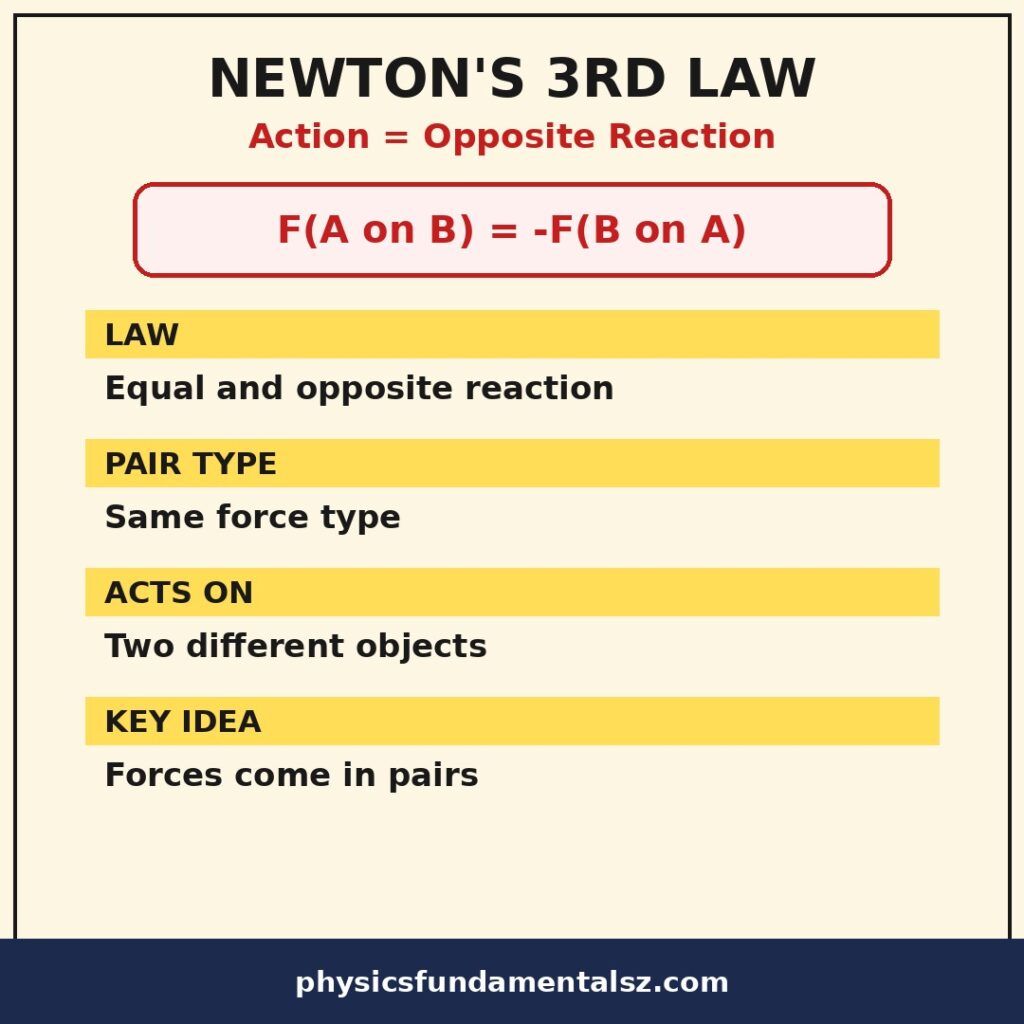
Definition Box — Newton’s Third Law: If object A exerts a force on object B, then object B exerts a force on object A that is equal in magnitude and opposite in direction. The two forces form an action-reaction pair. They act on different objects and occur at the same instant.
Formula: F(A on B) = −F(B on A). The minus sign shows the opposite direction. There is no separate third-law equation to memorise beyond this pairing rule, and the law works together with F = ma from the second law.
Key Takeaways
- Forces always occur in pairs: action and reaction.
- The pair is equal in size and opposite in direction.
- The two forces act on different objects, so they do not cancel.
- Action-reaction pairs happen at the same time, not one after the other.
- The pair must be the same type of force: both contact, both gravitational, and so on.
- A rocket works by pushing gas backward; the gas pushes the rocket forward.
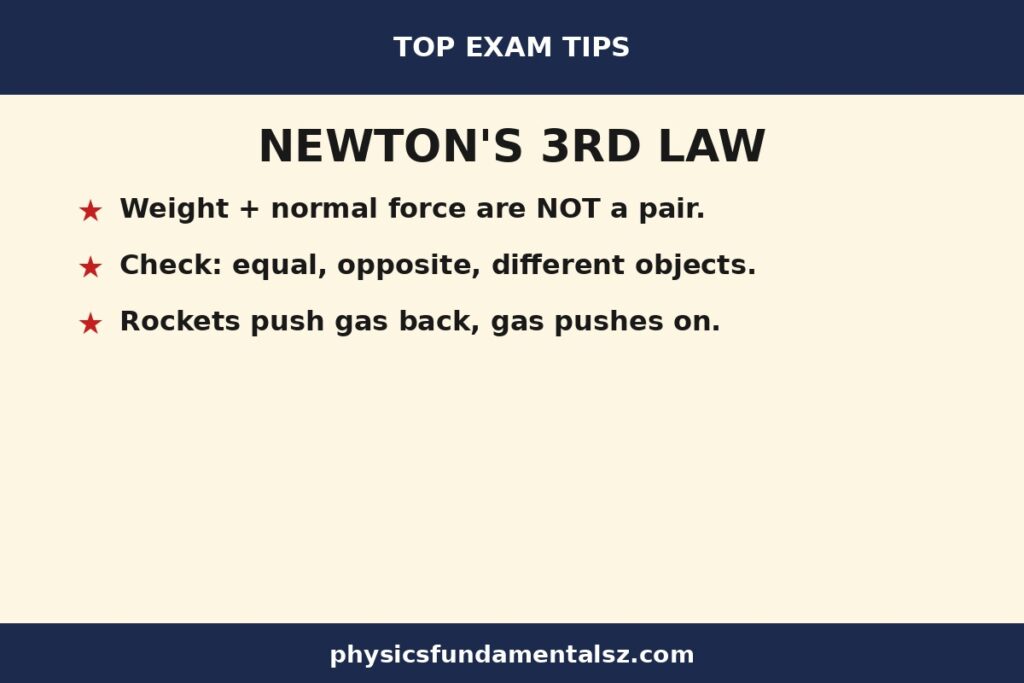
- Weight and the normal force are NOT an action-reaction pair, even though they are equal when you stand still.
- The third law explains walking, swimming, rowing, jumping, and recoil.
The Exact Statement of Newton’s Third Law
Isaac Newton published his three laws of motion in 1687 in the Principia. The third law appears in Latin, but the usual English version is clear enough.
“To every action there is always opposed an equal reaction.” The full statement adds that the actions of two bodies on each other are always equal and directed to opposite parts.
Modern textbooks phrase it more precisely. When two bodies interact, the forces they exert on each other are equal in magnitude and opposite in direction.
Three words in that sentence do heavy work. “Equal” means the sizes match exactly. “Opposite” means the directions are 180 degrees apart. “Interact” means the forces arise together, from the same event.
The law has no exceptions in classical mechanics. Every interaction, from a collision to a gravitational pull, obeys it. Quantum physics and relativity refine the picture at extremes, but school and AP physics use Newton’s version.
For the wider context, read our guide to Newton’s laws of motion, which places all three laws side by side.
Action and Reaction: What the Words Really Mean
The words action and reaction mislead students. They sound like a sequence: first the action, then the reaction. The physics says otherwise.
Both forces start at the same instant. Neither causes the other in time. They are two sides of one interaction, like two ends of a rope.
Either force can be called the action. If you call the push on the wall the action, the push on your hand is the reaction. Swap the labels and the physics is unchanged.
The labels are a convenience, not a sequence. What matters is that the pair exists, matches in size, and points in opposite directions.
The Third Law in One Sentence
If you remember one sentence, make it this one: forces come in pairs, equal and opposite, acting on different objects.
That sentence answers most exam questions. The rest of this guide shows how to apply it, and how to avoid the traps that come with it.
Action-Reaction Pairs: The Core Idea
An action-reaction pair is two forces from one interaction. They share four properties, and checking all four is the safest way to identify a pair.
First, the forces are equal in magnitude. Second, they are opposite in direction. Third, they act on different objects. Fourth, they are the same type of force.
Miss any one of these and the pair is wrong. Students most often fail the third test. They pick two forces on the same object and call them a pair.
The Four Tests for a True Pair
Use these tests on every candidate pair:
- Equal size: The magnitudes are identical, always.
- Opposite direction: The directions differ by 180 degrees.
- Different objects: Each force acts on a different body.
- Same type: Both are contact forces, or both are gravitational, or both are electric, and so on.
A genuine pair passes all four. Weight and the normal force fail tests three and four. Both act on the same person, and one is gravitational while the other is contact. They are not a pair, even when they are equal.
Same Type of Force
Force type matters because the pair comes from one interaction. A gravitational interaction produces two gravitational forces. A contact interaction produces two contact forces.
Earth pulls you down with gravity. You pull Earth up with gravity. That is a true pair: both gravitational, equal, opposite, on different objects.
The floor pushes you up with a contact force. You push the floor down with a contact force. That is another true pair: both contact, equal, opposite, on different objects.
Mixing the two interactions creates a false pair. Gravity on you and the floor’s push on you belong to different interactions. They are not partners.
Why Action-Reaction Forces Do Not Cancel Out
This is the hardest idea in the topic. If the forces are equal and opposite, why does anything move? The answer is that they act on different objects.
Cancelling only makes sense for forces on the same object. Add two equal and opposite forces on one body and the net force is zero. That is Newton’s first law territory.
Action-reaction forces never share an object. The action acts on body B. The reaction acts on body A. Each body feels only one of the pair, so each body can accelerate.
The Horse and Cart Problem
A classic puzzle asks why a horse can pull a cart if the cart pulls back equally. The answer is that the two pulls act on different bodies.
The cart pulls back on the horse. The horse pulls forward on the cart. The cart moves because the forward pull on it exceeds the friction holding it back.
The horse moves because its hooves push backward on the ground, and the ground pushes forward on the horse. That ground interaction is a separate pair, and it is what really drives the horse forward.
Every force in the story belongs to a pair. Every pair acts on two bodies. Motion follows from the forces on each body separately.
The Tug of War
In a tug of war, each team pulls the rope. The rope pulls back on each team with an equal force. The teams feel only their own side of the pair.
The winning team is not the one that pulls harder on the rope. The rope forces are equal by the third law. The winner is the team that pushes harder against the ground, gaining a larger forward force from the ground’s reaction.
Ground friction decides the contest. The rope only transmits the interaction. This is why footwear and footing matter so much in the sport.
Newton’s Third Law Examples in Everyday Life
Third-law pairs hide in plain sight. Once you learn to see them, everyday actions become physics demonstrations.
Walking
Walking is a third-law activity. Your foot pushes backward and down on the ground. The ground pushes forward and up on your foot.
The forward push from the ground is what moves you ahead. Without friction, the ground cannot push back. That is why walking on ice is so hard: the interaction is weak.
Try walking on a smooth floor in socks. Your feet slip because the contact pair is weak. Good shoes restore friction, and the ground’s reaction returns.
Swimming
A swimmer pushes water backward with hands and feet. The water pushes the swimmer forward. The stroke is a deliberate use of the third law.
Efficient swimmers maximise the backward push. They cup their hands and use the full arm. Every extra bit of water pushed back returns as forward motion.
Rowing a Boat
A rower pulls the oar through the water, pushing water backward. The water pushes the oar, and the oar pushes the boat, forward.
The same idea drives a paddle steamer and a propeller. The machine pushes fluid one way, and the fluid pushes the machine the other way. The medium changes, but the law does not.
Jumping
To jump, you push down on the ground. The ground pushes up on you. The upward reaction launches you into the air.
While you are airborne, only gravity acts on you. The launch force is gone. Your height depends on the push you gave the ground and the reaction it returned.
Athletes train leg strength to increase that push. The ground always returns an equal push, so stronger legs mean higher jumps.
Recoil of a Gun
A gun fires a bullet forward. The bullet pushes the gun backward. That backward push is recoil.
The forces are equal, but the effects differ. The bullet is light, so it gains huge acceleration. The gun is heavy, so it gains far less. Equal forces, different masses, different accelerations: that is the second law working with the third.
A Balloon Rocket
Blow up a balloon and let it go. Air rushes out the back, and the balloon flies forward. The balloon pushes air backward, and the air pushes the balloon forward.
This is the classroom model of a rocket. Real rockets burn fuel and expel hot gas at high speed. The principle is identical, and it works in the vacuum of space because the rocket pushes on its own exhaust, not on air.
NASA explains rocket propulsion with the third law on its rocket basics pages. The pages show that a rocket needs nothing to push against except its own exhaust.
Birds and Aeroplanes
A bird’s wing pushes air downward and backward. The air pushes the wing upward and forward. Lift is a third-law effect, combined with pressure differences over the wing.
An aeroplane propeller does the same job. It throws air backward, and the air throws the propeller forward. Jet engines throw exhaust backward at enormous speed for the same reason.
Sitting in a Chair
Sit still and the chair pushes you up. You push the chair down. That contact pair is equal and opposite, and it acts on two different objects: you and the chair.
The chair also pushes the floor down, and the floor pushes the chair up. The chain of pairs continues all the way to the ground. Every link obeys the third law.
Bouncing a Ball
A ball hits the ground and pushes down on it. The ground pushes up on the ball. The upward force reverses the ball’s motion, and it bounces.
The bounce height depends on elasticity. A squashy ball loses energy as heat, so it bounces lower. The third-law pair is still equal, but the energy story differs.
Rockets and Newton’s Third Law
Rockets are the most famous third-law application. They deserve a closer look because they correct a common myth.
The Myth: Rockets Push Against Air
Many people think rockets push against air to climb. If that were true, rockets could not work in space, where there is no air. Rockets plainly do work in space, so the myth is wrong.
A rocket pushes against its own exhaust. Hot gas rushes out the nozzle at high speed. The rocket exerts a backward force on the gas. The gas exerts a forward force on the rocket.
The forward force is called thrust. Thrust depends on how much gas leaves per second and how fast it leaves. More mass per second and higher speed both raise thrust.
How Thrust Works
Imagine standing on a skateboard and throwing heavy balls backward. Each throw pushes you forward. Throw faster or throw heavier balls, and you move faster.
A rocket does the same thing continuously. It throws gas backward thousands of times per second. The reaction is a steady forward push.
The exhaust speed matters most. Modern rockets expel gas at several kilometres per second. Even a modest mass of gas, thrown that fast, produces enormous thrust.
Why Rockets Work in a Vacuum
Space has no air, but a rocket carries its own reaction mass. The fuel and oxidiser are on board. Burning them creates the gas that the rocket pushes backward.
The third law needs no medium. It needs an interaction, and the rocket-gas interaction happens inside the nozzle. The vacuum outside is irrelevant.
This is why deep-space probes can accelerate far from any planet. They push on exhaust, and exhaust pushes on them, wherever they are.
Worked Examples: Finding Action-Reaction Pairs
Worked examples train the eye. Each one names the pair, checks the four tests, and explains the motion.
Example 1: A Book on a Table
Situation: A book rests on a table.
Pairs:
- Earth pulls the book down (gravity). The book pulls Earth up (gravity). True pair.
- The book pushes the table down (contact). The table pushes the book up (contact). True pair.
Not a pair: Earth’s pull on the book and the table’s push on the book. Both act on the book, and they are different force types.
Motion: The book stays still because the forces on it balance. The pairs do not cancel; the forces on the book do.
Example 2: A Person Pushing a Wall
Situation: You push a wall with a force of 50 N.
Pair: You push the wall with 50 N. The wall pushes you with 50 N in the opposite direction.
Motion: The wall does not move because it is fixed to the ground. You may slide backward if friction is low. The pair is equal, but the outcomes differ because the objects differ.
Example 3: Two Skaters Pushing Apart
Situation: Two skaters of equal mass stand facing each other. One pushes the other.
Pair: Skater A pushes skater B. Skater B pushes skater A with an equal and opposite force.
Motion: Both skaters glide apart. With equal masses, they gain equal speeds in opposite directions. This links directly to momentum in physics, where the total momentum stays zero.
Example 4: A Car Accelerating
Situation: A car speeds up on a road.
Pairs: The tyres push backward on the road. The road pushes forward on the tyres. The engine’s work appears in this interaction, not in a direct push on the car body.
Motion: The forward push from the road accelerates the car. Without road friction, the tyres would spin and the car would stay put.
Example 5: Earth and the Moon
Situation: Earth and the Moon attract each other.
Pair: Earth pulls the Moon. The Moon pulls Earth with an equal and opposite gravitational force.
Motion: The Moon orbits Earth, and Earth wobbles slightly in response. The forces are equal, but Earth’s huge mass means its acceleration is tiny. The guide to universal gravitation gives the numbers behind this pair.
Example 6: A Hammer Hitting a Nail
Situation: A hammer strikes a nail.
Pair: The hammer exerts a force on the nail. The nail exerts an equal and opposite force on the hammer.
Motion: The nail drives into the wood. The hammer slows down and stops. The forces are equal, but the nail’s small mass and the wood’s resistance shape the result.
Newton’s Third Law and Momentum
The third law and momentum conservation are close cousins. In a collision, each object exerts a force on the other. The forces are equal and opposite, and they act for the same time.
Equal force for equal time means equal impulse in opposite directions. One object gains momentum, and the other loses the same amount. Total momentum is conserved.
This is why conservation of momentum follows from the third law. The law guarantees the exchange is fair. Neither object can gain momentum without the other losing it.
Collisions and the Third Law
In an elastic collision, the pair of contact forces is large and brief. Both objects change velocity, but the total momentum stays fixed. The guide to elastic and inelastic collisions shows how energy behaves differently in each case.
In an inelastic collision, the objects stick together. The third-law pair still applies during contact. The total momentum is still conserved, even though kinetic energy is lost as heat and sound.
Explosions
An explosion is a collision in reverse. A single object splits into parts. Internal forces push the parts apart in pairs, so the total momentum stays the same as before.
A firework shell bursts and sends fragments in all directions. The vector sum of the fragment momenta equals the shell’s original momentum. The third law guarantees that balance.
Common Mistakes With Newton’s Third Law
Examiners see the same errors every year. Avoiding them is worth as many marks as knowing the law.
Mistake 1: Saying the Forces Cancel Out
The forces act on different objects, so they cannot cancel. Cancelling applies to forces on one object. State the objects clearly in every answer.
Mistake 2: Calling Weight and Normal Force a Pair
Weight is gravity on you, from Earth. The normal force is contact from the floor, on you. Both act on you, and they are different types. They are not a pair.
The true partners are: Earth pulls you, you pull Earth; floor pushes you, you push floor. Keep those straight and the marks follow.
Mistake 3: Thinking Action Comes Before Reaction
The forces start together. There is no delay. The words action and reaction are labels, not a timeline.
Mistake 4: Pairing Forces of Different Types
A gravitational force pairs only with a gravitational force. A contact force pairs only with a contact force. Mixed pairs are always wrong.
Mistake 5: Forgetting the Pair When Drawing Diagrams
Free-body diagrams show forces on one object only. That is correct for finding motion. But a full explanation may need the partner force on the other object.
Name the partner in words even when it is not on the diagram. “The reaction acts on the wall” is a complete and correct statement.
Mistake 6: Thinking Bigger Objects Exert Bigger Forces
The forces are equal no matter the sizes. A truck hitting a car exerts the same force on the car as the car exerts on the truck.
The effects differ because the masses differ. The car gains a larger acceleration from the same force. Equal force, unequal outcome: that is the second law again.
Khan Academy works through this truck-and-car case in its lesson on Newton’s third law. The lesson stresses that the forces match even when the damage does not.
Newton’s Three Laws Together
The third law completes the set. Each law answers a different question, and together they describe all of classical mechanics.
The first law says what happens with no net force: motion continues unchanged. It defines inertia, and it explains why mass matters.
The second law says what happens with a net force: acceleration equals force divided by mass. It is the workhorse for calculations.
The third law says where forces come from: interactions, in equal and opposite pairs. It explains why forces always involve two objects.
Which Law Applies When?
Use the first law for objects moving at steady velocity or at rest. Use the second law to calculate acceleration from known forces. Use the third law to find the partner force in an interaction.
Most real problems need more than one law. A rocket calculation uses the third law for thrust and the second law for acceleration. A collision uses the third law for the exchange and momentum conservation for the result.
The guide to Newton’s second law shows the calculation side, and the guide to work and energy shows where the motion leads.
Third Law in Sports and Engineering
Sports coaches use the third law without naming it. Every push, jump, and throw is an exercise in action and reaction.
Running and Sprinting
Sprinters push hard against starting blocks. The blocks push them forward. The blocks are bolted down so they cannot slide away, and the reaction is fully returned to the athlete.
On the track, each foot strike pushes backward. The ground returns a forward push. Spiked shoes grip the surface so the interaction stays strong.
Swimming and Rowing
Swimmers and rowers both push fluid backward. The fluid pushes them forward. Technique is largely about making the backward push as effective as possible.
Engineering: Bridges and Buildings
A bridge pushes down on its supports. The supports push up on the bridge. Engineers design for both sides of the pair.
The same logic applies to buildings. The structure’s weight pushes on the foundations, and the ground pushes back. The pair must balance, or the building sinks.
Engineering: Jet Engines and Propellers
Jet engines and propellers are third-law machines. They accelerate fluid backward and gain forward thrust. The design goal is to maximise the backward momentum of the fluid.
Efficiency comes from moving a large mass of air slowly, or a small mass quickly. Both raise thrust, but the energy costs differ. That trade-off shapes engine design.
Frequently Asked Questions
What is Newton’s third law in simple words?
For every action there is an equal and opposite reaction. When you push something, it pushes you back just as hard. The two pushes act on different objects.
What is an example of Newton’s third law in everyday life?
Walking is the best example. Your foot pushes backward on the ground, and the ground pushes you forward. Swimming, rowing, and jumping all work the same way.
What is the formula for Newton’s third law?
The law is written as F(A on B) = −F(B on A). The minus sign means the direction is opposite. The sizes are equal, and the forces act on different objects.
Do action and reaction forces cancel each other?
No. They act on different objects, so they cannot cancel. Forces cancel only when they act on the same object. Each object feels one force of the pair and can accelerate.
Are weight and normal force an action-reaction pair?
No. Both act on the same object, and they are different types of force. Weight is gravitational, from Earth. The normal force is contact, from a surface. The true pairs are Earth-you and surface-you, separately.
How does Newton’s third law explain rockets?
A rocket pushes exhaust gas backward. The gas pushes the rocket forward with an equal and opposite force. This works in space because the rocket pushes on its own exhaust, not on air.
Why does a gun kick back when fired?
The gun pushes the bullet forward. The bullet pushes the gun backward with an equal force. The bullet is light, so it accelerates hugely. The gun is heavy, so its recoil is slower.
What is the difference between Newton’s second and third laws?
The second law relates force, mass, and acceleration for one object: F = ma. The third law describes pairs of forces between two interacting objects. The second law calculates motion; the third law identifies where forces come from.
Does Newton’s third law apply in space?
Yes. The law applies everywhere in classical mechanics, including space. Rockets, satellites, and astronauts all obey it. Pushing off a spacecraft wall sends you one way and the spacecraft the other.
Can action-reaction forces be different types?
No. A true pair is always the same type of force. Gravitational pairs with gravitational, contact with contact, electric with electric. Mixed pairs are not action-reaction pairs.
Why does the Earth not move when I jump?
Earth does move, by an immeasurably tiny amount. You pull Earth up with the same force Earth pulls you down. Earth’s enormous mass means its acceleration is too small to detect.
What happens if action-reaction forces act on the same object?
They cannot. By definition, the pair acts on two different objects. Two equal and opposite forces on one object are a balanced pair, not an action-reaction pair.
Is Newton’s third law always true?
In classical mechanics, yes. It holds for every interaction at everyday scales. Extreme physics refines the picture, but school, AP, and engineering work uses Newton’s version without exception.
How do you identify an action-reaction pair in an exam?
Check four things: equal size, opposite direction, different objects, same force type. If all four hold, it is a pair. If any one fails, it is not.
What is thrust in terms of Newton’s third law?
Thrust is the reaction force on a rocket or jet. The engine pushes exhaust backward, and the exhaust pushes the engine forward. Thrust equals the rate at which backward momentum is given to the exhaust.
Why do heavier objects not exert larger third-law forces?
The third law fixes the forces as equal. Size and mass do not change the pair. They change the acceleration each object gains from its force, through F = ma.
Does Newton’s third law apply to magnets?
Yes. Two magnets attract or repel each other with equal and opposite forces. Each magnet feels one force of the pair. The forces are magnetic, and they obey the third law.
What is an action-reaction pair for friction?
When a tyre pushes backward on a road, friction from the road pushes the tyre forward. The two friction forces are a pair, acting on the road and the tyre respectively. The guide to friction explains the friction side in detail.
How does Newton’s third law help swimmers?
Swimmers push water backward with their arms and legs. The water pushes them forward. A stronger, better-shaped backward push returns a stronger forward push.
What is the most common exam mistake with the third law?
Calling weight and the normal force a pair. They are equal when you stand still, but they act on the same object and are different force types. Examiners test this distinction directly.
Conclusion
Newton’s third law is a rule about pairs. Every force has a partner, equal in size, opposite in direction, acting on a different object.
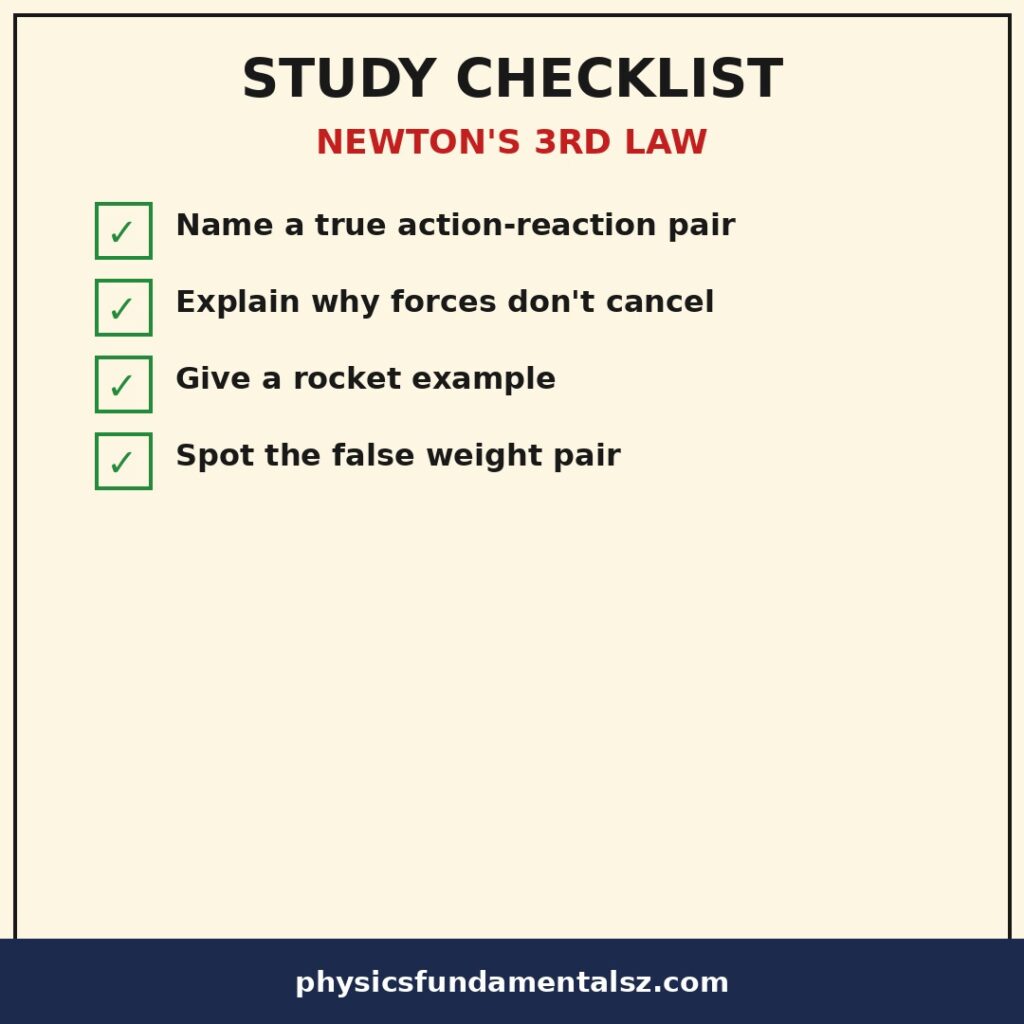
Remember the four tests: equal, opposite, different objects, same type. Apply them to every candidate pair, and the traps disappear.
Watch for the law in daily life. Walking, swimming, jumping, and driving all run on action and reaction. Rockets simply take the same rule to space.
For more mechanics, read our guides to speed and velocity and torque in physics. The third law will keep appearing, and now you will recognise it every time.