Radioactive Decay
An individual radioactive nucleus is utterly unpredictable — it might decay in the next second or survive for a billion years, and nothing can tell you which. Yet pile up trillions of them and a beautifully precise pattern emerges. This blend of pure randomness and statistical certainty is the heart of radioactive decay.
Why some nuclei are unstable
An atomic nucleus is a tight cluster of protons and neutrons held together by the strong nuclear force, fighting against the electrical repulsion of the positively charged protons. When the balance between these forces is unfavourable — too many neutrons, too few, or simply too many particles overall — the nucleus is unstable and will eventually rearrange itself into a more stable configuration, releasing energy as it does so.
That rearrangement is radioactive decay. The original nucleus is the parent; what it becomes is the daughter.
The three classic decay modes
There are three main ways a nucleus sheds its excess energy:
- Alpha decay — the nucleus ejects a helium-4 nucleus (2 protons, 2 neutrons). Heavy, slow, and stopped by a sheet of paper.
- Beta decay — a neutron turns into a proton (or vice versa), emitting a fast electron or positron. More penetrating; stopped by a few millimetres of aluminium.
- Gamma decay — the nucleus releases a high-energy photon to drop to a lower energy state, often after an alpha or beta event. Highly penetrating; needs thick lead or concrete.
The decay law
Although no one can predict a single nucleus, each unstable isotope has a fixed probability of decaying per unit time. This makes the number of surviving nuclei fall exponentially. If N is the number remaining and λ (the decay constant) is the probability of decay per nucleus per second:
Here N₀ is the number you started with. The activity — the number of decays per second, measured in becquerels — is proportional to how many nuclei remain, so it follows the same falling curve. The more you have, the faster the total decay rate, which is why activity drops off over time.
Radioactive decay is memoryless. A nucleus that has survived for a thousand years is no more “due” to decay than a brand-new one. Each instant, every surviving nucleus faces the same fixed probability of decaying.
Half-life: the practical measure
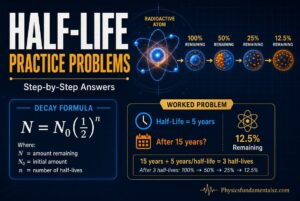
Rather than the abstract constant λ, scientists usually quote the half-life t½ — the time for half of any sample to decay. It connects to λ by a simple relation:
Half-lives span an astonishing range. Some isotopes have half-lives of fractions of a second; uranium-238’s is about 4.5 billion years, comparable to the age of the Earth. After one half-life, half the sample remains; after two, a quarter; after three, an eighth — the fraction halving each time.
Radioactive dating
Because half-lives are constant, decay acts as a natural clock. Carbon-14, with a half-life of about 5,730 years, is continuously made in the atmosphere and absorbed by living things. When an organism dies it stops taking in carbon-14, and the amount remaining slowly decays. By measuring how much is left, archaeologists date organic remains up to roughly 50,000 years old.
For far older samples — rocks and the Earth itself — geologists use isotopes with billion-year half-lives, such as uranium decaying to lead. The same exponential law, applied across vastly different timescales, lets us read history from atoms. The energy released in these transformations links to ideas in nuclear fission and fusion.
Decay chains and equilibrium
Often a daughter nucleus is itself unstable, decaying into yet another, forming a chain. Uranium-238 passes through more than a dozen steps before settling as stable lead-206. Along the way it produces radon gas, which is why uranium-rich rocks can release radon into basements. Understanding the whole chain matters for both geology and safety, and the released energy connects to the broader principle of mass-energy equivalence.
Frequently asked questions
Can we predict when a single atom will decay?
No. Decay is fundamentally random at the level of one nucleus. We can only state the probability per unit time. Precision emerges only when averaging over enormous numbers of atoms.
Does radioactive decay ever stop completely?
The exponential curve approaches zero but never mathematically reaches it. In practice, after many half-lives the remaining activity becomes negligible. A decay chain ends when it reaches a stable isotope that does not decay further.
Can we speed up or slow down decay?
For the most part, no. The decay rate is set by the nucleus and is almost completely immune to temperature, pressure or chemistry, which is precisely what makes radioactive clocks so trustworthy for dating.