Difference Between Heat and Temperature Explained Simply
Quick Answer Box
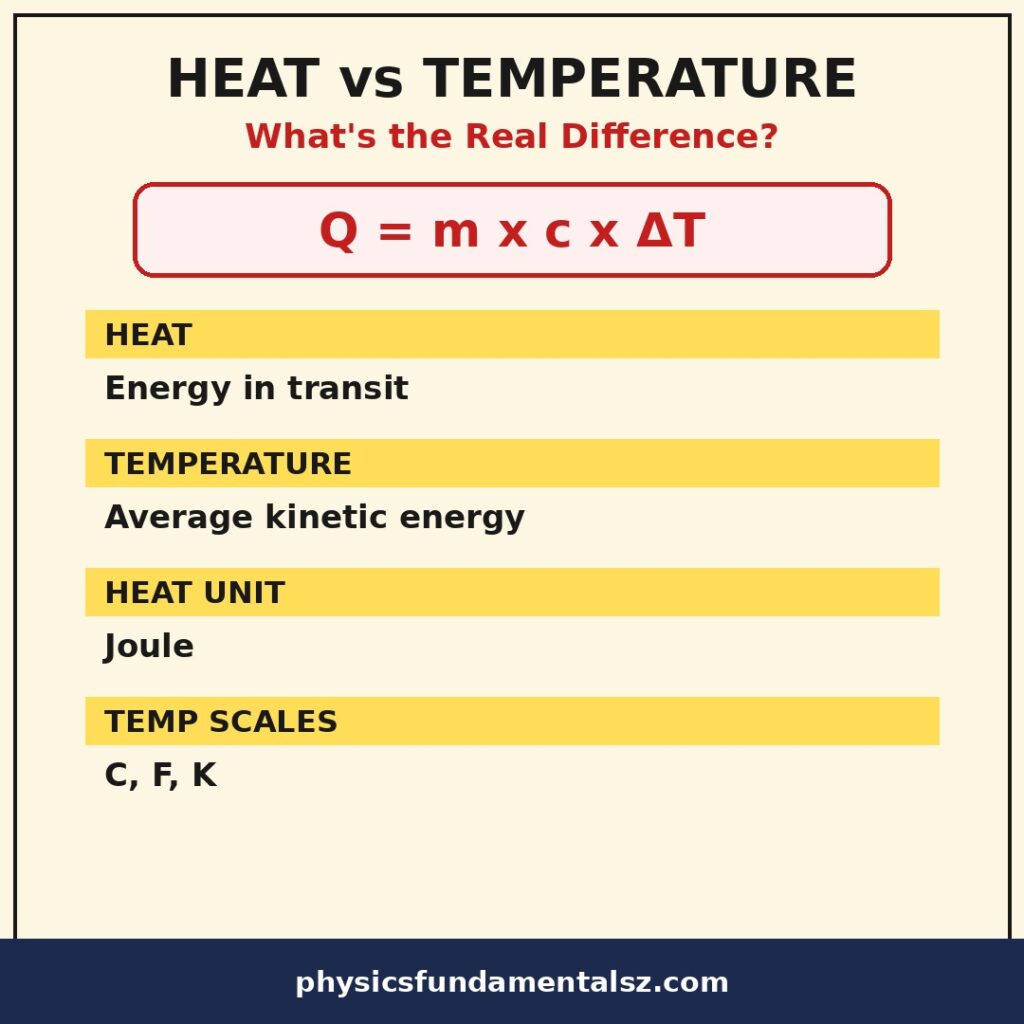
Heat and temperature are related, but they are not the same physical quantity. Temperature measures how hot or cold an object is on average at the particle level. Heat is energy transferred because of a temperature difference.
A small spark can have a very high temperature yet carry very little heat energy. A large bathtub of warm water has a lower temperature, but it stores far more total thermal energy. That contrast captures the whole difference in one picture.
Temperature is an intensive property, which means it does not depend on how much material is present. Heat is energy in transit, and its amount depends on mass, material, and temperature change. Once heat transfer stops, the energy is no longer called heat.
What Is Heat? Definition Box
Heat is energy transferred between a system and its surroundings because their temperatures differ. It flows spontaneously from the hotter object to the colder object. Heat is not a substance stored inside an object, even though everyday language often describes it that way.
In physics, heat is written with the symbol Q and measured in joules. A calorie is another unit of energy, and one calorie is about 4.184 joules. The direction of heat flow matters as much as its size.
What Is Temperature? Definition Box
Temperature is a measure of the average kinetic energy of the particles in a substance. A higher temperature usually means faster average particle motion. Temperature does not tell you the total energy of the whole object.
Temperature is measured in degrees Celsius, degrees Fahrenheit, or kelvin. Kelvin is the SI unit and starts at absolute zero, the lowest possible temperature. Two objects can share the same temperature while holding very different amounts of energy.
Key Takeaways
- Temperature measures average particle kinetic energy, not total energy.
- Heat is energy moving from a hotter object to a colder object.
- Heat flows only while a temperature difference exists.
- The same temperature can mean very different total energies for different masses.
- Thermal energy is the total kinetic and potential energy of all particles.
- Internal energy includes thermal energy plus other stored microscopic energy.
- Celsius, Fahrenheit, and kelvin measure temperature, while joules measure heat.
- Thermal equilibrium means equal temperatures and no net heat flow.
What Temperature Really Measures
Temperature is best understood as an average, not a total. Imagine a classroom where most students walk slowly, while one student runs across the room. The average speed describes the group, but it hides the fastest and slowest individuals.
Particles in a gas, liquid, or solid behave in a similar way. Their speeds follow a distribution, with some moving slowly and others moving quickly. Temperature reflects the average kinetic energy of that distribution, not the energy of any single particle.
That process does not require the objects to have the same mass or material. A small metal block and a large wooden block can reach the same temperature in time. Their final temperatures match, but their stored energies do not.
What Heat Really Is
Heat is not a property of an object in the same way that mass or volume is. It is a process quantity, which means it describes energy crossing a boundary. Once that energy arrives, it becomes part of the internal energy of the receiving object.
This distinction is important for solving physics problems correctly. You should never say that an object “contains heat” in a strict physics sense. Instead, say that the object has internal energy, and that heat was transferred to it.
The total heat transferred depends on several factors. Mass matters, because more particles can absorb or release more energy. Material matters, because different substances respond differently to the same energy input.
Heat can also cause a phase change without changing temperature. Melting ice absorbs energy while staying at zero degrees Celsius until all the ice has melted. Boiling water absorbs energy while staying at 100 degrees Celsius at standard atmospheric pressure.
During a phase change, the added energy breaks bonds between particles rather than speeding them up. The average kinetic energy stays roughly constant, so the temperature stays constant. This is why a thermometer in boiling water does not keep rising.
The Kinetic Theory Link
Kinetic theory connects the invisible motion of particles to measurable quantities like pressure and temperature. For an ideal gas, particles are treated as tiny spheres moving freely and colliding elastically. Their average kinetic energy is directly proportional to the absolute temperature.
This relationship gives temperature a clear microscopic meaning. Doubling the Kelvin temperature of an ideal gas doubles the average kinetic energy of its particles. It does not necessarily double the speed, because kinetic energy depends on the square of speed.
In solids, particles vibrate around fixed positions rather than moving freely. Higher temperature means larger vibration amplitudes and faster average vibration. In liquids, particles both vibrate and move past one another, which allows flow.
Kinetic theory also explains pressure in gases. Particles collide with container walls, and each collision exerts a tiny force. More frequent or harder collisions produce higher pressure at a given volume.
Temperature, pressure, and volume are therefore linked through particle motion. Heating a sealed gas increases particle speed, which increases collision force and frequency. The pressure rises unless the container expands to relieve it.
A useful related concept is kinetic energy in physics, which explains how mass and speed determine the energy of motion. Temperature focuses on the average of that energy across many particles. Heat describes energy moving when that average differs between two systems.
Units: Celsius, Fahrenheit, Kelvin, Joules, and Calories
Temperature scales are human conventions built on fixed reference points. Celsius sets the freezing point of water at zero degrees and the boiling point at 100 degrees at standard atmospheric pressure. Fahrenheit sets the freezing point at 32 degrees and the boiling point at 212 degrees on the same scale.
Kelvin uses the same degree size as Celsius but shifts the zero point to absolute zero. Zero kelvin equals negative 273.15 degrees Celsius. A temperature change of one kelvin equals a temperature change of one degree Celsius.
Conversion formulas are essential for exams and everyday science. To convert Celsius to Fahrenheit, multiply by nine fifths and add 32. To convert Fahrenheit to Celsius, subtract 32 and multiply by five ninths.
Kelvin conversions are simpler because only an offset is involved. Add 273.15 to a Celsius temperature to get kelvin. Subtract 273.15 from a kelvin temperature to get Celsius.
Heat and energy use different units from temperature. The joule is the SI unit of energy, work, and heat. One joule is the energy transferred when a force of one newton moves an object by one metre in the direction of the force.
The calorie is an older unit still common in nutrition and older textbooks. One small calorie is the energy needed to raise one gram of water by one degree Celsius. Food labels use kilocalories, often written simply as Calories with a capital C.
Temperature Scale Comparison
| Scale | Water freezes | Water boils | Absolute zero | Used for |
|---|---|---|---|---|
| Celsius | 0 degrees | 100 degrees | negative 273.15 degrees | Everyday science and weather in most countries |
| Fahrenheit | 32 degrees | 212 degrees | negative 459.67 degrees | Everyday weather in the United States |
| Kelvin | 273.15 kelvin | 373.15 kelvin | 0 kelvin | Scientific work and gas laws |
Energy Unit Comparison
| Unit | Symbol | Definition in plain terms | Common use |
|---|---|---|---|
| Joule | J | SI unit of energy | Physics problems and scientific work |
| Kilojoule | kJ | 1000 joules | Larger heating and engineering calculations |
| Calorie | cal | About 4.184 joules | Older textbooks and laboratory heating |
| Kilocalorie | kcal | 1000 calories | Food energy on nutrition labels |
Heat Transfer Methods: Conduction, Convection, and Radiation
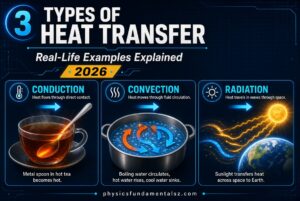
Heat can move by conduction, convection, or radiation, and often all three act together. Each method has a different mechanism and a different set of everyday examples. Recognizing the method is a common exam skill.
Conduction
Conduction transfers heat through direct particle interaction without bulk movement of the material. Faster particles collide with slower neighbors and pass energy along a chain. Metals conduct well because free electrons can carry energy quickly through the material.
A metal spoon in hot soup becomes hot at the handle because heat conducts along the spoon. A wooden spoon stays cooler because wood is a poor conductor. Insulators like wool, foam, and still air slow conduction by limiting particle interaction.
Conduction also explains why a metal handrail feels colder than a wooden bench on the same winter morning. Both objects are at the same temperature, but metal draws heat from your hand faster. Your skin senses the rate of heat loss, not temperature alone.
Convection
Convection transfers heat through the bulk movement of a fluid, such as a liquid or gas. Warmer fluid expands, becomes less dense, and rises, while cooler fluid sinks to take its place. This cycle is called a convection current.
Boiling water shows convection clearly as hot water rises and cooler water sinks. Room heating also relies on convection when warm air rises from a radiator and circulates. Ocean currents and atmospheric circulation are large-scale convection systems driven by uneven heating.
Convection can be natural or forced. Natural convection happens because of density differences alone. Forced convection uses a fan, pump, or stirrer to move the fluid faster and increase heat transfer.
Radiation
Radiation transfers heat through electromagnetic waves, and it needs no medium. The Sun warms Earth across the vacuum of space by radiation. A campfire warms your face even when cold air sits between you and the flames.
All objects emit thermal radiation, with hotter objects emitting more energy and shorter wavelengths. A glowing stove element emits visible light as well as infrared radiation. Dark surfaces absorb radiation more effectively than shiny surfaces.
Specific Heat Capacity
Specific heat capacity measures how much energy is needed to raise the temperature of one kilogram of a substance by one kelvin. Water has a very high specific heat capacity of about 4200 joules per kilogram per kelvin. Metals usually have much lower values, so they heat up and cool down faster.
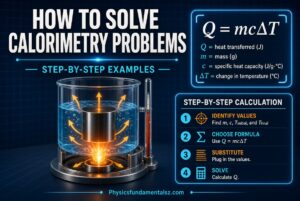
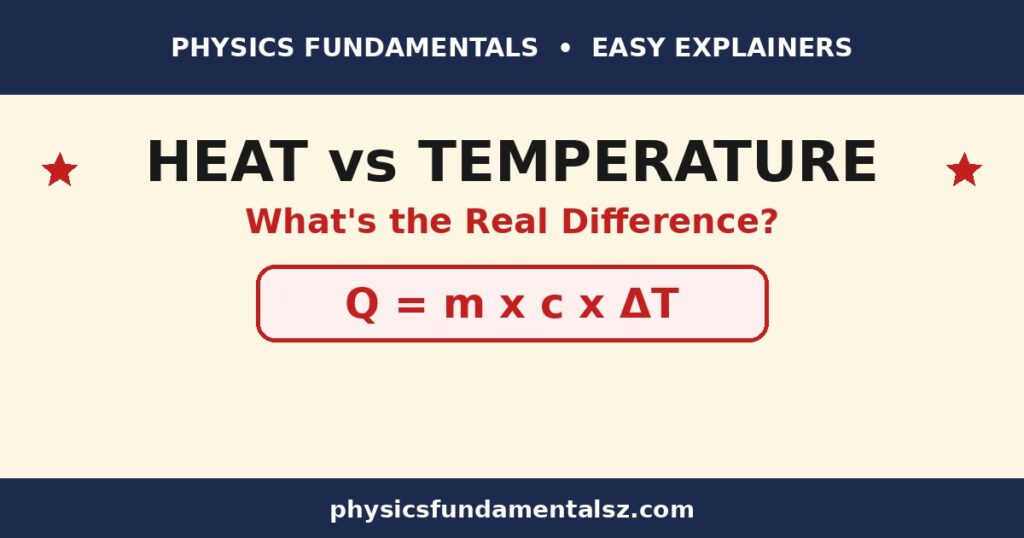
The defining equation is Q equals m times c times delta T. Here Q is heat transferred, m is mass, c is specific heat capacity, and delta T is temperature change. Temperature change can be measured in Celsius or kelvin because the size of one degree is the same.
Specific heat capacity explains why coastal climates are milder than inland climates. Oceans absorb large amounts of energy with only small temperature changes. Land heats and cools faster, which creates larger daily and seasonal temperature swings.
It also explains why water is useful for cooling engines and heating systems. A small mass of water can carry a large amount of energy. The same property makes burns from steam especially dangerous, because steam releases extra energy when it condenses.
Specific heat capacity is a material property, not a property of a single object. It depends on molecular structure and bonding, not on total mass. Heat capacity, by contrast, is the total energy needed to raise a whole object by one kelvin.
Thermal Equilibrium
Thermal equilibrium occurs when two objects in contact reach the same temperature. At that point, there is no net heat flow between them. Microscopic energy exchanges still happen, but they balance in both directions.
A thermometer works because of thermal equilibrium. The thermometer is placed in contact with an object until both reach the same temperature. The reading then reflects the object, not just the thermometer itself.
Thermal equilibrium is also the basis of the zeroth law of thermodynamics. If object A is in equilibrium with object C, and object B is also in equilibrium with object C, then A and B are in equilibrium with each other. This law makes temperature a consistent and useful concept.
Reaching equilibrium takes time, and the time depends on mass, material, and contact. A thin metal plate reaches equilibrium quickly, while a large insulated tank changes slowly. Good thermal contact speeds the process by allowing more particle collisions.
Equilibrium does not mean equal energy. A large cold lake and a small warm cup can reach the same temperature after mixing only if the system is isolated and balanced correctly. In practice, the larger mass dominates the final temperature.
The final temperature of a mixture can be predicted with energy conservation. Heat lost by the warmer substance equals heat gained by the cooler substance in an insulated container. This principle underlies calorimetry experiments.
Why a Spark Feels Different From a Bathtub of Warm Water
A spark from a firework or grinding metal can reach thousands of degrees Celsius. It still causes only a brief sting when it touches skin. A bathtub of warm water at 40 degrees Celsius can warm your whole body for a long time.
The difference is total energy, not peak temperature. A spark has tiny mass, so its total thermal energy is small. A bathtub holds a huge mass of water, so its total energy is large even at a modest temperature.
When a spark touches skin, only a small amount of energy transfers before the spark cools. The skin also conducts heat away and blood flow carries energy deeper into tissue. The result is a short, localized sensation rather than a serious burn in most cases.
Warm bath water keeps supplying energy because its mass is large. It maintains contact over a wide area for a long time. The total energy transferred is far greater, even though the temperature is much lower.
This example also shows why temperature alone cannot predict danger. High temperature with tiny mass may be harmless, while moderate temperature with large mass can cause deep heating. Safety depends on energy, contact time, contact area, and material properties.
Heat vs Temperature vs Thermal Energy vs Internal Energy
These four terms overlap, but each has a distinct role in physics. Temperature is the average kinetic energy of particles. Heat is energy transferred because of a temperature difference.
Thermal energy is the total kinetic and potential energy associated with particle motion and interaction. It increases with temperature, mass, and the number of particles. Thermal energy is a property of a system at a given moment.
Internal energy is broader than thermal energy. It includes thermal energy plus chemical energy, nuclear energy, and other microscopic stored energy. In many introductory problems, thermal energy and internal energy are treated as nearly the same, but the distinction matters in chemistry and advanced thermodynamics.
The first law of thermodynamics ties these ideas together. Change in internal energy equals heat added to the system plus work done on the system, depending on sign convention. This law is simply energy conservation applied to thermal systems.
Understanding the difference between work and power in physics helps here, because work and heat are both energy transfers. Power measures how fast that transfer happens. Heat describes the transfer itself when driven by temperature difference.
Four-Term Comparison Table
| Term | What it means | Depends on mass? | Measured in |
|---|---|---|---|
| Temperature | Average particle kinetic energy | No | Celsius, Fahrenheit, kelvin |
| Heat | Energy transferred due to temperature difference | Yes, through total transfer | Joules |
| Thermal energy | Total particle kinetic and potential energy | Yes | Joules |
| Internal energy | All microscopic stored energy, including thermal energy | Yes | Joules |
Worked Examples
Example 1: Heating Water
A student heats 2 kilograms of water from 20 degrees Celsius to 60 degrees Celsius. Water has a specific heat capacity of 4200 joules per kilogram per kelvin. The temperature change is 40 kelvin, because 60 minus 20 equals 40.
Using Q equals m times c times delta T, the calculation is 2 times 4200 times 40. The result is 336000 joules, or 336 kilojoules. This large value shows why heating water takes significant energy.
Example 2: Heating a Metal Block
A 0.5 kilogram aluminium block has a specific heat capacity of 900 joules per kilogram per kelvin. It absorbs 4500 joules of heat. Dividing heat by mass and specific heat gives a temperature rise of 10 kelvin.
The calculation is 4500 divided by the product of 0.5 and 900, which equals 4500 divided by 450, which equals 10. The block therefore warms by 10 degrees Celsius. The same energy would warm water far less because water has a higher specific heat capacity.
Example 3: Mixing Hot and Cold Water
One kilogram of water at 80 degrees Celsius is mixed with one kilogram of water at 20 degrees Celsius in an insulated container. Because the masses and material are equal, the final temperature is the midpoint. The final temperature is 50 degrees Celsius.
Energy conservation explains this result. Heat lost by hot water equals heat gained by cold water. Each kilogram changes by 30 degrees, so the energy transfers balance exactly.
Example 4: Different Masses Reaching Equilibrium
Two kilograms of water at 70 degrees Celsius are mixed with 1 kilogram of water at 10 degrees Celsius. The final temperature is closer to 70 degrees because the larger mass dominates. Let the final temperature be T, then heat lost equals heat gained.
The equation is 2 times 4200 times the difference between 70 and T, which equals 1 times 4200 times the difference between T and 10. Cancelling 4200 gives 140 minus 2T equals T minus 10, so 150 equals 3T, and T equals 50 degrees Celsius. The answer is 50 degrees Celsius, which sits closer to the larger mass.
Example 5: Temperature Conversion
Convert 25 degrees Celsius to Fahrenheit and kelvin. For Fahrenheit, multiply 25 by nine fifths to get 45, then add 32 to get 77 degrees Fahrenheit. For kelvin, add 273.15 to 25 to get 298.15 kelvin.
This example shows why unit conversion must happen before using gas laws. Absolute temperature in kelvin is required for proportional relationships. Celsius values must never be used directly in those ratios.
Example 6: Cooling and Heat Loss
A 3 kilogram iron block cools from 90 degrees Celsius to 30 degrees Celsius. Iron has a specific heat capacity of about 450 joules per kilogram per kelvin. The temperature change is 60 kelvin.
Heat released equals 3 times 450 times 60, which equals 81000 joules. The negative sign in a full thermodynamic treatment shows energy leaving the block. The magnitude alone is 81 kilojoules.
Real-World Applications
Cooking
Cooking depends on controlled heat transfer and specific heat capacity. Metal pans conduct heat from the burner to food quickly. Water-based sauces heat slowly because water stores energy well.
Ovens combine conduction, convection, and radiation. Hot air circulates by convection, oven walls radiate heat, and baking trays conduct heat into food. Stirring prevents uneven heating by forcing convection and redistributing hot liquid.
Weather and Climate
The Sun heats Earth unevenly because of angle, surface type, and cloud cover. Warm air rises and cool air sinks, creating wind and weather systems. Oceans moderate coastal climates because water stores heat with small temperature changes.
Sea breezes form when land heats faster than water during the day. Warm air over land rises, and cooler air from the sea moves in to replace it. At night, the pattern can reverse as land cools faster than water.
Engines and Machines
Engines convert thermal energy into useful work, but no engine is perfectly efficient. Fuel burns and creates hot gas, which expands and pushes a piston or turbine. Waste heat leaves through exhaust and cooling systems.
The second law of thermodynamics limits engine efficiency. Some heat must always be rejected to a colder reservoir. Engineers reduce losses with insulation, better materials, and heat recovery systems.
Insulation and Buildings
Good insulation slows conduction, convection, and radiation together. Wall insulation traps air to reduce conduction. Sealed windows reduce convection and drafts.
Roof insulation matters because warm air rises and escapes through the roof. Reflective barriers reduce radiative heat gain in hot climates. Building design balances insulation with ventilation to control moisture and air quality.
Body Temperature
The human body maintains an internal temperature near 37 degrees Celsius. Metabolism produces heat, while sweating, blood flow, and breathing release heat. Fever raises the set point, so the body feels cold even while temperature rises.
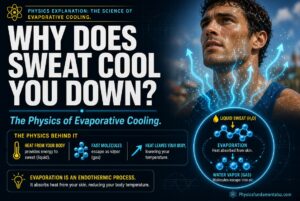
Sweating cools through evaporation, which removes energy from skin. Shivering produces heat through muscle activity. Blood vessels near the skin widen to release heat or narrow to conserve it.
Common Mistakes
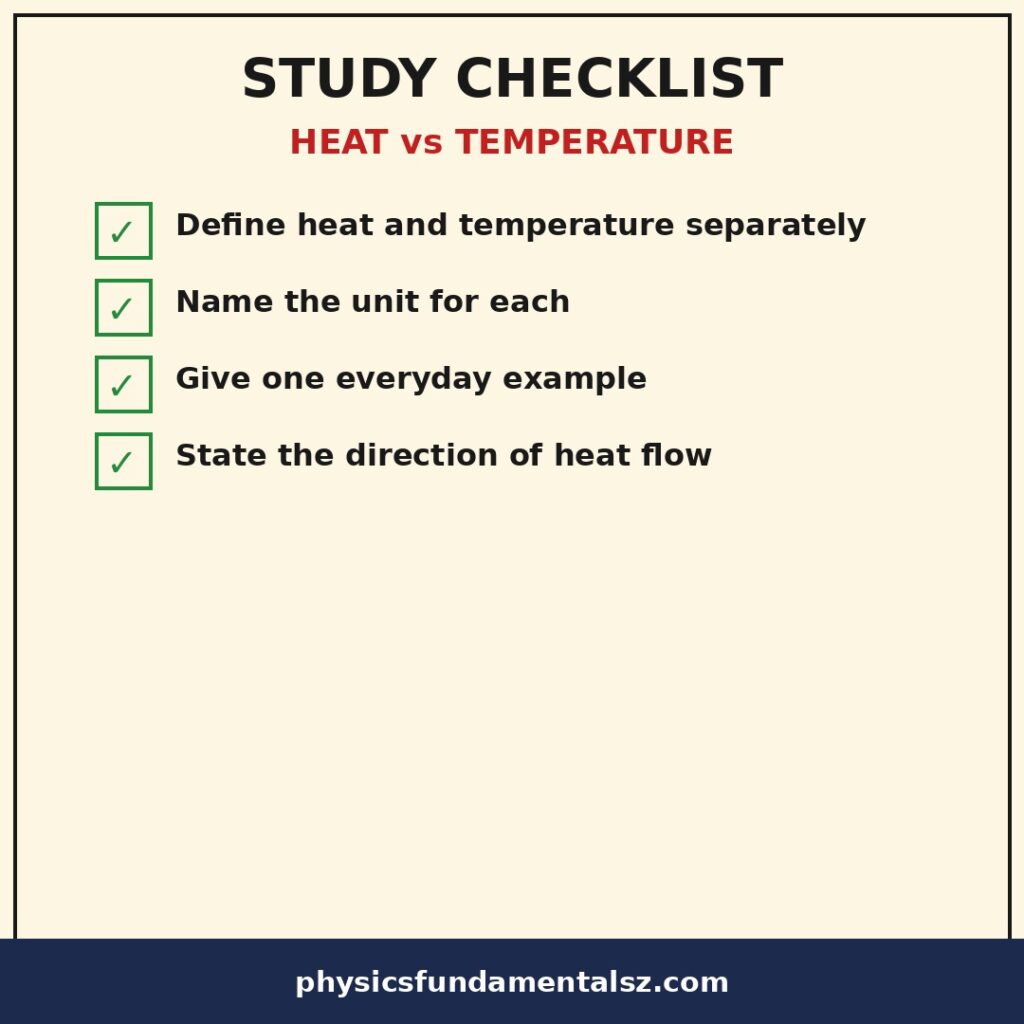
Many students say that heat is stored in an object, but physics treats heat as transfer. The stored quantity is internal energy, not heat. Using the correct term improves both understanding and exam marks.
Another common mistake is assuming that temperature measures total energy. Temperature measures an average, so mass must be considered separately. A large cool object can hold more energy than a small hot object.
Students also confuse temperature change with heat transferred. The same temperature change requires different energies for different materials. Specific heat capacity must be included in every Q equals mc delta T calculation.
Unit errors are frequent and avoidable. Fahrenheit differences cannot be substituted directly into equations that expect Celsius or kelvin differences. Energy must be converted to joules before comparing with values in joules per kilogram per kelvin.
Phase changes cause another misunderstanding. Adding heat during melting or boiling does not raise temperature. The energy changes particle arrangement instead of average kinetic energy.
AP Physics Exam Tips
Read every heat and temperature question for mass, material, and temperature change, and revise with Khan Academy physics if a concept feels shaky. Missing one of these values often means the question expects a ratio or equilibrium argument. Write the equation first, then substitute values with units.
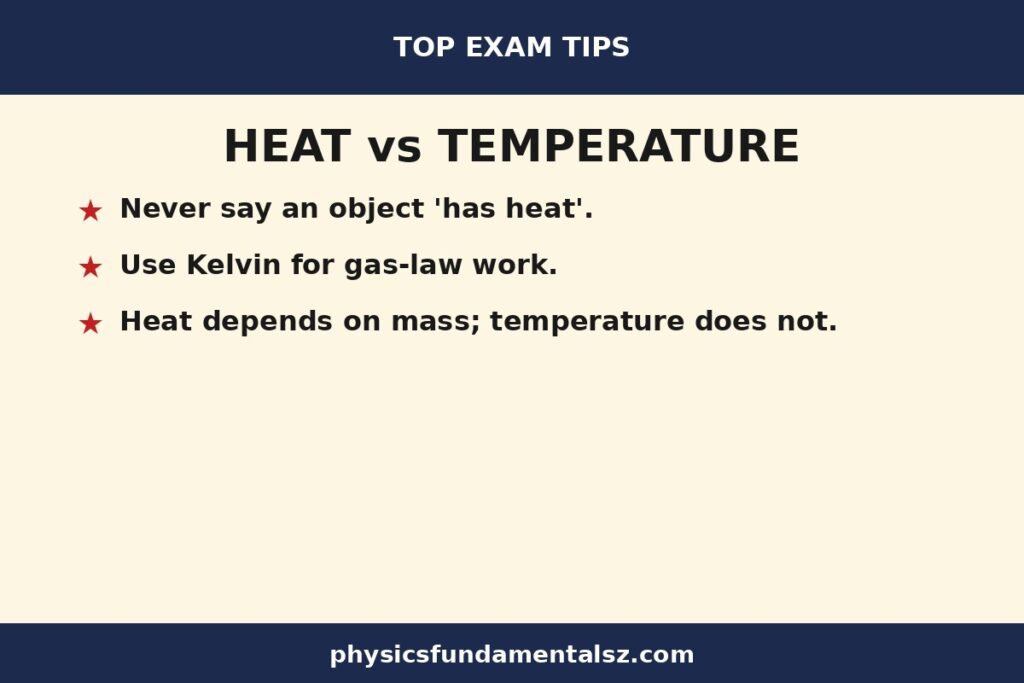
Use kelvin for gas law problems and absolute temperature ratios. Celsius is acceptable for temperature differences, but not for direct proportionality. Check whether the question asks for heat, temperature, or internal energy before choosing a formula.
In calorimetry problems, set heat lost equal to heat gained for an insulated system. Include the calorimeter itself if its mass and specific heat are given. Watch for phase changes, because latent heat must be added separately from sensible heating.
For multiple-choice questions, eliminate answers with wrong units. Heat answers must be in joules or a related energy unit. Temperature answers must be in a temperature unit, not joules.
Explain conduction, convection, and radiation with mechanism, not just examples. A strong answer states how particles or waves move energy. A weak answer only names a familiar object without explaining the transfer.
Useful background reading includes Ohm’s law in physics for electrical heating, where current through resistance converts electrical energy into thermal energy. That connection appears in problems about heaters, bulbs, and power dissipation. It also reinforces the idea that energy can change form while total energy stays conserved.
Heat vs Temperature at a Glance
| Feature | Heat | Temperature |
|---|---|---|
| Basic meaning | Energy in transit due to temperature difference | Average kinetic energy of particles |
| Symbol | Q | T |
| SI unit | Joule | Kelvin |
| Depends on amount? | Yes | No |
| Can it be negative? | Yes, by sign convention for loss | No, in kelvin |
| Measured with | Calorimeter or calculation | Thermometer |
| Stops when | Temperatures equalize | Never, it is a state value |
FAQs
1. What is the difference between heat and temperature in simple words?
Temperature tells you how hot something is on average. Heat is energy moving from a hotter thing to a colder thing. Once temperatures match, net heat flow stops.
2. Is heat the same as temperature?
No, heat and temperature are different quantities with different units. Temperature is measured in kelvin or degrees, while heat is measured in joules. They are linked, but one is not the other.
3. Can an object have heat?
In strict physics language, an object has internal energy rather than heat. Heat describes energy crossing a boundary because of a temperature difference. After transfer, that energy becomes part of internal energy.
4. Does a higher temperature always mean more heat energy?
No, total energy also depends on mass and material. A tiny spark can be extremely hot yet hold very little total energy. A large warm lake holds far more energy at a lower temperature.
5. What is thermal energy?
Thermal energy is the total kinetic and potential energy of particles in a substance. It increases with temperature and with the amount of material. It is measured in joules.
6. What is internal energy?
Internal energy is all microscopic energy stored in a system, including thermal energy. It also includes chemical and other microscopic forms of energy. In many simple problems, thermal energy is the main part that changes.
7. Why does temperature stay constant during melting?
Added energy breaks bonds between particles instead of increasing their average speed. The average kinetic energy stays about the same during the phase change. Temperature therefore remains constant until melting is complete.
8. What is absolute zero?
Absolute zero is 0 kelvin, or negative 273.15 degrees Celsius. It is the lowest possible temperature in classical physics. Real systems can approach it but cannot reach it.
9. Which temperature scale should I use in gas laws?
Use kelvin for gas laws and any temperature ratio. Kelvin has a true zero point linked to particle motion. Celsius and Fahrenheit do not work directly in those proportional equations.
10. How do you convert Celsius to Fahrenheit?
Multiply the Celsius value by nine fifths and add 32. For example, 20 degrees Celsius becomes 68 degrees Fahrenheit. The reverse conversion subtracts 32 and multiplies by five ninths.
11. What is specific heat capacity?
Specific heat capacity is the energy needed to raise one kilogram of a substance by one kelvin. Water has a high value, so it warms and cools slowly. Metals usually have lower values and change temperature faster.
12. What does Q equals mc delta T mean?
Q is heat transferred, m is mass, c is specific heat capacity, and delta T is temperature change. Multiply these three quantities to find the heat for a temperature change without phase change. Use consistent units, especially joules and kilograms.
13. What are conduction, convection, and radiation?
Conduction moves heat through particle collisions without bulk flow. Convection moves heat through bulk fluid motion. Radiation moves heat through electromagnetic waves and needs no medium.
14. Why does metal feel colder than wood at the same temperature?
Metal conducts heat away from your hand faster than wood. Your skin senses the rate of heat loss, not temperature alone. Both objects can be at the same temperature while feeling very different.
15. What is thermal equilibrium?
Thermal equilibrium means two objects in contact have the same temperature. Net heat flow between them becomes zero. Thermometers rely on this principle to give correct readings.
16. Does heat always flow from hot to cold?
Yes, net heat flow is spontaneously from hotter to colder objects. Refrigerators can move heat the other way only by using work input. The overall process still obeys the second law of thermodynamics.
17. Why is steam more dangerous than boiling water?
Steam releases extra latent heat when it condenses on skin. Boiling water transfers heat by contact, but steam adds condensation energy as well. That extra energy can cause deeper burns.
18. How is heat different from work?
Heat is energy transfer driven by a temperature difference. Work is energy transfer driven by a force acting through a distance. Both can change internal energy, but their mechanisms differ.
19. Why do coastal places have milder climates?
Oceans have high specific heat capacity and store large energy with small temperature changes. Land heats and cools faster, creating larger temperature swings inland. Water therefore moderates nearby air temperatures.
20. What is the most common exam mistake with heat and temperature?
Students often treat temperature as total energy and forget mass and specific heat. They may also use Fahrenheit differences directly in physics equations. Always check units, mass, and material before calculating.
Conclusion
Heat and temperature describe different parts of the same thermal story. Temperature gives the average particle energy, while heat tracks energy moving between systems. Thermal energy and internal energy complete the picture by describing what a system actually stores.
The spark and bathtub comparison remains the best mental test. Ask whether the question concerns an average or a total. Check mass, material, and temperature change before calculating energy.