Speed vs Velocity: Differences, Formulas & Solved Examples
Quick answer: Speed is how fast an object moves, regardless of direction — it is a scalar. Velocity is speed with direction — it is a vector. An object can have a large speed but zero velocity: run around a track and return to your starting point, and your average velocity is zero because your displacement is zero, even though your average speed was far from zero. The formulas look similar, but they answer different questions: speed uses distance travelled, velocity uses displacement.
Introduction
Ask a friend how fast they drove to school and they will answer with a number: “60 km/h.” That number is a speed. Now ask a physicist the same question and they will want one more piece of information: “60 km/h in which direction?” That extra detail turns speed into velocity, and the difference between the two is one of the first and most important distinctions in physics.
Students often treat speed and velocity as synonyms, because in everyday language they are. In physics they are not, and exam questions are built around the difference. A question that asks for average velocity when you computed average speed — or the reverse — will cost you the mark even if your arithmetic is perfect. Worse, confusing the two leads to real misunderstandings later: acceleration is defined as a change in velocity, not a change in speed, which is why an object moving at a constant speed around a circle is still accelerating.
In this guide, you will learn the speed definition, the velocity definition, the formulas for average and instantaneous speed and velocity, how to calculate each with worked examples, how speed and velocity appear on graphs, and the mistakes that cost students marks. We will also connect speed and velocity to the energy ideas in our other guides, because the speed in the kinetic energy formula is a speed, not a velocity — and that distinction matters.
What Is Speed?
Definition box: Speed is the rate at which an object covers distance. It tells you how fast something is moving, but says nothing about the direction of motion. Speed is a scalar quantity: it has magnitude only, and it is never negative.
The formula for average speed is:
Average speed = total distance travelled / total time taken
The SI unit of speed is meters per second (m/s). Kilometres per hour (km/h) and miles per hour (mph) are common in daily life, and converting between them is a routine exam skill: divide km/h by 3.6 to get m/s, and multiply m/s by 3.6 to get km/h.
Speed answers the question “how fast?” and nothing else. A car’s speedometer reads speed, not velocity: it tells you 60 km/h whether you are driving north, south, or around a roundabout. A runner’s pace watch measures speed. When a news report says a storm is moving at 40 km/h, it usually means speed — unless it adds a direction, such as “north-east,” in which case it has become a velocity.
Khan Academy defines speed as “how fast an object is moving,” measured as distance divided by time, and contrasts it with velocity, which adds direction (khanacademy.org). HyperPhysics makes the same distinction, noting that velocity is a vector quantity while speed is its scalar magnitude (hyperphysics.phy-astr.gsu.edu).
What Is Velocity?
Definition box: Velocity is the rate of change of displacement. It tells you how fast an object is moving and in which direction. Velocity is a vector quantity: it has both magnitude and direction, and it can be negative, because direction is encoded in the sign.
The formula for average velocity is:
Average velocity = displacement / total time taken
Displacement is the straight-line distance from the starting point to the ending point, with direction. If you walk 3 km east and then 3 km west, your total distance is 6 km, but your displacement is zero — you ended where you started. Your average speed over that walk is positive, but your average velocity is zero.
In one-dimensional problems, direction is shown with a sign: positive usually means to the right, east, or upward, and negative means the opposite. In two dimensions, direction is given as an angle or a compass bearing. The magnitude of the velocity vector — the number without the direction — is the speed. That is the cleanest way to remember the relationship: speed is the magnitude of velocity.
This vector nature is why velocity can change even when speed stays constant. Drive around a roundabout at a steady 30 km/h and your speed never changes, but your velocity changes continuously because your direction keeps changing. And since acceleration is defined as the rate of change of velocity, you are accelerating the whole way around, even though the speedometer never moves. This is one of the most tested ideas in introductory physics.
Speed vs Velocity: The Complete Comparison
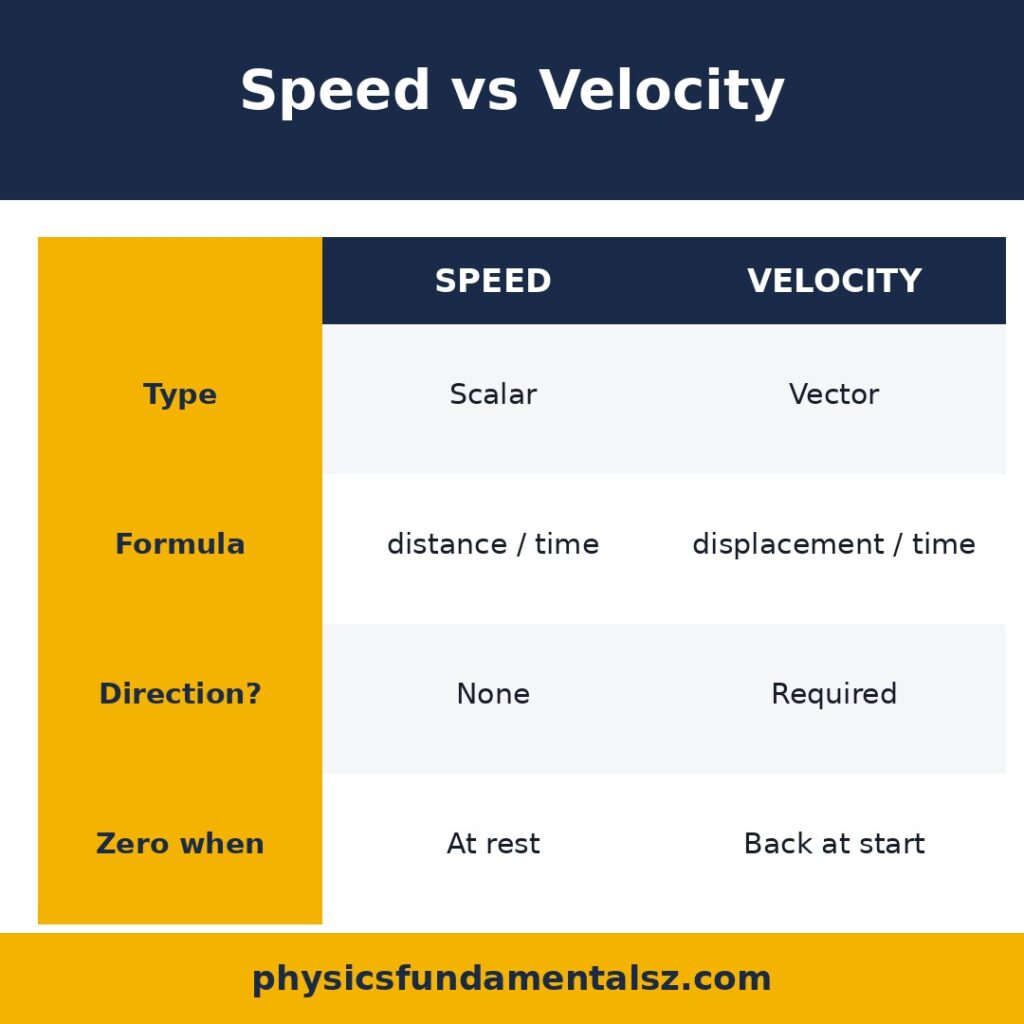
| Feature | Speed | Velocity |
|---|---|---|
| Definition | Distance per unit time | Displacement per unit time |
| Type | Scalar | Vector |
| Direction | None | Required |
| Can it be negative? | No, always ≥ 0 | Yes, sign shows direction |
| Formula | Total distance / total time | Displacement / total time |
| Zero when | Object is at rest | Object returns to start (or is at rest) |
| What it answers | “How fast?” | “How fast, and where to?” |
| Speedometer reading | Yes | No — it ignores direction |
| Changes in a circle at steady pace? | No | Yes — direction changes |
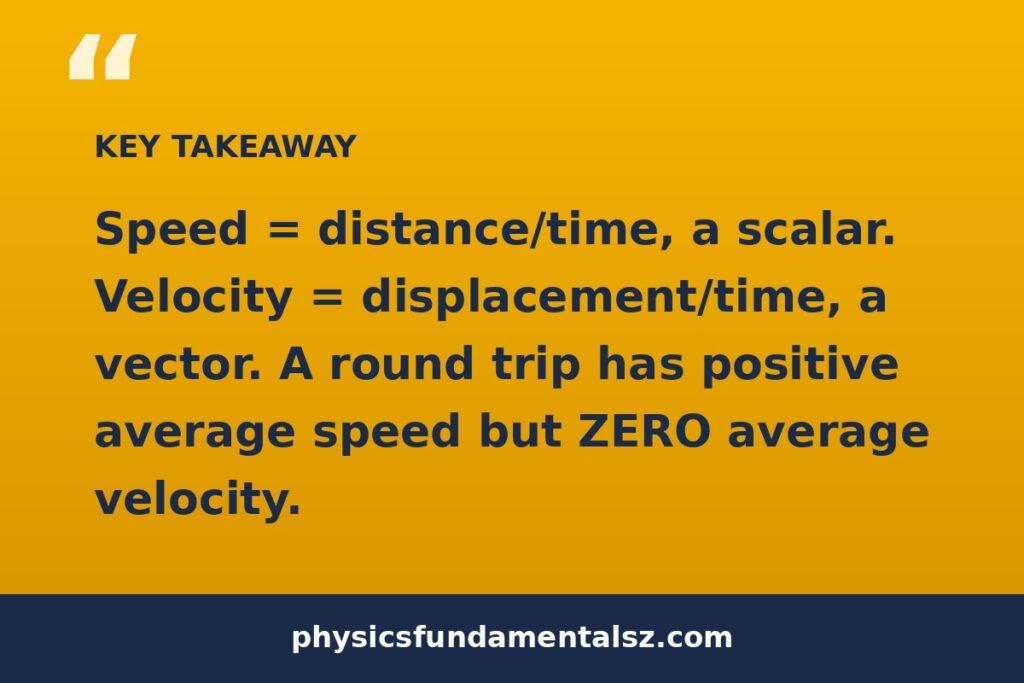
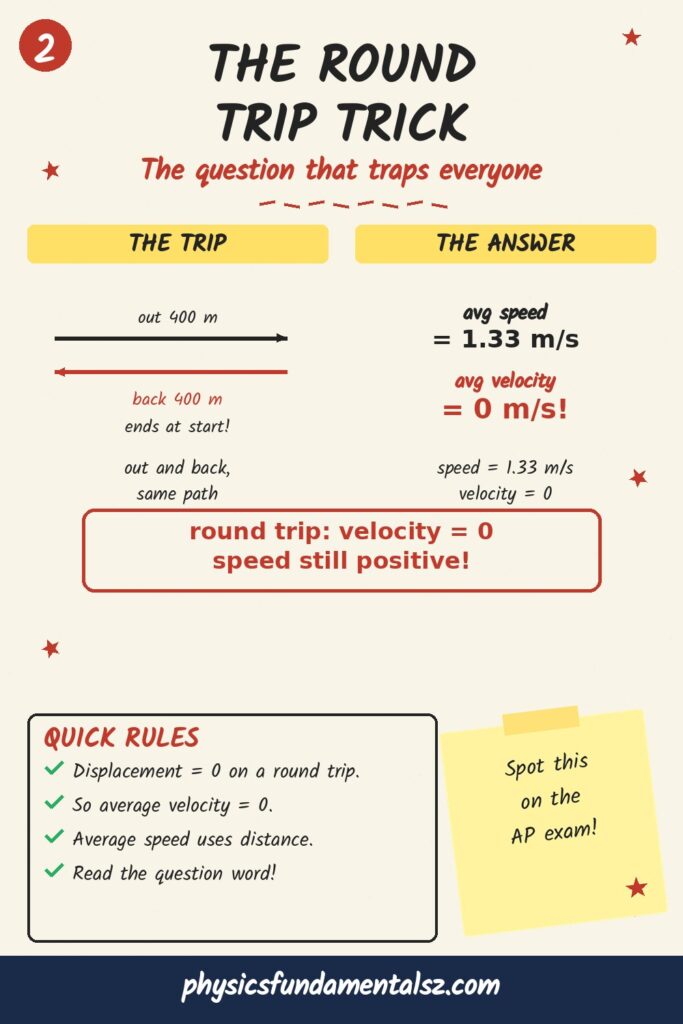
The table captures the exam essentials, but one row deserves emphasis: the zero row. Speed is zero only when the object is not moving at all. Velocity is zero whenever the object ends up where it started, no matter how far or fast it travelled in between. A round trip always has zero average velocity. This single fact appears in exam questions more than any other speed-versus-velocity idea.
Average Speed vs Average Velocity
Average speed and average velocity are computed over a whole journey, and they are the pair students confuse most. Work through the difference carefully with a concrete journey: a cyclist rides 30 km east in 1 hour, then 30 km west in 1 hour, returning home.
Total distance = 30 + 30 = 60 km. Total time = 2 hours. Average speed = 60/2 = 30 km/h.
Displacement = 0 km, because the cyclist ended at the start. Average velocity = 0/2 = 0 km/h.
Same journey, same effort, two completely different answers — and both are correct for their own quantity. The exam question will name one of them, and the name is the whole instruction. If it says “average speed,” use distance. If it says “average velocity,” use displacement.
A second classic case: a car travels to a town 60 km away at 40 km/h, then returns at 60 km/h. Many students average the two speeds and answer 50 km/h. That is wrong. Average speed is total distance divided by total time: the outward trip takes 1.5 hours and the return takes 1 hour, so total distance 120 km over 2.5 hours gives 48 km/h. The harmonic mean, not the arithmetic mean, is the right tool when distances are equal but speeds differ. Meanwhile the average velocity for the round trip is zero, again, because displacement is zero.
Instantaneous Speed vs Instantaneous Velocity
Averages describe whole journeys, but physics often needs the value at a single moment: the speed of a car as it passes a speed camera, or the velocity of a ball at the top of its throw. These are instantaneous values.
Instantaneous speed is the speed at one instant, and it is what a speedometer shows. Mathematically, it is the magnitude of the instantaneous velocity, and it can be found from a distance-time graph as the gradient of the tangent at that instant.
Instantaneous velocity is the velocity at one instant: the speed at that moment plus the direction of motion at that moment. On a displacement-time graph, it is the gradient of the tangent at that instant, and its sign tells you the direction.
A ball thrown straight up illustrates the difference beautifully. As it rises, its velocity is positive and shrinking; at the top of its flight, its instantaneous velocity is momentarily zero; as it falls, its velocity is negative and growing in magnitude. Its instantaneous speed, meanwhile, shrinks to zero at the top and then grows again — speed never goes negative, because it is just the magnitude. At the very top, both are zero, but for a different reason: the velocity is zero because the ball has momentarily stopped, and the speed is zero because it is the magnitude of that zero velocity.
Speed and Velocity on Graphs
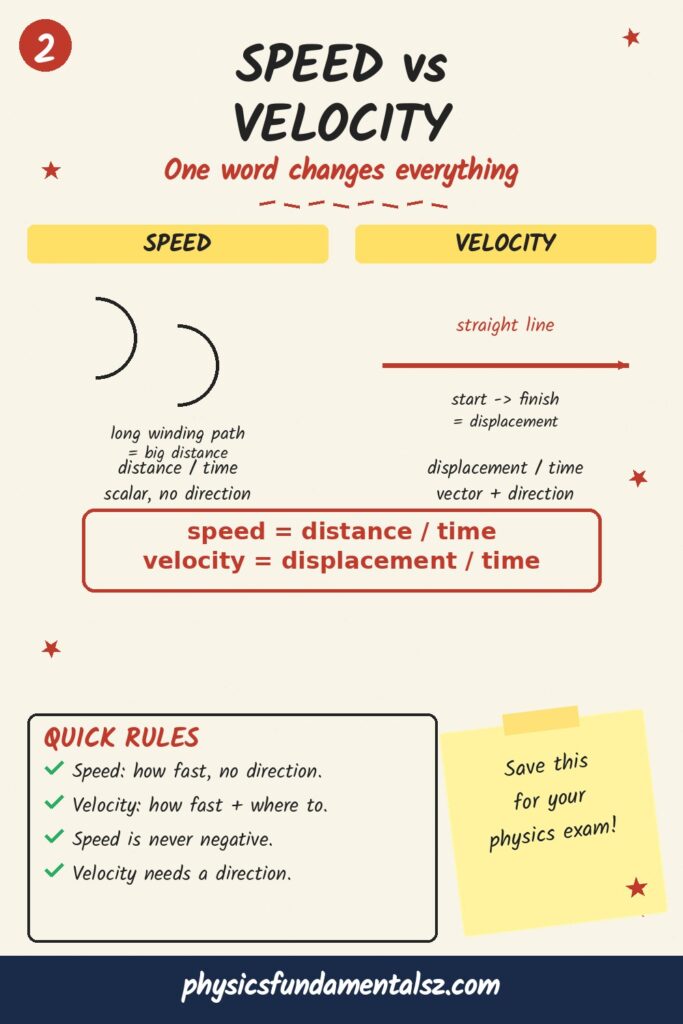
Graphs turn these definitions into pictures, and graph questions are a staple of exams. There are two graphs to master.
Distance-time graphs
On a distance-time graph, the gradient gives the speed. A straight line means constant speed; a steeper line means a faster speed; a horizontal line means the object is at rest. The graph can never go downward, because distance travelled only accumulates. The average speed over an interval is the total distance divided by the total time, which is the gradient of the chord joining the endpoints.
Displacement-time graphs
On a displacement-time graph, the gradient gives the velocity. A straight line means constant velocity; a steeper line means a larger velocity; a horizontal line means the object is at rest. Crucially, the graph can go downward: a downward slope means negative velocity, motion back toward the origin. A curve that rises then falls describes an object moving away and then returning, and the point where the graph returns to its starting level marks zero displacement — and therefore zero average velocity over the whole interval, even though the object was moving throughout.
Reading these two graphs side by side is the fastest way to check your understanding. If you can look at a displacement-time graph and immediately say where the velocity is positive, negative, and zero, and where the speed is largest, you have mastered this topic.
Worked Examples
Example 1: The morning run
A runner covers 5 km in 25 minutes. What is her average speed in m/s?
Distance = 5,000 m. Time = 25 × 60 = 1,500 s. Average speed = 5,000/1,500 = 3.33 m/s. This is a straightforward unit-conversion exercise: convert km to m and minutes to seconds before dividing.
Example 2: The round trip
A student walks 400 m east to school in 5 minutes, then walks 400 m west home in 5 minutes. Find (a) average speed and (b) average velocity.
(a) Total distance = 800 m, total time = 600 s, average speed = 800/600 = 1.33 m/s. (b) Displacement = 0 m, so average velocity = 0 m/s. The student was moving the whole time, yet the average velocity is zero — the signature result of a round trip.
Example 3: The two-speed journey
A car travels 90 km at 60 km/h, then a further 90 km at 90 km/h. Find the average speed.
First leg time = 90/60 = 1.5 hours. Second leg time = 90/90 = 1 hour. Total distance = 180 km, total time = 2.5 hours, average speed = 180/2.5 = 72 km/h. Note that 72 is not the average of 60 and 90 — it is closer to the slower speed, because the car spent more time at the slower speed. This is a classic trap.
Example 4: Velocity with direction
A boat sails 30 km north in 2 hours, then 40 km east in 2 hours. Find (a) the average speed and (b) the average velocity.
(a) Total distance = 70 km over 4 hours, so average speed = 17.5 km/h. (b) Displacement is the straight-line distance from start to finish: by Pythagoras, √(30² + 40²) = 50 km, in a direction 53.1° east of north. Average velocity = 50/4 = 12.5 km/h at 53.1° east of north. Notice that the average velocity (12.5 km/h) is smaller than the average speed (17.5 km/h) — the magnitude of average velocity can never exceed the average speed, because the straight-line displacement can never exceed the path length.
Example 5: Reading a graph
A displacement-time graph shows an object moving from 0 m to 20 m in 4 s, then staying at 20 m for 2 s, then returning to 0 m in 4 s. Describe the motion and find the average velocity over the full 10 s.
From 0–4 s, velocity = 20/4 = +5 m/s. From 4–6 s, velocity = 0 m/s. From 6–10 s, velocity = (0 − 20)/4 = −5 m/s. The object ends where it started, so displacement is zero and average velocity over the whole 10 s is zero. Its average speed, however, is total distance (40 m) over 10 s = 4 m/s. Same data, different quantities, different answers — and the graph makes the reason visible.
Speed, Velocity, and Acceleration
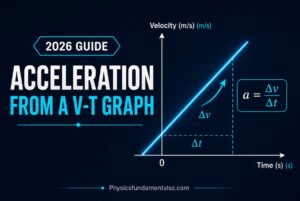
Acceleration is defined as the rate of change of velocity, not speed: a = Δv/Δt. This definition has two consequences that students must internalize. First, an object can accelerate while its speed stays constant, because its direction is changing — uniform circular motion is the standard example, and it appears in questions precisely to test this. Second, an object can have zero acceleration while moving, if its velocity is constant in both magnitude and direction.
Deceleration is not a separate physical quantity: it is simply acceleration in the direction opposite to the velocity. When a car’s velocity is +20 m/s and its acceleration is −5 m/s², the car is slowing down, and physicists describe this as negative acceleration rather than inventing a new term. Keeping the sign convention consistent — positive direction chosen once, used everywhere — prevents most sign errors in kinematics problems.
Speed and Velocity in Energy Problems
The speed in the kinetic energy formula, KE = ½mv², is a speed, not a velocity. Direction does not matter for kinetic energy, because speed is squared and direction is discarded. A car moving north at 20 m/s and a car moving south at 20 m/s have identical kinetic energies, even though their velocities are opposite. This is one reason physicists keep the two quantities distinct: energy calculations need the scalar, while momentum calculations need the vector. Our guide on what kinetic energy is explores that formula in depth, and the comparison with momentum there reinforces everything in this article.
The same distinction appears in the work-energy theorem. Work changes kinetic energy, which depends on speed, while impulse changes momentum, which depends on velocity. If you ever find yourself wondering whether a problem wants a scalar or a vector answer, check which quantity it asks about: energy questions want speed, momentum questions want velocity.
Common Mistakes to Avoid
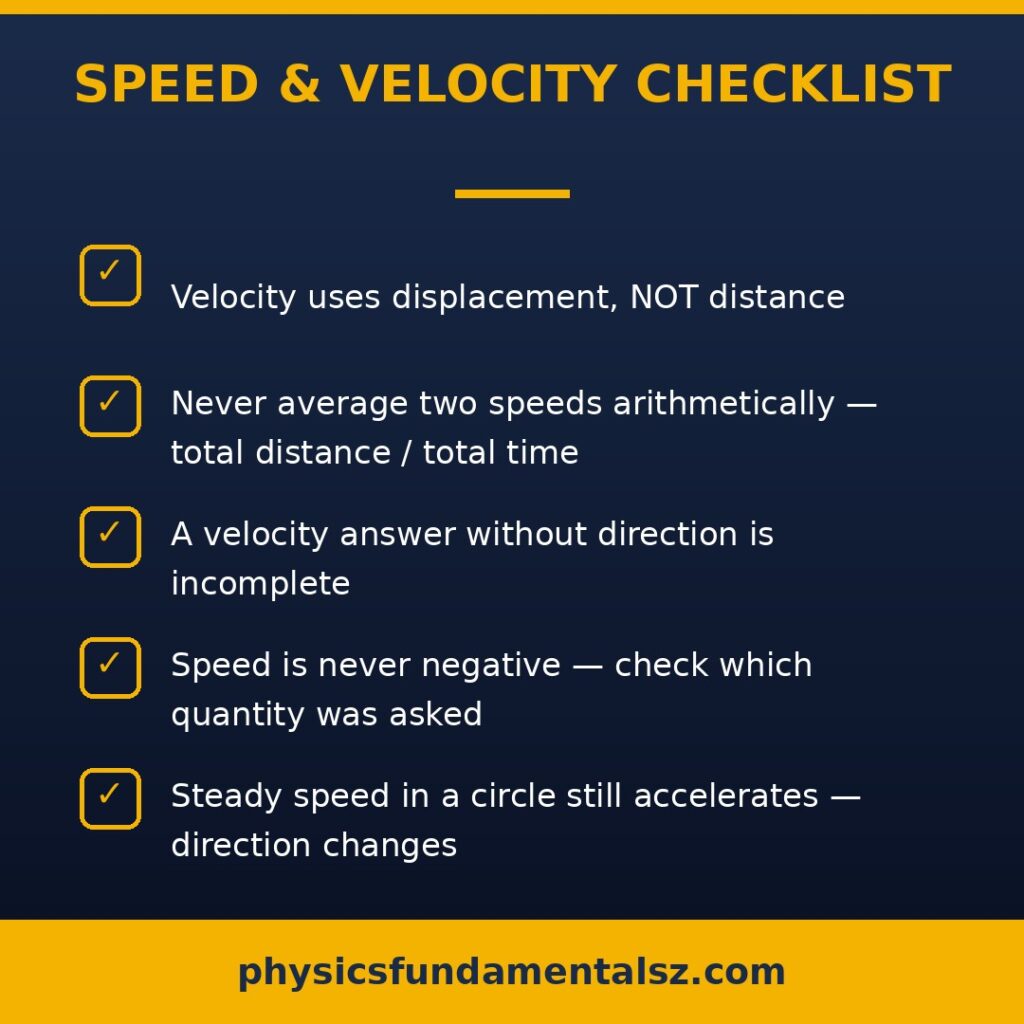
- Using distance for velocity. Average velocity uses displacement, not distance. On a round trip, displacement is zero.
- Averaging two speeds arithmetically. Average speed is total distance over total time, not the mean of two speeds. Weight by time, not by leg.
- Giving a velocity without a direction. A velocity answer without a direction (or a sign) is incomplete. Always state the direction.
- Letting speed go negative. Speed is never negative. If your speed calculation gives a negative number, you have actually computed a velocity component — check which quantity the question asked for.
- Forgetting unit conversions. Convert km to m, hours to seconds, and km/h to m/s (divide by 3.6) before calculating.
- Assuming constant speed means no acceleration. In circular motion, direction changes, so velocity changes, so acceleration is non-zero even at constant speed.
- Confusing instantaneous with average. A speedometer shows instantaneous speed; a journey’s average speed can be very different if the object stopped or changed pace along the way.
- Reading a displacement-time graph as a distance-time graph. A downward slope means negative velocity, not decreasing distance. Distance never decreases on its graph.
Speed and Velocity on the AP Physics 1 Exam
Speed and velocity open AP Physics 1 Unit 1 (Kinematics), and they return in every later unit, because every motion problem starts by sorting out which quantity is given and which is asked. Expect questions that give a multi-stage journey and ask for average speed in one part and average velocity in another — the two parts exist precisely to catch students who compute one number and reuse it. Expect graph questions where you must read velocity from the slope of a displacement-time graph and recognize that a curved graph means changing velocity, i.e., acceleration.
A reliable exam habit: the moment a question mentions motion, write down what you know with symbols and signs — distance or displacement, time, and the direction convention — before touching a formula. That one habit eliminates most speed-versus-velocity errors. And when a question asks for velocity, write the direction in your final answer even if the mark scheme seems to accept a bare number: the direction is part of the quantity.
Relative Velocity: Motion Depends on Who Is Watching
Velocity is always measured relative to something, and changing the observer changes the velocity. This idea, called relative velocity, is a favourite source of exam questions because it forces you to be explicit about your frame of reference.
Imagine you are walking toward the front of a train at 2 m/s while the train moves forward at 20 m/s relative to the ground. Relative to the train, your velocity is 2 m/s. Relative to the ground, it is 22 m/s. Neither answer is wrong; they answer different questions, because they use different frames. If you walk toward the back of the train instead, your ground velocity is 20 − 2 = 18 m/s forward. The rule is simple vector addition: the velocity of an object relative to the ground equals its velocity relative to the moving frame plus the velocity of that frame relative to the ground.
The classic exam version involves a boat crossing a river. A boat aims straight across a river flowing at 3 m/s, while its engine drives it across at 4 m/s relative to the water. The boat’s velocity relative to the bank is the vector sum: 5 m/s at an angle downstream, found by Pythagoras and a tangent. Students who add the speeds as scalars get 7 m/s and lose the mark; students who draw the vector triangle get it right. Whenever two motions combine, draw the triangle before you calculate.
Relative velocity also explains everyday puzzles. Rain appears to fall at an angle when you run through it, because your motion adds a horizontal component to the rain’s velocity relative to you. A car overtaking you slowly on the motorway looks almost stationary from your seat, because what you perceive is its velocity relative to you, not its velocity relative to the road. Frames of reference are not an advanced complication — they are how motion actually works.
Speed and Velocity in Two Dimensions
So far most examples have been one-dimensional, with direction shown by a sign. In two dimensions, velocity is described by its components, usually written as v_x and v_y, or by a magnitude and an angle. The magnitude is found by Pythagoras: v = √(v_x² + v_y²). The direction is found from the angle: θ = tan⁻¹(v_y/v_x), measured from the chosen reference axis.
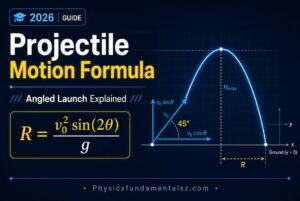
Projectile motion is the standard two-dimensional example. A ball launched at an angle has a horizontal velocity component that stays constant (ignoring air resistance) and a vertical velocity component that changes steadily under gravity. At the top of its flight, the vertical component is zero, but the horizontal component is not — so the ball’s velocity at the top is not zero, even though its vertical speed momentarily is. Its speed at the top is simply the horizontal component. Students who claim the ball “stops” at the top of its trajectory are confusing a zero vertical component with a zero vector, and projectile questions are designed to catch exactly that.
The same component thinking applies to circular motion. An object moving in a circle at constant speed has a velocity vector that is always tangent to the circle, constantly changing direction. Its speed — the magnitude — stays the same, but the velocity vector rotates, which means there is an acceleration pointing toward the center of the circle. This centripetal acceleration is why you feel pushed outward on a roundabout: your body wants to continue in a straight line, and the car must continuously change your velocity’s direction to keep you turning. Speed alone would never explain that feeling; only velocity, with its direction, can.
Frequently Asked Questions
1. What is the difference between speed and velocity?
Speed is how fast an object moves, without direction; velocity is speed with direction. Speed is a scalar, velocity is a vector.
2. What is the formula for speed?
Average speed = total distance travelled / total time taken. The SI unit is meters per second (m/s).
3. What is the formula for velocity?
Average velocity = displacement / total time taken. Displacement is the straight-line change in position, with direction.
4. Can speed be negative?
No. Speed is the magnitude of velocity and is always zero or positive. Velocity can be negative, because its sign indicates direction.
5. Can velocity be zero while speed is not zero?
Average velocity can be zero while average speed is positive, for example on a round trip that ends where it started. Instantaneous velocity is zero only when the object is momentarily at rest, at which point instantaneous speed is also zero.
6. Is speed a scalar or a vector?
Speed is a scalar quantity: it has magnitude but no direction. Velocity is the vector counterpart.
7. What is average speed?
Total distance travelled divided by total time taken for the whole journey, including any stops.
8. What is instantaneous speed?
The speed at a single instant in time, as shown by a speedometer. It is the magnitude of the instantaneous velocity.
9. How do you convert km/h to m/s?
Divide by 3.6. For example, 72 km/h = 20 m/s. Multiply by 3.6 to convert m/s back to km/h.
10. What does a speedometer measure?
Instantaneous speed, not velocity: it shows how fast you are going, but not the direction.
11. Can an object have constant speed but changing velocity?
Yes. In uniform circular motion, speed stays constant while direction changes continuously, so velocity changes and the object accelerates.
12. What is the difference between distance and displacement?
Distance is the total path length travelled, always positive. Displacement is the straight-line change in position from start to finish, with direction, and it can be zero or negative.
13. Why is average velocity zero for a round trip?
Because displacement is zero: the object ends where it started. Average velocity divides displacement by time, so the result is zero regardless of how fast the object travelled.
14. Which is bigger, average speed or average velocity?
Average speed is always greater than or equal to the magnitude of average velocity, because the path length is always at least as large as the straight-line displacement.
15. How is velocity shown on a graph?
On a displacement-time graph, velocity is the gradient. A positive gradient means motion in the positive direction; a negative gradient means motion in the opposite direction; a flat section means zero velocity.
16. What is the difference between speed and acceleration?
Speed is how fast an object moves; acceleration is how quickly its velocity changes. An object can move fast with zero acceleration, or accelerate while moving slowly.
17. Does kinetic energy use speed or velocity?
Speed. Kinetic energy, KE = ½mv², is a scalar: direction does not matter, because speed is squared.
18. What is relative velocity?
The velocity of one object as measured from another moving object. For example, a passenger walking forward inside a moving train has a small velocity relative to the train but a large velocity relative to the ground.
Conclusion
Speed and velocity differ by exactly one thing — direction — and that one thing changes everything. Speed tells you how fast; velocity tells you how fast and where to. Remember the formulas, remember that displacement (not distance) goes into velocity, remember that a round trip has zero average velocity, and remember that changing direction is acceleration even at constant speed. With those four ideas, speed-versus-velocity questions become free marks rather than traps.
Keep Learning
- What Is Kinetic Energy? Formula, Examples & Everyday Uses — the speed you have just mastered is the v in KE = ½mv².
- What Is Torque in Physics? Formula, Examples & How to Calculate It — rotation is where velocity’s direction matters most, because spinning objects constantly change direction.
- Elastic vs Inelastic Collision Difference — momentum is a vector like velocity, and collisions are where that vector nature decides the outcome.
- Difference Between Work and Power in Physics — work and power build on motion, and knowing speed versus velocity keeps their calculations straight.
- What Is Ohm’s Law? Formula, Triangle Trick & Circuit Examples — the next topic in this series, moving from motion to electricity.