Static vs Kinetic Friction: Differences, Formulas, and Worked Examples

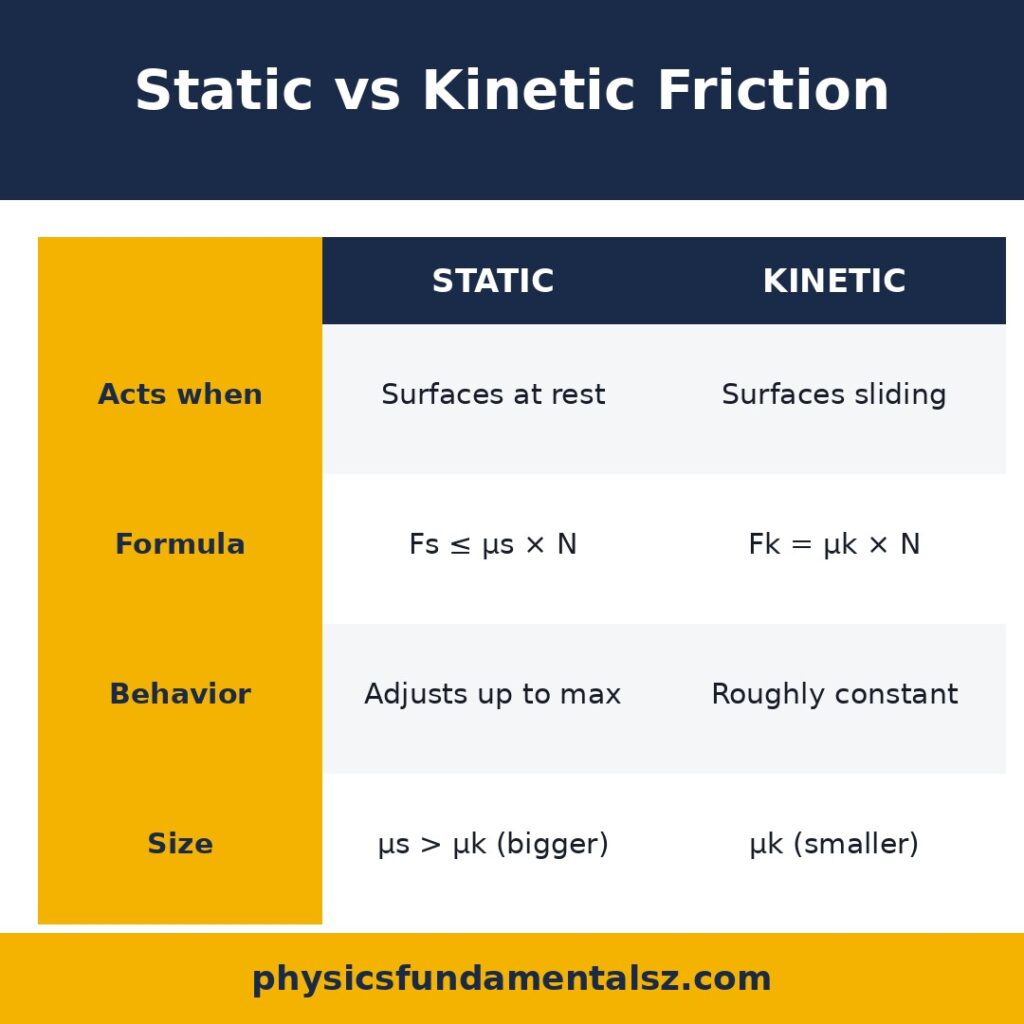
Quick answer: Static friction acts on surfaces that are at rest relative to each other — it adjusts to match the applied push, up to a maximum. Kinetic friction acts on surfaces that are sliding — it stays roughly constant no matter how hard you push. Static friction is usually stronger than kinetic friction, which is why it takes more force to start pushing a couch than to keep it moving.
If you have ever tried to shove a heavy couch across a room, you already know the difference between static and kinetic friction: the first push is the hardest. In this guide you will learn exactly what static and kinetic friction are, the formulas that govern them, how to solve exam problems, and where both types matter in the real world.
What Is Static Friction?
Static friction (Fs) is the friction force that acts between two surfaces that are not moving relative to each other. It is a reactive force: it exactly balances whatever push you apply, up to a limit. Push gently on a book and static friction pushes back gently; push harder and it pushes back harder — until you exceed its maximum.
The maximum static friction is given by:
Fs,max = μs × N
where μs is the coefficient of static friction (a property of the two surfaces) and N is the normal force pressing them together.
Key properties of static friction
- Self-adjusting. Static friction matches the applied force exactly (up to the maximum): if you push with 10 N, it pushes back with 10 N.
- Has a maximum. Once the applied force exceeds μsN, the object breaks free and starts sliding.
- Prevents motion. It is the force that keeps parked cars parked and books on tilted tables.
- Acts before motion begins. The instant sliding starts, static friction is replaced by kinetic friction.
What Is Kinetic Friction?
Kinetic friction (Fk) — also called sliding or dynamic friction — is the friction force that acts between two surfaces sliding past each other. Unlike static friction, it does not adjust to your push: it stays roughly constant as long as the surfaces keep sliding.
Fk = μk × N
where μk is the coefficient of kinetic friction and N is the normal force.
Key properties of kinetic friction
- Roughly constant. It does not grow when you push harder — push harder and the object just accelerates more.
- Opposes sliding. It always points opposite the direction of relative motion (not necessarily opposite your push).
- Usually weaker than static friction’s maximum. For the same surfaces, μk < μs.
- Converts kinetic energy to heat. This is why brakes get hot and meteors burn up.
Static vs Kinetic Friction: Head-to-Head Comparison
| Feature | Static Friction (Fs) | Kinetic Friction (Fk) |
|---|---|---|
| When it acts | Surfaces at rest (no sliding) | Surfaces sliding past each other |
| Magnitude | Variable: matches applied force, 0 ≤ Fs ≤ μsN | Constant: Fk = μkN |
| Direction | Opposes impending motion | Opposes actual sliding motion |
| Coefficient | μs (larger) | μk (smaller) |
| Energy effect | Does no work (no displacement) | Dissipates kinetic energy as heat |
| Graph vs applied force | Rises linearly with push, then drops | Flat line after motion begins |
| Everyday example | Pushing a couch that won’t budge | The couch scraping along once it moves |
Why Is Static Friction Greater Than Kinetic Friction?
This is one of the most asked questions in physics — and the answer lies at the microscopic level.
When two surfaces sit at rest, their microscopic bumps and valleys settle into each other, and weak molecular bonds (cold welds) form between the contact points. Breaking all of these at once takes a large force — that is the maximum static friction.
Once sliding begins, the surfaces ride up over each other’s bumps and the contact points have no time to settle or bond. Fewer, weaker connections mean less resistance — that is kinetic friction.
Definition box — cold welding: At the microscopic scale, no surface is truly flat. When two surfaces rest together, their asperities (tiny peaks) deform and form temporary molecular bonds. Static friction must break these bonds; kinetic friction never lets them fully form.
Coefficient of Friction: The Numbers That Matter
The coefficients μs and μk are dimensionless numbers (typically between 0 and 1, though μs can exceed 1 for very grippy pairs like rubber on rubber). Here are typical values:
| Surfaces | μs (static) | μk (kinetic) |
|---|---|---|
| Rubber on dry concrete | 1.0 | 0.8 |
| Rubber on wet concrete | 0.7 | 0.5 |
| Wood on wood | 0.5 | 0.3 |
| Steel on steel (dry) | 0.6 | 0.4 |
| Steel on ice | 0.1 | 0.05 |
| Glass on glass | 0.9 | 0.4 |
| Waxed ski on snow | 0.1 | 0.05 |
| Teflon on steel | 0.04 | 0.04 |
Expert tip: On AP Physics exams, if a problem gives you only one coefficient, check which situation applies: object at rest → μs; object sliding → μk. Using μk for a static situation is one of the most common errors.
The Friction Graph: What Happens as You Push Harder
Imagine pushing a crate with a steadily increasing force and plotting friction vs. applied force:
- Static region: friction rises in a straight line matching your push (Fs = F_applied).
- Breakaway point: friction peaks at Fs,max = μsN.
- Drop: the instant the crate moves, friction falls to Fk = μkN.
- Kinetic region: friction stays flat at μkN no matter how much harder you push.
This graph explains the familiar “lurch”: the force needed to start the crate is bigger than the force needed to keep it moving.
Worked Examples
Example 1: Maximum static friction
A 20 kg crate rests on a horizontal floor (μs = 0.5). What is the maximum static friction? How hard must you push to start it moving?
Step 1 — normal force: N = mg = 20 × 9.8 = 196 N
Step 2 — max static friction: Fs,max = μsN = 0.5 × 196 = 98 N
Answer: you must push with more than 98 N to start the crate.
Example 2: Kinetic friction while sliding
The same crate is now sliding (μk = 0.3). You push with 120 N. What is the friction force and the crate’s acceleration?
Step 1 — kinetic friction: Fk = μkN = 0.3 × 196 = 58.8 N (opposes motion)
Step 2 — net force: F_net = 120 − 58.8 = 61.2 N
Step 3 — acceleration: a = F_net/m = 61.2/20 = 3.06 m/s²
Note that pushing harder (120 N vs 98 N) does not increase friction — it stays at 58.8 N.
Example 3: Static friction on an incline
A 5 kg book rests on a ramp inclined at 30°. The coefficient of static friction is 0.6. Does the book slide? What is the friction force?
Step 1 — forces along the ramp: component of weight pulling down the ramp = mg·sin(30°) = 5 × 9.8 × 0.5 = 24.5 N
Step 2 — max static friction: N = mg·cos(30°) = 5 × 9.8 × 0.866 = 42.4 N; Fs,max = 0.6 × 42.4 = 25.4 N
Step 3 — compare: 24.5 N < 25.4 N, so the book does not slide.
Step 4 — actual friction: static friction matches the pull exactly: Fs = 24.5 N (not 25.4 N!)
This is the classic trap: static friction is whatever it needs to be up to the maximum — here 24.5 N, not the maximum 25.4 N.
Rolling Friction: A Special Case
Rolling friction (rolling resistance) is the force that opposes a wheel or ball rolling on a surface. It is much smaller than either static or kinetic friction — which is why wheels were invented.
- A rolling wheel’s contact point is instantaneously at rest, so static friction acts there (this is what lets car tires grip without slipping).
- Once a tire skids, kinetic friction takes over — which is why locked brakes stop a car slower than ABS-modulated braking (rolling grip > sliding grip).
Common Misconceptions
- “Friction always opposes motion.” Not quite — static friction opposes impending motion, and it can actually cause motion: the static friction between your shoes and the ground is what pushes you forward when you walk.
- “Heavier objects always have more friction.” Only if the extra weight increases the normal force. On a vertical wall, weight doesn’t affect the normal force at all.
- “μk depends on speed.” For most everyday speeds, μk is approximately constant. (At very high speeds it can drop slightly.)
- “Static friction has a single value.” No — it ranges from 0 to μsN. The formula gives the maximum, not the actual value.
- “Friction depends on contact area.” For most dry surfaces, friction is approximately independent of apparent contact area — only the normal force and materials matter (Amontons’s laws). (Real tires are an exception due to deformation.)
Real-World Applications
| Application | Friction type | Why it matters |
|---|---|---|
| Car tires gripping the road | Static (rolling) | Static friction between tire and road provides the grip for acceleration, braking, and turning |
| ABS brakes | Static > kinetic | ABS prevents lockup to keep tires in the high-grip static regime |
| Walking | Static | Each step pushes back; static friction pushes you forward |
| Ice skating | Kinetic (very low μk) | Minimal kinetic friction lets skaters glide |
| Rock climbing shoes | Static (high μs) | Maximum static grip on tiny holds |
| Engine pistons | Kinetic (minimize!) | Oil reduces μk to prevent wear and heat |
| Match striking | Kinetic → heat | Sliding generates the heat to ignite |
| Door hinges | Kinetic (minimize!) | Lubrication lowers μk for smooth motion |
Key Takeaways
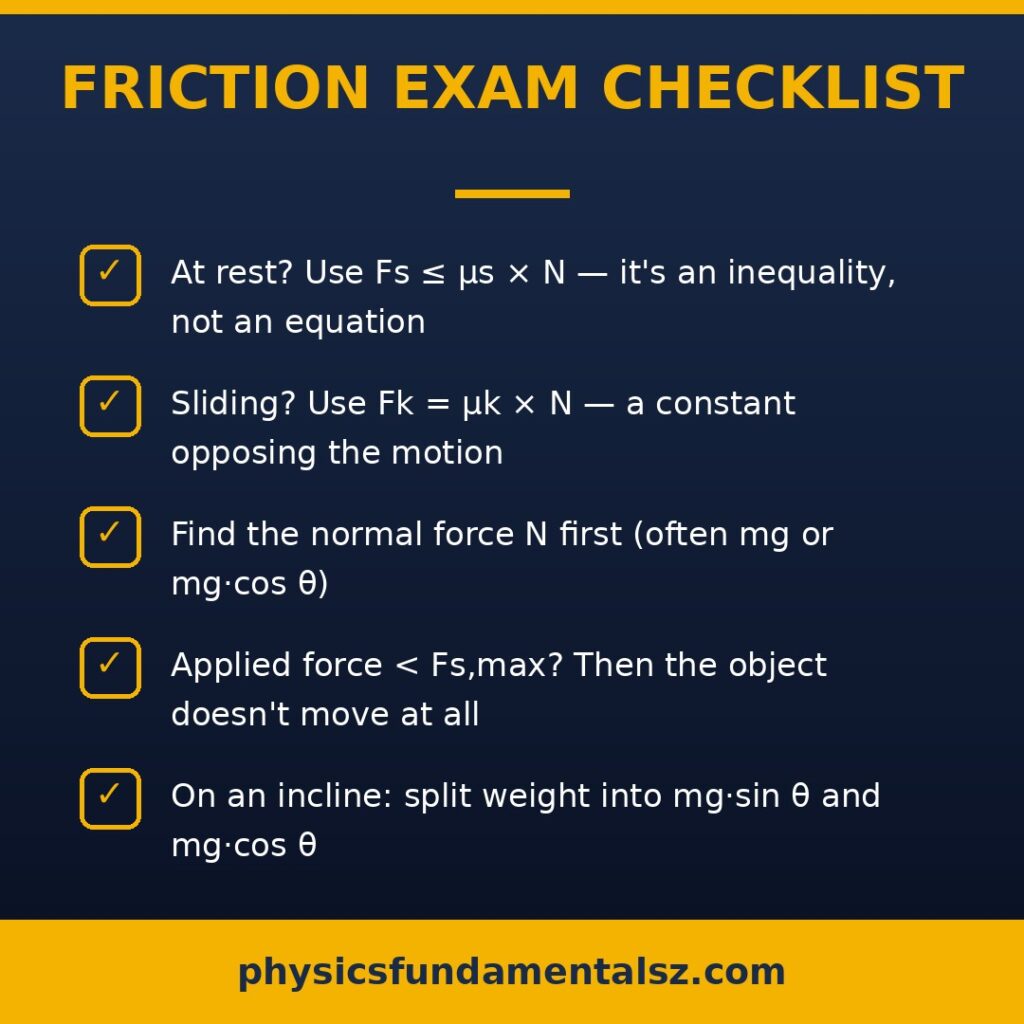
- Static friction acts before motion, adjusts to your push, maxes out at μsN.
- Kinetic friction acts during sliding, stays constant at μkN.
- μs > μk for the same surfaces — starting is harder than continuing.
- Static friction does no work (no displacement); kinetic friction turns motion into heat.
- On exams, check: at rest → μs (and Fs ≤ μsN, not =); sliding → μk.
FAQs
1. What is the difference between static and kinetic friction?
Static friction acts on stationary surfaces and adjusts to match the applied force up to a maximum (μsN); kinetic friction acts on sliding surfaces and stays constant (μkN). Static friction is generally stronger.
2. Which is greater: static or kinetic friction?
Static friction’s maximum is greater than kinetic friction for the same surfaces (μs > μk). That’s why it takes more force to start moving an object than to keep it moving.
3. What is the formula for static friction?
Static friction satisfies Fs ≤ μsN — it equals whatever is needed to prevent motion, up to the maximum μsN. Only at the point of slipping does Fs = μsN.
4. What is the formula for kinetic friction?
Fk = μkN, where μk is the coefficient of kinetic friction and N is the normal force. It is approximately constant while sliding continues.
5. Why is it harder to push a heavy object at first?
Because you must overcome maximum static friction (μsN), which is larger than the kinetic friction (μkN) that acts once the object is moving. The “extra” effort breaks the microscopic cold-weld bonds.
6. Does static friction do work?
No. Work requires displacement (W = F·d), and static friction acts with zero relative displacement. (It can be part of a system that moves, like a crate in an accelerating truck, but the friction force itself does no work on the contact.)
7. Can kinetic friction ever speed something up?
Kinetic friction opposes relative sliding, not necessarily an object’s motion. Example: a crate dropped onto a moving conveyor belt — kinetic friction accelerates the crate forward until it matches the belt speed.
8. What is the coefficient of friction?
A dimensionless number (μ) describing how grippy two surfaces are. μs applies to static situations, μk to sliding. Rougher, stickier pairs have higher values.
9. Does friction depend on surface area?
For dry, hard surfaces, approximately no — friction depends on normal force and materials, not apparent contact area (Amontons’s second law). Soft/deforming materials like rubber are exceptions.
10. What is limiting friction?
Another name for maximum static friction (μsN) — the threshold at which motion impends.
11. How do you reduce kinetic friction?
Lubrication (oil, grease), smoother surfaces, ball/roller bearings (replace sliding with rolling), or magnetic levitation for near-zero friction.
12. How do you increase static friction?
Rougher surfaces, higher normal force (press harder), or stickier materials (rubber soles, climbing shoes, tire tread).
13. Is rolling friction static or kinetic?
A rolling wheel’s contact patch is instantaneously at rest, so static friction acts — that’s the grip. If the wheel skids, kinetic friction takes over (lower grip).
14. Why do cars use ABS brakes?
ABS prevents wheels from locking up, keeping tires in the static-friction (gripping) regime rather than the lower-grip kinetic (skidding) regime — shorter stopping distances and steering control.
15. What is the angle of friction?
The angle whose tangent equals μs (φ = arctan μs). It is also the steepest incline angle at which an object remains at rest.
16. Can μs be greater than 1?
Yes. While most everyday pairs have μs < 1, very grippy combinations like rubber on rubber or specialized climbing shoes can exceed 1 — meaning the maximum static friction is greater than the normal force.
17. Does static friction act on a parked car on a hill?
Yes — static friction (plus the normal force) is what keeps it from sliding down. It exactly balances the downhill component of the weight, up to μsN.
18. Why do we oil machine parts?
To replace high-μk metal-on-metal sliding with low-μk lubricated contact, reducing wear, heat, and energy loss.
19. What is the difference between sliding and rolling friction?
Sliding (kinetic) friction acts when surfaces slip past each other; rolling resistance is far smaller and comes from deformation at the contact patch. A rolling wheel uses static friction for grip.
20. Why is it easier to keep a box moving than to start it?
Because kinetic friction (μkN) is less than maximum static friction (μsN). Once you break the initial cold-weld bonds, less force is needed to maintain motion.
External Authority Sources
- OpenStax University Physics Vol. 1, Friction chapter (openstax.org)
- The Physics Classroom: “Friction” (physicsclassroom.com)
- HyperPhysics, Georgia State University: Friction (hyperphysics.phy-astr.gsu.edu)
- Khan Academy: “Friction” — Forces and Newton’s laws (khanacademy.org)
- College Board AP Physics 1 Course and Exam Description — dynamics/friction section