Nuclear Fission and Fusion
The energy that lights cities and powers the Sun comes from the same place: the nucleus of the atom. Two opposite processes, fission and fusion, both unlock this energy, and understanding why requires looking at how tightly the particles inside a nucleus are bound together.
The two reactions in plain terms
Nuclear fission is the splitting of a heavy nucleus, such as uranium-235, into two lighter nuclei plus a few free neutrons. Nuclear fusion is the opposite: two light nuclei, such as isotopes of hydrogen, merge to form a heavier one. Both release energy, which seems paradoxical until you look at the underlying physics.
Mass becomes energy
The key insight is that the products of these reactions weigh slightly less than the ingredients. That missing mass is not destroyed; it is converted into energy according to Einstein’s famous relation:
Because the speed of light c is enormous, c² is about 9 × 10¹⁶ m²/s². A tiny amount of mass therefore yields a colossal amount of energy. Converting just one gram of mass would release roughly 90 trillion joules, comparable to burning thousands of tonnes of coal. You can read more about why c is so significant in our article on the speed of light.
Binding energy: the master curve
Why do both splitting and merging release energy? The answer is the binding energy per nucleon, the average energy holding each proton or neutron inside the nucleus. Plotted against atomic mass, this curve rises steeply from hydrogen, peaks near iron-56, and then slowly declines toward uranium.
- Nuclei lighter than iron become more tightly bound when fused, releasing energy.
- Nuclei heavier than iron become more tightly bound when split, also releasing energy.
Iron sits at the bottom of the energy valley. Move toward it from either direction and the nucleus settles into a lower-energy, more stable state, shedding the difference as kinetic energy of the products and radiation.
Energy is released whenever a reaction moves nuclei toward iron-56, the most tightly bound nucleus. Fusion does this for light elements; fission does it for heavy ones. Both climb down the same binding-energy hill.
How fission chains keep going
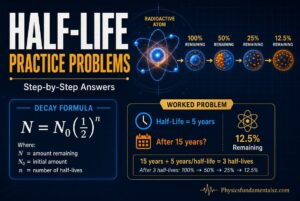
When uranium-235 absorbs a slow neutron, it becomes unstable and splits, releasing two or three new neutrons. If at least one of those neutrons strikes another uranium nucleus, the reaction sustains itself in a chain reaction. A reactor controls this with moderators that slow neutrons and control rods that absorb the excess, holding the system at exactly one new fission per fission, a state called criticality.
A typical single uranium-235 fission releases about 200 MeV (mega-electron-volts) of energy, mostly as the kinetic energy of the fragments, which heats the reactor and ultimately boils water to drive turbines.
Why fusion is so hard to harness
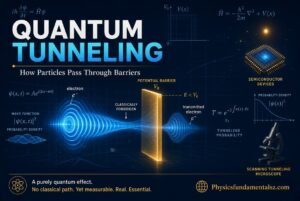
Fusion powers the stars, but reproducing it on Earth is extraordinarily difficult. The problem is electrostatic repulsion: two positively charged nuclei push each other away fiercely as they approach. Only at temperatures of tens of millions of kelvin do nuclei move fast enough to overcome this barrier, helped by the quantum effect of tunnelling.
The most studied reaction fuses deuterium and tritium:
Per unit mass, this fusion reaction releases several times more energy than fission, produces no long-lived high-level waste, and uses fuel that is effectively limitless in seawater. The challenge is confining a plasma hot enough and dense enough for long enough, the goal of devices such as tokamaks.
Comparing the two
- Fuel: Fission uses rare, heavy isotopes; fusion uses abundant light isotopes.
- Waste: Fission produces radioactive fission products; fusion’s main product is harmless helium.
- Conditions: Fission works at ordinary temperatures; fusion needs star-like heat.
- Risk: A fission chain can run away if uncontrolled; a fusion plasma simply cools and stops if confinement fails.
Frequently asked questions
If both release energy, why is iron the dividing line?
Iron-56 has the highest binding energy per nucleon, meaning its nucleons are held most tightly. Any reaction that produces nuclei closer to iron lowers the system’s energy, and that surplus is released. Reactions moving away from iron would instead require an input of energy.
Is the Sun powered by fission or fusion?
Fusion. In the Sun’s core, hydrogen nuclei fuse through the proton-proton chain to form helium, releasing the energy that radiates as sunlight. Stars do not run on fission.
Why does fusion produce more energy than fission per kilogram?
The binding-energy curve is far steeper on the light-element side. Climbing from hydrogen toward helium gains much more binding energy per nucleon than splitting uranium does, so fusion yields more energy for each kilogram of fuel.