AP Physics 2 vs AP Physics C: Difficulty, Math, Topics, and Which to Take
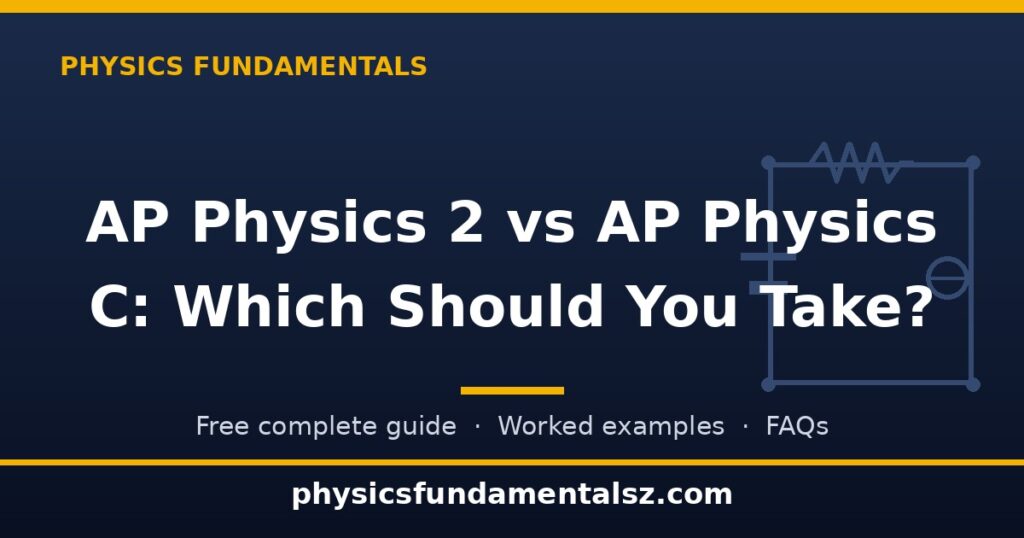
Quick answer: AP Physics C is harder than AP Physics 2. AP Physics C (especially Electricity & Magnetism) is calculus-based and rated 8.1/10 for difficulty — the toughest of all large AP classes surveyed — while AP Physics 2 is algebra-based, broader, and rated 6.6/10. Take Physics C if you are strong in calculus and heading into engineering or physics; take Physics 2 if you want broad conceptual coverage (fluids, thermodynamics, optics, modern physics) without calculus.
Choosing between AP Physics 2 and AP Physics C is one of the most common dilemmas for high school students planning a STEM schedule. Both are second-year physics courses, but they differ sharply in math level, depth, breadth, and who they serve best. This guide compares them head-to-head on difficulty, topics, exam format, and score data so you can make the right choice.
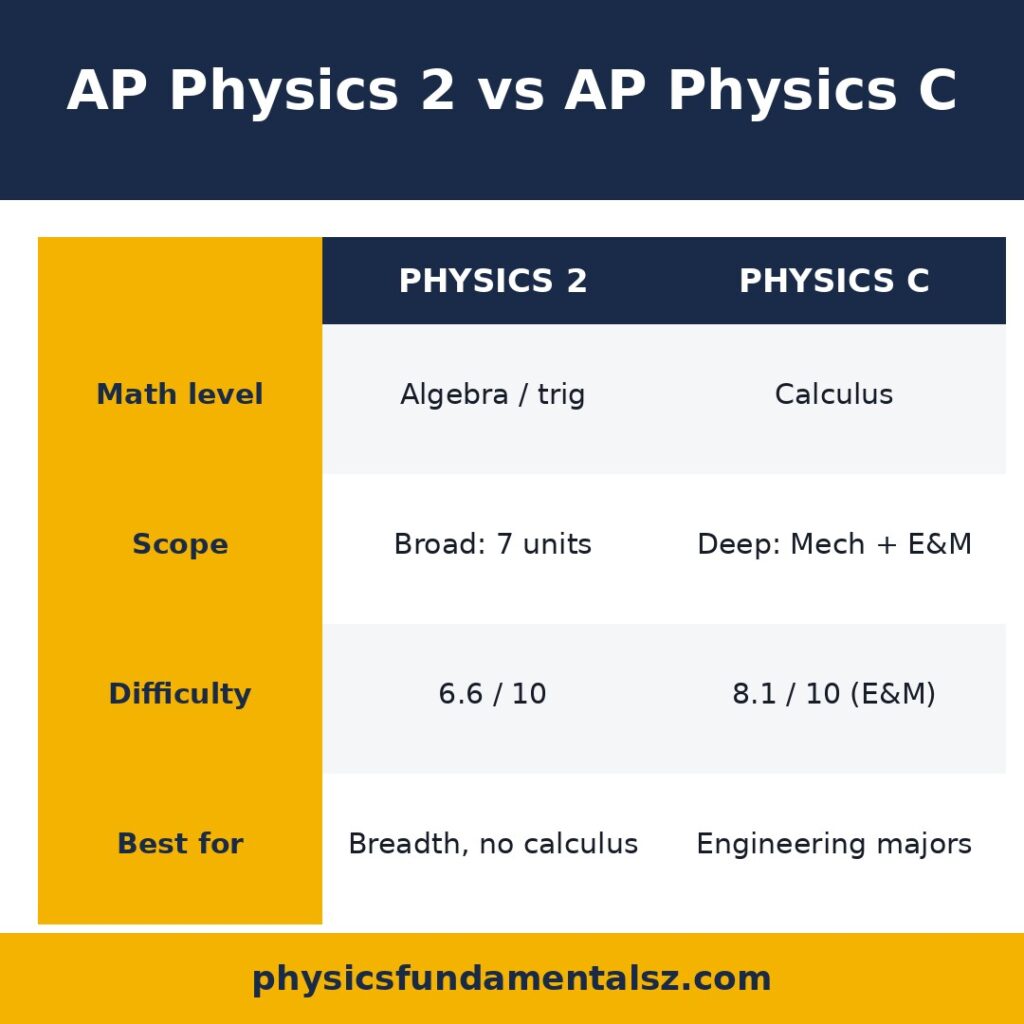
At a Glance: AP Physics 2 vs AP Physics C
| Factor | AP Physics 2 | AP Physics C |
|---|---|---|
| Math level | Algebra / trigonometry | Calculus (derivatives and integrals) |
| Scope | Broad: fluids, thermodynamics, E&M, optics, modern physics | Deep: mechanics + electricity & magnetism only |
| Difficulty rating (alumni) | 6.6/10 (6th hardest of 28 large APs) | 8.1/10 for E&M (hardest of 28); Mechanics ~7.3/10 |
| Number of exams | One exam | Two separate exams: Mechanics and E&M |
| Exam length | 3 hours | 90 minutes each |
| Pass rate (score 3+) | ~69% | Mechanics ~73%; E&M ~68% |
| Best for | Life sciences, pre-med, broad science literacy | Engineering, physics, math-heavy STEM majors |
| College credit value | Varies; less valued for engineering majors | Highly valued by engineering programs |
The Core Difference: Algebra vs Calculus
This is the single biggest distinction.
- AP Physics 2 uses algebra and trigonometry. You will solve problems with formulas, proportional reasoning, and right-triangle trigonometry — no derivatives or integrals.
- AP Physics C uses calculus throughout. You will differentiate position functions to get velocity, integrate to find work from variable forces, and apply Gauss’s law and Faraday’s law with calculus. Students who have not taken (or are not concurrently taking) AP Calculus AB/BC struggle significantly.
Definition box — calculus-based vs algebra-based physics: Algebra-based physics describes relationships with fixed formulas (e.g., v = d/t). Calculus-based physics treats quantities as continuously changing, using derivatives for rates of change and integrals for accumulation — the language in which the laws of physics are actually written.
Topics Covered: Breadth vs Depth
AP Physics 2 topics (broad survey)
- Fluids (density, pressure, buoyancy, Bernoulli’s principle)
- Thermodynamics (kinetic theory, laws of thermodynamics, heat engines)
- Electric force, field, and potential
- Electric circuits (steady-state DC)
- Magnetism and electromagnetic induction
- Geometric and physical optics
- Quantum, atomic, and nuclear physics
Physics 2 covers seven major units — the widest scope of any AP science. The tradeoff is less depth per topic.
AP Physics C topics (deep dive)
AP Physics C: Mechanics
- Kinematics, Newton’s laws, work/energy/power, momentum, rotation, oscillations, gravitation — all with calculus
AP Physics C: Electricity and Magnetism
- Electrostatics, conductors and dielectrics, electric circuits, magnetic fields, electromagnetism (Gauss’s law, Ampère’s law, Faraday’s law, inductance, Maxwell’s equations)
Physics C covers fewer topics but far more deeply. E&M in Physics C, for example, includes vector calculus treatments of fields that Physics 2 never touches.
Difficulty Comparison: The Data
| Measure | AP Physics 2 | AP Physics C: Mechanics | AP Physics C: E&M |
|---|---|---|---|
| Alumni difficulty (out of 10) | 6.6 | ~7.3 | 8.1 |
| Rank among 28 large APs | 6th hardest | Top 3 | #1 hardest |
| 2024 pass rate (3+) | ~69% | ~73% | ~68% |
| % scoring 5 | ~14% | ~26% | ~30% |
Two things stand out. First, AP Physics C: E&M is statistically the hardest large AP class by student rating. Second, the higher 5-rates in Physics C are misleading — the curve is generous because the exam is so hard, and the self-selected cohort is stronger in math.
Why students find AP Physics C harder
- Calculus fluency is mandatory, not optional. A shaky derivative ruins entire free-response problems.
- Abstract fields. Visualizing invisible electric and magnetic fields and applying Gauss’s law to 3D geometries is conceptually demanding.
- Multi-step problems. E&M free-response questions chain 4–6 steps; one algebra slip cascades.
- Pace. Two full college semesters of calculus physics compressed into a high school year.
Why students find AP Physics 2 hard (but differently)
- Sheer breadth. Seven units means constant context-switching; students call it “a mile wide and an inch deep.”
- Conceptual traps. Thermodynamics and fluids questions test understanding, not plug-and-chug — the AP 2 exam is famous for qualitative questions with tempting distractors.
- Weaker math shield. Without calculus, some derivations feel arbitrary, so students memorize instead of understanding.
Exam Format Comparison
AP Physics 2 exam (3 hours)
- Section 1: 50 multiple-choice questions (1 hr 30 min)
- Section 2: 4 free-response questions (1 hr 30 min) — experimental design, qualitative/quantitative translation, paragraph argument, and quantitative problem
- Formula sheet and calculator (graphing or scientific) provided/allowed
AP Physics C exams (90 minutes each)
- Section 1: 35 multiple-choice questions (45 min)
- Section 2: 3 free-response questions (45 min) — heavy calculus problem-solving
- Each exam (Mechanics, E&M) is scored separately on the 1–5 scale
Which Should You Take? Decision Guide
Take AP Physics C if…
- You are taking or have completed AP Calculus AB or BC (non-negotiable for success).
- You plan to major in engineering, physics, computer science, or applied math.
- You scored a 4 or 5 in AP Physics 1 and want the deepest challenge.
- Your target colleges grant strong credit for Physics C (most engineering programs do; many give less credit for Physics 2).
Take AP Physics 2 if…
- You are not taking calculus or are not confident in it.
- You plan to major in biology, chemistry, pre-med, environmental science, or another life science — Physics 2’s fluids/thermo/optics content is directly relevant.
- You want the broadest physics survey in one course.
- You already took AP Physics 1 and want a natural algebra-based sequel.
Can you take both? Should you skip Physics 2 for C?
- The College Board does not require Physics 2 before Physics C. Many strong students go Physics 1 → Physics C directly.
- Taking both is allowed and can be done in the same year, but it is an extreme workload — only advisable for the most committed STEM students.
- If you took a regular/honors physics class already, Physics 2 largely repeats mechanics at a higher level while adding new units; Physics C redoes mechanics with calculus, which feels genuinely new.
Study Strategy Differences
| Aspect | AP Physics 2 prep | AP Physics C prep |
|---|---|---|
| Math to review | Trig, systems of equations, proportional reasoning | Derivatives, integrals, basic differential equations |
| Highest-yield skill | Qualitative reasoning and experimental design | Calculus-based problem setups (e.g., dW = F·dx) |
| Best practice material | AP Classroom, past FRQs (2017+) | Past FRQs with scoring guidelines — the single best resource |
| Common pitfall | Memorizing formulas without concepts | Weak calculus slowing every problem |
| When to start | 6–8 weeks before the exam | 10–12 weeks before the exam (more ground to cover) |
How This Compares to AP Physics 1
For context from our earlier guide: AP Physics 1 (algebra-based mechanics) is the entry point. The typical difficulty ladder reported by students is:
AP Physics 1 < AP Physics 2 < AP Physics C: Mechanics < AP Physics C: E&M
Physics 2 is a step up from Physics 1 in breadth; Physics C is a step up in mathematical depth. E&M sits at the top because it combines the hardest concepts (fields, induction) with the heaviest calculus.

Key Takeaways
- AP Physics C is harder — calculus-based, deeper, and rated the most difficult large AP (E&M at 8.1/10).
- AP Physics 2 is broader — seven units from fluids to quantum physics, all algebra-based.
- Calculus is the gatekeeper: without it, take Physics 2; with it and a STEM major ahead, take Physics C.
- Engineering majors: Physics C earns better college credit. Life-science majors: Physics 2’s content is more relevant.
- You can skip Physics 2 and go straight from Physics 1 (or honors physics) to Physics C.
FAQs
1. Is AP Physics 2 harder than AP Physics C?
No — AP Physics C is generally considered harder. Physics C is calculus-based and rated 8.1/10 difficulty (E&M) versus 6.6/10 for Physics 2. Physics 2 is broader but mathematically gentler.
2. Do I need to take AP Physics 2 before AP Physics C?
No. The College Board has no such requirement. Many students go directly from AP Physics 1 (or honors physics) to AP Physics C, especially if they are strong in calculus.
3. Which is harder: AP Physics C Mechanics or E&M?
E&M is harder for most students (8.1/10 vs ~7.3/10). Electricity and magnetism concepts are more abstract, and the calculus applications (Gauss’s law, Faraday’s law) are more demanding.
4. Is AP Physics 2 calculus-based?
No. AP Physics 2 is algebra- and trigonometry-based. Only the AP Physics C courses use calculus.
5. Can I take AP Physics C without taking calculus first?
It is strongly discouraged. The course assumes you can differentiate and integrate fluently; students taking calculus concurrently do okay, but students with no calculus background struggle severely.
6. Which AP Physics is best for engineering majors?
AP Physics C (both Mechanics and E&M). Engineering programs value it most for admissions and typically grant the most college credit for it.
7. Which AP Physics is best for pre-med?
AP Physics 2 (or AP Physics 1 + 2). Its fluids, thermodynamics, and optics content aligns with the MCAT and life-science curricula, and medical schools rarely require calculus-based physics.
8. What is the pass rate for AP Physics 2 vs C?
Recent pass rates (score 3+): AP Physics 2 ~69%, Physics C: Mechanics ~73%, Physics C: E&M ~68%. The C exams have higher 5-rates partly because of generous curves and a self-selected strong cohort.
9. How many exams are in AP Physics C?
Two separate 90-minute exams — AP Physics C: Mechanics and AP Physics C: Electricity and Magnetism — each scored 1–5 independently. You can take one or both.
10. Is AP Physics 2 worth taking?
Yes, especially for life-science students. It is the broadest AP science survey, covers MCAT-relevant topics, and a good score still earns credit at many colleges.
11. How much harder is AP Physics C than AP Physics 1?
Substantially. Physics 1 is algebra-based mechanics; Physics C redo mechanics with calculus and adds E&M. Alumni rate Physics 1 around 6.4/10 and Physics C: E&M at 8.1/10.
12. Can I take AP Physics 2 and AP Physics C in the same year?
Yes, it is allowed, but the combined workload is extreme. Only consider it if you are taking calculus concurrently and have a prior physics background.
13. Does AP Physics 2 cover electricity and magnetism?
Yes, but at an algebra-based, conceptual level (electric force/field/potential, DC circuits, basic magnetism and induction). Physics C: E&M covers the same territory with calculus and much greater depth.
14. What math do I need for AP Physics 2?
Algebra II and trigonometry — solving systems of equations, trig functions, and proportional reasoning. No calculus required.
15. Which AP Physics exam has the most generous curve?
AP Physics C: E&M typically has one of the most generous curves (around 30% earn 5s), reflecting its extreme difficulty and strong student cohort — not easiness.
16. Should I take AP Physics 2 if I already took AP Physics 1?
It is the natural sequel: Physics 2 assumes Physics 1 mechanics knowledge and adds six new units. If you want calculus-based depth instead, jump to Physics C.
17. Do colleges prefer AP Physics C over AP Physics 2?
For engineering and physical-science admissions, yes — Physics C signals stronger quantitative preparation. For life sciences, Physics 2 is perfectly respected.
18. How should I study differently for Physics 2 vs Physics C?
For Physics 2, prioritize conceptual understanding and experimental-design FRQs. For Physics C, drill calculus-based problem setups and grind past free-response questions under timed conditions.
19. Is AP Physics C: E&M the hardest AP exam?
By alumni difficulty rating (8.1/10), AP Physics C: E&M is the hardest among the 28 large AP classes surveyed — harder than Physics C: Mechanics, AP Chemistry, and AP Calculus BC.
20. What topics are only in AP Physics 2 and not in Physics C?
Fluids, thermodynamics, geometric/physical optics, and quantum/atomic/nuclear physics. Physics C covers only mechanics and E&M.
External Authority Sources
- College Board: AP Physics 2 and AP Physics C Course and Exam Descriptions (apcentral.collegeboard.org)
- College Board: AP score distributions by subject
- OpenStax University Physics Vol. 1 & 2 (openstax.org)
- Khan Academy AP Physics courses (khanacademy.org)
- The Physics Classroom: AP preparation resources (physicsclassroom.com)