Why Does Metal Feel Colder Than Wood at Room Temperature? The Physics of Heat Flow Explained 2026
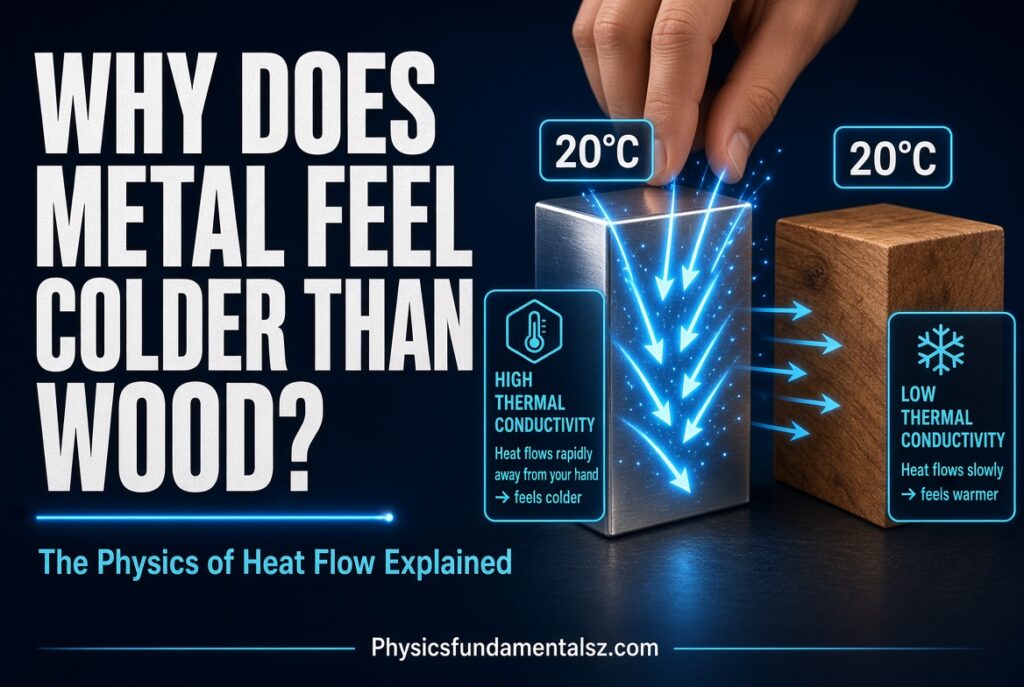
Why Does Metal Feel Colder Than Wood at Room Temperature? The answer lies in how quickly these materials transfer heat away from your skin. Even when metal and wood are at the same temperature, metal usually feels colder because it conducts heat much more efficiently than wood.
When you touch metal, heat flows from your warmer skin into the metal more rapidly, causing your skin’s surface temperature to drop faster.
Wood is a poor thermal conductor, so it removes heat from your skin more slowly and feels warmer by comparison. This difference in thermal conductivity explains why materials at the same room temperature can feel very different to the touch.
Table of Contents
Why Metal Feels Colder Than Wood
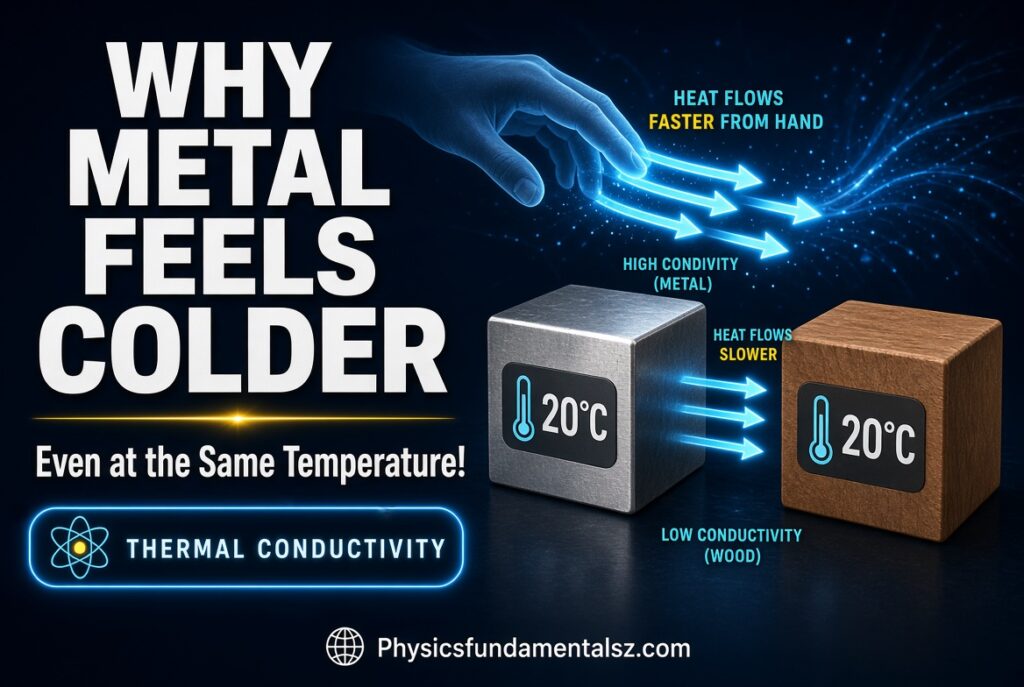
Your skin is warmer than a room at 20 °C, so heat flows from your hand into whatever you touch. Metal is an excellent thermal conductor and a good absorber of heat, so it carries heat away from the contact point quickly and keeps its surface cool. Wood is a poor conductor, so its surface warms up almost to skin temperature within moments.
Your brain reads the fast loss of heat as “cold.” The slow loss of heat into wood feels neutral or even warm.
Key Takeaways
- Metal and wood in the same room have the same temperature once they reach equilibrium.
- Heat always flows from your warmer skin into the cooler object, never the other way.
- Metal conducts heat hundreds to thousands of times better than wood.
- Your skin senses the rate of heat loss, not the temperature of the object.
- The best single measure of how cold a material feels on contact is thermal effusivity.
- If both objects were hotter than your skin, metal would feel hotter than wood.
Is Metal Actually Colder Than Wood?
No. This is the most common misconception about the topic. If a metal spoon and a wooden spoon lie on the same kitchen counter for several hours, both reach the temperature of the room.
You can confirm this with a thermometer. An infrared thermometer or a thermocouple will show the same reading for each object, apart from small measurement differences.
Why the Misconception Is So Common
Our sense of touch is convincing. When you touch a metal railing and then a wooden bench, the railing feels clearly colder. It is natural to conclude that the railing is at a lower temperature.
But touch measures something different from temperature. Your hand is a heat source, and the sensation depends on how the object responds to that heat source.
Thermal Equilibrium Explained
Thermal equilibrium means that two objects in contact, or in the same environment, stop exchanging net heat and settle at one temperature. A room full of objects reaches this state if nothing heats or cools them.
After a long time in a room at 20 °C, the walls, the table, the metal, and the wood all sit near 20 °C. Small exceptions occur near windows, radiators, and sunlit surfaces.
How to Check It Yourself
Place a metal block and a wooden block on a table for a few hours. Measure each with a digital thermometer touching the surface. Wait for the readings to settle.
You will find nearly identical values. Then touch each block with your fingers, and the difference in feel appears at once.
Temperature vs. Heat vs. Heat Flow
Three related ideas are often mixed up in this topic. Separating them makes the whole explanation clear.
Temperature, heat, and heat flow answer different questions. One describes a state, one describes energy, and one describes a rate.
| Concept | What it means | Unit |
|---|---|---|
| Temperature | A measure of the average kinetic energy of the particles | °C or K |
| Heat | Energy transferred because of a temperature difference | Joules (J) |
| Heat flow (heat flux) | The rate at which heat passes through a surface | W/m² |
What Temperature Tells You
Temperature tells you how hot or cold an object is in a physical sense. Two objects at the same temperature exchange no net heat when they touch each other.
Metal and wood at room temperature have the same temperature, so temperature alone cannot explain the difference in feel.
What Heat Flow Tells You
Heat flow tells you how fast energy leaves your skin. When you touch a cool object, heat flows out of your finger. A higher rate of flow means a stronger cooling sensation.
This rate is what your nerves respond to, and it depends strongly on the material.
Why Your Hand Is Not a Thermometer
A thermometer is designed to reach the temperature of the object it touches. Your skin is different. It is kept near 33 °C by your body, and it constantly loses heat to its surroundings.
Your hand therefore reports how quickly it is being cooled. It does not report the temperature of the surface.
How Your Skin Senses “Cold”
Your skin contains thermoreceptors, which are nerve endings that respond to changes in temperature. Some respond mainly to cooling and others to warming.
These receptors react to changes in skin temperature and to the speed of those changes. A rapid drop in skin temperature triggers a strong cold signal.
Skin Temperature vs. Core Body Temperature
Your core body temperature stays near 37 °C. Skin is cooler, typically about 32 to 34 °C on the hands in a comfortable room. This is the temperature that matters when you touch something.
The difference between skin temperature and room temperature is about 12 to 14 °C. This gap drives the heat flow into the object you touch.
The Role of Rate of Change
Cold receptors respond not only to the final temperature but also to how fast the temperature falls. A quick drop produces a stronger sensation than a slow one, even if the final temperature is the same.
When you touch metal, the contact surface of your skin cools rapidly within the first fraction of a second. That fast drop is the signal your brain reads as “cold.”
Why Wood Feels Neutral or Warm
When you touch wood, your skin loses heat more slowly. The wood surface warms up and the skin temperature falls only slightly. The signal is weak, so the wood feels neutral or mildly warm.
The wood has not become warmer than the room. It simply takes less heat from you.
What Is Heat Conduction?
Conduction is the transfer of heat through a material, or between materials in contact, without the bulk movement of matter. It happens when faster-moving particles pass energy to slower neighbors.
When you grip a metal bar, conduction moves heat from your skin into the metal and then through the metal.
Conduction in Metals
Metals contain free electrons that move through the material. These electrons carry energy quickly from hot regions to cool ones. This is the same reason metals conduct electricity well.
In addition, vibrations of the atomic lattice transfer heat. In metals, the electron contribution dominates, which explains their very high thermal conductivity.
Conduction in Wood
Wood is made of cellulose and lignin fibers with many tiny air-filled spaces. It has no free electrons. Heat travels only through slow lattice vibrations and across air pockets.
Air is a very poor conductor, and the porous structure of wood adds many barriers. As a result, wood conducts heat poorly.
Fourier’s Law of Heat Conduction
The rate of heat conduction through a material is given by q = −k × dT/dx. In a simple slab with a temperature difference ΔT across a thickness L, this becomes q = k × ΔT / L.
Here, q is the heat flux in watts per square meter, k is the thermal conductivity in W/m·K, ΔT is the temperature difference, and L is the thickness. A larger k means a larger heat flux.
Thermal Conductivity: Metal vs. Wood
Thermal conductivity, written k, measures how well a material conducts heat. It is the first property most explanations mention, and it captures the main idea.
The values below are typical at room temperature. Exact numbers vary with alloy, wood species, and moisture content.
| Material | Thermal conductivity k (W/m·K) |
|---|---|
| Copper | About 400 |
| Aluminum | About 205 to 237 |
| Carbon steel | About 50 |
| Stainless steel | About 15 |
| Glass | About 1.0 |
| Oak (across the grain) | About 0.17 |
| Pine (across the grain) | About 0.12 |
| Polystyrene foam | About 0.03 |
| Still air | About 0.026 |
How Large Is the Difference?
Pure aluminum conducts heat about 1,400 times better than oak, since 237 divided by 0.17 is roughly 1,394. Copper is more than 2,000 times better than oak.
Even stainless steel, a relatively poor metal conductor, is about 90 times better than oak.
Conductivity Alone Is Not the Whole Story
Many articles stop here. But thermal conductivity does not tell you how a material behaves in the first seconds of contact. It describes steady heat flow through a slab.
Touch is a short, transient event. To explain it properly, we also need density and specific heat, which brings us to the idea of effusivity.
Specific Heat and Density: The Missing Pieces
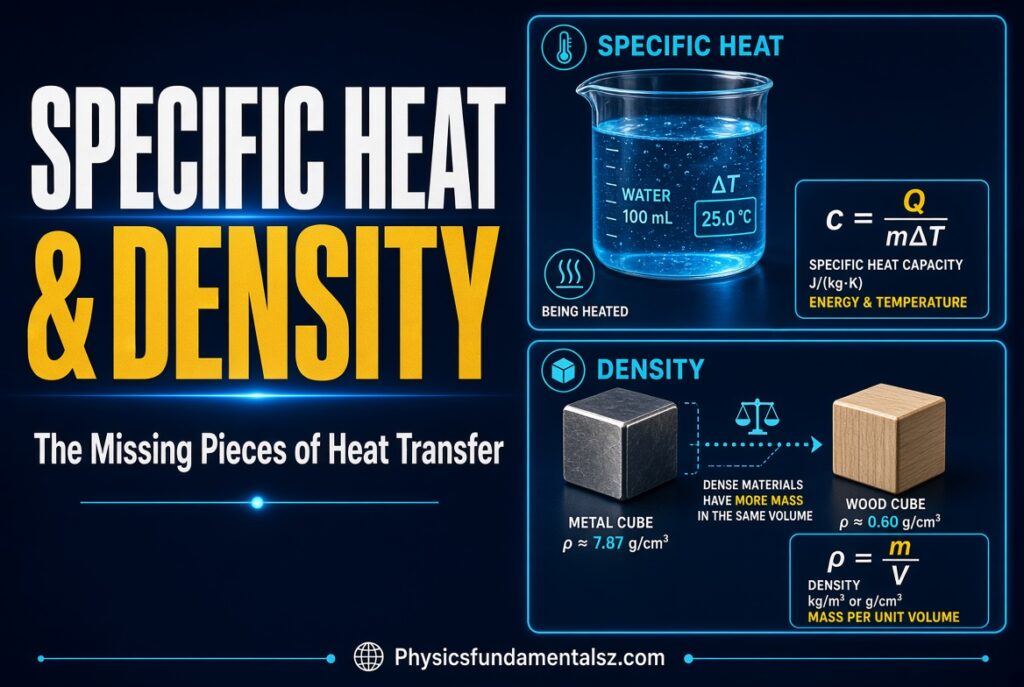
When heat leaves your skin and enters an object, two things happen. The heat spreads through the object, and it raises the temperature of the material it reaches. The first depends on conductivity. The second depends on how much energy it takes to warm the material.
That second factor depends on density and specific heat. Together they form the volumetric heat capacity.
Specific Heat Capacity
Specific heat capacity, written c, is the energy needed to raise the temperature of one kilogram of a material by one kelvin. Its unit is J/kg·K.
A material with a high specific heat can absorb a lot of energy with only a small temperature rise.
Density
Density, written ρ, is mass per unit volume. A denser material packs more atoms into the same space. That means more material is available near the surface to absorb heat.
Metals are much denser than wood. Aluminum is about 2,700 kg/m³, while oak is about 700 kg/m³.
Volumetric Heat Capacity
Multiply density by specific heat to get ρc, the energy needed to warm one cubic meter by one kelvin. This tells you how much heat a given volume of material can soak up.
| Material | Density ρ (kg/m³) | Specific heat c (J/kg·K) | ρc (MJ/m³·K) |
|---|---|---|---|
| Aluminum | 2,700 | 900 | 2.4 |
| Copper | 8,960 | 385 | 3.4 |
| Carbon steel | 7,850 | 490 | 3.8 |
| Oak | 700 | 1,700 | 1.2 |
| Pine | 500 | 1,600 | 0.8 |
Notice that wood has a high specific heat per kilogram, but its low density keeps its heat capacity per cubic meter well below that of metals.
Thermal Diffusivity: How Fast Heat Spreads
Thermal diffusivity, written α, tells you how quickly a temperature change spreads through a material. It is defined as α = k / (ρ × c).
A high diffusivity means heat moves through the material quickly relative to how much it takes to warm it.
Diffusivity Values
For aluminum, α = 237 / (2,700 × 900) = 9.75 × 10⁻⁵ m²/s. For oak, α = 0.17 / (700 × 1,700) = 1.43 × 10⁻⁷ m²/s.
Heat spreads through aluminum about 680 times faster than through oak. That is why a piece of metal quickly evens out its temperature, while a piece of wood keeps a warm patch where you touched it.
What Diffusivity Means for Touch
When you touch metal, the heat you transfer is carried deep into the metal almost immediately. The surface under your finger does not warm up.
When you touch wood, the heat lingers near the surface. The wood surface warms quickly toward your skin temperature, and the heat flow slows down.
Thermal Effusivity: The Best Explanation for How Cold Something Feels
Thermal effusivity measures how readily a material exchanges heat with its surroundings when two objects touch. It combines conductivity, density, and specific heat in one number.
The formula is e = √(k × ρ × c). Its unit is W·s^½/(m²·K). Effusivity is the property that best predicts how warm or cold a material feels on first contact.
Why Effusivity Combines Three Properties
Conductivity decides how fast heat moves away from the contact point. Density and specific heat decide how much energy the material can store in the region the heat reaches.
A material with high effusivity both moves heat away quickly and has room to store it. It therefore keeps its surface cool and draws a large flow of heat from your skin.
Effusivity Values for Common Materials
| Material | Effusivity (W·s^½/m²K) | Feels on touch |
|---|---|---|
| Copper | About 37,000 | Very cold |
| Aluminum | About 24,000 | Very cold |
| Carbon steel | About 14,000 | Very cold |
| Stainless steel | About 7,700 | Cold |
| Marble or stone | About 2,600 | Cool |
| Concrete | About 1,700 | Cool |
| Glass | About 1,400 | Cool |
| Human skin | About 1,200 | Reference |
| Acrylic plastic | About 600 | Slightly cool |
| Oak | About 450 | Neutral to warm |
| Pine | About 310 | Warm |
| Polystyrene foam | About 34 | Very warm |
| Still air | About 6 | Very warm |
These are rounded values for typical samples. Exact figures depend on the specific alloy, species, moisture, and temperature.
Example 1: Effusivity of Aluminum
Use k = 237 W/m·K, ρ = 2,700 kg/m³, and c = 900 J/kg·K. Then k × ρ × c = 237 × 2,700 × 900 = 5.76 × 10⁸.
The square root is about 24,000 W·s^½/m²K.
Example 2: Effusivity of Oak
Use k = 0.17, ρ = 700, and c = 1,700. Then k × ρ × c = 0.17 × 700 × 1,700 = 202,300.
The square root is about 450 W·s^½/m²K.
Example 3: Comparing the Two
The ratio of the effusivities is 24,000 / 450 = about 53. Aluminum exchanges heat with your skin roughly 50 times more strongly than oak does in the first moments of contact.
This ratio is much more modest than the conductivity ratio of 1,400. That is one reason why effusivity gives a more realistic picture than conductivity alone.
The Contact Temperature Formula
When two objects touch, the surface where they meet quickly settles at a single temperature called the contact temperature. It lies between the two starting temperatures.
The contact temperature is the key to the whole puzzle, because it tells you how far your skin surface cools down.
The Formula
For two large bodies initially at temperatures T₁ and T₂ with effusivities e₁ and e₂, the contact temperature is T_c = (e₁ × T₁ + e₂ × T₂) / (e₁ + e₂).
This is a weighted average of the two temperatures. The material with the larger effusivity gets the larger weight, so the contact temperature lies closer to its starting temperature.
Where the Formula Comes From
Heat leaving the warm body must equal the heat entering the cool body at the interface. For a sudden contact, each body delivers or absorbs heat at a rate proportional to its effusivity and to the temperature change at the surface.
Setting the two rates equal gives e₁ × (T₁ − T_c) = e₂ × (T_c − T₂). Solving for T_c gives the formula above.
What the Formula Assumes
The formula treats both bodies as very thick, perfectly flat, and in perfect thermal contact. It ignores blood flow, sweat, surface roughness, and the finite size of your finger.
Real contact temperatures differ somewhat from the formula. Still, it explains the effect and predicts the right order of magnitude.
Contact Temperature for Skin Touching Metal and Wood
Let the skin start at 33 °C with an effusivity of about 1,200. Let the objects start at the room temperature of 20 °C.
The table below shows the predicted contact temperature for each material.
| Material touched | Effusivity | Contact temperature |
|---|---|---|
| Copper | About 37,000 | About 20.4 °C |
| Aluminum | About 24,000 | About 20.6 °C |
| Stainless steel | About 7,700 | About 21.8 °C |
| Glass | About 1,400 | About 25.9 °C |
| Oak | About 450 | About 29.5 °C |
| Pine | About 310 | About 30.3 °C |
| Polystyrene foam | About 34 | About 32.6 °C |
Example 4: Skin Touching Aluminum
Use T_c = (1,200 × 33 + 24,000 × 20) / (1,200 + 24,000). The numerator is 39,600 + 480,000 = 519,600. The denominator is 25,200.
The result is T_c = 20.6 °C. The skin surface falls from 33 °C to nearly room temperature almost instantly.
Example 5: Skin Touching Oak
Use T_c = (1,200 × 33 + 450 × 20) / (1,200 + 450). The numerator is 39,600 + 9,000 = 48,600. The denominator is 1,650.
The result is T_c = 29.5 °C. The skin surface falls by only about 3.5 °C.
What These Numbers Tell You
When you touch aluminum, your skin surface drops by about 12.4 °C. When you touch oak, it drops by about 3.5 °C. That is a difference of roughly a factor of three and a half in the skin cooling.
This large difference in surface cooling is what you feel as the metal being “colder.” The metal itself barely warms up, since its surface stays near 20.6 °C.
Heat Flow Into Metal vs. Wood After You Touch Them
The contact temperature tells you where the surface settles. The heat flux tells you how strongly your skin is being drained of heat.
For a sudden contact between two thick bodies, the heat flux from the skin at time t is q = e_skin × (T_skin − T_c) / √(π t).
What the Formula Shows
The flux starts large and decays in proportion to one over the square root of time. The initial burst is the strongest part of the sensation. That is why metal feels coldest at the first touch.
The flux is also proportional to the drop in skin surface temperature, which depends on the effusivity of the touched material.
Example 6: Heat Flux After One Second
For aluminum, q = 1,200 × (33 − 20.6) / √π = 1,200 × 12.4 / 1.772 = about 8,400 W/m².
For oak, q = 1,200 × (33 − 29.5) / 1.772 = 1,200 × 3.5 / 1.772 = about 2,400 W/m².
The heat flow out of your skin is roughly 3.5 times larger for aluminum than for oak at one second after contact.
Example 7: Heat Flux After Ten Seconds
The flux falls by a factor of √10, which is about 3.16. For aluminum, the flux drops to about 2,650 W/m². For oak, it drops to about 760 W/m².
The strong initial cold feeling therefore fades. This matches experience: a metal handle feels coldest on the first touch, then less cold as you hold it.
Example 8: Total Energy Removed in Ten Seconds
The total heat removed per unit area is Q = 2 × e_skin × (T_skin − T_c) × √(t / π). For t = 10 s, √(10 / π) = 1.78.
For aluminum, Q = 2 × 1,200 × 12.4 × 1.78 = about 53,000 J/m². For oak, Q = 2 × 1,200 × 3.5 × 1.78 = about 15,000 J/m².
A fingertip pad of about 1 cm² (10⁻⁴ m²) would lose roughly 5.3 J to aluminum and 1.5 J to oak in ten seconds.
A Note on Accuracy
These calculations are simplified. Real skin is warmed by blood flow, which slowly resupplies heat. The skin surface also has a thin layer of moisture and oils that changes the contact.
Still, the numbers reveal the correct pattern. Metal draws several times more heat from the skin than wood at the same starting temperature.
Why Metal Stays Cool at the Surface
The cool contact temperature of metal arises from two effects working together. Heat leaves the contact region quickly, and the metal has plenty of heat capacity to absorb it.
Both effects keep the metal surface from warming up, so the temperature gap between your skin and the surface stays large.
Metal Spreads the Heat Away
When your finger touches metal, the heat enters the metal and spreads rapidly sideways and downward. The region under your finger does not accumulate heat.
As a result, the metal surface stays near its original temperature, and your skin keeps losing heat.
Wood Holds the Heat Near the Surface
In wood, heat cannot spread easily. It builds up in a thin layer just under your finger, and that layer warms up to nearly skin temperature.
Once the wood surface is almost as warm as your skin, the temperature gap is small and the heat flow slows down. The wood feels comfortable.
The Role of Free Electrons
Free electrons in metals carry heat quickly. This extra pathway for energy is the reason metals have conductivities hundreds of times larger than non-metals.
It is also why good electrical conductors, such as copper and aluminum, are good thermal conductors too.
Does Metal Feel Hotter Than Wood When It Is Hot?
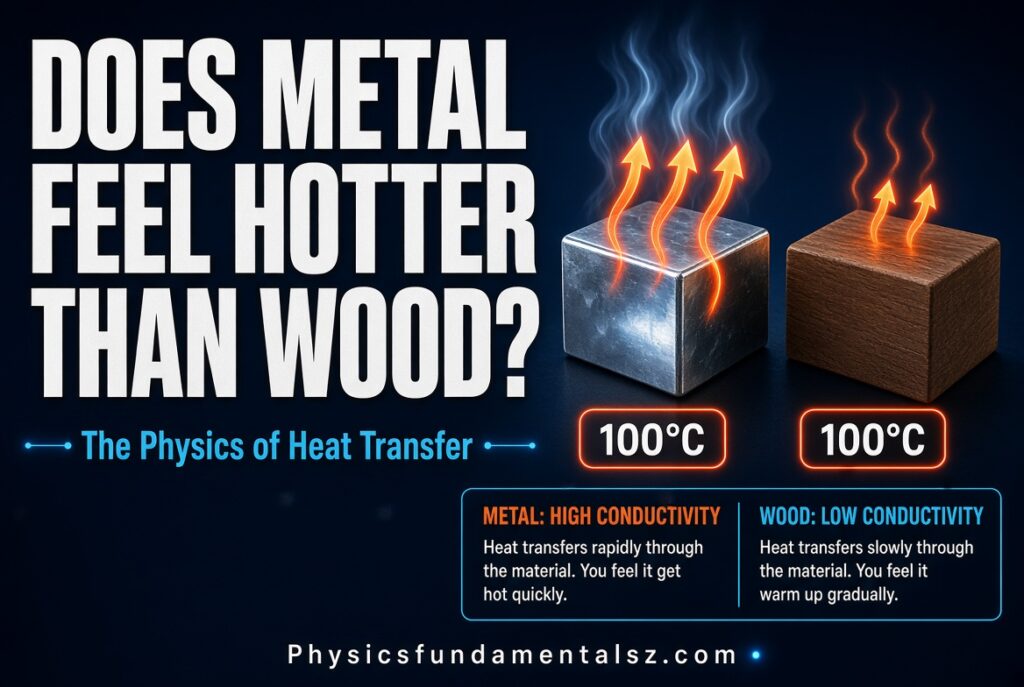
Yes. The same physics works in reverse. If a metal object and a wooden object are both hotter than your skin, heat flows into your skin. Metal delivers it faster, so it feels hotter.
This is why a metal seat belt buckle in a parked car in summer can burn, while the wooden or plastic parts nearby feel only warm.
Example 9: Skin Touching Objects at 50 °C
Use skin at 33 °C and objects at 50 °C. For aluminum, T_c = (1,200 × 33 + 24,000 × 50) / 25,200 = 1,239,600 / 25,200 = about 49.2 °C.
For oak, T_c = (1,200 × 33 + 450 × 50) / 1,650 = 62,100 / 1,650 = about 37.6 °C.
The aluminum surface heats your skin to nearly 49 °C, which can cause a burn. The oak heats it to under 38 °C, which feels warm and comfortable.
The Sauna Example
In a sauna at 80 to 90 °C, wooden benches are safe to sit on. Metal nails or fasteners that are exposed on the surface can cause burns, even though they are at the same temperature as the wood.
For this reason, sauna builders use wood and cover or recess any metal fittings.
Only the Match With Skin Temperature Gives a Neutral Feel
If an object is exactly at skin temperature, no net heat flows and no sensation of heat or cold arises. A metal bar at 33 °C feels neutral, just like a wooden one.
The difference between metal and wood appears only when the objects are warmer or cooler than your skin.
Why Some Metal Objects Feel Cold Only for a Moment
A small metal object, such as a ring or a key, feels cold at first and then warms up in your hand. A large metal object, such as a railing or a table leg, stays cold to the touch for as long as you hold it.
The difference is the amount of metal available to absorb heat.
Small Objects Warm Up
A ring has a small mass and a small heat capacity. Once your skin has given it a little heat, its whole body rises toward skin temperature. The temperature gap closes, and the heat flow stops.
This is why a ring feels cold for a second and then feels neutral.
Large Objects Act Like Infinite Heat Sinks
A big metal bar or a thick metal plate has a very large heat capacity. Your hand cannot noticeably raise its temperature, and it conducts heat away from the contact area throughout its whole volume.
The metal surface stays near room temperature, and your skin keeps cooling for as long as you maintain contact.
Thin Metal Sheets
A thin sheet of metal that rests on insulating material behaves differently. The sheet has little mass, so it warms up under your hand and then feels less cold.
The same sheet bonded to a large metal frame feels cold again, since the frame acts as a heat sink.
How Different Materials Compare in Feel
Many materials fall between metal and wood. Their feel depends on their effusivity, as shown in the table above.
The following table groups common surfaces by how cool they feel at normal room temperature.
| Feel at room temperature | Typical materials |
|---|---|
| Very cold | Copper, aluminum, steel |
| Cold | Stainless steel, cast iron |
| Cool | Stone, ceramic tile, glass, concrete |
| Slightly cool | Hard plastics, acrylic |
| Neutral to warm | Hardwood, bamboo |
| Warm | Softwood, cork, leather |
| Very warm | Foam, wool, carpet, fabric |
Why Tile Feels Colder Than Carpet
A bathroom tile floor and a carpet in the next room are at the same temperature. Tile has high conductivity and density, so it draws heat from your feet quickly. Carpet traps air in its fibers, so it draws little heat.
Bare feet on tile feel cold for the same reason that fingers on metal feel cold.
Why Metal Feels Colder Than Plastic
Most plastics have low thermal conductivity, typically between 0.1 and 0.5 W/m·K. They have lower effusivity than metals, so the contact temperature on your skin stays closer to your skin temperature.
A plastic handle on a metal tool feels warmer than the metal shaft, even though both share the same temperature.
Why Metal Feels Colder Than Water in Some Cases
Water has a conductivity of about 0.6 W/m·K and a high specific heat, giving an effusivity near 1,600. That is much lower than metal. A glass of room-temperature water feels cooler than wood but not nearly as cold as aluminum.
When your skin is wet, the water layer improves contact, which can increase the heat flow into a cool object.
Why Cold Hardwood Floors Feel Cooler Than Cold Cork
Hardwood has a higher density and conductivity than cork, so its effusivity is higher. Both are warmer to the touch than stone or tile, but cork wins as the warmest surface of the three.
Does the Type of Wood Matter?
Yes, slightly. Dense hardwoods such as oak or maple have higher effusivity than light softwoods such as pine or balsa. They feel a little cooler.
Compared with metal, though, all woods feel warm. The gap between wood species is small next to the gap between wood and metal.
Moisture Content
Water conducts heat much better than dry wood fibers. A damp piece of wood has a higher conductivity and a higher heat capacity than a dry piece. It feels cooler to the touch.
Wet wood can feel noticeably colder than seasoned wood at the same temperature.
Surface Finish
A thin coat of varnish or paint has little effect on the bulk behavior. But a thick layer of insulating material, such as a rubber grip or a thick plastic coating, reduces the heat flow substantially.
Grain Direction
Heat conducts better along the grain than across it, by a factor of about two for many woods. The surface of a plank sees mostly cross-grain heat flow, but the end grain of a log conducts heat along the fibers and feels slightly cooler.
Everyday Examples of the Metal vs. Wood Effect
This effect shows up everywhere. Recognizing it helps you see how much design depends on thermal physics.
Door Handles and Handrails
Metal door handles and stair rails feel cold, especially on winter mornings. Wooden handrails feel more welcoming. Designers choose wood or plastic grips for places where people hold on for a long time.
Cookware and Kitchen Tools
Pots and pans use metal bodies for fast heat transfer, but they use wood or plastic handles to stay comfortable. A wooden spoon in a hot pot stays cool enough to hold, because wood conducts heat slowly.
Playground Equipment
Metal slides and bars feel very cold in winter and can feel dangerously hot in summer sun. Plastic and wood surfaces stay near a comfortable feel in both seasons.
Outdoor Benches and Bleachers
Metal bleachers feel cold in the morning and scorching in the afternoon. Wooden slats on the same structure feel mild in both conditions.
Hand Tools
Wrenches and screwdrivers with plastic or rubber grips are easier to use in cold weather than bare metal tools. The grip prevents rapid heat loss from the hand.
Cold-Weather Safety
At temperatures below freezing, touching bare metal can be dangerous. Moisture on your skin can freeze to the metal, and the rapid heat loss can cause frostbite or tear skin when you pull away.
Wear gloves when you handle metal in freezing weather, and never put your tongue on frozen metal.
Simple Experiments to Test the Effect at Home
You can verify these ideas with household items. The experiments show that the temperature is the same while the feel is different.
Experiment 1: The Two-Hand Test
Leave a metal block and a wooden block on a table for several hours. Place one hand on each at the same time. The hand on the metal will feel colder.
Then measure both blocks with a thermometer. The readings will be the same.
Experiment 2: The Ice Cube Race
Place one ice cube on an aluminum plate and another on a wooden cutting board, both at room temperature. The cube on the aluminum plate melts noticeably faster.
The metal conducts heat from the room into the ice more quickly, which shows that the same property that chills your finger also warms the ice.
Experiment 3: The Insulation Test
Wrap part of a metal bar with cloth or a thin layer of foam. Touch the wrapped and bare parts in turn. The wrapped part feels warmer, although the temperature is the same.
Experiment 4: The Hot-Water Test
Hold a metal spoon and a wooden spoon in a cup of warm water, then touch their handles after a minute. The metal handle warms up faster and feels hotter, which shows that high conductivity works in both directions.
Experiment 5: The Thermometer Check
Use a thermometer that reads surface temperature. Read the metal, the wood, a plastic item, and a glass item in the same room. All will read about the same.
Common Misconceptions About Metal and Wood
Several incorrect ideas circulate about this topic. Correcting them gives you a clear picture of the physics.
Misconception 1: Metal Is Colder Than Wood
False. At equilibrium both have the same temperature. Metal feels colder because it conducts heat away from your skin faster.
Misconception 2: Metal Absorbs Cold
Cold is not a substance. There is only heat, and heat flows from hot to cold. Metal does not absorb cold. It absorbs heat from your hand.
Misconception 3: Wood Is Warmer Than Metal
False for the same reason. Wood feels warmer because it takes less heat from you, not because it is hotter.
Misconception 4: Metal Is Always Colder to the Touch
Only when the metal is cooler than your skin. If the metal is hotter than your skin, it feels hotter than wood at the same temperature.
Misconception 5: Good Conductors Are the Same as Good Heat Storage
Conductivity and heat capacity are different properties. The feeling of coldness depends on both, which is why effusivity is the best measure.
Misconception 6: Your Skin Reads the Object’s Temperature
Your skin reads its own temperature and how fast that temperature is changing. It cannot read the object’s temperature directly.
How to Make Metal Feel Warmer
If you want to reduce the cold feel of metal surfaces, you must reduce the heat flow from your skin into the metal. That means adding insulation or changing the material.
The following methods are common in product design.
- Add an insulating grip. Rubber, foam, plastic, or wood handles lower the heat flow.
- Apply a thick coating. Powder coating or a rubber coating adds a thermal barrier.
- Use gloves. Fabric and leather add insulation between skin and metal.
- Choose a different material. Wood, plastic, or composite materials feel warmer.
- Warm the metal. Heating the metal toward skin temperature reduces the temperature gap.
- Use thin, low-mass metal pieces. They warm up quickly when touched.
Why Thin Paint Does Not Help Much
A thin layer of paint is only a few tenths of a millimeter thick. Heat crosses it in a fraction of a second, so the metal below still dominates the feel.
A thicker layer of low-conductivity material works far better.
Practice Problems with Answers
Try these problems to test your understanding. Use skin at 33 °C with effusivity 1,200 W·s^½/m²K unless stated otherwise.
Problem 1
Find the thermal effusivity of copper with k = 400 W/m·K, ρ = 8,960 kg/m³, and c = 385 J/kg·K.
Answer: k × ρ × c = 400 × 8,960 × 385 = 1.38 × 10⁹. The square root is about 37,150 W·s^½/m²K.
Problem 2
Find the contact temperature when skin touches stainless steel (e = 7,700) at 20 °C.
Answer: T_c = (1,200 × 33 + 7,700 × 20) / 8,900 = 193,600 / 8,900 = 21.8 °C.
Problem 3
How many times larger is the thermal conductivity of aluminum (237 W/m·K) than that of pine (0.12 W/m·K)?
Answer: 237 / 0.12 = about 1,975 times.
Problem 4
Find the contact temperature when skin touches pine (e = 310) at 20 °C.
Answer: T_c = (1,200 × 33 + 310 × 20) / 1,510 = 45,800 / 1,510 = 30.3 °C.
Problem 5
A garage is at 15 °C. Find the contact temperature for skin touching aluminum (e = 24,000) and oak (e = 450).
Answer: For aluminum, T_c = (39,600 + 360,000) / 25,200 = 15.9 °C. For oak, T_c = (39,600 + 6,750) / 1,650 = 28.1 °C. The skin surface drops by about 17.1 °C on aluminum and only 4.9 °C on oak.
Problem 6
Find the heat flux from the skin to aluminum at 20 °C at t = 2 s, using the contact temperature of 20.6 °C.
Answer: q = 1,200 × (33 − 20.6) / √(2π) = 14,880 / 2.507 = about 5,900 W/m².
Problem 7
Find the thermal diffusivity of copper.
Answer: α = 400 / (8,960 × 385) = 400 / 3,449,600 = 1.16 × 10⁻⁴ m²/s.
Problem 8
Which feels cooler at 20 °C: glass (e = 1,400) or marble (e = 2,600)?
Answer: Glass gives T_c = 25.9 °C, and marble gives T_c = (39,600 + 52,000) / 3,800 = 24.1 °C. Marble feels cooler.
Problem 9
Find the contact temperature for skin touching copper (e = 37,150) at 50 °C.
Answer: T_c = (39,600 + 1,857,500) / 38,350 = 49.5 °C. The skin surface is heated almost to the temperature of the copper.
Problem 10
Find the contact temperature for skin touching polystyrene foam (e = 34) at 20 °C.
Answer: T_c = (39,600 + 680) / 1,234 = 32.6 °C. The skin surface barely cools, so the foam feels warm.
Why the Topic Matters in Science and Engineering
The metal-versus-wood puzzle introduces ideas that appear throughout engineering. Thermal comfort, building design, electronics cooling, and food safety all depend on how materials exchange heat.
Understanding the difference between temperature and heat flow also prevents common errors in everyday reasoning about warm and cold.
Building and Interior Design
Architects choose flooring based on thermal feel. Radiant floor heating often pairs with stone or tile because their high conductivity spreads the heat evenly, while wooden floors are chosen for their comfortable warmth underfoot.
Electronics Cooling
Heat sinks use aluminum or copper to pull heat away from chips quickly. The same property that makes metal feel cold makes it ideal for removing heat from hot components.
Cooking and Food Handling
Metal pans heat food quickly, and metal surfaces can chill dough or keep pastries cool. Wooden boards give a warmer, more insulating surface for resting meat or kneading bread.
Thermal Imaging and Measurement
Infrared cameras measure surface emission, not feel. Differences in emissivity can make shiny metal appear cooler or hotter than wood in an image, even when both have the same real temperature.
Conduction, Convection, and Radiation: What Else Happens When You Touch an Object?
Heat moves in three ways: conduction, convection, and radiation. When you touch a solid object, conduction dominates. The other two matter before and after contact.
Knowing all three helps you see why touch is a special case.
Conduction
Conduction moves heat through direct contact between particles. It governs the heat flow from your finger into the object. This is the process behind the metal-versus-wood difference.
Convection
Convection moves heat through the motion of a fluid such as air. Warm air rises from your skin, and cool air replaces it. Convection explains why a room feels cooler when a fan blows over your skin.
When you stand near a cold wall, convection currents add to the chill, but they are not the reason metal feels colder than wood on contact.
Radiation
Radiation moves heat as electromagnetic waves. Your body radiates heat to cooler surroundings all the time. Standing near a cold window, you lose more heat by radiation.
Radiation does not depend on touch, so it does not explain the difference between metal and wood in direct contact.
Why Touch Isolates Conduction
At the moment of contact, conduction is by far the fastest route for heat to leave your skin. The heat flux through direct contact with metal is many times larger than the heat lost to air by convection and radiation at the same skin area.
That is why a short touch is such a sensitive test of a material’s thermal behavior.
How to Explain the Effect in a Short Exam Answer
Exams often ask for a brief explanation. A clear answer includes four points. Use them in order.
- Both objects are at the same temperature as the room.
- Skin is warmer than the room, so heat flows from the hand to the object.
- Metal conducts heat much faster than wood, so it removes heat from the skin more quickly.
- The faster heat loss makes the skin cool more, so the brain senses the metal as colder.
A Model Answer
“Metal and wood in the same room are at the same temperature. Heat flows from the warmer hand into each object. Metal has a much higher thermal conductivity, so it carries heat away from the contact point faster and keeps its surface cooler. The hand therefore loses heat more quickly to the metal, and this faster heat loss is sensed as the metal feeling colder.”
A Stronger Answer for Advanced Courses
Mention thermal effusivity and the contact temperature. Say that the interface temperature lies closer to the starting temperature of the material with the larger effusivity. Metal has much larger effusivity than wood, so its contact temperature is near room temperature, while wood’s is near skin temperature.
Decision Guide: Will It Feel Cold or Warm?
You can predict how an object will feel by asking three questions. They work for any material and any temperature.
| Question | What it tells you |
|---|---|
| Is the object cooler or hotter than your skin (about 33 °C)? | Decides whether it feels cold or hot |
| Is its effusivity high or low? | Decides how strong the feeling is |
| Is it a large object or a small one? | Decides whether the feeling fades or lasts |
Reading the Results
An object cooler than skin with high effusivity feels very cold. An object cooler than skin with low effusivity feels neutral or slightly cool. An object hotter than skin with high effusivity feels very hot. An object hotter than skin with low effusivity feels warm.
An object at skin temperature feels neutral, whatever it is made of.
Frequently Asked Questions (FAQs)
Why does metal feel colder than wood at room temperature?
Metal conducts heat away from your skin much faster than wood does. Your nerves sense this fast heat loss as cold, even though both objects have the same temperature.
Is metal actually colder than wood?
No. If both sit in the same room for long enough, they reach the same temperature. A thermometer shows the same reading for each.
Why does wood feel warmer than metal?
Wood is a poor heat conductor, so it takes heat from your skin slowly. Its surface warms up almost to skin temperature, and your skin loses little heat.
What is thermal conductivity?
Thermal conductivity is a measure of how well a material conducts heat. It is measured in W/m·K. Metals have high values, and wood has a low value.
What is thermal effusivity?
Thermal effusivity is the square root of the product of thermal conductivity, density, and specific heat. It measures how readily a material exchanges heat with another material it touches.
Why is effusivity better than conductivity for explaining the feel of materials?
Touch is a short event, not a steady heat flow. Effusivity includes the heat capacity of the material, so it predicts the contact temperature and the early heat flow more accurately.
What is contact temperature?
It is the temperature at the interface when two bodies at different temperatures touch. It lies between the two starting temperatures and is closer to the one with the larger effusivity.
What is the formula for contact temperature?
The formula is T_c = (e₁T₁ + e₂T₂) / (e₁ + e₂). Here, e₁ and e₂ are the effusivities and T₁ and T₂ are the initial temperatures.
How cold does aluminum feel compared with oak?
With skin at 33 °C and both at 20 °C, the contact temperature is about 20.6 °C for aluminum and about 29.5 °C for oak. The skin surface cools much more on aluminum.
Do metal and wood have the same temperature in a room?
Yes, after they have been in the room long enough to reach thermal equilibrium. Objects near heaters, windows, or sunlight can be exceptions.
Why does metal feel hot in summer?
If the metal is hotter than your skin, heat flows into your skin rapidly. Metal delivers that heat faster than wood, so it feels hotter and can cause burns.
Why does a metal ring feel cold only for a moment?
A ring has little mass. After it absorbs a small amount of heat from your finger, it warms up to near skin temperature, and the heat flow stops.
Why do large metal objects stay cold when I hold them?
Large objects have a large heat capacity and spread heat through their whole volume. Their surface stays near room temperature, so your skin keeps losing heat.
Does the type of wood change how cold it feels?
A little. Dense hardwoods feel cooler than light softwoods. Damp wood feels cooler than dry wood. All woods still feel warmer than metal.
Why does tile feel colder than carpet?
Tile conducts heat well and has a high effusivity, so it takes heat from your feet quickly. Carpet traps air and conducts heat poorly.
Why does plastic feel warmer than metal?
Plastics have low thermal conductivity and low effusivity. They take less heat from your skin, so their contact temperature stays near your skin temperature.
Do our nerves measure temperature or heat flow?
Skin thermoreceptors respond to the temperature of the skin and to how fast it changes. In effect, you sense the rate of heat loss and the change in skin temperature rather than the object’s temperature.
What is a normal skin temperature?
Skin on the hands is typically about 32 to 34 °C in a comfortable room. Core body temperature is about 37 °C.
Does the effect work in reverse for hot objects?
Yes. A metal object hotter than your skin feels hotter than a wooden object at the same temperature, because it delivers heat to your skin faster.
Why do metal objects feel colder in winter?
The temperature gap between your skin and the metal is larger, so the heat flow is larger. Below freezing, moisture on your skin can freeze to the metal, which adds a risk of injury.
How can I make metal feel warmer?
Add an insulating layer such as a rubber grip, a thick coating, or a glove. You can also choose a material with lower effusivity, such as wood or plastic.
Why do saunas use wood and not metal benches?
Wood has low effusivity, so at high temperature it does not deliver heat to your skin quickly. Metal at the same temperature would burn you.
Does the color of an object change how cold it feels?
Color affects how much sunlight an object absorbs, so it changes the object’s temperature outdoors. At a fixed temperature indoors, color has no effect on how cold the object feels.
Why does ice melt faster on a metal plate?
Metal conducts heat from the surrounding air into the ice faster than a poor conductor does. The same property that draws heat from your finger feeds heat to the ice.
Can a thermometer tell the difference between metal and wood in a room?
If both are at equilibrium, a thermometer will show the same temperature for each. Differences in reading usually come from measurement error or from emissivity effects in infrared devices.
Conclusion
Metal feels colder than wood at room temperature because of how each material exchanges heat with your hand. The two objects share the same temperature, but metal drains heat from your skin much faster.
Your skin is warmer than the room, so heat flows into whatever you touch. Metal conducts that heat away quickly and has plenty of capacity to absorb it, so its surface stays cool and your skin surface drops by more than 12 °C. Wood warms to almost skin temperature, so your skin cools only a few degrees.
Thermal effusivity, together with the contact temperature formula, explains this clearly. It also predicts that metal feels hotter than wood when both are above skin temperature, and that thin or small metal pieces stop feeling cold once they warm up.
With these ideas, you can explain why tile feels cold, why plastic handles feel warm, why saunas use wood, and why gloves matter in winter. The sensation of cold is not a measurement of temperature. It is a measurement of heat leaving your body.