Difference Between Electric Field and Electric Potential: Definitions, Formulas and Relationship 2026
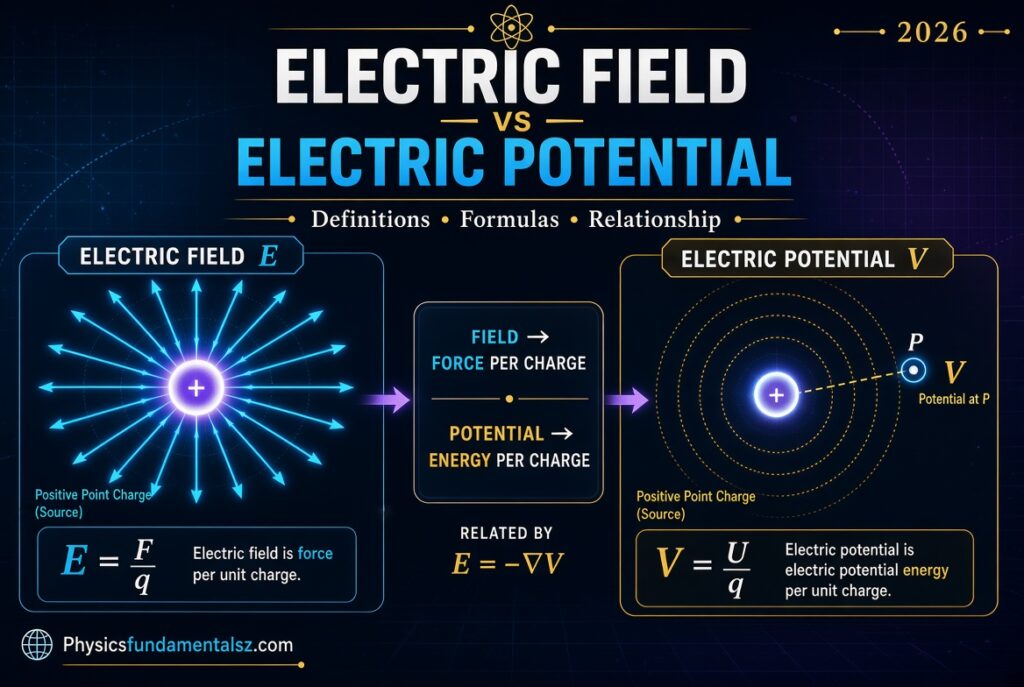
The difference between electric field and electric potential is simple to state. The electric field is a vector that tells you the force a charge would feel per unit charge. The electric potential is a scalar that tells you the energy a charge would have per unit charge.
Quick answer: Electric field (E) is force per unit charge, measured in newtons per coulomb (N/C) or volts per meter (V/m), and it has direction. Electric potential (V) is potential energy per unit charge, measured in volts (V), and it has no direction. The two are linked by E = −dV/dx: the field is the negative slope of the potential.
Both quantities describe the same situation around charges. They answer different questions, though. One asks which way and how hard a charge would be pushed. The other asks how much energy a charge would store at a given location.
Students mix them up because the formulas look alike. The field of a point charge is kq/r², and its potential is kq/r. A single missing square changes the physics completely.
Table of Contents
Electric Field vs Electric Potential at a Glance
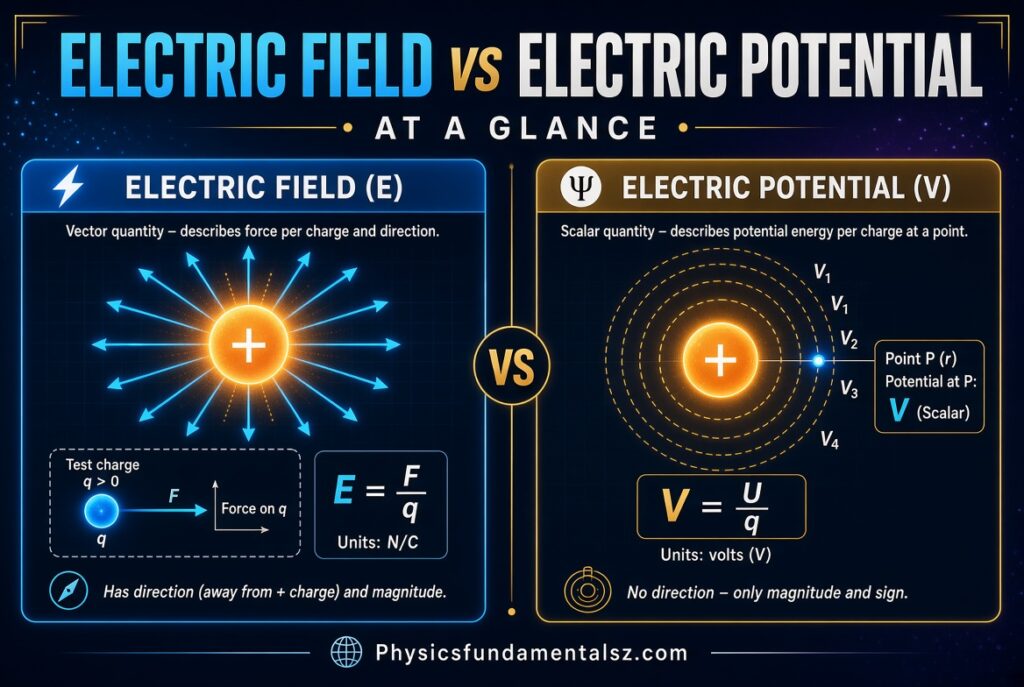
Start with the overview. Every row in this table is explained in detail later in the article.
| Feature | Electric field (E) | Electric potential (V) |
|---|---|---|
| What it measures | Force per unit charge | Potential energy per unit charge |
| Definition | E = F / q₀ | V = U / q₀ |
| Quantity type | Vector | Scalar |
| Direction | Yes | No |
| SI unit | N/C or V/m | Volt (V), equal to J/C |
| Point charge formula | E = kq / r² | V = kq / r |
| Falls with distance as | 1/r² | 1/r |
| Adding contributions from many charges | Vector addition | Ordinary (algebraic) addition |
| Sign | Magnitude is positive; direction carries the sign | Can be positive, negative, or zero |
| Link between them | E = −dV/dx | V = −∫E·dl |
| Best visual | Field lines | Equipotential surfaces |
| Physical role | Explains the force on a charge | Explains the energy of a charge |
What Is an Electric Field?
An electric field is the region around a charged object where other charges feel an electric force. Every charge creates a field, and the field exists even when no other charge is nearby.
Definition: The electric field at a point is the electric force per unit positive test charge placed at that point.
E = F / q₀
The field is a vector quantity. It has magnitude and direction. The direction is the way a positive test charge would be pushed.
Electric Field of a Point Charge
For a single point charge q, the field magnitude at distance r is:
E = k|q| / r²
Here k is Coulomb’s constant, about 8.99 × 10⁹ N·m²/C². The field points away from a positive charge and toward a negative charge.
Units of Electric Field
The SI unit is newtons per coulomb (N/C). An equivalent unit is volts per meter (V/m).
The two units are identical. Force-based problems tend to use N/C, and potential-based problems tend to use V/m.
Key Properties of the Electric Field
- It is a vector, so direction matters.
- It falls off as 1/r² around a point charge.
- It is found by vector addition when several charges are present.
- It is zero inside a conductor in electrostatic equilibrium.
- It points from higher potential to lower potential.
What the Field Tells You
If you know E at a location, you know the force on any charge q placed there: F = qE. Positive charges are pushed along the field. Negative charges are pushed against it.
That is the whole job of the field. It converts a charge into a force.
What Is Electric Potential?
Electric potential is the amount of electric potential energy per unit charge at a point in an electric field. It tells you how much energy a unit positive charge would have if you placed it there.
V = U / q₀
Electric potential is a scalar quantity. It has a value but no direction.
Formal Definition With a Reference Point
Potential is always measured relative to a reference. The usual choice is infinity, where the potential is defined as zero.
So the potential at a point equals the work per unit charge needed to bring a positive test charge from infinity to that point.
Electric Potential of a Point Charge
For a single point charge q, the potential at distance r is:
V = kq / r
Here the sign of q is kept. A positive charge creates positive potential around it. A negative charge creates negative potential.
Unit of Electric Potential
The SI unit is the volt (V). One volt equals one joule per coulomb.
1 V = 1 J/C
A 9 V battery, for example, gives each coulomb of charge 9 joules of energy as it passes through.
Key Properties of Electric Potential
- It is a scalar, so no direction is involved.
- It falls off as 1/r around a point charge.
- It is found by simple algebraic addition when several charges are present.
- It can be positive, negative, or zero.
- Only differences in potential have direct physical meaning.
What Potential Tells You
If you know V at a point, you know the potential energy of any charge q placed there: U = qV. A positive charge at high potential has high energy. It will gain kinetic energy by moving toward lower potential.
That is the job of potential. It converts a charge into an energy.
Electric Potential Difference (Voltage)
Electric potential difference is the difference in electric potential between two points. In everyday language, it is voltage.
ΔV = V_B − V_A = W / q
Here W is the work done per charge when moving between the points. Voltage is the quantity a voltmeter reads, and it is a difference by nature.
Potential vs Potential Difference
Potential belongs to a single point and depends on the chosen zero. Potential difference involves two points and does not depend on the zero.
| Feature | Electric potential | Electric potential difference |
|---|---|---|
| Defined at | One point | Between two points |
| Needs a reference | Yes, usually infinity or ground | No |
| Symbol | V | ΔV |
| Unit | Volt | Volt |
| Quantity type | Scalar | Scalar |
| Everyday name | Potential at a point | Voltage |
Path Independence
The potential difference between two points does not depend on the path taken. This is true because the electrostatic force is conservative.
Move a charge along a straight line or along a long curve between the same two points, and the work per unit charge comes out the same.
Voltage, EMF, and Potential Difference
These terms are close but not identical. Potential difference is measured between any two points in a circuit. EMF (electromotive force) is the energy per unit charge a source such as a battery supplies, measured when no current flows.
A real battery’s terminal voltage drops below its EMF when current flows, because of internal resistance.
Electric Potential Energy vs Electric Potential
A third quantity often creates confusion. Electric potential energy (U) belongs to a charge. Electric potential (V) belongs to a point in space.
U = qV
The same location has a single potential, but different charges placed there have different energies.
Potential Energy of Two Charges
For two point charges separated by distance r, the potential energy of the pair is:
U = k q₁ q₂ / r
It is positive for like charges and negative for opposite charges. The unit is the joule (J).
Comparison Table
| Quantity | Symbol | Belongs to | Unit | Type |
|---|---|---|---|---|
| Electric field | E | A point in space | N/C or V/m | Vector |
| Electric force | F | A charge in a field | N | Vector |
| Electric potential | V | A point in space | V | Scalar |
| Electric potential energy | U | A charge at a point (or a pair of charges) | J | Scalar |
Memory Rule
Field and potential are properties of the space. Force and energy are what a charge experiences in that space. Multiply by the charge to move from the first pair to the second: F = qE and U = qV.
Difference Between Electric Field and Electric Potential: Detailed Comparison
The overview table gave the highlights. This section explains each difference in depth.
1. Vector vs Scalar
The electric field is a vector. At each point, it has a magnitude and a direction. Two fields combine by vector addition.
The electric potential is a scalar. At each point, it is a single number. Two potentials combine by ordinary addition.
2. Force vs Energy
The field tells you the force on a charge. The potential tells you the energy of a charge.
Force is about what happens right now at a point. Energy is about what a charge can do as it moves from one place to another.
3. Different Formulas
The definitions differ by the quantity in the numerator.
E = F / q₀ while V = U / q₀
The point charge formulas differ by one power of distance.
E = kq / r² while V = kq / r
4. Different Distance Dependence
Double the distance from a point charge and the field falls to one quarter. The potential falls to one half.
| Distance from charge | Relative field (1/r²) | Relative potential (1/r) |
|---|---|---|
| r | 1 | 1 |
| 2r | 1/4 | 1/2 |
| 3r | 1/9 | 1/3 |
| 4r | 1/16 | 1/4 |
| r/2 | 4 | 2 |
5. Different Units
The electric field is measured in N/C or V/m. The potential is measured in volts. Volts per meter and volts differ by one unit of length.
That one factor of length is the signature of the derivative relationship between them.
6. Different Ways of Combining Charges
For a system of charges, the field is the vector sum and the potential is the algebraic sum.
E_net = E₁ + E₂ + … (vectors)
V_net = V₁ + V₂ + … (scalars, signs kept)
This makes potential much easier to calculate. You skip all the component work.
7. Different Zero Conditions
The field and the potential can vanish independently. Zero field does not imply zero potential, and zero potential does not imply zero field.
You will see concrete numbers for both cases later in this article.
8. Different Dependence on the Reference Point
The field has no reference ambiguity. It is a definite vector at each point.
The potential depends on where you set zero. Shifting the zero point adds a constant to every potential. The field does not change, because the derivative of a constant is zero.
9. Different Graphical Representations
Fields are drawn as arrows or field lines. Potentials are drawn as equipotential surfaces or as a graph of V against position.
A map of equipotentials works like a contour map. A field line map works like a map of arrows pointing downhill.
10. Different Roles in Real Devices
Field strength determines whether insulation breaks down. Voltage determines how much energy a battery or power supply can deliver.
Engineers care about both. A 10,000 V gap of 1 cm and a 10,000 V gap of 1 mm have the same voltage but very different fields.
Relationship Between Electric Field and Electric Potential
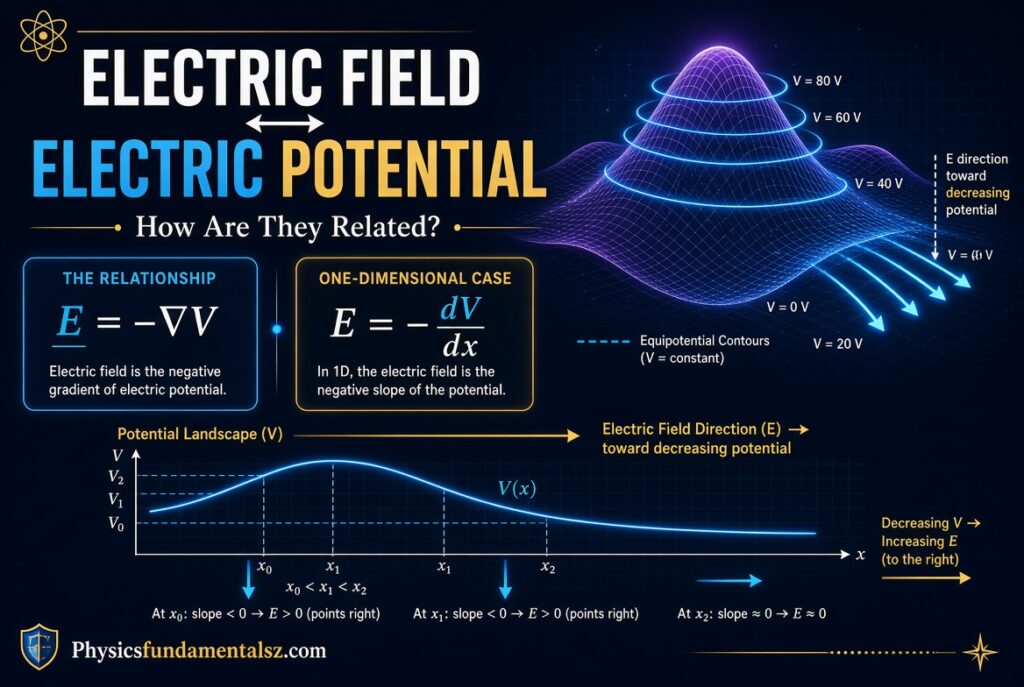
The two quantities are not independent. The electric field is the negative gradient of the electric potential.
E = −∇V
In one dimension, this reduces to a more familiar form.
E_x = −dV/dx
What the Equation Says
The field tells you how fast the potential changes with position. The minus sign means the field points toward decreasing potential.
A steep change in V gives a strong field. A flat potential gives a weak field.
Going the Other Way: From Field to Potential
Integrate the field along a path to get the potential difference.
V_B − V_A = −∫ E · dl (from A to B)
For a uniform field along a straight path of length d, the integral simplifies to ΔV = −E d (when moving along the field).
The Hill Analogy
Think of potential as the height of a landscape. The field is the slope of the hill.
A ball placed on a steep slope rolls fast. A ball on flat ground does not move. The ball moves from high to low, and the force follows the steepest downhill direction.
| Hill picture | Electric picture |
|---|---|
| Height of the ground | Electric potential V |
| Steepness of the slope | Electric field magnitude |
| Direction of steepest descent | Direction of the electric field |
| Contour lines | Equipotential lines |
| Flat ground | Zero field, constant potential |
| Ball’s gravitational energy | Charge’s potential energy U = qV |
A Common Textbook Error
Some study sites claim that when the field increases, the potential also increases. That is not correct as a general rule.
The field is the slope of V, not its size. Near a positive point charge, the field and the potential both rise as you approach the charge. Between parallel plates, the field is constant while the potential changes steadily. A constant potential means zero field. So no single “increases together” rule holds.
Direction Rule
The electric field always points from higher potential to lower potential. A positive charge released in the field accelerates toward lower potential. A negative charge accelerates toward higher potential.
Electric Field and Electric Potential in a Uniform Field
A uniform field has the same magnitude and direction everywhere. It appears between two large parallel plates, away from their edges.
Formulas for a Uniform Field
E = V / d and ΔV = −E d
Here d is the separation measured along the field direction. The potential falls linearly as you move along the field.
Worked Example 1: Field Between Parallel Plates
Two plates are separated by 1.5 cm, with a potential difference of 300 V. Find the field between them.
E = V / d = 300 / 0.015 = 2.0 × 10⁴ V/m
The field is 2.0 × 10⁴ N/C, pointing from the positive plate to the negative plate.
Worked Example 2: Potential Difference From a Known Field
A uniform field of 500 N/C exists in a region. Find the potential difference between two points 0.20 m apart along the field.
ΔV = E d = 500 × 0.20 = 100 V
The point downstream (further along the field) is at a potential 100 V lower than the starting point.
Worked Example 3: Force on an Electron Between the Plates
Use the plates from Example 1. An electron sits between them. Find the force on it.
F = eE = (1.602 × 10⁻¹⁹)(2.0 × 10⁴) = 3.2 × 10⁻¹⁵ N
The force points opposite to the field, toward the positive plate.
Equipotential Planes in a Uniform Field
Surfaces of constant potential in a uniform field are flat planes perpendicular to the field. Equal spacing between planes means equal steps in potential.
If planes are 1 cm apart and the field is 2.0 × 10⁴ V/m, each step corresponds to 200 V.
Equipotential Surfaces and Electric Field Lines
Field lines and equipotential surfaces are two ways to draw the same physical situation. Each one tells part of the story.
What Is an Equipotential Surface?
An equipotential surface is a surface where the potential has the same value at every point. Moving a charge along such a surface requires no work.
W = q ΔV = 0 when ΔV = 0.
Why Field Lines Cross Equipotentials at Right Angles
If the field had a component along an equipotential surface, a charge moving along the surface would gain or lose energy. That would contradict the definition of an equipotential.
So the field must be perpendicular to the surface everywhere.
Equipotentials of a Point Charge
Around a single point charge, equipotential surfaces are concentric spheres. Field lines are radial and cross each sphere at right angles.
The spacing of the spheres for equal steps in V grows with distance, which shows the field weakening.
Equipotentials of Two Opposite Charges
For an electric dipole, the zero-potential surface is the plane halfway between the charges. Surfaces near each charge wrap around it in closed shapes.
Field lines run from the positive charge to the negative charge and cross every equipotential perpendicularly.
Reading a Potential Map
| Feature on the map | Meaning |
|---|---|
| Equipotential lines close together | Strong field |
| Equipotential lines far apart | Weak field |
| Field direction | Perpendicular to the lines, toward lower V |
| No equipotentials crossing | Potential has one value per point |
| Closed lines around a charge | Source of the field inside |
Electric Field and Potential of a Single Point Charge: Worked Comparison
A point charge shows the difference in the clearest way. Take a +2.0 nC charge and compute both quantities at several distances.
First compute kq: (8.99 × 10⁹)(2.0 × 10⁻⁹) = 17.98 V·m.
| Distance r | Field E = kq/r² | Potential V = kq/r |
|---|---|---|
| 0.50 m | 71.9 N/C | 36.0 V |
| 1.0 m | 18.0 N/C | 18.0 V |
| 2.0 m | 4.50 N/C | 8.99 V |
| 4.0 m | 1.12 N/C | 4.50 V |
What the Numbers Show
Going from 1 m to 2 m, the field drops by a factor of 4 but the potential drops only by a factor of 2. The potential has a much longer reach.
This is why electric potential matters in long-range energy calculations, such as ionization and orbital energies.
Check the Relationship E = −dV/dx
Take V = kq/r with kq = 17.98 V·m. Differentiate: dV/dr = −kq/r². So E = −dV/dr = kq/r².
At r = 1.0 m, E = 17.98 N/C. The table agrees.
Worked Example 4: Field and Potential at 0.30 m
Find the field and the potential at 0.30 m from a +5.0 nC charge.
kq = (8.99 × 10⁹)(5.0 × 10⁻⁹) = 44.95 V·m
E = 44.95 / (0.30)² = 499 N/C, pointing away from the charge.
V = 44.95 / 0.30 = 150 V
The field has direction. The potential is just a number.
Electric Field and Potential of Two Charges: Why Zero Field Does Not Mean Zero Potential
Two charges show how the quantities can behave independently. The cases below are favorites in exams.
Case 1: Equal Like Charges at the Midpoint
Take two +2.0 μC charges, 10 cm apart. At the midpoint, each is 0.050 m away.
Field: the two fields have equal magnitude and opposite direction.
E_net = 0
Potential: each charge contributes kq/r = (8.99 × 10⁹)(2.0 × 10⁻⁶)/0.050 = 3.596 × 10⁵ V. The contributions add.
V_net = 2 × 3.596 × 10⁵ = 7.19 × 10⁵ V
So the field is zero but the potential is not.
Case 2: Equal Opposite Charges at the Midpoint
Take +2.0 μC and −2.0 μC, 10 cm apart, and look at the midpoint again.
Field: both fields point the same way and add.
E_net = 2 × 7.19 × 10⁶ = 1.44 × 10⁷ N/C
Potential: the two contributions have equal size and opposite sign.
V_net = +3.596 × 10⁵ − 3.596 × 10⁵ = 0
Now the potential is zero but the field is not.
Summary of the Two Cases
| Case | Electric field at midpoint | Electric potential at midpoint |
|---|---|---|
| +2.0 μC and +2.0 μC | 0 | 7.19 × 10⁵ V |
| +2.0 μC and −2.0 μC | 1.44 × 10⁷ N/C | 0 |
Why This Happens
The field depends on how the potential changes with position. The potential depends on the sum of signed contributions. These are different operations.
At the like-charge midpoint, the potential reaches a local minimum along the line between the charges. A minimum has zero slope, so the field is zero there, even though V is large.
Worked Example 5: Two-Dimensional Point
A +3.0 μC charge sits at (0, 0) and a −3.0 μC charge sits at (0.40 m, 0). Find the potential and the field at P = (0.20 m, 0.15 m).
Each charge is 0.25 m from P.
V = kq₁/r + kq₂/r = (8.99 × 10⁹)(3.0 × 10⁻⁶)/0.25 − (8.99 × 10⁹)(3.0 × 10⁻⁶)/0.25 = 0
The field, by vector addition, is 6.90 × 10⁵ N/C in the +x direction.
At P, the potential is exactly zero while the field is large. For the full vector steps, see the method for calculating the electric field between two charges.
When Is the Electric Field Zero, and When Is the Potential Constant?
These conditions are linked. They also trip up many students.
Zero Field Means Constant Potential (Locally)
If E = 0 throughout a region, then dV/dx = 0 there. The potential is constant across that region.
Inside a conductor in electrostatic equilibrium, E = 0, so the whole conductor is at one potential.
Constant Potential Along a Surface Does Not Mean Zero Field
On an equipotential surface, V is constant along the surface. The field can still be strong, but it must be perpendicular to the surface.
The surface of a charged conductor is an equipotential, and the field just outside it points straight out and equals σ/ε₀.
Zero Potential Does Not Mean Zero Field
Many points around a dipole sit at V = 0. The field there can be large. Only a constant potential through a region forces the field to vanish.
Summary Table
| Statement | True or false |
|---|---|
| E = 0 at a point, so V = 0 there | False |
| V = 0 at a point, so E = 0 there | False |
| E = 0 throughout a region, so V is constant there | True |
| V is constant throughout a region, so E = 0 there | True |
| E = 0 at a point, so dV/dx = 0 there | True |
Conductors: Constant Potential and Zero Field
A conductor in electrostatic equilibrium has two firm properties. The field inside is zero, and the whole conductor is an equipotential.
Free charges move until they cancel the internal field. After that, no net force acts on them.
Faraday Cage
A closed metal shell shields its interior from external fields. This is the principle behind a Faraday cage. The inside of a car or an airplane protects occupants from lightning for the same reason.
Why Sharp Points Have Strong Fields
For a conductor at fixed potential, the field is strongest where the surface curves most sharply. This is why lightning rods have pointed tips and why corona discharge occurs at needle points.
Two spheres of different radius, connected by a wire, share the same potential. The smaller sphere carries less charge but has the larger surface field, because E = V/R for an isolated sphere at potential V.
Finding the Electric Field From the Electric Potential
The relation E = −dV/dx gives a practical method. If you know V as a function of position, differentiate to get the field.
This is often the easiest route, because V is a scalar and simpler to build from several charges.
Worked Example 6: Field From a Potential Function
In a region, the potential along the x-axis is V(x) = 6x² − 3x volts, with x in meters. Find the field at x = 0.50 m and the point where the field is zero.
E_x = −dV/dx = −(12x − 3) = 3 − 12x
At x = 0.50 m: E_x = 3 − 6 = −3 V/m, so the field points in the −x direction with magnitude 3 N/C.
Set E_x = 0: 3 − 12x = 0, so x = 0.25 m. At that point, the potential has its minimum value and the field vanishes.
Worked Example 7: Potential From a Point Charge Field
For a point charge, E = kq/r². Integrate from infinity to r to find V.
V(r) = −∫ from ∞ to r of (kq/r’²) dr’ = kq / r
This recovers the standard potential. The choice of V = 0 at infinity fixed the constant of integration.
Three-Dimensional Form
In three dimensions, each component of the field is the negative partial derivative of V.
E_x = −∂V/∂x, E_y = −∂V/∂y, E_z = −∂V/∂z
The gradient symbol ∇V packages all three derivatives into one vector equation.
Why Engineers Prefer Potential
Computing V for many charges is a simple sum. Computing E needs vector components. Numerical solvers for circuits, sensors, and semiconductor devices therefore solve for V first and obtain E by differentiation.
Work, Energy, and Potential Difference
The most important use of potential is to find energy changes. The work done by the field on a charge q moving from A to B is:
W = −q ΔV = q (V_A − V_B)
A positive charge moving to lower potential gains kinetic energy. Equivalently, the field does positive work on it.
Worked Example 8: Work Done on a Charge
A +3.0 μC charge moves through a potential difference of 200 V, from the higher potential to the lower.
W = qΔV = (3.0 × 10⁻⁶)(200) = 6.0 × 10⁻⁴ J
The field does 0.60 mJ of work on the charge.
Worked Example 9: Electron Accelerated Through a Potential Difference
An electron starts at rest and accelerates through 100 V. Find its kinetic energy and speed.
KE = eΔV = (1.602 × 10⁻¹⁹)(100) = 1.602 × 10⁻¹⁷ J = 100 eV
v = √(2KE/m) = √(2 × 1.602 × 10⁻¹⁷ / 9.11 × 10⁻³¹) ≈ 5.9 × 10⁶ m/s
Notice that no distance or field strength was needed. Only the potential difference mattered.
The Electron-Volt
An electron-volt (eV) is the energy gained by one elementary charge moving through one volt. It equals 1.602 × 10⁻¹⁹ J.
Particle physicists and chemists use it because atomic and nuclear energies are tiny in joules.
Worked Example 10: Potential Energy of Two Charges
Two charges, +2.0 μC and +3.0 μC, are 0.10 m apart. Find the potential energy of the pair.
U = kq₁q₂/r = (8.99 × 10⁹)(2.0 × 10⁻⁶)(3.0 × 10⁻⁶)/0.10 = 0.539 J
The positive value shows that work had to be done to bring the like charges together from far away.
When to Use Field Methods vs Potential Methods
| Question | Better tool |
|---|---|
| What force acts on a charge here? | Electric field |
| In which direction will the charge accelerate? | Electric field |
| How fast will the charge be moving after it travels from A to B? | Electric potential (energy conservation) |
| How much work is needed to move a charge between two points? | Electric potential difference |
| What happens at a boundary or surface? | Both, using field direction and equipotential |
| Many charges and a scalar answer | Electric potential |
Gravitational Analogy: Field and Potential
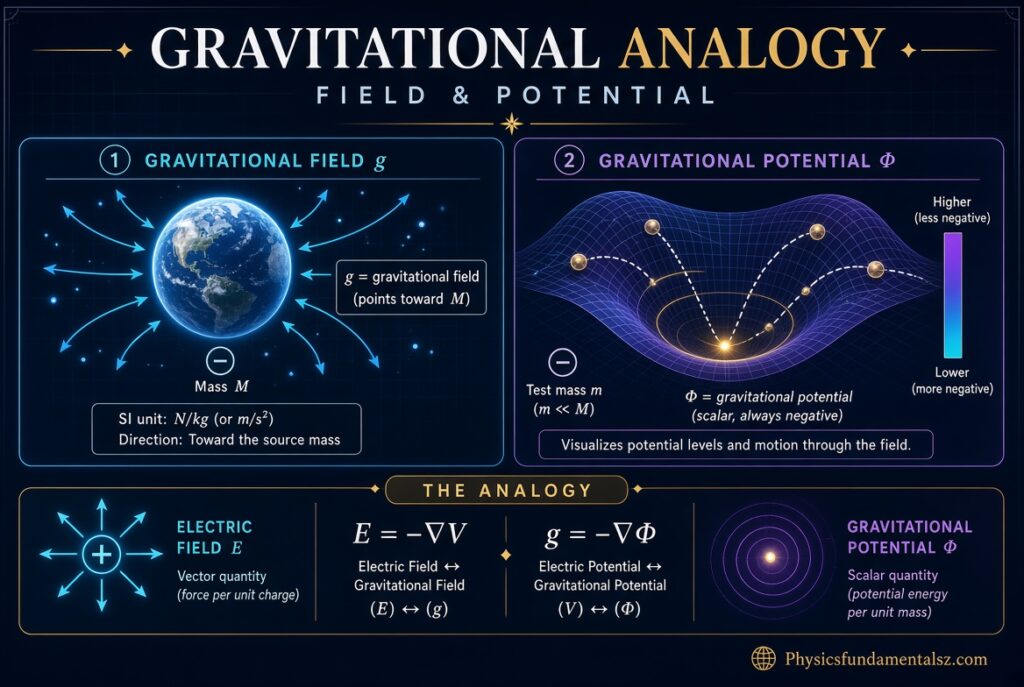
Gravity offers a close parallel. The gravitational field g is force per unit mass. The gravitational potential is energy per unit mass.
| Electric quantity | Gravitational equivalent |
|---|---|
| Electric field E = F/q | Gravitational field g = F/m |
| Electric potential V = U/q | Gravitational potential φ = U/m |
| Point source field: kq/r² | Point source field: GM/r² |
| Point source potential: kq/r | Point source potential: −GM/r |
| Charge q | Mass m |
| Can repel or attract | Only attracts |
Near the Earth’s Surface
Near the ground, the gravitational field is nearly constant at about 9.8 N/kg. The gravitational potential rises with height: ΔΦ = gh.
This matches the electric picture between parallel plates, where the field is constant and the potential changes linearly with distance.
A Point Worth Remembering
The gravitational potential is negative because gravity is purely attractive and zero is set at infinity. The electric potential of a negative charge is also negative, for the same reason. Signs follow the source.
Common Misconceptions About Electric Field and Electric Potential
These mistakes appear every year in physics classes. The table lists them with corrections.
| Misconception | Correction |
|---|---|
| Electric field and electric potential are the same thing | They measure different things: force per charge vs energy per charge |
| Both are vectors | Only the field is a vector. Potential is a scalar |
| Zero field means zero potential | Not in general. Equal like charges give zero field at the midpoint but nonzero potential |
| Zero potential means zero field | Not in general. Equal opposite charges give zero potential at the midpoint but nonzero field |
| Higher potential means higher field | The field depends on the slope of V, not its value |
| Potential is the same as potential energy | Potential is per unit charge. Energy is U = qV |
| Voltage flows through a wire | Voltage is a difference across two points. Current flows |
| A bird on a power line is safe because voltage is low | It is safe because there is almost no potential difference across its body |
| Field lines are paths of moving charges | Field lines show force direction. Charges follow them only in special cases |
| Potential has an absolute value | Only differences are physical. The zero is chosen by convention |
The Bird on the Wire
A bird sitting on a single high-voltage line sits at nearly the same potential across its feet. With no significant potential difference across its body, almost no current flows through it.
The danger comes from touching two points at different potentials, such as a line and the ground.
Voltage Does Not Mean Danger by Itself
What matters for safety is the current through the body, which depends on the voltage difference and the resistance. Static electricity can involve thousands of volts but carries very little charge, so the shock is brief and minor.
Real-World Applications
Both quantities appear throughout technology and nature. The two ideas play separate roles.
Batteries and Circuits
A battery maintains a potential difference between its terminals. That voltage drives current through a circuit. Inside the wires, a small electric field pushes the charge carriers along.
Ohm’s law can be written in field form: J = σE, where J is current density and σ is conductivity. Voltage is the integral of this field along the wire.
Capacitors
A capacitor stores energy in the field between two plates. The voltage across it is V = Ed, and the stored energy is ½CV².
The maximum voltage is set by the breakdown field of the insulator between the plates. For dry air, that is roughly 3 × 10⁶ V/m.
Power Transmission
Long-distance lines run at hundreds of kilovolts to reduce current and loss. The large potential difference between the line and the ground creates a strong field in the surrounding air. Spacing and insulator design keep that field below breakdown.
Particle Accelerators and Electron Guns
Charged particles gain kinetic energy equal to qΔV. Older cathode ray tubes, electron microscopes, and X-ray tubes use thousands to hundreds of thousands of volts to accelerate electrons.
Lightning
Charge separation in storm clouds produces a large potential difference, often on the order of 10⁸ V or more, between the cloud and the ground. When the local field exceeds the breakdown strength of air, a discharge forms.
Medical Devices
Electrocardiograms measure small potential differences between points on the skin. The patterns reflect the heart’s electrical activity. Defibrillators discharge a capacitor to send a brief, controlled pulse through the chest.
Electrostatic Painting and Precipitators
Both use strong fields to move charged particles. The designer chooses the voltage and electrode spacing to set the field strength at the particles.
How Electric Field and Electric Potential Are Measured
Different instruments measure different quantities. This difference reflects the physics.
Measuring Electric Potential Difference
A voltmeter measures potential difference between two points. It connects in parallel across the part of the circuit of interest.
An oscilloscope shows how a potential difference changes with time.
Measuring Electric Field
An electric field meter, such as a field mill, measures the field at a point. Another approach is to place a small test charge and measure the force, using E = F/q.
In practice, field values are often calculated from voltage and geometry, using E ≈ V/d for plates.
Why Measurement Needs Care
An instrument can disturb what it measures. A voltmeter has high but finite resistance. A test charge, if large, changes the field. Good measurements keep the disturbance small.
Units and Dimensions of Electric Field and Electric Potential
A quick unit check separates the two quantities clearly.
| Quantity | SI unit | Base-unit form |
|---|---|---|
| Electric field | N/C = V/m | kg·m·s⁻³·A⁻¹ |
| Electric potential | V = J/C | kg·m²·s⁻³·A⁻¹ |
| Potential difference | V | kg·m²·s⁻³·A⁻¹ |
| Electric force | N | kg·m·s⁻² |
| Potential energy | J | kg·m²·s⁻² |
The potential carries one extra factor of length compared with the field. That extra length is what the derivative or integral between them supplies.
Showing That N/C Equals V/m
One volt equals one joule per coulomb. One joule equals one newton-meter. So 1 V/m = 1 (N·m/C)/m = 1 N/C.
Either unit is correct for the field. Use the one that fits the data in the problem.
Electric Field vs Electric Potential Graphs
Graphs help you see the slope relationship. Here is what to expect for the common cases.
Point Charge
For a positive point charge, V(r) = kq/r falls smoothly from large positive values near the charge toward zero far away. E(r) = kq/r² falls faster.
The slope of the V curve at any point equals the negative of the field at that point.
Uniform Field
V(x) is a straight line with a constant negative slope. E(x) is a horizontal line at a constant value.
The slope of the straight line is −E.
Two Equal Like Charges Along the Axis
V(x) has a valley at the midpoint, with a minimum there. E(x) crosses zero at the midpoint and changes sign.
Near each charge, V rises steeply, and the field points away from the charge.
Two Equal Opposite Charges Along the Axis
V(x) falls from large positive values near the positive charge, passes through zero at the midpoint, and reaches large negative values near the negative charge. E(x) stays on one side and has its smallest magnitude at the midpoint.
How to Read Any V–x Graph
- Steep slope: large field.
- Flat region: field near zero.
- Slope sign negative: field points in the +x direction.
- Slope sign positive: field points in the −x direction.
Practice Problems With Answers
Try each problem first. Use k = 8.99 × 10⁹ N·m²/C² and e = 1.602 × 10⁻¹⁹ C.
Problem 1: Field and Potential of a Point Charge
Find the electric field and the electric potential at 0.60 m from a +4.0 nC charge.
Solution: kq = (8.99 × 10⁹)(4.0 × 10⁻⁹) = 35.96 V·m.
E = 35.96 / (0.60)² = 99.9 N/C, pointing away from the charge.
V = 35.96 / 0.60 = 59.9 V
Problem 2: Uniform Field and Voltage
The field between two plates is 8.0 × 10³ V/m. The plates are 2.5 mm apart. What is the potential difference?
Solution: ΔV = Ed = (8.0 × 10³)(0.0025) = 20 V.
Problem 3: Field From a Potential Function
In a region, V(x) = 4x³ − 2x volts. Find the field at x = 0.50 m.
Solution: E_x = −dV/dx = −(12x² − 2) = 2 − 12x².
At x = 0.50 m: E_x = 2 − 3 = −1 V/m. The field has magnitude 1 N/C and points in the −x direction.
Problem 4: Speed of a Proton
A proton starts from rest and accelerates through 500 V. Find its final speed. The proton mass is 1.673 × 10⁻²⁷ kg.
Solution: KE = eΔV = (1.602 × 10⁻¹⁹)(500) = 8.01 × 10⁻¹⁷ J.
v = √(2KE/m) = √(2 × 8.01 × 10⁻¹⁷ / 1.673 × 10⁻²⁷) ≈ 3.1 × 10⁵ m/s
Problem 5: Zero Field, Nonzero Potential
Two +1.0 μC charges are 0.20 m apart. Find E and V at the midpoint.
Solution: The midpoint is 0.10 m from each charge.
E = 0, because the equal fields point in opposite directions.
V = 2 × (8.99 × 10⁹)(1.0 × 10⁻⁶)/0.10 = 1.80 × 10⁵ V
Problem 6: Zero Potential, Nonzero Field
A +1.0 μC charge and a −1.0 μC charge are 0.20 m apart. Find E and V at the midpoint.
Solution: Each field is (8.99 × 10⁹)(1.0 × 10⁻⁶)/(0.10)² = 8.99 × 10⁵ N/C, and both point toward the negative charge.
E = 2 × 8.99 × 10⁵ = 1.80 × 10⁶ N/C
V = +8.99 × 10⁴ − 8.99 × 10⁴ = 0
Problem 7: Work Done Moving a Charge
How much work does the field do on a −2.0 μC charge moved from a point at 150 V to a point at 50 V?
Solution: W = q(V_A − V_B) = (−2.0 × 10⁻⁶)(150 − 50) = −2.0 × 10⁻⁴ J.
The field does −0.20 mJ of work. An outside agent must supply that energy, because a negative charge moves toward lower potential against its natural direction.
Calculating Electric Field and Electric Potential With Python
A short script lets you compute both quantities for any set of charges and confirm E = −dV/dx numerically. This example uses two charges on a line.
import numpy as np

k = 8.99e9  # N·m²/C²
charges = [(+2.0e-6, 0.0), (-2.0e-6, 0.10)]  # (charge in C, position in m)

def V(x):
    return sum(k * q / abs(x - xq) for q, xq in charges)

def E(x):
    return sum(k * q * np.sign(x - xq) / (x - xq) ** 2 for q, xq in charges)

x = 0.03
h = 1e-6
E_numeric = -(V(x + h) - V(x - h)) / (2 * h)

print(f"V({x}) = {V(x):.4e} V")
print(f"E({x}) direct sum  = {E(x):.4e} N/C")
print(f"E({x}) from -dV/dx = {E_numeric:.4e} N/C")
print(f"V(0.05) = {V(0.05):.3e} V, E(0.05) = {E(0.05):.3e} N/C")
Running it gives these results:
- V(0.03) = 3.4248 × 10⁵ V
- E(0.03), direct vector sum = 2.3647 × 10⁷ N/C
- E(0.03), from −dV/dx = 2.3647 × 10⁷ N/C
- At the midpoint, V = 0 and E = 1.438 × 10⁷ N/C
What the Output Proves
The two field values match. The direct sum of point charge fields and the negative slope of the potential give the same answer.
The midpoint result also confirms the earlier worked example: zero potential with a strong field.
Formula Cheat Sheet
Keep this table for homework and exams.
| Concept | Formula |
|---|---|
| Electric field (definition) | E = F / q₀ |
| Electric field of a point charge | E = k|q| / r² |
| Electric potential (definition) | V = U / q₀ |
| Electric potential of a point charge | V = kq / r |
| Potential energy of a charge | U = qV |
| Potential energy of two charges | U = k q₁ q₂ / r |
| Potential difference | ΔV = V_B − V_A = W / q |
| Field from potential | E = −∇V, E_x = −dV/dx |
| Potential from field | ΔV = −∫ E · dl |
| Uniform field | E = V / d |
| Net field of many charges | Vector sum of fields |
| Net potential of many charges | Algebraic sum of potentials |
| Force on a charge | F = qE |
| Work by the field | W = −qΔV |
| Kinetic energy gained from rest | KE = qΔV |
| Coulomb’s constant | k = 1/(4πε₀) ≈ 8.99 × 10⁹ N·m²/C² |
| Permittivity of free space | ε₀ ≈ 8.854 × 10⁻¹² C²/(N·m²) |
How to Decide: Do You Need the Field or the Potential?
Choose the tool that matches the question. A short checklist saves time on exams.
Ask These Questions
- Does the question mention force, acceleration, or direction? Use the electric field.
- Does it mention energy, speed after moving, or work? Use the electric potential.
- Are there many charges and you need a single number? Use potential, because you can add scalars.
- Do you need the force at one point from a given voltage? Compute E from the potential, then use F = qE.
- Is the geometry a pair of parallel plates? Use E = V/d.
A Short Routine
Write what is given. Identify whether the unknown is a force-type quantity or an energy-type quantity. Pick the formula that matches. Check units at the end.
Newtons per coulomb mean you computed a field. Volts mean you computed a potential.
Exam Tips
A few habits prevent most lost marks in this topic.
- State whether each quantity is a vector or a scalar before you calculate.
- Keep the signs of the charges when computing potential. Use absolute values only for field magnitudes.
- Remember that potential has no direction. Never write a direction for V.
- Convert microcoulombs, nanocoulombs, and centimeters to SI units first.
- When a question says “zero field,” check the potential separately, and vice versa.
- Use energy conservation (qΔV = ½mv²) for speed questions. It avoids needing the field.
- Show the relation E = −dV/dx when a graph is given, and read the slope.
The Science Behind the Concepts: A Short History
The idea of a field came from Michael Faraday in the 1830s, who pictured lines of force filling the space around charges and magnets. The field was a way to explain action at a distance without direct contact.
Mathematicians such as Pierre-Simon Laplace, Siméon Denis Poisson, and George Green developed the potential as a tool for solving force problems. The word “potential” for a function whose gradient gives the force comes from this period.
Maxwell and the Unified Picture
James Clerk Maxwell, in the 1860s, put the electric and magnetic fields into a single mathematical theory. In it, the scalar potential and a vector potential became central to the equations.
Today, potentials are fundamental in quantum mechanics and in field theory. In electrostatics, the pair E and V remain the standard teaching tools.
Advanced Notes: Beyond Static Charges
Everything above assumes static charges. A few extensions are worth knowing.
Time-Varying Fields
When magnetic fields change with time, the electric field is no longer a pure gradient of a scalar potential. Faraday’s law of induction adds a second contribution to E.
The relation E = −∇V then becomes E = −∇V − ∂A/∂t, where A is the magnetic vector potential. For static situations, the extra term vanishes.
Poisson’s Equation
The potential satisfies Poisson’s equation: ∇²V = −ρ/ε₀, where ρ is the charge density. In empty space, this becomes Laplace’s equation: ∇²V = 0.
Many practical problems are solved by finding the potential that satisfies these equations and then differentiating to get the field.
Gauss’s Law and the Field
Gauss’s law relates the field to the enclosed charge: the electric flux through a closed surface equals Q/ε₀. It is the best tool for fields with spherical, cylindrical, or planar symmetry.
The potential is then found by integrating the field.
Electric Field and Potential of a Charged Sphere
A charged sphere is a useful case because it shows the field and the potential behaving very differently inside and outside. Take a conducting sphere of radius R carrying total charge Q.
Outside the Sphere (r ≥ R)
The sphere acts like a point charge at its center.
E = kQ / r² and V = kQ / r
Inside the Sphere (r < R)
For a conductor in equilibrium, the charge sits on the surface. The field inside is zero, and the potential is constant and equal to its surface value.
E = 0 and V = kQ / R
Worked Example 11: Field and Potential Around a Charged Sphere
A conducting sphere of radius 0.10 m carries +5.0 nC. Find E and V at the center, at the surface, and at 0.30 m from the center.
First compute kQ = (8.99 × 10⁹)(5.0 × 10⁻⁹) = 44.95 V·m.
| Location | Electric field | Electric potential |
|---|---|---|
| Center (r = 0) | 0 | 449.5 V |
| Surface (r = 0.10 m) | 44.95 / 0.01 = 4,495 N/C | 44.95 / 0.10 = 449.5 V |
| Outside (r = 0.30 m) | 44.95 / 0.09 = 499 N/C | 44.95 / 0.30 = 150 V |
What This Example Teaches
Inside the sphere, the field is zero while the potential is a large constant. This is a clean example of “zero field, nonzero potential.”
The field jumps from zero inside to its maximum value at the surface. The potential, in contrast, changes smoothly with no jump. Potential is always continuous across a boundary, but the field can be discontinuous when surface charge is present.
Field and Potential Graphs for the Sphere
- V(r): flat at 449.5 V inside, then falling as 1/r outside.
- E(r): zero inside, then a sudden jump at the surface and a 1/r² decline outside.
The slope of the V curve outside matches the negative of E at every point.
Electric Field and Potential on the Axis of a Charged Ring
A ring of charge Q and radius R gives a clear example where the potential is easy and the field takes more work. Consider a point on the axis at distance x from the center.
V = kQ / √(R² + x²)
E = kQx / (R² + x²)^(3/2)
The field points along the axis, away from the ring for positive Q.
Why the Potential Is Easier
Every bit of charge on the ring is the same distance, √(R² + x²), from the axis point. So the potential is just kQ divided by that distance. No directions are needed.
For the field, the sideways components cancel by symmetry, and only the axial components add. That adds a factor of x/√(R² + x²).
Worked Example 12: Ring on the Axis
A ring of radius 0.30 m carries +10 nC. Find V and E on the axis at x = 0.40 m.
√(R² + x²) = √(0.09 + 0.16) = 0.50 m
V = (8.99 × 10⁹)(10 × 10⁻⁹) / 0.50 = 180 V
E = (8.99 × 10⁹)(10 × 10⁻⁹)(0.40) / (0.50)³ = 288 N/C
Check With E = −dV/dx
Differentiate V = kQ(R² + x²)^(−1/2). The result is −kQx(R² + x²)^(−3/2). With the minus sign from E = −dV/dx, the field becomes kQx/(R² + x²)^(3/2), which matches the direct formula.
This confirms that both routes give the same answer. The potential route required one line of algebra and a derivative. The direct route required symmetry arguments.
Electric Field and Potential of an Electric Dipole
An electric dipole has two equal and opposite charges separated by a small distance. Far from the dipole, the field and potential fall off at different rates.
Potential of a Dipole
At a large distance r and angle θ from the dipole axis:
V ≈ k p cos θ / r²
On the axis (θ = 0), V = kp/r². On the equatorial plane (θ = 90°), V = 0.
Field of a Dipole
The field falls as 1/r³.
E_axis ≈ 2kp / r³ and E_equatorial ≈ kp / r³
Worked Example 13: Dipole Far Away
A dipole has p = 1.0 × 10⁻⁹ C·m. Find V and E on the axis at r = 0.50 m, using the far-field formulas.
V = (8.99 × 10⁹)(1.0 × 10⁻⁹) / (0.50)² = 36 V
E = 2(8.99 × 10⁹)(1.0 × 10⁻⁹) / (0.50)³ = 144 N/C
Pattern Across Source Types
| Source | Potential falls as | Field falls as |
|---|---|---|
| Point charge | 1/r | 1/r² |
| Dipole (far field) | 1/r² | 1/r³ |
| Infinite plane (uniform field) | Linear in distance | Constant |
Each time the potential drops by one more power of r, the field drops by one more power as well. That follows directly from differentiation.
Electric Potential Depends on the Zero Point, the Field Does Not
Potential values depend on the chosen reference. For a point charge, setting V = 0 at infinity gives V = kq/r. Choosing a different reference adds a constant.
V’ = V + C
The field is the derivative of V, and the derivative of a constant is zero.
What This Means in Practice
Electrical engineers often set the potential of the Earth, or the negative terminal of a circuit, to zero. Different choices produce different potential values at the same point. Voltage differences and fields stay the same.
Why Only Differences Matter
Every physical effect depends on the field, on potential differences, or on energy changes. None of them depend on the absolute value of V. For that reason, textbooks emphasize voltage over absolute potential.
Gauge Freedom
Physicists call this freedom to shift the potential by a constant gauge freedom. It appears again in electrodynamics, where both the scalar and vector potentials can be changed without altering the fields.
Electric Field and Electric Potential in Capacitors and Dielectrics
A parallel plate capacitor shows the two quantities together. The field is uniform between the plates, and the potential changes linearly.
E = V/d and C = ε₀A/d
Effect of a Dielectric
Insert a dielectric with relative permittivity κ between the plates, with the charge held fixed. The field inside drops to E/κ, and the voltage falls by the same factor.
The capacitance rises by κ. For a vacuum-gap capacitor of 100 pF, a dielectric with κ = 4 raises it to 400 pF.
Energy in the Field
The energy stored in a capacitor can be written two ways.
U = ½ C V² and u = ½ ε₀ E² (energy per unit volume)
The first form uses potential. The second form uses the field. Both describe the same energy, which shows how closely the two ideas are connected.
Breakdown Limit
Every insulator has a maximum field, called its dielectric strength, before it breaks down. For dry air, it is about 3 × 10⁶ V/m. Designers use this to set the maximum voltage for a given plate spacing: V_max = E_max × d.
A 1 mm air gap can hold about 3,000 V before sparking, in the ideal case.
Summary of the Key Differences in Short
Use this short list for quick revision.
- The electric field is a vector. The electric potential is a scalar.
- The field is force per unit charge. The potential is energy per unit charge.
- The field is measured in N/C or V/m. The potential is measured in volts.
- A point charge gives E = kq/r² and V = kq/r.
- Fields add as vectors. Potentials add as numbers.
- The field is the negative slope of the potential.
- Field lines are perpendicular to equipotential surfaces.
- Zero field does not require zero potential, and the reverse is also true.
- The potential needs a reference point. The field does not.
Frequently Asked Questions (FAQs)
What is the difference between electric field and electric potential?
The electric field is a vector giving force per unit charge, measured in N/C. The electric potential is a scalar giving potential energy per unit charge, measured in volts.
What is the relationship between electric field and electric potential?
The field is the negative gradient of the potential: E = −dV/dx in one dimension. The field points toward decreasing potential, and its size equals the steepness of the change.
Is electric field a vector or a scalar?
It is a vector. It has both magnitude and direction, so fields from several charges add by vector addition.
Is electric potential a vector or a scalar?
It is a scalar. It has magnitude only, so potentials from several charges add as ordinary numbers with their signs.
What are the units of electric field and electric potential?
Electric field is measured in newtons per coulomb (N/C) or volts per meter (V/m). Electric potential is measured in volts (V), which equals joules per coulomb.
What is the formula for electric field and electric potential of a point charge?
The field is E = kq/r². The potential is V = kq/r. The field falls with the square of the distance, and the potential falls with the first power.
Can the electric field be zero where the potential is not zero?
Yes. At the midpoint of two equal like charges, the field is zero, but the potential is the sum of two positive contributions.
Can the electric potential be zero where the electric field is not zero?
Yes. At the midpoint of two equal and opposite charges, the potential is zero, but the field is strong and points toward the negative charge.
If the electric field is zero in a region, what is the potential there?
It is constant throughout that region. A zero field means no slope, so the potential does not change.
Does a higher electric potential mean a stronger electric field?
No. The field depends on how fast the potential changes with position. A high but flat potential gives a weak field.
In which direction does the electric field point relative to potential?
It points from higher potential to lower potential, along the direction of steepest decrease.
What is electric potential difference?
It is the difference in electric potential between two points. It equals the work per unit charge to move a charge between them and is commonly called voltage.
Is voltage the same as electric potential?
Voltage usually means potential difference between two points. Electric potential refers to a single point relative to a chosen zero, often at infinity or ground.
What is the difference between electric potential and electric potential energy?
Potential is energy per unit charge and belongs to a point in space. Potential energy is the energy of a particular charge, found from U = qV.
Why is electric potential easier to calculate than electric field?
Potential is a scalar, so contributions from several charges simply add. The field needs vector components and directions.
How do you find the electric field from electric potential?
Take the negative derivative of the potential with respect to position: E_x = −dV/dx. In three dimensions, use E = −∇V.
How do you find the electric potential from the electric field?
Integrate the field along a path: ΔV = −∫E·dl. For a uniform field, ΔV = −Ed along the field direction.
What is an equipotential surface?
It is a surface on which every point has the same potential. No work is needed to move a charge along it, and field lines cross it at right angles.
Why are field lines perpendicular to equipotential surfaces?
A field component along the surface would do work on a charge moving along it. That contradicts constant potential, so the field must be perpendicular.
What is the electric field between two parallel plates?
It is E = V/d, where V is the voltage across the plates and d is their separation. The field is nearly uniform and points from the positive plate to the negative one.
Why is the electric field zero inside a conductor?
Free charges move until they cancel any internal field. In equilibrium, the field is zero inside and the whole conductor sits at one potential.
Does a bird on a power line get shocked?
Not normally. Its feet are at nearly the same potential, so almost no current flows through its body. Danger arises when a body touches two points with different potentials.
What is the difference between EMF and potential difference?
EMF is the energy per unit charge supplied by a source, such as a battery, measured with no current. Potential difference is the voltage between any two points in a circuit and can be lower than the EMF when current flows.
How are electric field and gravitational field similar?
Both are force per unit of source quantity, and both follow an inverse square law around a point source. Electric forces can attract or repel, while gravity only attracts.
What is the electron-volt?
It is the energy gained by an elementary charge moving through one volt. One electron-volt equals 1.602 × 10⁻¹⁹ joules.
Conclusion
The difference between electric field and electric potential comes down to what each one measures. The field is a vector that gives the force per unit charge. The potential is a scalar that gives the energy per unit charge.
They are tied together by one equation: the field is the negative slope of the potential. Steep changes in V mean strong fields, and flat regions mean zero field.
Remember the main cautions. Zero field does not mean zero potential, and zero potential does not mean zero field. Field lines cross equipotentials at right angles, and potentials add as scalars while fields add as vectors.
Use the field to answer questions about force and direction. Use the potential to answer questions about energy, work, and speed. Practice the worked examples, and the two ideas will stop feeling alike.