How to Calculate Electric Field Between Two Charges: Formula and Step-by-Step Method 2026
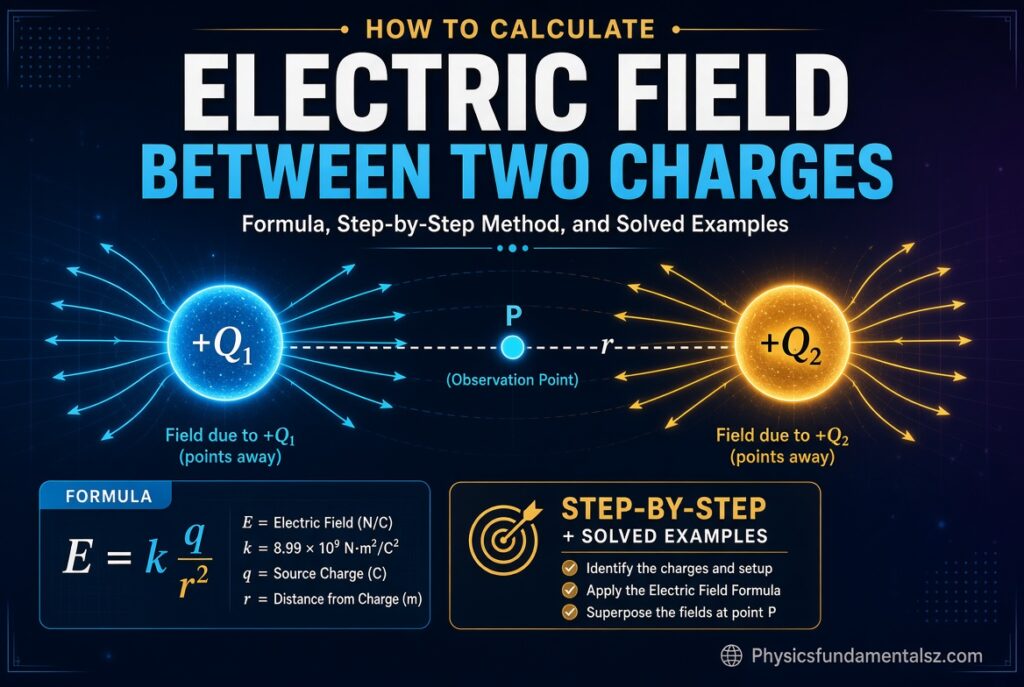
Learning how to calculate electric field between two charges comes down to one idea: find the field from each charge separately, then add the two as vectors. The formula for a single point charge is E = kq/r², and the principle of superposition does the rest.
To calculate the electric field between two charges, compute the magnitude of each field using E = k|q|/r², assign each a direction (away from positive, toward negative), and add them as vectors. On a straight line, that means adding or subtracting signed values.
The method works for any two point charges, whether they are like charges, opposite charges, equal, or unequal. It also works at any location: between the charges, outside them, or off to the side in two dimensions.
Table of Contents
What Is an Electric Field?
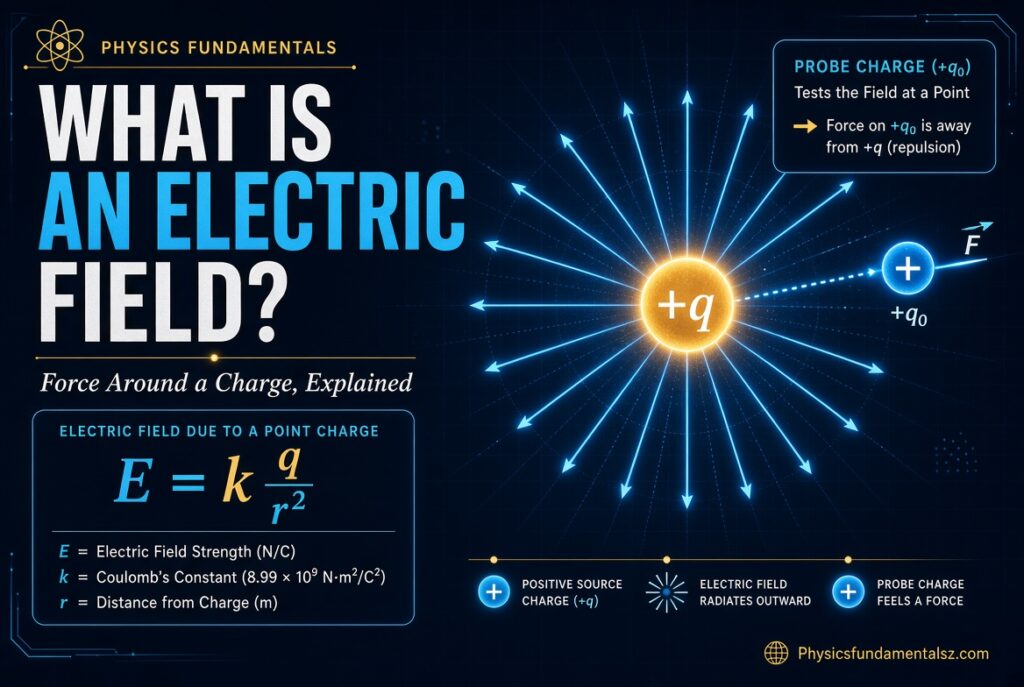
An electric field is the region around a charged object where other charges feel a force. Every charge creates one. The field exists whether or not another charge is nearby.
Definition: The electric field at a point is the electric force per unit positive test charge placed at that point.
In equation form, this is E = F/q₀, where F is the force on the test charge and q₀ is the test charge.
The field is a vector quantity. It has a magnitude (how strong) and a direction (which way a positive test charge would be pushed).
Units of Electric Field
The SI unit of electric field is newtons per coulomb (N/C). An equivalent unit is volts per meter (V/m).
Both units describe the same physical quantity. Which one you use depends on the problem. Force-based problems usually use N/C, and potential-based problems usually use V/m.
Why a Test Charge Matters
A test charge is a tiny positive charge used to probe the field. It is small enough that it does not disturb the charges creating the field.
You do not need a real test charge to calculate a field. It is a thinking tool that helps define direction and magnitude.
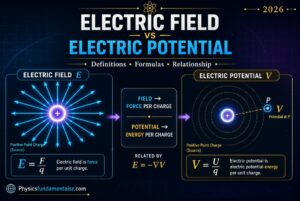
Electric Field vs Electric Force
Students often mix these two ideas up. The field belongs to a point in space. The force belongs to a specific charge sitting in that field.
| Quantity | Symbol | Formula | SI Unit | Depends on |
|---|---|---|---|---|
| Electric force | F | F = k q₁q₂ / r² | newton (N) | Both charges |
| Electric field | E | E = k q / r² | N/C or V/m | Source charge only |
| Force on a charge in a field | F | F = qE | newton (N) | Field and that charge |
| Electric potential | V | V = k q / r | volt (V) | Source charge only |
Electric Field Formula for a Point Charge
The electric field formula for a single point charge is the building block for every two-charge problem. Master this and the rest is bookkeeping.
E = k × |q| / r²
Here, E is the field magnitude, k is Coulomb’s constant, q is the source charge, and r is the distance from the charge to the point where you want the field.
What Each Symbol Means
- E is the electric field magnitude in N/C.
- k is Coulomb’s constant, about 8.99 × 10⁹ N·m²/C².
- q is the source charge in coulombs (C).
- r is the distance from the charge to the point, in meters (m).
Coulomb’s Constant and Permittivity of Free Space
Coulomb’s constant is linked to the permittivity of free space (ε₀) by k = 1 / (4πε₀).
The value of ε₀ is about 8.854 × 10⁻¹² C²/(N·m²). Using it, the same formula can be written as E = q / (4πε₀r²).
Both forms give identical answers. Textbooks that cover Gauss’s law tend to prefer the ε₀ form.
Deriving the Formula From Coulomb’s Law
Coulomb’s law gives the force between two point charges: F = k q Q / r². Place a small positive test charge q₀ in the field of a source charge Q.
The force on the test charge is F = k Q q₀ / r². Divide by q₀ to get the field.
E = F / q₀ = k Q / r²
The test charge cancels out. That is why the field depends only on the source charge and the distance.
The Inverse Square Law
The field falls with the square of the distance. Double the distance and the field drops to one quarter. Triple it and the field drops to one ninth.
This rapid fall-off is the reason the closer charge usually dominates the net field at a point.
| Distance from charge | Relative field strength |
|---|---|
| r | 1 |
| 2r | 1/4 |
| 3r | 1/9 |
| 4r | 1/16 |
| r/2 | 4 |
Where the Formula Applies
The formula is exact for point charges and for spherically symmetric charge distributions, measured outside the sphere. A uniformly charged sphere acts as if all its charge sat at its center.
It does not apply at r = 0. At the exact location of a point charge, the formula divides by zero, so the field is undefined there.
Electric Field Due to Two Charges
The electric field due to two charges at any point is the vector sum of the field from charge one and the field from charge two.
E_net = E₁ + E₂
Each term is a vector. Each is found from the single-charge formula. Only the final step, the addition, involves both charges together.
Why You Cannot Just Add Magnitudes
If both fields point the same way, you add the magnitudes. If they point in opposite directions, you subtract. If they point at an angle, you must use components.
Adding magnitudes without checking direction is the most common error in this topic.
The Two Charges Do Not Interfere With Each Other
One charge does not weaken or change the field of the other. Each charge creates its own field as if the other were absent.
The net field is simply the sum. This independence is the content of the superposition principle.
Principle of Superposition
The principle of superposition states that the net electric field at a point equals the vector sum of the fields produced by each individual charge.
This works because electric fields are linear. Doubling a charge doubles its field, and fields from separate sources combine without distortion.
Superposition for N Charges
The principle extends to any number of charges.
E_net = E₁ + E₂ + E₃ + … + E_N
Two charges are just the simplest case. The same procedure scales to three, four, or a whole ring of charges.
Vector Form of the Electric Field
In vector notation, the field at position r from a charge q₁ at position r₁ is:
E₁ = k q₁ (r − r₁) / |r − r₁|³
The vector (r − r₁) points from the charge to the field point. Dividing by the cube of its length gives the 1/r² magnitude and the correct unit direction in one step.
The sign of q₁ automatically flips the direction for negative charges. Many programming solutions use this form directly.
Direction of the Electric Field
Direction is half of every electric field answer. A correct magnitude with the wrong direction is still a wrong answer.
The Two Rules You Need
- The field of a positive charge points away from the charge.
- The field of a negative charge points toward the charge.
These rules come from the definition. The field shows where a positive test charge would be pushed.
Electric Field Lines
Field lines are a drawing tool for direction and relative strength. They start on positive charges and end on negative charges.
Lines never cross. Where lines are close together, the field is strong. Where they spread out, the field is weak.
Field Lines for Two Like Charges
For two equal positive charges, lines leave both charges and curve away from each other. Between the charges, the lines bend apart, which shows that the fields oppose each other there.
At the midpoint of two equal like charges, the net field is zero. This is a neutral point.
Field Lines for Two Opposite Charges
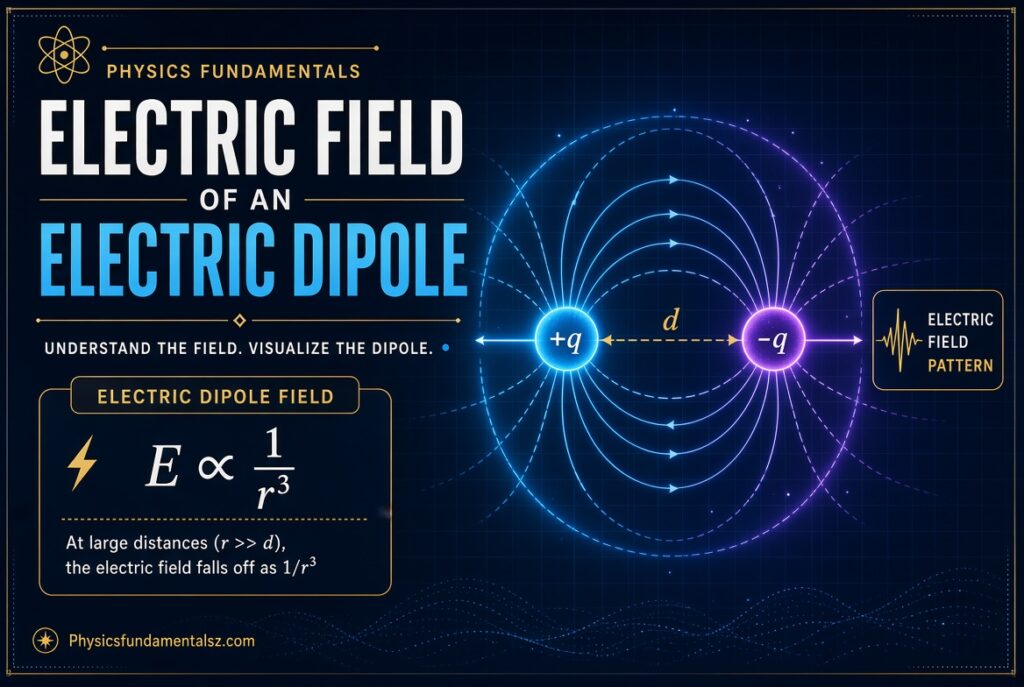
For a positive and a negative charge of equal size (an electric dipole), lines run from the positive charge to the negative charge. Between the two, they are dense and nearly parallel.
The field between opposite charges is strong, and both individual fields point in the same direction there.
Step-by-Step Method to Calculate Electric Field Between Two Charges
Follow the same six steps every time. They work for one-dimensional and two-dimensional problems alike.
Step 1: Draw a Diagram
Sketch the two charges and mark the point P where you want the field. Label the charges q₁ and q₂ with their signs.
Add a coordinate axis. A clear diagram prevents most sign errors before they start.
Step 2: Convert All Units to SI
Convert microcoulombs (μC) and nanocoulombs (nC) to coulombs. Convert centimeters to meters.
| Prefix | Symbol | Value | Example |
|---|---|---|---|
| micro | μ | 10⁻⁶ | 3 μC = 3 × 10⁻⁶ C |
| nano | n | 10⁻⁹ | 5 nC = 5 × 10⁻⁹ C |
| pico | p | 10⁻¹² | 2 pC = 2 × 10⁻¹² C |
| centi | c | 10⁻² | 10 cm = 0.10 m |
| milli | m | 10⁻³ | 40 mm = 0.040 m |
Step 3: Find the Distance From Each Charge to Point P
Measure r₁ from q₁ to P and r₂ from q₂ to P. On a straight line, subtract positions. Off the line, use the Pythagorean theorem.
Never use the separation between the two charges unless P is on one of them.
Step 4: Calculate Each Field Magnitude
Apply E = k|q|/r² twice. Use the absolute value of each charge and keep the sign for the direction step.
Keep two or three extra digits until the final answer. This avoids rounding drift.
Step 5: Decide the Direction of Each Field
Draw an arrow at P for each charge. Away from a positive charge. Toward a negative charge.
Label the arrows E₁ and E₂. Write each as a signed number or a pair of components.
Step 6: Add the Vectors
On a line, add the signed values. In two dimensions, add the x-components and y-components separately, then combine them.
E = √(Eₓ² + E_y²), and the angle is θ = tan⁻¹(E_y / Eₓ)
State the final answer with magnitude, unit, and direction.
How to Calculate Electric Field Between Two Charges on a Straight Line
The classic textbook case places both charges and the field point on a single line. This is what most students mean when they ask about the field “between” two charges.
Three regions exist: to the left of both charges, between them, and to the right of both.
Sign Convention on a Line
Choose the positive x-direction to point right. A field pointing right is positive. A field pointing left is negative.
This turns vector addition into ordinary signed arithmetic.
Field Direction in Each Region
Take q₁ on the left and q₂ on the right. The table shows what happens in each region.
| Charge pair | Left of both | Between the charges | Right of both |
|---|---|---|---|
| Both positive (+ +) | Fields add, point left | Fields oppose, subtract | Fields add, point right |
| Both negative (− −) | Fields add, point right | Fields oppose, subtract | Fields add, point left |
| Left +, right − | Fields oppose, subtract | Fields add, point right | Fields oppose, subtract |
| Left −, right + | Fields oppose, subtract | Fields add, point left | Fields oppose, subtract |
Use this table as a quick check. If your answer contradicts it, recheck your directions.
Key Pattern to Remember
For like charges, the fields cancel partly between the charges. For opposite charges, the fields reinforce between the charges.
That single pattern predicts the shape of nearly every field diagram you will meet.
Electric Field at the Midpoint Between Two Charges
The midpoint is the most popular exam location. It makes the distances equal, which simplifies the algebra.
At the midpoint, r₁ = r₂ = d/2, where d is the separation between the charges.
Equal Like Charges at the Midpoint
If both charges have the same sign and the same size, the two fields have equal magnitude and opposite direction. They cancel.
E_net = 0 at the exact midpoint of two equal like charges.
Equal Opposite Charges at the Midpoint
If the charges are equal in size but opposite in sign, the two fields point the same way. They add.
E_net = 2kq / (d/2)² = 8kq / d²
The result points from the positive charge toward the negative charge.
Unequal Charges at the Midpoint
For unequal charges, compute each field separately. Then add or subtract according to the sign pattern.
The larger charge usually dominates at the midpoint, and the net field points in the direction of the larger charge’s field.
Worked Example 1: Two Opposite Charges, Midpoint
Two point charges of +2.0 μC and −2.0 μC are 10.0 cm apart. Find the electric field at the midpoint between them.
Given
- q₁ = +2.0 × 10⁻⁶ C
- q₂ = −2.0 × 10⁻⁶ C
- Separation d = 0.100 m
- Distance to midpoint r = 0.050 m
- k = 8.99 × 10⁹ N·m²/C²
Solution
Field from q₁:
E₁ = (8.99 × 10⁹)(2.0 × 10⁻⁶) / (0.050)² = 7.19 × 10⁶ N/C
The positive charge pushes the field away from itself, toward q₂.
Field from q₂:
E₂ = (8.99 × 10⁹)(2.0 × 10⁻⁶) / (0.050)² = 7.19 × 10⁶ N/C
The negative charge pulls the field toward itself, also toward q₂.
Both fields point the same way, so they add:
E_net = 7.19 × 10⁶ + 7.19 × 10⁶ = 1.44 × 10⁷ N/C
Answer
The net field is about 1.44 × 10⁷ N/C, directed from the positive charge toward the negative charge.
Common Mistake in This Problem
Some students say the fields cancel because the charges are equal in size. That is only true for equal like charges. Here the opposite signs make the fields add.
Worked Example 2: Two Unequal Like Charges, Midpoint
Two positive charges, +2.0 μC and +6.0 μC, are 0.60 m apart. Find the field at the midpoint.
Solution
The midpoint is 0.30 m from each charge. Place q₁ = +2.0 μC on the left and q₂ = +6.0 μC on the right.
E₁ = (8.99 × 10⁹)(2.0 × 10⁻⁶) / (0.30)² = 1.998 × 10⁵ N/C, pointing right (away from q₁).
E₂ = (8.99 × 10⁹)(6.0 × 10⁻⁶) / (0.30)² = 5.993 × 10⁵ N/C, pointing left (away from q₂).
The fields oppose, so subtract with the right-pointing direction as positive:
E_net = 1.998 × 10⁵ − 5.993 × 10⁵ = −3.995 × 10⁵ N/C
Answer
The net field is about 4.0 × 10⁵ N/C, pointing left, toward the smaller charge q₁. The larger charge wins, and its field points away from itself.
Electric Field at a Point Outside the Two Charges
Points outside the pair behave differently. Both distances change, and they are no longer equal.
Let the charges sit at x = 0 and x = d. A point at x > d has r₂ = x − d and r₁ = x.
Example With Numbers
Take q₁ = +3.0 μC at x = 0 and q₂ = −3.0 μC at x = 0.40 m. Find the field at x = 0.80 m.
Distance from q₁ is 0.80 m. Distance from q₂ is 0.40 m.
E₁ = (8.99 × 10⁹)(3.0 × 10⁻⁶) / (0.80)² = 4.21 × 10⁴ N/C, pointing right (away from +).
E₂ = (8.99 × 10⁹)(3.0 × 10⁻⁶) / (0.40)² = 1.686 × 10⁵ N/C, pointing left (toward −).
E_net = 4.21 × 10⁴ − 1.686 × 10⁵ = −1.265 × 10⁵ N/C
The net field is about 1.27 × 10⁵ N/C, pointing left toward the negative charge.
Why the Nearer Charge Wins
Both charges have the same size here, but q₂ is only half as far away. Its field is four times stronger per the inverse square law.
That is why the net field follows the nearer charge.
Where Is the Electric Field Zero Between Two Charges?
A neutral point is a location where the net electric field equals zero. Finding it is one of the most common two-charge problems.
The idea is simple. Set the magnitudes of the two fields equal at the unknown position and solve for the distance.
Neutral Point for Two Like Charges
For two like charges, the neutral point lies between them, closer to the smaller charge.
Let x be the distance from q₁. Then the distance from q₂ is d − x.
Set the magnitudes equal: k q₁ / x² = k q₂ / (d − x)².
Take the square root of both sides and solve:
x = d √q₁ / (√q₁ + √q₂)
Worked Example 3: Neutral Point for Two Positive Charges
Charges of +1.5 μC and +3.0 μC are 0.20 m apart. Where is the field zero?
x = 0.20 × √1.5 / (√1.5 + √3.0) = 0.20 × 1.2247 / (1.2247 + 1.7321) = 0.0828 m
The neutral point is 8.28 cm from the +1.5 μC charge and 11.72 cm from the +3.0 μC charge.
Check the Answer
At x = 0.0828 m: k(1.5 × 10⁻⁶)/(0.0828)² and k(3.0 × 10⁻⁶)/(0.1172)² both equal about 1.97 × 10⁶ N/C. They match, so the fields cancel.
Neutral Point for Two Opposite Charges
For opposite charges, the neutral point lies outside the pair. It sits on the side of the smaller charge, on the line through both.
Between opposite charges, the fields always point the same way, so they can never cancel there.
Formula for the Opposite Charge Case
Let q₁ be the larger magnitude. The neutral point is a distance x beyond the smaller charge q₂.
x = d √q₂ / (√q₁ − √q₂)
If the charges have equal magnitude, no finite neutral point exists. The denominator becomes zero.
Worked Example 4: Neutral Point for Opposite Charges
A +4.0 μC charge is at x = 0 and a −1.0 μC charge is at x = 0.30 m. Find the point on the x-axis where E = 0.
x = 0.30 × √1.0 / (√4.0 − √1.0) = 0.30 × 1 / (2 − 1) = 0.30 m
The point is 0.30 m beyond the negative charge, at x = 0.60 m.
Verification
At x = 0.60 m, the field from the +4.0 μC charge is k(4.0 × 10⁻⁶)/(0.60)² = 1.0 × 10⁵ N/C pointing right. The field from the −1.0 μC charge is k(1.0 × 10⁻⁶)/(0.30)² = 1.0 × 10⁵ N/C pointing left. They cancel.
Zero Field Does Not Mean Zero Potential
At a neutral point, the field is zero but the electric potential usually is not. Potential is a scalar and comes from adding signed terms. A zero field and a zero potential are separate conditions.
Calculating Electric Field Between Two Charges in Two Dimensions
Many problems place the field point off the line joining the charges. Now the two fields point in different directions, and you need components.
The method is the same. Only the addition step changes.
Components of a Field Vector
If a field of magnitude E points at angle θ from the +x axis, its components are:
Eₓ = E cos θ and E_y = E sin θ
Use the geometry of the triangle formed by the charge and point P to find θ. A direction vector divided by its length works equally well.
Using Unit Vectors
A unit vector r̂ points from the source charge to point P. For a positive charge, the field is E = (kq/r²) r̂. For a negative charge, the field is E = −(k|q|/r²) r̂.
This form handles the sign automatically once the charge sign is built in.
Worked Example 5: Symmetric Two-Dimensional Problem
A +3.0 μC charge sits at (0, 0) and a −3.0 μC charge sits at (0.40 m, 0). Find the electric field at P = (0.20 m, 0.15 m).
Step 1: Distances
Each charge is the same distance from P:
r = √(0.20² + 0.15²) = √0.0625 = 0.25 m
Step 2: Field Magnitudes
E₁ = E₂ = (8.99 × 10⁹)(3.0 × 10⁻⁶) / (0.25)² = 4.315 × 10⁵ N/C
Step 3: Directions
Field from q₁ points away from q₁, along the unit vector (0.8, 0.6). Field from q₂ points toward q₂, along the unit vector (0.8, −0.6).
Step 4: Components
| Component | From q₁ | From q₂ | Net |
|---|---|---|---|
| x | 4.315 × 10⁵ × 0.8 = 3.452 × 10⁵ | 4.315 × 10⁵ × 0.8 = 3.452 × 10⁵ | 6.90 × 10⁵ |
| y | 4.315 × 10⁵ × 0.6 = 2.589 × 10⁵ | 4.315 × 10⁵ × (−0.6) = −2.589 × 10⁵ | 0 |
Answer
The net field at P is 6.90 × 10⁵ N/C in the +x direction. The vertical parts cancel by symmetry.
Worked Example 6: Non-Symmetric Two-Dimensional Problem
A +6.0 μC charge is at (0, 0) and a −4.0 μC charge is at (0.30 m, 0). Find the field at P = (0, 0.40 m).
Step 1: Distances
P is directly above q₁, so r₁ = 0.40 m. The distance to q₂ is:
r₂ = √(0.30² + 0.40²) = 0.50 m
Step 2: Magnitudes
E₁ = (8.99 × 10⁹)(6.0 × 10⁻⁶) / (0.40)² = 3.371 × 10⁵ N/C
E₂ = (8.99 × 10⁹)(4.0 × 10⁻⁶) / (0.50)² = 1.438 × 10⁵ N/C
Step 3: Directions
E₁ points straight up (+y), away from the positive charge.
E₂ points toward the negative charge, along the unit vector (0.3, −0.4)/0.5 = (0.6, −0.8).
Step 4: Components of E₂
E₂ₓ = 1.438 × 10⁵ × 0.6 = 8.63 × 10⁴ N/C
E₂y = 1.438 × 10⁵ × (−0.8) = −1.151 × 10⁵ N/C
Step 5: Add the Components
Eₓ = 0 + 8.63 × 10⁴ = 8.63 × 10⁴ N/C
E_y = 3.371 × 10⁵ − 1.151 × 10⁵ = 2.221 × 10⁵ N/C
Step 6: Magnitude and Angle
E = √((8.63 × 10⁴)² + (2.221 × 10⁵)²) ≈ 2.38 × 10⁵ N/C
θ = tan⁻¹(2.221 × 10⁵ / 8.63 × 10⁴) ≈ 68.8° above the +x axis.
Answer
The net field at P is about 2.38 × 10⁵ N/C at 68.8° above the +x axis.
Force on a Charge Placed Between Two Charges
Once you know the net field, finding the force on a third charge is one multiplication. The force on a charge q₀ placed in field E is:
F = q₀ E
For a positive q₀, the force points along the field. For a negative q₀, it points opposite to the field.
Worked Example 7: Force on a Test Charge
A +2.0 nC test charge sits at the midpoint of Example 1. The net field there is 1.44 × 10⁷ N/C.
F = (2.0 × 10⁻⁹)(1.44 × 10⁷) = 2.88 × 10⁻² N
The force is about 0.029 N, directed toward the negative charge.
Acceleration of a Particle in the Field
Pair F = qE with Newton’s second law to get acceleration. For an electron, with charge −1.602 × 10⁻¹⁹ C and mass 9.11 × 10⁻³¹ kg, the acceleration is a = eE/m.
In a field of 1.0 × 10⁶ N/C, that gives about 1.76 × 10¹⁷ m/s². The electron accelerates opposite to the field direction because its charge is negative.
Electric Field Between Two Parallel Charged Plates
People also search for the field between two plates, which is a different but closely related case. Two large, flat, oppositely charged plates create a nearly uniform field in the space between them.
Away from the edges, the field has the same magnitude and direction at every point.
Formula for a Parallel Plate Field
Two equivalent formulas apply:
E = σ / ε₀ and E = V / d
Here σ is the surface charge density (C/m²), V is the potential difference between the plates, and d is the plate separation.
Worked Example 8: Field From Voltage and Separation
Two plates are 2.0 cm apart with a potential difference of 120 V.
E = V / d = 120 / 0.020 = 6,000 V/m
The field is 6.0 × 10³ N/C, pointing from the positive plate to the negative plate.
Worked Example 9: Field From Surface Charge Density
The plates carry a surface charge density of 1.0 × 10⁻⁶ C/m².
E = σ / ε₀ = (1.0 × 10⁻⁶) / (8.854 × 10⁻¹²) = 1.13 × 10⁵ N/C
Why the Field Is Uniform
Each infinite sheet produces a field of σ/(2ε₀) that does not depend on distance. Between oppositely charged sheets, the two contributions point the same way and add up to σ/ε₀.
Outside the plates, the two contributions point opposite ways and cancel. That is why a parallel plate capacitor keeps its field confined between the plates.
Point Charges vs Parallel Plates
| Feature | Two point charges | Two parallel plates |
|---|---|---|
| Field uniformity | Not uniform | Nearly uniform between plates |
| Main formula | E = kq/r² (per charge) | E = σ/ε₀ or V/d |
| Dependence on distance | Falls as 1/r² | Constant between plates |
| Typical method | Superposition of vectors | Direct formula |
| Common application | Dipoles, ion interactions | Capacitors, particle deflection |
Electric Field of an Electric Dipole
An electric dipole consists of two equal and opposite charges, +q and −q, separated by a small distance d. It is the most important real-world two-charge system.
Water molecules, many biological molecules, and antennas all behave as dipoles.
Dipole Moment
The dipole moment p measures how strongly a dipole creates and responds to fields.
p = q × d
It is a vector pointing from the negative charge to the positive charge. Its SI unit is the coulomb-meter (C·m).
Field on the Axis of a Dipole
At a distance r along the axis, far from the dipole (r much larger than d), the field magnitude is approximately:
E_axis ≈ 2kp / r³
It points in the direction of the dipole moment.
Field on the Equatorial Line
On the perpendicular bisector, far from the dipole, the field is about half as strong and points opposite the dipole moment.
E_equatorial ≈ kp / r³
Dipole Fields Fall Faster
A single charge’s field falls as 1/r². A dipole’s field falls as 1/r³. The two charges partly cancel each other from far away.
That faster decay is the reason neutral molecules interact only at short range.
Electric Potential vs Electric Field for Two Charges
Potential offers a second route to many two-charge problems. It is a scalar, so it adds with ordinary arithmetic.
V = kq₁/r₁ + kq₂/r₂
Keep the signs of the charges when you use this formula. Do not use absolute values.
Relation Between Potential and Field
The field is the negative gradient of the potential: E = −∇V. In one dimension, E_x = −dV/dx.
Where the potential changes steeply, the field is strong. Where the potential is flat, the field is weak.
Key Differences
| Property | Electric field | Electric potential |
|---|---|---|
| Type | Vector | Scalar |
| Formula (point charge) | E = kq/r² | V = kq/r |
| Falls with distance as | 1/r² | 1/r |
| Combining two charges | Vector addition | Simple algebraic addition |
| Unit | N/C or V/m | volt (V) |
| Zero at neutral point? | Yes, by definition | Not necessarily |
Equipotential Surfaces
Equipotential surfaces connect points with the same potential. Electric field lines always cross them at right angles.
For two opposite charges, the zero-potential surface is the plane that bisects the pair. For two like charges, no zero-potential surface exists at finite distance.
Electric Field Inside a Medium (Dielectric)
Everything so far assumed a vacuum, which is also a good approximation for air. In a dielectric material, the field is reduced.
E = kq / (κ r²)
The symbol κ is the relative permittivity, also called the dielectric constant. For air, κ is about 1.0006. For water at room temperature, it is about 80.
What This Means for Two Charges
Place two charges in water instead of air and the field from each drops by a factor of about 80. This is one reason many salts dissolve readily in water.
When a problem does not mention a medium, assume a vacuum.
Electric Field From Continuous Charge vs Two Point Charges
Real objects are not points. Rods, rings, and discs spread charge over a region. The approach is to divide the object into tiny point charges and sum their fields with an integral.
Two point charges are the discrete version of the same idea.
When Point Charge Approximations Work
Treat objects as point charges when their size is much smaller than the distance to the field point. Charged spheres count as point charges outside their surface.
For nearby fields, or for non-spherical objects, use integration or Gauss’s law instead.
Where Gauss’s Law Helps
Gauss’s law simplifies fields with high symmetry: spheres, infinite lines, and infinite planes. It does not directly solve a general two-charge problem, because the combined arrangement lacks that symmetry.
Superposition remains the right tool for two separate charges.
Common Mistakes When Calculating Electric Field Between Two Charges
Most lost marks come from a short list of repeat errors. Check your work against this table.
| Mistake | Why it is wrong | Fix |
|---|---|---|
| Forgetting to square the distance | Field follows an inverse square law | Always divide by r² |
| Using centimeters in the formula | k assumes meters | Convert to meters first |
| Adding magnitudes regardless of direction | Fields are vectors | Draw arrows, then add or subtract |
| Using the separation d as r | r is the distance to the field point | Measure from each charge to P |
| Mixing up force and field formulas | F = kq₁q₂/r² has two charges | Use E = kq/r² for the field |
| Putting the negative sign into the magnitude | Direction handles the sign | Use the absolute value of q for magnitude, then assign direction |
| Forgetting units on the final answer | N/C or V/m is required | Always write the unit |
| Assuming the field is zero at the midpoint | True only for equal like charges | Check the sign and size of both charges |
A Simple Self-Check
Estimate which charge should dominate at P. The closer and larger charge wins. If your final direction disagrees, recheck your arrows.
Also confirm the size. Field strengths in typical classroom problems fall between about 10³ and 10⁸ N/C.
Practice Problems With Answers
Try each problem before reading the solution. Use k = 8.99 × 10⁹ N·m²/C².
Problem 1: Equal Like Charges
Two +5.0 μC charges are 0.40 m apart. What is the field at the midpoint?
Answer: Zero. The two fields have equal magnitude and opposite direction, so they cancel.
Problem 2: Unequal Opposite Charges
A +1.0 μC charge and a −3.0 μC charge are 0.20 m apart. Find the field at the midpoint.
Solution: The midpoint is 0.10 m from each charge.
E₁ = (8.99 × 10⁹)(1.0 × 10⁻⁶) / (0.10)² = 8.99 × 10⁵ N/C
E₂ = (8.99 × 10⁹)(3.0 × 10⁻⁶) / (0.10)² = 2.697 × 10⁶ N/C
Both fields point toward the negative charge, so they add.
Answer: E = 3.60 × 10⁶ N/C, directed toward the −3.0 μC charge.
Problem 3: Neutral Point for Two Positive Charges
Charges of +9.0 μC and +1.0 μC are 0.40 m apart. Where between them is the field zero?
Solution: Use x = d√q₁ / (√q₁ + √q₂).
x = 0.40 × 3 / (3 + 1) = 0.30 m
Answer: The field is zero 0.30 m from the +9.0 μC charge, and 0.10 m from the +1.0 μC charge.
Problem 4: Field at a Point on the Perpendicular Bisector
Two +4.0 nC charges are at (−0.30 m, 0) and (+0.30 m, 0). Find the field at (0, 0.40 m).
Solution: The distance to each charge is √(0.30² + 0.40²) = 0.50 m.
E = (8.99 × 10⁹)(4.0 × 10⁻⁹) / (0.50)² = 143.8 N/C for each charge.
The horizontal components cancel. Each vertical component is 143.8 × (0.40/0.50) = 115.1 N/C.
Answer: E = 2 × 115.1 = 230 N/C in the +y direction.
Problem 5: Force on a Third Charge
Using the field from Problem 2, find the force on a −5.0 nC charge placed at the midpoint.
Solution: F = qE = (5.0 × 10⁻⁹)(3.60 × 10⁶) = 1.80 × 10⁻² N.
Answer: The force is 0.018 N. Because the charge is negative, it points opposite to the field, away from the −3.0 μC charge and toward the +1.0 μC charge.
Problem 6: Parallel Plates
A uniform field of 4.0 × 10³ N/C exists between two plates 5.0 mm apart. What is the potential difference?
Solution: V = Ed = (4.0 × 10³)(0.0050) = 20 V.
Answer: The potential difference is 20 V.
Calculating Electric Field Between Two Charges With Python
A short script is useful when you have many field points or three or more charges. The code below follows the vector formula from earlier.
import numpy as np

k = 8.99e9  # N·m²/C²

def field(q, source, point):
    """Electric field at 'point' from charge q at 'source' (2D)."""
    r_vec = np.array(point) - np.array(source)
    r = np.linalg.norm(r_vec)
    return k * q * r_vec / r**3

# Example 6: +6.0 µC at (0, 0) and -4.0 µC at (0.30, 0), point P = (0, 0.40)
E1 = field(6.0e-6, (0, 0), (0, 0.40))
E2 = field(-4.0e-6, (0.30, 0), (0, 0.40))
E_net = E1 + E2

magnitude = np.linalg.norm(E_net)
angle = np.degrees(np.arctan2(E_net[1], E_net[0]))
print(f"E = {magnitude:.3e} N/C at {angle:.1f} degrees")
The output matches the hand calculation: about 2.38 × 10⁵ N/C at 68.8°.
Why the Code Works
The line k * q * r_vec / r**3 is the vector formula E = kq(r − r₁)/|r − r₁|³. A negative q reverses the direction automatically.
Add more charges by calling the function again and summing the results.
Electric Field Calculators and Simulations
Online tools can check your answers. A two-charge electric field calculator takes the charges, their positions, and the field point, then returns the net field.
Interactive simulations show field lines and vectors and let you drag charges around. They build intuition faster than static diagrams.
How to Use a Calculator Responsibly
Solve the problem by hand first. Then use the calculator to verify. If the two differ, compare the individual field values from each charge to find the mismatch.
Remember that many simple calculators work in one dimension only. For two-dimensional layouts, check that the tool handles vector components.
Real-World Applications of Electric Fields Between Charges
Two-charge field calculations are not just exam material. They sit behind many familiar technologies.
Capacitors
A capacitor stores energy in the uniform field between two charged plates. The field strength is limited by the breakdown strength of the insulating material between the plates.
Dry air breaks down at roughly 3 × 10⁶ V/m. Above that, a spark jumps across the gap.
Inkjet Printers and Electrostatic Painting
Charged droplets pass through an electric field that steers them to the correct position on paper. Electrostatic spray painting charges paint particles so they are drawn to the grounded object, which reduces waste.
Electrostatic Precipitators
Power plants and factories use strong electric fields to charge smoke particles. The charged particles then move to collector plates and are removed from the exhaust.
Photocopiers and Laser Printers
These machines use charged drums. The field pulls toner particles to the drum in a pattern that matches the image.
Molecular Physics and Chemistry
Water is a polar molecule. It acts like a tiny dipole, and its fields explain surface tension, hydrogen bonding, and why water dissolves many ionic compounds.
Medical and Scientific Instruments
Electrocardiograms record the electric field pattern of the heart as it beats. Mass spectrometers use electric fields to separate ions by their charge-to-mass ratio.
Lightning and Atmospheric Electricity
Charge separation inside storm clouds builds a strong field between the cloud base and the ground. When the field exceeds the breakdown value of air, lightning discharges.
Formula Cheat Sheet
Keep this table handy for homework and exams.
| Situation | Formula |
|---|---|
| Field of a point charge | E = k|q| / r² |
| Definition of electric field | E = F / q₀ |
| Net field of two charges | E_net = E₁ + E₂ (vector sum) |
| Force on a charge in a field | F = qE |
| Coulomb’s constant | k = 1 / (4πε₀) ≈ 8.99 × 10⁹ N·m²/C² |
| Permittivity of free space | ε₀ ≈ 8.854 × 10⁻¹² C²/(N·m²) |
| Midpoint, equal opposite charges | E = 8kq / d² |
| Midpoint, equal like charges | E = 0 |
| Neutral point, like charges | x = d√q₁ / (√q₁ + √q₂) from q₁ |
| Neutral point, opposite charges | x = d√q₂ / (√q₁ − √q₂) beyond q₂ (q₁ larger) |
| Parallel plates | E = σ/ε₀ = V/d |
| Dipole moment | p = qd |
| Dipole field on axis (far) | E ≈ 2kp / r³ |
| Potential of two charges | V = kq₁/r₁ + kq₂/r₂ |
| Field in a dielectric | E = kq / (κr²) |
Exam Tips for Electric Field Problems
A small amount of discipline pays off in electric field questions. These habits help most.
Build a Consistent Routine
- Draw the diagram first, every time.
- Write down all given values in SI units.
- Compute magnitudes with absolute values, then assign directions with arrows.
- Add as vectors, using components in two dimensions.
- Check the answer against your quick estimate of which charge dominates.
Know the Special Cases
Many questions are variations of three cases: the midpoint of equal charges, a neutral point, and a symmetric two-dimensional point. Practice each until the setup feels automatic.
Show Your Work Clearly
Most graders award marks for the correct formula, correct substitution, and correct direction. Show each of these even if your final number is off.
The Science Behind the Formula: A Short History
The formula traces back to the late 1700s. Charles-Augustin de Coulomb measured the force between small charged spheres using a torsion balance and showed that it follows an inverse square law.
Michael Faraday later introduced the idea of field lines in the 1830s. He imagined the space around a charge as filled with lines of force.
James Clerk Maxwell then unified electricity and magnetism with a mathematical framework in the 1860s. The modern definition of the electric field as force per unit charge grew out of this work.
Modern Value of the Constants
Today, the SI system defines the elementary charge exactly as 1.602176634 × 10⁻¹⁹ C. The value of Coulomb’s constant is derived from measured quantities, and the standard value is published by the National Institute of Standards and Technology (NIST) through the CODATA recommended values.
For classroom work, 8.99 × 10⁹ N·m²/C² is accurate enough. Many problems also allow the rounded value 9.0 × 10⁹.
Advanced Topics: Three or More Charges and Real Geometries
Once you can solve two-charge problems, the extension to more charges takes no new physics. Compute each field, then add them.
Three Charges in a Line
Treat each charge as a separate source. Assign direction using the sign of each charge and the position of the field point.
The number of regions grows with the number of charges. For N charges on a line, the field point can fall into N + 1 regions.
Charges at the Corners of a Triangle or Square
Use symmetry to simplify. For a square with equal charges at the corners, the field at the center is zero because opposite corners cancel in pairs.
When charges differ, resolve each field into components and sum.
Test for Equilibrium
A third charge placed at a neutral point of two fixed charges feels no net electrostatic force from them at that instant. Whether it stays there is a separate question, and Earnshaw’s theorem answers it.
Earnshaw’s theorem states that a collection of fixed point charges cannot hold a charged particle in stable equilibrium using electrostatic forces alone.
Connecting Two-Charge Fields to Other Physics Topics
Electric field calculations link to a wide range of topics. Seeing the connections strengthens your understanding.
- Coulomb’s law: The field is the force per unit charge, so every field problem is a hidden force problem.
- Gauss’s law: For symmetric charges, it gives the field without integration.
- Electric potential and potential energy: The field is the slope of the potential.
- Capacitance: The uniform field between plates sets the voltage and stored energy.
- Magnetism: Moving charges create magnetic fields, and electric and magnetic fields together make electromagnetic waves.
- Gravity: The inverse square form mirrors Newton’s law of gravitation, but electric forces can be attractive or repulsive and are far stronger between particles.
Electric vs Gravitational Field
| Feature | Electric field | Gravitational field |
|---|---|---|
| Source | Electric charge | Mass |
| Force direction | Attractive or repulsive | Always attractive |
| Strength constant | k ≈ 8.99 × 10⁹ | G ≈ 6.674 × 10⁻¹¹ |
| Distance law | 1/r² | 1/r² |
| Shielding possible | Yes | No |
Why N/C and V/m Are the Same Unit
The two units can look unrelated, so a short proof helps. One volt equals one joule per coulomb, and one joule equals one newton-meter.
Substitute: 1 V/m = 1 (N·m/C) / m = 1 N/C.
The units cancel to the same result. Use whichever fits the problem, since they carry identical meaning.
Understanding Negative Answers and Signs
A negative sign on a one-dimensional answer is not an error. It tells you the direction relative to your chosen axis.
If you set +x to the right, a result of −3.995 × 10⁵ N/C means the field points left with a magnitude of 3.995 × 10⁵ N/C.
Sign of the Charge vs Sign of the Field
The sign of a charge does not decide the sign of the field at P by itself. Position decides too.
A positive charge on the left of P gives a positive (rightward) field at P. A positive charge on the right of P gives a negative (leftward) field at P.
A Reliable Habit
State the answer in words as well as numbers. For example, “4.0 × 10⁵ N/C toward the left charge.” This removes any ambiguity about the sign.
Significant Figures and Rounding
Report the answer with the same number of significant figures as your least precise input. If the charges are given as 2.0 μC, two significant figures are appropriate.
Round only at the end. Rounding the intermediate field values can change the third digit of the answer, especially when two large fields nearly cancel.
When Fields Nearly Cancel
If two fields differ by a small amount, subtraction magnifies relative rounding error. Carry at least four digits through the calculation in such cases.
Visualizing the Field Between Two Charges
A mental picture helps you predict the answer before computing it. Sketch the field direction at a few points first.
Neutral Points on Field Diagrams
For two like charges, the neutral point looks like a gap in the field lines between the charges. Lines curve away from it in two directions and toward it in the other two.
For unequal opposite charges, the neutral point appears outside the pair, on the side of the weaker charge.
Strength Along the Line Joining the Charges
For two like charges, the field drops to zero at the neutral point and rises steeply near each charge. For two opposite charges, the field has a minimum at the midpoint of equal charges and rises toward each charge.
The minimum is still nonzero. For +2.0 μC and −2.0 μC at 10 cm separation, the midpoint field is 1.44 × 10⁷ N/C, which is the lowest value on the segment between them.
How the Electric Field Changes as You Move Between Two Charges
The field changes continuously as you move along the line. You can model it as a function of position.
For charges q₁ at x = 0 and q₂ at x = d, the field at position x between them (0 < x < d) is:
E(x) = k q₁ / x² − k q₂ / (d − x)² (signed charges)
Positive values point right. Negative values point left. A zero of this function is a neutral point.
What Happens Near Each Charge
As x approaches 0, the first term grows without limit. The field near a charge is dominated by that charge, no matter how large the other charge is.
This is why field lines look almost radial close to any individual charge.
Quick Decision Guide: Which Method to Use
Choose the approach that fits the geometry.
| Situation | Best method |
|---|---|
| Two point charges, point on the line joining them | Signed sum of two fields |
| Two point charges, point off the line | Components and vector addition |
| Find where the net field is zero | Set magnitudes equal and solve |
| Large flat plates | E = σ/ε₀ or E = V/d |
| Symmetric sphere, line, or plane | Gauss’s law |
| Many charges or many points | Python or spreadsheet |
| Small, close charge pair seen from far away | Dipole approximation |
Reverse Problems: Finding a Charge or Distance From a Known Field
Not every question gives you the charges. Sometimes the field is known, and you must find an unknown charge or position. The same equations apply, only rearranged.
Worked Example 10: Find the Charge From the Midpoint Field
Two equal and opposite charges are 0.20 m apart. The field at the midpoint is measured as 3.6 × 10⁶ N/C. Find the magnitude of each charge.
Use E = 8kq / d² and solve for q:
q = E d² / (8k) = (3.6 × 10⁶)(0.20)² / (8 × 8.99 × 10⁹) = 2.0 × 10⁻⁶ C
Each charge has a magnitude of 2.0 μC.
Worked Example 11: Find an Unknown Charge From a Neutral Point
A +8.0 μC charge sits 0.20 m from a point P. A second positive charge sits 0.10 m from P on the opposite side, and the net field at P is zero. Find the second charge.
Set the magnitudes equal: k(8.0 × 10⁻⁶)/(0.20)² = k q₂/(0.10)².
q₂ = 8.0 × 10⁻⁶ × (0.10/0.20)² = 2.0 × 10⁻⁶ C
The second charge is +2.0 μC. The closer charge is smaller, which matches the rule that the neutral point lies nearer the weaker charge.
Strategy for Reverse Problems
Write the field equation first, with the unknown as a symbol. Solve algebraically before substituting numbers. This keeps the units visible and makes errors easier to spot.
Typical Electric Field Strengths for Reference
A sense of scale helps you judge whether an answer is reasonable. The table lists approximate values.
| Situation | Approximate field strength |
|---|---|
| Fair-weather field near Earth’s surface | About 100 N/C |
| Between the plates of a small classroom capacitor | 10³ to 10⁵ N/C |
| Breakdown of dry air (spark) | About 3 × 10⁶ N/C |
| Midpoint of ±2.0 μC charges, 10 cm apart | About 1.4 × 10⁷ N/C |
| Electron in a hydrogen atom, at the Bohr radius | About 5 × 10¹¹ N/C |
If your classroom answer lands near 10⁻³⁰ or 10³⁰ N/C, a unit conversion has probably gone wrong.
How to Sanity-Check a Result
Compare your answer with the field of the stronger charge alone. The net field of two charges cannot exceed the sum of the two magnitudes, and it cannot be smaller than their difference.
|E₁ − E₂| ≤ E_net ≤ E₁ + E₂
This inequality catches many arithmetic slips in seconds.
Like Charges vs Opposite Charges: Side-by-Side Comparison
The two cases behave very differently. This table summarizes the key contrasts for the field between two charges.
| Feature | Two like charges | Two opposite charges |
|---|---|---|
| Fields between the charges | Oppose each other | Point the same way |
| Net field between the charges | Smaller than the larger single field | Larger than either single field |
| Neutral point | Between the charges | Outside the pair (unequal charges only) |
| Midpoint of equal charges | Zero | 8kq/d² |
| Field line pattern | Lines repel and bend away | Lines run from + to − |
| Force on each charge | Repulsive | Attractive |
Memory Aid
Think of “same signs push apart, so the middle is calm.” Think of “opposite signs pull together, so the middle is busy.” The calm middle has a neutral point. The busy middle never does.
Thinking About the Field Without a Test Charge
The field is a property of space created by the source charges. You can calculate it at a point where nothing is placed.
Physicists treat it as real because it carries energy and momentum. Electromagnetic waves, including light, are the proof.
Why the Test Charge Must Be Small
A large test charge would push the source charges around and change the field. The formal definition therefore uses the limit of a vanishingly small test charge: E = lim (F / q₀) as q₀ approaches zero.
For calculation purposes, this limit is built into the formula E = kq/r². You never need to worry about the size of the test charge when using it.
Frequently Asked Questions (FAQs)
How do you calculate the electric field between two charges?
Find the field from each charge using E = k|q|/r². Assign each a direction, away from positive and toward negative. Then add them as vectors at the point you care about.
What is the formula for the electric field of two charges?
There is no single formula, because the net field is a vector sum. The expression is E_net = E₁ + E₂, where each term is kq/r² with the proper direction.
What is the electric field at the midpoint between two equal positive charges?
It is zero. The two fields have equal magnitude and point in opposite directions, so they cancel exactly.
What is the electric field at the midpoint between a positive and a negative charge of equal size?
It is 8kq/d², pointing from the positive charge toward the negative charge. Both fields point the same way, so they add.
Is the electric field between two opposite charges uniform?
No. For two point charges, the field varies from point to point and is strongest near each charge. A nearly uniform field appears only between two large parallel plates.
How do you find the point where the electric field is zero between two charges?
Set the magnitudes equal: kq₁/x² = kq₂/(d − x)². Solve for x. For like charges, the solution lies between the charges, closer to the smaller one.
Can the electric field be zero between two opposite charges?
No. Between opposite charges, both fields point the same way, so they always add. A neutral point can exist only outside the pair.
Where is the neutral point for opposite charges of unequal size?
It lies on the line through the charges, outside the pair, on the side of the smaller charge. Equal opposite charges have no finite neutral point.
What is the SI unit of electric field?
The SI unit is newtons per coulomb (N/C), which is equal to volts per meter (V/m).
What is the value of Coulomb’s constant?
It is about 8.99 × 10⁹ N·m²/C², equal to 1/(4πε₀). Many textbooks round it to 9.0 × 10⁹.
Why does the electric field follow an inverse square law?
The field spreads over the surface of an imaginary sphere around the charge. The area of that sphere grows with r², so the field strength falls with 1/r².
Is the electric field a vector or a scalar?
It is a vector. It has both magnitude and direction, so fields from two charges must be added as vectors.
Do I add or subtract the fields from two charges?
Add them as vectors. On a line, that means adding signed values. If the arrows point in opposite directions, the magnitudes subtract.
What is the principle of superposition?
It states that the total field at a point is the vector sum of the fields from each individual charge. Each charge creates its field independently of the others.
How do you find the direction of the electric field?
A positive charge creates a field pointing away from it. A negative charge creates a field pointing toward it. The net direction comes from adding these arrows.
How do I calculate the field at a point that is not on the line between the charges?
Find each distance with the Pythagorean theorem. Calculate each field magnitude, split each field into x and y components, then sum the components and combine them.
How do you convert microcoulombs to coulombs?
Multiply by 10⁻⁶. For example, 4.5 μC equals 4.5 × 10⁻⁶ C. Nanocoulombs convert by 10⁻⁹.
What is the difference between electric field and electric force?
The field is the force per unit charge at a point in space. The force is what a specific charge feels. They are related by F = qE.
How do you find the force on a charge placed between two charges?
Calculate the net field at that location, then multiply by the charge: F = qE. Negative charges feel force opposite to the field direction.
What is the electric field between two parallel plates?
It is E = σ/ε₀, or equivalently E = V/d. The field is nearly uniform between the plates and points from the positive plate to the negative plate.
What is an electric dipole?
An electric dipole is a pair of equal and opposite charges separated by a small distance. Its strength is measured by the dipole moment p = qd.
How does the electric field change if the charges are in water?
The field is divided by the dielectric constant of the medium. For water, that factor is about 80, so each field is roughly 80 times weaker than in a vacuum.
Can the electric field be negative?
A magnitude is never negative. In one-dimensional problems, a negative value means the field points in the negative direction of your chosen axis.
How do you calculate the electric potential between two charges?
Add the potentials of each charge as scalars: V = kq₁/r₁ + kq₂/r₂. Keep the signs of the charges in the formula.
Is zero electric field the same as zero potential?
No. At a neutral point, the field is zero, but the potential is usually not zero. Potential is a scalar sum, and field is a vector sum.
What mistakes should I avoid when solving electric field problems?
Do not forget to square the distance. Do not use centimeters in the formula. Do not add magnitudes without checking direction.
Conclusion
To calculate electric field between two charges, treat each charge on its own, find its field with E = kq/r², and add the results as vectors. That single method solves midpoint questions, neutral points, and two-dimensional geometry.
Keep the direction rules in mind: away from positive, toward negative. Check your result against the sign pattern in the region table, and keep every quantity in SI units.
Remember the key shortcuts. Equal like charges cancel at the midpoint. Equal opposite charges add there. Neutral points exist between like charges and outside opposite charges.
Practice the worked examples until the steps feel automatic. Then extend the same approach to dipoles, parallel plates, and systems with three or more charges.